
Deuteronomy 21:5

Hebrew (Westminster Leningrad Codex) Deuteronomy 21:5 appears in the Hebrew Old Testament. The text above is from the Westminster Leningrad Codex. Each word links to its Strong’s number, a concise gloss, and parsing drawn from the Open Scriptures Hebrew Bible morphology. Click any word for its full Brown-Driver-Briggs (BDB) entry.
Download image
Cite this verse

Deuteronomy 21:5 (World English Bible). Public Domain. Lemma interlinear Bible study tool, https://lemma.gebible.app/v/deuteronomy/21/5.

Show BibTeX & RIS
BibTeX
RIS
English Translation
The priests the sons of Levi shall come near; for them Yahweh your God has chosen to minister to him, and to bless in the name of Yahweh; and according to their word shall every controversy and every stroke be.
World English Bible · Public Domain
Download a study sheet

One document with this verse’s original text, its word-by-word gloss line, the meaning frame, cross-references with their text, attributed commentary, and full source and license credits — printable, and it pastes into notes with its structure intact.

This verse Autodidact and up

Study sheet (.html) Plain text (.txt)

A passage Seminary Student

Up to 50 verses in one chapter. A passage sheet keeps up to 6 commentary sources and 12 cross-references per verse, in the order this page ranks them, and says so on the sheet whenever that leaves anything out. Ask for a single verse and you get the Autodidact verse sheet above.

Everything on this page stays free to read, with no account — the sheet is a download of what is already on screen, not access to it.

Want to remove ads? Support Godless Engineer
Compare translations 3

The same verse in 3 English versions, stacked beneath the original-language interlinear above. Click any original word for its lexicon entry.

Each is an independent rendering of the whole verse — the interlinear is not word-aligned to these translations.

Highlighted words mark where these versions differ — a whole-verse word diff, not a word-by-word alignment.

  • World English Bible Public Domain
    The priests the sons of Levi shall come near; for them Yahweh your God has chosen to minister to him, and to bless in the name of Yahweh; and according to their word shall every controversy and every stroke be.
  • King James Version Public Domain
    And the priests the sons of Levi shall come near; for them the LORD thy God hath chosen to minister unto him, and to bless in the name of the LORD; and by their word shall every controversy and every stroke be tried:
  • unfoldingWord Literal Text CC BY-SA 4.0
    And the priests, the sons of Levi, shall come forward, for Yahweh your God has chosen them to serve him and give blessing in the name of Yahweh, and upon their mouth is every dispute and every assault.

unfoldingWord Literal Text — © unfoldingWord, licensed CC BY-SA 4.0. Word-aligned USFM3 via Door43 (git.door43.org/unfoldingWord/en_ult).

Versions to compare (up to 4)

3 of 4 selected

Show all 18 translations

Every available English version of this verse, each an independent rendering of the whole verse.

  • World English Bible Public Domain
    The priests the sons of Levi shall come near; for them Yahweh your God has chosen to minister to him, and to bless in the name of Yahweh; and according to their word shall every controversy and every stroke be.
  • Berean Standard Bible Public Domain
    And the priests, the sons of Levi, shall come forward, for the LORD your God has chosen them to serve Him and pronounce blessings in His name and to give a ruling in every dispute and case of assault.
  • Majority Standard Bible Public Domain
    And the priests, the sons of Levi, shall come forward, for the LORD your God has chosen them to serve Him and pronounce blessings in His name and to give a ruling in every dispute and case of assault.
  • King James Version Public Domain
    And the priests the sons of Levi shall come near; for them the LORD thy God hath chosen to minister unto him, and to bless in the name of the LORD; and by their word shall every controversy and every stroke be tried:
  • American Standard Version (1901) Public Domain
    And the priests the sons of Levi shall come near; for them Jehovah thy God hath chosen to minister unto him, and to bless in the name of Jehovah; and according to their word shall every controversy and every stroke be.
  • Revised Version (1885) Public Domain
    and the priests the sons of Levi shall come near; for them the LORD thy God hath chosen to minister unto him, and to bless in the name of the LORD; and according to their word shall every controversy and every stroke be:
  • Geneva Bible (1599) Public Domain
    Also the Priests the sonnes of Leui (whom the Lord thy God hath chosen to minister, and to blesse in the name of the Lord) shall come forth, and by their word shall all strife and plague be tried.
  • Douay-Rheims (1899) Public Domain
    And the priests the sons of Levi shall come, whom the Lord thy God hath chosen to minister to him, and to bless in his name, and that by their word every matter should be decided, and whatsoever is clean or unclean should be judged.
  • Young's Literal Translation Public Domain
    `And the priests, sons of Levi, have come nigh -- for on them hath Jehovah thy God fixed to serve Him, and to bless in the name of Jehovah, and by their mouth is every strife, and every stroke --
  • Literal Standard Version CC BY-SA 4.0
    And the priests, sons of Levi, have come near—for your God YHWH has fixed on them to serve Him and to bless in the Name of YHWH, and by their mouth is every strife and every stroke—
  • Unlocked Literal Bible CC BY-SA 4.0
    The priests, descendants of Levi, must come forward, for Yahweh your God has chosen them to serve him and give blessing in the name of Yahweh and to decide every case of dispute and assault by their word.
  • unfoldingWord Literal Text CC BY-SA 4.0
    And the priests, the sons of Levi, shall come forward, for Yahweh your God has chosen them to serve him and give blessing in the name of Yahweh, and upon their mouth is every dispute and every assault.
  • Darby Bible Public Domain
    and the priests the sons of Levi shall come near; for them Jehovah thy God hath chosen to do service unto him, and to bless in the name of Jehovah; and according to their word shall be every controversy and every stroke.
  • World Messianic Bible Public Domain
    The priests the sons of Levi shall come near, for them the LORD your God has chosen to minister to him, and to bless in the LORD’s name; and according to their word shall every controversy and every assault be decided.
  • Webster's Bible Public Domain
    And the priests the sons of Levi shall come near (for them the LORD thy God hath chosen to minister to him, and to bless in the name of the LORD) and by their word shall every controversy and every stroke be tried;
  • Free Bible Version CC BY-SA 4.0
    The Levitical priests must be there too, because the Lord your God has chosen them to serve him and to give blessings in his name, and to decide on legal disputes and cases of assault.
  • Bible in Basic English Public Domain
    Then the priests, the sons of Levi, are to come near; for they have been marked out by the Lord your God to be his servants and to give blessings in the name of the Lord; and by their decision every argument and every blow is to be judged:
  • JPS Tanakh (1917) Public Domain
    And the priests the sons of Levi shall come near — for them the LORD thy God hath chosen to minister unto Him, and to bless in the name of the LORD; and according to their word shall every controversy and every stroke be.

Literal Standard Version (2020), Covenant Press — licensed CC BY-SA 4.0. Text via the HelloAO Bible API (eBible.org). Unlocked Literal Bible (unfoldingWord) — licensed CC BY-SA 4.0. Text via the HelloAO Bible API (eBible.org). unfoldingWord Literal Text — © unfoldingWord, licensed CC BY-SA 4.0. Word-aligned USFM3 via Door43 (git.door43.org/unfoldingWord/en_ult). Free Bible Version, Dr. Jonathan Gallagher — licensed CC BY-SA 4.0. Text via the HelloAO Bible API (eBible.org).

Word by word

More ways to search: Search by grammar → Find every occurrence → Compare this word →

Practice this passage: Drill this verse → Learn its vocabulary →

רִ֥יב
rîyb
H7379
“strife”
Noun, Common, Both, Singular, Absolute
Part of Speech
Noun
Type
Common
Gender
Both
Number
Singular
State
Absolute
Full BDB Definition

Origin: from H7378

TWOT: 2159a

strife, controversy, dispute - strife, quarrel - dispute, controversy, case at law
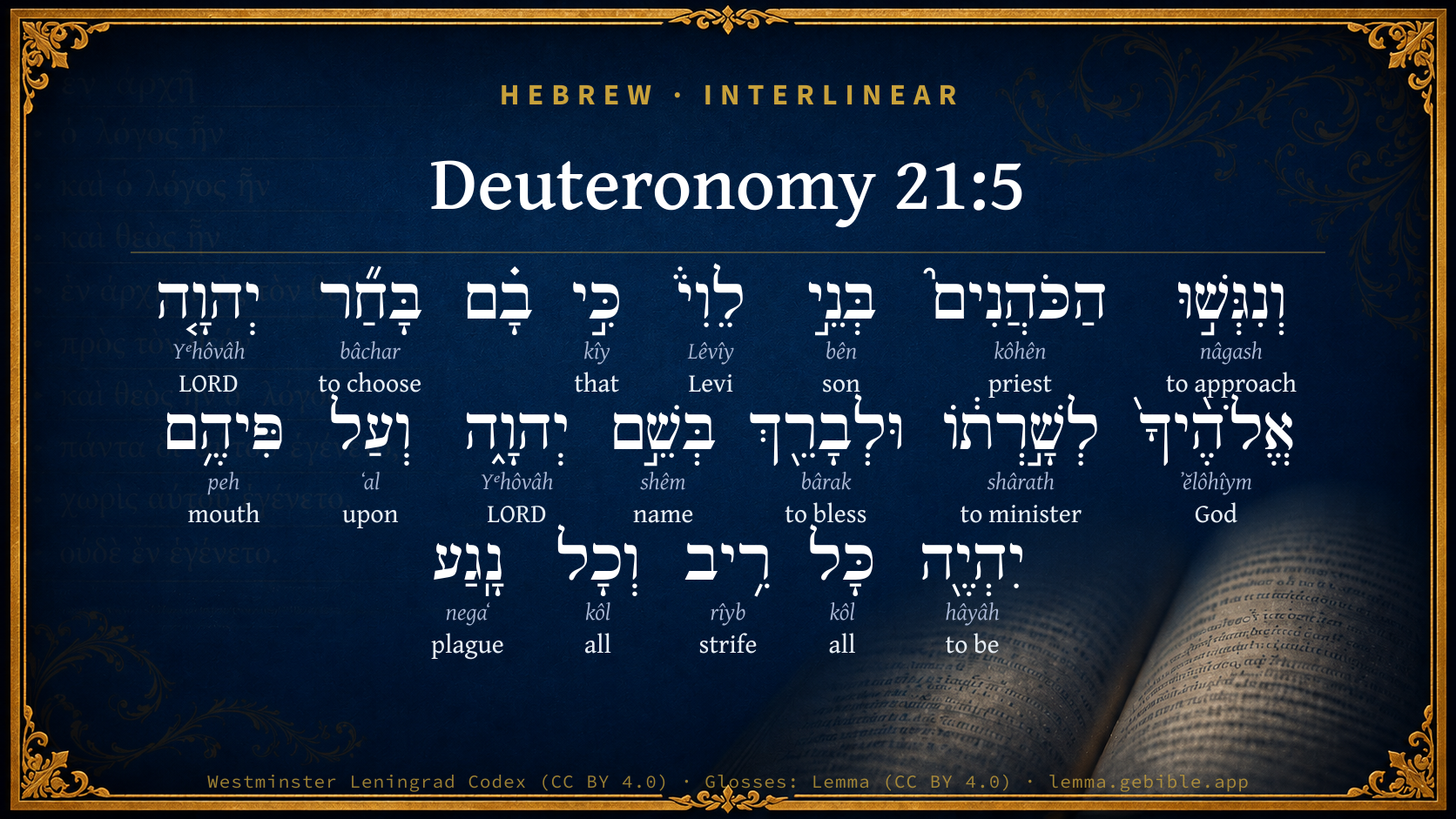
  1. וְנִגְּשׁ֣וּ nâgash H5066 “and · to approach” Conjunction + Verb, Niphal, Sequential Perfect, 3rd Person, Common, Plural
  2. הַכֹּהֲנִים֮ kôhên H3548 “the · priests” Particle, Definite Article + Noun, Common, Masculine, Plural, Absolute
  3. בְּנֵ֣י bên H1121 “sons of” Noun, Common, Masculine, Plural, Construct
  4. לֵוִי֒ Lêvîy H3878 “Levi” Noun, Proper
  5. כִּ֣י kîy H3588 “that” Conjunction
  6. בָּחַ֞ר bâchar H977 “to choose” Verb, Qal, Perfect, 3rd Person, Masculine, Singular
  7. יְהוָ֤ה Yᵉhôvâh H3068 “LORD” Noun, Proper
  8. אֱלֹהֶ֨יךָ֙ ʼĕlôhîym H430 “God(s) · your” Noun, Common, Masculine, Plural, Construct + Suffix, Personal, 2nd Person, Masculine, Singular
  9. לְשָׁ֣רְת֔וֹ shârath H8334 “to minister · him” Preposition + Verb, Piel, Infinitive Construct + Suffix, Personal, 3rd Person, Masculine, Singular
  10. וּלְבָרֵ֖ךְ bârak H1288 “and · to bless” Conjunction + Preposition + Verb, Piel, Infinitive Construct
  11. בְּשֵׁ֣ם shêm H8034 “in/at · name of” Preposition + Noun, Common, Masculine, Singular, Construct
  12. יְהוָ֑ה Yᵉhôvâh H3068 “LORD” Noun, Proper
  13. וְעַל ʻal H5921 “and · upon” Conjunction + Preposition
  14. פִּיהֶ֥ם peh H6310 “mouth · their” Noun, Common, Masculine, Singular, Construct + Suffix, Personal, 3rd Person, Masculine, Plural
  15. יִהְיֶ֖ה hâyâh H1961 “to be” Verb, Qal, Imperfect, 3rd Person, Masculine, Singular
  16. כָּל kôl H3605 “all of” Noun, Common, Masculine, Singular, Construct
  17. וְכָל kôl H3605 “and · all of” Conjunction + Noun, Common, Masculine, Singular, Construct
  18. נָֽגַע negaʻ H5061 “plague” Noun, Common, Masculine, Singular, Absolute

About this verse

These counts appear in no published source. They are computed here, from the morphology-tagged text and Lemma’s own curated glosses. What Lemma adds →

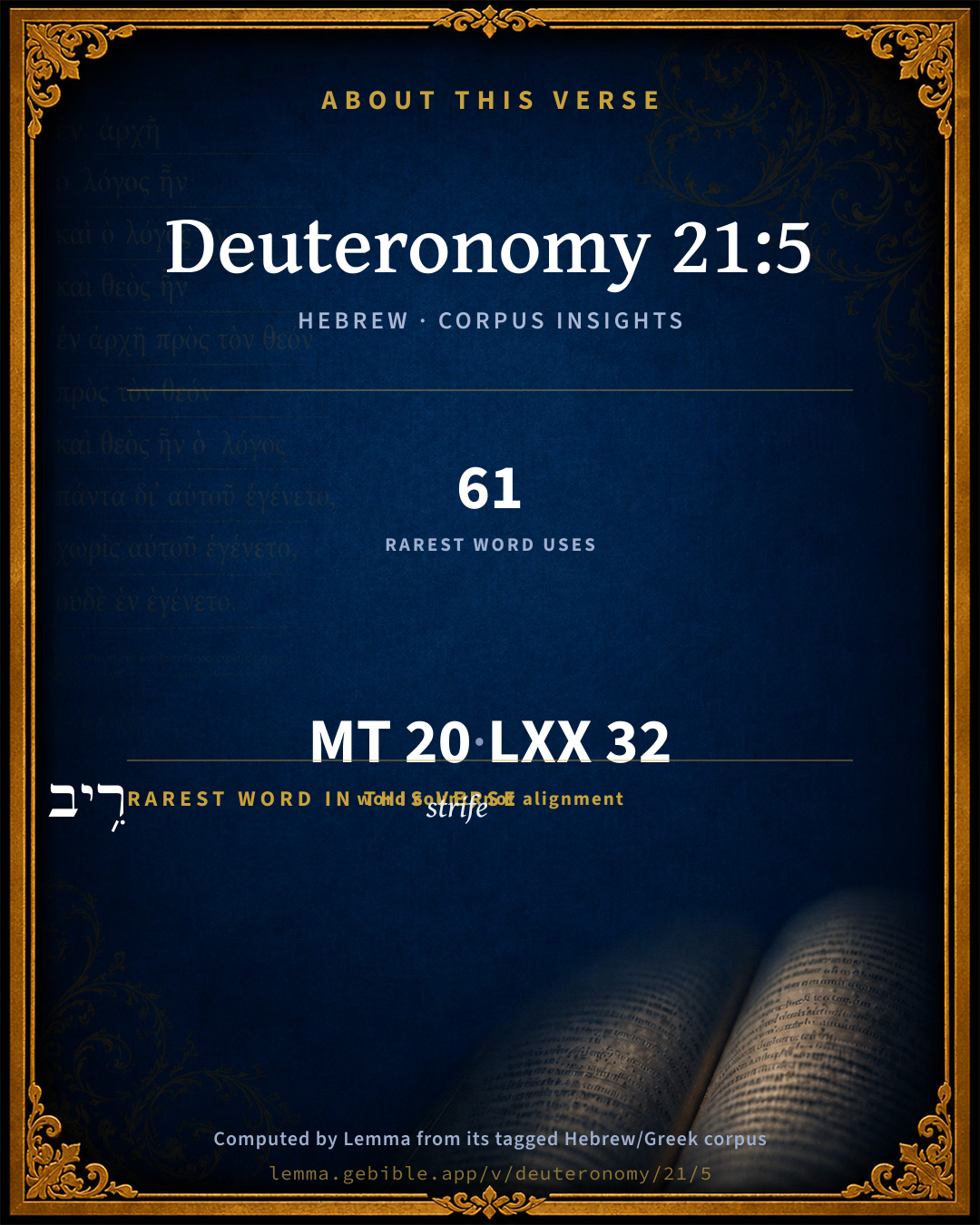
20
words
17
distinct lemmas
Pentateuch
section

Grammatical profile

  • 5 verbs
  • 12 nouns
  • 2 prepositions
  • 1 conjunction

Verb forms

  • וְנִגְּשׁ֣וּ Niphal · Sequential Perfect
  • בָּחַ֞ר Qal · Perfect
  • לְשָׁ֣רְת֔וֹ Piel · Infinitive Construct
  • וּלְבָרֵ֖ךְ Piel · Infinitive Construct
  • יִהְיֶ֖ה Qal · Imperfect

Repetition

Words recur within this verse — often emphatic in Hebrew:

  • יְהוָ֤ה LORD H3068 ×2
  • כָּל all H3605 ×2

Hebrew & Septuagint length

In English translation the verse runs 40 words from the Hebrew and 36 from the Septuagint (LXX English) — closely comparable.

A rough comparison of the two English renderings, which tokenize alike — not a word-level alignment.

Word counts can differ between the Hebrew and the Greek without any difference in meaning — e.g. the Hebrew direct-object marker אֵת has no separate Greek word, and Greek often adds the article ὁ.

In the original languages it is 20 Hebrew tokens and 32 Greek tokens — but the two are counted differently (Hebrew bundles its prefixes and suffixes into one token; the Greek is in lemma form), so that isn’t a like-for-like length.

Cross-references

7

Topical passages linked to Deuteronomy 21:5 in the Treasury of Scripture Knowledge — connected by theme and wording, ordered by reader-vote popularity; previews shown in the World English Bible.

  • 1 Chronicles 23:13 The sons of Amram: Aaron and Moses; and Aaron was separated, that he should sanctify the most holy things, he and his sons, forever, to burn incense before Yahweh, to minister to him, and to bless in his name, forever.
  • Deuteronomy 10:8 At that time Yahweh set apart the tribe of Levi, to bear the ark of the covenant of Yahweh, to stand before Yahweh to minister to him, and to bless in his name, to this day.
  • Malachi 2:7 For the priest's lips should keep knowledge, and they should seek the law at his mouth; for he is the messenger of Yahweh of Hosts.
  • Deuteronomy 19:17 then both the men, between whom the controversy is, shall stand before Yahweh, before the priests and the judges who shall be in those days;
  • Numbers 6:22–27 Yahweh spoke to Moses, saying,
  • Deuteronomy 18:5 For Yahweh your God has chosen him out of all your tribes, to stand to minister in the name of Yahweh, him and his sons for ever.
  • Deuteronomy 17:8–12 If there arise a matter too hard for you in judgment, between blood and blood, between plea and plea, and between stroke and stroke, being matters of controversy within your gates; then shall you arise, and go up to the place which Yahweh your God shall choose;

Cross-references courtesy of OpenBible.info (CC BY 4.0).

Hebrew and Greek witnesses Masoretic Hebrew ↔ Greek Septuagint

The same verse in the two great witnesses to the Old Testament, shown verse-for-verse.

These are two independent witnesses, not word-aligned to each other, and the Septuagint is shown in lemma (dictionary) form.

Hebrew Deuteronomy 21:5 Masoretic · Westminster Leningrad Codex

וְנִגְּשׁ֣וּ הַכֹּהֲנִים֮ בְּנֵ֣י לֵוִי֒ כִּ֣י בָ֗ם בָּחַ֞ר יְהוָ֤ה אֱלֹהֶ֨יךָ֙ לְשָׁ֣רְת֔וֹ וּלְבָרֵ֖ךְ בְּשֵׁ֣ם יְהוָ֑ה וְעַל פִּיהֶ֥ם יִהְיֶ֖ה כָּל רִ֥יב וְכָל נָֽגַע

The priests the sons of Levi shall come near; for them Yahweh your God has chosen to minister to him, and to bless in the name of Yahweh; and according to their word shall every controversy and every stroke be.

World English Bible · Public Domain

Greek LXX Deuteronomy 21:5 Septuagint · lemma form

καί προςἔρχομαι ὁ ἱερεύς ὁ λευίτης ὅτι αὐτός ἐπιλέγω κύριος ὁ θεός σύ παραἵστημι αὐτός καί εὐλογέω ἐπί ὁ ὄνομα αὐτός καί ἐπί ὁ στόμα αὐτός εἰμί πᾶς ἀντιλογία καί πᾶς ἁφή

And the priests the Levites shall come, because the Lord God has chosen them to stand by him, and to bless in his name, and by their word shall every controversy and every stroke be decided.

LXX2012 (modern English Septuagint) · Public Domain

Hebrew: Westminster Leningrad Codex (CC BY 4.0). Greek: Septuagint (public domain); English from LXX2012 (modern English Septuagint) (Public Domain). How the Septuagint differs from the Hebrew →

Targum (Aramaic paraphrase)

2

The Targum is the ancient Jewish Aramaic paraphrase of the Hebrew Scriptures — an interpretive translation, not the Hebrew text itself. Onkelos (literal) and Pseudo-Jonathan (expansive) render the Torah, and Jonathan the Prophets. Coverage is partial: where no permissively-licensed English translation exists for a verse, only the Aramaic is shown. This is verse-level text, not a word-by-word alignment to the Hebrew.

  1. Targum Onkelos Torah (Genesis–Deuteronomy)
    וְיִתְקָרְבוּן כָּהֲנַיָא בְּנֵי לֵוִי אֲרֵי בְהוֹן יִתִּרְעֵי יְיָ אֱלָהָךְ לְשַׁמָשׁוּתֵהּ וּלְבָרָכָא בִּשְׁמָא דַיְיָ וְעַל מֵימְרֵהוֹן יְהֵי כָּל דִין וְכָל מַכְתַּשׁ סְגִירוּ

    (no public-domain English translation for this verse)

    Targum Onkelos — Aramaic: “Onkelos Genesis” (public domain); “Onkelos Exodus” (public domain); “Onkelos Leviticus” (public domain); “Onkelos Numbers” (public domain); “Onkelos Deuteronomy” (public domain). English: “Sefaria Community Translation” (CC0 1.0 (public-domain dedication)); “J.W. Etheridge. The Targums of Onkelos and Jonathan Ben Uzziel on the Pentateuch. London: Longmans, Green, 1862” (public domain). Text via Sefaria.

  2. Targum Pseudo-Jonathan Torah (Genesis–Deuteronomy)
    וִיקַרְבוּן כַּהֲנַיָא בְּנֵי לֵוִי אֲרוּם בְּהוֹן אִתְרְעֵי מֵימְרָא דַיְיָ אֱלָהָכוֹן לְשַׁמָשׁוּתֵיהּ וּלְבָרָכָא יַת יִשְרָאֵל בִּשְׁמֵיהּ וְעַל מֵימַר פּוּמְהוֹן יְהִי מִתְדָן כָּל דִּין וְכָל מַכְתַּשׁ צוֹרְעָא לְמִסְגוֹר וּלְמַחְלוֹט

    And the priests the sons of Levi shall draw near; for the Lord your God hath chosen them to minister to Him, and to bless Israel in His Name, and according to their words to resolve every judgment, and in any plague of leprosy to shut up, and pronounce concerning it;

    Targum Pseudo-Jonathan — Aramaic: “Targum Jonathan on Genesis” (public domain); “Targum Jonathan on Exodus” (public domain); “Targum Jonathan on Leviticus” (public domain); “Targum Jonathan on Numbers” (public domain); “Targum Jonathan on Deuteronomy” (public domain). English: “The Targum of Jonathan ben Uzziel, trans. J. W. Etheridge, London, 1862” (public domain). Text via Sefaria.

Commentary

Notes on Deuteronomy 21:5 from classic Christian and Jewish commentators (each source and its license shown beneath its notes). The classic Christian expositions comment on the surrounding passage and are grouped to its opening verse, so a note may address several verses; the Jewish commentaries on the Tanakh (Rashi and others) are per-verse, so they appear only where the commentator wrote on this verse.

Lemma curates 59 commentaries, every one of them public domain or Creative Commons licensed, each selected and text-cleaned for this edition rather than reprinted as found. About our sources →

Trapp's Complete Commentary

John Trapp

Deu 21:5 And the priests the sons of Levi shall come near; for them the LORD thy God hath chosen to minister unto him, and to bless in the name of the LORD; and by their word shall every controversy and every stroke be [tried]:

Ver. 5. And by their word,] i.e., According to that exposition that they shall give of God’s Word, and not by any absolute or arbitrary power of their own.

John Trapp, A Commentary or Exposition upon All the Books of the Old and New Testament (1647–1656) — public domain. Text from a community e-Sword module.

Joseph Benson's Commentary

Deu 21:5-6. By their word shall every controversy be tried — That is, every one of this kind, every one that shall arise about any stroke, whether such a mortal stroke as is here spoken of, or any other, or wound given by one man to another. In these matters they shall give sentence, being consulted by the elders or judges of the cities, Deu 17:9-12. The elders shall wash their hands — Protesting their innocence, says a learned Jewish writer, (Chazkuni,) in these words: “As our hands are now clean, so are we innocent of the blood which has been shed.” See an allusion to this, Psa 26:6; Mat 27:24.

Joseph Benson's Commentary on the Old and New Testaments (1811–1818) — public domain. Text from a community e-Sword module.

The Cambridge Bible for Schools and Colleges

gen. ed. J. J. S. Perowne

5. the priests the sons of Levi shall come near] The same vb as of the priest in Deu_20:2, R.V. approach. The appearance of the priests is remarkable, for they have nothing else to do in the ceremony. They have been introduced, then, either by D or, since they are not designated by D’s usual title for them (the priests the Levites), by an editor who, under the later priestly conceptions, cannot imagine such a ceremony without them. The rest of the v. reads as though the insertor gave it as his reason for bringing them in. For the formulas of which it consists see on Deu_10:8, Deu_17:8; Deu_17:12, Deu_18:5.

The Cambridge Bible for Schools and Colleges (gen. ed. J. J. S. Perowne; Cambridge University Press, 1878–1918) — public domain. Text from a community e-Sword module.

John Gill's Exposition

And the priests the sons of Levi shall come near,.... Who were clearly of the tribe of Levi, as Aben Ezra notes; about whom there could be no dispute; for it seems there sometimes were persons in that office, of whom there was some doubt at least whether they were of that tribe; these seem to be such that belonged to the court of judicature at Jerusalem; see Deu 17:9, who were to be present at this solemnity, to direct in the performance of it, and to judge and determine in any matter of difficulty that might arise:

for them the Lord thy God hath chosen to minister unto him; in the service of the sanctuary, by offering sacrifices, &c.

and to bless in the name of the Lord; the people; see Num 6:23.

and by their word shall every controversy and every stroke be tried; every controversy between man and man respecting civil things, and every stroke or blow which one man may give another; and whatsoever came before them was tried by them, according to the respective laws given concerning the things in question, and were not determined by them in an arbitrary way, according to their own will and pleasure; see Deu 17:8.

John Gill's Exposition of the Whole Bible (1746–1763) — public domain (CC PDM 1.0). Text via the HelloAO Bible API.

Haydock's Catholic Bible Commentary

Judged. We see here again the great authority of the priests, chap. xvii. 9. Hebrew, "by their word shall every controversy and every stroke be tried," as the Protestants render it. (Haydock) --- Some understand by stroke, the leprosy, of which they were undoubtedly the judges. But it is better to explain it of all wounds, and even of death, (Calmet) concerning which Moses is here speaking. (Haydock) --- The Rabbins restrain the authority of priests as much as they can, to give greater power to their chimerical Sanhedrim. They pretend here that they had only to pronounce the blessing, ver. 8. Josephus ([Antiquities?] iv. 8) joins the magistrates with them in the whole ceremony. This awful meeting of so many people, tended to discover the authors of the murder, as all would naturally converse together on the subject, and each person declaring what he knew, some suspicions might at last be formed, which might by degrees lead to the detection. Josephus says rewards were proposed to any who might make a discovery. Draco decreed, that on the very day when a murder was announced, if the author was not known, the whole people (of Athens) should be purified. (Calmet) --- Abulensis insinuates, that if the murderer was present in the crowd, he might be detected by blood gushing from to corpse of the deceased, &c., as God often brings murder to light in a wonderful manner. (Cic.[Cicero,?] Div. 1.) (Tirinus)

George Leo Haydock (1774–1849), Haydock's Catholic Family Bible and Commentary, 1859 edition — public domain. Excludes Psalms (Douay-Rheims chapter numbering differs from Protestant) and Deuterocanonical books (Catholic canon only).

Matthew Poole's English Annotations

The priests shall come near, both to direct them in all the circumstances of action and to see that the law was observed, and to bless them in God’s name, by praying for them, and absolving or pronouncing them guiltless in this matter.

Every controversy; not absolutely all manner of controversies that could possibly arise, as if their word were to determine whether there were a God or providence or no, whether God should be worshipped, and his commands observed, or no, whether Moses was a true prophet or an impostor, whether apostate and idolatrous Israelites should be punished or no, which is apparently absurd and ridiculous; but every such controversy as might arise about the matter here spoken of; nothing being more usual than to understand universal expressions in a limited sense; and indeed this is limited and explained by the following words,

and every stroke, the particle and being put expositively, of which instances have been formerly given, i.e. every controversy which shall arise about any stroke, whether such a mortal stroke as is here spoken of, a murder, which may well be called a stroke, as to smite is oft used for to kill, as Gen 4:15; Lev 24:17, &c., or any other stroke or wound given by one man to another.

Matthew Poole's English Annotations on the Holy Bible (1683–1685) — public domain. Text from a community e-Sword/MySword module.

Whedon's Commentary on the Bible

Daniel D. Whedon

5. And the priests… shall come near — The priests were not to take part in the matter, but were present to see that all things were done in accordance with law.

Daniel D. Whedon (gen. ed.), Commentary on the Old and New Testaments (1874–1909) — public domain. Text from a community e-Sword module.

The Pulpit Commentary

And the priests the sons of Levi shall come near. The presence of the priests at this ceremony was due to their position as the servants of Jehovah the King of Israel, on whom it devolved to see that all was done in any matter as his Law prescribed. The priests present were probably those from the nearest Levitical town. And by their word shall every controversy and every stroke he tried; literally, And upon their mouth shall be every strife and every stroke, i.e. by their judgment the character of the act shall be determined, and as they decide so shall the matter stand. (cf. Deu_10:8 Deu_17:8) In the present case the presence of the priests at the transaction gave it sanction as valid.

The Pulpit Commentary (1880–1919), ed. H.D.M. Spence-Jones & Joseph S. Exell — public domain. Text from a community e-Sword module.

John Wesley's Explanatory Notes

Every controversy - Of this kind: every controversy which shall rise about any stroke, whether such a mortal stroke as is here spoken of, or any other stroke or wound given by one man to another.

John Wesley, Explanatory Notes Upon the Whole Bible (1754–1765) — public domain. Text via the GEBible commentary corpus.

unfoldingWord translationNotes

Door43 World Missions Community

General Information:

Moses continues speaking to the people of Israel.

must come forward

"must come to the valley"

for Yahweh your God has chosen them to serve him

"because the priests are the ones whom Yahweh your God has chosen to serve him"

Yahweh your God

Moses speaks to the Israelites as if he were speaking to one man, so the word "your" is singular. (See: Forms of You)

give blessing

"bless the people of Israel"

in the name of Yahweh

Here the metonym "in the name of" refers to Yahweh and his authority. AT: "as one who says and does what Yahweh himself would say and do" (See: Metonymy)

Yahweh and to decide every case of dispute and assault by their word

"Yahweh, and they will be the ones who settle all disagreements and cases of violence"

translationWords

priest

descend

Levi

chosen one

servant

bless

people group

name

word

unfoldingWord translationNotes — © Distant Shores Media and the Door43 World Missions Community, licensed CC BY-SA 4.0. Source: git.door43.org/Door43/en_tn.

Lesson kit

Teaching starters — assembled from the data on this page, not authored interpretation. Every prompt links to the verse data it draws on. Edit before teaching.

Deuteronomy, in the Pentateuch, opens this verse with 20 words (17 distinct Hebrew lemmas). Its most distinctive word is rîyb (“strife”). A historical commentator’s framing appears above. Read the whole chapter for the surrounding context.

Discussion questions

  1. The word rîyb carries the sense “strife.” How does it shape the verse?
  2. How does 1 Chronicles 23:13, which shares this passage’s theme, read alongside this verse?
  3. What does the repetition of “LORD” (2× in this one verse) do in this verse?
  4. These translations render this verse differently; the difference is in the English rendering, not the original. What questions does that raise?
  5. «וְנִגְּשׁ֣וּ» is a Niphal Sequential Perfect verb. How does that grammatical form shape the action described?
  6. Compare how Trapp's Complete Commentary and Joseph Benson's Commentary read this verse. Where do they agree or differ?

Things to notice

Reading settings

Reading text

Shown beneath each verse's original-language words.

Old Testament
Old Testament edition

Read the OT as the Masoretic Hebrew (MT) or the Greek Septuagint (LXX).

English shown for the Greek Septuagint (in the Hebrew ↔ Greek comparison).

Comparing translations? Open the Compare panel on any verse page to stack up to four side by side.