

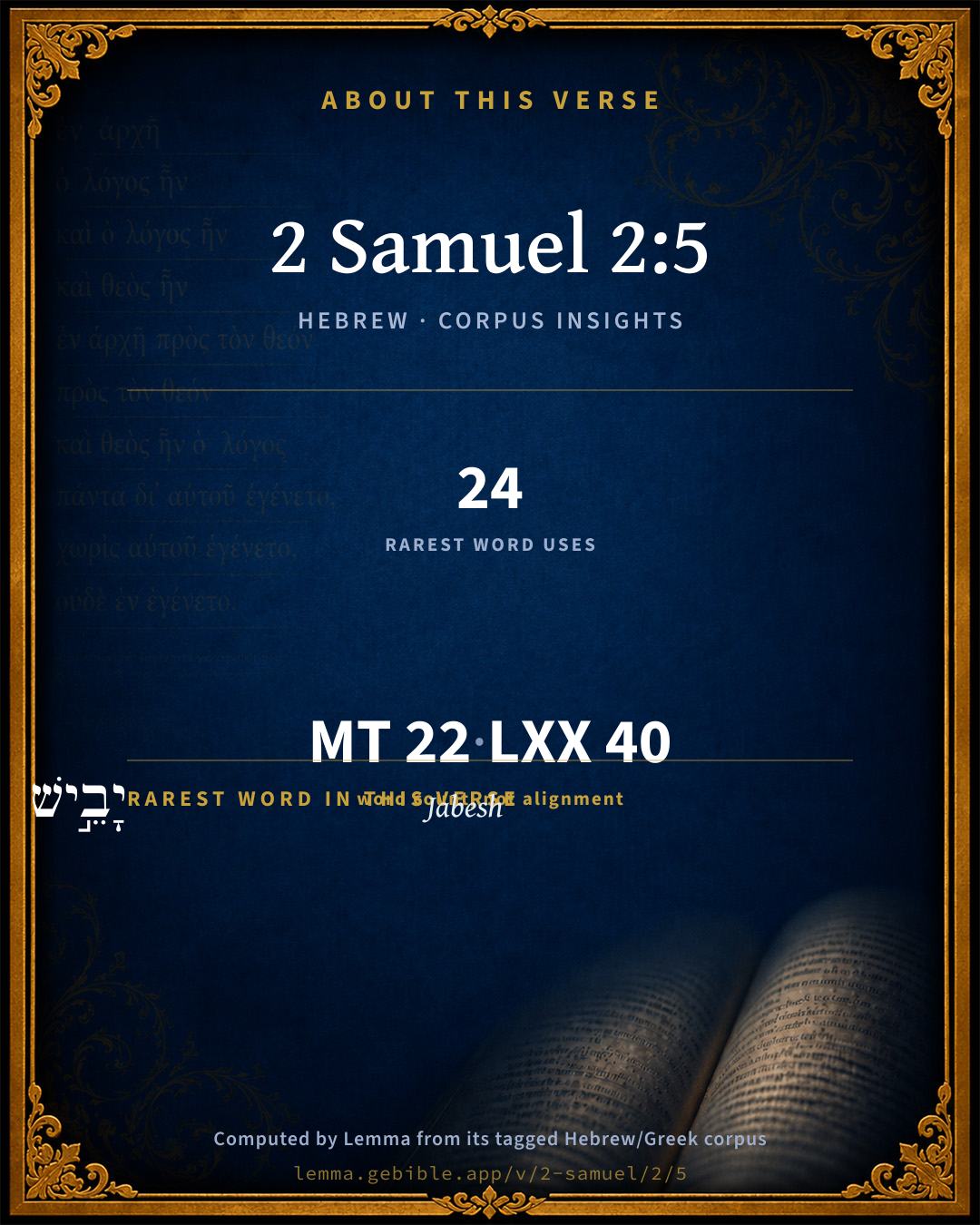
2 Samuel 2:5

Hebrew (Westminster Leningrad Codex) 2 Samuel 2:5 appears in the Hebrew Old Testament. The text above is from the Westminster Leningrad Codex. Each word links to its Strong’s number, a concise gloss, and parsing drawn from the Open Scriptures Hebrew Bible morphology. Click any word for its full Brown-Driver-Briggs (BDB) entry.
Download image
Cite this verse

2 Samuel 2:5 (World English Bible). Public Domain. Lemma interlinear Bible study tool, https://lemma.gebible.app/v/2-samuel/2/5.

Show BibTeX & RIS
BibTeX
RIS
English Translation
David sent messengers to the men of Jabesh Gilead, and said to them, Blessed be you of Yahweh, that you have shown this kindness to your lord, even to Saul, and have buried him.
World English Bible · Public Domain
Download a study sheet

One document with this verse’s original text, its word-by-word gloss line, the meaning frame, cross-references with their text, attributed commentary, and full source and license credits — printable, and it pastes into notes with its structure intact.

This verse Autodidact and up

Study sheet (.html) Plain text (.txt)

A passage Seminary Student

Up to 50 verses in one chapter. A passage sheet keeps up to 6 commentary sources and 12 cross-references per verse, in the order this page ranks them, and says so on the sheet whenever that leaves anything out. Ask for a single verse and you get the Autodidact verse sheet above.

Everything on this page stays free to read, with no account — the sheet is a download of what is already on screen, not access to it.

Want to remove ads? Support Godless Engineer
Compare translations 3

The same verse in 3 English versions, stacked beneath the original-language interlinear above. Click any original word for its lexicon entry.

Each is an independent rendering of the whole verse — the interlinear is not word-aligned to these translations.

Highlighted words mark where these versions differ — a whole-verse word diff, not a word-by-word alignment.

  • World English Bible Public Domain
    David sent messengers to the men of Jabesh Gilead, and said to them, Blessed be you of Yahweh, that you have shown this kindness to your lord, even to Saul, and have buried him.
  • King James Version Public Domain
    And David sent messengers unto the men of Jabeshgilead, and said unto them, Blessed be ye of the LORD, that ye have showed this kindness unto your lord, even unto Saul, and have buried him.
  • unfoldingWord Literal Text CC BY-SA 4.0
    And David sent messengers to the men of Jabesh Gilead, and he said to them, “Blessed you by Yahweh, that you have done this kindness with your master, with Saul, and have buried him.

unfoldingWord Literal Text — © unfoldingWord, licensed CC BY-SA 4.0. Word-aligned USFM3 via Door43 (git.door43.org/unfoldingWord/en_ult).

Versions to compare (up to 4)

3 of 4 selected

Show all 18 translations

Every available English version of this verse, each an independent rendering of the whole verse.

  • World English Bible Public Domain
    David sent messengers to the men of Jabesh Gilead, and said to them, Blessed be you of Yahweh, that you have shown this kindness to your lord, even to Saul, and have buried him.
  • Berean Standard Bible Public Domain
    So David sent messengers to the men of Jabesh-gilead to tell them, “The LORD bless you, because you showed this kindness to Saul your lord when you buried him.
  • Majority Standard Bible Public Domain
    So David sent messengers to the men of Jabesh-gilead to tell them, “The LORD bless you, because you showed this kindness to Saul your lord when you buried him.
  • King James Version Public Domain
    And David sent messengers unto the men of Jabeshgilead, and said unto them, Blessed be ye of the LORD, that ye have showed this kindness unto your lord, even unto Saul, and have buried him.
  • American Standard Version (1901) Public Domain
    And David sent messengers unto the men of Jabesh-gilead, and said unto them, Blessed be ye of Jehovah, that ye have showed this kindness unto your lord, even unto Saul, and have buried him.
  • Revised Version (1885) Public Domain
    And David sent messengers unto the men of Jabesh-gilead, and said unto them, Blessed be ye of the LORD, that ye have shewed this kindness unto your lord, even unto Saul, and have buried him.
  • Geneva Bible (1599) Public Domain
    And Dauid sent messengers vnto the men of Iabesh Gilead, and said vnto them, Blessed are ye of the Lord, that yee haue shewed such kindenes vnto your lord Saul, that you haue buried him.
  • Douay-Rheims (1899) Public Domain
    David therefore sent messengers to the men of Jabes Galaad, and said to them: Blessed be you to the Lord, who have shewn this mercy to your master Saul, and have buried him.
  • Young's Literal Translation Public Domain
    And David sendeth messengers unto the men of Jabesh-Gilead, and saith unto them, `Blessed `are' ye of Jehovah, in that ye have done this kindness with your lord, with Saul, that ye bury him.
  • Literal Standard Version CC BY-SA 4.0
    And David sends messengers to the men of Jabesh-Gilead and says to them, “Blessed [are] you of YHWH, in that you have done this kindness with your lord, with Saul, that you bury him.
  • Unlocked Literal Bible CC BY-SA 4.0
    So David sent messengers to the men of Jabesh Gilead and said to them, “You are blessed by Yahweh, since you have showed this loyalty to your master Saul and have buried him.
  • unfoldingWord Literal Text CC BY-SA 4.0
    And David sent messengers to the men of Jabesh Gilead, and he said to them, “Blessed you by Yahweh, that you have done this kindness with your master, with Saul, and have buried him.
  • Darby Bible Public Domain
    And David sent messengers to the men of Jabesh-Gilead, and said to them, Blessed be ye of Jehovah, that ye have shewn this kindness to your lord, to Saul, and have buried him!
  • World Messianic Bible Public Domain
    David sent messengers to the men of Jabesh Gilead, and said to them, “Blessed are you by the LORD, that you have shown this kindness to your lord, even to Saul, and have buried him.
  • Webster's Bible Public Domain
    And David sent messengers to the men of Jabesh-gilead, and said to them, Blessed be ye of the LORD, that ye have shown this kindness to your lord, even to Saul, and have buried him.
  • Free Bible Version CC BY-SA 4.0
    he sent messengers to them, saying, “May the Lord bless you, because you demonstrated your loyal love to Saul your master, and you buried him properly.
  • Bible in Basic English Public Domain
    And David sent to the men of Jabesh-gilead and said to them, May the Lord give you his blessing, because you have done this kind act to Saul your lord, and have put his body to rest!
  • JPS Tanakh (1917) Public Domain
    And David sent messengers unto the men of Jabesh-gilead, and said unto them: 'Blessed be ye of the LORD, that ye have shown this kindness unto your lord, even unto Saul, and have buried him.

Literal Standard Version (2020), Covenant Press — licensed CC BY-SA 4.0. Text via the HelloAO Bible API (eBible.org). Unlocked Literal Bible (unfoldingWord) — licensed CC BY-SA 4.0. Text via the HelloAO Bible API (eBible.org). unfoldingWord Literal Text — © unfoldingWord, licensed CC BY-SA 4.0. Word-aligned USFM3 via Door43 (git.door43.org/unfoldingWord/en_ult). Free Bible Version, Dr. Jonathan Gallagher — licensed CC BY-SA 4.0. Text via the HelloAO Bible API (eBible.org).

Word by word

More ways to search: Search by grammar → Find every occurrence → Compare this word →

Practice this passage: Drill this verse → Learn its vocabulary →

יָבֵ֣ישׁ
Yâbêsh
H3003
“Jabesh”
Noun, Proper
Part of Speech
Noun
Type
Proper
Full BDB Definition

Origin: the same as H3002 (also Yabeysh yaw-bashe')

TWOT: None

Jabesh = "dry" - a town in the territory of Gilead; according to Eusebius, it is beyond the Jordan, 6 miles (10 kilometers) from Pella, on the mountain road to Gerasa; site unknown but may be modern 'Wadi Yabes' (noun proper locative) - father of Shallum, the 15th king of the northern kingdom (noun proper masculine)
  1. וַיִּשְׁלַ֤ח shâlach H7971 “and · to send” Conjunction + Verb, Qal, Sequential Imperfect, 3rd Person, Masculine, Singular
  2. דָּוִד֙ Dâvid H1732 “David” Noun, Proper
  3. מַלְאָכִ֔ים mălʼâk H4397 “messengers” Noun, Common, Masculine, Plural, Absolute
  4. אֶל ʼêl H413 “to” Preposition
  5. אַנְשֵׁ֖י ʼîysh H376 “men of” Noun, Common, Masculine, Plural, Construct
  6. גִּלְעָ֑ד Gilʻâd H1568 “Gilead” Noun, Proper
  7. וַיֹּ֣אמֶר ʼâmar H559 “and · to say” Conjunction + Verb, Qal, Sequential Imperfect, 3rd Person, Masculine, Singular
  8. אֲלֵיהֶ֗ם ʼêl H413 “to · them” Preposition + Suffix, Personal, 3rd Person, Masculine, Plural
  9. בְּרֻכִ֤ים bârak H1288 “blessed” Verb, Qal, Participle Passive, Masculine, Plural, Absolute
  10. אַתֶּם֙ ʼattâh H859 “you” Pronoun, Personal, 2nd Person, Masculine, Plural
  11. לַֽיהוָ֔ה Yᵉhôvâh H3068 “to/for · LORD” Preposition + Noun, Proper
  12. אֲשֶׁ֨ר ʼăsher H834 “which” Particle, Relative
  13. עֲשִׂיתֶ֜ם ʻâsâh H6213 “to do” Verb, Qal, Perfect, 2nd Person, Masculine, Plural
  14. הַחֶ֣סֶד chêçêd H2617 “the · kindness” Particle, Definite Article + Noun, Common, Masculine, Singular, Absolute
  15. הַזֶּ֗ה zeh H2088 “the · this” Particle, Definite Article + Pronoun, Demonstrative, Masculine, Singular
  16. עִם ʻim H5973 “with” Preposition
  17. אֲדֹֽנֵיכֶם֙ ʼâdôwn H113 “lords · your” Noun, Common, Masculine, Plural, Construct + Suffix, Personal, 2nd Person, Masculine, Plural
  18. עִם ʻim H5973 “with” Preposition
  19. שָׁא֔וּל Shâʼûwl H7586 “Saul” Noun, Proper
  20. וַֽתִּקְבְּר֖וּ qâbar H6912 “and · to bury” Conjunction + Verb, Qal, Sequential Imperfect, 2nd Person, Masculine, Plural
  21. אֹתֽוֹ ʼêth H853 “- · him” Particle, Direct Object + Suffix, Personal, 3rd Person, Masculine, Singular

About this verse

These counts appear in no published source. They are computed here, from the morphology-tagged text and Lemma’s own curated glosses. What Lemma adds →

22
words
20
distinct lemmas
Historical
section

Notable vocabulary

The rarest word here is יָבֵ֣ישׁ Jabesh H3003 — appearing just 24 times in the whole Hebrew Bible.

Shared distinctive vocabulary

יָבֵ֣ישׁ Jabesh H3003 occurs in 21 verses of the Hebrew Bible. Also found in:

Grammatical profile

  • 5 verbs
  • 9 nouns
  • 2 pronouns
  • 4 prepositions
  • 2 particles

Verb forms

  • וַיִּשְׁלַ֤ח Qal · Sequential Imperfect
  • וַיֹּ֣אמֶר Qal · Sequential Imperfect
  • בְּרֻכִ֤ים Qal · Participle Passive
  • עֲשִׂיתֶ֜ם Qal · Perfect
  • וַֽתִּקְבְּר֖וּ Qal · Sequential Imperfect

Repetition

Words recur within this verse — often emphatic in Hebrew:

Hebrew & Septuagint length

In English translation the verse runs 34 words from the Hebrew and 51 from the Septuagint (LXX English) — the Septuagint runs noticeably longer here. See the side-by-side →

A rough comparison of the two English renderings, which tokenize alike — not a word-level alignment.

Word counts can differ between the Hebrew and the Greek without any difference in meaning — e.g. the Hebrew direct-object marker אֵת has no separate Greek word, and Greek often adds the article ὁ.

In the original languages it is 22 Hebrew tokens and 40 Greek tokens — but the two are counted differently (Hebrew bundles its prefixes and suffixes into one token; the Greek is in lemma form), so that isn’t a like-for-like length.

Cross-references

7

Topical passages linked to 2 Samuel 2:5 in the Treasury of Scripture Knowledge — connected by theme and wording, ordered by reader-vote popularity; previews shown in the World English Bible.

  • 1 Samuel 23:21 Saul said, Blessed be you of Yahweh; for you have had compassion on me.
  • Psalms 115:15 Blessed are you by Yahweh, Who made heaven and earth.
  • Ruth 2:20 Naomi said to her daughter-in-law, Blessed be he of Yahweh, who has not left off his kindness to the living and to the dead. Naomi said to her, The man is a close relative to us, one of our near kinsmen.
  • Ruth 3:10 He said, Blessed are you by Yahweh, my daughter: you have shown more kindness in the latter end than at the beginning, inasmuch as you didn't follow young men, whether poor or rich.
  • 1 Samuel 24:19 For if a man finds his enemy, will he let him go away unharmed? Therefore may Yahweh reward you good for that which you have done to me this day.
  • 1 Samuel 25:32–33 David said to Abigail, Blessed be Yahweh, the God of Israel, who sent you this day to meet me:
  • Ruth 1:8 Naomi said to her two daughters-in-law, Go, return each of you to her mother's house: Yahweh deal kindly with you, as you have dealt with the dead, and with me.

Cross-references courtesy of OpenBible.info (CC BY 4.0).

Hebrew and Greek witnesses Masoretic Hebrew ↔ Greek Septuagint

The same verse in the two great witnesses to the Old Testament, shown verse-for-verse.

Here the Septuagint runs noticeably longer than the Hebrew — LXX2012 (modern English Septuagint) 51 words vs World English Bible 34. A rough length comparison of the two English translations, not a word-level alignment — read both below.

These are two independent witnesses, not word-aligned to each other, and the Septuagint is shown in lemma (dictionary) form.

Hebrew 2 Samuel 2:5 Masoretic · Westminster Leningrad Codex

וַיִּשְׁלַ֤ח דָּוִד֙ מַלְאָכִ֔ים אֶל אַנְשֵׁ֖י יָבֵ֣ישׁ גִּלְעָ֑ד וַיֹּ֣אמֶר אֲלֵיהֶ֗ם בְּרֻכִ֤ים אַתֶּם֙ לַֽיהוָ֔ה אֲשֶׁ֨ר עֲשִׂיתֶ֜ם הַחֶ֣סֶד הַזֶּ֗ה עִם אֲדֹֽנֵיכֶם֙ עִם שָׁא֔וּל וַֽתִּקְבְּר֖וּ אֹתֽוֹ

David sent messengers to the men of Jabesh Gilead, and said to them, Blessed be you of Yahweh, that you have shown this kindness to your lord, even to Saul, and have buried him.

World English Bible · Public Domain

Greek LXX 2 Samuel 2:5 Septuagint · lemma form

καί ἀποστέλλω δαυίδ ἄγγελος πρός ὁ ἡγέομαι ιαβις ὁ γαλααδίτιδος καί εἶπον πρός αὐτός εὐλογέω σύ ὁ κύριος ὅτι ποιέω ὁ ἔλεος οὗτος ἐπί ὁ κύριος σύ ἐπί σαούλ ὁ χριστός κύριος καί θάπτω αὐτός καί ιωναθαν ὁ υἱός αὐτός

And David sent messengers to the rulers of Jabis of the country of Galaad, and David said to them, Blessed be you⌃ of the Lord, because you⌃ have wrought this mercy toward your lord, even toward Saul the anointed of the Lord, and you⌃ have buried him and Jonathan his son.

LXX2012 (modern English Septuagint) · Public Domain

Hebrew: Westminster Leningrad Codex (CC BY 4.0). Greek: Septuagint (public domain); English from LXX2012 (modern English Septuagint) (Public Domain). How the Septuagint differs from the Hebrew →

Targum (Aramaic paraphrase)

1

The Targum is the ancient Jewish Aramaic paraphrase of the Hebrew Scriptures — an interpretive translation, not the Hebrew text itself. Onkelos (literal) and Pseudo-Jonathan (expansive) render the Torah, and Jonathan the Prophets. Coverage is partial: where no permissively-licensed English translation exists for a verse, only the Aramaic is shown. This is verse-level text, not a word-by-word alignment to the Hebrew.

  1. Targum Jonathan Prophets (Joshua–Malachi)
    וּשְׁלַח דָוִד אִזְגַדִין לְוַת אֱנָשֵׁי יָבֵשׁ גִלְעָד וַאֲמַר לְהוֹן בְּרִיכִין אַתּוּן קֳדָם יְיָ דַעְבַדְתּוּן חִסְדָא הָדֵין עִם רִבּוֹנְכוֹן עִם שָׁאוּל וּקְבַרְתּוּן יָתֵיהּ:

    (no public-domain English translation for this verse)

    Targum Jonathan — Aramaic: “Mikraot Gedolot” (public domain). English: “Sefaria Community Translation” (CC0 1.0 (public-domain dedication)); “London "Chaldee Paraphrase," 1871” (public domain). Text via Sefaria.

Commentary

Notes on 2 Samuel 2:5 from classic Christian and Jewish commentators (each source and its license shown beneath its notes). The classic Christian expositions comment on the surrounding passage and are grouped to its opening verse, so a note may address several verses; the Jewish commentaries on the Tanakh (Rashi and others) are per-verse, so they appear only where the commentator wrote on this verse.

Lemma curates 59 commentaries, every one of them public domain or Creative Commons licensed, each selected and text-cleaned for this edition rather than reprinted as found. About our sources →

Trapp's Complete Commentary

John Trapp

2Sa 2:5 And David sent messengers unto the men of Jabeshgilead, and said unto them, Blessed [be] ye of the LORD, that ye have shewed this kindness unto your lord, [even] unto Saul, and have buried him.

Ver. 5. That ye have showed this kindness unto your lord.] Whose not only subjects ye were - as others - but beneficiaries also in a special mannor; for he rescued you from Nahash, king of Ammon; and I, for this your last good office to him, shall be ready to requite you; so little grudge bear I to him, or any that favoured him: you may trust me.

John Trapp, A Commentary or Exposition upon All the Books of the Old and New Testament (1647–1656) — public domain. Text from a community e-Sword module.

The Biblical Illustrator

Joseph S. Exell

2Sa_2:5-32

And David sent messengers unto the men of Jabesh-Gilead.

Attempts at conciliation defeated

1. The chief anxiety of David, alter being anointed king over the house of Judah, would naturally be how to secure the peaceful allegiance of the other tribes. Prompted by the desire to prevent civil war, and also by the amiable feelings of his own heart, he sent a kind and grateful message to the men of Jabesh-Gilead, complimenting them on the respect they had shown for the mutilated remains of Saul and his sons. Every action of David in reference to his great rival evinces the superiority of his spirit to that which has often prevailed in similar circumstances. Within the Scriptures themselves we have instances of the dishonour that was often put on the body of a conquered foe: the cases of Jehoram and Jezebel will readily occur to every one. The shocking fate of Hector's dead body, dragged thrice round the walls of Troy behind the chariot of Achilles, was regarded as only such a calamity as might be looked for amid the changing fortunes of war. Mark Anthony is said to have broken out into laughter at the sight of the hands and head of Cicero, which he had caused to be cut off. It is very true that David was not strong enough at this time to offer any such outrage to his opponents, even if he had been willing; it would have been alike impolitic and cruel; but it is unfair to allege, that motives of policy were the only consideration that influenced him. The spirit of kindly regard, both to the person and the family of his predecessor, evidently breathed out from David's inmost soul, and is not to be denied or disparaged because the course it prompted was likewise the course of sound policy. When we come to examine his proceeding in giving up seven of Soul's sons to the Gibeonites, we shall see that that act was not an exception to his ordinary spirit.

2. The message which David sent to the men of Jabesh-Gilead was not merely fitted to gratify them, but was calculated to give confidence to the old friends and supporters of the former king. It would have been natural enough for them to apprehend--considering the ordinary practice of conquerors and the ordinary fate of the conquered, that when David came to power he would adopt very rigid measures against the comrades of his persecutor. By the message which he sent to them across the country, and across the Jordan, he showed clearly that he was animated by quite an opposite spirit; that instead of trying to punish those who had served with Saul, he was rather disposed to show them favour. Divine grace, acting on his native character, made David thus kind and forgiving, and presented to the world the beautiful spectacle of an eminent religious profession in union with most honourable and magnanimous behaviour.

3. But the spirit in which David acted to the friends of Saul did not receive the fitting return. His peaceable purpose was defeated through Abner, captain of Soul's host, who set up Ishbosheth, one Of Soul's sons, as king, in opposition to David. Ishbosheth himself was evidently a mere tool in Abner's hands; he was a man of no spirit or activity; and in setting him up as a claimant for the kingdom, Abner most probably had an eye to his own interest. It is plain that he acted in this matter in the spirit of daring ungodliness; he knew that God had given the kingdom to David, for he afterwards taunted Ishbosheth with the fact (2Sa_3:9); and nothing but personal motives of irresistible strength could have induced him to act in direct opposition to God. Under Saul, he had been chief captain of the host; under David, he could not expect to hold so high a position; and if the secret motive that induced him to set up Ishbosheth were revealed, it would probably be this--that a better place might be provided for himself--that Abner might be the first subject in the realm. The world's annals, alas! contain but too many instances of such reckless selfishness; wars without number, with their untold masses of victims, have sprung from no higher motive than the ambition of some Diotrephes to have the pre-eminence. What need has every man to guard against this selfish and therefore murderous spirit, and to pray that the animating spring of his conduct may be that love--that Christian charity, which is the queen of all the graces, and the very bond of perfectness! The well-meant and earnest efforts of David to ward off strife were thus frustrated; it was now his bitter lot to see the kingdom torn by that most dreadful of all scourges--civil war. As regarded the immediate occasion of the war, he had a perfectly clear conscience--Abner alone was responsible; but the war itself, to a feeling and patriotic heart like David's, must have occasioned inconceivable anguish. Did it ever occur to him that he was now brought, against his will, into the very position which he had professed to King Achish to be so eager to occupy? Did he ever think that in the providence of God, placed, as he now was, in an attitude of hostility to his own countrymen, he was undergoing chastisement for the words he had then so rashly uttered? From a proposal made by Abner, with a view to simplify the contest (2Sa_2:14), it would appear that that general's conscience was not quite at ease in regard to the dismal slaughter he was on the point of provoking. The proposal seems to have been, that a small and equal number of young men should be chosen on each side, and that the contest should be held as settled in favour of the army whose young men should be victorious. The practice was common enough in ancient times; Roman history furnishes some memorable instances of it--that of Romulus and Aruns, and that of the Horatii and Curiatii; the challenge of Goliath to the host of Israel was another instance of the same practice. The young men were accordingly chosen; but they rushed against each other with such terrible impetuosity, that each of them slew his opponent, and the contest remained undecided as before. There was now nothing for it but a general appeal to arms; and when the shock of battle came at Gibeon, the victory fell to David; Abner and his troops were signally defeated. At the conclusion of the battle, at the sight of the flying foe, David might have said (though the psalm was, probably, not written for this occasion) Now know I that the Lord saveth His anointed; He will hear him from His holy heaven, with the saving strength of His right hand. Some trust in chariots, and some in horses; but we will remember the name of the Lord our God. They are brought down and fallen, but we are risen and stand upright. Save, Lord: let the king hear us when we call (Psa_20:6-9). (W. G. Blaikie, M. A.)

The Biblical Illustrator, edited by Joseph S. Exell (c. 1880s–1900s) — public domain. Text from a community e-Sword module.

Joseph Benson's Commentary

2Sa 2:5-7. That ye have showed this kindness — This respect and affection. For as it is an act of inhumanity to deny burial to the dead, so it is an act of mercy and kindness to bury them. The Lord show kindness and truth unto you — That is, true and real kindness; not in words only, but also in actions, as you have done to your king. I also will requite you — So far am I from being offended with you for this kindness to my late enemy. This shows the great generosity of David’s spirit, who expressed such affection and gratitude to those who had honoured the dead body of one that hated and sought to kill him. Let your hands be strengthened — Be not afraid lest the Philistines should punish you for this act, but take courage. For, &c. — Or rather, though your master Saul be dead — And so your hearts might faint, as if you were now as sheep without a shepherd. The house of Judah have anointed me king — This he mentions that they might not be discouraged on the ground of their wanting one to head them, for he intimates that, being invested with the royal dignity by the tribe of Judah, he would look upon himself as bound to protect them also.

Joseph Benson's Commentary on the Old and New Testaments (1811–1818) — public domain. Text from a community e-Sword module.

Jamieson, Fausset & Brown

Robert Jamieson, A. R. Fausset & David Brown

David sent messengers unto the men of Jabesh-gilead--There can be no doubt that this message of thanks for their bold and dangerous enterprise in rescuing the bodies of Saul and his sons was an expression of David's personal and genuine feeling of satisfaction. At the same time, it was a stroke of sound and timely policy. In this view the announcement of his royal power in Judah, accompanied by the pledge of his protection of the men of Jabesh-gilead, should they be exposed to danger for their adventure at Beth-shan, would bear an important significance in all parts of the country and hold out an assurance that he would render them the same timely and energetic succor that Saul had done at the beginning of his reign.

Jamieson, Fausset & Brown — Commentary Critical and Explanatory on the Whole Bible (1871) — public domain (CC PDM 1.0). Text via the HelloAO Bible API.

Adam Clarke's Commentary

Verse 5. David sent messengers unto - Jabesh-gilead] This was a generous and noble act, highly indicative of the grandeur of David's mind. He respected Saul as his once legitimate sovereign; he loved Jonathan as his most intimate friend. The former had greatly injured him, and sought his destruction; but even this did not cancel his respect for him, as the anointed of God, and as the king of Israel. This brings to my remembrance that fine speech of Saurin, when speaking of the banishment of the Protestants from France by the revocation of the edict of Nantes. He thus at the Hague apostrophizes Louis XIV., their persecutor: Et toi, prince redoubtable, que j'honorai jadis comme mon roi, et que je respecte encore comme le fleau do Seigneur. "And thou, O formidable prince, whom I once honoured as my king, and whom I still reverence as the scourge of the Lord!"

Adam Clarke's Commentary on the Bible (1810–1826) — public domain. Text from a community e-Sword/MySword module.

John Gill's Exposition

And David sent messengers unto the men of Jabeshgilead,.... To return them thanks for their courage and boldness in rescuing the bodies of Saul and his sons out of the hands of the Philistines, and for their civility in the burial of them:

and said unto them, blessed be ye of the Lord; which may be considered either as a wish, the Lord bless you for it, or as a prediction, the Lord will bless you:

that ye have showed this kindness unto your lord, even unto Saul,

and have buried him. To bury the dead, with the Jews, was always reckoned an instance of humanity and kindness, and indeed of piety; an act done in imitation of God (z), who buried Moses, and so it might be expected the divine blessing would attend it.

(z) T. Bab. Bava Metzia, fol. 32. 2. and Sotah, fol. 14. 1.

John Gill's Exposition of the Whole Bible (1746–1763) — public domain (CC PDM 1.0). Text via the HelloAO Bible API.

Matthew Poole's English Annotations

This kindness; this respect and affection to procure him burial. For as it is and ever was esteemed an act of inhumanity to deny burial to the dead; so it is an act of mercy and kindness to bury them.

Matthew Poole's English Annotations on the Holy Bible (1683–1685) — public domain. Text from a community e-Sword/MySword module.

The Pulpit Commentary

David sent messengers unto the men of Jabesh-Gilead. This was David"s first act as king, and it was worthy of him. Some suppose that when David was told of their deed, it was with a view of prejudicing him against them. But this is not credible. By this time all men knew how loyal and affectionate were David"s feelings towards his former king; and moreover the men of Jabesh were bound to Saul by no ordinary ties of gratitude. (1Sa 11) Nor could David wish that Saul"s remains, and those of Jonathan, should be subject to indignity. We may well feel sure that information respecting Saul was eagerly welcomed at Hebron, and the valiant men there would all rejoice at finding that the high spirit of the nation was not quenched. But in sending to thank them, in premising to requite them, and in bidding them persevere in similar conduct, David was acting as the head of the nation; and, to justify his action, he informs them that the men of Judah had made him their king.

Vers. 5-7.

Gratitude and policy.

David was now king of the tribe of Judah by their own choice, but the rest of the tribes had not declared themselves. Amongst these the tribes beyond the Jordan were of special importance and influence; and David took an opportunity of reminding them of his position and claims. The chief city amongst those tribes was Jabesh-Gilead. Brave men from that city had rescued the bodies of Saul and his sons from the wall of Bethshan, and, after burning them, had buried their bones under the tamarisk tree (Revised Version) at Jabesh. David, being made acquainted with what they had done, sends messengers to assure them of his appreciation of their conduct, and at the same time to hint that, Saul being dead, and he having been appointed king over Judah, the way was clear for them to aid, if so disposed, in promoting his election as king by the other tribes. The message was at once a suitable expression of his gratitude and a politic endeavour to ingratiate himself with them.

I DAVID"S GRATITUDE.

1. On what account. Their burial of Saul. He speaks of this as kindness to him. We can show kindness to the dead by suitably interring them. Other ways of doing this would be upholding their reputation, caring for those they leave behind, promoting for their sakes any cause in which they were deeply interested. David could not but highly appreciate the brave deed of these men. His own marvellous courage would impel him to admire theirs. But it was the respect they had thus shown to their departed sovereign which especially moved him to send a message to them. His gratitude for this was quite in accordance with his usual feelings towards Saul, both during his life and after his death.

2. How he expresses his gratitude.

(1) By sending the messengers and message. "I also will requite," etc., should be (according to Otto Thenius and the "Speaker"s Commentary") "I also show you this goodness," viz. sending the messengers with a kind message. They would value David"s message as soldiers distinguishing themselves in the field value a message from the queen.

(2) By the terms of the message. In which he invokes upon them the blessing of God, his "kindness and truth," his true, faithful, constant kindness. A phrase common in the Old Testament (Psa_25:10 Psa_40:11, Gen_24:49 Gen_47:29, etc.) and reproduced in the New with some additional meaning. (Joh_1:14) To pray for God"s blessing on those to whom we feel grateful is always suitable. When we can do nothing else, we can do this; and when we can show gratitude in other ways, we do well to show it thus also. For God"s blessing far surpasses ours, and will render ours more valuable and effectual. Only we should be careful not to substitute prayers for deeds when these are possible. But in some way or other we ought to express as well as cherish gratitude and other kindly feelings to others. It is good for ourselves and good for others. It encourages good and noble deeds. It tends to bind men together in the best bonds. It promotes happiness of a high order. We may enlarge the thought. We are required to confess God and our Saviour, as in other ways so by thanksgiving and praise. It is meet and right so to do. It promotes our own spiritual good and that of others. It glorifies God.

II DAVID"S POLICY. He intended by this message not only to give to brave men their due, but to win their favour towards himself. He justly thought that those who had at such hazards honoured their deceased king would be fitting helpers of himself, and likely to become loyal subjects. There was nothing unworthy in the course he took, for there was no flattery in his expressed appreciation of their conduct, and his endeavour to gain their cooperation was not an act of mere selfishness or ambition, but of regard to the will of God who had chosen him to be King of Israel, and to the welfare of the people, which was bound up with his speedy and peaceful recognition as king. We have here an illustration of mixed motives; and we learn that:

1. We should not hesitate to do what is right because tee see that it will also be beneficial to ourselves. All piety, rectitude, and benevolence tend, and are usually seen to tend, to the good of those who practise them. The promises of God are promises of blessing to those who serve him and their brethren, and are to be received as encouragements in doing so.

2. We may even in some cases aim to do good to ourselves by doing what is right. Only we must place first that which is first, or our good deeds will cease to be good, and become only another form of selfishness. Where motives are mixed, we need carefully to guard our hearts lest the lower predominate.

3. We should be glad of opportunities of showing pure, disinterested kindness. We thus most closely resemble our heavenly Father and our Lord Jesus Christ, and secure the best evidence of our being the children of God (Luk_6:32-36; Joh_13:34, Joh_13:35; Eph_5:1, Eph_5:2)

4. We ought not, without clearest evidence, to suspect of selfish motivesthose who in doing good secure for themselves present reward. It is to be hoped that only few are like the contributor to some charity who, being asked whether he wished his gift to be published, replied, "Why do you suppose I gave it to you?" And when the motives are not clearly revealed, it is often as just as it is charitable to give credit for the best. G.W.

The Pulpit Commentary (1880–1919), ed. H.D.M. Spence-Jones & Joseph S. Exell — public domain. Text from a community e-Sword module.

John Wesley's Explanatory Notes

Kindness - This respect and affection. For as it is, an act of inhumanity to deny burial to the dead; so it is an act of mercy and kindness to bury them.

John Wesley, Explanatory Notes Upon the Whole Bible (1754–1765) — public domain. Text via the GEBible commentary corpus.

Lesson kit

Teaching starters — assembled from the data on this page, not authored interpretation. Every prompt links to the verse data it draws on. Edit before teaching.

2 Samuel, in the Historical, opens this verse with 22 words (20 distinct Hebrew lemmas). Its most distinctive word is Yâbêsh (“Jabesh”). The Greek Septuagint runs longer here. A historical commentator’s framing appears above. Read the whole chapter for the surrounding context.

Discussion questions

  1. What does “Jabesh” (Yâbêsh) contribute to the verse as a whole?
  2. Judges 21:8 shares the word «Jabesh» with this verse. How do the two illuminate each other?
  3. “to” occurs 2× in this one verse. What is the effect of the repetition?
  4. Compared with the Hebrew, the Septuagint runs longer here. What questions does that raise?
  5. These translations render this verse differently. What is at stake in choosing one wording over another?
  6. The verb «וַיִּשְׁלַ֤ח» is Qal Sequential Imperfect. How does its form color the action?
  7. Reading how Trapp's Complete Commentary and The Biblical Illustrator read this verse, where do the two commentators agree and where do they part?

Things to notice

Reading settings

Reading text

Shown beneath each verse's original-language words.

Old Testament
Old Testament edition

Read the OT as the Masoretic Hebrew (MT) or the Greek Septuagint (LXX).

English shown for the Greek Septuagint (in the Hebrew ↔ Greek comparison).

Comparing translations? Open the Compare panel on any verse page to stack up to four side by side.