Exodus 23:25

Hebrew (Westminster Leningrad Codex) Exodus 23:25 appears in the Hebrew Old Testament. The text above is from the Westminster Leningrad Codex. Each word links to its Strong’s number, a concise gloss, and parsing drawn from the Open Scriptures Hebrew Bible morphology. Click any word for its full Brown-Driver-Briggs (BDB) entry.
Download image
Cite this verse

Exodus 23:25 (World English Bible). Public Domain. Lemma interlinear Bible study tool, https://lemma.gebible.app/v/exodus/23/25.

Show BibTeX & RIS
BibTeX
RIS
English Translation
You shall serve Yahweh your God, and he will bless your bread and your water, and I will take sickness away from your midst.
World English Bible · Public Domain
Download a study sheet

One document with this verse’s original text, its word-by-word gloss line, the meaning frame, cross-references with their text, attributed commentary, and full source and license credits — printable, and it pastes into notes with its structure intact.

This verse Autodidact and up

Study sheet (.html) Plain text (.txt)

A passage Seminary Student

Up to 50 verses in one chapter. A passage sheet keeps up to 6 commentary sources and 12 cross-references per verse, in the order this page ranks them, and says so on the sheet whenever that leaves anything out. Ask for a single verse and you get the Autodidact verse sheet above.

Everything on this page stays free to read, with no account — the sheet is a download of what is already on screen, not access to it.

Want to remove ads? Support Godless Engineer
Compare translations 3

The same verse in 3 English versions, stacked beneath the original-language interlinear above. Click any original word for its lexicon entry.

Each is an independent rendering of the whole verse — the interlinear is not word-aligned to these translations.

Highlighted words mark where these versions differ — a whole-verse word diff, not a word-by-word alignment.

  • World English Bible Public Domain
    You shall serve Yahweh your God, and he will bless your bread and your water, and I will take sickness away from your midst.
  • King James Version Public Domain
    And ye shall serve the LORD your God, and he shall bless thy bread, and thy water; and I will take sickness away from the midst of thee.
  • unfoldingWord Literal Text CC BY-SA 4.0
    And you shall serve Yahweh your God, and he will bless your bread and your water. And I will remove sickness from among you.

unfoldingWord Literal Text — © unfoldingWord, licensed CC BY-SA 4.0. Word-aligned USFM3 via Door43 (git.door43.org/unfoldingWord/en_ult).

Versions to compare (up to 4)

3 of 4 selected

Show all 18 translations

Every available English version of this verse, each an independent rendering of the whole verse.

  • World English Bible Public Domain
    You shall serve Yahweh your God, and he will bless your bread and your water, and I will take sickness away from your midst.
  • Berean Standard Bible Public Domain
    So you shall serve the LORD your God, and He will bless your bread and your water. And I will take away sickness from among you.
  • Majority Standard Bible Public Domain
    So you shall serve the LORD your God, and He will bless your bread and your water. And I will take away sickness from among you.
  • King James Version Public Domain
    And ye shall serve the LORD your God, and he shall bless thy bread, and thy water; and I will take sickness away from the midst of thee.
  • American Standard Version (1901) Public Domain
    And ye shall serve Jehovah your God, and he will bless thy bread, and thy water; and I will take sickness away from the midst of thee.
  • Revised Version (1885) Public Domain
    And ye shall serve the LORD your God, and he shall bless thy bread, and thy water; and I will take sickness away from the midst of thee.
  • Geneva Bible (1599) Public Domain
    For ye shall serue the Lord your God, and he shall blesse thy bread and thy water, and I will take all sickenes away from the middes of thee.
  • Douay-Rheims (1899) Public Domain
    And you shall serve the Lord your God, that I may bless your bread and your waters, and may take away sickness from the midst of thee.
  • Young's Literal Translation Public Domain
    `And ye have served Jehovah your God, and He hath blessed thy bread and thy water, and I have turned aside sickness from thine heart;
  • Literal Standard Version CC BY-SA 4.0
    And you have served your God YHWH, and He has blessed your bread and your water, and I have turned aside sickness from your heart;
  • Unlocked Literal Bible CC BY-SA 4.0
    You must worship Yahweh your God, and he will bless your bread and water. I will remove sickness from among you.
  • unfoldingWord Literal Text CC BY-SA 4.0
    And you shall serve Yahweh your God, and he will bless your bread and your water. And I will remove sickness from among you.
  • Darby Bible Public Domain
    And ye shall serve Jehovah your God; and he shall bless thy bread and thy water; and I will take sickness away from thy midst.
  • World Messianic Bible Public Domain
    You shall serve the LORD your God, and he will bless your bread and your water, and I will take sickness away from among you.
  • Webster's Bible Public Domain
    And ye shall serve the LORD your God, and he will bless thy bread, and thy water; and I will take sickness away from the midst of thee.
  • Free Bible Version CC BY-SA 4.0
    You are to worship the Lord your God, and he will bless your food and water. I will make sure none of you fall sick.
  • Bible in Basic English Public Domain
    And give worship to the Lord your God, who will send his blessing on your bread and on your water; and I will take all disease away from among you.
  • JPS Tanakh (1917) Public Domain
    And ye shall serve the LORD your God, and He will bless thy bread, and thy water; and I will take sickness away from the midst of thee.

Literal Standard Version (2020), Covenant Press — licensed CC BY-SA 4.0. Text via the HelloAO Bible API (eBible.org). Unlocked Literal Bible (unfoldingWord) — licensed CC BY-SA 4.0. Text via the HelloAO Bible API (eBible.org). unfoldingWord Literal Text — © unfoldingWord, licensed CC BY-SA 4.0. Word-aligned USFM3 via Door43 (git.door43.org/unfoldingWord/en_ult). Free Bible Version, Dr. Jonathan Gallagher — licensed CC BY-SA 4.0. Text via the HelloAO Bible API (eBible.org).

Word by word

More ways to search: Search by grammar → Find every occurrence → Compare this word →

Practice this passage: Drill this verse → Learn its vocabulary →

מַחֲלָ֖ה
machăleh
H4245
“disease”
Noun, Common, Feminine, Singular, Absolute
Part of Speech
Noun
Type
Common
Gender
Feminine
Number
Singular
State
Absolute
Full BDB Definition

Origin: from H2470

TWOT: 655b , 655c

disease, sickness
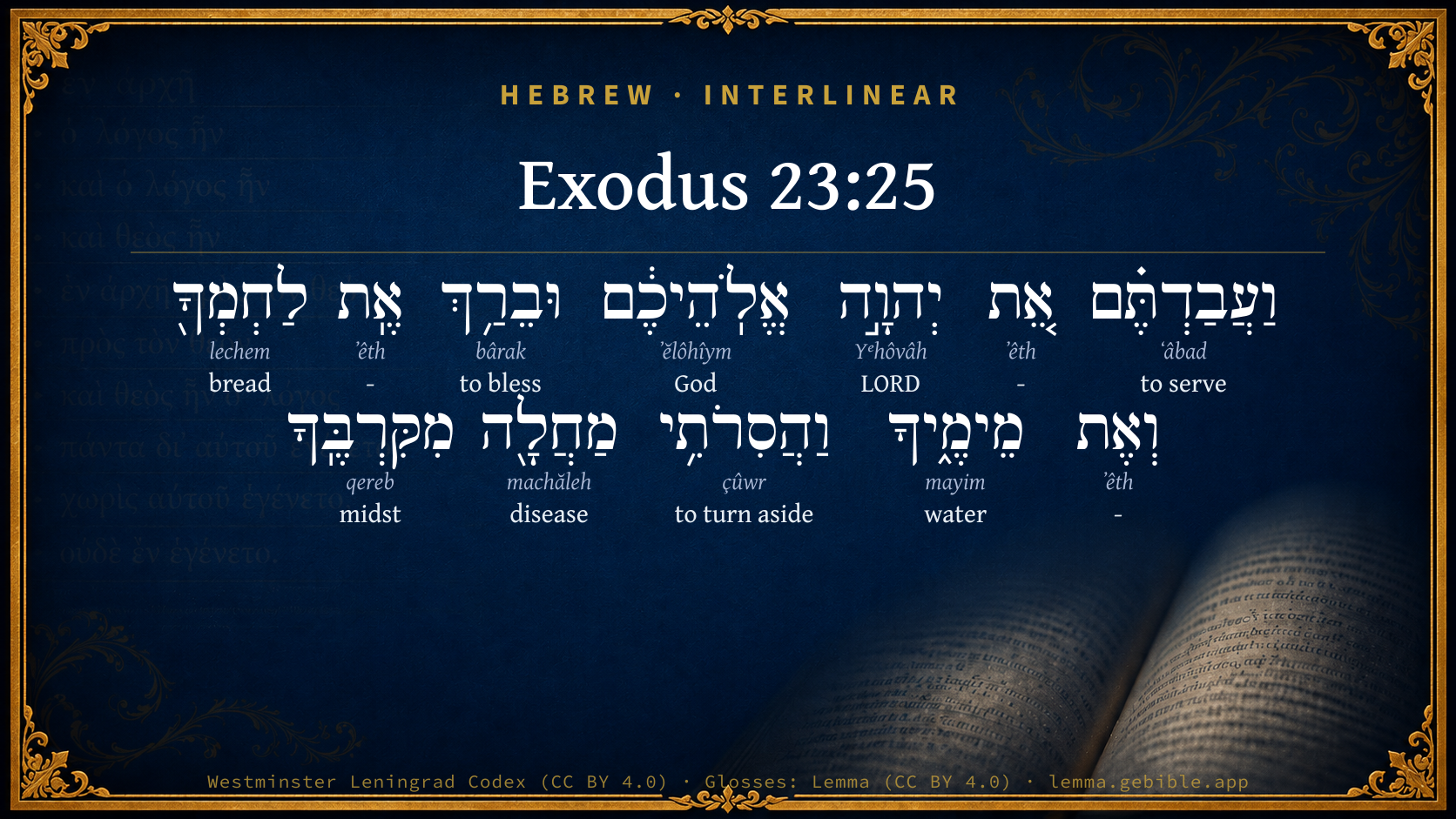
  1. וַעֲבַדְתֶּ֗ם ʻâbad H5647 “and · to serve” Conjunction + Verb, Qal, Sequential Perfect, 2nd Person, Masculine, Plural
  2. אֵ֚ת ʼêth H853 “-” Particle, Direct Object
  3. יְהוָ֣ה Yᵉhôvâh H3068 “LORD” Noun, Proper
  4. אֱלֹֽהֵיכֶ֔ם ʼĕlôhîym H430 “God(s) · your” Noun, Common, Masculine, Plural, Construct + Suffix, Personal, 2nd Person, Masculine, Plural
  5. וּבֵרַ֥ךְ bârak H1288 “and · to bless” Conjunction + Verb, Piel, Sequential Perfect, 3rd Person, Masculine, Singular
  6. אֶֽת ʼêth H853 “-” Particle, Direct Object
  7. לַחְמְךָ֖ lechem H3899 “bread · your” Noun, Common, Both, Singular, Construct + Suffix, Personal, 2nd Person, Masculine, Singular
  8. וְאֶת ʼêth H853 “and · -” Conjunction + Particle, Direct Object
  9. מֵימֶ֑יךָ mayim H4325 “water(s) · your” Noun, Common, Masculine, Plural, Construct + Suffix, Personal, 2nd Person, Masculine, Singular
  10. וַהֲסִרֹתִ֥י çûwr H5493 “and · to turn aside” Conjunction + Verb, Hiphil, Sequential Perfect, 1st Person, Common, Singular
  11. מִקִּרְבֶּֽךָ qereb H7130 “from · midst · your” Preposition + Noun, Common, Masculine, Singular, Construct + Suffix, Personal, 2nd Person, Masculine, Singular

About this verse

These counts appear in no published source. They are computed here, from the morphology-tagged text and Lemma’s own curated glosses. What Lemma adds →

12
words
10
distinct lemmas
Pentateuch
section

Notable vocabulary

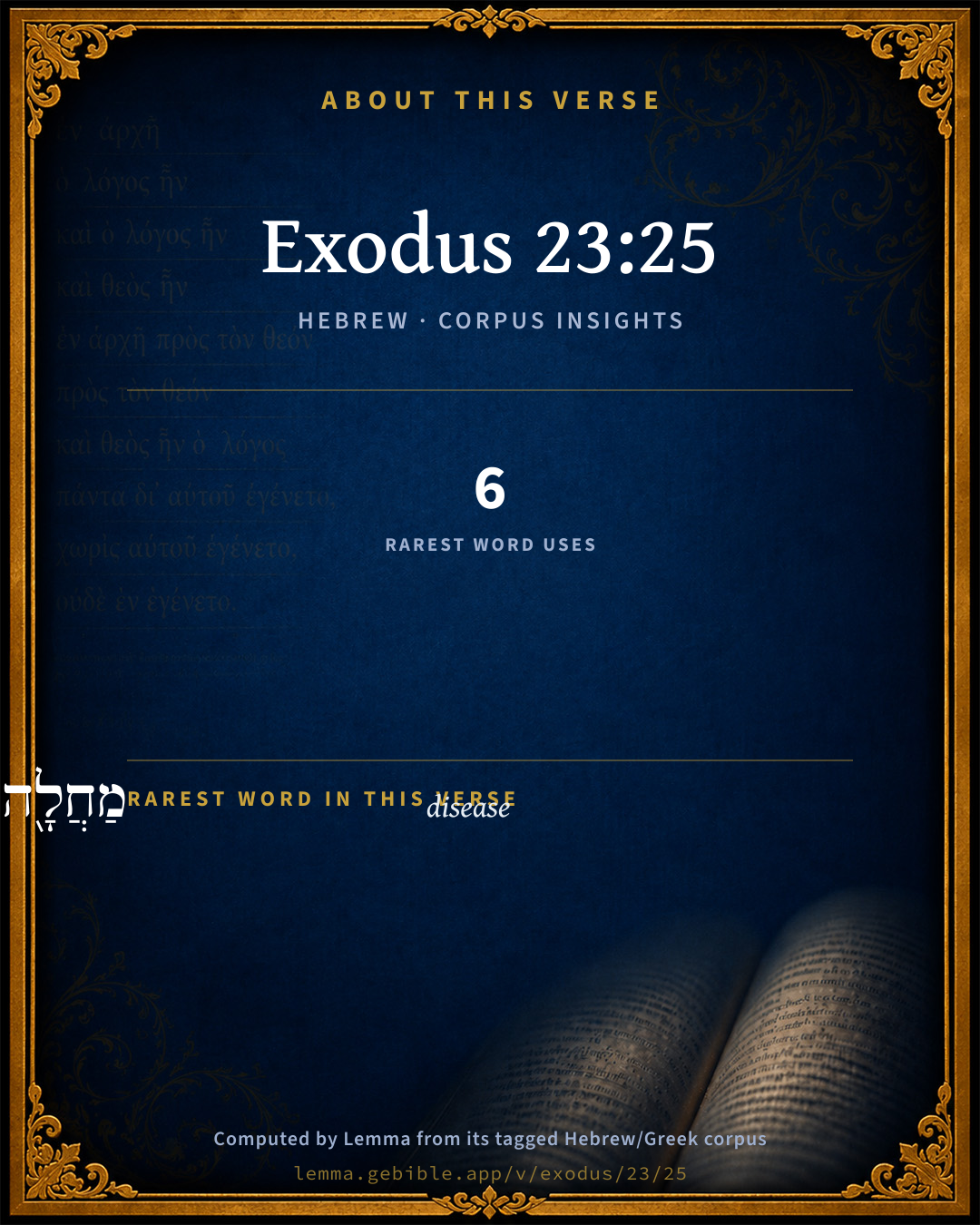
The rarest word here is מַחֲלָ֖ה disease H4245 — appearing just 6 times in the whole Hebrew Bible.

Shared distinctive vocabulary

מַחֲלָ֖ה disease H4245 occurs in 6 verses of the Hebrew Bible. Also found in:

Grammatical profile

  • 3 verbs
  • 6 nouns
  • 3 particles

Verb forms

  • וַעֲבַדְתֶּ֗ם Qal · Sequential Perfect
  • וּבֵרַ֥ךְ Piel · Sequential Perfect
  • וַהֲסִרֹתִ֥י Hiphil · Sequential Perfect

Hebrew & Septuagint length

In English translation the verse runs 24 words from the Hebrew and 28 from the Septuagint (LXX English) — closely comparable.

A rough comparison of the two English renderings, which tokenize alike — not a word-level alignment.

Word counts can differ between the Hebrew and the Greek without any difference in meaning — e.g. the Hebrew direct-object marker אֵת has no separate Greek word, and Greek often adds the article ὁ.

Cross-references

22

Topical passages linked to Exodus 23:25 in the Treasury of Scripture Knowledge — connected by theme and wording, ordered by reader-vote popularity; previews shown in the World English Bible.

  • Deuteronomy 7:15 Yahweh will take away from you all sickness; and none of the evil diseases of Egypt, which you know, will he put on you, but will lay them on all those who hate you.
  • Exodus 15:26 and he said, "If you will diligently listen to the voice of Yahweh your God, and will do that which is right in his eyes, and will pay attention to his commandments, and keep all his statutes, I will put none of the diseases on you, which I have put on the Egyptians; for I am Yahweh who heals you."
  • Joshua 22:5 Only take diligent heed to do the commandment and the law which Moses the servant of Yahweh commanded you, to love Yahweh your God, and to walk in all his ways, and to keep his commandments, and to cleave to him, and to serve him with all your heart and with all your soul.
  • Isaiah 33:24 The inhabitant shall not say, I am sick: the people who dwell therein shall be forgiven their iniquity.
  • Psalms 103:3 Who forgives all your sins; Who heals all your diseases;
  • Deuteronomy 7:13 and he will love you, and bless you, and multiply you; he will also bless the fruit of your body and the fruit of your ground, your grain and your new wine and your oil, the increase of your cattle and the young of your flock, in the land which he swore to your fathers to give you.
  • Deuteronomy 10:12 Now, Israel, what does Yahweh your God require of you, but to fear Yahweh your God, to walk in all his ways, and to love him, and to serve Yahweh your God with all your heart and with all your soul,
  • Deuteronomy 6:13 You shall fear Yahweh your God; and him shall you serve, and shall swear by his name.
  • 1 Samuel 12:20 Samuel said to the people, "Don't be afraid; you have indeed done all this evil; yet don't turn aside from following Yahweh, but serve Yahweh with all your heart:
  • Matthew 4:10 Then Jesus said to him, "Get behind me, Satan! For it is written, 'You shall worship the Lord your God, and him only shall you serve.'"
  • Deuteronomy 10:20 You shall fear Yahweh your God; him shall you serve; and to him shall you cleave, and by his name shall you swear.
  • Deuteronomy 11:13–14 It shall happen, if you shall listen diligently to my commandments which I command you this day, to love Yahweh your God, and to serve him with all your heart and with all your soul,
  • Deuteronomy 13:4 You shall walk after Yahweh your God, and fear him, and keep his commandments, and obey his voice, and you shall serve him, and cleave to him.
  • Joshua 24:21 The people said to Joshua, No; but we will serve Yahweh.
  • 1 Samuel 7:3 Samuel spoke to all the house of Israel, saying, If you do return to Yahweh with all your heart, then put away the foreign gods and the Ashtaroth from among you, and direct your hearts to Yahweh, and serve him only; and he will deliver you out of the hand of the Philistines.
  • Joshua 24:24 The people said to Joshua, Yahweh our God will we serve, and to his voice will we listen.
  • Joshua 24:14–15 Now therefore fear Yahweh, and serve him in sincerity and in truth; and put away the gods which your fathers served beyond the River, and in Egypt; and serve you Yahweh.
  • Malachi 3:10 Bring the whole tithe into the store-house, that there may be food in my house, and test me now in this," says Yahweh of hosts, "if I will not open you the windows of heaven, and pour you out a blessing, that there shall not be room enough for.
  • Deuteronomy 28:1–14 It shall happen, if you shall listen diligently to the voice of Yahweh your God, to observe to do all his commandments which I command you this day, who Yahweh your God will set you on high above all the nations of the earth:
  • Isaiah 33:16 He shall dwell on high; his place of defense shall be the munitions of rocks; his bread shall be given [him]; his waters shall be sure.
  • 1 Samuel 12:24 Only fear Yahweh, and serve him in truth with all your heart; for consider how great things he has done for you.
  • Jeremiah 8:2 and they shall spread them before the sun, and the moon, and all the host of the sky, which they have loved, and which they have served, and after which they have walked, and which they have sought, and which they have worshiped: they shall not be gathered, nor be buried, they shall be for dung on the surface of the earth.

Cross-references courtesy of OpenBible.info (CC BY 4.0).

Hebrew and Greek witnesses Masoretic Hebrew ↔ Greek Septuagint

The same verse in the two great witnesses to the Old Testament, shown verse-for-verse.

These are two independent witnesses, not word-aligned to each other, and the Septuagint is shown in lemma (dictionary) form.

Hebrew Exodus 23:25 Masoretic · Westminster Leningrad Codex

וַעֲבַדְתֶּ֗ם אֵ֚ת יְהוָ֣ה אֱלֹֽהֵיכֶ֔ם וּבֵרַ֥ךְ אֶֽת לַחְמְךָ֖ וְאֶת מֵימֶ֑יךָ וַהֲסִרֹתִ֥י מַחֲלָ֖ה מִקִּרְבֶּֽךָ

You shall serve Yahweh your God, and he will bless your bread and your water, and I will take sickness away from your midst.

World English Bible · Public Domain

Greek LXX Exodus 23:25 Septuagint · lemma form

καί λατρεύω κύριος ὁ θεός σύ καί εὐλογέω ὁ ἄρτος σύ καί ὁ οἶνος σύ καί ὁ ὕδωρ σύ καί ἀποστρέφω μαλακία ἀπό σύ

And you shall serve the Lord your God, and I will bless your bread and your wine and your water, and I will turn away sickness from you.

LXX2012 (modern English Septuagint) · Public Domain

On this verse, The Cambridge Bible for Schools and Colleges discusses the Septuagint’s reading. Read the note in Commentary ↓

Hebrew: Westminster Leningrad Codex (CC BY 4.0). Greek: Septuagint (public domain); English from LXX2012 (modern English Septuagint) (Public Domain). How the Septuagint differs from the Hebrew →

Targum (Aramaic paraphrase)

2

The Targum is the ancient Jewish Aramaic paraphrase of the Hebrew Scriptures — an interpretive translation, not the Hebrew text itself. Onkelos (literal) and Pseudo-Jonathan (expansive) render the Torah, and Jonathan the Prophets. Coverage is partial: where no permissively-licensed English translation exists for a verse, only the Aramaic is shown. This is verse-level text, not a word-by-word alignment to the Hebrew.

  1. Targum Onkelos Torah (Genesis–Deuteronomy)
    וְתִפְלְחוּן קֳדָם יְיָ אֱלָהֲכוֹן וִיבָרֵךְ יָת מֵיכְלָךְ וְיָת מִשְׁתְּיָךְ וְאַעְדִי מַרְעִין בִּישִׁין מִבֵּינָךְ:

    (no public-domain English translation for this verse)

    Targum Onkelos — Aramaic: “Onkelos Genesis” (public domain); “Onkelos Exodus” (public domain); “Onkelos Leviticus” (public domain); “Onkelos Numbers” (public domain); “Onkelos Deuteronomy” (public domain). English: “Sefaria Community Translation” (CC0 1.0 (public-domain dedication)); “J.W. Etheridge. The Targums of Onkelos and Jonathan Ben Uzziel on the Pentateuch. London: Longmans, Green, 1862” (public domain). Text via Sefaria.

  2. Targum Pseudo-Jonathan Torah (Genesis–Deuteronomy)
    וְתִפְלְחוּן קֳדָם יְיָ אֱלָהָכוֹן וִיבָרֵךְ יַת מְזוֹנֵי מֵיכְלָךְ וּמִשְׁתַּיָּיךְ וְאַעֲדֵי מְחַת מָרִירְתָּא מִגַּוָּוךְ

    And you shall do service before the Lord our God and He will bless the provision of thy food and thy drinks, and remove the bitter plague from among thee.

    Targum Pseudo-Jonathan — Aramaic: “Targum Jonathan on Genesis” (public domain); “Targum Jonathan on Exodus” (public domain); “Targum Jonathan on Leviticus” (public domain); “Targum Jonathan on Numbers” (public domain); “Targum Jonathan on Deuteronomy” (public domain). English: “The Targum of Jonathan ben Uzziel, trans. J. W. Etheridge, London, 1862” (public domain). Text via Sefaria.

Commentary

Notes on Exodus 23:25 from classic Christian and Jewish commentators (each source and its license shown beneath its notes). The classic Christian expositions comment on the surrounding passage and are grouped to its opening verse, so a note may address several verses; the Jewish commentaries on the Tanakh (Rashi and others) are per-verse, so they appear only where the commentator wrote on this verse.

Lemma curates 59 commentaries, every one of them public domain or Creative Commons licensed, each selected and text-cleaned for this edition rather than reprinted as found. About our sources →

Trapp's Complete Commentary

John Trapp

Exo 23:25 And ye shall serve the LORD your God, and he shall bless thy bread, and thy water; and I will take sickness away from the midst of thee.

Ver. 25. Bless thy bread.] God’s blessing is the staff of bread, and strength of water. {See Trapp on "Mat 4:4"}

John Trapp, A Commentary or Exposition upon All the Books of the Old and New Testament (1647–1656) — public domain. Text from a community e-Sword module.

Joseph Benson's Commentary

Exo 23:25-26. He shall bless thy bread and thy water — And God’s blessing will make bread and water more refreshing and nourishing than a feast of fat things, and wines on the lees, without that blessing. And I will take sickness away — Either prevent it or remove it. Thy land shall not be visited with epidemical diseases, which are very dreadful, and sometimes have laid countries waste. The number of thy days I will fulfil — And they shall not be cut off in the midst by untimely deaths. Thus hath godliness the promise of the life that now is.

Joseph Benson's Commentary on the Old and New Testaments (1811–1818) — public domain. Text from a community e-Sword module.

Geneva Bible (1599)

Geneva Bible translators

That is, all things necessary for this present life.

Geneva Bible (1599) marginal notes — public domain. Text via Bolls.life.

Adam Clarke's Commentary

Verse 25. Shall bless thy bread and thy water] That is, all thy provisions, no matter of what sort; the meanest fare shall be sufficiently nutritive when God's blessing is in it.

Adam Clarke's Commentary on the Bible (1810–1826) — public domain. Text from a community e-Sword/MySword module.

Ellicott's Commentary for English Readers

(25) He shall bless thy bread, and thy water—i.e., all the food, whether meat or drink, on which they subsisted. It is God’s blessing which makes food healthful to us.

Take sickness away.—Half the sicknesses from which men suffer are directly caused by sin, and would disappear if men led godly, righteous, and sober lives. Others, as plague and pestilence, are scourges sent by God to punish those who have offended Him. If Israel had walked in God’s ways, He would have preserved them from sicknesses of all kinds by a miraculous interposition. (Comp. Deu_7:15.)

A Bible Commentary for English Readers, edited by Charles John Ellicott (1878–1897) — public domain. Text from a community e-Sword module.

The Cambridge Bible for Schools and Colleges

gen. ed. J. J. S. Perowne

25a. The positive complement of v. 24: Jehovah is to be the object of Israel’s worship.

25b, 26. The blessings which will follow upon Israel’s obedience: abundance of food, freedom from sickness, fertility of flocks and herds, and long life.

25b. and he shall bless] read with LXX., Vulg., Di., &c., and I will bless (cf. the following, ‘and I will take’); originally (if vv. 23–25a be a later insertion) the continuation of v. 22 end.

take sickness away, &c.] Cf. Exo_15:26; and the reminiscence of the present passage in Deu_7:15 (as of v. 26a in Deu_7:14 b).

26a. Cf. Deu_7:14 b; also (expressed positively) the blessings promised in Deu_28:11; Deu_30:9, and Lev_26:9 (H).

26b. I will fulfil] Life will not come to an end prematurely, either for the individual, or for the nation (cf. Exo_20:12).

The Cambridge Bible for Schools and Colleges (gen. ed. J. J. S. Perowne; Cambridge University Press, 1878–1918) — public domain. Text from a community e-Sword module.

John Gill's Exposition

And I will send my fear before thee,.... What should cause fear among the nations of the land of Canaan; either the hornets mentioned in the next verse as the explanative of this; or the fame of his mighty works, which he had done for Israel in Egypt, at the Red sea, and in the wilderness; which struck the inhabitants of Canaan with such a panic, that they were ready to faint and melt away, and lost all courage, Jos 2:9.

and will destroy all the people to whom thou shalt come; that is, the greatest part of them:

and I will make all thine enemies turn their backs unto thee; flee away, not being able to face them and stand a battle, or, however, not stand it long, but run and make their escape: "or I will give thee the neck of them" (p); cause them to submit, to lay down their necks and be trampled upon; an expression denoting their subjection, and an entire conquest of them, see Psa 18:39.

(p) "et dabo-cervicem", Pagninus, Montanus; "exponam tibi cervicem", Junius & Tremellius, Piscator; "ponam ad te cervicem", Drusius.

John Gill's Exposition of the Whole Bible (1746–1763) — public domain (CC PDM 1.0). Text via the HelloAO Bible API.

Haydock's Catholic Bible Commentary

Waters, or all things necessary for your sustenance.

George Leo Haydock (1774–1849), Haydock's Catholic Family Bible and Commentary, 1859 edition — public domain. Excludes Psalms (Douay-Rheims chapter numbering differs from Protestant) and Deuterocanonical books (Catholic canon only).

Matthew Poole's English Annotations

Thy bread and thy water, i.e. thy meat and thy drink, that they shall be able to nourish thee, and give thee comfort, which without my blessing they will never be able to do.

Matthew Poole's English Annotations on the Holy Bible (1683–1685) — public domain. Text from a community e-Sword/MySword module.

Whedon's Commentary on the Bible

Daniel D. Whedon

25. Take sickness away — This promise to give health and blessing is in accord with Exo_15:26, where Jehovah calls himself Israel’s healer. Great temporal abundance and a long life passed in divine favour are held up as ideals of excellence.

Daniel D. Whedon (gen. ed.), Commentary on the Old and New Testaments (1874–1909) — public domain. Text from a community e-Sword module.

The Pulpit Commentary

He shall bless thy bread and thy water. If the Israelites were exact in their obedience, and destroyed the idols, and served God only, then he promised to bless "their bread and their water the food, i.e. , whether meat or drink, on which they subsisted, and to give them vigorous health, free from sickness of any kind, which he pledged himself to take away from the midst of them. Though Christians have no such special pledge, there is, no doubt, that virtuous and godly living would greatly conduce to health, and take away half the sicknesses from which men suffer, even at the present day.

The Pulpit Commentary (1880–1919), ed. H.D.M. Spence-Jones & Joseph S. Exell — public domain. Text from a community e-Sword module.

John Wesley's Explanatory Notes

He shall bless thy bread and thy water - And God's blessing will make bread and water more refreshing and nourishing, than a feast of fat things, and wines on the lees, without that blessing. And I will take sickness away - Either prevent it or remove it. Thy land shall not be visited with epidemical diseases, which are very dreadful, and sometimes have laid countries waste.

John Wesley, Explanatory Notes Upon the Whole Bible (1754–1765) — public domain. Text via the GEBible commentary corpus.

Ramban (Nachmanides)

Rabbi Moshe ben Nachman (Ramban / Nachmanides)

AND YE SHALL SERVE THE ETERNAL YOUR G-D, AND HE WILL BLESS THY BREAD, AND THY WATER. The intention of this verse is as follows. Most idolators acknowledge and know that the revered G-d is G-d of gods, and Lord of lords, and they do not intend to worship the idols themselves, but they think that because of these acts of worship they will have success in their endeavors. Thus when they worship the sun it is because they have found it to have a beneficial power over their crops, and they find the moon to have influence over fountains and all deep waters, and similarly [they attribute powers] to all the hosts of heaven. They are even more inclined to think that they will be greatly benefitted by worshipping the angels, since they are invested with dignity through ministering before the Great G-d. Therefore this verse states that only through the worship of the Holy One, blessed be He, can you have success and protection, and the uprooting of idolatry will not cause damage; on the contrary, it will add goodness and blessing to you, for the Holy One, blessed be He, will bless your “bread,” this being a term which includes all manner of food, and will bless your “water,” which is a generic term for all liquids that people drink. The blessing referred to means increase, so that you will have an exceeding abundance of them.

AND I WILL TAKE SICKNESS AWAY FROM THE MIDST OF THEE. That is to say, through them [the bread and water that I will bless], I will free you from disease, for when your food and drink are good and healthy, they do not cause sicknesses but, on the contrary, heal you. And He states furthermore that there will not be amongst you a woman that miscarries, a miscarrying womb nor one barren of the womb and with dry breasts, for when food and drink and the air are blessed, human bodies become healthy and the organs of reproduction are able to function properly. The verse singles out women because they are liable to miscarriage, and sterility too is more common amongst them than amongst men. It is possible that [male sterility] is included in the expression, and I will take sickness away from the midst of thee, for barrenness is a sickness in bodies. He addresses Himself without specifications to men, and afterwards He mentioned the women, as He said, there shall not be male or female barren among you. The meaning of the expression in thy land, [None shall miscarry, nor be barren, in thy land], is to include also the animals, just as He said there, or amongst your cattle. The number of thy days I will fulfill means that one will not die prematurely in battle, nor through an epidemic caused by a change in the atmosphere, but only at a ripe age, whatever happens to be the normal span of life during that particular generation, such as seventy or eighty years as in the generation of King David. I have already mentioned, and on Genesis 17:1 (Vol. I, p. 215). that these are all miracles, G-d showing wonders in the heavens and in the earth for the sake of those who do His will. And then He said that just as He will do on their behalf a sign for good, so will He do to their enemies for bad; He will give them a trembling heart, (Verse 27). and in the chambers terror., 32:25. — Ramban derives this from the expression here: And I will cause discomfort to all the people to whom thou shalt come. Moreover, He will send the tzir’ah amongst them, this being a certain kind of hornet of the family of the bee. The Sages mention it continually: “Bees’ honey, hornets’ honey.” The meaning of the verse is that He will send this plague through the atmosphere of their land, like the locust that He had sent in Egypt: the canker-worm, and the caterpillar, and the palmer-worm, His great army which came in the days of Joel. The meaning of the expression, and she [the hornet] will drive out the Hivite etc., is that this will be the cause of their being driven out of the land, for since the hornets will cover the face of the earth and darken it, they will not be able to go into battle. Moreover, it will eat up all their produce in the field, similar to that which is said in the imprecations, Thou shalt carry much seed out into the field, and shalt gather little in; for the locust shall consume it, etc.; All thy trees and the fruit of thy land shall the locust possess., Verse 42. Similarly He said here that He will do such things to our enemies.Scripture mentioned here the Hivite, the Canaanite, and the Hittite, [and not the other four nations as well], because it adopted here a shortened form, and the intention is to all those mentioned above. The correct interpretation appears to me to be that the majority of these three nations [mentioned here] did not go out to battle and thus avoided being killed by the sword, because they remained strongly enclosed in their fortified places. It is against them that He sent only this form of death [through the hornet], in a similar manner to that which is said of Egypt, And thy houses shall be filled, and the houses of all thy servants, and the houses of all the Egyptians. It is this which He said in the Book of Deuteronomy: Moreover the Eternal thy G-d will send the hornet amongst them, until they that are left, and they that hide themselves, perish from before thee, and it is this hornet that crossed the Jordon with Joshua. cross the Jordan but merely “placed themselves on the east bank of the Jordan and from there injected the poison against them” applies to the hornet of the days of Moses. The one in the days of Joshua did cross the Jordan. This distinction is made in Sotah 36a. So did the Rabbis conclude in Tractate Sotah, cross the Jordan but merely “placed themselves on the east bank of the Jordan and from there injected the poison against them” applies to the hornet of the days of Moses. The one in the days of Joshua did cross the Jordan. This distinction is made in Sotah 36a. saying that the hornet injected a poison into them which caused their death, and indeed there is nowadays also in the hornet a poisonous substance which harms or even kills the victim. And it is written in the Book of Joshua: And ye went over the Jordan, and came unto Jericho; and the men of Jericho fought against you, the Amorite, and the Perizzite, and the Canaanite, and the Hittite, and the Girgashite, the Hivite and the Jebusite; and I delivered them into your hand, and it is further written there, And I sent the hornet before you, which drove them out from before you, even the two kings of the Amorites; not with thy sword, nor with thy bow., Verse 12. The phrase which drove them out, Verse 12. refers to those that are left amongst them, for after I delivered into your hand all the nations mentioned, I sent the hornet to drive out those that are left and they that hide themselves. He mentioned the two kings of the Amorites, Verse 12. meaning Sichon and Og whom He had referred to earlier. All this you have done not with thy sword, nor with thy bow., Verse 12.Rabbi Abraham ibn Ezra wrote that the tzir’ah refers to a disease in the body, the word being of the root tzara’ath (leprosy). But there is no need for this interpretation.And ye shall serve the Eternal your G-d means that service [by offering or prayer] is to be devoted to the Proper Name [i.e., the Tetragrammaton]. The verse stating and He will bless… and I will take, [thus changing from the third-person pronoun to the first-person pronoun], is similar to the verse and thou wilt keep all His statutes… for I am the Eternal that healeth thee. I have already explained it, and the person learned [in the mystic lore of the Cabala] will understand the verse here from what I have written there.

Ramban (Nachmanides) on the Tanakh — English translation: “Commentary on the Torah by Ramban (Nachmanides). Translated and annotated by Charles B. Chavel. New York, Shilo Pub. House, 1971-1976” (CC BY 4.0). Text via Sefaria.

Lesson kit

Teaching starters — assembled from the data on this page, not authored interpretation. Every prompt links to the verse data it draws on. Edit before teaching.

Exodus, in the Pentateuch, opens this verse with 12 words (10 distinct Hebrew lemmas). Its most distinctive word is machăleh (“disease”). A historical commentator’s framing appears above. Read the whole chapter for the surrounding context.

Discussion questions

  1. What does “disease” (machăleh) contribute to the verse as a whole?
  2. Exodus 15:26 shares the word «disease» with this verse. How do the two illuminate each other?
  3. These translations render this verse differently. What is at stake in choosing one wording over another?
  4. The verb «וַעֲבַדְתֶּ֗ם» is Qal Sequential Perfect. How does its form color the action?
  5. Reading how Trapp's Complete Commentary and Joseph Benson's Commentary read this verse, where do the two commentators agree and where do they part?

Things to notice

Reading settings

Reading text

Shown beneath each verse's original-language words.

Old Testament
Old Testament edition

Read the OT as the Masoretic Hebrew (MT) or the Greek Septuagint (LXX).

English shown for the Greek Septuagint (in the Hebrew ↔ Greek comparison).

Comparing translations? Open the Compare panel on any verse page to stack up to four side by side.