
Exodus 20:11

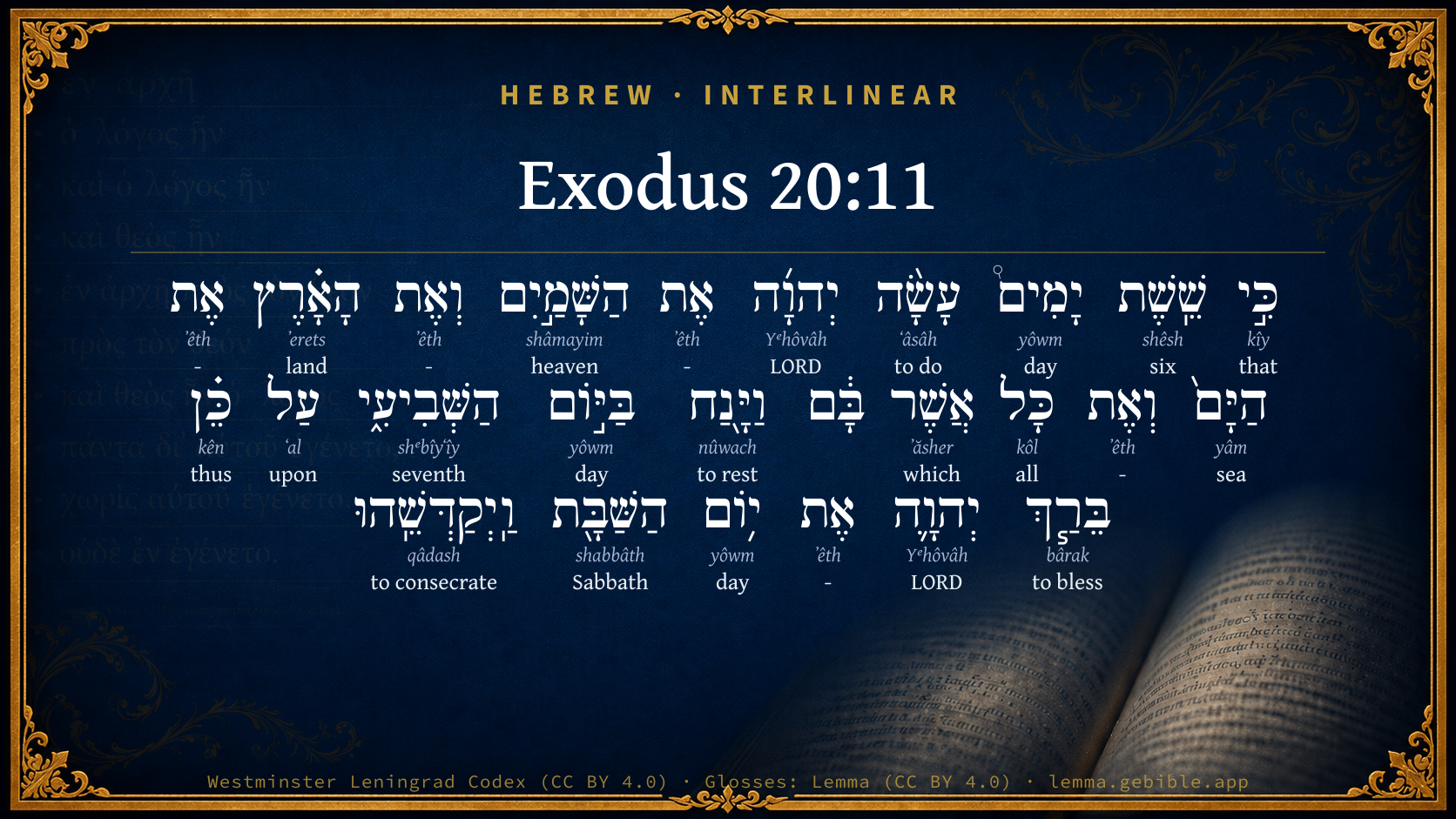
Hebrew (Westminster Leningrad Codex) Exodus 20:11 appears in the Hebrew Old Testament. The text above is from the Westminster Leningrad Codex. Each word links to its Strong’s number, a concise gloss, and parsing drawn from the Open Scriptures Hebrew Bible morphology. Click any word for its full Brown-Driver-Briggs (BDB) entry.
Download image
Cite this verse

Exodus 20:11 (World English Bible). Public Domain. Lemma interlinear Bible study tool, https://lemma.gebible.app/v/exodus/20/11.

Show BibTeX & RIS
BibTeX
RIS
English Translation
for in six days Yahweh made heaven and earth, the sea, and all that is in them, and rested the seventh day; therefore Yahweh blessed the Sabbath day, and made it holy.
World English Bible · Public Domain
Download a study sheet

One document with this verse’s original text, its word-by-word gloss line, the meaning frame, cross-references with their text, attributed commentary, and full source and license credits — printable, and it pastes into notes with its structure intact.

This verse Autodidact and up

Study sheet (.html) Plain text (.txt)

A passage Seminary Student

Up to 50 verses in one chapter. A passage sheet keeps up to 6 commentary sources and 12 cross-references per verse, in the order this page ranks them, and says so on the sheet whenever that leaves anything out. Ask for a single verse and you get the Autodidact verse sheet above.

Everything on this page stays free to read, with no account — the sheet is a download of what is already on screen, not access to it.

Want to remove ads? Support Godless Engineer
Compare translations 3

The same verse in 3 English versions, stacked beneath the original-language interlinear above. Click any original word for its lexicon entry.

Each is an independent rendering of the whole verse — the interlinear is not word-aligned to these translations.

Highlighted words mark where these versions differ — a whole-verse word diff, not a word-by-word alignment.

  • World English Bible Public Domain
    for in six days Yahweh made heaven and earth, the sea, and all that is in them, and rested the seventh day; therefore Yahweh blessed the Sabbath day, and made it holy.
  • King James Version Public Domain
    For in six days the LORD made heaven and earth, the sea, and all that in them is, and rested the seventh day: wherefore the LORD blessed the sabbath day, and hallowed it.
  • unfoldingWord Literal Text CC BY-SA 4.0
    For in six days Yahweh made the heavens and earth, the sea, and everything that is in them, and rested on the seventh day. Therefore Yahweh blessed the Sabbath day and set it apart.

unfoldingWord Literal Text — © unfoldingWord, licensed CC BY-SA 4.0. Word-aligned USFM3 via Door43 (git.door43.org/unfoldingWord/en_ult).

Versions to compare (up to 4)

3 of 4 selected

Show all 18 translations

Every available English version of this verse, each an independent rendering of the whole verse.

  • World English Bible Public Domain
    for in six days Yahweh made heaven and earth, the sea, and all that is in them, and rested the seventh day; therefore Yahweh blessed the Sabbath day, and made it holy.
  • Berean Standard Bible Public Domain
    For in six days the LORD made the heavens and the earth and the sea and all that is in them, but on the seventh day He rested. Therefore the LORD blessed the Sabbath day and set it apart as holy.
  • Majority Standard Bible Public Domain
    For in six days the LORD made the heavens and the earth and the sea and all that is in them, but on the seventh day He rested. Therefore the LORD blessed the Sabbath day and set it apart as holy.
  • King James Version Public Domain
    For in six days the LORD made heaven and earth, the sea, and all that in them is, and rested the seventh day: wherefore the LORD blessed the sabbath day, and hallowed it.
  • American Standard Version (1901) Public Domain
    for in six days Jehovah made heaven and earth, the sea, and all that in them is, and rested the seventh day: wherefore Jehovah blessed the sabbath day, and hallowed it.
  • Revised Version (1885) Public Domain
    for in six days the LORD made heaven and earth, the sea, and all that in them is, and rested the seventh day: wherefore the LORD blessed the sabbath day, and hallowed it.
  • Geneva Bible (1599) Public Domain
    For in sixe dayes the Lord made the heauen and the earth, the sea, and all that in them is, and rested the seuenth day: therefore the Lord blessed the Sabbath day, and hallowed it.
  • Douay-Rheims (1899) Public Domain
    For in six days the Lord made heaven and earth, and the sea, and all things that are in them, and rested on the seventh day: therefore the Lord blessed the seventh day, and sanctified it.
  • Young's Literal Translation Public Domain
    for six days hath Jehovah made the heavens and the earth, the sea, and all that `is' in them, and resteth in the seventh day; therefore hath Jehovah blessed the Sabbath-day, and doth sanctify it.
  • Literal Standard Version CC BY-SA 4.0
    for [in] six days YHWH has made the heavens and the earth, the sea, and all that [is] in them, and rests in the seventh day; therefore YHWH has blessed the Sabbath day and sanctifies it.
  • Unlocked Literal Bible CC BY-SA 4.0
    For in six days Yahweh made the heavens and earth, the sea, and everything that is in them, and rested on the seventh day. Therefore Yahweh blessed the Sabbath day and set it apart.
  • unfoldingWord Literal Text CC BY-SA 4.0
    For in six days Yahweh made the heavens and earth, the sea, and everything that is in them, and rested on the seventh day. Therefore Yahweh blessed the Sabbath day and set it apart.
  • Darby Bible Public Domain
    For in six days Jehovah made the heavens and the earth, the sea, and all that is in them, and rested on the seventh day; therefore Jehovah blessed the sabbath day, and hallowed it.
  • World Messianic Bible Public Domain
    for in six days the LORD made heaven and earth, the sea, and all that is in them, and rested the seventh day; therefore the LORD blessed the Sabbath day, and made it holy.
  • Webster's Bible Public Domain
    For in six days the LORD made heaven and earth, the sea, and all that is in them, and rested the seventh day: wherefore the LORD blessed the sabbath-day, and hallowed it.
  • Free Bible Version CC BY-SA 4.0
    For the Lord made the heavens and the earth, the sea, and everything in them in six days, and then rested on the seventh day. That's why the Lord blessed the Sabbath day and made it holy.
  • Bible in Basic English Public Domain
    For in six days the Lord made heaven and earth, and the sea, and everything in them, and he took his rest on the seventh day: for this reason the Lord has given his blessing to the seventh day and made it holy.
  • JPS Tanakh (1917) Public Domain
    for in six days the LORD made heaven and earth, the sea, and all that in them is, and rested on the seventh day; wherefore the LORD blessed the sabbath day, and hallowed it.

Literal Standard Version (2020), Covenant Press — licensed CC BY-SA 4.0. Text via the HelloAO Bible API (eBible.org). Unlocked Literal Bible (unfoldingWord) — licensed CC BY-SA 4.0. Text via the HelloAO Bible API (eBible.org). unfoldingWord Literal Text — © unfoldingWord, licensed CC BY-SA 4.0. Word-aligned USFM3 via Door43 (git.door43.org/unfoldingWord/en_ult). Free Bible Version, Dr. Jonathan Gallagher — licensed CC BY-SA 4.0. Text via the HelloAO Bible API (eBible.org).

Word by word

More ways to search: Search by grammar → Find every occurrence → Compare this word →

Practice this passage: Drill this verse → Learn its vocabulary →

וַיָּ֖נַח
nûwach
H5117
“and · to rest”
Conjunction + Verb, Qal, Sequential Imperfect, 3rd Person, Masculine, Singular
Part of Speech
Conjunction + Verb
Stem
Qal
Form
Sequential Imperfect
Person
3rd Person
Gender
Masculine
Number
Singular
Full BDB Definition

Origin: a primitive root

TWOT: 1323

to rest - (Qal) - to rest, settle down and remain - to repose, have rest, be quiet - (Hiphil) - to cause to rest, give rest to, make quiet - to cause to rest, cause to alight, set down - to lay or set down, deposit, let lie, place - to let remain, leave - to leave, depart from - to abandon - to permit - (Hophal) - to obtain rest, be granted rest - to be left, be placed - open space (substantive)
  1. כִּ֣י kîy H3588 “that” Conjunction
  2. שֵֽׁשֶׁת shêsh H8337 “six” Adjective, Cardinal number, Masculine, Singular, Construct
  3. יָמִים֩ yôwm H3117 “days” Noun, Common, Masculine, Plural, Absolute
  4. עָשָׂ֨ה ʻâsâh H6213 “to do” Verb, Qal, Perfect, 3rd Person, Masculine, Singular
  5. יְהוָ֜ה Yᵉhôvâh H3068 “LORD” Noun, Proper
  6. אֶת ʼêth H853 “-” Particle, Direct Object
  7. הַשָּׁמַ֣יִם shâmayim H8064 “the · heaven(s)” Particle, Definite Article + Noun, Common, Masculine, Plural, Absolute
  8. וְאֶת ʼêth H853 “and · -” Conjunction + Particle, Direct Object
  9. הָאָ֗רֶץ ʼerets H776 “the · land” Particle, Definite Article + Noun, Common, Both, Singular, Absolute
  10. אֶת ʼêth H853 “-” Particle, Direct Object
  11. הַיָּם֙ yâm H3220 “the · sea” Particle, Definite Article + Noun, Common, Masculine, Singular, Absolute
  12. וְאֶת ʼêth H853 “and · -” Conjunction + Particle, Direct Object
  13. כָּל kôl H3605 “all of” Noun, Common, Masculine, Singular, Construct
  14. אֲשֶׁר ʼăsher H834 “which” Particle, Relative
  15. בַּיּ֣וֹם yôwm H3117 “in/at the · day” Preposition, Determined + Noun, Common, Masculine, Singular, Absolute
  16. הַשְּׁבִיעִ֑י shᵉbîyʻîy H7637 “the · seventh” Particle, Definite Article + Adjective, Ordinal number, Masculine, Singular, Absolute
  17. עַל ʻal H5921 “upon” Preposition
  18. כֵּ֗ן kên H3651 “thus” Particle, Demonstrative
  19. בֵּרַ֧ךְ bârak H1288 “to bless” Verb, Piel, Perfect, 3rd Person, Masculine, Singular
  20. יְהוָ֛ה Yᵉhôvâh H3068 “LORD” Noun, Proper
  21. אֶת ʼêth H853 “-” Particle, Direct Object
  22. י֥וֹם yôwm H3117 “day of” Noun, Common, Masculine, Singular, Construct
  23. הַשַּׁבָּ֖ת shabbâth H7676 “the · Sabbath” Particle, Definite Article + Noun, Common, Both, Singular, Absolute
  24. וַֽיְקַדְּשֵֽׁהוּ qâdash H6942 “and · to consecrate · him” Conjunction + Verb, Piel, Sequential Imperfect, 3rd Person, Masculine, Singular + Suffix, Personal, 3rd Person, Masculine, Singular

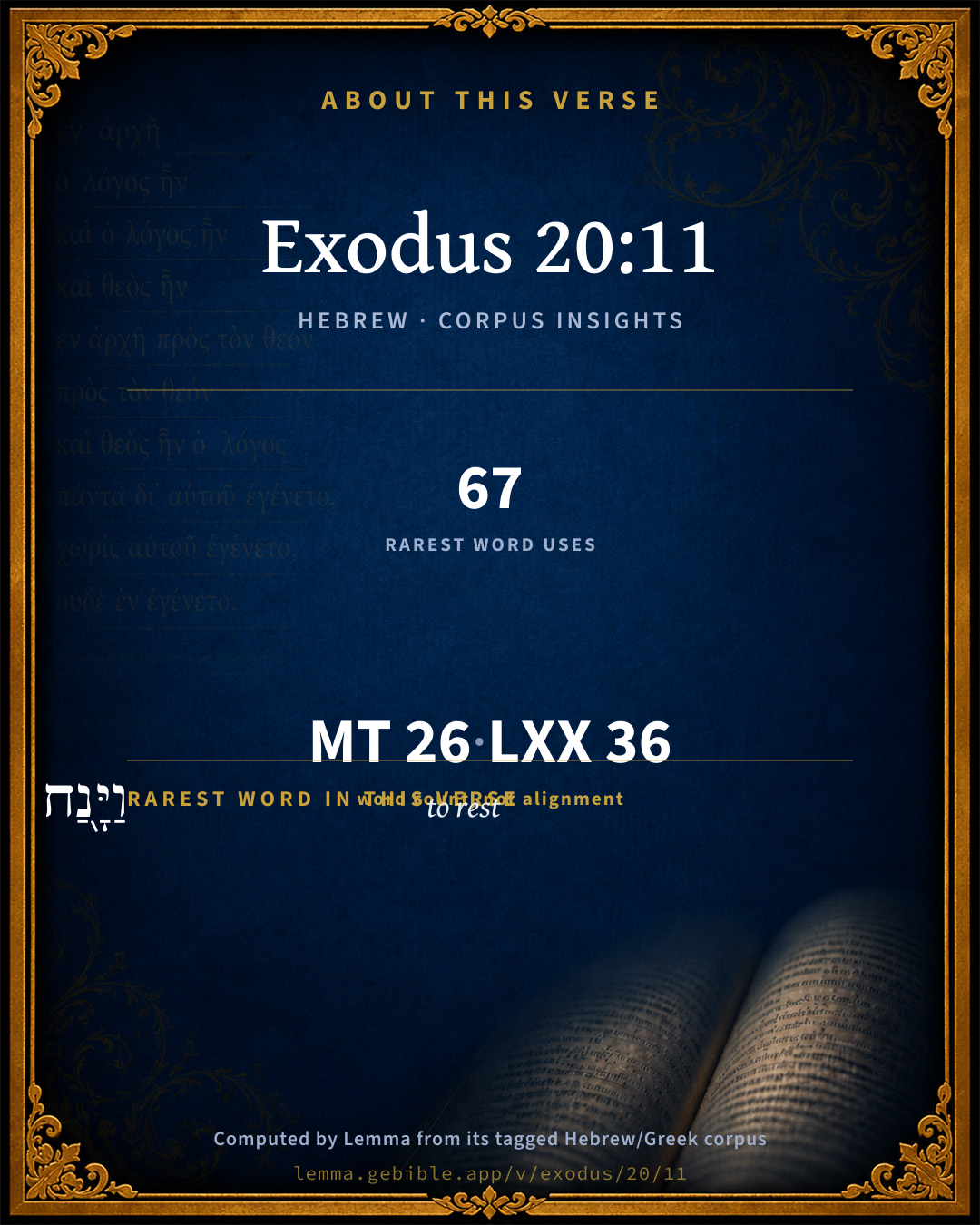
About this verse

These counts appear in no published source. They are computed here, from the morphology-tagged text and Lemma’s own curated glosses. What Lemma adds →

26
words
18
distinct lemmas
Pentateuch
section

Grammatical profile

  • 4 verbs
  • 10 nouns
  • 2 adjectives
  • 2 prepositions
  • 1 conjunction
  • 7 particles

Verb forms

  • עָשָׂ֨ה Qal · Perfect
  • וַיָּ֖נַח Qal · Sequential Imperfect
  • בֵּרַ֧ךְ Piel · Perfect
  • וַֽיְקַדְּשֵֽׁהוּ Piel · Sequential Imperfect

Repetition

Words recur within this verse — often emphatic in Hebrew:

  • יָמִים֩ day H3117 ×3
  • יְהוָ֜ה LORD H3068 ×2

Hebrew & Septuagint length

In English translation the verse runs 32 words from the Hebrew and 36 from the Septuagint (LXX English) — closely comparable.

A rough comparison of the two English renderings, which tokenize alike — not a word-level alignment.

Word counts can differ between the Hebrew and the Greek without any difference in meaning — e.g. the Hebrew direct-object marker אֵת has no separate Greek word, and Greek often adds the article ὁ.

In the original languages it is 26 Hebrew tokens and 36 Greek tokens — but the two are counted differently (Hebrew bundles its prefixes and suffixes into one token; the Greek is in lemma form), so that isn’t a like-for-like length.

Cross-references

6

Topical passages linked to Exodus 20:11 in the Treasury of Scripture Knowledge — connected by theme and wording, ordered by reader-vote popularity; previews shown in the World English Bible.

  • Genesis 1:1–2 In the beginning God created the heavens and the earth.
  • Genesis 2:2–3 On the seventh day God finished his work which he had made; and he rested on the seventh day from all his work which he had made.
  • Exodus 31:17 It is a sign between me and the children of Israel forever; for in six days Yahweh made heaven and earth, and on the seventh day he rested, and was refreshed.'"
  • Mark 2:27–28 He said to them, "The Sabbath was made for man, not man for the Sabbath.
  • Psalms 95:4–7 In his hand are the deep places of the earth. The heights of the mountains are also his.
  • Genesis 1:28 God blessed them. God said to them, "Be fruitful, multiply, fill the earth, and subdue it. Have dominion over the fish of the sea, over the birds of the sky, and over every living thing that moves on the earth."

Cross-references courtesy of OpenBible.info (CC BY 4.0).

Hebrew and Greek witnesses Masoretic Hebrew ↔ Greek Septuagint

The same verse in the two great witnesses to the Old Testament, shown verse-for-verse.

These are two independent witnesses, not word-aligned to each other, and the Septuagint is shown in lemma (dictionary) form.

Hebrew Exodus 20:11 Masoretic · Westminster Leningrad Codex

כִּ֣י שֵֽׁשֶׁת יָמִים֩ עָשָׂ֨ה יְהוָ֜ה אֶת הַשָּׁמַ֣יִם וְאֶת הָאָ֗רֶץ אֶת הַיָּם֙ וְאֶת כָּל אֲשֶׁר בָּ֔ם וַיָּ֖נַח בַּיּ֣וֹם הַשְּׁבִיעִ֑י עַל כֵּ֗ן בֵּרַ֧ךְ יְהוָ֛ה אֶת י֥וֹם הַשַּׁבָּ֖ת וַֽיְקַדְּשֵֽׁהוּ

for in six days Yahweh made heaven and earth, the sea, and all that is in them, and rested the seventh day; therefore Yahweh blessed the Sabbath day, and made it holy.

World English Bible · Public Domain

Greek LXX Exodus 20:11 Septuagint · lemma form

ἐν γάρ ἕξ ἡμέρα ποιέω κύριος ὁ οὐρανός καί ὁ γῆ καί ὁ θάλασσα καί πᾶς ὁ ἐν αὐτός καί καταπαύω ὁ ἡμέρα ὁ ἕβδομος διά οὗτος εὐλογέω κύριος ὁ ἡμέρα ὁ ἕβδομος καί ἁγιάζω αὐτός

For in six days the Lord made the heaven and the earth, and the sea and all things in them, and rested on the seventh day; therefore the Lord blessed the seventh day, and hallowed it.

LXX2012 (modern English Septuagint) · Public Domain

Hebrew: Westminster Leningrad Codex (CC BY 4.0). Greek: Septuagint (public domain); English from LXX2012 (modern English Septuagint) (Public Domain). How the Septuagint differs from the Hebrew →

Targum (Aramaic paraphrase)

2

The Targum is the ancient Jewish Aramaic paraphrase of the Hebrew Scriptures — an interpretive translation, not the Hebrew text itself. Onkelos (literal) and Pseudo-Jonathan (expansive) render the Torah, and Jonathan the Prophets. Coverage is partial: where no permissively-licensed English translation exists for a verse, only the Aramaic is shown. This is verse-level text, not a word-by-word alignment to the Hebrew.

  1. Targum Onkelos Torah (Genesis–Deuteronomy)
    אֲרֵי שִׁתָּא יוֹמִין עֲבַד יְיָ יָת שְׁמַיָא וְיָת אַרְעָא יָת יַמָא וְיָת כָּל דִי בְהוֹן וְנָח בְּיוֹמָא שְׁבִיעָאָה עַל כֵּן בָּרִיךְ יְיָ יָת יוֹמָא דְשַׁבְּתָא וְקַדְשֵׁהּ:

    (no public-domain English translation for this verse)

    Targum Onkelos — Aramaic: “Onkelos Genesis” (public domain); “Onkelos Exodus” (public domain); “Onkelos Leviticus” (public domain); “Onkelos Numbers” (public domain); “Onkelos Deuteronomy” (public domain). English: “Sefaria Community Translation” (CC0 1.0 (public-domain dedication)); “J.W. Etheridge. The Targums of Onkelos and Jonathan Ben Uzziel on the Pentateuch. London: Longmans, Green, 1862” (public domain). Text via Sefaria.

  2. Targum Pseudo-Jonathan Torah (Genesis–Deuteronomy)
    אֲרוּם בְּשִׁתָּא יוֹמִין בָּרָא יְיָ יַת שְׁמַיָא וְיַת אַרְעָא יַת יַמָא וְיַת כָּל מַה דְּאִית בְּהוֹן וְנַח בְּיוֹמָא שְׁבִיעָאָה בְּגִין כֵּן בְּרִיךְ יְיָ יַת יוֹמָא דְשַׁבְּתָא וְקַדִּישׁ יָתֵיהּ

    For in six days the Lord created the heavens, and the earth, and the sea, and whatever is therein, and rested on the seventh day: therefore the Lord hath blessed the day of Shabbatha and sanctified it.

    Targum Pseudo-Jonathan — Aramaic: “Targum Jonathan on Genesis” (public domain); “Targum Jonathan on Exodus” (public domain); “Targum Jonathan on Leviticus” (public domain); “Targum Jonathan on Numbers” (public domain); “Targum Jonathan on Deuteronomy” (public domain). English: “The Targum of Jonathan ben Uzziel, trans. J. W. Etheridge, London, 1862” (public domain). Text via Sefaria.

Commentary

Notes on Exodus 20:11 from classic Christian and Jewish commentators (each source and its license shown beneath its notes). The classic Christian expositions comment on the surrounding passage and are grouped to its opening verse, so a note may address several verses; the Jewish commentaries on the Tanakh (Rashi and others) are per-verse, so they appear only where the commentator wrote on this verse.

Lemma curates 59 commentaries, every one of them public domain or Creative Commons licensed, each selected and text-cleaned for this edition rather than reprinted as found. About our sources →

Trapp's Complete Commentary

John Trapp

Exo 20:11 For [in] six days the LORD made heaven and earth, the sea, and all that in them [is], and rested the seventh day: wherefore the LORD blessed the sabbath day, and hallowed it.

Ver. 11. For in six days.] God took six days to make the world in, to the end that we might be in a muse when we think of it; and think on his works in that order that he made them.

And rested the seventh day.] Not as tired out - for he made all without either tool or toil; his Fiat only did the deed - but to give us example, as Joh 13:15.

Wherefore the Lord blessed, &c.] How God esteemeth the strict observation of the Sabbath day, may appear by the exact delivery of it. For he hath fenced it about, like mount Sinai, with marks and bounds, that profaneness might not approach it: (l.) By his watchword, "Remember"; (2.) By his bounty, "Six days," &c.; (3.) By his sovereignty, "It is the Sabbath of the Lord thy God"; (4.) By the latitude, "Thou, nor thy son," &c.; (5.) By his own example, "And he rested the seventh day"; (6.) By his benediction, as here, "He blessed it," and ordained it to be a means of much blessing to those that observe it. Add hereunto, that God hath placed this command in the midst of the Decalogue, betwixt the two tables; as much conducing to the keeping of both. It stands like the sensus communis, between the inward and outward senses, being serviceable to both. {a}

And hallowed it.] Diem septimam opifex, ut mundi natalem, sibi sacravit. {See Trapp (for summary of Law) on "Exo 20:17"}

{a} Bodin., Theat. Naturae.

John Trapp, A Commentary or Exposition upon All the Books of the Old and New Testament (1647–1656) — public domain. Text from a community e-Sword module.

Tyndale Open Study Notes

Tyndale Open Resources

20:11 To be in covenant with God is to do what God does; since he rested from his work (Gen 2:1-3), how can we think that we need no rest?

Tyndale Open Study Notes — © Tyndale Open Resources, licensed CC BY-SA 4.0. Text via the HelloAO Bible API.

Ellicott's Commentary for English Readers

(11) For in six days the Lord made heaven and earth.—Comp. Gen_2:2-3, and Exo_31:17. It is not improbable that the work of creation was made to occupy six days because one day in seven is the appropriate proportion of rest to labour for such a being as man. God might have created all things on one day had He so pleased; but, having the institution of the Sabbath in view, He prefigured it by spreading His work over six days, and then resting on the seventh. His law of the Sabbath established a conformity between the method of His own working and that of His reasonable creatures, and taught men to look on work, not as an aimless, indefinite, incessant, weary round, but as leading on to an end, a rest, a fruition, a time for looking back, and seeing the result and rejoicing in it. Each Sabbath is such a time, and is a type and foretaste of that eternal “sabbatising” in another world which “remaineth for the people of God” (Heb_4:9). The secondary object of the institution of the Sabbath, assigned in Deu_5:15, is in no way incompatible with this primary one. The thought of God’s works in creation might well be associated in the mind of an. Israelite with the thought of His “wondrous works” in Egypt, and the recollection of the blessed peace and rest in which creation resulted, with the memory of the glad time of repose and refreshment which supervened upon the weary task work of the Egyptian bondage.

A Bible Commentary for English Readers, edited by Charles John Ellicott (1878–1897) — public domain. Text from a community e-Sword module.

The Cambridge Bible for Schools and Colleges

gen. ed. J. J. S. Perowne

11. Why the sabbath is to be observed. The reason is based upon Gen_2:3, cf. Exo_31:17 b (both P). The motive may have operated with the writer of the comment; but it cannot state the real reason for the observance of the sabbath. ‘P’s story of the Creation, with the six days followed by the sacred seventh, is not the cause of the Sabbath, but the result of the fact that the week ending with the Sabbath was an existing institution. P adjusts the work of creation to it’ (McNeile). Cf. the present writer’s Genesis, p. 35. On the different motive assigned for the observance in Deu_5:15, see p. 192.

rested] This is the word nûaḥ, meaning relaxation, referred to on v. 8: cf. Exo_23:12 b, Deu_5:14 b; and for the thought Exo_31:17 b (‘desisted, and was refreshed’). (In Gen_2:2-3 the word used is ‘desisted.’)

blessed … hallowed] i.e. made it a day which would bring a blessing on those who observed it, and made it sacred to Himself.

It is impossible to consider here with any fulness the history and significance of the sabbath; and for a more detailed discussion the writer must refer to his art. Sabbath in DB. iv. It is not impossible that ultimately the institution was of Babylonian origin: in Babylonian there occurs (though rarely) the word shabattum, meaning day for propitiating a deity’s anger1[178], and in Babylonia also, especially in the earlier periods of the history, every seventh day of the month was marked by abstention from secular business2[179]: but even if that was the case (for connecting links are still wanting), it is certain that when adopted by the Hebrews, a new character was impressed upon it by the higher and purer religion of Israel. In the earliest legislation of the Hebrews, the sabbath appears as a day of cessation from (in particular) field-work, designed with a humanitarian end (Exo_23:12 E; Exo_34:21 J), and, to judge from the context, possessing already a religious character: in the Decalogue, in what is probably (see above) the oldest part of the Commandment, it is to be kept ‘holy’ by the Israelite: in the early historical books, it is associated with the ‘new moon,’ in a manner which implies that both were occasions of intermission from labour and trade (Amo_8:5), and holidays (2Ki_4:22-23); Hosea (Exo_2:11), and Isaiah (Exo_1:13), both allude to it as a day of religious observance. In later times, both the religious observances and also the abstention from labour were increasingly emphasized. In H and Ezek. (see on Eze_31:13) the observance of the sabbath is repeatedly insisted on: cf. a little later Isa_56:2; Isa_56:4; Isa_56:6; Isa_58:13 f., and (in the ideal future) Isa_66:23. Ezekiel, also, in his ideal legislation for the future (chs. 40–48), gives directions,—based, presumably, upon already existing usage,—respecting the sacrifices to be offered every sabbath by the ‘prince’ on behalf o the nation in the restored temple (Eze_45:17, Eze_46:4 f.). In the legislation of P, the regulations respecting the sabbath become both more numerous and more strict: its institution is thrown back to the end of the week of Creation (Gen_2:2-3, Exo_31:17); it is to be observed (Lev_23:3) by a ‘holy convocation,’ or religious gathering; additional sacrifice (viz. double those offered on ordinary days) are prescribed for it (Num_28:8 f.); and death is the penalty imposed (Exo_31:15), and exacted (Num_15:32-36), for its non-observance, Thus in the priestly law, the original character and objects of the sabbath have receded into the background, and it has become more distinctly a purely ceremonial observance: Christ, in opposition to later Rabbinical exaggerations and refinements, brought men back to the great truth that ‘the sabbath was made for man, and not man for the sabbath’; and, transformed into the Christian Sunday, it has become in Christian countries a wonderful means both of securing rest from bodily toil, and of maintaining the life of a pure and spiritual religion.

[178] See DB. iv. 319a, adding the instance, discussed by Zimmern, ZDMG. 1904, p. 199 ff., in which shabattum is applied to the 15th day of the month, i.e. (see p. 201) to the day of the full moon.

[179] See DB. ibid., or the writer’s Genesis, p. 34. and esp. Johns, Expos. Times, Sept. 1906, p. 567 (with detailed statistics); and comp. McNeile, p. 122 f.

The Cambridge Bible for Schools and Colleges (gen. ed. J. J. S. Perowne; Cambridge University Press, 1878–1918) — public domain. Text from a community e-Sword module.

John Gill's Exposition

For in six days the Lord made heaven and earth, the sea,

and all that in them is, &c. And of which six days, and of the several things made in each of them, see the notes on the first chapter of Genesis:

and resteth the seventh day: which does not suppose labour, attended with weariness and fatigue; for the Creator of the ends of the earth fainteth not, neither is weary, Isa 40:28 nor ease and refreshment from it, but only a cessation from the works of creation, they being finished and completed, though not from the works of Providence, in which he is continually concerned: now this circumstance, before recorded in the history of the creation, is wisely improved to engage an attention to this command, and to the observation of it; there being an analogy between the one and the other, that as God worked six days, and, having done his work completely, ceased from it and rested, so it was fit and proper, that as the Israelites had six days allowed them to labour in, and do all their work, they should rest on the seventh, they and all that belonged to them, or had any connection with them:

wherefore the Lord blessed the sabbath, and hallowed it: he separated it from all other days of the week, and set it apart for holy use and service, by obliging his people to cease from all work on it, and to give up themselves to the exercises of religion, as hearing, reading the word, prayer, praise, &c. and he blessed it with his presence, and with the communications of his grace, as he still continues to do, whatsoever day his people make use of for his worship and service. The note of Jarchi is,"he blessed it with manna, by giving double bread on the sixth, and sanctified it by manna, that it might not descend on it;''so that there was a provision made for it, which was blessing it; and it was distinguished from all other days, no manna falling on it, which was the sanctification of it; and all showed it to be a day the Lord had a particular regard to, and that it was to be a day of rest, and exemption from labour. (This verse shows that the days in the first chapter of Genesis were real twenty four hour days. For you compare like things to like. Just as God worked six days and rested on the seventh, so the Israelites were to do also. The comparison would make no sense if the days were "seven ages" or were "seven ages" that overlapped each other (Day Age Theory) or if there was a huge gap between the days (Gap Theory). These are modern compromises to accomodate the alleged geological ages with the Biblical account of creation.Further this verse allows one to determine the age of the universe. Using the biblical geneologies Bishop Ussher determined the date of creation to be 4004 B.C. Although this may be off by one or two percent, it is a very accurate estimate based on biblical revelation not man's speculation. Editor.)

John Gill's Exposition of the Whole Bible (1746–1763) — public domain (CC PDM 1.0). Text via the HelloAO Bible API.

Matthew Poole's English Annotations

In six days, and neither in more nor less time, as he could have done.

Rested, i.e. ceased from his creating works; otherwise he worketh still (Joh 5:17) by his providence and grace; and neither is idle nor weary, Isa 40:28; but this rest is ascribed to him for our admonition and imitation.

The Lord blessed the sabbath day, i.e. made it a day of blessing; as well of receiving blessings and praises from men, as of conferring his blessings and favours upon those that religiously observe it. The day is said to be blessed when men are blessed by it, and in it, by a common metonymy, as a man’s field, Gen 27:27, and basket and store, Deu 28:5, and the work of his hands, Job 1:10, are said to be blessed when a man is blessed in them. It is remarkable, the blessing and sanctification are not appropriated to the seventh day, but to the sabbath day, whether it should be the seventh day, as to the Jews it then was, or the first day, as to us Christians now it is, which change seems hereby to be insinuated.

Hallowed it, i.e. separated it from the rest of the days, and from all common employments, and consecrated it to his own holy service, and man’s holy use.

Matthew Poole's English Annotations on the Holy Bible (1683–1685) — public domain. Text from a community e-Sword/MySword module.

Whedon's Commentary on the Bible

Daniel D. Whedon

11. For in six days the Lord made heaven and earth — Here is a direct reference to what is recorded in Gen_1:1 to Gen_2:3, where see notes, and also pages 63 and 64 of the Introduction. Those writers who maintain that the Sabbath was a purely Mosaic institution find no little embarrassment in explaining away the obvious import of this verse. Both here and in Gen_2:1-3, God’s rest at the close of the creative week is made a reason for the sanctifying of the seventh day. Other reasons are also given, as in Deu_5:15, where the deliverance from Egyptian bondage is mentioned as an additional ground for its observance. That a seventh-day rest is necessary to the highest good of man may be argued from the following considerations: (1.) From this explicit commandment of the decalogue. Its position among other moral laws of universal obligation shows that it is something more than a mere temporary Mosaic institution. (2.) The typical example of God’s resting from his work, here given as a reason for this law, implies that the seventh-day rest is an ordinance old as the creation of man. (3.) This is confirmed by traces of it in the weekly divisions of time among several ancient nations, (see on Exo_16:23,) and especially among the ancient Babylonians and Assyrians, who had their “day of rest for the heart.” (4.) Because of its association with Israel’s deliverance from Egyptian bondage, (Deu_5:15,) and the severity with which its violation was punished. Num_15:35; 2Ch_36:21. (5.) Christ’s words in Mar_2:27, confirm all the above, and show it to be a law of the highest good for man, grounded in the needs of his physical and moral nature. (6.) The remarkable fact has been often proven and illustrated by fair trial, that both man and beast will do more and better work by observing one rest day in seven than by continuous labour in violation of the sabbath law. (7.) The sabbath rest, properly utilized, is admirably adapted to promote the culture of all that is highest and best in the spiritual nature of man.

Daniel D. Whedon (gen. ed.), Commentary on the Old and New Testaments (1874–1909) — public domain. Text from a community e-Sword module.

The Pulpit Commentary

For in six days the Lord made heaven and earth. Two reasons are assigned for the sanctification of the seventh day in the Pentateuch:

1. The fact that the work of creation took six days, and that on the seventhGod rested; and

2. The further fact, that God brought the Israelites out of Egypt, and gavethem a time of rest after a time of labour and toil. (Deu_5:15) It is not expressly said that the deliverance took place on the Sabbath, but such is the Jewish tradition on the subject. The reason here assigned must be regarded as the main reason, man"s rest being purposely assimilated to God"s rest, in order to show the resemblance between man"s nature anti, (Gen_1:27) and to point towards that eternal rest wherein man, united with God, will find his highest bliss and the true end of his being. "There remaineth a rest for the people of God."

The Pulpit Commentary (1880–1919), ed. H.D.M. Spence-Jones & Joseph S. Exell — public domain. Text from a community e-Sword module.

Rashi

Rabbi Shlomo Yitzchaki (Rashi)

וינח ביום השביעי AND HE RESTED ON THE SEVENTH DAY — If one may say so, He recorded rest about Himself (recorded that He rested) to teach from this an inference à fortiori as regards a human being whose work is performed only by labour and toil — that he should rest on the Sabbath day (Mekhilta).

ברך… ויקדשהו HE BLESSED … AND SANCTIFIED IT — He blessed it through the Manna by giving a double portion on the sixth day — “double bread”; and He sanctified it through the Manna in that on it none fell (Mekhilta; cf. Rashi on Genesis 2:3).

Rashi on the Tanakh — English translations: “The Judaica Press complete Tanach with Rashi, translated by A. J. Rosenberg” (CC BY 4.0); “Pentateuch with Rashi's commentary by M. Rosenbaum and A.M. Silbermann, 1929-1934” (public domain); “The Metsudah Tanach series, Lakewood, N.J” (CC BY 4.0); and “The Book of Joshua, Metsudah Publications, 1997” (CC BY 4.0). Text via Sefaria.

Ramban (Nachmanides)

Rabbi Moshe ben Nachman (Ramban / Nachmanides)

THE ETERNAL BLESSED THE SABBATH-DAY, AND SANCTIFIED IT. The verse is stating that the Sabbath-day will be blessed and hallowed because He has commanded to bless it and glorify it by remembering it. Therefore, He commanded us to rest thereon so that the day will be sacred to us, and that we should not do any work on it. And Rabbi Abraham ibn Ezra wrote that G-d blessed this day and sanctified it by endowing it with a greater capacity to enable the soul to receive additional wisdom than on all of the other days. I have already written concerning this matter by way of the Truth, [the mystic lore of the Cabala], on the verse in Vayechulu. From there, you will succeed in understanding that the expression ki sheisheth yamim asa hashem — [literally: “for six days the Eternal made”] six days the Eternal made.” — is not missing the letter beth, [which would make the verse read: “for in six days the Eternal made”]. Rather, the sense of the verse is that G-d made six days six days G-d made.” The six days represent the six milleniums of world-history, while the seventh millenium “will be wholly a Sabbath and will bring rest for life everlasting” (ibid., p. 64). and on the seventh day He ceased from work and rested.

Ramban (Nachmanides) on the Tanakh — English translation: “Commentary on the Torah by Ramban (Nachmanides). Translated and annotated by Charles B. Chavel. New York, Shilo Pub. House, 1971-1976” (CC BY 4.0). Text via Sefaria.

Lesson kit

Teaching starters — assembled from the data on this page, not authored interpretation. Every prompt links to the verse data it draws on. Edit before teaching.

Exodus, in the Pentateuch, opens this verse with 26 words (18 distinct Hebrew lemmas). Its most distinctive word is nûwach (“to rest”). A historical commentator’s framing appears above. Read the whole chapter for the surrounding context.

Discussion questions

  1. How does “to rest” (nûwach) shape what this verse is saying?
  2. Genesis 1:1–2 shares this passage’s theme. How do the two illuminate each other?
  3. “day” occurs 3× in this one verse. What is the effect of the repetition?
  4. These translations render this verse differently. What is at stake in choosing one wording over another?
  5. The verb «עָשָׂ֨ה» is Qal Perfect. How does its form color the action?
  6. Reading how Trapp's Complete Commentary and Tyndale Open Study Notes read this verse, where do the two commentators agree and where do they part?

Things to notice

Reading settings

Reading text

Shown beneath each verse's original-language words.

Old Testament
Old Testament edition

Read the OT as the Masoretic Hebrew (MT) or the Greek Septuagint (LXX).

English shown for the Greek Septuagint (in the Hebrew ↔ Greek comparison).

Comparing translations? Open the Compare panel on any verse page to stack up to four side by side.