Genesis 12:3

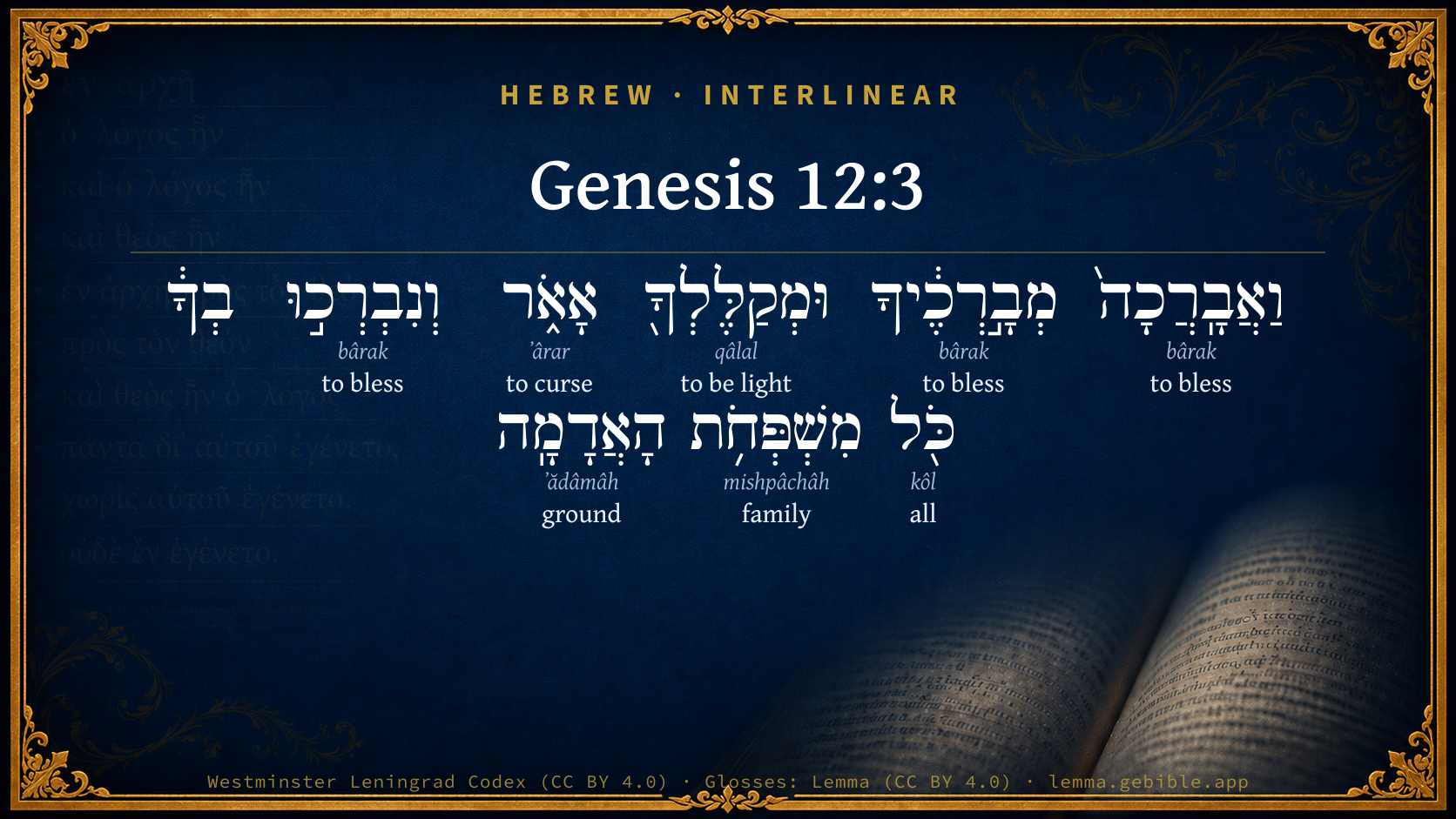
Hebrew (Westminster Leningrad Codex) Genesis 12:3 appears in the Hebrew Old Testament. The text above is from the Westminster Leningrad Codex. Each word links to its Strong’s number, a concise gloss, and parsing drawn from the Open Scriptures Hebrew Bible morphology. Click any word for its full Brown-Driver-Briggs (BDB) entry.
Download image
Cite this verse

Genesis 12:3 (World English Bible). Public Domain. Lemma interlinear Bible study tool, https://lemma.gebible.app/v/genesis/12/3.

Show BibTeX & RIS
BibTeX
RIS
English Translation
I will bless those who bless you, and I will curse him who curses you. In you will all of the families of the earth be blessed."
World English Bible · Public Domain
Download a study sheet

One document with this verse’s original text, its word-by-word gloss line, the meaning frame, cross-references with their text, attributed commentary, and full source and license credits — printable, and it pastes into notes with its structure intact.

This verse Autodidact and up

Study sheet (.html) Plain text (.txt)

A passage Seminary Student

Up to 50 verses in one chapter. A passage sheet keeps up to 6 commentary sources and 12 cross-references per verse, in the order this page ranks them, and says so on the sheet whenever that leaves anything out. Ask for a single verse and you get the Autodidact verse sheet above.

Everything on this page stays free to read, with no account — the sheet is a download of what is already on screen, not access to it.

Want to remove ads? Support Godless Engineer
Compare translations 3

The same verse in 3 English versions, stacked beneath the original-language interlinear above. Click any original word for its lexicon entry.

Each is an independent rendering of the whole verse — the interlinear is not word-aligned to these translations.

Highlighted words mark where these versions differ — a whole-verse word diff, not a word-by-word alignment.

  • World English Bible Public Domain
    I will bless those who bless you, and I will curse him who curses you. In you will all of the families of the earth be blessed."
  • King James Version Public Domain
    And I will bless them that bless thee, and curse him that curseth thee: and in thee shall all families of the earth be blessed.
  • unfoldingWord Literal Text CC BY-SA 4.0
    And I will bless those who bless you, but whoever curses you I will curse. And in you all the families of the earth will be blessed.”

unfoldingWord Literal Text — © unfoldingWord, licensed CC BY-SA 4.0. Word-aligned USFM3 via Door43 (git.door43.org/unfoldingWord/en_ult).

Versions to compare (up to 4)

3 of 4 selected

Show all 18 translations

Every available English version of this verse, each an independent rendering of the whole verse.

  • World English Bible Public Domain
    I will bless those who bless you, and I will curse him who curses you. In you will all of the families of the earth be blessed."
  • Berean Standard Bible Public Domain
    I will bless those who bless you and curse those who curse you; and all the families of the earth will be blessed through you.”
  • Majority Standard Bible Public Domain
    I will bless those who bless you and curse those who curse you; and all the families of the earth will be blessed through you.”
  • King James Version Public Domain
    And I will bless them that bless thee, and curse him that curseth thee: and in thee shall all families of the earth be blessed.
  • American Standard Version (1901) Public Domain
    and I will bless them that bless thee, and him that curseth thee will I curse: and in thee shall all the families of the earth be blessed.
  • Revised Version (1885) Public Domain
    and I will bless them that bless thee, and him that curseth thee will I curse: and in thee shall all the families of the earth be blessed.
  • Geneva Bible (1599) Public Domain
    I will also blesse them that blesse thee, and curse them that curse thee, and in thee shall all families of the earth be blessed.
  • Douay-Rheims (1899) Public Domain
    I will bless them that bless thee, and curse them that curse thee, and IN THEE shall all the kindred of the earth be blessed:
  • Young's Literal Translation Public Domain
    And I bless those blessing thee, and him who is disesteeming thee I curse, and blessed in thee have been all families of the ground.'
  • Literal Standard Version CC BY-SA 4.0
    And I bless those blessing you, and I curse him who is cursing you, and all families of the ground have been blessed in you.”
  • Unlocked Literal Bible CC BY-SA 4.0
    I will bless those who bless you, but whoever dishonors you I will curse. Through you will all the families of the earth be blessed.”
  • unfoldingWord Literal Text CC BY-SA 4.0
    And I will bless those who bless you, but whoever curses you I will curse. And in you all the families of the earth will be blessed.”
  • Darby Bible Public Domain
    And I will bless them that bless thee, and curse him that curseth thee; and in thee shall all families of the earth be blessed.
  • World Messianic Bible Public Domain
    I will bless those who bless you, and I will curse him who treats you with contempt. All the families of the earth will be blessed through you.”
  • Webster's Bible Public Domain
    And I will bless them that bless thee, and curse him that curseth thee: and in thee shall all families of the earth be blessed.
  • Free Bible Version CC BY-SA 4.0
    I will bless those who bless you; I will curse those who curse you. Everyone on earth will be blessed through you.”
  • Bible in Basic English Public Domain
    To them who are good to you will I give blessing, and on him who does you wrong will I put my curse: and you will become a name of blessing to all the families of the earth.
  • JPS Tanakh (1917) Public Domain
    And I will bless them that bless thee, and him that curseth thee will I curse; and in thee shall all the families of the earth be blessed.'

Literal Standard Version (2020), Covenant Press — licensed CC BY-SA 4.0. Text via the HelloAO Bible API (eBible.org). Unlocked Literal Bible (unfoldingWord) — licensed CC BY-SA 4.0. Text via the HelloAO Bible API (eBible.org). unfoldingWord Literal Text — © unfoldingWord, licensed CC BY-SA 4.0. Word-aligned USFM3 via Door43 (git.door43.org/unfoldingWord/en_ult). Free Bible Version, Dr. Jonathan Gallagher — licensed CC BY-SA 4.0. Text via the HelloAO Bible API (eBible.org).

Word by word

More ways to search: Search by grammar → Find every occurrence → Compare this word →

Practice this passage: Drill this verse → Learn its vocabulary →

אָאֹ֑ר
ʼârar
H779
“to curse”
Verb, Qal, Imperfect, 1st Person, Common, Singular
Part of Speech
Verb
Stem
Qal
Form
Imperfect
Person
1st Person
Gender
Common
Number
Singular
Full BDB Definition

Origin: a primitive root

TWOT: 168

to curse - (Qal) - to curse - cursed be he (participle used pr in curses) - (Niphal) to be cursed, cursed - (Piel) to curse, lay under a curse, put a curse on - (Hophal) to be made a curse, be cursed
  1. וַאֲבָֽרֲכָה֙ bârak H1288 “and · to bless” Conjunction + Verb, Piel, Imperfect, 1st Person, Common, Singular
  2. מְבָ֣רְכֶ֔יךָ bârak H1288 “blessing · you” Verb, Piel, Participle Active, Masculine, Plural, Construct + Suffix, Personal, 2nd Person, Masculine, Singular
  3. וּמְקַלֶּלְךָ֖ qâlal H7043 “and · being light · you” Conjunction + Verb, Piel, Participle Active, Masculine, Singular, Construct + Suffix, Personal, 2nd Person, Masculine, Singular
  4. וְנִבְרְכ֣וּ bârak H1288 “and · to bless” Conjunction + Verb, Niphal, Perfect, 3rd Person, Common, Plural
  5. כֹּ֖ל kôl H3605 “all of” Noun, Common, Masculine, Singular, Construct
  6. מִשְׁפְּחֹ֥ת mishpâchâh H4940 “families of” Noun, Common, Feminine, Plural, Construct
  7. הָאֲדָמָֽה ʼădâmâh H127 “the · ground” Particle, Definite Article + Noun, Common, Feminine, Singular, Absolute

About this verse

These counts appear in no published source. They are computed here, from the morphology-tagged text and Lemma’s own curated glosses. What Lemma adds →

9
words
6
distinct lemmas
Pentateuch
section

Grammatical profile

  • 5 verbs
  • 3 nouns
  • 1 preposition

Verb forms

  • וַאֲבָֽרֲכָה֙ Piel · Imperfect
  • מְבָ֣רְכֶ֔יךָ Piel · Participle Active
  • וּמְקַלֶּלְךָ֖ Piel · Participle Active
  • אָאֹ֑ר Qal · Imperfect
  • וְנִבְרְכ֣וּ Niphal · Perfect

Repetition

A word recurs within this verse — often emphatic in Hebrew:

  • וַאֲבָֽרֲכָה֙ to bless H1288 ×3

Hebrew & Septuagint length

In English translation the verse runs 27 words from the Hebrew and 26 from the Septuagint (LXX English) — closely comparable.

A rough comparison of the two English renderings, which tokenize alike — not a word-level alignment.

Word counts can differ between the Hebrew and the Greek without any difference in meaning — e.g. the Hebrew direct-object marker אֵת has no separate Greek word, and Greek often adds the article ὁ.

Cross-references

22

Topical passages linked to Genesis 12:3 in the Treasury of Scripture Knowledge — connected by theme and wording, ordered by reader-vote popularity; previews shown in the World English Bible.

  • Galatians 3:8 The Scripture, foreseeing that God would justify the Gentiles by faith, preached the Gospel beforehand to Abraham, saying, "In you all the nations will be blessed."
  • Genesis 22:18 In your seed will all the nations of the earth be blessed, because you have obeyed my voice."
  • Genesis 27:29 Let peoples serve you, Nations bow down to you. Be lord over your brothers, Let your mother's sons bow down to you. Cursed be everyone who curses you, Blessed be everyone who blesses you."
  • Acts 3:25–26 You are the children of the prophets, and of the covenant which God made with our fathers, saying to Abraham, 'In your seed will all the families of the earth be blessed.'
  • Numbers 24:9 He couched, he lay down as a lion, As a lioness; who shall rouse him up? Blessed be everyone who blesses you, Cursed be everyone who curses you.
  • Genesis 26:4 I will multiply your seed as the stars of the sky, and will give to your seed all these lands. In your seed will all the nations of the earth be blessed,
  • Genesis 28:14 Your seed will be as the dust of the earth, and you will spread abroad to the west, and to the east, and to the north, and to the south. In you and in your seed will all the families of the earth be blessed.
  • Genesis 18:18 seeing that Abraham has surely become a great and mighty nation, and all the nations of the earth will be blessed in him?
  • Galatians 3:16 Now the promises were spoken to Abraham and to his seed. He doesn't say, "To seeds," as of many, but as of one, "To your seed," which is Christ.
  • Romans 4:11 He received the sign of circumcision, a seal of the righteousness of the faith which he had while he was in uncircumcision, that he might be the father of all those who believe, though they be in uncircumcision, that righteousness might also be accounted to them.
  • Exodus 23:22 But if you indeed listen to his voice, and do all that I speak, then I will be an enemy to your enemies, and an adversary to your adversaries.
  • Galatians 3:28 There is neither Jew nor Greek, there is neither slave nor free man, there is neither male nor female; for you are all one in Christ Jesus.
  • Psalms 72:17 His name endures forever. His name continues as long as the sun. Men shall be blessed by him. All nations will call him blessed.
  • Revelation 7:9 After these things I looked, and behold, a great multitude, which no man could number, out of every nation and of all tribes, peoples, and languages, standing before the throne and before the Lamb, dressed in white robes, with palm branches in their hands.
  • Genesis 30:27 Laban said to him, "If now I have found favor in your eyes, stay here, for I have divined that Yahweh has blessed me for your sake."
  • Colossians 3:11 where there can't be Greek and Jew, circumcision and uncircumcision, barbarian, Scythian, bondservant, freeman; but Christ is all, and in all.
  • Genesis 39:5 It happened from the time that he made him overseer in his house, and over all that he had, that Yahweh blessed the Egyptian's house for Joseph's sake; and the blessing of Yahweh was on all that he had, in the house and in the field.
  • Matthew 25:40 "The King will answer them, 'Most assuredly I tell you, inasmuch as you did it to one of the least of these my brothers, you did it to me.'
  • Matthew 25:45 "Then he will answer them, saying, 'Most assuredly I tell you, inasmuch as you didn't do it to one of the least of these, you didn't do it to me.'
  • Ephesians 1:3 Blessed be the God and Father of our Lord Jesus Christ, who has blessed us with every spiritual blessing in the heavenly places in Christ;
  • Genesis 30:30 For it was little which you had before I came, and it has increased to a multitude. Yahweh has blessed you wherever I turned. Now when will I provide for my own house also?"
  • 1 Corinthians 1:30 But of him, you are in Christ Jesus, who was made to us wisdom from God, and righteousness and sanctification, and redemption:

Cross-references courtesy of OpenBible.info (CC BY 4.0).

Hebrew and Greek witnesses Masoretic Hebrew ↔ Greek Septuagint

The same verse in the two great witnesses to the Old Testament, shown verse-for-verse.

These are two independent witnesses, not word-aligned to each other, and the Septuagint is shown in lemma (dictionary) form.

Hebrew Genesis 12:3 Masoretic · Westminster Leningrad Codex

וַאֲבָֽרֲכָה֙ מְבָ֣רְכֶ֔יךָ וּמְקַלֶּלְךָ֖ אָאֹ֑ר וְנִבְרְכ֣וּ בְךָ֔ כֹּ֖ל מִשְׁפְּחֹ֥ת הָאֲדָמָֽה

I will bless those who bless you, and I will curse him who curses you. In you will all of the families of the earth be blessed."

World English Bible · Public Domain

Greek LXX Genesis 12:3 Septuagint · lemma form

καί εὐλογέω ὁ εὐλογέω σύ καί ὁ καταἀράομαι σύ καταἀράομαι καί ἐνεὐλογέω ἐν σύ πᾶς ὁ φυλή ὁ γῆ

And I will bless those that bless you, and curse those that curse you, and in you shall all the tribes of the earth be blessed.

LXX2012 (modern English Septuagint) · Public Domain

Hebrew: Westminster Leningrad Codex (CC BY 4.0). Greek: Septuagint (public domain); English from LXX2012 (modern English Septuagint) (Public Domain). How the Septuagint differs from the Hebrew →

Targum (Aramaic paraphrase)

2

The Targum is the ancient Jewish Aramaic paraphrase of the Hebrew Scriptures — an interpretive translation, not the Hebrew text itself. Onkelos (literal) and Pseudo-Jonathan (expansive) render the Torah, and Jonathan the Prophets. Coverage is partial: where no permissively-licensed English translation exists for a verse, only the Aramaic is shown. This is verse-level text, not a word-by-word alignment to the Hebrew.

  1. Targum Onkelos Torah (Genesis–Deuteronomy)
    וֶאֱבָרֵךְ מְבָרְכָךְ וּמְלַטְטָךְ אֵילוּט וְיִתְבָּרֲכוּן בְּדִילָךְ כֹּל זַרְעֲיַת אַרְעָא

    And I will bless him who blesseth thee, and him who curseth thee I will curse; and through thee all the progenies of the earth shall be blessed.

    Targum Onkelos — Aramaic: “Onkelos Genesis” (public domain); “Onkelos Exodus” (public domain); “Onkelos Leviticus” (public domain); “Onkelos Numbers” (public domain); “Onkelos Deuteronomy” (public domain). English: “Sefaria Community Translation” (CC0 1.0 (public-domain dedication)); “J.W. Etheridge. The Targums of Onkelos and Jonathan Ben Uzziel on the Pentateuch. London: Longmans, Green, 1862” (public domain). Text via Sefaria.

  2. Targum Pseudo-Jonathan Torah (Genesis–Deuteronomy)
    וַאֲבָרֵךְ יַת כַּהֲנַיָא דְפַרְסִין יְדֵיהוֹן בִּצְלוֹ וּמְבָרְכִין יַת בְּנָךְ וּבִלְעָם דִמְלַטֵט יַתְהוֹן אֵילוֹט וְיִקְטְלוּנֵיהּ לְפִתְגַם דְחָרֶב וְיִתְבָּרְכוּן בָּךְ כָּל זַרְעַיַת אַרְעָא

    And I will bless the priests who will spread forth their hands in prayer, and bless thy sons; and Bileam, who will curse them, I will curse, and they shall slay him with the mouth of the sword; and in thee shall be blessed all the generations of the earth.

    Targum Pseudo-Jonathan — Aramaic: “Targum Jonathan on Genesis” (public domain); “Targum Jonathan on Exodus” (public domain); “Targum Jonathan on Leviticus” (public domain); “Targum Jonathan on Numbers” (public domain); “Targum Jonathan on Deuteronomy” (public domain). English: “The Targum of Jonathan ben Uzziel, trans. J. W. Etheridge, London, 1862” (public domain). Text via Sefaria.

Commentary

Notes on Genesis 12:3 from classic Christian and Jewish commentators (each source and its license shown beneath its notes). The classic Christian expositions comment on the surrounding passage and are grouped to its opening verse, so a note may address several verses; the Jewish commentaries on the Tanakh (Rashi and others) are per-verse, so they appear only where the commentator wrote on this verse.

Lemma curates 59 commentaries, every one of them public domain or Creative Commons licensed, each selected and text-cleaned for this edition rather than reprinted as found. About our sources →

Trapp's Complete Commentary

John Trapp

Gen 12:3 And I will bless them that bless thee, and curse him that curseth thee: and in thee shall all families of the earth be blessed.

Ver. 3. And I will bless them that bless thee.] Some there are that will curse those whom God blessed; but nothing so many as they that will rise up and call them blessed. These are expressed here in the plural number; those in the singular only. "For who is he that will harm you, if ye be followers of that which is good?" {1Pe 3:13} But say there be some Balaams that would curse God’s Israel, {Num 23:2} or some Esaus that could wish them unblest again; yet God will turn Balaam’s curse into a blessing (which is reckoned as a great favour); and he will tell Esau (if not in his ear, yet in his conscience) that Jacob is blest, "and he shall be blest." {Gen 27:33} If Isaac, drawn aside by natural affection, would go about to reverse the blessing, God will cause him to "tremble very exceedingly," and so overawe him that he shall not be able to do it. But see here (as in a mirror) the wonderful love of God to his children: so dear they are unto him, that he cannot but love all that love them, and bless those that bless them. They have a powerful speech in Spain, - He that wipes the child’s nose kisseth the mother’s cheek. Surely, as natural parents take the kindnesses and unkindnesses showed to their children as done to themselves, so doth God.

And in thee shall all families, &c.] That is, "in thy seed," as it is interpreted, Gen 22:18. To wit, in Christ that shall take flesh of thee, as both Peter and Paul expound it, Act 3:25 Gal 3:9; Gal 3:16. Hence Christ is called "the gift," {Joh 4:10} and "the benefit," {1Ti 6:2} by an excellency, "and the desire of all nations," {Hag 2:7} sent a purpose "to bless us, in turning every one of us from our iniquities". {Act 3:26}

John Trapp, A Commentary or Exposition upon All the Books of the Old and New Testament (1647–1656) — public domain. Text from a community e-Sword module.

Joseph Benson's Commentary

Gen 12:3. In thee shall all families of the earth be blessed — This promise crowned all the rest; for it pointed at the Messiah, “in whom all the promises are yea and amen.” Now, with what astonishing exactness has God fulfilled these promises, and yet how unlikely it was, at the time they were made, that they should be fulfilled! Surely we need no other proof that the historian wrote by inspiration of God!

Joseph Benson's Commentary on the Old and New Testaments (1811–1818) — public domain. Text from a community e-Sword module.

Tyndale Open Study Notes

Tyndale Open Resources

12:3 Based on Abram’s obedience to the command to be a blessing (12:2), God gave him three more promises. • those who treat you with contempt: People who disregarded Abram and his covenant were rejecting God’s choice and plan. • All the families on earth will be blessed: By faith, they could participate in the covenant God was making with Abram. The blessing spread to the whole world through Abraham, Israel, the covenants, the prophets, Scripture, and the Messiah (Gal 3:8, 16; cp. Rom 9:4-5).

Tyndale Open Study Notes — © Tyndale Open Resources, licensed CC BY-SA 4.0. Text via the HelloAO Bible API.

Adam Clarke's Commentary

Verse 3. In thee] In thy posterity, in the Messiah, who shall spring from thee, shall all families of the earth be blessed; for as he shall take on him human nature from the posterity of Abraham, he shall taste death for every man, his Gospel shall be preached throughout the world, and innumerable blessings be derived on all mankind through his death and intercession.

Adam Clarke's Commentary on the Bible (1810–1826) — public domain. Text from a community e-Sword/MySword module.

John Calvin's Commentaries

3. And I will bless them that bless thee. Here the extraordinary kindness of God manifests itself, in that he familiarly makes a covenant with Abram, as men are wont to do with their companions and equals. For this is the accustomed form of covenants between kings and others, that they mutually promise to have the same enemies and the same friends. This certainly is an inestimable pledge of special love, that God should so greatly condescend for our sake. For although he here addresses one man only, he elsewhere declares the same affection towards his faithful people. We may therefore infer this general doctrine, that God so embraced us with his favor, that he will bless our friends, and take vengeance on our enemies. We are, moreover, warned by this passage, that however desirous the sons of God may be of peace, they will never want enemies. Certainly, of all persons who ever conducted themselves so peaceably among men as to deserve the esteem of all, Abram might be reckoned among the chief, yet even he was not without enemies; because he had the devil for his adversary, who holds the wicked in his hand, whom he incessantly impels to molest the good. There is then, no reason why the ingratitude of the world should dishearten us, even though many hate us without cause, and, when provoked by no injury, study to do us harm; but let us be content with this single consolation, that God engages on our side in the war. Besides, God exhorts his people to cultivate fidelity and humanity with all good men, and, further, to abstain from all injury. For this is no common inducement to excite us to assist the faithful, that if we discharge any duty towards them, God will repay it; nor ought it less to alarm us, that he denounces war against us, if we hurt any one belonging to him.

In thee shall all families of the earth be blessed. Should any one choose to understand this passage in a restricted sense, as if, by a proverbial mode of speech, they who shall bless their children or their friends, shall be called after the name of Abram, let him enjoy his opinion; for the Hebrew phrase will bear the interpretation, that Abram shall be called a signal example of happiness. But I extend the meaning further; because I suppose the same thing to be promised in this place, which God afterwards repeats more clearly, (Genesis 22:18.) And the authority of Paul brings me to this point; who says, that the promise to the seed of Abraham, that is, to Christ, was given four hundred and thirty years before the law, (Galatians 3:17.) But the computation of years requires us to understand, that the blessing was promised him in Christ, when he was coming into the land of Canaan. Therefore God (in my judgment) pronounces that all nations should be blessed in his servant Abram because Christ was included in his loins. In this manner, he not only intimates that Abram would be an example, but a cause of blessing; so that there should be an understood antithesis between Adam and Christ. For whereas, from the time of the first man’s alienation from God, we are all born accursed, here a new remedy is offered unto us. Nor is there any thing contrary to this in the assertion, that we must by no means seek a blessing in Abram himself, inasmuch as the expression is used in reference to Christ. Here the Jews petulantly object, and heap together many testimonies of Scripture, from which it appears that to bless or curse in any one, is nothing else than to wish good or evil to another, according to him as a pattern. But their cavil may be set aside without difficulty. I acknowledge, that what they say is often, but not always true. For when it is said, that the tribe of Levi shall bless in the name of God, in Deuteronomy 10:8 Isaiah 65:16, and in similar passages, it is sufficiently evident, that God is declared to be the fountain of all good, in order that Israel may not seek any portion of good elsewhere Seeing, therefore, that the language is ambiguous, let them grant the necessity of choosing this, or the other sense, as may be most suitable to the subject and the occasion. Now Paul assumes it as an axiom which is received among all the pious, and which ought to be taken for granted, that the whole human race is obnoxious to a curse, and therefore that the holy people are blessed only through the grace of the Mediator. Whence he concludes, that the covenant of salvation which God made with Abram, is neither stable nor firm except in Christ. I therefore thus interpret the present place; that God promises to his servant Abram that blessing which shall afterwards flow down to all people. But because this subject will be more amply explained else where, I now only briefly touch upon it.

John Calvin's Commentaries (1540-1563) — public domain. Text from the Calvin Translation Society English edition (1840s-50s) via the Christian Classics Ethereal Library (ccel.org). Calvin's coverage is partial (roughly two-thirds of the Bible); uncommented books and verses are honest gaps, never fabricated. The 19th-century editor's footnotes and remarks are omitted so the notes are faithfully Calvin's own voice.

The Cambridge Bible for Schools and Colleges

gen. ed. J. J. S. Perowne

3. and I will bless, &c.] The blessing which Abram receives from God is to be a source of good to his friends and of evil to his foes. Observe the delicacy with which the recipients of the blessing are expressed in the plural; but of the curse in the singular (“him that curseth will I curse”). It is assumed that his friends are numerous and his foes few.

curse] Cf. Gen_27:29, “Cursed be every one that curseth thee.”

in thee shall all the families of the earth, &c.] These words can be understood in two ways, according as the verb is rendered (a) passively, (b) reflexively. (a) “On account of thee the whole world shall be blessed.” In Abram is impersonated a blessing that shall become universal. The directly Messianic application of this rendering is obvious. (b) “In thy name all the families of the earth will find the true formula of benediction.” The blessing of Abram shall pass into a universal proverb. All will regard it as the best object of human wishes to participate in the happiness of Abram. The rendering would then be, “shall bless themselves.” Cf. Gen_48:20. This rendering is probably supported by Gen_22:18, Gen_26:4; Psa_72:17. Like the alternative rendering, it admits of a Messianic application in the universal recognition of the place of Abram in the Divine scheme of Redemption.

In this passage, the thought which was faintly foreshadowed in the prediction of (1) the conflict between man and the power of evil in Gen_3:15, and of (2) the privilege of the family of Shem in Gen_9:26, becomes more definite in (3) the selection of the patriarchal family as the channel of universal blessing.

4b (P). and Abram was seventy and five years old] Comparing this statement with Gen_11:26, we gather Abram left Haran when Terah was 145 years old. In Gen_11:32, Terah lived to an age of 205. If so, he lived for 60 years after Abram’s departure. We should, however, naturally infer both from this verse, and from Gen_11:32, that Terah died before Abram left Haran. We must conclude, either, that the text of the figures in Gen_11:32 is erroneous, and should be 145; or, that Abram was born 60 years after Nahor and Haran (Gen_11:26); or, that divergent strata of tradition have been incorporated in the narrative.

The connexion of the ancestry of Israel with the Aramaeans is elsewhere indicated in chap. 24, Gen_28:1 to Gen_32:2, and Deu_26:5.

The Cambridge Bible for Schools and Colleges (gen. ed. J. J. S. Perowne; Cambridge University Press, 1878–1918) — public domain. Text from a community e-Sword module.

John Gill's Exposition

And I will bless them that bless thee,.... Not the priests only that should bless his children, the children of Israel, as the Targum of Jonathan, but all men of all nations, and of every age, that speak well of him, commend him for his faith and holiness, and tread in his steps, these are blessed with faithful Abraham, Gal 3:7.

And curse him that curseth thee; here is a change of numbers, before the plural, here the singular, denoting, it may be, that many would bless him, and but few curse him, and that every individual person that did curse him should be cursed himself: the Targum of Jonathan wrongly restrains this to Balaam's cursing Abraham's children, and was cursed by God; Maimonides (y) thinks, there is no doubt to be made of it, that the Zabaeans, the idolatrous people Abram was brought up with, when he contradicted them, loaded him with curses and reproaches; and, because he bore them all patiently for the glory of God, as became him, therefore these words are said; but they, without question, respect future as well as present times, and regard all such, in every age and of every nation, that disapproves of, or rejects and reproaches Abram's God, his faith, his religion, and his people.

And in thee shall all families of the earth be blessed; that is, in his seed, as in Gen 22:18 and which is interpreted of Christ, Act 3:25 meaning not every individual of all the families or nations of the earth; but that as many as believe in Christ, of all nations, are blessed in him; and that whoever of them are blessed, they are blessed and only blessed in him, and that they are blessed for his sake with all spiritual blessings; see Eph 1:3 such as redemption, justification, remission of sins, sanctification, adoption, and eternal life.

(y) More Nevochim, ut supra. (par. 3. c. 29. p. 421.)

John Gill's Exposition of the Whole Bible (1746–1763) — public domain (CC PDM 1.0). Text via the HelloAO Bible API.

Haydock's Catholic Bible Commentary

In thee, &c., or in the Messias, who will be one of thy descendants, and the source of all the blessings to be conferred on any of the human race, Galatians iii. 16. Many of the foregoing promises regarded a future world, and Abram was by no means incredulous, when he found himself afflicted here below, as if God had forgot his promises. (Calmet) --- He was truly blessed, in knowing how to live poor in spirit, even amid riches and honours; faithful in all tribulations and trials; following God in all things, ver. 1.

George Leo Haydock (1774–1849), Haydock's Catholic Family Bible and Commentary, 1859 edition — public domain. Excludes Psalms (Douay-Rheims chapter numbering differs from Protestant) and Deuterocanonical books (Catholic canon only).

Matthew Poole's English Annotations

Those that are friends or enemies to thee shall be the same to me; a marvellous condescension and privilege.

In thee, i.e. in thy Seed, as it is explained Gen 22:18; 26:4; 28:14, i.e. in and through Christ, Act 3:25; Gal 3:9,16,28-29; or, for thee, as the Chaldee hath it, i.e. for thy sake; or, by thee, i.e. by thy means; or, with thee, by comparing this with Gal 3:8-9, i.e. in the same way and manner in which thou art blessed, that is, by a fruitful faith: compare Rom 4:11-12,16.

All families of the earth, i.e. all nations; which is to be limited to the believers of all nations, by the whole current of the Scriptures. All that shall be blessed shall be blessed by this means, and no other way.

Matthew Poole's English Annotations on the Holy Bible (1683–1685) — public domain. Text from a community e-Sword/MySword module.

Whedon's Commentary on the Bible

Daniel D. Whedon

3. I will bless… curse — The promise is here expanded — Abram, as the man of faith, is to be identified with the divine plan for human redemption; his friends are, therefore, God’s friends, his enemies God’s enemies. Faith makes man one with God; takes up his plans into the divine plan. Thus “all things work together for good to them that love God, to them who are the called [as was Abram] according to his purpose,” who elects, as sons of God, those in whom this faith is foreknown. Rom_8:28-29. The foreknowledge of Abram’s faith was the basis of the great promise, in thee shall all families of the earth be blessed. This promise was conspicuously fulfilled in three modes by Abram. Abram became a channel of the divine law to all mankind. 1) From him came the Hebrew people, who for fifteen centuries preserved the knowledge of the unity, spirit, and holiness of God amidst manifold and abominable idolatries, which saturated all the ancient ceremonies. 2) From him thus came the Bible, God’s book, to the world. 3) And from him came the Messiah, the Incarnate God and Redeemer. This promise is as broad as mankind, as deep and high as human wants and aspirations, as far reaching as immortality itself. Abram believed it, though imperfectly comprehending it; not receiving in his earthly lifetime the thing promised, yet having God’s testimony of acceptance through faith, (Heb_11:39,) God having, in all this preparatory dispensation, provided, (Heb_11:40,) foreseen, and arranged for better things concerning us who enjoy the revelations in full sunshine, whose twilight gleam patriarchs saw afar off. Yet they were made perfect in their love by this distant view; what then must be our responsibility, who have come unto Mount Zion?

Daniel D. Whedon (gen. ed.), Commentary on the Old and New Testaments (1874–1909) — public domain. Text from a community e-Sword module.

Rashi

Rabbi Shlomo Yitzchaki (Rashi)

ונברכו בך AND IN THEE SHALL BE BLESSED — There are many Agadoth concerning this but the plain sense of the text is as follows: A man says to his son, “Mayest thou become as Abraham”. This, too, is the meaning wherever the phrase ונברכו בך “And in thee shall be blessed” occurs in Scripture, and the following example proves this: (Genesis 48:20) בך יברך “By thee shall Israel bless their children saying, “May God make thee as Ephraim and Manasseh”.

Rashi on the Tanakh — English translations: “The Judaica Press complete Tanach with Rashi, translated by A. J. Rosenberg” (CC BY 4.0); “Pentateuch with Rashi's commentary by M. Rosenbaum and A.M. Silbermann, 1929-1934” (public domain); “The Metsudah Tanach series, Lakewood, N.J” (CC BY 4.0); and “The Book of Joshua, Metsudah Publications, 1997” (CC BY 4.0). Text via Sefaria.

Radak

Rabbi David Kimhi (Radak)

ואברכה מברכך, your allies and those who seek your welfare.” A reference to Oner, Eshkol, and Mamre, Avram’s allies, as well as others whom the Torah has not named. The blessing‘s effect is that people displaying sympathy and love for Jews will be recompensed by G’d. A prominent example of this is that the house of Potiphar was blessed as a result of Potiphar’s positive attitude to Joseph, his Hebrew slave. (Genesis 39,5) Even Yaakov’s arch enemy Lavan, admitted that his presence with him had resulted in G’d making him rich. (Genesis 30,27)

ומקללך אאור, it is not customary to use the plural mode when speaking of curses. Seeing that there would be very few people, if any, who would curse Avram, this is hinted at in the use of the singular mode in the word ומקללך, “someone who curses you.”

ונברכו בך כל משפחות, all the families of the earth within whose radius Avram would make his residence, such as the land of Canaan, Egypt, and the land of the Philistines, would experience a special blessing due to the proximity of Avram.

Radak on the Tanakh — English translations: “Sefaria Community Translation” (CC0 1.0 (public-domain dedication)); “Eliyahu Munk, HaChut Hameshulash” (CC BY 4.0); “Rabbi Mike Feuer, Jerusalem Anthology” (CC BY 4.0); and “R. David Kimhi on the first book of Psalms, Translated by R.G. Finch, London, 1919” (public domain). Text via Sefaria.

Lesson kit

Teaching starters — assembled from the data on this page, not authored interpretation. Every prompt links to the verse data it draws on. Edit before teaching.

Genesis, in the Pentateuch, opens this verse with 9 words (6 distinct Hebrew lemmas). Its most distinctive word is ʼârar (“to curse”). A historical commentator’s framing appears above. Read the whole chapter for the surrounding context.

Discussion questions

  1. The word ʼârar carries the sense “to curse.” How does it shape the verse?
  2. Galatians 3:8 shares this passage’s theme. How do the two illuminate each other?
  3. “to bless” occurs 3× in this one verse. What is the effect of the repetition?
  4. The translations on this page render this verse differently — a whole-verse word diff, not a word-by-word alignment. What might account for the different wordings?
  5. The verb «וַאֲבָֽרֲכָה֙» is Piel Imperfect. How does its form color the action?
  6. Reading how Trapp's Complete Commentary and Joseph Benson's Commentary read this verse, where do the two commentators agree and where do they part?

Things to notice

  • These translations choose different wording for 7 words in this verse.
  • “to bless” occurs 3× in this single verse.
  • 6 distinct Hebrew lemmas span 9 words in this verse.

Reading settings

Reading text

Shown beneath each verse's original-language words.

Old Testament
Old Testament edition

Read the OT as the Masoretic Hebrew (MT) or the Greek Septuagint (LXX).

English shown for the Greek Septuagint (in the Hebrew ↔ Greek comparison).

Comparing translations? Open the Compare panel on any verse page to stack up to four side by side.