
Psalms 132:15

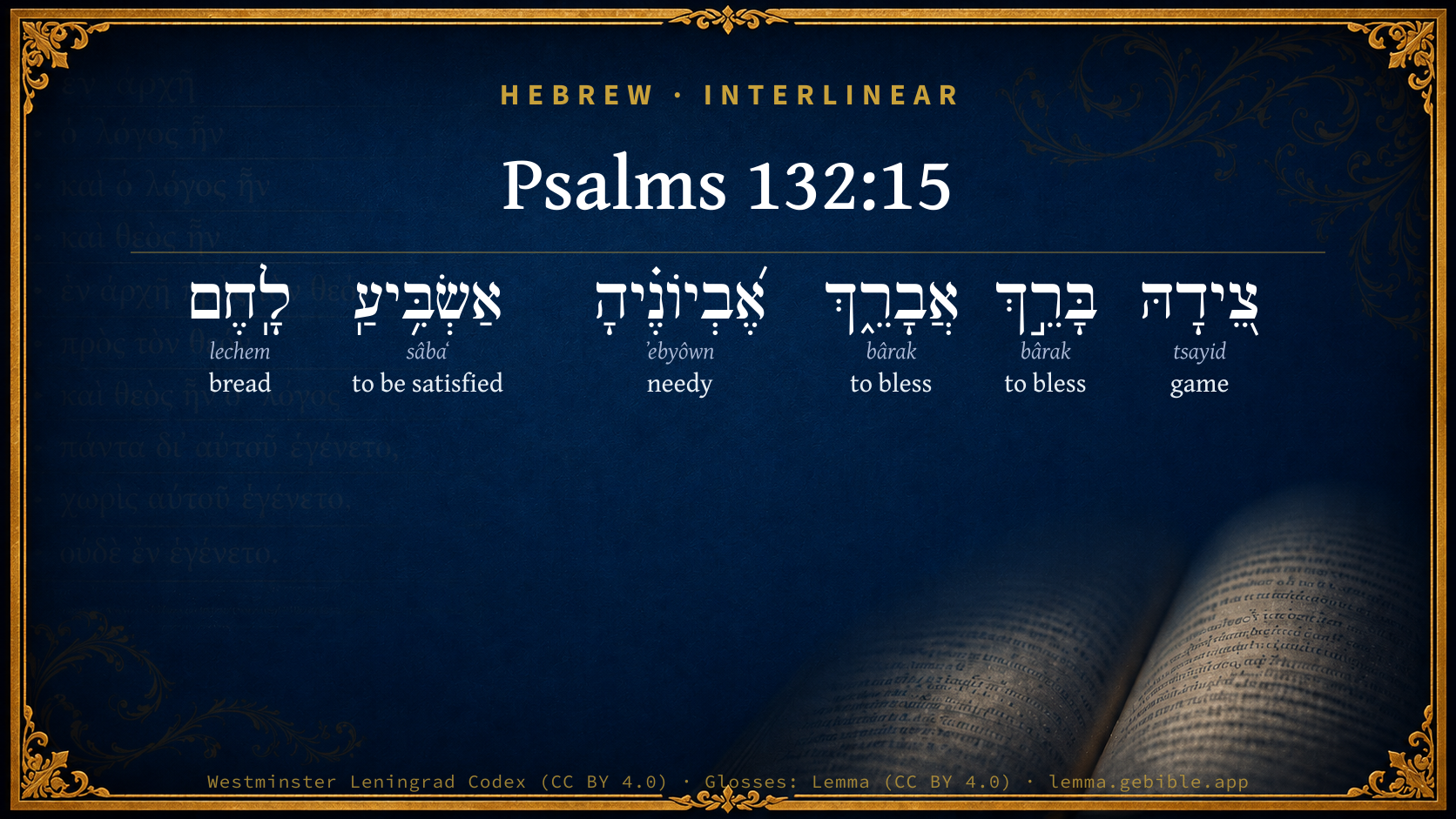
Hebrew (Westminster Leningrad Codex) Psalms 132:15 appears in the Hebrew Old Testament. The text above is from the Westminster Leningrad Codex. Each word links to its Strong’s number, a concise gloss, and parsing drawn from the Open Scriptures Hebrew Bible morphology. Click any word for its full Brown-Driver-Briggs (BDB) entry.
Download image
Cite this verse

Psalms 132:15 (World English Bible). Public Domain. Lemma interlinear Bible study tool, https://lemma.gebible.app/v/psalms/132/15.

Show BibTeX & RIS
BibTeX
RIS
English Translation
I will abundantly bless her provision. I will satisfy her poor with bread.
World English Bible · Public Domain
Download a study sheet

One document with this verse’s original text, its word-by-word gloss line, the meaning frame, cross-references with their text, attributed commentary, and full source and license credits — printable, and it pastes into notes with its structure intact.

This verse Autodidact and up

Study sheet (.html) Plain text (.txt)

A passage Seminary Student

Up to 50 verses in one chapter. A passage sheet keeps up to 6 commentary sources and 12 cross-references per verse, in the order this page ranks them, and says so on the sheet whenever that leaves anything out. Ask for a single verse and you get the Autodidact verse sheet above.

Everything on this page stays free to read, with no account — the sheet is a download of what is already on screen, not access to it.

Want to remove ads? Support Godless Engineer
Compare translations 3

The same verse in 3 English versions, stacked beneath the original-language interlinear above. Click any original word for its lexicon entry.

Each is an independent rendering of the whole verse — the interlinear is not word-aligned to these translations.

Highlighted words mark where these versions differ — a whole-verse word diff, not a word-by-word alignment.

  • World English Bible Public Domain
    I will abundantly bless her provision. I will satisfy her poor with bread.
  • King James Version Public Domain
    I will abundantly bless her provision: I will satisfy her poor with bread.
  • unfoldingWord Literal Text CC BY-SA 4.0
    Blessing I will bless her provisions; her needy I will satisfy bread.

unfoldingWord Literal Text — © unfoldingWord, licensed CC BY-SA 4.0. Word-aligned USFM3 via Door43 (git.door43.org/unfoldingWord/en_ult).

Versions to compare (up to 4)

3 of 4 selected

Show all 17 translations

Every available English version of this verse, each an independent rendering of the whole verse.

  • World English Bible Public Domain
    I will abundantly bless her provision. I will satisfy her poor with bread.
  • Berean Standard Bible Public Domain
    I will bless her with abundant provisions; I will satisfy her poor with bread.
  • Majority Standard Bible Public Domain
    I will bless her with abundant provisions; I will satisfy her poor with bread.
  • King James Version Public Domain
    I will abundantly bless her provision: I will satisfy her poor with bread.
  • American Standard Version (1901) Public Domain
    I will abundantly bless her provision: I will satisfy her poor with bread.
  • Revised Version (1885) Public Domain
    I will abundantly bless her provision: I will satisfy her poor with bread.
  • Geneva Bible (1599) Public Domain
    I will surely blesse her vitailes, and will satisfie her poore with bread,
  • Young's Literal Translation Public Domain
    Her provision I greatly bless, Her needy ones I satisfy `with' bread,
  • Literal Standard Version CC BY-SA 4.0
    I greatly bless her provision, || I satisfy her poor [with] bread,
  • Unlocked Literal Bible CC BY-SA 4.0
    I will abundantly bless her with provisions. I will satisfy her poor with bread.
  • unfoldingWord Literal Text CC BY-SA 4.0
    Blessing I will bless her provisions; her needy I will satisfy bread.
  • Darby Bible Public Domain
    I will abundantly bless her provision; I will satisfy her needy ones with bread;
  • World Messianic Bible Public Domain
    I will abundantly bless her provision. I will satisfy her poor with bread.
  • Webster's Bible Public Domain
    I will abundantly bless her provision: I will satisfy her poor with bread.
  • Free Bible Version CC BY-SA 4.0
    I will provide the people of the city with all they need; I will feed the poor.
  • Bible in Basic English Public Domain
    My blessing will be on her food; and her poor will be full of bread.
  • JPS Tanakh (1917) Public Domain
    I will abundantly bless her provision; I will give her needy bread in plenty.

Literal Standard Version (2020), Covenant Press — licensed CC BY-SA 4.0. Text via the HelloAO Bible API (eBible.org). Unlocked Literal Bible (unfoldingWord) — licensed CC BY-SA 4.0. Text via the HelloAO Bible API (eBible.org). unfoldingWord Literal Text — © unfoldingWord, licensed CC BY-SA 4.0. Word-aligned USFM3 via Door43 (git.door43.org/unfoldingWord/en_ult). Free Bible Version, Dr. Jonathan Gallagher — licensed CC BY-SA 4.0. Text via the HelloAO Bible API (eBible.org).

Word by word

More ways to search: Search by grammar → Find every occurrence → Compare this word →

Practice this passage: Drill this verse → Learn its vocabulary →

About this verse

These counts appear in no published source. They are computed here, from the morphology-tagged text and Lemma’s own curated glosses. What Lemma adds →

6
words
5
distinct lemmas
Wisdom
section

Notable vocabulary

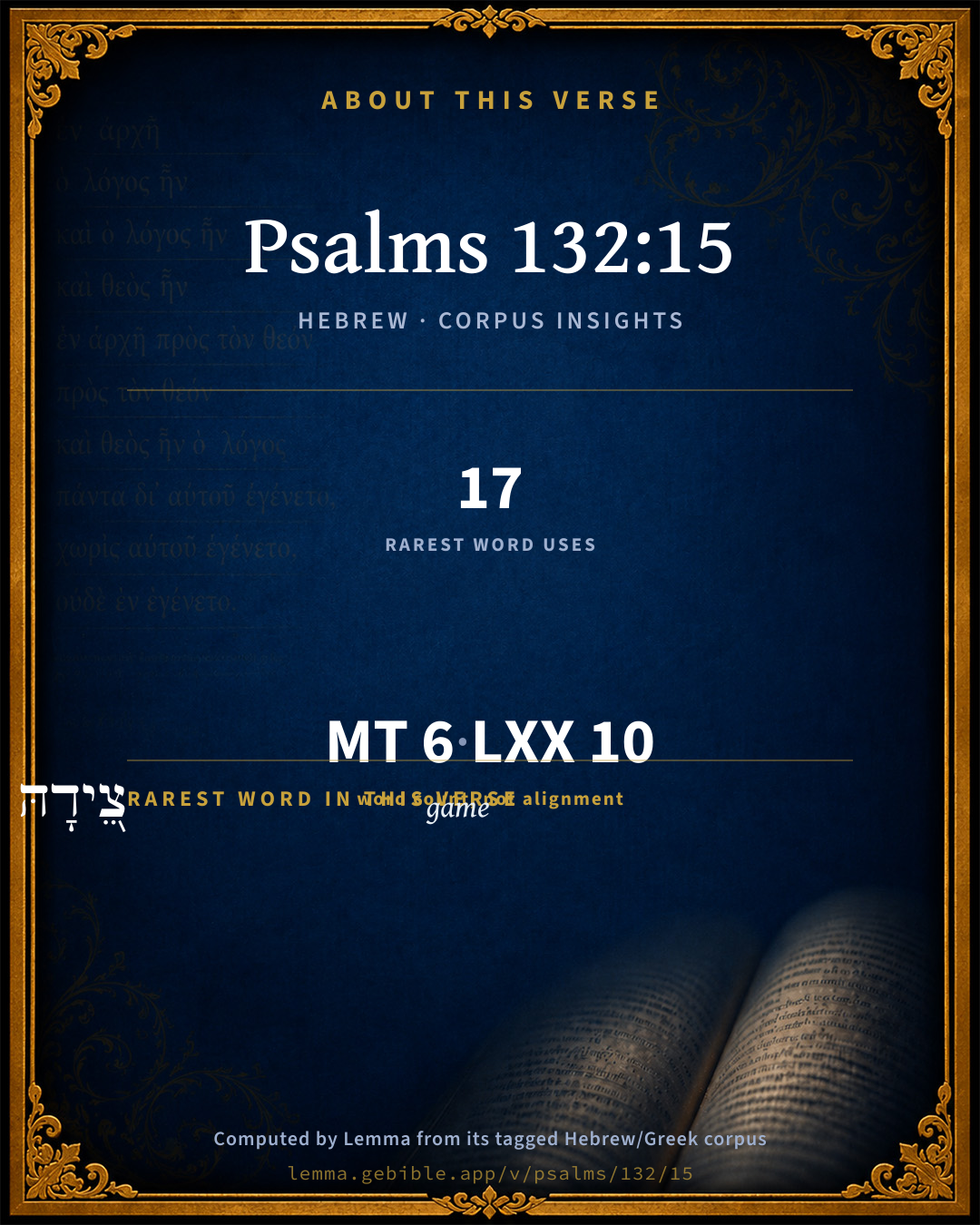
The rarest word here is צֵ֭ידָהּ game H6718 — appearing just 17 times in the whole Hebrew Bible.

Shared distinctive vocabulary

צֵ֭ידָהּ game H6718 occurs in 16 verses of the Hebrew Bible. Also found in:

Grammatical profile

  • 3 verbs
  • 2 nouns
  • 1 adjective

Verb forms

  • בָּרֵ֣ךְ Piel · Infinitive Absolute
  • אֲבָרֵ֑ךְ Piel · Imperfect
  • אַשְׂבִּ֥יעַֽ Hiphil · Imperfect

Repetition

A word recurs within this verse — often emphatic in Hebrew:

  • בָּרֵ֣ךְ to bless H1288 ×2

Hebrew & Septuagint length

In English translation the verse runs 13 words from the Hebrew and 13 from the Septuagint (LXX English) — the same length.

A rough comparison of the two English renderings, which tokenize alike — not a word-level alignment.

Word counts can differ between the Hebrew and the Greek without any difference in meaning — e.g. the Hebrew direct-object marker אֵת has no separate Greek word, and Greek often adds the article ὁ.

In the original languages it is 6 Hebrew tokens and 10 Greek tokens — but the two are counted differently (Hebrew bundles its prefixes and suffixes into one token; the Greek is in lemma form), so that isn’t a like-for-like length.

Cross-references

24

Topical passages linked to Psalms 132:15 in the Treasury of Scripture Knowledge — connected by theme and wording, ordered by reader-vote popularity; previews shown in the World English Bible.

  • Psalms 147:14 He makes peace in your borders. He fills you with the finest of the wheat.
  • Leviticus 26:4–5 then I will give you your rains in their season, and the land shall yield its increase, and the trees of the field shall yield their fruit.
  • Proverbs 3:9–10 Honor Yahweh with your substance, With the first fruits of all your increase:
  • Mark 8:6–9 He commanded the multitude to sit down on the ground, and he took the seven loaves. Having given thanks, he broke them, and gave them to his disciples to serve, and they served the multitude.
  • 2 Corinthians 9:10–11 Now may he who supplies seed to the sower and bread for food, supply and multiply your seed for sowing, and increase the fruits of your righteousness;
  • Matthew 5:6 Blessed are those who hunger and thirst after righteousness, For they shall be filled.
  • Exodus 23:25 You shall serve Yahweh your God, and he will bless your bread and your water, and I will take sickness away from your midst.
  • Deuteronomy 14:29 and the Levite, because he has no portion nor inheritance with you, and the foreigner living among you, and the fatherless, and the widow, who are within your gates, shall come, and shall eat and be satisfied; that Yahweh your God may bless you in all the work of your hand which you do.
  • Psalms 107:9 For he satisfies the longing soul. He fills the hungry soul with good.
  • Isaiah 33:16 He shall dwell on high; his place of defense shall be the munitions of rocks; his bread shall be given [him]; his waters shall be sure.
  • Jeremiah 31:14 I will satiate the soul of the priests with fatness, and my people shall be satisfied with my goodness, says Yahweh.
  • Haggai 1:6 You have sown much, and bring in little. You eat, but you don't have enough. You drink, but you aren't filled with drink. You clothe yourselves, but no one is warm, and he who earns wages earns wages to put them into a bag with holes in it."
  • Haggai 1:9 "You looked for much, and, behold, it came to little; and when you brought it home, I blew it away. Why?" says Yahweh of Hosts, "Because of my house that lies waste, while each of you is busy with his own house.
  • Haggai 2:16–19 Through all that time, when one came to a heap of twenty measures, there were only ten. When one came to the wine vat to draw out fifty, there were only twenty.
  • Malachi 2:2 If you will not listen, and if you will not lay it to heart, to give glory to my name," says Yahweh of Hosts, "then will I send the curse on you, and I will curse your blessings. Indeed, I have cursed them already, because you do not lay it to heart.
  • Matthew 6:32–33 For the Gentiles seek after all these things, for your heavenly Father knows that you need all these things.
  • Luke 1:53 He has filled the hungry with good things. He has sent the rich away empty.
  • Deuteronomy 28:2–5 and all these blessings shall come on you, and overtake you, if you shall listen to the voice of Yahweh your God.
  • Psalms 22:26 The humble shall eat and be satisfied. They shall praise Yahweh who seek after him. Let your hearts live forever.
  • Psalms 33:18–19 Behold, Yahweh's eye is on those who fear him, On those who hope in his loving kindness;
  • Psalms 36:8 They shall be abundantly satisfied with the abundance of your house. You will make them drink of the river of your pleasures.
  • Psalms 37:3 Trust in Yahweh, and do good. Dwell in the land, and enjoy safe pasture.
  • Psalms 37:19 They shall not be disappointed in the time of evil. In the days of famine they shall be satisfied.
  • Matthew 14:19–21 He commanded the multitudes to sit down on the grass; and he took the five loaves and the two fish, and looking up to heaven, he blessed, broke and gave the loaves to the disciples, and the disciples gave to the multitudes.

Cross-references courtesy of OpenBible.info (CC BY 4.0).

Hebrew and Greek witnesses Masoretic Hebrew ↔ Greek Septuagint

The same verse in the two great witnesses to the Old Testament, shown verse-for-verse.

You’re reading Greek Psalm 131 (Hebrew Psalm 132). The Septuagint counts the superscription, so verse numbers can differ from the Hebrew — chapter-level alignment, not verse-by-verse. Numbering follows Rahlfs.

These are two independent witnesses, not word-aligned to each other, and the Septuagint is shown in lemma (dictionary) form.

Hebrew Psalms 132:15 Masoretic · Westminster Leningrad Codex

צֵ֭ידָהּ בָּרֵ֣ךְ אֲבָרֵ֑ךְ אֶ֝בְיוֹנֶ֗יהָ אַשְׂבִּ֥יעַֽ לָֽחֶם

I will abundantly bless her provision. I will satisfy her poor with bread.

World English Bible · Public Domain

Greek LXX Greek Psalm 131:15 Septuagint · lemma form

ὁ θήρα αὐτός εὐλογέω εὐλογέω ὁ πτωχός αὐτός χορτάζω ἄρτος

I will surely bless her provision: I will satisfy her poor with bread.

LXX2012 (modern English Septuagint) · Public Domain

On this verse, John Calvin's Commentaries discusses the Septuagint’s reading. Read the note in Commentary ↓

Hebrew: Westminster Leningrad Codex (CC BY 4.0). Greek: Septuagint (public domain); English from LXX2012 (modern English Septuagint) (Public Domain). How the Septuagint differs from the Hebrew →

Commentary

Notes on Psalms 132:15 from classic Christian and Jewish commentators (each source and its license shown beneath its notes). The classic Christian expositions comment on the surrounding passage and are grouped to its opening verse, so a note may address several verses; the Jewish commentaries on the Tanakh (Rashi and others) are per-verse, so they appear only where the commentator wrote on this verse.

Lemma curates 59 commentaries, every one of them public domain or Creative Commons licensed, each selected and text-cleaned for this edition rather than reprinted as found. About our sources →

Trapp's Complete Commentary

John Trapp

Psa 132:15 I will abundantly bless her provision: I will satisfy her poor with bread.

Ver. 15. I will abundantly bless her provision] Her stock and her store; so that she shall not want necessaries, which yet she shall hunt for (that is, labour for), as the Hebrew word importeth; and know how she comes by; Viatico eius affatim benedicam (Trem.): therefore it is added,

I will satisfy her poor with bread] Dainties I will not promise them; a sufficiency, but not a superfluity; poor they may be, but not destitute; bread they shall have, and of that, God’s plenty, as they say; enough to bring them to their Father’s house, where is bread enough. Let not, therefore, the poor Israelite fear to bring his offerings, or to disfurnish himself for God’s worship, &c.

John Trapp, A Commentary or Exposition upon All the Books of the Old and New Testament (1647–1656) — public domain. Text from a community e-Sword module.

The Biblical Illustrator

Joseph S. Exell

Psa_132:15

I will abundantly bless her provision.

An abundant blessing promised to the Church upon her spiritual provision

I. The glorious speaker--God Himself.

1. The God for whom a habitation has been prepared in the Church. If you enjoy the blessing of God upon your provision, you will cheerfully contribute your mite for preparing Him a habitation.

2. The God who hath chosen Zion, and taken up His habitation in her. By this means He knows every circumstance relative to her and to every one of her members; lie is ready to hear all the requests of His people, and to grant them without loss of time.

3. The God from whom all her provision comes. As He knows what provision is suitable to every ones taste, and to every ones need, He knows what blessing is proper to make every ones provision effectual for affording him the promised satisfaction.

II. The party spoken of--Zion. The Church is spoken of in the feminine gender, chiefly to put us in mind of two things.

1. Of her weakness and helplessness, considered in herself.

2. Of that happy relation that subsists between Christ and her. So close and intimate is that mysterious relation, that it can be compared to no other earthly relation--so fitly as to that between husband and wife. He has betrothed her to Himself for ever. He nourishes and cherishes her as a loving husband the wife of his youth.

III. The benefit promised--a blessing. As soon as any person is brought into a state of union with Christ, and is blessed in Him,--being justified freely by the grace of God; not only is that person adjudged to happiness, but that sentence has an effect upon all that he meets with in the course of Providence. All the common benefits of life have a commission from God to be means, not merely of rendering his present life happy, as far as happiness is attainable here,--but likewise of preparing him for eternal happiness, and of conducting him to it. Yea, the trials, afflictions, and miseries of this life, are all under an appointment of God, to be conducive to the same end (2Co_4:17).

IV. The more immediate subject of this blessing--her provision. The-spiritual Israel have nothing of their own to support the life of their souls: and the wilderness, through which they pass, affords nothing fit for that purpose. They behoved, therefore, to perish, if their Heavenly Father did not give them the true bread from heaven, which is no other than the flesh and blood of His own eternal Son, which He gave for the life of the world.

V. The degree in which this blessing is bestowed--abundantly. (John Young, D. D.)

I will satisfy her poor with bread.--

The poor-laws of the Bible

Those who are not familiar with the Bible, especially with the Old Testament, might be disposed to smile at the statement, that if we could get the poor-laws of the Bible fairly administered, there would be an end to the miseries and complaints of the poor. God has from the beginning made the poor mans cause His own. His aim has been to stir men up to consideration and sympathy, by identifying the poor with Himself in His account with mankind. He that hath pity on the poor lendeth to the Lord. That is the principle; the claim of the poor on men is the claim of God. And throughout the Old Testament God announces and enforces His provision for the poor (Deu_15:7-11; Isa_58:6-8; Neh_8:10). The principle runs through the whole Book. Whatever men felt that they owed to God they were to pay to the poor. Would it be possible to place their claim on a surer and firmer foundation? And there is a tenderness in the tone of the Bible about the poor and helpless, which is unmatched, as far as I know, in any ancient literature; and it is one of the most sacred traditions which the elder dispensation handed down to the Christian Church. But there is nothing in the way in which the Bible deals with the question which gives countenance even for a moment to the notion that bread is the great necessity of man. Gods cure of disease is always radical; therefore the method is slow, deep, and, on the surface, long invisible. And herein Gods method differs essentially from the various panaceas for social wrong and misery which have been promulgated in various ages by the philosophers. Bread is precious to those who use life nobly. But he who should assure bread on a sufficient scale to all men, and make no provision for their spiritual culture, for their concord, brotherly love, energy, industry, and perseverance, would miss the deepest elements of human misery, would, in the end, nourish it fearfully, and would hasten, instead of retarding, the overthrow of society. God, in His method of dealing with the problem, considers the what then? He takes things in their true order, the heavenly order, the order of their necessity. He does not flood the world with plenty, and leave man to wrangle and wrestle over the partition of it. He would first cure the radical selfishness and wickedness out of which in the long run all absolute poverty springs. It is a mistake to use the term Christian Socialism, under the idea of commending the Gospel to those who favour Communistic views. The Gospel aims at an ideal which, as a dream, has haunted the imagination of every great world reformer who has ever pored over the dark problems of society, but it aims at it by a path which is all its own. It begins from within, and works outwards; it puts love in the heart, and then sends plenty. All true abundance springs out of love. There was a movement in the early Church which had, no doubt, a communistic aspect, and which some may connect with the essential spirit of Christianity, and regard as the only true form of life in the Christian society (Act_2:42-47). It seems to have been confined to the Church at Jerusalem, and there it was carried too far and lasted too long. We find from apostolic records that the Church at Jerusalem became rapidly the poorest and the most helpless of all the primitive Churches, and was compelled to throw herself on the charities of the Gentile Christian world (Rom_15:25-27), and this history is very important and instructive. It reveals the inevitable issue of a communistic administration of the temporal affairs of men. The rights of property were most carefully guarded in the early Churches, as we gather from all the apostolic epistles; while brotherly love and the most large and constant charity were enjoined on the most sacred grounds. There is nothing that God reiterates more earnestly than the poor mans claim. There is nothing that God sustains more mightily than the poor mans cause. There is nothing that God avenges more awfully than the poor mans wrong. Would God that I could see it, many a poor man cries; but, as far as I see, the masters that profess most are often the hardest; and those who say that they have most to do with God, and from whom we might hope to find what God can do to help us, are too frequently known as grinding the faces of the poor. Well, there is truth in this, alas l no doubt; but be very chary of attaching value to the criticism of employers by the employed; their judgment will be constantly narrow, selfish, and unjust. But ye masters, remember the higher judgment. Ye are My witnesses, saith the Lord; ye, who say that ye know My name. Beware how you drag it through the mire of selfish and sensual lives, and put it before all men, and especially before the poor, to an open shame. We may all take the warning home. But ye poor, be just. Do not charge on God the wrongs and evils which He is doing His best by His own patient but radical method to cure. He hates the grinding of the face of the poor more entirely, I believe, than He hates any evil thing that is done under the sun. Be just. See how God is fighting your battle in all ages, and maintaining your cause against the oppressor. There is one method by which God is always maintaining the cause of the poor, which they are very slow to recognize and to honour, and that is against themselves, against their own idleness, improvidence, and lust. Mans folly and sin do not withhold, do not restrain, Gods mercy, or we had none of us been here. But while He pities, He educates and purifies. Side by side with the pity there is the hard, stern rule, that if a man will not work, neither shall he eat. Giving is the cheapest and easiest form of charity. To take poverty by the hand and lift it is harder work, and demands a resolution, the ultimate spring of which is on high. Self-help must be the message of our visitors and almoners. We must have done with the pampering method of the constant dole. Help the industrious and necessitous over a crisis that they may help themselves again. Stir up the energies of the indolent and dependent. (J. B. Brown, B. A.)

The Biblical Illustrator, edited by Joseph S. Exell (c. 1880s–1900s) — public domain. Text from a community e-Sword module.

The Treasury of David

Charles H. Spurgeon

Ver. 15.

1. Blessed provision.

2. Satisfied people"satisfy her poor."

3. Glorified God"I will."

4. Happy placeZion.

Psalms 132:15*

Ver. 15. I will abundantly bless her provision. It must be so. How can we be without a blessing when the Lord is among us? We live upon his word, we are clothed by his charity, we are armed by his power: all sorts of provision are in him, and how can they be otherwise than blessed? The provision is to be abundantly blessed;then it will be abundant and blessed. Daily provision, royal pie vision, satisfying provision, overflowingly joyful provision the church shall receive; and the divine benediction shall cause us to receive it with faith, to feed upon it by experience, to grow upon it by sanctification, to be strengthened by it to labour, cheered by it to patience, and built up by it to perfection. I will satisfy her poor with bread. The citizens of Zion are poor in themselves, poor in spirit, and often poor in pocket, but their hearts and souls shall dwell in such abundance that they shall neither need more nor desire more. Satisfaction is the crown of experience. Where God rests his people shall be satisfied. They are to be satisfied with what the Lord himself calls "bread", and we may be sure that he knows what is really bread for souls. He will not give us a stone. The Lord's poor shall "have food convenient for them": that which will suit their palate, remove their hunger, fill their desire, build up their frame, and perfect their growth. The breadth of earth is "the bread that perisheth", but the bread of God endureth to life eternal. In the church where God rests his people shall not starve; the Lord would never rest if they did. He did not take rest for six days till he had prepared the world for the first man to live in; he would not stay his hand till all things were ready; therefore, we may be sure if the Lord rests it is because "it is finished", and the Lord hath prepared of his goodness for the poor. Where God finds his desire his people shall find theirs; if he is satisfied, they shall be.

Taking the two clauses together, we see that nothing but an abundant blessing in the church will satisfy the Lord's poor people: they are naked and miserable till that comes. All the provision that Solomon himself could make would not have satisfied the saints of his day: they looked higher, and longed for the Lord's own boundless blessing, and hungered for the bread which came down from heaven. Blessed be the Lord, they had in this verse two of the "I wills" of God to rest upon, and nothing could be a better support to their faith.

Ver. 15. I will abundantly bless her provision, etc. The provision of Zion, the church of God, the word and ordinances, of which Christ is the sum and substance; the gospel is milk for babes, and meat for strong men; the ordinances are a feast of fat things; Christ's flesh is meat indeed, and his blood drink indeed; the whole provision is spiritual, savoury, salutary, strengthening, satisfying, and nourishing, when the Lord blesses it; as he does to those who hunger and thirst after it, and feed upon it by faith; so that their souls grow thereby, and they become fat and flourishing; grace increases in them, and they are fruitful in every good work; and this the Lord promises to do abundantly, in a very large way and manner; or certainly, for it is, in the original text, "in blessing I will bless", that is, will surely bless, as this phrase is sometimes rendered.

I will satisfy her poor with bread. Zion has her poor; persons may be poor and yet belong to Zion, belong to Zion and yet be poor; there are poor in all the churches of Christ: our Lord told his disciples that they had the poor, and might expect to have them, always with them; and particular directions are given to take care of Zion's poor under the gospel dispensation, that they may not want bread in a literal sense: though by the poor are chiefly designed the Lord's afflicted and distressed ones; or those who in a spiritual sense are poor, sensible of their spiritual poverty, and seeking after the true riches; or are poor in spirit, to whom the kingdom of heaven belongs; these the Lord promises to satisfy, to fill them to the full with the bread of the gospel, made of the finest of the wheat, of which there is enough and to spare in his house; and with Christ the bread of life, of which those that eat shall never die, but live for ever. John Gill.

Ver. 15. Her provision; I will bless, I will bless. The repetition of the verb may express either certainty or fulness. I will surely bless, or I will bless abundantly. Joseph Addison Alexander.

Ver. 15. I will abundantly bless her provision. Believe it, a saint hath rare fare, gallant cheer, and rich diet, and all at free cost. He is feasted all the day long; he is brought oft into the banqueting house, and hath the rarest, the costliest, the most wholesome diet, that which is most hearty and strengthening, which is most dainty and pleasant, and the greatest variety, and nothing is wanting that may make his state happy, except a full enjoyment of glory itself. The Lord gives him all the experiences of his power and goodness to his Church in former ages to feed his hopes upon; nay, many choice providences, many of prayer, many foretastes of glory, many ordinances, especially that great one the Lord's Supper, at which Christ and all his benefits are served up in a royal dish to refresh and feast the faith, hope, and love of the saints. And that which sweetens all thishe knows that all this is but a little to what he shall shortly live upon when he comes to the marriage supper; then he shall always be feasted and never surfeited. And beside all this, he hath the sweet and refreshing incomes of the Spirit, filling him with such true pleasure, that he can easily spare the most sumptuous banquet, the noblest feast, and highest worldly delights, as infinitely short of one hour's treatment in his Friend's chamber. And, if this be his entertainment in the inn, what shall he have at the court? If this heavenly manna be his food in the wilderness, at what rate is he like to live when he comes into Canaan? If this be the provision of the way, what is that of the country? John Janeway, about 1670.

Ver. 15. I will satisfy her poor with bread. Christ is a satisfying good. A wooden loaf, a silver loaf, a golden loaf will not satisfy a hungry man; the man must have bread. The dainties and dignities of the world, the grandeur and glory of the world, the plenty and prosperity of the world, the puff and popularity of the world, will not satisfy a soul sailing by the gates of hell, and crying out of the depths; it must be a Christ. "Children, or I die", was the cry of the woman; a Christ, or I diea Christ, or I am damned, is the doleful ditty and doleful dialect of a despairing or desponding soul. "He that loveth silver shall not be satisfied therewith; nor he that loveth abundance with increase:" Ec 5:10. It is a good observation, that the world is round, but the heart of man is triangular. Now, all the globe of the world will not fill the triangular heart of man. What of the world and in the world can give quietness, when Christ, the Sun of Righteousness, goes down upon the soul? The heart is a three square, and nothing but a trinity in unity and a unity in trinity will satisfy this. Not riches, nor relations, nor barns, nor bags, will satisfy a convinced and deserted soul. This person can say concerning his bags as a great person upon a sick, if not a dying, bed, did concerning his bags, Away, and away for ever. Though there be bag upon bag, yet they are altogether insignificant in a dying hour; these bags, they are but as so many ciphers before a figure. This is the cry of despairing and desponding souls: "O satisfy us early with thy mercy; that we may rejoice and be glad all our days:" Ps 90:14. Richard Mayhew, 1679.

Ver. 15. I will satisfy her poor with bread. Dainties I will not promise them; a sufficiency, but not, a superfluity:poor they may be, but not destitute; bread they shall have, and of that God's plenty, as they say; enough to bring them to their Father's house, "where there is bread enough." Let not, therefore, the poor Israelite fear to bring his offerings, or to disfurnish himself for God's worship, etc. John Trapp.

Psalms 132:16*

Charles H. Spurgeon's The Treasury of David (1869–1885) — public domain. Psalms only. Text from a community e-Sword/MySword module.

J. A. Alexander on Psalms

Joseph Addison Alexander

15. (Psa 132:15) Her provision I will bless, I will bless; her poor I will satisfy (with) bread. The repetition of the verb may express either certainty or fulness. I will surely bless, or I will bless abundantly. See above, on Psa 126:6. The word translated provision is a cognate form to that in Psa 78:25. Satisfy, amply or abundantly supply.

Joseph Addison Alexander, The Psalms Translated and Explained (1850) — public domain. Text from a community e-Sword module.

Adam Clarke's Commentary

Verse 15. I will abundantly bless her provision] There shall be an abundant provision of salvation made for mankind in the Christian Church. Our Lord's multiplication of the loaves was a type and proof of it.

Adam Clarke's Commentary on the Bible (1810–1826) — public domain. Text from a community e-Sword/MySword module.

John Calvin's Commentaries

15. Blessing I will bless, etc. God’s dwelling in the midst of the people was what constituted the great source of their blessedness; and now some of the proofs are mentioned which he would give of his fatherly regard, such as preparing and administering their ordinary food, relieving their wants, clothing their priests with salvation, and filling all his people with joy and gladness. This it was necessary should be added, for unless we have ocular demonstration of the divine goodness, we are not spiritual enough to rise upwards to the apprehension of it. We have a twofold demonstration of it in the matter of our daily food; first in the earth’s being enriched so as to furnish us with corn, and wine, and oil; and again in the earth’s produce being multiplied, through a secret power, so as to provide us with sufficient nourishment. There is here a promise that God would exert a special care over his own people to supply them with food, and that though they might not have a great abundance, yet the poor would be satisfied. We must not omit mentioning the remarkable and ludicrous mistake which the Papists have made upon this passage, and which shows the judicial stupidity they lie under to be such, that there is nothing so absurd they will not swallow. By confounding two letters into one, for victus they read vidus, and then conjectured that this must be a mutilation for viduas — blessing I will bless her widows! Thus they made “widows” out of “food” — an extraordinary blunder, which we would scarcely credit, were it not a fact that they sing the word out in their temples to this present day. “צידה, her provision. The word ציד signifies food which is taken in hunting, and then it is used to express food of any kind — provision generally. The Septuagint has θήραν, which denotes provision that has been hunted, and so obtained; but another reading of the Greek version τὴν χήραν αὐτὢς, which has been followed by the Vulgate, Arabic, and Ethiopic; the rendering of the Vulgate being viduam ejus This corrupt reading is noticed by Jerome.” — Phillips.

John Calvin's Commentaries (1540-1563) — public domain. Text from the Calvin Translation Society English edition (1840s-50s) via the Christian Classics Ethereal Library (ccel.org). Calvin's coverage is partial (roughly two-thirds of the Bible); uncommented books and verses are honest gaps, never fabricated. The 19th-century editor's footnotes and remarks are omitted so the notes are faithfully Calvin's own voice.

The Cambridge Bible for Schools and Colleges

gen. ed. J. J. S. Perowne

15. I will abundantly bless &c.] Or, I will surely bless. The Divine blessing will rest upon people, priests (16), and rulers (17f.). Even the poor shall not want. Cp. Deu_15:4. Palestine was liable to famines, and in the early days of the Restoration the community had suffered severely from scarcity (Hag_1:6 ff.), but this was not God’s Will[83].

[83] The word for provision (צידה) means also prey, and was rendered literally by the LXX, θήραν (אaT); but in some MSS (e.g. אAR) this was changed to χήραν widow(s) either through a scribe’s mistake, or because prey seemed unintelligible and widows might naturally be classed with the poor. Cp. Deu_14:29. Hence the Vulg. viduam, Douay, her widow.

The Cambridge Bible for Schools and Colleges (gen. ed. J. J. S. Perowne; Cambridge University Press, 1878–1918) — public domain. Text from a community e-Sword module.

John Gill's Exposition

There will I make the horn of David to bud,.... Which the Targum interprets "a glorious" King; and both Kimchi and Ben Melech, and also Arama, understand it of the Messiah, and very rightly; called the horn of the Lord's Anointed, and the horn of salvation, Sa1 2:10, Luk 1:69; expressive of his power and strength, in allusion to the horns of cattle, with which they push their enemies and defend themselves; so horns are interpreted kings, Dan 7:24; and is fitly applied to Christ, raised up of the seed of David, the man of God's right hand, made strong for himself, who is a mighty King and an able Saviour; as appears by what he has done and suffered, by the deliverance and salvation of his people, and by the destruction of all their enemies: and it is here promised that God would make this horn to "bud" or branch out, in allusion to another name of the Messiah, the "branch"; and it is the same as raising up to David a righteous branch, or causing the Messiah to spring forth as a branch out of his roots, for which reason he is called the Lord's servant, the branch, and the man the branch; see Jer 23:5; and it should be further observed that the Lord says, "there" will I do it; that is, either at Ephratah, which is Bethlehem, the place where the Messiah was to be born, and was born; or else at Zion or Jerusalem, where he appeared and showed himself, where he taught his doctrines and wrought many of his miracles, and near to which he suffered and died; and this shows that the Messiah must be come, that this horn of David must have budded, or the man the branch brought forth, since Bethlehem and Jerusalem are long ago demolished;

I have ordained a lamp for mine anointed; which Jerom understands of John the Baptist, the forerunner of Christ, who was a burning and shining light, but was not "that light", that famous light, that was to come, but was sent to bear witness of it; he being but as a candle, as the word here used signifies, in comparison of the sun of righteousness; but rather it means a son and successor of David, the Lord's anointed; in which sense the phrase is often used, Kg1 11:36; and here the famous and illustrious Son and successor of his, the Messiah, the light which lightens every man with the light of reason; and who is the light of the world of his people, enlightening them with the light of grace, and will be the light of the New Jerusalem state, and of the ultimate glory; him God has "ordained" as such, even foreordained him before the foundation of the world; this lamp, or light, he prepared in eternity, and it dwelt with him, and therefore was desired to be sent out from him, Dan 2:22; which places are to be understood of the Messiah; See Gill on Dan 2:22 and See Gill on Psa 43:3.

John Gill's Exposition of the Whole Bible (1746–1763) — public domain (CC PDM 1.0). Text via the HelloAO Bible API.

Albert Barnes' Notes on the Bible

I will abundantly bless her provision - Margin, surely. Hebrew, “Blessing I will bless,” a strong affirmation, meaning that he would certainly do it; that he would do it in every way; that every needed blessing would be imparted. The word rendered provision is a cognate form of the word in Psa 78:25, translated meat: “He sent them meat to the full.” It properly refers to food for a journey, but it is applicable to any kind of food. The original idea is that of food obtained by hunting - as game, venison: Gen 25:28; Job 38:41. The meaning here is, that God would provide abundantly for their support.

I will satisfy her poor with bread - I will give them what they need. See the notes at Psa 37:25.

Albert Barnes' Notes on the Bible (1834–1885) — public domain. Text from a community e-Sword/MySword module.

Matthew Poole's English Annotations

I will plentifully provide for Jerusalem, and all that live in her or resort to her for worship; nor shall they seek my face in vain.

Matthew Poole's English Annotations on the Holy Bible (1683–1685) — public domain. Text from a community e-Sword/MySword module.

Whedon's Commentary on the Bible

Daniel D. Whedon

15. Provision—Primarily, what is taken in hunting, as venison, but generally nourishment. The parallel clause has it bread. Temporal blessings are always included in all God’s covenants with man.

Abundantly bless— Literally, Blessing I will bless; that is, I will surely bless.

Daniel D. Whedon (gen. ed.), Commentary on the Old and New Testaments (1874–1909) — public domain. Text from a community e-Sword module.

The Pulpit Commentary

I will abundantly bless her provision: I will satisfy her poor with bread. Literally, this seems to point to the blessing of abundance of food. Spiritually, it may be a promise of ample spiritual sustenance.

The Pulpit Commentary (1880–1919), ed. H.D.M. Spence-Jones & Joseph S. Exell — public domain. Text from a community e-Sword module.

unfoldingWord translationNotes

Door43 World Missions Community

Connecting Statement:

God continues to speak about the city of Zion as if Zion was a woman. (See: Personification)

will abundantly bless her

"will abundantly bless Zion"

will satisfy her poor with bread

Here "poor" refers to the poor people in Zion and "bread" probably represents food in general. AT: "will satisfy the poor people in Zion with food" (See: Nominal Adjectives and Synecdoche)

I will clothe her priests with salvation

Salvation is spoken of as if it is clothing. Possible meanings are 1) "I will cause the priests to behave in a manner worthy of ones whom I have saved" or 2) "I will save her priests" (See: Metaphor)

translationWords

bless

bread

priest

save

faithful

unfoldingWord translationNotes — © Distant Shores Media and the Door43 World Missions Community, licensed CC BY-SA 4.0. Source: git.door43.org/Door43/en_tn.

Rashi

Rabbi Shlomo Yitzchaki (Rashi)

its provision its food.

Rashi on the Tanakh — English translations: “The Judaica Press complete Tanach with Rashi, translated by A. J. Rosenberg” (CC BY 4.0); “Pentateuch with Rashi's commentary by M. Rosenbaum and A.M. Silbermann, 1929-1934” (public domain); “The Metsudah Tanach series, Lakewood, N.J” (CC BY 4.0); and “The Book of Joshua, Metsudah Publications, 1997” (CC BY 4.0). Text via Sefaria.

Lesson kit

Teaching starters — assembled from the data on this page, not authored interpretation. Every prompt links to the verse data it draws on. Edit before teaching.

Psalms, in the Wisdom, opens this verse with 6 words (5 distinct Hebrew lemmas). Its most distinctive word is tsayid (“game”). A historical commentator’s framing appears above. Read the whole chapter for the surrounding context.

Discussion questions

  1. How does “game” (tsayid) shape what this verse is saying?
  2. Genesis 10:9 shares the word «game» with this verse. How do the two illuminate each other?
  3. “to bless” occurs 2× in this one verse. What is the effect of the repetition?
  4. The translations on this page render this verse differently — a whole-verse word diff, not a word-by-word alignment. What might account for the different wordings?
  5. The verb «בָּרֵ֣ךְ» is Piel Infinitive Absolute. How does its form color the action?
  6. Reading how Trapp's Complete Commentary and The Biblical Illustrator read this verse, where do the two commentators agree and where do they part?

Things to notice

Reading settings

Reading text

Shown beneath each verse's original-language words.

Old Testament
Old Testament edition

Read the OT as the Masoretic Hebrew (MT) or the Greek Septuagint (LXX).

English shown for the Greek Septuagint (in the Hebrew ↔ Greek comparison).

Comparing translations? Open the Compare panel on any verse page to stack up to four side by side.