Ruth 4:14

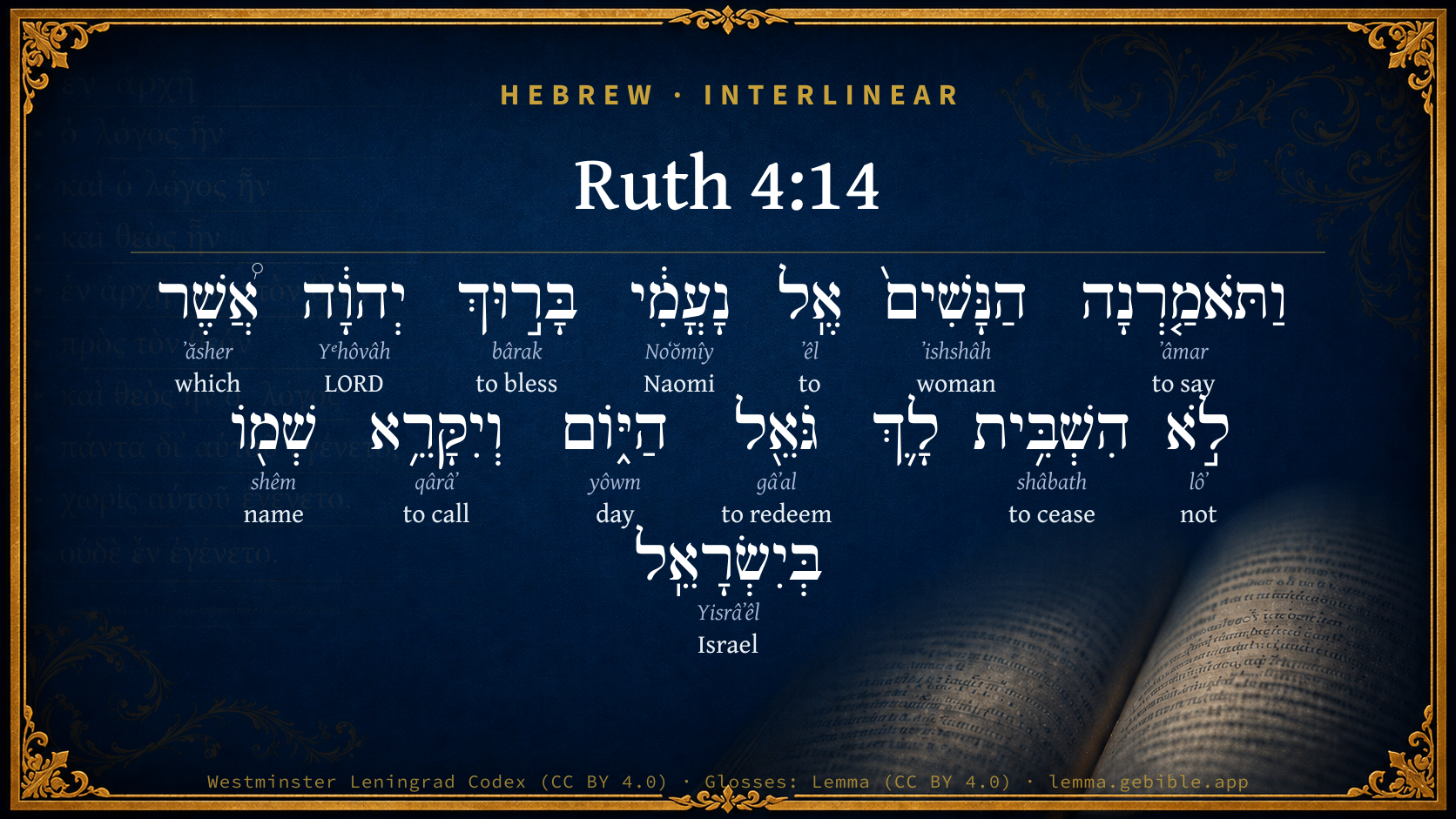
Hebrew (Westminster Leningrad Codex) Ruth 4:14 appears in the Hebrew Old Testament. The text above is from the Westminster Leningrad Codex. Each word links to its Strong’s number, a concise gloss, and parsing drawn from the Open Scriptures Hebrew Bible morphology. Click any word for its full Brown-Driver-Briggs (BDB) entry.
Download image
Cite this verse

Ruth 4:14 (World English Bible). Public Domain. Lemma interlinear Bible study tool, https://lemma.gebible.app/v/ruth/4/14.

Show BibTeX & RIS
BibTeX
RIS
English Translation
The women said to Naomi, Blessed be Yahweh, who has not left you this day without a near kinsman; and let his name be famous in Israel.
World English Bible · Public Domain
Download a study sheet

One document with this verse’s original text, its word-by-word gloss line, the meaning frame, cross-references with their text, attributed commentary, and full source and license credits — printable, and it pastes into notes with its structure intact.

This verse Autodidact and up

Study sheet (.html) Plain text (.txt)

A passage Seminary Student

Up to 50 verses in one chapter. A passage sheet keeps up to 6 commentary sources and 12 cross-references per verse, in the order this page ranks them, and says so on the sheet whenever that leaves anything out. Ask for a single verse and you get the Autodidact verse sheet above.

Everything on this page stays free to read, with no account — the sheet is a download of what is already on screen, not access to it.

Want to remove ads? Support Godless Engineer
Compare translations 3

The same verse in 3 English versions, stacked beneath the original-language interlinear above. Click any original word for its lexicon entry.

Each is an independent rendering of the whole verse — the interlinear is not word-aligned to these translations.

Highlighted words mark where these versions differ — a whole-verse word diff, not a word-by-word alignment.

  • World English Bible Public Domain
    The women said to Naomi, Blessed be Yahweh, who has not left you this day without a near kinsman; and let his name be famous in Israel.
  • King James Version Public Domain
    And the women said unto Naomi, Blessed be the LORD, which hath not left thee this day without a kinsman, that his name may be famous in Israel.
  • unfoldingWord Literal Text CC BY-SA 4.0
    Then the women said to Naomi, “Blessed be Yahweh, who has not left you today without a kinsman-redeemer. May his name be renowned in Israel!

unfoldingWord Literal Text — © unfoldingWord, licensed CC BY-SA 4.0. Word-aligned USFM3 via Door43 (git.door43.org/unfoldingWord/en_ult).

Versions to compare (up to 4)

3 of 4 selected

Show all 18 translations

Every available English version of this verse, each an independent rendering of the whole verse.

  • World English Bible Public Domain
    The women said to Naomi, Blessed be Yahweh, who has not left you this day without a near kinsman; and let his name be famous in Israel.
  • Berean Standard Bible Public Domain
    Then the women said to Naomi, “Blessed be the LORD, who has not left you this day without a kinsman-redeemer. May his name become famous in Israel.
  • Majority Standard Bible Public Domain
    Then the women said to Naomi, “Blessed be the LORD, who has not left you this day without a kinsman-redeemer. May his name become famous in Israel.
  • King James Version Public Domain
    And the women said unto Naomi, Blessed be the LORD, which hath not left thee this day without a kinsman, that his name may be famous in Israel.
  • American Standard Version (1901) Public Domain
    And the women said unto Naomi, Blessed be Jehovah, who hath not left thee this day without a near kinsman; and let his name be famous in Israel.
  • Revised Version (1885) Public Domain
    And the women said unto Naomi, Blessed be the LORD, which hath not left thee this day without a near kinsman, and let his name be famous in Israel.
  • Geneva Bible (1599) Public Domain
    And the women sayd vnto Naomi, Blessed be the Lord, which hath not left thee this day without a kinsman, and his name shalbe continued in Israel.
  • Douay-Rheims (1899) Public Domain
    And the women said to Noemi: Blessed be the Lord, who hath not suffered thy family to want a successor, that his name should be preserved in Israel.
  • Young's Literal Translation Public Domain
    And the women say unto Naomi, `Blessed `is' Jehovah who hath not let a redeemer cease to thee to-day, and his name is proclaimed in Israel,
  • Literal Standard Version CC BY-SA 4.0
    And the women say to Naomi, “Blessed [is] YHWH who has not let a redeemer cease to you today, and his name is proclaimed in Israel,
  • Unlocked Literal Bible CC BY-SA 4.0
    The women said to Naomi, “May Yahweh be blessed, who has not left you today without a near kinsman, this baby. May his name be famous in Israel.
  • unfoldingWord Literal Text CC BY-SA 4.0
    Then the women said to Naomi, “Blessed be Yahweh, who has not left you today without a kinsman-redeemer. May his name be renowned in Israel!
  • Darby Bible Public Domain
    And the women said to Naomi, Blessed be Jehovah who hath not left thee this day without one that has the right of redemption, and may his name be famous in Israel!
  • World Messianic Bible Public Domain
    The women said to Naomi, “Blessed be the LORD, who has not left you today without a near kinsman. Let his name be famous in Israel.
  • Webster's Bible Public Domain
    And the women said to Naomi, Blessed be the LORD, who hath not left thee this day without a kinsman, that his name may be famous in Israel.
  • Free Bible Version CC BY-SA 4.0
    The women of the town came to Naomi and said, “Praise the Lord, for today he didn't leave you without a family redeemer by giving you this grandson —may he become famous throughout Israel.
  • Bible in Basic English Public Domain
    And the women said to Naomi, A blessing on the Lord, who has not let you be this day without a near relation, and may his name be great in Israel.
  • JPS Tanakh (1917) Public Domain
    And the women said unto Naomi: 'Blessed be the LORD, who hath not left thee this day without a near kinsman, and let his name be famous in Israel.

Literal Standard Version (2020), Covenant Press — licensed CC BY-SA 4.0. Text via the HelloAO Bible API (eBible.org). Unlocked Literal Bible (unfoldingWord) — licensed CC BY-SA 4.0. Text via the HelloAO Bible API (eBible.org). unfoldingWord Literal Text — © unfoldingWord, licensed CC BY-SA 4.0. Word-aligned USFM3 via Door43 (git.door43.org/unfoldingWord/en_ult). Free Bible Version, Dr. Jonathan Gallagher — licensed CC BY-SA 4.0. Text via the HelloAO Bible API (eBible.org).

Word by word

More ways to search: Search by grammar → Find every occurrence → Compare this word →

Practice this passage: Drill this verse → Learn its vocabulary →

נָעֳמִ֔י
Noʻŏmîy
H5281
“Naomi”
Noun, Proper
Part of Speech
Noun
Type
Proper
Full BDB Definition

Origin: from H5278

TWOT: None

Naomi = "my delight" - wife of Elimelech, mother of Mahlon and Chilion, and mother-in-law of Ruth and Orpah
  1. וַתֹּאמַ֤רְנָה ʼâmar H559 “and · to say” Conjunction + Verb, Qal, Sequential Imperfect, 3rd Person, Feminine, Plural
  2. הַנָּשִׁים֙ ʼishshâh H802 “the · women” Particle, Definite Article + Noun, Common, Feminine, Plural, Absolute
  3. אֶֽל ʼêl H413 “to” Preposition
  4. בָּר֣וּךְ bârak H1288 “blessed” Verb, Qal, Participle Passive, Masculine, Singular, Absolute
  5. יְהוָ֔ה Yᵉhôvâh H3068 “LORD” Noun, Proper
  6. אֲ֠שֶׁר ʼăsher H834 “which” Particle, Relative
  7. לֹ֣א lôʼ H3808 “not” Particle, Negative
  8. הִשְׁבִּ֥ית shâbath H7673 “to cease” Verb, Hiphil, Perfect, 3rd Person, Masculine, Singular
  9. גֹּאֵ֖ל gâʼal H1350 “redeeming” Verb, Qal, Participle Active, Masculine, Singular, Absolute
  10. הַיּ֑וֹם yôwm H3117 “the · day” Particle, Definite Article + Noun, Common, Masculine, Singular, Absolute
  11. וְיִקָּרֵ֥א qârâʼ H7121 “and · to call” Conjunction + Verb, Niphal, Imperfect, 3rd Person, Masculine, Singular
  12. שְׁמ֖וֹ shêm H8034 “name · his” Noun, Common, Masculine, Singular, Construct + Suffix, Personal, 3rd Person, Masculine, Singular
  13. בְּיִשְׂרָאֵֽל Yisrâʼêl H3478 “in/at · Israel” Preposition + Noun, Proper

About this verse

These counts appear in no published source. They are computed here, from the morphology-tagged text and Lemma’s own curated glosses. What Lemma adds →

15
words
14
distinct lemmas
Historical
section

Notable vocabulary

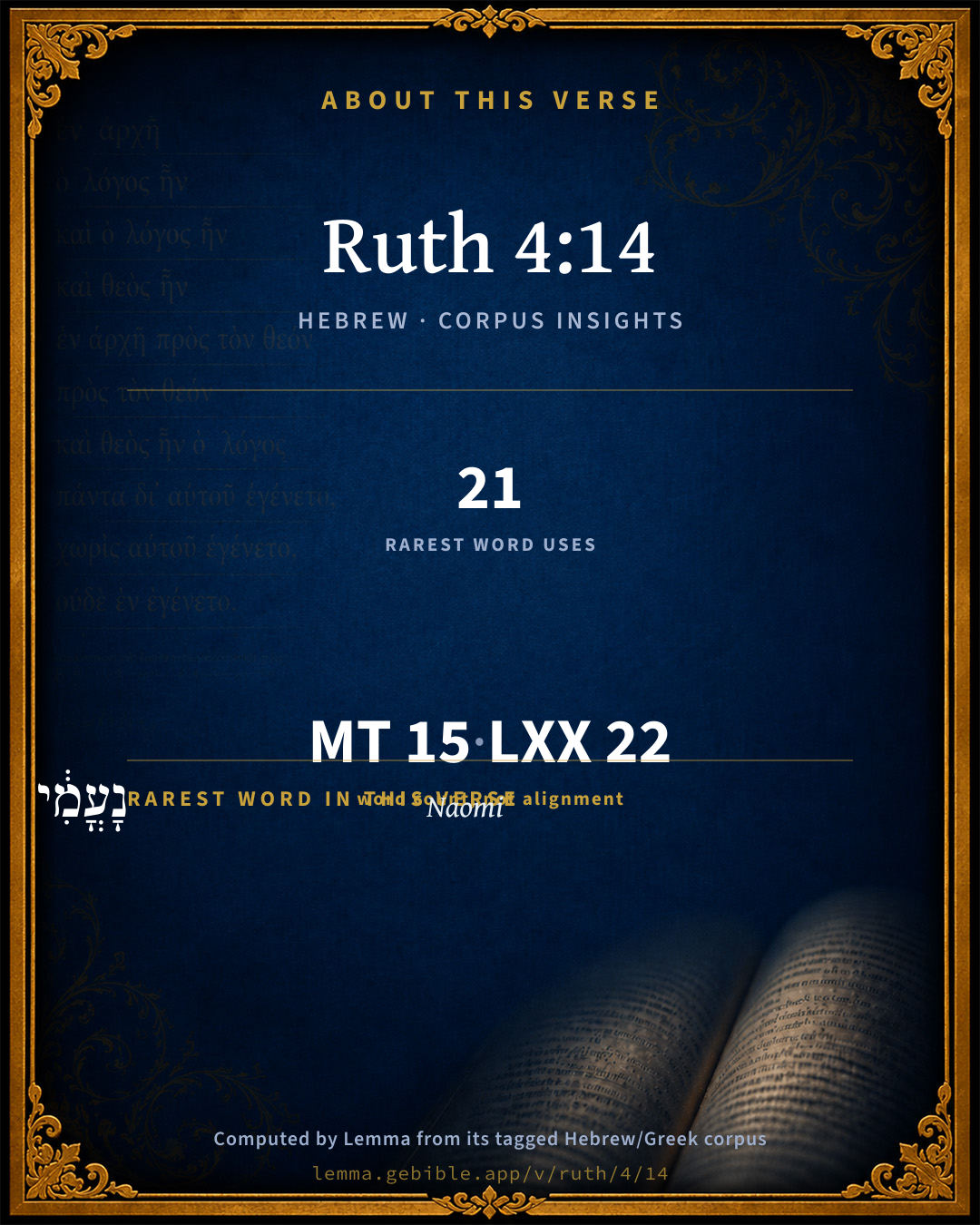
The rarest word here is נָעֳמִ֔י Naomi H5281 — appearing just 21 times in the whole Hebrew Bible.

Shared distinctive vocabulary

נָעֳמִ֔י Naomi H5281 occurs in 20 verses of the Hebrew Bible. Also found in:

Grammatical profile

  • 5 verbs
  • 6 nouns
  • 2 prepositions
  • 2 particles

Verb forms

  • וַתֹּאמַ֤רְנָה Qal · Sequential Imperfect
  • בָּר֣וּךְ Qal · Participle Passive
  • הִשְׁבִּ֥ית Hiphil · Perfect
  • גֹּאֵ֖ל Qal · Participle Active
  • וְיִקָּרֵ֥א Niphal · Imperfect

Hebrew & Septuagint length

In English translation the verse runs 27 words from the Hebrew and 29 from the Septuagint (LXX English) — closely comparable.

A rough comparison of the two English renderings, which tokenize alike — not a word-level alignment.

Word counts can differ between the Hebrew and the Greek without any difference in meaning — e.g. the Hebrew direct-object marker אֵת has no separate Greek word, and Greek often adds the article ὁ.

In the original languages it is 15 Hebrew tokens and 22 Greek tokens — but the two are counted differently (Hebrew bundles its prefixes and suffixes into one token; the Greek is in lemma form), so that isn’t a like-for-like length.

Cross-references

13

Topical passages linked to Ruth 4:14 in the Treasury of Scripture Knowledge — connected by theme and wording, ordered by reader-vote popularity; previews shown in the World English Bible.

  • Genesis 12:2 I will make of you a great nation. I will bless you, and make your name great. You will be a blessing.
  • Matthew 1:5–20 Salmon became the father of Boaz by Rahab. Boaz became the father of Obed by Ruth. Obed became the father of Jesse.
  • Luke 1:58 Her neighbors and her relatives heard that the Lord had magnified his mercy towards her, and they rejoiced with her.
  • Isaiah 11:1–4 There shall come forth a shoot out of the stock of Jesse, and a branch out of his roots shall bear fruit.
  • Ruth 4:21–22 and Salmon became the father of Boaz, and Boaz became the father of Obed,
  • Psalms 34:1–3 I will bless Yahweh at all times. His praise will always be in my mouth.
  • 1 Corinthians 12:26 When one member suffers, all the members suffer with it. Or when one member is honored, all the members rejoice with it.
  • Genesis 24:27 He said, "Blessed be Yahweh, the God of my master Abraham, who has not forsaken his loving kindness and his truth toward my master. As for me, Yahweh has led me in the way to the house of my master's relatives."
  • Genesis 29:35 She conceived again, and bare a son. She said, "This time will I praise Yahweh." Therefore she named him Judah. Then she stopped bearing.
  • Psalms 103:1–2 Praise Yahweh, my soul! All that is within me, praise his holy name!
  • Romans 12:15 Rejoice with those who rejoice. Weep with those who weep.
  • 1 Thessalonians 5:18 In everything give thanks, for this is the will of God in Christ Jesus toward you.
  • 2 Thessalonians 1:3 We are bound to always give thanks to God for you, brothers, even as it is appropriate, because your faith grows exceedingly, and the love of each and every one of you towards one another abounds;

Cross-references courtesy of OpenBible.info (CC BY 4.0).

Hebrew and Greek witnesses Masoretic Hebrew ↔ Greek Septuagint

The same verse in the two great witnesses to the Old Testament, shown verse-for-verse.

These are two independent witnesses, not word-aligned to each other, and the Septuagint is shown in lemma (dictionary) form.

Hebrew Ruth 4:14 Masoretic · Westminster Leningrad Codex

וַתֹּאמַ֤רְנָה הַנָּשִׁים֙ אֶֽל נָעֳמִ֔י בָּר֣וּךְ יְהוָ֔ה אֲ֠שֶׁר לֹ֣א הִשְׁבִּ֥ית לָ֛ךְ גֹּאֵ֖ל הַיּ֑וֹם וְיִקָּרֵ֥א שְׁמ֖וֹ בְּיִשְׂרָאֵֽל

The women said to Naomi, Blessed be Yahweh, who has not left you this day without a near kinsman; and let his name be famous in Israel.

World English Bible · Public Domain

Greek LXX Ruth 4:14 Septuagint · lemma form

καί εἶπον ὁ γυνή πρός νωεμιν εὐλογητός κύριος ὅς οὐ καταλύω σύ σήμερον ὁ ἀγχιστεύς καί καλέω ὁ ὄνομα σύ ἐν ἰσραήλ

And the women said to Noemin, Blessed is the Lord, who has not suffered a redeemer to fail you this day, even to make your name famous in Israel.

LXX2012 (modern English Septuagint) · Public Domain

Hebrew: Westminster Leningrad Codex (CC BY 4.0). Greek: Septuagint (public domain); English from LXX2012 (modern English Septuagint) (Public Domain). How the Septuagint differs from the Hebrew →

Commentary

Notes on Ruth 4:14 from classic Christian and Jewish commentators (each source and its license shown beneath its notes). The classic Christian expositions comment on the surrounding passage and are grouped to its opening verse, so a note may address several verses; the Jewish commentaries on the Tanakh (Rashi and others) are per-verse, so they appear only where the commentator wrote on this verse.

Lemma curates 59 commentaries, every one of them public domain or Creative Commons licensed, each selected and text-cleaned for this edition rather than reprinted as found. About our sources →

Trapp's Complete Commentary

John Trapp

Rth 4:14 And the women said unto Naomi, Blessed [be] the LORD, which hath not left thee this day without a kinsman, that his name may be famous in Israel.

Ver. 14. And the women said unto Naomi.] This was a holy way of gossipping. So Luk 1:58. God was praised and called upon: the time was not wasted in idle chat and frivolous prattle, much less in scurrility and ribaldry.

Which hath not left thee this day without a kinsman.] So good a kinsnmn, or redeemer, as Boaz, so hopeful a kinsman as Obed, to take charge of thee, and care for thee.

That his name may be famous in Israel.] This the men had wished, {Rth 4:11} and now the women second it. This cheered up the old woman’s heart exceedingly, whose last years were very happy, as were likewise Jacob’s, Joseph’s, Esther’s, &c. The Jews, after their seventy years’ captivity, had seven seventies of years (Daniel’s weeks) granted for the enjoyment of their own country.

John Trapp, A Commentary or Exposition upon All the Books of the Old and New Testament (1647–1656) — public domain. Text from a community e-Sword module.

Joseph Benson's Commentary

Rth 4:14. The women said unto Naomi — After Ruth’s delivery. Which hath not left thee without a kinsman — The words may be rendered, who hath not made, or suffered, thy kinsman to fail thee; that is, to refuse to perform his duty to thee and thine, as the other kinsman did. The Hebrew גאל, goel, which we translate kinsman, properly belonged to Boaz, and not to his son who was born; and yet the women seem to speak this with a reference to the child, which probably induced the Arabic translator to render it, hath not left thee without an heir. That his name may — Hebrew, and his name shall be famous in Israel; On account of this noble and worthy action.

Joseph Benson's Commentary on the Old and New Testaments (1811–1818) — public domain. Text from a community e-Sword module.

Tyndale Open Study Notes

Tyndale Open Resources

4:14 This child replaced the family Naomi had lost when her own two sons died in Moab. The women of the town recognized that this child completed the circle of redemption for Naomi.

Tyndale Open Study Notes — © Tyndale Open Resources, licensed CC BY-SA 4.0. Text via the HelloAO Bible API.

Geneva Bible (1599)

Geneva Bible translators

He shall leave continual posterity.

Geneva Bible (1599) marginal notes — public domain. Text via Bolls.life.

Ellicott's Commentary for English Readers

(14) Left thee without.—Literally, not allowed to cease to thee.

A kinsman.—That is, the child (See next verse). The word kinsman here is Goel, a redeemer.

A Bible Commentary for English Readers, edited by Charles John Ellicott (1878–1897) — public domain. Text from a community e-Sword module.

The Cambridge Bible for Schools and Colleges

gen. ed. J. J. S. Perowne

14. On account of the words this day, Bertholet and Nowack take the near kinsman (go’el) as referring to the new-born son. It is true that the words which follow, ‘let his name be famous,’ apply to the child; but throughout the story the near kinsman is Boaz. He has done all, and more than all, that could be expected of a go’el; he has redeemed the property, and now (this day) he has secured an heir for Naomi’s family.

The Cambridge Bible for Schools and Colleges (gen. ed. J. J. S. Perowne; Cambridge University Press, 1878–1918) — public domain. Text from a community e-Sword module.

John Gill's Exposition

And the women said unto Naomi,.... The inhabitants of Bethlehem, as they fell into her company; or perhaps these were the women that were called to the labour of Ruth, and attended the birth of the child:

blessed be the Lord, which hath not left thee this day without a kinsman; a grandchild born to her that day. In Moab she was bereaved of her husband and of two sons; but now she is not left without a relation, a kinsman, and a redeemer, for which the women blessed God, and stirred her up to do the same. Alshech observes, that the women said, blessed be the Lord, because from him would spring the Messiah of the Lord, as did. Some refer this to Boaz, to whom the name of kinsman, or redeemer, more properly belonged; and who appeared to have done the office and duty of such an one, by redeeming the estate of his kinsman, and marrying his widow, the effect of which was, that a son was born, who would be heir of the estate; but the text speaks of what was done that day, and what is after said in the next verse all relates to the child born:

that his name may be famous in Israel; some refer this to the name of God, by whose providence this was brought about; others to Boaz, who was well spoken of for his charity, integrity, and humility, shown in redeeming the estate, and taking Ruth to wife; or rather it refers to the newborn child, of whom they express their hope and confidence, that when he came to man's estate would be very famous and honourable in Israel, being a worthy and virtuous man himself, and the progenitor of such illustrious persons as Jesse, David, &c. and even of the Messiah.

John Gill's Exposition of the Whole Bible (1746–1763) — public domain (CC PDM 1.0). Text via the HelloAO Bible API.

Albert Barnes' Notes on the Bible

Without a kinsman - i. e. Boaz, not the infant Obed.

Albert Barnes' Notes on the Bible (1834–1885) — public domain. Text from a community e-Sword/MySword module.

Haydock's Catholic Bible Commentary

Successor. Hebrew, "redeemer, that his (Booz, or the Lord’s) name," &c. (Calmet)

George Leo Haydock (1774–1849), Haydock's Catholic Family Bible and Commentary, 1859 edition — public domain. Excludes Psalms (Douay-Rheims chapter numbering differs from Protestant) and Deuterocanonical books (Catholic canon only).

Matthew Poole's English Annotations

Without a kinsman; which is understood, either, first, Of the son new born. Or rather, secondly, Of Boaz; for the name of goel, which is translated kinsman or redeemer, is never, that I know of, given to the child born, but always to the person begetting him of his brother’s or near kinsman’s wife. And whereas it is objected, that there was no cause for this congratulation at this time in reference to Boaz, because that was done divers months before this time; it may be replied, that the memory of that generous action was revived upon this occasion, and therefore is fitly mentioned as the foundation of this child’s birth; and this happy effect justly leads them to the cause and original of it, which was this, that Boaz had shown himself to be a kinsman or not only in name and title, as the other kinsman was, Rth 4:6, but in truth and reality. The words may be rendered,

which hath not made or suffered thy kinsman to fail to thee, i.e. to neglect or refuse the performance of his duty to thee and thine, as the other kinsman did.

That his name may be famous in Israel, Heb. and his name shall be famous in Israel, for this noble and worthy action, wherein he gave so great an example of piety, charity, humility, and self-denial.

Matthew Poole's English Annotations on the Holy Bible (1683–1685) — public domain. Text from a community e-Sword/MySword module.

Whedon's Commentary on the Bible

Daniel D. Whedon

14. The women — The women of Beth-lehem, Naomi’s neighbours and friends. Rth_4:17.

Not left thee this day without a kinsman — The kinsman or redeemer in this passage refers not to Boaz, but to the child born to Ruth, as is evident from the words that follow.

That his name may be famous — Rather, and may his name (that is, the child’s name) be famous; become honourably perpetuated by a numerous and worthy posterity in Israel.

Daniel D. Whedon (gen. ed.), Commentary on the Old and New Testaments (1874–1909) — public domain. Text from a community e-Sword module.

The Pulpit Commentary

And the women said to Naomi, Blessed he Yahveh, who has given thee a kinsman this day! May his name become famous in Israel. Of course it is Ruth"s son who is the kinsman referred to, the nearest kinsman, still nearer than Boaz. The kinsman was given, said the women, "this day," the day when the child was born. The expression which we have rendered, "who has given thee a kinsman," is, literally, "who has not caused to fail to thee a kinsman." The sympathetic women who had gathered together in Boaz"s house were sanguine, or at least enthusiastically desirous, that a son so auspiciously given, after most peculiar antecedents, would yet become a famous name in Israel. Canon Cook supposes that the kinsman referred to by the women was not the child, but his father, Boaz ("Speaker"s Commentary," in loc.). Yet it is obvious that the kinsman specified was the one who, as they said, had been given, or had not been caused to fail, "that day." He was, moreover, the one of whom they went on to say, "May his name become famous in Israel, and may he be to thee a restorer of life, and for the support of thine old age," &c. Dr. ;Cooks objections are founded on a too narrow view of the functions devolving on, and of the privileges accruing to, a goel.

HOMILIES BY J.R. THOMSON Vers. 14-17. The benevolent happiness of old age.

The story of Ruth closes amidst domestic prosperity and happiness, and amidst neighborly congratulations. And it is observable that Naomi, whose trials and sorrows interest us so deeply at the commencement of this book, appears at its close radiant with renewed happiness: her daughter-in-law a mother, she herself a grand-parent, surrounded by rejoicing neighbors, expressing their congratulations, and invoking blessing upon her and those dear to her. The narrative loses sight of Ruth in picturing the felicity of her mother-in-law. The neighbors who before had asked, "Is this Naomi?" now exclaim, "There is a son born to Naomi: blessed be the Lord, which hath not left thee this day without a kinsman." She is encompassed with the blessings which, in the language of our poet, "should accompany old age love, obedience, troops of friends.

I UNSELFISHNESS IS REWARDED. Naomi had all along thought more of Ruth"s sorrows and of Ruth"s happiness than of her own. And now this very Ruth is made the means of her prosperity, comfort, and joy in declining years.

II HOPES ARE FULFILLED. It was Naomi"s desire that Ruth might attain to "rest," and her counsels had been directed to this end. Now she sees the Moabitess a happy wife, a happy mother.

III A JOYOUS PROSPECT IS OPENED UP. The day has been cloudy and stormy, but how brightly does the sun shine out at eventide! "A restorer of her life," "a nourisher of her old age," is given her. The child Obed becomes her delight, and her imaginations picture his manhood, and his position in an honorable line of descent.

IV SYMPATHY ENHANCES HAPPINESS. There is mutual reaction here; Ruth, Naomi, and the neighbors, with unselfish congratulations, rejoicings, and prayers, contribute to one another"s welfare. T.

The Pulpit Commentary (1880–1919), ed. H.D.M. Spence-Jones & Joseph S. Exell — public domain. Text from a community e-Sword module.

John Wesley's Explanatory Notes

Which hath not, &c. - The words may be rendered, Which hath not made, or suffered thy kinsman to fail thee; that is, to refuse the performances of his duty to thee and thine, as the other kinsman did. Famous - Hebrew. and his name shall be famous in Israel, for this noble and worthy action.

John Wesley, Explanatory Notes Upon the Whole Bible (1754–1765) — public domain. Text via the GEBible commentary corpus.

Ibn Ezra

Rabbi Abraham ibn Ezra

"That he will not leave to you an empty one as a redeemer." The reason being that the name of the deceased would be established upon his inheritance.

Ibn Ezra on the Tanakh — English translations: “Sefaria Community Translation” (CC0 1.0 (public-domain dedication)); “Yalkut, Sifsei Chachomim Chumash, Metsudah Publications, 2009” (CC BY 4.0); and “Commentary of Ibn Ezra on Isaiah - trans. by M. Friedlander, 1873” (public domain). Text via Sefaria.

Lesson kit

Teaching starters — assembled from the data on this page, not authored interpretation. Every prompt links to the verse data it draws on. Edit before teaching.

Ruth, in the Historical, opens this verse with 15 words (14 distinct Hebrew lemmas). Its most distinctive word is Noʻŏmîy (“Naomi”). A historical commentator’s framing appears above. Read the whole chapter for the surrounding context.

Discussion questions

  1. The word Noʻŏmîy carries the sense “Naomi.” How does it shape the verse?
  2. Ruth 1:2 shares the word «Naomi» with this verse. How do the two illuminate each other?
  3. The translations on this page render this verse differently — a whole-verse word diff, not a word-by-word alignment. What might account for the different wordings?
  4. The verb «וַתֹּאמַ֤רְנָה» is Qal Sequential Imperfect. How does its form color the action?
  5. Reading how Trapp's Complete Commentary and Joseph Benson's Commentary read this verse, where do the two commentators agree and where do they part?

Things to notice

Reading settings

Reading text

Shown beneath each verse's original-language words.

Old Testament
Old Testament edition

Read the OT as the Masoretic Hebrew (MT) or the Greek Septuagint (LXX).

English shown for the Greek Septuagint (in the Hebrew ↔ Greek comparison).

Comparing translations? Open the Compare panel on any verse page to stack up to four side by side.