
Joshua 22:7

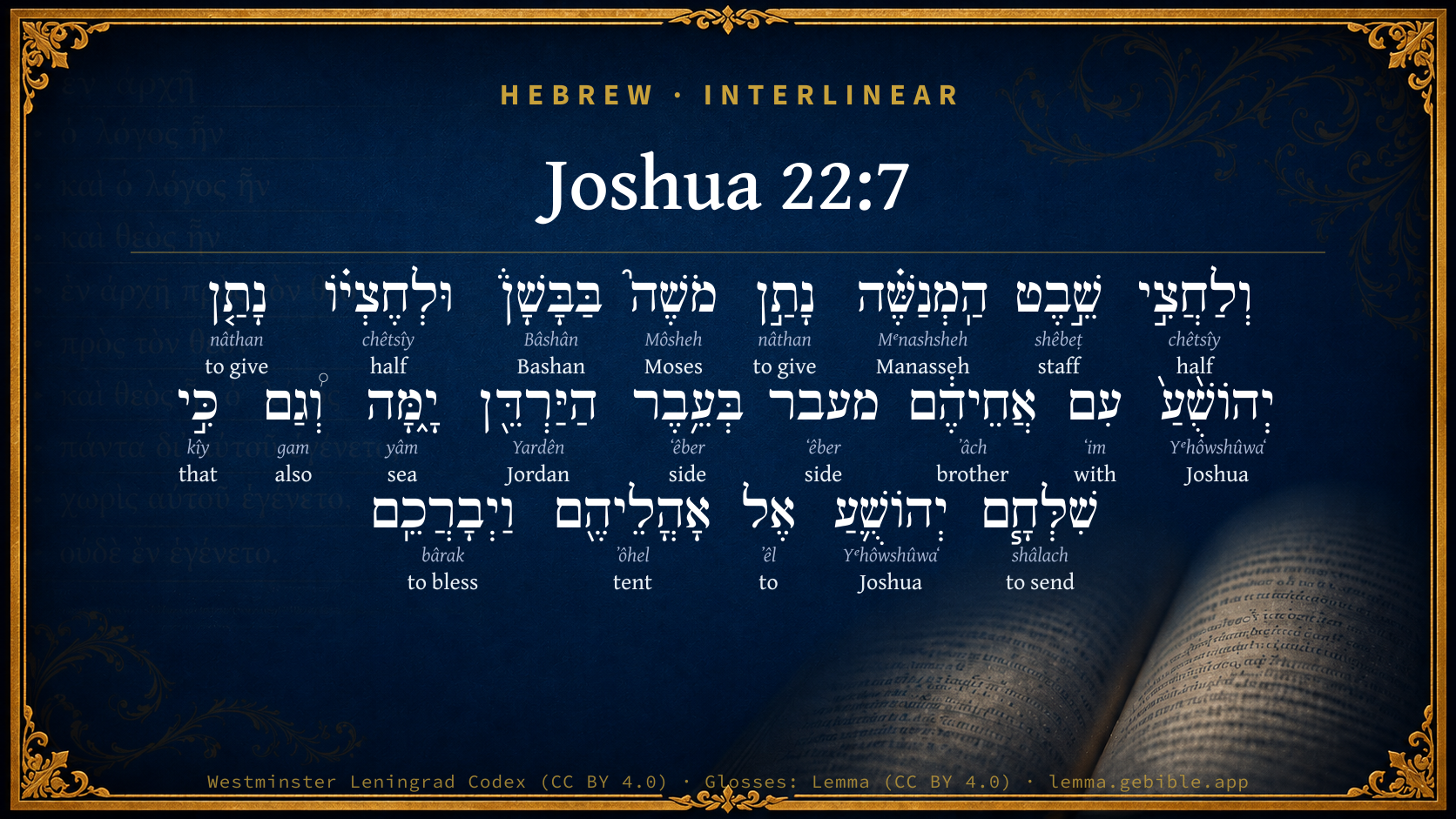
Hebrew (Westminster Leningrad Codex) Joshua 22:7 appears in the Hebrew Old Testament. The text above is from the Westminster Leningrad Codex. Each word links to its Strong’s number, a concise gloss, and parsing drawn from the Open Scriptures Hebrew Bible morphology. Click any word for its full Brown-Driver-Briggs (BDB) entry.
Download image
Cite this verse

Joshua 22:7 (World English Bible). Public Domain. Lemma interlinear Bible study tool, https://lemma.gebible.app/v/joshua/22/7.

Show BibTeX & RIS
BibTeX
RIS
English Translation
Now to the one half-tribe of Manasseh Moses had given [inheritance] in Bashan; but to the other half gave Joshua among their brothers beyond the Jordan westward; moreover when Joshua sent them away to their tents, he blessed them,
World English Bible · Public Domain
Download a study sheet

One document with this verse’s original text, its word-by-word gloss line, the meaning frame, cross-references with their text, attributed commentary, and full source and license credits — printable, and it pastes into notes with its structure intact.

This verse Autodidact and up

Study sheet (.html) Plain text (.txt)

A passage Seminary Student

Up to 50 verses in one chapter. A passage sheet keeps up to 6 commentary sources and 12 cross-references per verse, in the order this page ranks them, and says so on the sheet whenever that leaves anything out. Ask for a single verse and you get the Autodidact verse sheet above.

Everything on this page stays free to read, with no account — the sheet is a download of what is already on screen, not access to it.

Want to remove ads? Support Godless Engineer
Compare translations 3

The same verse in 3 English versions, stacked beneath the original-language interlinear above. Click any original word for its lexicon entry.

Each is an independent rendering of the whole verse — the interlinear is not word-aligned to these translations.

Highlighted words mark where these versions differ — a whole-verse word diff, not a word-by-word alignment.

  • World English Bible Public Domain
    Now to the one half-tribe of Manasseh Moses had given [inheritance] in Bashan; but to the other half gave Joshua among their brothers beyond the Jordan westward; moreover when Joshua sent them away to their tents, he blessed them,
  • King James Version Public Domain
    Now to the one half of the tribe of Manasseh Moses had given possession in Bashan: but unto the other half thereof gave Joshua among their brethren on this side Jordan westward. And when Joshua sent them away also unto their tents, then he blessed them,
  • unfoldingWord Literal Text CC BY-SA 4.0
    Now to the half of the tribe of Manasseh, Moses had given in Bashan, and to half of him, Joshua gave with their brothers on the other side of the Jordan, seaward. And when Joshua sent them away to their tents, then he also blessed them,

unfoldingWord Literal Text — © unfoldingWord, licensed CC BY-SA 4.0. Word-aligned USFM3 via Door43 (git.door43.org/unfoldingWord/en_ult).

Versions to compare (up to 4)

3 of 4 selected

Show all 18 translations

Every available English version of this verse, each an independent rendering of the whole verse.

  • World English Bible Public Domain
    Now to the one half-tribe of Manasseh Moses had given [inheritance] in Bashan; but to the other half gave Joshua among their brothers beyond the Jordan westward; moreover when Joshua sent them away to their tents, he blessed them,
  • Berean Standard Bible Public Domain
    (To the half-tribe of Manasseh Moses had given land in Bashan, and to the other half Joshua gave land on the west side of the Jordan among their brothers.) When Joshua sent them to their homes he blessed them,
  • Majority Standard Bible Public Domain
    (To the half-tribe of Manasseh Moses had given land in Bashan, and to the other half Joshua gave land on the west side of the Jordan among their brothers.) When Joshua sent them to their homes he blessed them,
  • King James Version Public Domain
    Now to the one half of the tribe of Manasseh Moses had given possession in Bashan: but unto the other half thereof gave Joshua among their brethren on this side Jordan westward. And when Joshua sent them away also unto their tents, then he blessed them,
  • American Standard Version (1901) Public Domain
    Now to the one half-tribe of Manasseh Moses had given `inheritance' in Bashan; but unto the other half gave Joshua among their brethren beyond the Jordan westward; moreover when Joshua sent them away unto their tents, he blessed them,
  • Revised Version (1885) Public Domain
    Now to the one half tribe of Manasseh Moses had given inheritance in Bashan: but unto the other half gave Joshua among their brethren beyond Jordan westward. Moreover when Joshua sent them away unto their tents, he blessed them,
  • Geneva Bible (1599) Public Domain
    Nowe vnto one halfe of the tribe of Manasseh Moses had giuen a possession in Bashan: and vnto the other halfe thereof gaue Ioshua among their brethren on this side Iorden Westwarde: therefore when Ioshua sent them away vnto their tents, and blessed them,
  • Douay-Rheims (1899) Public Domain
    Now to half the tribe of Manasses, Moses had given a possession in Basan: and therefore to the half that remained, Josue gave a lot among the rest of their brethren beyond the Jordan to the west. And when he sent them away to their dwellings and had blessed them,
  • Young's Literal Translation Public Domain
    And to the half of the tribe of Manasseh hath Moses given, in Bashan, and to its `other' half hath Joshua given with their brethren beyond the Jordan westward; and also when Joshua hath sent them away unto their tents, then he doth bless them,
  • Literal Standard Version CC BY-SA 4.0
    And to the half-tribe of Manasseh Moses has given, in Bashan, and to its [other] half Joshua has given with their brothers beyond the Jordan westward; and also when Joshua has sent them away to their tents, then he blesses them,
  • Unlocked Literal Bible CC BY-SA 4.0
    Now to one-half of the tribe of Manasseh Moses had given an inheritance in Bashan, but to the other half Joshua gave an inheritance beside their brothers in the land west of the Jordan. Joshua sent them away to their tents; he blessed them
  • unfoldingWord Literal Text CC BY-SA 4.0
    Now to the half of the tribe of Manasseh, Moses had given in Bashan, and to half of him, Joshua gave with their brothers on the other side of the Jordan, seaward. And when Joshua sent them away to their tents, then he also blessed them,
  • Darby Bible Public Domain
    And to half the tribe of Manasseh Moses had given [inheritance] in Bashan, and to the other half thereof had Joshua given among their brethren on this side the Jordan westward. And when Joshua sent them away to their tents, he blessed them also,
  • World Messianic Bible Public Domain
    Now to the one half-tribe of Manasseh Moses had given inheritance in Bashan; but Joshua gave to the other half among their brothers beyond the Jordan westward. Moreover when Joshua sent them away to their tents, he blessed them,
  • Webster's Bible Public Domain
    Now to the one half of the tribe of Manasseh Moses had given possession in Bashan: but to the other half of it gave Joshua among their brethren on this side of Jordan westward. And when Joshua sent them away also to their tents, then he blessed them,
  • Free Bible Version CC BY-SA 4.0
    Moses had given to the half-tribe of Manasseh the land of Bashan, and to the other half of the tribe Joshua had given land west of the Jordan. Joshua blessed them and sent them home.
  • Bible in Basic English Public Domain
    Now to the one half of the tribe of Manasseh, Moses had given a heritage in Bashan; but to the other half, Joshua gave a heritage among their brothers on the west side of Jordan. Now when Joshua sent them away to their tents, he gave them his blessing,
  • JPS Tanakh (1917) Public Domain
    Now to the one half-tribe of Manasseh Moses had given inheritance in Bashan; but unto the other half gave Joshua among their brethren beyond the Jordan westward. Moreover when Joshua sent them away unto their tents, he blessed them,

Literal Standard Version (2020), Covenant Press — licensed CC BY-SA 4.0. Text via the HelloAO Bible API (eBible.org). Unlocked Literal Bible (unfoldingWord) — licensed CC BY-SA 4.0. Text via the HelloAO Bible API (eBible.org). unfoldingWord Literal Text — © unfoldingWord, licensed CC BY-SA 4.0. Word-aligned USFM3 via Door43 (git.door43.org/unfoldingWord/en_ult). Free Bible Version, Dr. Jonathan Gallagher — licensed CC BY-SA 4.0. Text via the HelloAO Bible API (eBible.org).

Word by word

More ways to search: Search by grammar → Find every occurrence → Compare this word →

Practice this passage: Drill this verse → Learn its vocabulary →

בַּבָּשָׁן֒
Bâshân
H1316
“in/at the · Bashan”
Preposition, Determined + Noun, Proper
Part of Speech
Preposition + Noun
Type
Proper
Full BDB Definition

Origin: of uncertain derivation

TWOT: None

Bashan = "fruitful" - a district east of the Jordan known for its fertility which was given to the half-tribe of Manasseh
  1. וְלַחֲצִ֣י chêtsîy H2677 “and · to/for · half of” Conjunction + Preposition + Noun, Common, Masculine, Singular, Construct
  2. שֵׁ֣בֶט shêbeṭ H7626 “staff of” Noun, Common, Masculine, Singular, Construct
  3. הַֽמְנַשֶּׁ֗ה Mᵉnashsheh H4519 “the · Manasseh” Particle, Definite Article + Noun, Proper
  4. נָתַ֣ן nâthan H5414 “to give” Verb, Qal, Perfect, 3rd Person, Masculine, Singular
  5. מֹשֶׁה֮ Môsheh H4872 “Moses” Noun, Proper
  6. וּלְחֶצְי֗וֹ chêtsîy H2677 “and · to/for · half · his” Conjunction + Preposition + Noun, Common, Masculine, Singular, Construct + Suffix, Personal, 3rd Person, Masculine, Singular
  7. נָתַ֤ן nâthan H5414 “to give” Verb, Qal, Perfect, 3rd Person, Masculine, Singular
  8. יְהוֹשֻׁ֨עַ֙ Yᵉhôwshûwaʻ H3091 “Joshua” Noun, Proper
  9. עִם ʻim H5973 “with” Preposition
  10. אֲחֵיהֶ֔ם ʼâch H251 “brothers · their” Noun, Common, Masculine, Plural, Construct + Suffix, Personal, 3rd Person, Masculine, Plural
  11. מעבר ʻêber H5676 “from · side of” Preposition + Noun, Common, Masculine, Singular, Construct
  12. בְּעֵ֥בֶר ʻêber H5676 “in/at · side of” Preposition + Noun, Common, Masculine, Singular, Construct
  13. הַיַּרְדֵּ֖ן Yardên H3383 “the · Jordan” Particle, Definite Article + Noun, Proper
  14. יָ֑מָּה yâm H3220 “sea · toward” Noun, Common, Masculine, Singular, Absolute + Suffix, Demonstrative
  15. וְ֠גַם gam H1571 “and · also” Conjunction + Particle, Accusative
  16. כִּ֣י kîy H3588 “that” Conjunction
  17. שִׁלְּחָ֧ם shâlach H7971 “to send · them” Verb, Piel, Perfect, 3rd Person, Masculine, Singular + Suffix, Personal, 3rd Person, Masculine, Plural
  18. יְהוֹשֻׁ֛עַ Yᵉhôwshûwaʻ H3091 “Joshua” Noun, Proper
  19. אֶל ʼêl H413 “to” Preposition
  20. אָהֳלֵיהֶ֖ם ʼôhel H168 “tents · their” Noun, Common, Masculine, Plural, Construct + Suffix, Personal, 3rd Person, Masculine, Plural
  21. וַיְבָרֲכֵֽם bârak H1288 “and · to bless · them” Conjunction + Verb, Piel, Sequential Imperfect, 3rd Person, Masculine, Singular + Suffix, Personal, 3rd Person, Masculine, Plural

About this verse

These counts appear in no published source. They are computed here, from the morphology-tagged text and Lemma’s own curated glosses. What Lemma adds →

22
words
18
distinct lemmas
Historical
section

Shared distinctive vocabulary

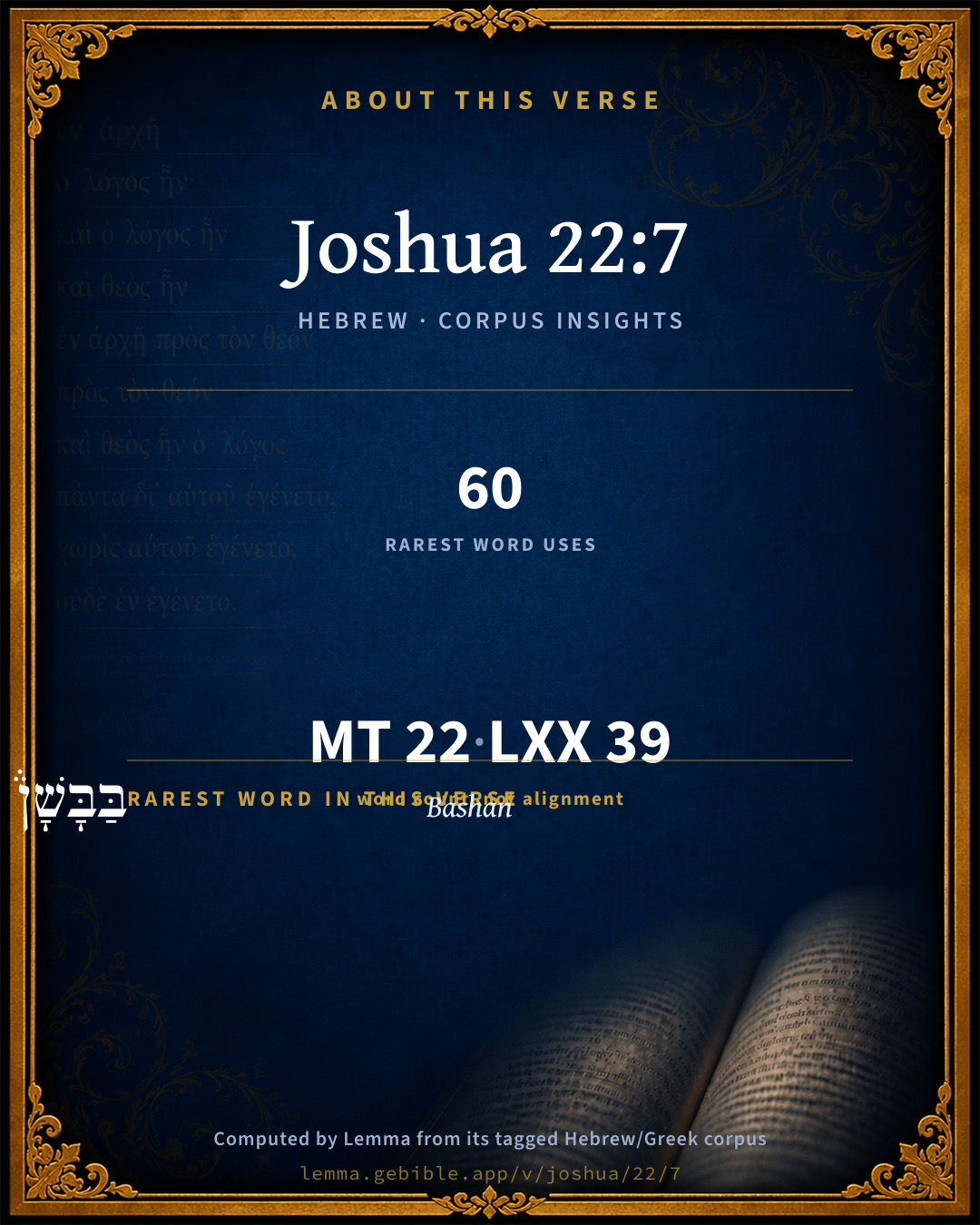
בַּבָּשָׁן֒ Bashan H1316 occurs in 53 verses of the Hebrew Bible. Also found in:

Grammatical profile

  • 4 verbs
  • 14 nouns
  • 2 prepositions
  • 1 conjunction
  • 1 particle

Verb forms

  • נָתַ֣ן Qal · Perfect
  • נָתַ֤ן Qal · Perfect
  • שִׁלְּחָ֧ם Piel · Perfect
  • וַיְבָרֲכֵֽם Piel · Sequential Imperfect

Repetition

Words recur within this verse — often emphatic in Hebrew:

  • וְלַחֲצִ֣י half H2677 ×2
  • נָתַ֣ן to give H5414 ×2
  • יְהוֹשֻׁ֨עַ֙ Joshua H3091 ×2
  • מעבר side H5676 ×2

Hebrew & Septuagint length

In English translation the verse runs 39 words from the Hebrew and 49 from the Septuagint (LXX English) — closely comparable.

A rough comparison of the two English renderings, which tokenize alike — not a word-level alignment.

Word counts can differ between the Hebrew and the Greek without any difference in meaning — e.g. the Hebrew direct-object marker אֵת has no separate Greek word, and Greek often adds the article ὁ.

In the original languages it is 22 Hebrew tokens and 39 Greek tokens — but the two are counted differently (Hebrew bundles its prefixes and suffixes into one token; the Greek is in lemma form), so that isn’t a like-for-like length.

Cross-references

3

Topical passages linked to Joshua 22:7 in the Treasury of Scripture Knowledge — connected by theme and wording, ordered by reader-vote popularity; previews shown in the World English Bible.

  • Joshua 17:1–12 [This] was the lot for the tribe of Manasseh; for he was the firstborn of Joseph. As for Machir the firstborn of Manasseh, the father of Gilead, because he was a man of war, therefore he had Gilead and Bashan.
  • Numbers 32:33 Moses gave to them, even to the children of Gad, and to the children of Reuben, and to the half-tribe of Manasseh the son of Joseph, the kingdom of Sihon king of the Amorites, and the kingdom of Og king of Bashan, the land, according to the cities of it with [their] borders, even the cities of the land round about.
  • Joshua 13:29–31 Moses gave [inheritance] to the half-tribe of Manasseh: and it was for the half-tribe of the children of Manasseh according to their families.

Cross-references courtesy of OpenBible.info (CC BY 4.0).

Hebrew and Greek witnesses Masoretic Hebrew ↔ Greek Septuagint

The same verse in the two great witnesses to the Old Testament, shown verse-for-verse.

These are two independent witnesses, not word-aligned to each other, and the Septuagint is shown in lemma (dictionary) form.

Hebrew Joshua 22:7 Masoretic · Westminster Leningrad Codex

וְלַחֲצִ֣י שֵׁ֣בֶט הַֽמְנַשֶּׁ֗ה נָתַ֣ן מֹשֶׁה֮ בַּבָּשָׁן֒ וּלְחֶצְי֗וֹ נָתַ֤ן יְהוֹשֻׁ֨עַ֙ עִם אֲחֵיהֶ֔ם מעבר בְּעֵ֥בֶר הַיַּרְדֵּ֖ן יָ֑מָּה וְ֠גַם כִּ֣י שִׁלְּחָ֧ם יְהוֹשֻׁ֛עַ אֶל אָהֳלֵיהֶ֖ם וַיְבָרֲכֵֽם

Now to the one half-tribe of Manasseh Moses had given [inheritance] in Bashan; but to the other half gave Joshua among their brothers beyond the Jordan westward; moreover when Joshua sent them away to their tents, he blessed them,

World English Bible · Public Domain

Greek LXX Joshua 22:7 Septuagint · lemma form

καί ὁ ἥμισυς φυλή μανασσή δίδωμι μωυσῆς ἐν ὁ βασανῖτις καί ὁ ἥμισυς δίδωμι ἰησοῦς μετά ὁ ἀδελφός αὐτός ἐν ὁ πέραν ὁ ἰορδάνης παρά θάλασσα καί ἡνίκα ἐκ ἀποστέλλω αὐτός ἰησοῦς εἰς ὁ οἶκος αὐτός καί εὐλογέω αὐτός

And to one half the tribe of Manasse Moses gave a portion in the land of Basan, and to the other half Joshua gave a portion with his brethren on the other side of Jordan westward: and when Joshua sent them away to their homes, then he blessed them.

LXX2012 (modern English Septuagint) · Public Domain

Hebrew: Westminster Leningrad Codex (CC BY 4.0). Greek: Septuagint (public domain); English from LXX2012 (modern English Septuagint) (Public Domain). How the Septuagint differs from the Hebrew →

Targum (Aramaic paraphrase)

1

The Targum is the ancient Jewish Aramaic paraphrase of the Hebrew Scriptures — an interpretive translation, not the Hebrew text itself. Onkelos (literal) and Pseudo-Jonathan (expansive) render the Torah, and Jonathan the Prophets. Coverage is partial: where no permissively-licensed English translation exists for a verse, only the Aramaic is shown. This is verse-level text, not a word-by-word alignment to the Hebrew.

  1. Targum Jonathan Prophets (Joshua–Malachi)
    וּלְפַלְגוּת שִׁבְטָא דִמְנַשֶׁה יְהַב מֹשֶׁה בְּמַתְנָן וּלְפַלְגֵיהוֹן יְהַב יְהוֹשֻׁעַ עִם אֲחֵיהוֹן בְּעִבְרָא דְיַרְדְנָא לְמַעֲרָבָא וְאַף אֲרֵי שַׁלְחִינוּן יְהוֹשֻׁעַ לְקִרְוֵיהוֹן וּבָרְכִינוּן:

    (no public-domain English translation for this verse)

    Targum Jonathan — Aramaic: “Mikraot Gedolot” (public domain). English: “Sefaria Community Translation” (CC0 1.0 (public-domain dedication)); “London "Chaldee Paraphrase," 1871” (public domain). Text via Sefaria.

Commentary

Notes on Joshua 22:7 from classic Christian and Jewish commentators (each source and its license shown beneath its notes). The classic Christian expositions comment on the surrounding passage and are grouped to its opening verse, so a note may address several verses; the Jewish commentaries on the Tanakh (Rashi and others) are per-verse, so they appear only where the commentator wrote on this verse.

Lemma curates 59 commentaries, every one of them public domain or Creative Commons licensed, each selected and text-cleaned for this edition rather than reprinted as found. About our sources →

Trapp's Complete Commentary

John Trapp

Jos 22:7 Now to the [one] half of the tribe of Manasseh Moses had given [possession] in Bashan: but unto the [other] half thereof gave Joshua among their brethren on this side Jordan westward. And when Joshua sent them away also unto their tents, then he blessed them,

Ver. 7. Then he blessed them.] See Jos 22:6.

John Trapp, A Commentary or Exposition upon All the Books of the Old and New Testament (1647–1656) — public domain. Text from a community e-Sword module.

Joseph Benson's Commentary

Jos 22:7. Then he blessed them — Not only prayed for them as a friend, but blessed them as a father, in the name of the Lord, recommending them, their families, and affairs to the grace of God. It seems probable, from the manner in which this is stated, that this his blessing was peculiarly and separately given to the half-tribe of Manasseh. He was somewhat more nearly related to them than to the other two, as being an Ephraimite, and perhaps they might be more reluctant to depart than the others, as they were leaving one half of their own tribe behind them, and therefore might have more need than the others of the comfort and encouragement of his blessing.

Joseph Benson's Commentary on the Old and New Testaments (1811–1818) — public domain. Text from a community e-Sword module.

Tyndale Open Study Notes

Tyndale Open Resources

22:7 Moses had given: The author takes great care to emphasize that the tribes east of the Jordan were part of Israel.

Tyndale Open Study Notes — © Tyndale Open Resources, licensed CC BY-SA 4.0. Text via the HelloAO Bible API.

Adam Clarke's Commentary

Verse 7. Then he blessed them] Spoke respectfully of their fidelity and exertions, wished them every spiritual and temporal good, prayed to God to protect and save them, and probably gave some gifts to those leaders among them that had most distinguished themselves in this seven years' war. In all the above senses the word bless is frequently taken in Scripture.

Adam Clarke's Commentary on the Bible (1810–1826) — public domain. Text from a community e-Sword/MySword module.

Ellicott's Commentary for English Readers

(7, 8) Joshua blesses the half tribe of Manasseh that dwelt on the west of Jordan.

(7) When Joshua sent them away also unto their tents, then he blessed them.—It is noteworthy that of all the tribes of Israel who followed Joshua, and remained with him, this half tribe alone is mentioned as receiving a special blessing. We cannot fail to observe that both in ancient times, and also among ourselves, the conduct of the two and a half tribes in choosing their inheritance on the east of Jordan has been regarded as laying them open to some blame. Historically, this is incorrect. God delivered the land of Sihon and Og to Israel; some one must inherit it. Again, the true eastern boundary of Palestine is not the Jordan, but the mountain range of Gilead, which parts it from the desert that lies beyond. Really the two and a half tribes were as much in Palestine as the rest, only their position does not take advantage of that wonderful miracle by which Jordan was driven back, and the Israelites were enabled to strike at the heart of their Canaanitish foes. They themselves, however, were compelled to cross the Jordan before they could obtain the nest which they seemed to have won before they crossed it—“that they without us should not be made perfect.” In the spiritual world these two and a half tribes answer to the people who received their inheritance from Moses (i.e., from the law); the others are those who received nothing until they followed Joshua, i.e., the Captain of salvation, Jesus Christ, who gives rest to all. When He came, His own people were divided, like the tribe of Manasseh. Some could not forsake Moses, a sacrifice which they thought He required of them; some gave up all, and followed Him. “Forgetting (Heb., M’nâsheh—i.e., Manasseh) the things that were behind, and reaching forth unto the things before,” they would take nothing but what He gave. These are they who receive special blessing from Him. (See Names on the Gates of Pearl—Manasseh, p. 165, &c.)

A Bible Commentary for English Readers, edited by Charles John Ellicott (1878–1897) — public domain. Text from a community e-Sword module.

The Cambridge Bible for Schools and Colleges

gen. ed. J. J. S. Perowne

7. Now to the one half] The repetition here of what has been already described more fully (Jos_17:5, &c.), may seem to us superfluous. But “it agrees with the fulness, abundant in repetitions, of the ancient Hebrew style of narrative.” Keil. “A modern author will refer his readers to what he has stated elsewhere. The Jewish historian scarcely ever quotes or reminds, but repeats so much as may be necessary to make his account of the transaction in hand fully intelligible by itself.” The Speaker’s Commentary, in loc.

The Cambridge Bible for Schools and Colleges (gen. ed. J. J. S. Perowne; Cambridge University Press, 1878–1918) — public domain. Text from a community e-Sword module.

John Gill's Exposition

And he spake unto them,.... To the half tribe of Manasseh only, though some think also to the other ten tribes:

saying, return with much riches unto your tents; that is, return to their own land, and habitations there, with whatsoever riches they had got from the spoil of the enemy:

and with very much cattle; they had taken from them, and fell to their share, and for which they had good pasturage in Gilead and Bashan, and therefore very proper to take with them:

with silver and with gold, and with brass, and with iron; whether in massive pieces, or wrought up into vessels, which they found in the houses of the Canaanites when they plundered them:

and with very much raiment; some no doubt very rich and costly, such as their kings, princes, nobles, and great personages among them wore:

divide the spoil of your enemies with your brethren; according to Jarchi and Kimchi, this is spoken to the half tribe of Manasseh, to divide their spoil with the tribes of Reuben and Gad; but it rather means the dividing the above spoil, when they came to their own country with their brethren they left behind; who as they were employed in guarding and defending their cities, their wives and children, herds and flocks, in their absence, they had a right to part of the spoil; and as in other instances it appears to be a common case for those that stayed at home to share in the spoil with them that went to war, see Num 31:27; though the notion of Abarbinel pleases me best, that by "their brethren" are meant the other half tribe of Manasseh that remained in Canaan, and were settled there: when the spoil of the Canaanites was divided among all the tribes, the whole tribe of Manasseh had its share; and whereas now half of it were going to their own country on the other side Jordan, it was but reasonable they should have their part of the spoil to carry with them; and this seems to be the true reason of their being separately addressed, and dismissed and blessed.

John Gill's Exposition of the Whole Bible (1746–1763) — public domain (CC PDM 1.0). Text via the HelloAO Bible API.

Albert Barnes' Notes on the Bible

The insertion of this explanation about the half tribe, and the repetition of Joshua’s farewell, are examples of a marked characteristic of very ancient writers and of Hebrew writers as much as any - that of giving a completeness and finish to each section of their story. The Jewish historian scarcely ever quotes or reminds, but repeats so much as may be necessary to make his account of the transaction in hand fully intelligible by itself. (Compare also Jos 13:14, Jos 13:33; Jos 14:3; Jos 18:7.) It is quite possible, however, that the particulars special to Jos 22:8, may be due to some other narrative of the whole event than that to which Jos 22:5 belongs, and may have been interwoven by a later reviser.

Albert Barnes' Notes on the Bible (1834–1885) — public domain. Text from a community e-Sword/MySword module.

Whedon's Commentary on the Bible

Daniel D. Whedon

7. Bashan — See Jos_2:10, note.

Daniel D. Whedon (gen. ed.), Commentary on the Old and New Testaments (1874–1909) — public domain. Text from a community e-Sword module.

The Pulpit Commentary

Now to the one half of the tribe of Manasseh. We have here, as Keil remarks, a specimen of our author"s habit of repetition. Four times do we read (Jos_13:14, 33 14:3 18:7) that the Levites were to have no share in the division of the land. Four times (in Jos_13:8 Jos_14:3 Jos_18:7, and here) does he repeat that the tribe of Manasseh was divided into two, and had its inheritance on either side Jordan. The same kind of repetition occurs in the narrative of the passing of the Jordan. It has been before remarked to be a characteristic of the style of the Old Testament generally, but nowhere is it found to a greater degree than in the Book of Joshua. Yet this, to which critics of the analytical school have objected as a sign of spuriousness, is in fact one of those peculiarities of style which mark the individuality of the writer. It is to inspired history what the Gospel and Epistles of St. John are to inspired theology. The form belongs to the author; the matter, at least as regards its general purport, belongs to God. A Hebrew writer, we are reminded in the "Speaker"s Commentary," does not quote or refer to what has been already stated. If it is necessary to make his narrative clear, he repeats it.

The Pulpit Commentary (1880–1919), ed. H.D.M. Spence-Jones & Joseph S. Exell — public domain. Text from a community e-Sword module.

unfoldingWord translationNotes

Door43 World Missions Community

the Jordan

This was a short name for the Jordan River.

iron

a strong, hard, magnetic metal

plunder

The winning army would take everything of value from the people they conquered.

translationWords

tribe

Manasseh

inherit

Bashan

Joshua

brother

tent

livestock

silver

gold

bronze

unfoldingWord translationNotes — © Distant Shores Media and the Door43 World Missions Community, licensed CC BY-SA 4.0. Source: git.door43.org/Door43/en_tn.

Rashi

Rabbi Shlomo Yitzchaki (Rashi)

Furthermore, when Yehoshua sent them off. He sent off the half-tribe of Menashe in the same manner as he sent off the Bnei Reuvein and the Bnei Gad.

Rashi on the Tanakh — English translations: “The Judaica Press complete Tanach with Rashi, translated by A. J. Rosenberg” (CC BY 4.0); “Pentateuch with Rashi's commentary by M. Rosenbaum and A.M. Silbermann, 1929-1934” (public domain); “The Metsudah Tanach series, Lakewood, N.J” (CC BY 4.0); and “The Book of Joshua, Metsudah Publications, 1997” (CC BY 4.0). Text via Sefaria.

Lesson kit

Teaching starters — assembled from the data on this page, not authored interpretation. Every prompt links to the verse data it draws on. Edit before teaching.

Joshua, in the Historical, opens this verse with 22 words (18 distinct Hebrew lemmas). Its most distinctive word is Bâshân (“Bashan”). A historical commentator’s framing appears above. Read the whole chapter for the surrounding context.

Discussion questions

  1. How does “Bashan” (Bâshân) shape what this verse is saying?
  2. How does Numbers 21:33, which shares the word «Bashan», read alongside this verse?
  3. What does the repetition of “half” (2× in this one verse) do in this verse?
  4. The translations on this page render this verse differently — a whole-verse word diff, not a word-by-word alignment. What might account for the different wordings?
  5. «נָתַ֣ן» is a Qal Perfect verb. How does that grammatical form shape the action described?
  6. Compare how Trapp's Complete Commentary and Joseph Benson's Commentary read this verse. Where do they agree or differ?

Things to notice

Reading settings

Reading text

Shown beneath each verse's original-language words.

Old Testament
Old Testament edition

Read the OT as the Masoretic Hebrew (MT) or the Greek Septuagint (LXX).

English shown for the Greek Septuagint (in the Hebrew ↔ Greek comparison).

Comparing translations? Open the Compare panel on any verse page to stack up to four side by side.