Numbers 23:11

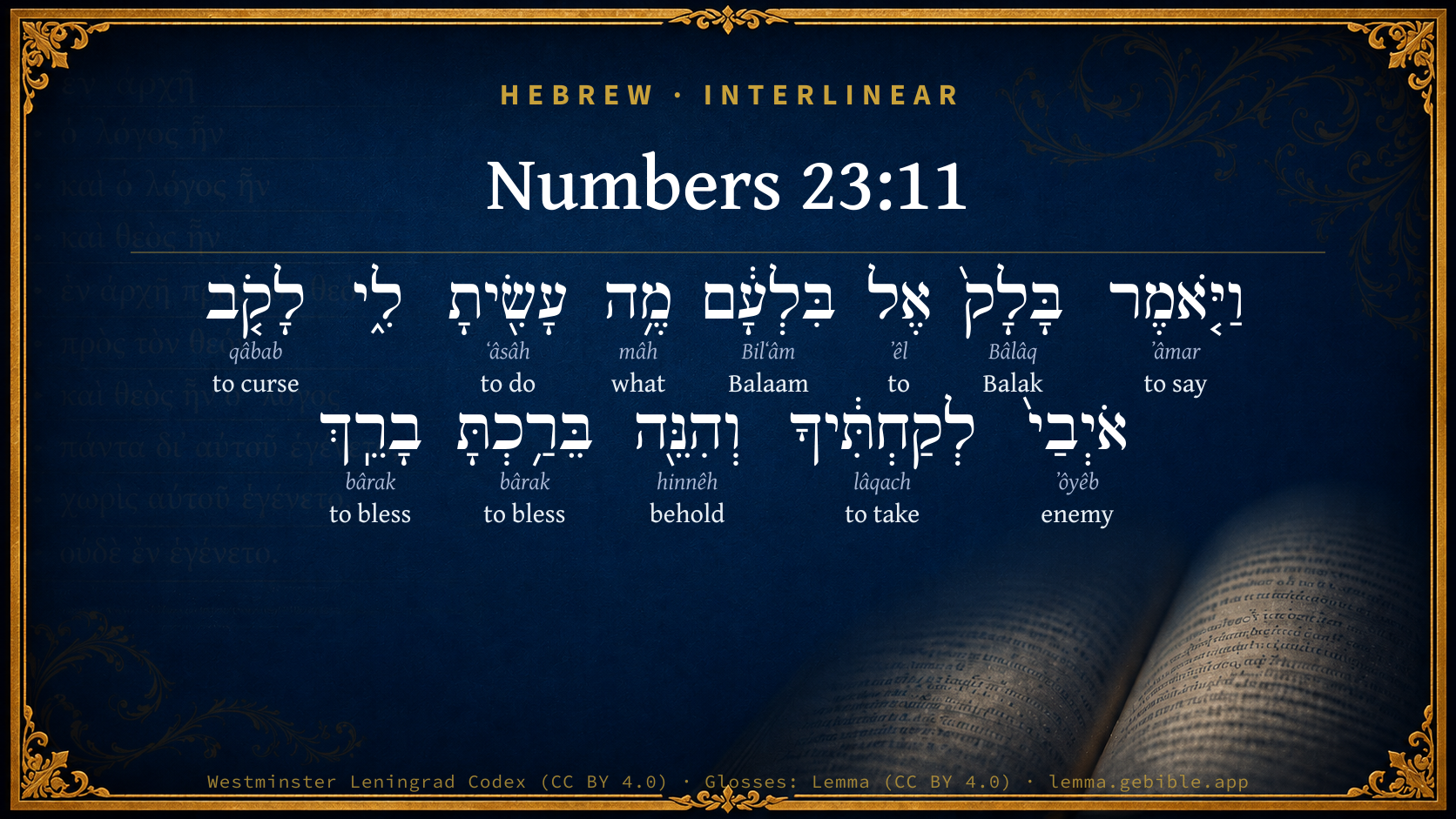
Hebrew (Westminster Leningrad Codex) Numbers 23:11 appears in the Hebrew Old Testament. The text above is from the Westminster Leningrad Codex. Each word links to its Strong’s number, a concise gloss, and parsing drawn from the Open Scriptures Hebrew Bible morphology. Click any word for its full Brown-Driver-Briggs (BDB) entry.
Download image
Cite this verse

Numbers 23:11 (World English Bible). Public Domain. Lemma interlinear Bible study tool, https://lemma.gebible.app/v/numbers/23/11.

Show BibTeX & RIS
BibTeX
RIS
English Translation
Balak said to Balaam, What have you done to me? I took you to curse my enemies, and, behold, you have blessed them altogether.
World English Bible · Public Domain
Download a study sheet

One document with this verse’s original text, its word-by-word gloss line, the meaning frame, cross-references with their text, attributed commentary, and full source and license credits — printable, and it pastes into notes with its structure intact.

This verse Autodidact and up

Study sheet (.html) Plain text (.txt)

A passage Seminary Student

Up to 50 verses in one chapter. A passage sheet keeps up to 6 commentary sources and 12 cross-references per verse, in the order this page ranks them, and says so on the sheet whenever that leaves anything out. Ask for a single verse and you get the Autodidact verse sheet above.

Everything on this page stays free to read, with no account — the sheet is a download of what is already on screen, not access to it.

Want to remove ads? Support Godless Engineer
Compare translations 3

The same verse in 3 English versions, stacked beneath the original-language interlinear above. Click any original word for its lexicon entry.

Each is an independent rendering of the whole verse — the interlinear is not word-aligned to these translations.

Highlighted words mark where these versions differ — a whole-verse word diff, not a word-by-word alignment.

  • World English Bible Public Domain
    Balak said to Balaam, What have you done to me? I took you to curse my enemies, and, behold, you have blessed them altogether.
  • King James Version Public Domain
    And Balak said unto Balaam, What hast thou done unto me? I took thee to curse mine enemies, and, behold, thou hast blessed them altogether.
  • unfoldingWord Literal Text CC BY-SA 4.0
    And Balak said to Balaam, “What have you done to me? I took you to curse my enemies, and behold, blessing, you have blessed!”

unfoldingWord Literal Text — © unfoldingWord, licensed CC BY-SA 4.0. Word-aligned USFM3 via Door43 (git.door43.org/unfoldingWord/en_ult).

Versions to compare (up to 4)

3 of 4 selected

Show all 18 translations

Every available English version of this verse, each an independent rendering of the whole verse.

  • World English Bible Public Domain
    Balak said to Balaam, What have you done to me? I took you to curse my enemies, and, behold, you have blessed them altogether.
  • Berean Standard Bible Public Domain
    Then Balak said to Balaam, “What have you done to me? I brought you here to curse my enemies, and behold, you have only blessed them!”
  • Majority Standard Bible Public Domain
    Then Balak said to Balaam, “What have you done to me? I brought you here to curse my enemies, and behold, you have only blessed them!”
  • King James Version Public Domain
    And Balak said unto Balaam, What hast thou done unto me? I took thee to curse mine enemies, and, behold, thou hast blessed them altogether.
  • American Standard Version (1901) Public Domain
    And Balak said unto Balaam, What hast thou done unto me? I took thee to curse mine enemies, and, behold, thou hast blessed them altogether.
  • Revised Version (1885) Public Domain
    And Balak said unto Balaam, What hast thou done unto me? I took thee to curse mine enemies, and, behold, thou hast blessed them altogether.
  • Geneva Bible (1599) Public Domain
    Then Balak saide vnto Balaam, What hast thou done vnto mee? I tooke thee to curse mine enemies, and beholde, thou hast blessed them altogether.
  • Douay-Rheims (1899) Public Domain
    And Balac said to Balaam: What is this that thou dost? I sent for thee to curse my enemies: and thou contrariwise blessest them.
  • Young's Literal Translation Public Domain
    And Balak saith unto Balaam, `What hast thou done to me? to pierce mine enemies I have taken thee -- and lo, thou hast certainly blessed;'
  • Literal Standard Version CC BY-SA 4.0
    And Balak says to Balaam, “What have you done to me? I have taken you to pierce my enemies, and behold, you have certainly blessed”;
  • Unlocked Literal Bible CC BY-SA 4.0
    Balak said to Balaam, “What have you done to me? I brought you to curse my enemies, but look, you have blessed them.”
  • unfoldingWord Literal Text CC BY-SA 4.0
    And Balak said to Balaam, “What have you done to me? I took you to curse my enemies, and behold, blessing, you have blessed!”
  • Darby Bible Public Domain
    And Balak said to Balaam, What hast thou done to me? I took thee to curse mine enemies, and behold, thou hast blessed them altogether.
  • World Messianic Bible Public Domain
    Balak said to Balaam, “What have you done to me? I took you to curse my enemies, and behold, you have blessed them altogether.”
  • Webster's Bible Public Domain
    And Balak said to Balaam, What hast thou done to me? I took thee to curse my enemies, and behold, thou hast blessed them altogether.
  • Free Bible Version CC BY-SA 4.0
    Then Balak complained to Balaam, “What on earth have you done to me? I brought you here to curse my enemies, and now look! All you have done is bless them!”
  • Bible in Basic English Public Domain
    Then Balak said to Balaam, What have you done to me? I sent for you so that my haters might be cursed, and see, you have given them a blessing.
  • JPS Tanakh (1917) Public Domain
    And Balak said unto Balaam: 'What hast thou done unto me? I took thee to curse mine enemies, and, behold, thou hast blessed them altogether.'

Literal Standard Version (2020), Covenant Press — licensed CC BY-SA 4.0. Text via the HelloAO Bible API (eBible.org). Unlocked Literal Bible (unfoldingWord) — licensed CC BY-SA 4.0. Text via the HelloAO Bible API (eBible.org). unfoldingWord Literal Text — © unfoldingWord, licensed CC BY-SA 4.0. Word-aligned USFM3 via Door43 (git.door43.org/unfoldingWord/en_ult). Free Bible Version, Dr. Jonathan Gallagher — licensed CC BY-SA 4.0. Text via the HelloAO Bible API (eBible.org).

Word by word

More ways to search: Search by grammar → Find every occurrence → Compare this word →

Practice this passage: Drill this verse → Learn its vocabulary →

לָקֹ֤ב
qâbab
H6895
“to curse”
Preposition + Verb, Qal, Infinitive Construct
Part of Speech
Preposition + Verb
Stem
Qal
Form
Infinitive Construct
Full BDB Definition

Origin: a primitive root

TWOT: 1978

to curse, utter a curse against - (Qal) to curse
  1. וַיֹּ֤אמֶר ʼâmar H559 “and · to say” Conjunction + Verb, Qal, Sequential Imperfect, 3rd Person, Masculine, Singular
  2. בָּלָק֙ Bâlâq H1111 “Balak” Noun, Proper
  3. אֶל ʼêl H413 “to” Preposition
  4. בִּלְעָ֔ם Bilʻâm H1109 “Balaam” Noun, Proper
  5. מֶ֥ה mâh H4100 “what” Particle, Interrogative
  6. עָשִׂ֖יתָ ʻâsâh H6213 “to do” Verb, Qal, Perfect, 2nd Person, Masculine, Singular
  7. אֹיְבַי֙ ʼôyêb H341 “enemy · me” Verb, Qal, Participle Active, Masculine, Plural, Construct + Suffix, Personal, 1st Person, Common, Singular
  8. לְקַחְתִּ֔יךָ lâqach H3947 “to take · you” Verb, Qal, Perfect, 1st Person, Common, Singular + Suffix, Personal, 2nd Person, Masculine, Singular
  9. וְהִנֵּ֖ה hinnêh H2009 “and · behold” Conjunction + Particle, Demonstrative
  10. בֵּרַ֥כְתָּ bârak H1288 “to bless” Verb, Piel, Perfect, 2nd Person, Masculine, Singular
  11. בָרֵֽךְ bârak H1288 “to bless” Verb, Piel, Infinitive Absolute

About this verse

These counts appear in no published source. They are computed here, from the morphology-tagged text and Lemma’s own curated glosses. What Lemma adds →

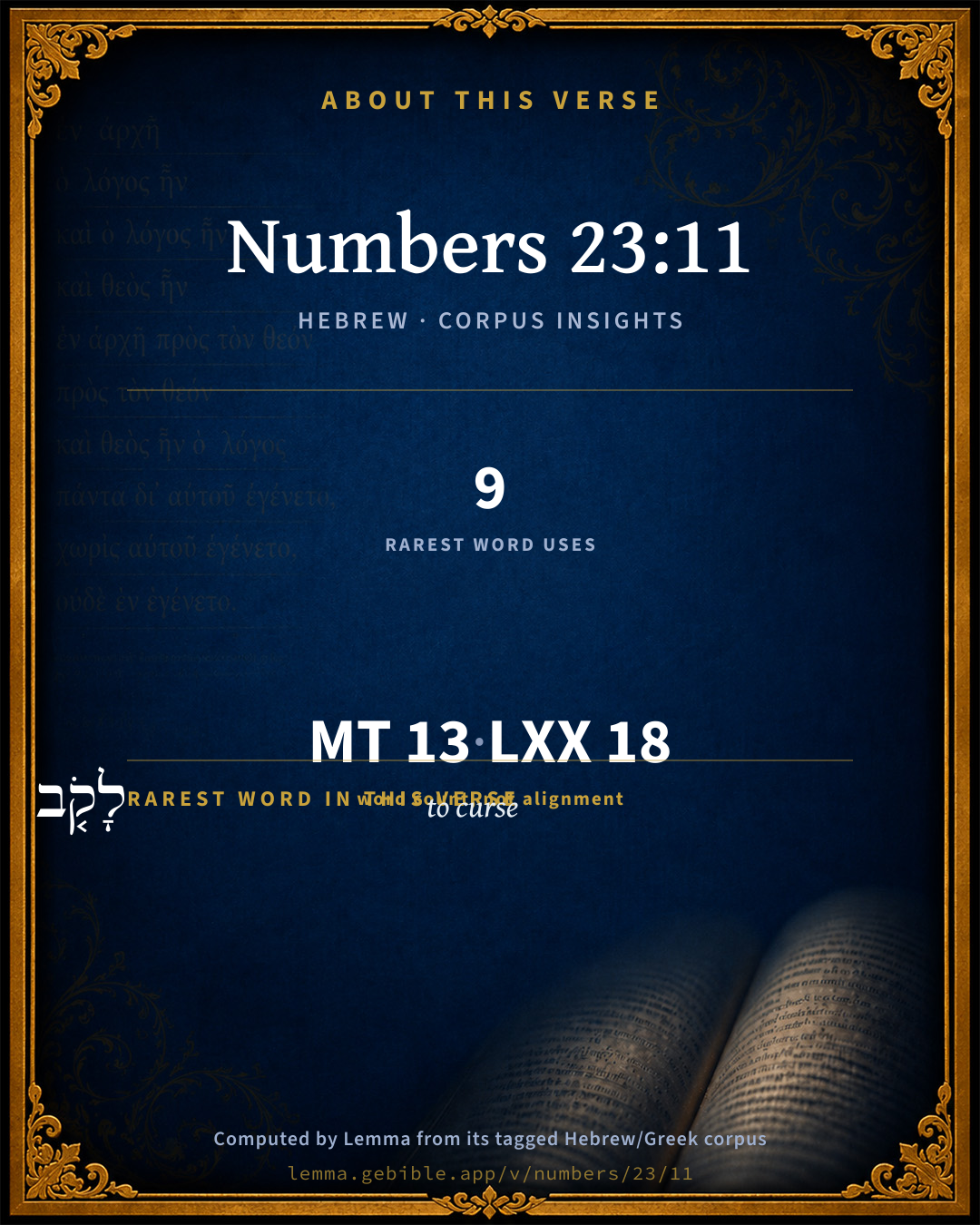
13
words
11
distinct lemmas
Pentateuch
section

Notable vocabulary

The rarest word here is לָקֹ֤ב to curse H6895 — appearing just 9 times in the whole Hebrew Bible.

Shared distinctive vocabulary

לָקֹ֤ב to curse H6895 occurs in 9 verses of the Hebrew Bible. Also found in:

Grammatical profile

  • 7 verbs
  • 2 nouns
  • 2 prepositions
  • 2 particles

Verb forms

  • וַיֹּ֤אמֶר Qal · Sequential Imperfect
  • עָשִׂ֖יתָ Qal · Perfect
  • לָקֹ֤ב Qal · Infinitive Construct
  • אֹיְבַי֙ Qal · Participle Active
  • לְקַחְתִּ֔יךָ Qal · Perfect
  • בֵּרַ֥כְתָּ Piel · Perfect
  • בָרֵֽךְ Piel · Infinitive Absolute

Repetition

A word recurs within this verse — often emphatic in Hebrew:

  • בֵּרַ֥כְתָּ to bless H1288 ×2

Hebrew & Septuagint length

In English translation the verse runs 24 words from the Hebrew and 25 from the Septuagint (LXX English) — closely comparable.

A rough comparison of the two English renderings, which tokenize alike — not a word-level alignment.

Word counts can differ between the Hebrew and the Greek without any difference in meaning — e.g. the Hebrew direct-object marker אֵת has no separate Greek word, and Greek often adds the article ὁ.

In the original languages it is 13 Hebrew tokens and 18 Greek tokens — but the two are counted differently (Hebrew bundles its prefixes and suffixes into one token; the Greek is in lemma form), so that isn’t a like-for-like length.

Cross-references

6

Topical passages linked to Numbers 23:11 in the Treasury of Scripture Knowledge — connected by theme and wording, ordered by reader-vote popularity; previews shown in the World English Bible.

  • Nehemiah 13:2 because they didn't meet the children of Israel with bread and with water, but hired Balaam against them, to curse them: however our God turned the curse into a blessing.
  • Numbers 24:10 Balak's anger was kindled against Balaam, and he struck his hands together; and Balak said to Balaam, I called you to curse my enemies, and, behold, you have altogether blessed them these three times.
  • Numbers 22:17 for I will promote you to very great honor, and whatever you say to me I will do. Please come therefore, and curse this people for me.
  • Numbers 23:7–8 He took up his parable, and said, From Aram has Balak brought me, The king of Moab from the mountains of the East: Come, curse me Jacob, Come, defy Israel.
  • Psalms 109:17–20 Yes, he loved cursing, and it came to him. He didn't delight in blessing, and it was far from him.
  • Numbers 22:11 Behold, the people that is come out of Egypt, it covers the surface of the earth: now, come curse me them; peradventure I shall be able to fight against them, and shall drive them out.

Cross-references courtesy of OpenBible.info (CC BY 4.0).

Hebrew and Greek witnesses Masoretic Hebrew ↔ Greek Septuagint

The same verse in the two great witnesses to the Old Testament, shown verse-for-verse.

These are two independent witnesses, not word-aligned to each other, and the Septuagint is shown in lemma (dictionary) form.

Hebrew Numbers 23:11 Masoretic · Westminster Leningrad Codex

וַיֹּ֤אמֶר בָּלָק֙ אֶל בִּלְעָ֔ם מֶ֥ה עָשִׂ֖יתָ לִ֑י לָקֹ֤ב אֹיְבַי֙ לְקַחְתִּ֔יךָ וְהִנֵּ֖ה בֵּרַ֥כְתָּ בָרֵֽךְ

Balak said to Balaam, What have you done to me? I took you to curse my enemies, and, behold, you have blessed them altogether.

World English Bible · Public Domain

Greek LXX Numbers 23:11 Septuagint · lemma form

καί εἶπον βαλακ πρός βαλααμ τίς ποιέω ἐγώ εἰς κατάρασις ἐχθρός ἐγώ καλέω σύ καί ἰδού εὐλογέω εὐλογία

And Balac said to Balaam, What have you done to me? I called you to curse my enemies, and behold you have greatly blessed them.

LXX2012 (modern English Septuagint) · Public Domain

Hebrew: Westminster Leningrad Codex (CC BY 4.0). Greek: Septuagint (public domain); English from LXX2012 (modern English Septuagint) (Public Domain). How the Septuagint differs from the Hebrew →

Targum (Aramaic paraphrase)

2

The Targum is the ancient Jewish Aramaic paraphrase of the Hebrew Scriptures — an interpretive translation, not the Hebrew text itself. Onkelos (literal) and Pseudo-Jonathan (expansive) render the Torah, and Jonathan the Prophets. Coverage is partial: where no permissively-licensed English translation exists for a verse, only the Aramaic is shown. This is verse-level text, not a word-by-word alignment to the Hebrew.

  1. Targum Onkelos Torah (Genesis–Deuteronomy)
    וַאֲמַר בָּלָק לְבִלְעָם מֶה עֲבַדְתָּא לִי לְמֵילַט סַנְאַי דְבַרְתִּיךְ וְהָא בְּרָכָא מְבָרְכַת לְהוֹן

    (no public-domain English translation for this verse)

    Targum Onkelos — Aramaic: “Onkelos Genesis” (public domain); “Onkelos Exodus” (public domain); “Onkelos Leviticus” (public domain); “Onkelos Numbers” (public domain); “Onkelos Deuteronomy” (public domain). English: “Sefaria Community Translation” (CC0 1.0 (public-domain dedication)); “J.W. Etheridge. The Targums of Onkelos and Jonathan Ben Uzziel on the Pentateuch. London: Longmans, Green, 1862” (public domain). Text via Sefaria.

  2. Targum Pseudo-Jonathan Torah (Genesis–Deuteronomy)
    וַאֲמַר בָּלָק לְבִלְעָם מָה עָבַדְתְּ לִי לְמֵילוֹט סַנְאַי דְבַרְתִּיךְ וְהָא בָרְכָא מְבָרְכַת לְהוֹן

    And Balak said to Bileam, What hast thou done to me? I brought thee to curse my enemies, and, behold, blessing, thou hast blessed them.

    Targum Pseudo-Jonathan — Aramaic: “Targum Jonathan on Genesis” (public domain); “Targum Jonathan on Exodus” (public domain); “Targum Jonathan on Leviticus” (public domain); “Targum Jonathan on Numbers” (public domain); “Targum Jonathan on Deuteronomy” (public domain). English: “The Targum of Jonathan ben Uzziel, trans. J. W. Etheridge, London, 1862” (public domain). Text via Sefaria.

Commentary

Notes on Numbers 23:11 from classic Christian and Jewish commentators (each source and its license shown beneath its notes). The classic Christian expositions comment on the surrounding passage and are grouped to its opening verse, so a note may address several verses; the Jewish commentaries on the Tanakh (Rashi and others) are per-verse, so they appear only where the commentator wrote on this verse.

Lemma curates 59 commentaries, every one of them public domain or Creative Commons licensed, each selected and text-cleaned for this edition rather than reprinted as found. About our sources →

Trapp's Complete Commentary

John Trapp

Num 23:11 And Balak said unto Balaam, What hast thou done unto me? I took thee to curse mine enemies, and, behold, thou hast blessed [them] altogether.

Ver. 11. What hast thou done unto me.] Hereby it appears that Balak, in serving of God by building altars and offering sacrifices, did but serve himself upon God; as Ephraim bore "fruit to himself"; {Hos 10:1} and "Did ye fast to me, even to me?" {Zec 7:5}

John Trapp, A Commentary or Exposition upon All the Books of the Old and New Testament (1647–1656) — public domain. Text from a community e-Sword module.

Lange's Commentary on the Holy Scriptures

F.—THE SECOND BLESSING

Num_23:11-24

11And Balak said unto Balaam, What hast thou done unto me? I took thee to curse mine enemies, and, behold, thou hast blessed them altogether. 12And he answered and said, Must I not take heed to speak that which the Lord hath put in my mouth? 13And Balak said unto him, Come, I pray thee, with me unto another place, from whence thou mayest see them: thou shalt see but the utmost part of them, and shalt not see them all: and curse me them from thence.

14And he brought him into the field of Zophim, to the top of Pisgah,3 and built seven altars, and offered a bullock and a ram on every altar. 15And he said unto 16Balak, Stand here by thy burnt offering, while I meet the LORD yonder. And the Lord met Balaam, and put a word in his mouth, and said, Go again unto Balak, and say thus. 17And when he came to him, behold, he stood by his burnt offering, and the princes of Moab with him. And Balak said unto him, What hath the Lord spoken?

18And he took up his parable, and said,

Rise up, Balak, and hear;

Hearken unto me, thou son of Zippor;

19     God is not a man that he should lie;

Neither the son of man that he should repent;

Hath he said—and shall he not do it?

Or hath he spoken—and shall he not make it good?

20     Behold, I have received commandment to bless.

And he hath blessed; and I cannot reverse it.

21     He hath not beheld iniquity in Jacob,

Neither hath he seen perverseness in Israel;

The Lord his God is with him,

And the shout of a king is among them.

22     God brought them out of Egypt;

He hath as it were the strength of an unicorn.

23     Surely there is no enchantment against4 Jacob,

Neither is there any divination against Israel:

According to this time it shall be said of Jacob

And of Israel, What hath God wrought!

24     Behold, the people shall rise Up as a great lion,

And lift up himself as a young lion:

He shall not lie down until he eat of the prey

And drink the blood of the slain.

TEXTUAL AND GRAMMATICAL

[Num_23:11. בֵּרַכתָּ בָרֵךְ Thou hast blessed to bless. Thou hast blessed only and continually.—A. G.]

[Num_23:13. אֶפֶם קָצֵתוּ—correctly rendered the utmost part—not as Including the whole, but, as the following clause shows, a small part, the mere stragglers of the camp, as it were.—A. G.]

[Num_23:14. Zophim, or watchers, or spies.—A. G.]

[Num_23:15. Here—yonder. כּהֹ, so—thus. The sense is not local. It is the manner.—A. G.]

[Num_23:19. Heb. cause it to stand.—A. G.]

[Num_23:20. Literally: I have taken, received to bless. How he had received it, the word does not explain. The word, however, was put in his mouth, and hence our version correctly supplies commandment.—A. G.]

[Num_23:21. Heb. trouble, sorrow, suffering, generally as the result of sin.—A. G.]

[Num_23:22. The participle מוֹצִיאָם designates the bringing out as still incomplete and going forward.—A. G.]

[Num_23:23. In both cases it is in, not against. Auguries and divinations are not practised in Israel. They had the immediate revelation.—A. G.]

EXEGETICAL AND CRITICAL

1. Balak’s dissatisfaction and his renewed attempt. He thinks already that in the words of Balaam he hears the utterance of the most definite and positive blessing. Balaam appeals to his absolute dependence. Jehovah put the words in his mouth. But now the blinded and superstitious king conceives the idea that he has made a mistake in the position to which he had led the prophet. He had placed him at first where he could see only a part of the camp. It now appears to him that even this was too much. Come thou with me to another place, the end of the end of them (only the extreme, meagre part of them) thou shalt see, and shalt not see them all. Keil takes just the opposite view. Balak, he says, “led the seer to the field of the watchers that he might now see the entire people.” He explains the words “thou shalt not see them all,” as referring to the view from Bamoth-Baal. But the changed position for the third saying, where he first overlooked the whole camp of Israel, lies against this view. The full description of the second position leads also to the rejection of Keil’s view. Kurtz’s theory also, that the utmost part denotes the whole, is to be rejected. The phrase “end of the end” is by no means an “intolerable tautology,” but a very expressive description. The field of the watchers is clearly an elevated plateau upon Pisgah from which watchers made their observations; but that does not determine whether the watchers were soldiers, bird-augurs, or astrologers; nor does it inform us whether this place was the peak Nebo upon Pisgah, or a field of Moab upon the heights of Pisgah. The near lying valley regions are often invisible from lofty summits concealed by wooded ridges and the lower peaks. In any case the design of Balak is clear, that Balaam should see as little as possible of the camp of Israel. Balak must bring again his great sacrifice. I will go to meet yonder, viz., the manifestation of God. [I will go and meet “is a technical term here for going out for auguries or for a divine revelation,” Keil. The term is not local, but expresses the purpose for which he went.—A. G.]. [Hirsch has an ingenious and striking explanation of the places chosen by Balak—Baal, Zophim, Peor—as indicating in his mind the three great potencies which decide the weal or woe of nations, through each of which he hopes to secure the curse of Balaam and the ruin of his foes. First Baal, the physical or material, then the field of seers and watchers, the intellectual, and then Peor, the moral. He would see how richly they were endowed, or through what avenues in these respects their ruin could be accomplished.—A. G.]

2. The blessing. Now he begins his blessing with an address to Balak. He must rise up as if to receive the command of a king; nor is it a mark of distinction directly, a term of majesty and glory when he addresses him as the Son of Zippor. With his first word he reproves the thought of Balak that God might perhaps take back His word. This lies entirely beyond the power of Balaam. So also with the declaration I have received to bless; he (God) hath blessed, and I cannot reverse it.—Now also he speaks positively of blessing, and of the entire failure of the purpose to curse. The blessing branches into the following parts: 1. Israel’s blessed condition spiritually. No iniquity is discovered in Jacob, and (therefore) no trouble or affliction in Israel.—Hence there are no points to which the curse can attach itself. [This applies not to individuals in their moral character, as if they were faultless in the sight of God, but to the people in their calling and in their covenant relation to God.—A. G.]. 2. Israel is the people of God. Jehovah is with him as his God. He Himself is the King, whose trumpet note sounds among them. 3. Hence his way is one in which God leads him. God has brought him out of Egypt, and thus he goes forward rapidly and with the irresistible power of the buffalo. [The Reem was probably some species of the wild ox, of great fierceness and of indomitable strength. See Art. Unicorn, Smith’s Bib. Dict.—A. G.]. 4. Therefore also Israel is secure against the unclean spirits of soothsaying and divination. On the contrary it was guided by the pure spirit of prophecy. The words sound as if Balaam uttered judgment upon his own equivocal position. [“The augury and the divination were the two means employed by the heathen for looking into futurity.” There was no call or place for them in Israel. It was not only secure against their arts, but they had no basis, no legitimate existence. According to the time, i.e., at the right time, in due time, it shall be said, God will reveal His will and purposes.—A. G.]. 5. Hence the lion-like character of the people; its mighty, terrible, irresistible power; its certain triumph over its foes. [Bible Com. “Beyond the camp Balaam’s eye would pass on to the bed of the Jordan. It was perhaps a lion coming up in his strength from the swelling of that stream (Jer_49:19) that indicated to him this similitude.”—A. G.].

Num_23:19. We have already spoken of the apparent repenting of God as a confirmation of His unchangeableness.

Num_23:21. We prefer not to regard God as the subject of הִבִּיט and רָאָה, but to take them as an indefinite form of the third person. [But see Hengst., p. 112, and comp. Hab_1:3; Hab_1:13.—A. G.] The cause of this glory of Israel is found in the fact that God is their King. As the mighty God (El) He leads them (continuously) out of Egypt. Ought any one to make the sinlessness of Israel the cause? תֹּועֶפֹת may express the rhythmic motion in the alternate leaps and pauses of the buffalo in its progress. [It denotes rather the stirring, restless, unwearied efforts with which the animal forces his way upwards.—A. G.].

Num_23:23. Their progress will be sure and constant, because they do not waver here and there under the delusions of magic arts, but march forward with confidence, instructed by the word of God, which shall be given them from time to time. They shall then know what great things the mighty God will do for them.

Num_23:24. The words of Judah’s blessing (Gen_49:9) transferred to the whole people.

Footnotes:

[3]Marg. the hill.

[4]Marg. or in.

Lange's Commentary on the Holy Scriptures (Critical, Doctrinal, and Homiletical), ed. John Peter Lange, English translation edited by Philip Schaff (1864–1880) — public domain. Text from a community e-Sword module.

Ellicott's Commentary for English Readers

(11) Thou hast blessed them altogether.—Hebrew, Thou hast blessed, to bless: an emphatic mode of stating that Balaam had continued to give utterance to nothing but blessings.

A Bible Commentary for English Readers, edited by Charles John Ellicott (1878–1897) — public domain. Text from a community e-Sword module.

The Cambridge Bible for Schools and Colleges

gen. ed. J. J. S. Perowne

11–17. Balak was angry that Jehovah did not put a curse into Balaam’s mouth, and begged him to try again on another spot. The seven-fold sacrifice was again offered.

The Cambridge Bible for Schools and Colleges (gen. ed. J. J. S. Perowne; Cambridge University Press, 1878–1918) — public domain. Text from a community e-Sword module.

John Gill's Exposition

And Balak said unto Balaam, what hast thou done unto me?.... Or "for me" (f); nothing at all, to answer his purpose, or his end in sending for him:

I took thee to curse mine enemies: so he calls the Israelites, though they had never done him any wrong; nor committed any acts of hostility against him, nor showed any intention to commit any; nay, were forbidden by the Lord their God to contend in battle with him and his people:

and, behold, thou hast blessed them altogether; or, "in blessing blessed" (g), done nothing but bless them, and that with many blessings, or pronounced them blessed, and prophesied of their blessedness, for their number, their safety, and of their happiness, not only in life, but at and after death.

(f) "pro me". (g) "benedixisti benedicendo", Pagninus, Montanus, Piscator.

John Gill's Exposition of the Whole Bible (1746–1763) — public domain (CC PDM 1.0). Text via the HelloAO Bible API.

Keil & Delitzsch

C. F. Keil & F. Delitzsch

Balak reproached Balaam for this utterance, which announced blessings to the Israelites instead of curses. But he met his reproaches with the remark, that he was bound by the command of Jehovah. The infinitive absolute, בּרך, after the finite verb, expresses the fact that Balaam had continued to give utterance to nothing but blessings. לדבּר שׁמר, to observe to speak; שׁמר, to notice carefully, as in Deu 5:1, Deu 5:29, etc. But Balak thought that the reason might be found in the unfavourable locality; he therefore led the seer to "the field of the watchers, upon the top of Pisgah," whence he could see the whole of the people of Israel. The words וגו תּראנּוּ אשׁר (Num 23:13) are to be rendered, "whence thou wilt see it (Israel); thou seest only the end of it, but not the whole of it" (sc., here upon Bamoth-baal). This is required by a comparison of the verse before us with Num 22:41, where it is most unquestionably stated, that upon the top of Bamoth-baal Balaam only saw "the end of the people." For this reason Balak regarded that place as unfavourable, and wished to lead the seer to a place from which he could see the people, without any limitation whatever. Consequently, notwithstanding the omission of כּי (for), the words קצהוּ אפס can only be intended to assign the reason why Balak supposed the first utterances of Balaam to have been unfavourable. קצהוּ = העם קצה, the end of the people (Num 22:41), cannot possibly signify the whole nation, or, as Marck, de Geer, Gesenius, and Kurtz suppose, "the people from one end to the other," in which case העם קצה (the end of the people) would signify the very opposite of קצהוּ (the end of it); for העם קצה is not interchangeable, or to be identified, with מקּצה כּל־העם (Gen 19:4), "the whole people, from the end or extremity of it," or from its last man; in other words, "to the very last man." Still less does העם קצה אפס signify "the uttermost end of the whole people, the end of the entire people," notwithstanding the fact that Kurtz regards the expression, "the end of the end of the people," as an intolerable tautology. קבנו, imperative with nun epenth., from קבב. The "field of the watchers," or "spies (zophim), upon the top of Pisgah," corresponds, no doubt, to "the field of Moab, upon the top of Pisgah," on the west of Heshbon (see at Num 21:20). Mount Nebo, from which Moses surveyed the land of Canaan in all its length and breadth, was one summit, and possibly the summit of Pisgah (see Deu 3:27; Deu 34:1). The field of the spies was very probably a tract of table-land upon Nebo; and so called either because watchers were stationed there in times of disturbance, to keep a look-out all round, or possibly because it was a place where augurs made their observations of the heavens and of birds (Knobel). The locality has not been thoroughly explored by travellers; but from the spot alluded to, it must have been possible to overlook a very large portion of the Arboth Moab. Still farther to the north, and nearer to the camp of the Israelites in these Arboth, was the summit of Peor, to which Balak afterwards conducted Balaam (Num 23:28), and where he not only saw the whole of the people, but could see distinctly the camps of the different tribes (Num 24:2).

Num 23:14-17

Upon Pisgah, Balak and Balaam made the same preparations for a fresh revelation from God as upon Bamoth-baal (Num 23:1-6). כּה in Num 23:15 does not mean "here" or "yonder," but "so" or "thus," as in every other case. The thought is this: "Do thou stay (sc., as thou art), and I will go and meet thus" (sc., in the manner required). אקּרה (I will go and meet) is a technical term here for going out for auguries (Num 24:1), or for a divine revelation.

Keil & Delitzsch — Biblical Commentary on the Old Testament (1861–1891) — public domain (CC PDM 1.0). Text via the HelloAO Bible API. (Old Testament only.)

unfoldingWord translationNotes

Door43 World Missions Community

Balak

This is the king of Moab. See how you translated this in Numbers 22:2.

What have you done to me?

Balak uses this question to scold Balaam. This rhetorical question can be translated as a statement. AT: "I cannot believe you did this to me!" (See: Rhetorical Question)

but look

This emphasizes the shocking action that follows.

Should I not be careful to say only what Yahweh puts in my mouth?

Balaam uses this rhetorical question to defend his actions. This can be translated as a statement. AT: "I must be very careful to say only what Yahweh tells me to say." (See: Rhetorical Question)

to say only what Yahweh puts in my mouth

The message is spoken of as if it is something that God put into his mouth. See how you translated a similar phrase in Numbers 22:38. AT: "to say only what Yahweh wants me to say" (See: Metaphor)

translationWords

Balaam

curse

adversary

bless

unfoldingWord translationNotes — © Distant Shores Media and the Door43 World Missions Community, licensed CC BY-SA 4.0. Source: git.door43.org/Door43/en_tn.

Lesson kit

Teaching starters — assembled from the data on this page, not authored interpretation. Every prompt links to the verse data it draws on. Edit before teaching.

Numbers, in the Pentateuch, opens this verse with 13 words (11 distinct Hebrew lemmas). Its most distinctive word is qâbab (“to curse”). A historical commentator’s framing appears above. Read the whole chapter for the surrounding context.

Discussion questions

  1. How does “to curse” (qâbab) shape what this verse is saying?
  2. How does Numbers 22:11, which shares the word «to curse», read alongside this verse?
  3. What does the repetition of “to bless” (2× in this one verse) do in this verse?
  4. These translations render this verse differently; the difference is in the English rendering, not the original. What questions does that raise?
  5. «וַיֹּ֤אמֶר» is a Qal Sequential Imperfect verb. How does that grammatical form shape the action described?
  6. Compare how Trapp's Complete Commentary and Lange's Commentary on the Holy Scriptures read this verse. Where do they agree or differ?

Things to notice

Reading settings

Reading text

Shown beneath each verse's original-language words.

Old Testament
Old Testament edition

Read the OT as the Masoretic Hebrew (MT) or the Greek Septuagint (LXX).

English shown for the Greek Septuagint (in the Hebrew ↔ Greek comparison).

Comparing translations? Open the Compare panel on any verse page to stack up to four side by side.