
Numbers 23:20

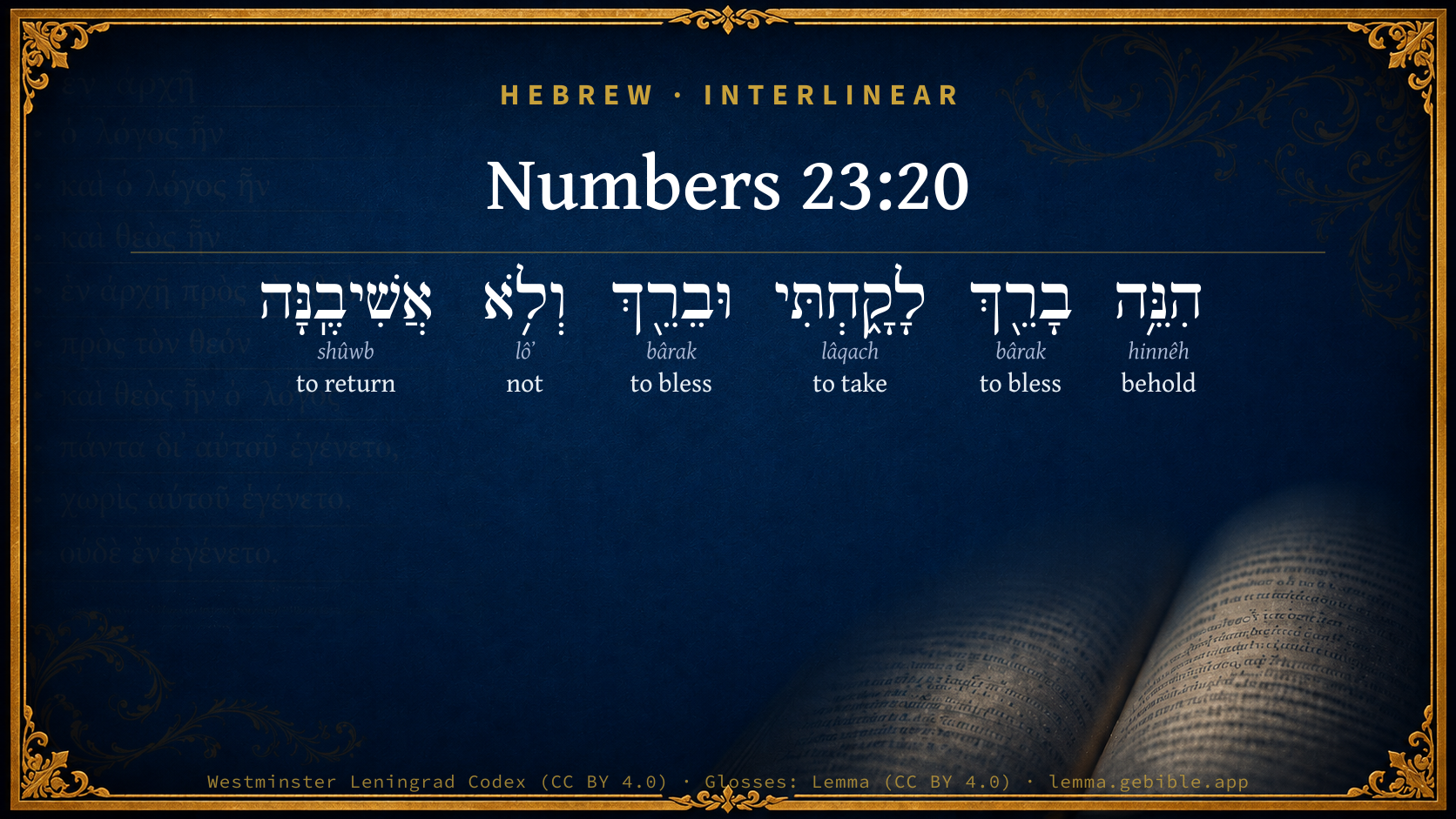
Hebrew (Westminster Leningrad Codex) Numbers 23:20 appears in the Hebrew Old Testament. The text above is from the Westminster Leningrad Codex. Each word links to its Strong’s number, a concise gloss, and parsing drawn from the Open Scriptures Hebrew Bible morphology. Click any word for its full Brown-Driver-Briggs (BDB) entry.
Download image
Cite this verse

Numbers 23:20 (World English Bible). Public Domain. Lemma interlinear Bible study tool, https://lemma.gebible.app/v/numbers/23/20.

Show BibTeX & RIS
BibTeX
RIS
English Translation
Behold, I have received [commandment] to bless: He has blessed, and I can't reverse it.
World English Bible · Public Domain
Download a study sheet

One document with this verse’s original text, its word-by-word gloss line, the meaning frame, cross-references with their text, attributed commentary, and full source and license credits — printable, and it pastes into notes with its structure intact.

This verse Autodidact and up

Study sheet (.html) Plain text (.txt)

A passage Seminary Student

Up to 50 verses in one chapter. A passage sheet keeps up to 6 commentary sources and 12 cross-references per verse, in the order this page ranks them, and says so on the sheet whenever that leaves anything out. Ask for a single verse and you get the Autodidact verse sheet above.

Everything on this page stays free to read, with no account — the sheet is a download of what is already on screen, not access to it.

Want to remove ads? Support Godless Engineer
Compare translations 3

The same verse in 3 English versions, stacked beneath the original-language interlinear above. Click any original word for its lexicon entry.

Each is an independent rendering of the whole verse — the interlinear is not word-aligned to these translations.

Highlighted words mark where these versions differ — a whole-verse word diff, not a word-by-word alignment.

  • World English Bible Public Domain
    Behold, I have received [commandment] to bless: He has blessed, and I can't reverse it.
  • King James Version Public Domain
    Behold, I have received commandment to bless: and he hath blessed; and I cannot reverse it.
  • unfoldingWord Literal Text CC BY-SA 4.0
    Behold, to bless I have received, and he has blessed, and I cannot turn it back.

unfoldingWord Literal Text — © unfoldingWord, licensed CC BY-SA 4.0. Word-aligned USFM3 via Door43 (git.door43.org/unfoldingWord/en_ult).

Versions to compare (up to 4)

3 of 4 selected

Show all 18 translations

Every available English version of this verse, each an independent rendering of the whole verse.

  • World English Bible Public Domain
    Behold, I have received [commandment] to bless: He has blessed, and I can't reverse it.
  • Berean Standard Bible Public Domain
    I have indeed received a command to bless; He has blessed, and I cannot change it.
  • Majority Standard Bible Public Domain
    I have indeed received a command to bless; He has blessed, and I cannot change it.
  • King James Version Public Domain
    Behold, I have received commandment to bless: and he hath blessed; and I cannot reverse it.
  • American Standard Version (1901) Public Domain
    Behold, I have received `commandment' to bless: And he hath blessed, and I cannot reverse it.
  • Revised Version (1885) Public Domain
    Behold, I have received commandment to bless: And he hath blessed, and I cannot reverse it.
  • Geneva Bible (1599) Public Domain
    Behold, I haue receiued commandement to blesse: for he hath blessed, and I cannot alter it.
  • Douay-Rheims (1899) Public Domain
    I was brought to bless, the blessing I am not able to hinder.
  • Young's Literal Translation Public Domain
    Lo, to bless I have received: Yea, He blesseth, and I `can'not reverse it.
  • Literal Standard Version CC BY-SA 4.0
    Behold, I have received [only] to bless; Indeed, He blesses, and I cannot reverse it.
  • Unlocked Literal Bible CC BY-SA 4.0
    Look, I have been commanded to bless. God has given a blessing, and I cannot reverse it.
  • unfoldingWord Literal Text CC BY-SA 4.0
    Behold, to bless I have received, and he has blessed, and I cannot turn it back.
  • Darby Bible Public Domain
    Behold, I have received [mission] to bless; and he hath blessed, and I cannot reverse it.
  • World Messianic Bible Public Domain
    Behold, I have received a command to bless. He has blessed, and I can’t reverse it.
  • Webster's Bible Public Domain
    Behold, I have received commandment to bless: and he hath blessed, and I cannot reverse it.
  • Free Bible Version CC BY-SA 4.0
    Look, I have been ordered to give a blessing. God has blessed, and I can't change that.
  • Bible in Basic English Public Domain
    See, I have had orders to give blessing: and he has given a blessing which I have no power to take away.
  • JPS Tanakh (1917) Public Domain
    Behold, I am bidden to bless; and when He hath blessed, I cannot call it back.

Literal Standard Version (2020), Covenant Press — licensed CC BY-SA 4.0. Text via the HelloAO Bible API (eBible.org). Unlocked Literal Bible (unfoldingWord) — licensed CC BY-SA 4.0. Text via the HelloAO Bible API (eBible.org). unfoldingWord Literal Text — © unfoldingWord, licensed CC BY-SA 4.0. Word-aligned USFM3 via Door43 (git.door43.org/unfoldingWord/en_ult). Free Bible Version, Dr. Jonathan Gallagher — licensed CC BY-SA 4.0. Text via the HelloAO Bible API (eBible.org).

Word by word

More ways to search: Search by grammar → Find every occurrence → Compare this word →

Practice this passage: Drill this verse → Learn its vocabulary →

About this verse

These counts appear in no published source. They are computed here, from the morphology-tagged text and Lemma’s own curated glosses. What Lemma adds →

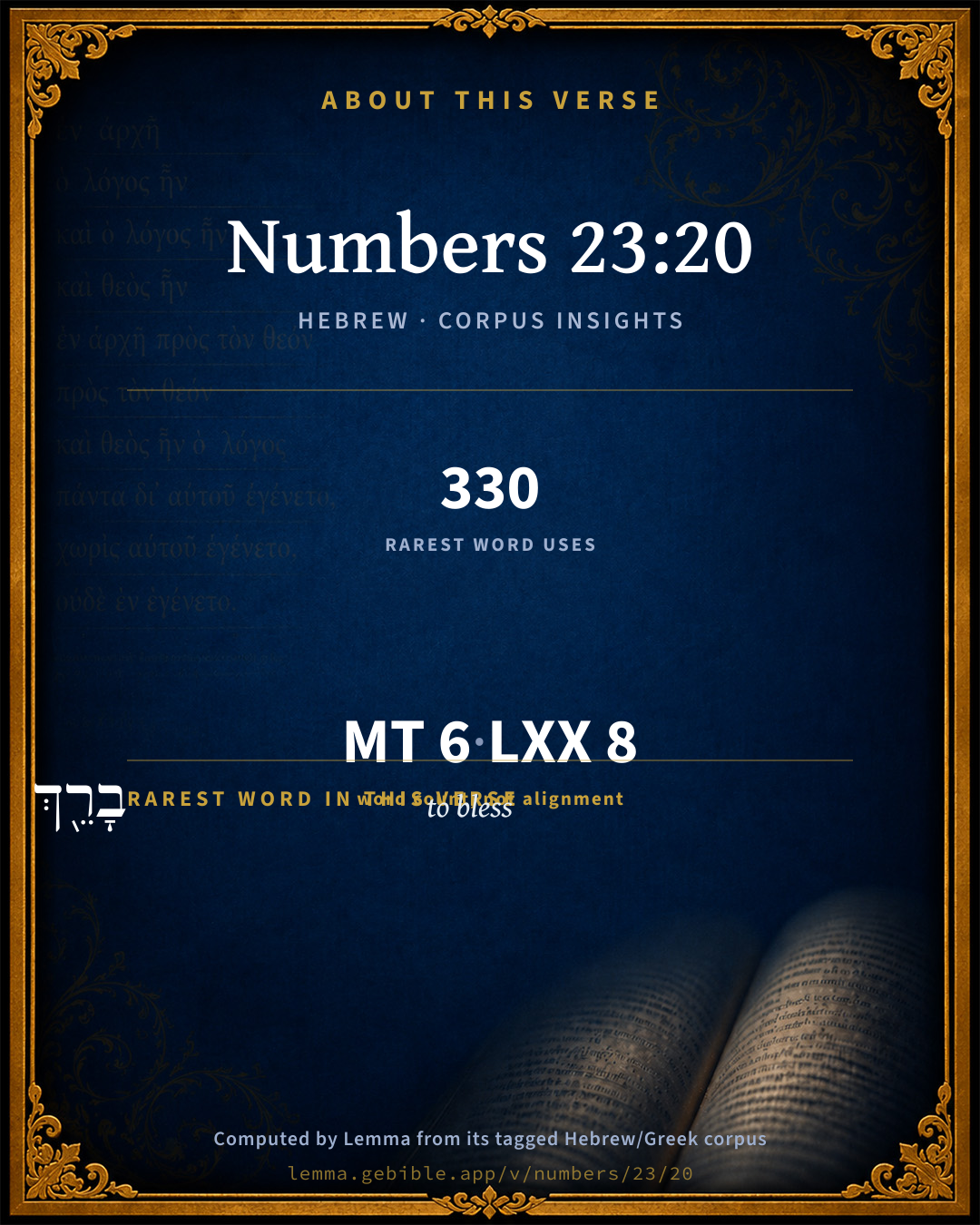
6
words
5
distinct lemmas
Pentateuch
section

Grammatical profile

  • 4 verbs
  • 2 particles

Verb forms

  • בָרֵ֖ךְ Piel · Infinitive Absolute
  • לָקָ֑חְתִּי Qal · Perfect
  • וּבֵרֵ֖ךְ Piel · Perfect
  • אֲשִׁיבֶֽנָּה Hiphil · Imperfect

Repetition

A word recurs within this verse — often emphatic in Hebrew:

  • בָרֵ֖ךְ to bless H1288 ×2

Hebrew & Septuagint length

In English translation the verse runs 15 words from the Hebrew and 14 from the Septuagint (LXX English) — closely comparable.

A rough comparison of the two English renderings, which tokenize alike — not a word-level alignment.

Word counts can differ between the Hebrew and the Greek without any difference in meaning — e.g. the Hebrew direct-object marker אֵת has no separate Greek word, and Greek often adds the article ὁ.

In the original languages it is 6 Hebrew tokens and 8 Greek tokens — but the two are counted differently (Hebrew bundles its prefixes and suffixes into one token; the Greek is in lemma form), so that isn’t a like-for-like length.

Cross-references

9

Topical passages linked to Numbers 23:20 in the Treasury of Scripture Knowledge — connected by theme and wording, ordered by reader-vote popularity; previews shown in the World English Bible.

  • John 10:27–29 My sheep hear my voice, and I know them, and they follow me.
  • Numbers 22:12 God said to Balaam, You shall not go with them; you shall not curse the people; for they are blessed.
  • Genesis 12:2 I will make of you a great nation. I will bless you, and make your name great. You will be a blessing.
  • Genesis 22:17 that in blessing I will bless you, and in multiplying I will multiply your seed as the stars of the heavens, and as the sand which is on the seashore. Your seed will possess the gate of his enemies.
  • Isaiah 43:13 Yes, since the day was I am he; and there is none who can deliver out of my hand: I will work, and who can hinder it?
  • Numbers 22:18 Balaam answered the servants of Balak, If Balak would give me his house full of silver and gold, I can't go beyond the word of Yahweh my God, to do less or more.
  • Romans 8:38–39 For I am persuaded, that neither death, nor life, nor angels, nor principalities, nor things present, nor things to come, nor powers,
  • 1 Peter 1:5 who by the power of God are guarded through faith for a salvation ready to be revealed in the last time.
  • Numbers 22:38 Balaam said to Balak, Behold, I have come to you: have I now any power at all to speak anything? the word that God puts in my mouth, that shall I speak.

Cross-references courtesy of OpenBible.info (CC BY 4.0).

Hebrew and Greek witnesses Masoretic Hebrew ↔ Greek Septuagint

The same verse in the two great witnesses to the Old Testament, shown verse-for-verse.

These are two independent witnesses, not word-aligned to each other, and the Septuagint is shown in lemma (dictionary) form.

Hebrew Numbers 23:20 Masoretic · Westminster Leningrad Codex

הִנֵּ֥ה בָרֵ֖ךְ לָקָ֑חְתִּי וּבֵרֵ֖ךְ וְלֹ֥א אֲשִׁיבֶֽנָּה

Behold, I have received [commandment] to bless: He has blessed, and I can't reverse it.

World English Bible · Public Domain

Greek LXX Numbers 23:20 Septuagint · lemma form

ἰδού εὐλογέω παραλαμβάνω εὐλογέω καί οὐ μή ἀποστρέφω

Behold, I have received commandment to bless: I will bless, and not turn back.

LXX2012 (modern English Septuagint) · Public Domain

On this verse, The Cambridge Bible for Schools and Colleges discusses the Septuagint’s reading. Read the note in Commentary ↓

Hebrew: Westminster Leningrad Codex (CC BY 4.0). Greek: Septuagint (public domain); English from LXX2012 (modern English Septuagint) (Public Domain). How the Septuagint differs from the Hebrew →

Targum (Aramaic paraphrase)

2

The Targum is the ancient Jewish Aramaic paraphrase of the Hebrew Scriptures — an interpretive translation, not the Hebrew text itself. Onkelos (literal) and Pseudo-Jonathan (expansive) render the Torah, and Jonathan the Prophets. Coverage is partial: where no permissively-licensed English translation exists for a verse, only the Aramaic is shown. This is verse-level text, not a word-by-word alignment to the Hebrew.

  1. Targum Onkelos Torah (Genesis–Deuteronomy)
    הָא בִּרְכָן קַבֵּילִית וַאֲבָרֵכִינֵיהּ לְיִשְׂרָאֵל וְלָא אָתֵב בִּרְכְּתִי מִינֵיה

    (no public-domain English translation for this verse)

    Targum Onkelos — Aramaic: “Onkelos Genesis” (public domain); “Onkelos Exodus” (public domain); “Onkelos Leviticus” (public domain); “Onkelos Numbers” (public domain); “Onkelos Deuteronomy” (public domain). English: “Sefaria Community Translation” (CC0 1.0 (public-domain dedication)); “J.W. Etheridge. The Targums of Onkelos and Jonathan Ben Uzziel on the Pentateuch. London: Longmans, Green, 1862” (public domain). Text via Sefaria.

  2. Targum Pseudo-Jonathan Torah (Genesis–Deuteronomy)
    הָא בִּרְכָתָא קַבֵּלִית מִן פּוּם מֵימַר קוּדְשָׁא לָא אֶמְנַע סֵדֶר בִּרְכַתְהוֹן מִנְהוֹן

    Behold, from the mouth of the Holy Word I have received the benediction, and their appointed benediction I cannot restrain from them.

    Targum Pseudo-Jonathan — Aramaic: “Targum Jonathan on Genesis” (public domain); “Targum Jonathan on Exodus” (public domain); “Targum Jonathan on Leviticus” (public domain); “Targum Jonathan on Numbers” (public domain); “Targum Jonathan on Deuteronomy” (public domain). English: “The Targum of Jonathan ben Uzziel, trans. J. W. Etheridge, London, 1862” (public domain). Text via Sefaria.

Commentary

Notes on Numbers 23:20 from classic Christian and Jewish commentators (each source and its license shown beneath its notes). The classic Christian expositions comment on the surrounding passage and are grouped to its opening verse, so a note may address several verses; the Jewish commentaries on the Tanakh (Rashi and others) are per-verse, so they appear only where the commentator wrote on this verse.

Lemma curates 59 commentaries, every one of them public domain or Creative Commons licensed, each selected and text-cleaned for this edition rather than reprinted as found. About our sources →

Trapp's Complete Commentary

John Trapp

Num 23:20 Behold, I have received [commandment] to bless: and he hath blessed; and I cannot reverse it.

Ver. 20. Behold, I have, &c.] A bad man may bless by command from God, and he say Amen to it. The precious stone Lyncuris may issue out of the body of the lynx, an unclean and spotted beast.

John Trapp, A Commentary or Exposition upon All the Books of the Old and New Testament (1647–1656) — public domain. Text from a community e-Sword module.

The Biblical Illustrator

Joseph S. Exell

Num_23:20

He hath blessed; and I cannot reverse it.

Immutable benedictions

I. Blessings are decreed for the people of God. The difficulty of believing in the glorious truth of the supreme blessedness of the children of God is so common that there must be some reasons for it.

1. One reason is that the largest blessings belong to the future. For the present, Christians have to endure the trials of a wilderness pilgrimage. We need faith to expect the good things of the unseen future.

2. A deeper reason is that the best blessings are spiritual. To the carnal mind they appear wearisome in the extreme, just as the exquisite tones of the finest melody do to a man who has no ear for music. Here also men need faith to believe that the highest blessings are necessarily at present above their appreciation.

II. The attempt to reverse these blessings results in the increase of them. The evil intention results unwittingly in a beneficent action. Consider some of the applications of this principle of Providence.

1. The captivity. Nebuchadnezzar, who aimed at destroying the Jewish nation, was indirectly its great benefactor in fulfilling the Divine prophecies of necessary chastisement and forcing the people to a painful discipline, which effectually and for ever purged them of their old besetting sin of idolatry.

2. The temptation of Christ. The tempter sought to overthrow the Son of God and Saviour of the world. But the result of the forty days trial in the wilderness was that Christ came forth fitted to be our great high priest by means of the very endurance of that temptation.

3. The death of Christ. His enemies hoped to overthrow His cause by means of this. But it was overruled to secure His triumph and to accomplish the great end of His mission.

4. The persecution of the Church. The Christians, scattered by the persecution that followed the death of Stephen, fled from Jerusalem only to spread the gospel in all directions, and so to increase their own numbers and to magnify the name of their God.

5. The troubles of life generally. The sufferer is described as being delivered unto Satan. The motive of Satan must be purely malignant. Yet the suffering he inflicts is expressly designed for the good of the sufferer--that the spirit may be saved in the day of the Lord Jesus (1Co_5:5).

III. The blessings of which the people of god cannot be robbed by their most violent foes may be lost by their own sin, (W. F. Adeney, M. A.)

The curses of man turned into blessings by God

The principle embodied here is this: that when God hath determined to bless His people, His purposes will be executed even by those whose intent it is only to reverse them. Tills is the solution of all the apparent mysteries and incongruities in the present state of things: and it will apply--

I. To the Church of Christ at large--and, next, to every individual among the people of God. To this Church--that is, this army of the living God, though separated in different divisions, we look, in the interpretation of Gods promises, as Balaam looked upon Jacob in his goodly tents, and Israel in his outstretched tabernacle. To these we refer the benediction of the royal psalmist, They shall prosper that love Thee; and to these we apply what may be termed the reversed invocation of the text -a curse becoming a blessing--Behold, I have received commandment to bless; and He hath blessed; and I cannot reverse it. But it is not less needful, though it be less pleasing, to observe how, as in the case of Israel, the most severe and searching probation came upon them--not amidst the perils and privations of the wilderness, but amid the abundance and prosperity of the promised land. So the Church, when the fires of persecution had been extinguished, was, and still continues to be, in danger far more imminent. We must beware, lest those prevail who would openly assault her bulwarks, and attempt her battlements in vain. As to the end, indeed, all is safe, and all is sure; God has determined to bless, and earth and hell cannot reverse it (Isa_2:2; Hab_2:14; Php_2:10-11). But it is not the less needful to beware lest, in the meantime, corruption be introduced amongst us from an unsuspected quarter, by intermixture with the enemies of God, while, amidst the rising mists of error, our candlestick burns dimly, if even, through apostasy, it be not removed out of its place. Intercourse with the irreligious and unbelieving, whatever be the pretext, is plainly to be suspected and to be shunned. The blessing of God upon a good cause may be forfeited, and will be nullified, by alliance with wicked men. What else can the crew expect, if they allow themselves to be piloted by traitors, but that they shall strike on a rock suddenly, and go down into the depths of destruction?

II. I proceed, however, to the second, and more practical part of the subject--the application of the principle embodied in the text to each individual believer. Rightly understood, and closely applied, it is to him a covert from all the storms of life, a shield against the fiery arrows of the wicked one, a very present help in time of trouble. God hath blessed, man cannot reverse it: and, however the world may plot, and however it may appear to the servant of the Most High, there is One who worketh all things after the counsel of His own will. The devices of man may appear to be successful, but it is His counsel only that shall abide. It is very important, however, to keep in mind that, while Scripture develops the purposes of Gods will, it does not profess to reveal the processes of Gods work. It states a definite and determined end, but it makes no specific mention of the means. The Lord will perfect that which concerneth me, declares the Psalmist, but how, and by whom, God only knows. He that hath begun a good work in you, says the apostle, will perform it until the day of Jesus Christ; but who can say whether the work will proceed in sunshine or in clouds? Perhaps the latter; not improbably the latter. It is enough for us to know that God is working out a blessing: we must not be cast down, though it come through the channel of a calamity, and with the aspect of a curse. The richest stream of benefit and glory that ever flowed forth to a lost and polluted world was thus opened. How did Christ redeem us from the curse of the law but by being made a curse for us? Many sought to quench Gods light by lifting up the Redeemer on the Cross, and they thus imparted to it instrumentally a power which in the end shall draw all men unto Him. (T. Dale, M. A.)

The Biblical Illustrator, edited by Joseph S. Exell (c. 1880s–1900s) — public domain. Text from a community e-Sword module.

Tyndale Open Study Notes

Tyndale Open Resources

23:20-21 Since the Lord would follow through on his promises to bless his people (bringing them no misfortune or trouble), Balaam was in no position to reverse God’s intentions. Though God punished the Hebrews for acts of disobedience, his advocacy of Israel’s cause was evident from the time he delivered them from Egypt.

Tyndale Open Study Notes — © Tyndale Open Resources, licensed CC BY-SA 4.0. Text via the HelloAO Bible API.

The Cambridge Bible for Schools and Colleges

gen. ed. J. J. S. Perowne

20. And if he blesseth, then I cannot reverse it] It is not necessary to read, with LXX. , ‘and I will bless.’

The Cambridge Bible for Schools and Colleges (gen. ed. J. J. S. Perowne; Cambridge University Press, 1878–1918) — public domain. Text from a community e-Sword module.

John Gill's Exposition

Behold, I have received commandment to bless,.... The people of Israel, to pronounce a blessing upon them, to declare them a happy people:

and he hath blessed, and I cannot reverse it; God has blessed them, has determined to bless them, has promised to bless them, has blessed them in the victories he has given them, and will complete the blessing of them, by bringing them into the land he has given them: so the blessings which God has designed for his spiritual Israel, and bestows upon them, are irreversible; they are blessings indeed, spiritual ones, and are for ever; he blesses them with himself, as their covenant; God, their portion here and hereafter, with Christ his Son, and all things with him, with righteousness, peace, and pardon, with his Spirit and the grace thereof, with sonship, heirship, and eternal life.

John Gill's Exposition of the Whole Bible (1746–1763) — public domain (CC PDM 1.0). Text via the HelloAO Bible API.

Albert Barnes' Notes on the Bible

I have received commandment to bless - literally, “I have received to bless.” The reason of his blessing lay in the augury which he acknowledged, and in the divine overruling impulse which he could not resist, not in any “commandment” in words.

Albert Barnes' Notes on the Bible (1834–1885) — public domain. Text from a community e-Sword/MySword module.

Haydock's Catholic Bible Commentary

To bless, not by my own intention, or by that of Balac, but by God, who hath only suffered me to proceed on my journey, on condition that I would declare his will, chap. xxii. 35. (Haydock) --- Hebrew, "Behold, I have received an order to bless;" or, with the Septuagint, "I have been chosen to pronounce a blessing; I will bless, and will not revoke, or leave off." (Calmet)

George Leo Haydock (1774–1849), Haydock's Catholic Family Bible and Commentary, 1859 edition — public domain. Excludes Psalms (Douay-Rheims chapter numbering differs from Protestant) and Deuterocanonical books (Catholic canon only).

Matthew Poole's English Annotations

Or, I have received a blessing, to wit, a sentence of blessing, which God hath put into my mind and mouth, and which I cannot forbear to utter. Heb. I have received to bless. The infinitive put for the noun, as is frequent.

Matthew Poole's English Annotations on the Holy Bible (1683–1685) — public domain. Text from a community e-Sword/MySword module.

The Pulpit Commentary

I have received commandment to bless. The word "commandment "is not wanted here. Balaam had received, not instructions, but an inward revelation of the Divine will which he could not contravene.

The Pulpit Commentary (1880–1919), ed. H.D.M. Spence-Jones & Joseph S. Exell — public domain. Text from a community e-Sword module.

Rashi

Rabbi Shlomo Yitzchaki (Rashi)

הנה ברך לקחתי BEHOLD, I HAVE RECEIVED COMMANDMENT TO BLESS — You ask me derisively, (v. 17) “What hath the Lord spoken”? I will tell you: I have received an order from Him to bless them.

וברך ולא אשיבנה AND HE HAS BLESSED AND I CANNOT REVERSE IT — “He” has blessed them, and “I” cannot reverse this blessing.

וברך — This is equivalent to וּבִרֵּךְ. This is the rule of the letter ר, as in (Psalms 74:18): “the enemy blasphemeth”, חֵרֵף like חִרֵּף; and similarly (Psalms 10:3): [ובצע בֵּרֵךְ [נאץ ה׳ (where בֵּרֵךְ is for בִּרֵּךְ), which means, He who praises and blesses the robber (בצע) and says, ‘Do not be afraid, for you will not be punished; peace will be unto you’, he angers (נאץ) God thereby (but see Rashi on this verse where another translation is given). — One cannot say that ברך is a noun, for if it were, it would be voweled in both syllables with Short Patach (our Segol), and its accent would be on the first syllable (בֶּרָךְ) because it is a verb in the Piel conjugation, it is voweled with Short Kametz (our Tzéré) on both syllables, and its accent is on the last syllable.

Rashi on the Tanakh — English translations: “The Judaica Press complete Tanach with Rashi, translated by A. J. Rosenberg” (CC BY 4.0); “Pentateuch with Rashi's commentary by M. Rosenbaum and A.M. Silbermann, 1929-1934” (public domain); “The Metsudah Tanach series, Lakewood, N.J” (CC BY 4.0); and “The Book of Joshua, Metsudah Publications, 1997” (CC BY 4.0). Text via Sefaria.

Lesson kit

Teaching starters — assembled from the data on this page, not authored interpretation. Every prompt links to the verse data it draws on. Edit before teaching.

Numbers, in the Pentateuch, opens this verse with 6 words (5 distinct Hebrew lemmas). Its most distinctive word is bârak (“to bless”). A historical commentator’s framing appears above. Read the whole chapter for the surrounding context.

Discussion questions

  1. The word bârak carries the sense “to bless.” How does it shape the verse?
  2. How does John 10:27–29, which shares this passage’s theme, read alongside this verse?
  3. What does the repetition of “to bless” (2× in this one verse) do in this verse?
  4. The translations on this page render this verse differently — a whole-verse word diff, not a word-by-word alignment. What might account for the different wordings?
  5. «בָרֵ֖ךְ» is a Piel Infinitive Absolute verb. How does that grammatical form shape the action described?
  6. Compare how Trapp's Complete Commentary and The Biblical Illustrator read this verse. Where do they agree or differ?

Things to notice

Reading settings

Reading text

Shown beneath each verse's original-language words.

Old Testament
Old Testament edition

Read the OT as the Masoretic Hebrew (MT) or the Greek Septuagint (LXX).

English shown for the Greek Septuagint (in the Hebrew ↔ Greek comparison).

Comparing translations? Open the Compare panel on any verse page to stack up to four side by side.