
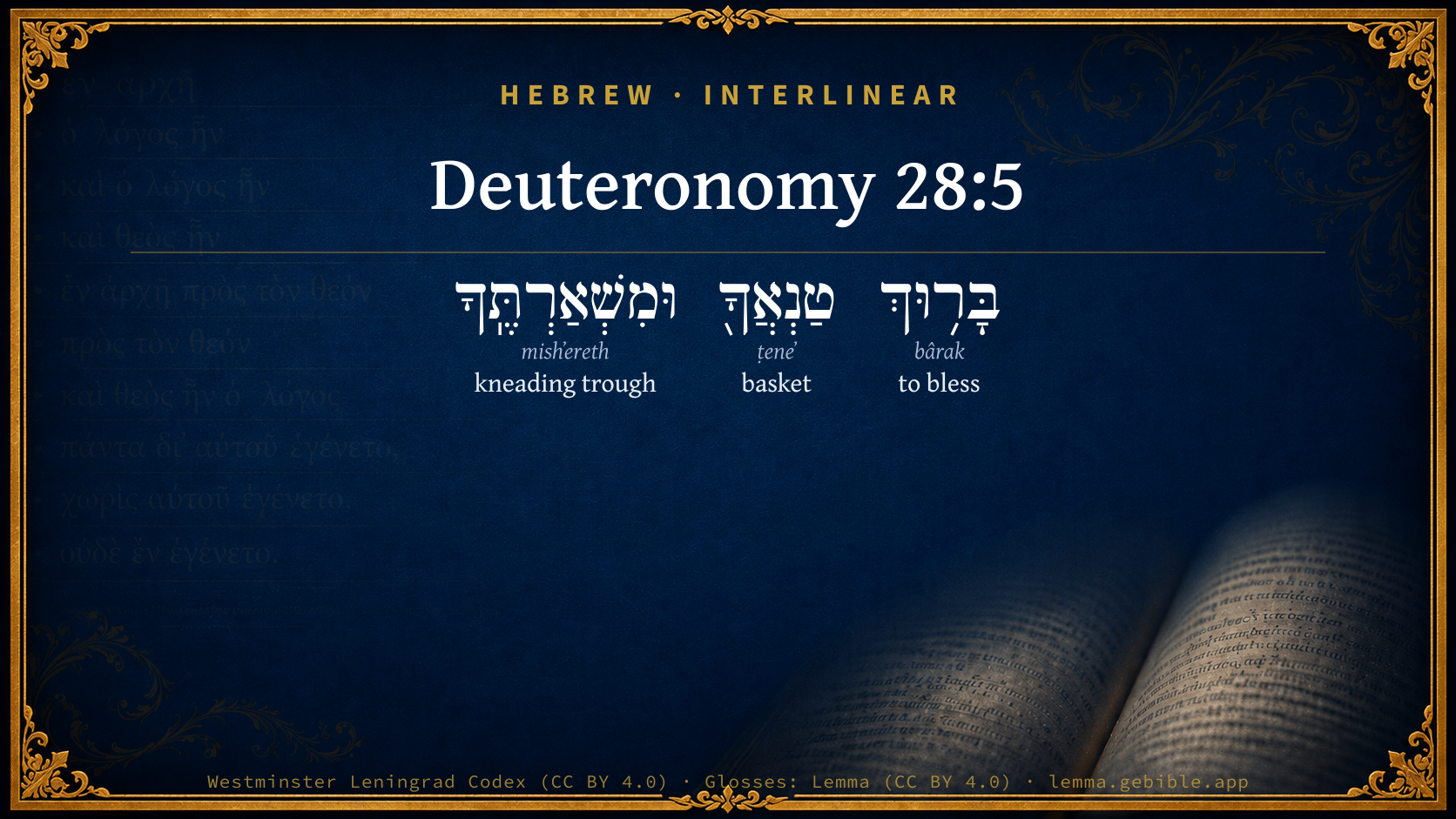
Deuteronomy 28:5

Hebrew (Westminster Leningrad Codex) Deuteronomy 28:5 appears in the Hebrew Old Testament. The text above is from the Westminster Leningrad Codex. Each word links to its Strong’s number, a concise gloss, and parsing drawn from the Open Scriptures Hebrew Bible morphology. Click any word for its full Brown-Driver-Briggs (BDB) entry.
Download image
Cite this verse

Deuteronomy 28:5 (World English Bible). Public Domain. Lemma interlinear Bible study tool, https://lemma.gebible.app/v/deuteronomy/28/5.

Show BibTeX & RIS
BibTeX
RIS
English Translation
Blessed shall be your basket and your kneading-trough.
World English Bible · Public Domain
Download a study sheet

One document with this verse’s original text, its word-by-word gloss line, the meaning frame, cross-references with their text, attributed commentary, and full source and license credits — printable, and it pastes into notes with its structure intact.

This verse Autodidact and up

Study sheet (.html) Plain text (.txt)

A passage Seminary Student

Up to 50 verses in one chapter. A passage sheet keeps up to 6 commentary sources and 12 cross-references per verse, in the order this page ranks them, and says so on the sheet whenever that leaves anything out. Ask for a single verse and you get the Autodidact verse sheet above.

Everything on this page stays free to read, with no account — the sheet is a download of what is already on screen, not access to it.

Want to remove ads? Support Godless Engineer
Compare translations 3

The same verse in 3 English versions, stacked beneath the original-language interlinear above. Click any original word for its lexicon entry.

Each is an independent rendering of the whole verse — the interlinear is not word-aligned to these translations.

Highlighted words mark where these versions differ — a whole-verse word diff, not a word-by-word alignment.

  • World English Bible Public Domain
    Blessed shall be your basket and your kneading-trough.
  • King James Version Public Domain
    Blessed shall be thy basket and thy store.
  • unfoldingWord Literal Text CC BY-SA 4.0
    Blessed your basket and your kneading trough.

unfoldingWord Literal Text — © unfoldingWord, licensed CC BY-SA 4.0. Word-aligned USFM3 via Door43 (git.door43.org/unfoldingWord/en_ult).

Versions to compare (up to 4)

3 of 4 selected

Show all 18 translations

Every available English version of this verse, each an independent rendering of the whole verse.

  • World English Bible Public Domain
    Blessed shall be your basket and your kneading-trough.
  • Berean Standard Bible Public Domain
    Your basket and kneading bowl will be blessed.
  • Majority Standard Bible Public Domain
    Your basket and kneading bowl will be blessed.
  • King James Version Public Domain
    Blessed shall be thy basket and thy store.
  • American Standard Version (1901) Public Domain
    Blessed shall be thy basket and thy kneading-trough.
  • Revised Version (1885) Public Domain
    Blessed shall be thy basket and thy kneadingtrough.
  • Geneva Bible (1599) Public Domain
    Blessed shalbe thy basket and thy dough.
  • Douay-Rheims (1899) Public Domain
    Blessed shall be thy barns and blessed thy stores.
  • Young's Literal Translation Public Domain
    `Blessed `is' thy basket and thy kneading-trough.
  • Literal Standard Version CC BY-SA 4.0
    Blessed [is] your basket and your kneading-trough.
  • Unlocked Literal Bible CC BY-SA 4.0
    Blessed will be your basket and your kneading trough.
  • unfoldingWord Literal Text CC BY-SA 4.0
    Blessed your basket and your kneading trough.
  • Darby Bible Public Domain
    Blessed shall be thy basket and thy kneading-trough.
  • World Messianic Bible Public Domain
    Your basket and your kneading trough shall be blessed.
  • Webster's Bible Public Domain
    Blessed shall be thy basket and thy store.
  • Free Bible Version CC BY-SA 4.0
    You will be blessed with plenty of bread.
  • Bible in Basic English Public Domain
    A blessing will be on your basket and on your bread-basin.
  • JPS Tanakh (1917) Public Domain
    Blessed shall be thy basket and thy kneading-trough.

Literal Standard Version (2020), Covenant Press — licensed CC BY-SA 4.0. Text via the HelloAO Bible API (eBible.org). Unlocked Literal Bible (unfoldingWord) — licensed CC BY-SA 4.0. Text via the HelloAO Bible API (eBible.org). unfoldingWord Literal Text — © unfoldingWord, licensed CC BY-SA 4.0. Word-aligned USFM3 via Door43 (git.door43.org/unfoldingWord/en_ult). Free Bible Version, Dr. Jonathan Gallagher — licensed CC BY-SA 4.0. Text via the HelloAO Bible API (eBible.org).

Word by word

More ways to search: Search by grammar → Find every occurrence → Compare this word →

Practice this passage: Drill this verse → Learn its vocabulary →

About this verse

These counts appear in no published source. They are computed here, from the morphology-tagged text and Lemma’s own curated glosses. What Lemma adds →

3
words
3
distinct lemmas
Pentateuch
section

Notable vocabulary

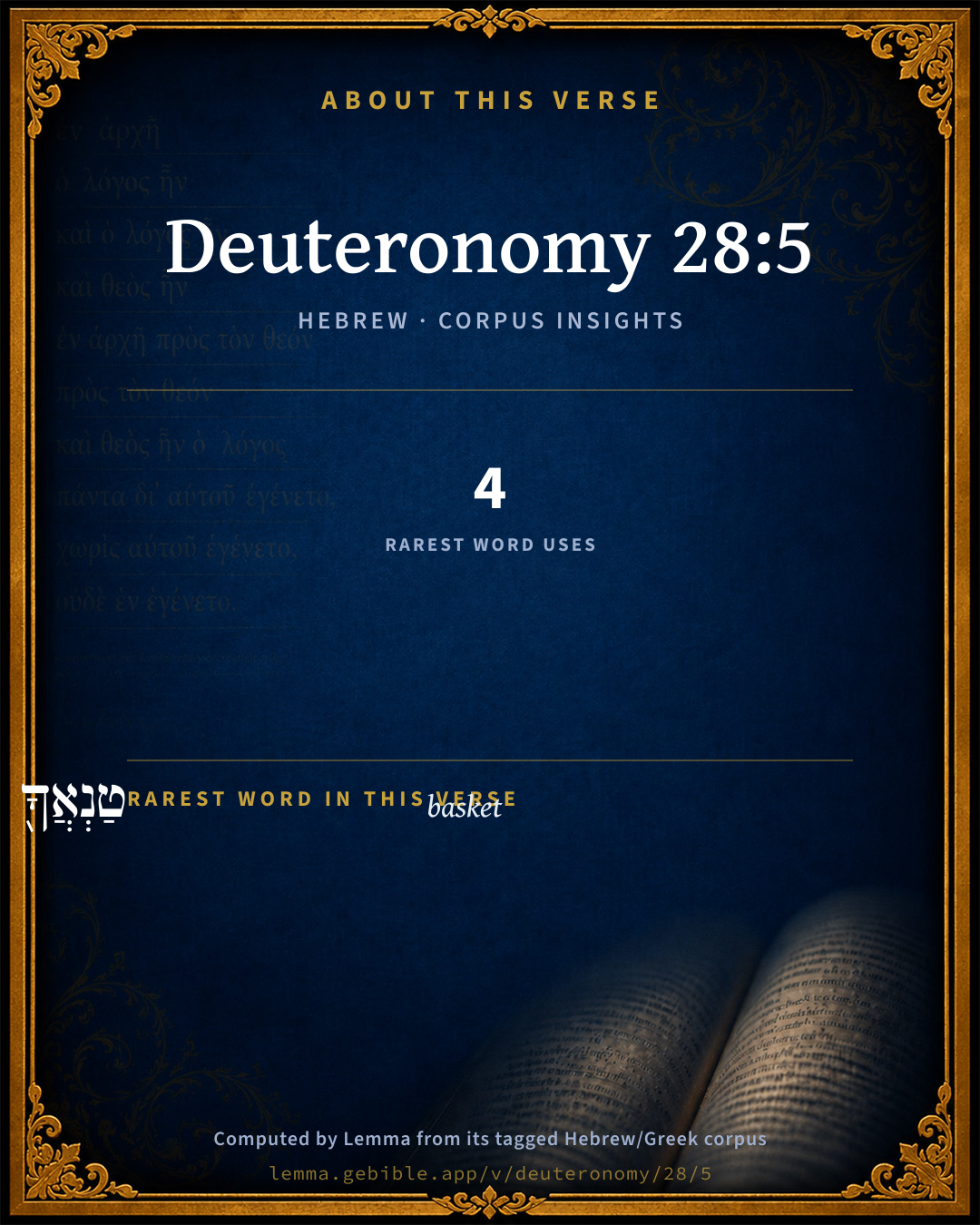
The rarest word here is טַנְאֲךָ֖ basket H2935 — appearing just 4 times in the whole Hebrew Bible.

Shared distinctive vocabulary

טַנְאֲךָ֖ basket H2935 occurs in 4 verses of the Hebrew Bible. Also found in:

Grammatical profile

  • 1 verb
  • 2 nouns

Verb forms

  • בָּר֥וּךְ Qal · Participle Passive

Hebrew & Septuagint length

In English translation the verse runs 8 words from the Hebrew and 8 from the Septuagint (LXX English) — the same length.

A rough comparison of the two English renderings, which tokenize alike — not a word-level alignment.

Word counts can differ between the Hebrew and the Greek without any difference in meaning — e.g. the Hebrew direct-object marker אֵת has no separate Greek word, and Greek often adds the article ὁ.

Hebrew and Greek witnesses Masoretic Hebrew ↔ Greek Septuagint

The same verse in the two great witnesses to the Old Testament, shown verse-for-verse.

These are two independent witnesses, not word-aligned to each other, and the Septuagint is shown in lemma (dictionary) form.

Hebrew Deuteronomy 28:5 Masoretic · Westminster Leningrad Codex

בָּר֥וּךְ טַנְאֲךָ֖ וּמִשְׁאַרְתֶּֽךָ

Blessed shall be your basket and your kneading-trough.

World English Bible · Public Domain

Greek LXX Deuteronomy 28:5 Septuagint · lemma form

εὐλογέω ὁ ἀποθήκη σύ καί ὁ ἐγκαταλείμμα σύ

Blessed shall be your barns, and your stores.

LXX2012 (modern English Septuagint) · Public Domain

On this verse, Ellicott's Commentary for English Readers discusses the Septuagint’s reading. Read the note in Commentary ↓

Hebrew: Westminster Leningrad Codex (CC BY 4.0). Greek: Septuagint (public domain); English from LXX2012 (modern English Septuagint) (Public Domain). How the Septuagint differs from the Hebrew →

Targum (Aramaic paraphrase)

2

The Targum is the ancient Jewish Aramaic paraphrase of the Hebrew Scriptures — an interpretive translation, not the Hebrew text itself. Onkelos (literal) and Pseudo-Jonathan (expansive) render the Torah, and Jonathan the Prophets. Coverage is partial: where no permissively-licensed English translation exists for a verse, only the Aramaic is shown. This is verse-level text, not a word-by-word alignment to the Hebrew.

  1. Targum Onkelos Torah (Genesis–Deuteronomy)
    בְּרִיךְ סַלָךְ וְאַצְוָתָךְ

    (no public-domain English translation for this verse)

    Targum Onkelos — Aramaic: “Onkelos Genesis” (public domain); “Onkelos Exodus” (public domain); “Onkelos Leviticus” (public domain); “Onkelos Numbers” (public domain); “Onkelos Deuteronomy” (public domain). English: “Sefaria Community Translation” (CC0 1.0 (public-domain dedication)); “J.W. Etheridge. The Targums of Onkelos and Jonathan Ben Uzziel on the Pentateuch. London: Longmans, Green, 1862” (public domain). Text via Sefaria.

  2. Targum Pseudo-Jonathan Torah (Genesis–Deuteronomy)
    בְּרִיךְ סַלֵי בִּיכּוּרֵיכוֹן וְחַלַת שֵׁירוֹי אַצְוַותְכוֹן

    Blessed shall be the basket of your first fruits, and the first cakes of your flour.

    Targum Pseudo-Jonathan — Aramaic: “Targum Jonathan on Genesis” (public domain); “Targum Jonathan on Exodus” (public domain); “Targum Jonathan on Leviticus” (public domain); “Targum Jonathan on Numbers” (public domain); “Targum Jonathan on Deuteronomy” (public domain). English: “The Targum of Jonathan ben Uzziel, trans. J. W. Etheridge, London, 1862” (public domain). Text via Sefaria.

Commentary

Notes on Deuteronomy 28:5 from classic Christian and Jewish commentators (each source and its license shown beneath its notes). The classic Christian expositions comment on the surrounding passage and are grouped to its opening verse, so a note may address several verses; the Jewish commentaries on the Tanakh (Rashi and others) are per-verse, so they appear only where the commentator wrote on this verse.

Lemma curates 59 commentaries, every one of them public domain or Creative Commons licensed, each selected and text-cleaned for this edition rather than reprinted as found. About our sources →

Adam Clarke's Commentary

Verse 5. Thy basket] Thy olive gathering and vintage, as the basket was employed to collect those fruits.

Store.] משארת mishereth, kneading-trough, or remainder; all that is laid up for future use, as well as what is prepared for present consumption. Some think that by basket all their property abroad may be meant, and by store all that they have at home, i. e., all that is in the fields, and all that is in the houses. The following note of Mr. Harmer is important: -

"Commentators seem to be at a great loss how to explain the basket and the store mentioned De 28:5; De 28:17. Why Moses, who in the other verses mentions things in general, should in this case be so minute as to mention baskets, seems strange; and they that interpret either the first or the second of these words of the repositories of their corn, c., forget that their barns or storehouses are spoken of presently after this in De 28:8. Might I be permitted to give my opinion here, I should say that the basket, טנא tene, in this place means their travelling baskets, and the other word משארת mishereth, (their store,) signifies their leathern bags, in both which they were wont to carry things in travelling. The first of these words occurs nowhere else in the Scriptures but in the account that is given us of the conveyance in which they were to carry their first-fruits to Jerusalem the other nowhere but in the description of the hurrying journey of Israel out of Egypt, where it means the utensils in which they then carried their dough, which I have shown elsewhere in these papers means a piece of leather drawn together by rings, and forming a kind of bag. Agreeably to this, Hasselquist informs us that the Eastern people use baskets in travelling; for, speaking of that species of the palm tree which produces dates, and its great usefulness to the people of those countries, he tells us that of the leaves of this tree they make baskets, or rather a kind of short bags, which are used in Turkey on journeys and in their houses; pages 261, 262. Hampers and panniers are English terms denoting travelling baskets, as tene seems to be a Hebrew word of the same general import, though their forms might very much differ, as it is certain that of the travelling baskets mentioned by Hasselquist now does.

"In like manner as they now carry meal, figs, and raisins, in a goat's skin in Barbary for a viaticum, they might do the same anciently, and consequently might carry merchandise after the same manner, particularly their honey, oil, and balm, mentioned Eze 27:17. They were the proper vessels for such things. So Sir J. Chardin, who was so long in the East, and observed their customs with so much care, supposed, in a manuscript note on Ge 43:11, that the balm and the honey sent by Jacob into Egypt for a present were carried in a goat or kid's skin, in which all sorts of things, both dry and liquid, are wont to be carried in the East.

"Understood after this manner, the passage promises Israel success in their commerce, as the next verse (the 6th) promises them personal safety in their going out and in their return. In this view the passage appears with due distinctness, and a noble extent." - Observations, vol. 2:, p. 181.

Adam Clarke's Commentary on the Bible (1810–1826) — public domain. Text from a community e-Sword/MySword module.

Trapp's Complete Commentary

John Trapp

Deu 28:5 Blessed [shall be] thy basket and thy store.

Ver. 5. Blessed shall be thy basket and thy store.] Or, Thy dough trough. The Greek hath it, Thy barns and thy remainders. The meaning is, Thou shalt know no want. Cicero {a} saith, One friend should wish to another three things only, to enjoy health, to possess honour, and not suffer necessity. He that observeth God’s commands to do them, as Deu 28:1, shall have all these and more.

{a} Ad Attic.

John Trapp, A Commentary or Exposition upon All the Books of the Old and New Testament (1647–1656) — public domain. Text from a community e-Sword module.

The Biblical Illustrator

Joseph S. Exell

Deu_28:5

Blessed shall be thy basket and thy store.

A blessing on basket and store

Obedience brings a blessing on all the provisions which our industry earns for us. That which comes in and goes out at once, like fruit in the basket which is for immediate use, shall be blessed; and that which is laid by with us for a longer season shall equally receive a blessing. Perhaps ours is a hand basket portion. We have a little for breakfast, and a scanty bite for dinner in a basket when we go out to our work in the morning. This is well, for the blessing of God is promised to the basket. If we live from hand to mouth, getting each days supply in the day, we are as well off as Israel; for when the Lord entertained His favoured people He only gave them a days manna at a time. What more did they need? What more do we need? But if we have a store, how much we need the Lord to bless it! For there is the care of getting, the care of keeping, the care of managing, the care of using; and, unless the Lord bless it, these cares will eat into our hearts, till our goods become our gods, and our cares prove cankers. O Lord, bless our substance. Enable us to use it for Thy glory. Help us to keep worldly things in their proper places, and never may our savings endanger the saving of our souls. (C. H. Spurgeon.)

The Biblical Illustrator, edited by Joseph S. Exell (c. 1880s–1900s) — public domain. Text from a community e-Sword module.

Tyndale Open Study Notes

Tyndale Open Resources

28:5 The breadboards were blessed because the harvest was blessed.

Tyndale Open Study Notes — © Tyndale Open Resources, licensed CC BY-SA 4.0. Text via the HelloAO Bible API.

Ellicott's Commentary for English Readers

(5) Thy basket—(Only here and in Deu_28:17, and Deu_26:2; Deu_26:4)—i.e., the portion which is brought out for the present occasion. Thy store, that which is left, and put away for future use. But this view rests upon the LXX. translation of the word for “store.” All the Targums, and all the Jewish commentators I have been able to consult, and the lexicons also, take a different view. The word is identical in form with that used for “kneading troughs” in Exo_8:3; Exo_12:34. And so the contrast is taken to be, either (1) between firstfruits in their natural condition (Deu_26:2) and the dough offered when already prepared for food, as in the wave-loaves (Lev_23:17); or (2) between the basket in which the corn is carried and the receptacle for the meal or dough, or (as Rashi takes it) between the vessel for things moist and the vessel for things dry. But the view taken by the LXX. is as old as any, and the contrast indicated by “basket” and “store” is simpler and more comprehensive than that which is drawn from a reference to the details of the law. The Authorised Version is, therefore, distinctly to be preferred, in my opinion. There are other technical reasons, which cannot be given here.

A Bible Commentary for English Readers, edited by Charles John Ellicott (1878–1897) — public domain. Text from a community e-Sword module.

The Cambridge Bible for Schools and Colleges

gen. ed. J. J. S. Perowne

5. basket] See on Deu_26:2.

kneading-bowl] See Dri. on Exo_8:3. Cp. mill, Deu_24:6.

The Cambridge Bible for Schools and Colleges (gen. ed. J. J. S. Perowne; Cambridge University Press, 1878–1918) — public domain. Text from a community e-Sword module.

John Gill's Exposition

Blessed shall be thy basket,.... Which the Targums of Jonathan and Jerusalem restrain to the basket of firstfruits, and the cake of the first of their dough; but it intends any and every vessel in which they put their provisions for present use, and that that should never be empty of them, and that they should always have a sufficiency:

and thy store; what remained, and was laid up in their barns, cellars, and storehouses, for future use, or in proper places for seed.

John Gill's Exposition of the Whole Bible (1746–1763) — public domain (CC PDM 1.0). Text via the HelloAO Bible API.

Haydock's Catholic Bible Commentary

Barns. Hebrew tene, is translated (chap. xxvi. 2,) basket, in which bread was kept, and served up at table. Loaves were placed thus in baskets, near the altar of holocausts. --- Stores. What thou hast laid up for thy provisions in corn, fruit, &c. (Calmet)

George Leo Haydock (1774–1849), Haydock's Catholic Family Bible and Commentary, 1859 edition — public domain. Excludes Psalms (Douay-Rheims chapter numbering differs from Protestant) and Deuterocanonical books (Catholic canon only).

Matthew Poole's English Annotations

i.e. It shall always be well replenished, and the provision thou hast there shall be preserved for, and in due time brought forth to, thy use and service. See Deu 26:2,10.

Matthew Poole's English Annotations on the Holy Bible (1683–1685) — public domain. Text from a community e-Sword/MySword module.

John Wesley's Explanatory Notes

Store - Store-house, it shall always be well replenished and the provision thou hast there shall be preserved for thy use and service.

John Wesley, Explanatory Notes Upon the Whole Bible (1754–1765) — public domain. Text via the GEBible commentary corpus.

unfoldingWord translationNotes

Door43 World Missions Community

General Information:

Moses speaks to the Israelites as if they were one man, so the words "you" and "your" here are singular. (See: Forms of You)

Blessed will be

This can be stated in active form. AT: "Yahweh will bless" (See: Active or Passive)

your basket and your kneading trough

Israelites used a basket to carry grain. A "kneading trough" was a bowl they used to mix the grain and make bread. AT: "all the food you grow and all the food you eat" (See: Metonymy)

when you come in ... when you go out

This merism refers to all of life's activities everywhere they go. (See: Merism)

translationWords

bless

basket

unfoldingWord translationNotes — © Distant Shores Media and the Door43 World Missions Community, licensed CC BY-SA 4.0. Source: git.door43.org/Door43/en_tn.

Rashi

Rabbi Shlomo Yitzchaki (Rashi)

ברוך טנאך BLESSED SHALL BE THY BASKET — i.e. thy fruits (which are kept in baskets). — Another explanation of טנאך is that it means liquids which you filter through baskets (wicker work).

ומשארתך accordingly means dry produce that remains (נשאר) in the vessel and does not flow out.

Rashi on the Tanakh — English translations: “The Judaica Press complete Tanach with Rashi, translated by A. J. Rosenberg” (CC BY 4.0); “Pentateuch with Rashi's commentary by M. Rosenbaum and A.M. Silbermann, 1929-1934” (public domain); “The Metsudah Tanach series, Lakewood, N.J” (CC BY 4.0); and “The Book of Joshua, Metsudah Publications, 1997” (CC BY 4.0). Text via Sefaria.

Lesson kit

Teaching starters — assembled from the data on this page, not authored interpretation. Every prompt links to the verse data it draws on. Edit before teaching.

Deuteronomy, in the Pentateuch, opens this verse with 3 words (3 distinct Hebrew lemmas). Its most distinctive word is ṭeneʼ (“basket”). A historical commentator’s framing appears above. Read the whole chapter for the surrounding context.

Discussion questions

  1. What does “basket” (ṭeneʼ) contribute to the verse as a whole?
  2. Deuteronomy 26:2 shares the word «basket» with this verse. How do the two illuminate each other?
  3. These translations render this verse differently. What is at stake in choosing one wording over another?
  4. The verb «בָּר֥וּךְ» is Qal Participle Passive. How does its form color the action?
  5. Reading how Adam Clarke's Commentary and Trapp's Complete Commentary read this verse, where do the two commentators agree and where do they part?

Things to notice

Reading settings

Reading text

Shown beneath each verse's original-language words.

Old Testament
Old Testament edition

Read the OT as the Masoretic Hebrew (MT) or the Greek Septuagint (LXX).

English shown for the Greek Septuagint (in the Hebrew ↔ Greek comparison).

Comparing translations? Open the Compare panel on any verse page to stack up to four side by side.