
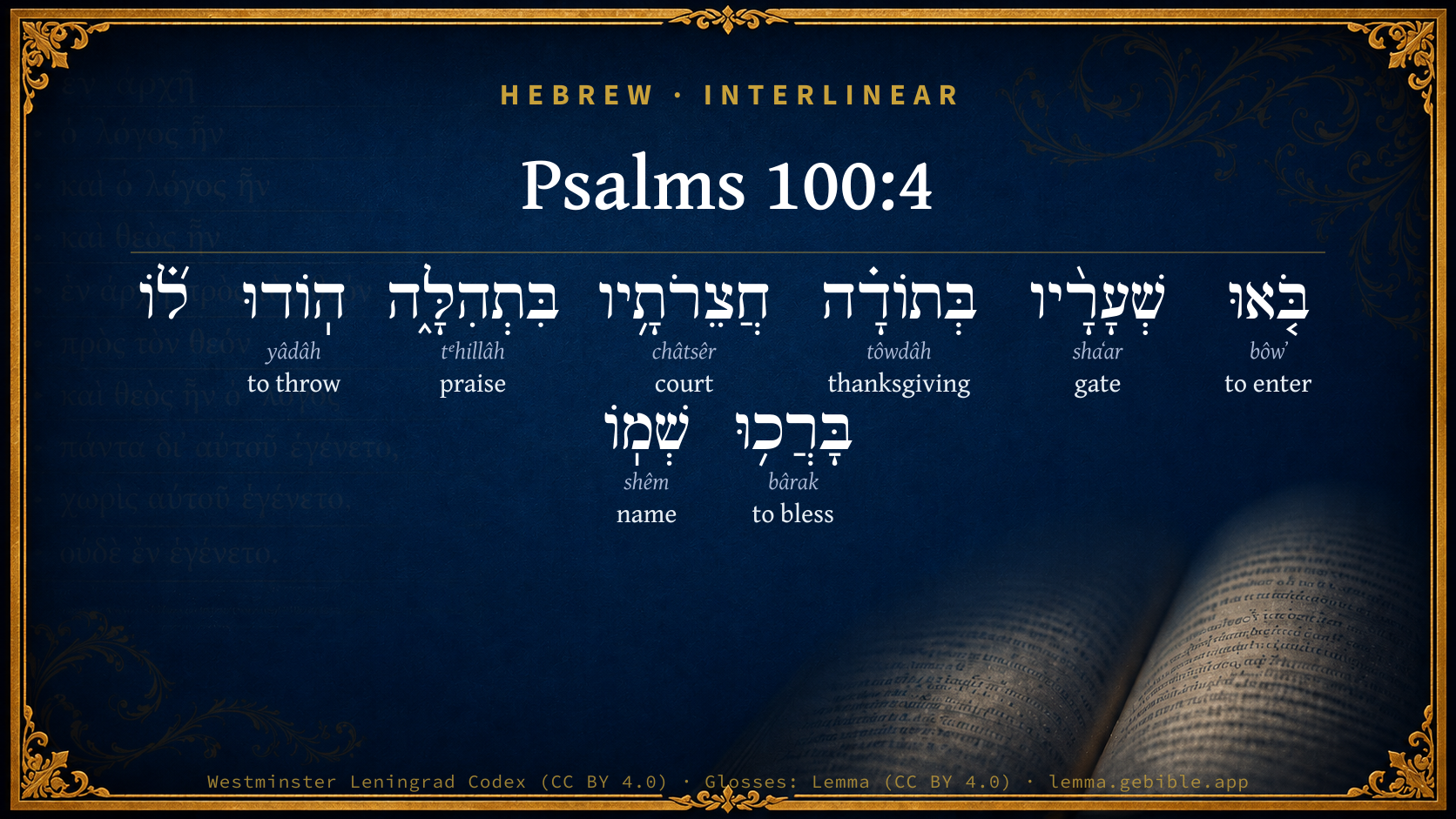
Psalms 100:4

Hebrew (Westminster Leningrad Codex) Psalms 100:4 appears in the Hebrew Old Testament. The text above is from the Westminster Leningrad Codex. Each word links to its Strong’s number, a concise gloss, and parsing drawn from the Open Scriptures Hebrew Bible morphology. Click any word for its full Brown-Driver-Briggs (BDB) entry.
Download image
Cite this verse

Psalms 100:4 (World English Bible). Public Domain. Lemma interlinear Bible study tool, https://lemma.gebible.app/v/psalms/100/4.

Show BibTeX & RIS
BibTeX
RIS
English Translation
Enter into his gates with thanksgiving, Into his courts with praise. Give thanks to him, and bless his name.
World English Bible · Public Domain
Download a study sheet

One document with this verse’s original text, its word-by-word gloss line, the meaning frame, cross-references with their text, attributed commentary, and full source and license credits — printable, and it pastes into notes with its structure intact.

This verse Autodidact and up

Study sheet (.html) Plain text (.txt)

A passage Seminary Student

Up to 50 verses in one chapter. A passage sheet keeps up to 6 commentary sources and 12 cross-references per verse, in the order this page ranks them, and says so on the sheet whenever that leaves anything out. Ask for a single verse and you get the Autodidact verse sheet above.

Everything on this page stays free to read, with no account — the sheet is a download of what is already on screen, not access to it.

Want to remove ads? Support Godless Engineer
Compare translations 3

The same verse in 3 English versions, stacked beneath the original-language interlinear above. Click any original word for its lexicon entry.

Each is an independent rendering of the whole verse — the interlinear is not word-aligned to these translations.

Highlighted words mark where these versions differ — a whole-verse word diff, not a word-by-word alignment.

  • World English Bible Public Domain
    Enter into his gates with thanksgiving, Into his courts with praise. Give thanks to him, and bless his name.
  • King James Version Public Domain
    Enter into his gates with thanksgiving, and into his courts with praise: be thankful unto him, and bless his name.
  • unfoldingWord Literal Text CC BY-SA 4.0
    Enter his gates with thanksgiving and his courts with praise. Give thanks to him; bless his name.

unfoldingWord Literal Text — © unfoldingWord, licensed CC BY-SA 4.0. Word-aligned USFM3 via Door43 (git.door43.org/unfoldingWord/en_ult).

Versions to compare (up to 4)

3 of 4 selected

Show all 18 translations

Every available English version of this verse, each an independent rendering of the whole verse.

  • World English Bible Public Domain
    Enter into his gates with thanksgiving, Into his courts with praise. Give thanks to him, and bless his name.
  • Berean Standard Bible Public Domain
    Enter His gates with thanksgiving and His courts with praise; give thanks to Him and bless His name.
  • Majority Standard Bible Public Domain
    Enter His gates with thanksgiving and His courts with praise; give thanks to Him and bless His name.
  • King James Version Public Domain
    Enter into his gates with thanksgiving, and into his courts with praise: be thankful unto him, and bless his name.
  • American Standard Version (1901) Public Domain
    Enter into his gates with thanksgiving, And into his courts with praise: Give thanks unto him, and bless his name.
  • Revised Version (1885) Public Domain
    Enter into his gates with thanksgiving, and into his courts with praise: give thanks unto him, and bless his name.
  • Geneva Bible (1599) Public Domain
    Enter into his gates with prayse, and into his courts with reioycing: prayse him and blesse his Name.
  • Douay-Rheims (1899) Public Domain
    Go ye into his gates with praise, into his courts with hymns: and give glory to him. Praise ye his name:
  • Young's Literal Translation Public Domain
    Enter ye His gates with thanksgiving, His courts with praise, Give ye thanks to Him, bless ye His Name.
  • Literal Standard Version CC BY-SA 4.0
    Enter His gates with thanksgiving, || His courts with praise, || Give thanks to Him, bless His Name.
  • Unlocked Literal Bible CC BY-SA 4.0
    Enter into his gates with thanksgiving and into his courts with praise. Give thanks to him and bless his name.
  • unfoldingWord Literal Text CC BY-SA 4.0
    Enter his gates with thanksgiving and his courts with praise. Give thanks to him; bless his name.
  • Darby Bible Public Domain
    Enter into his gates with thanksgiving [and] into his courts with praise; give thanks unto him, bless his name:
  • World Messianic Bible Public Domain
    Enter into his gates with thanksgiving, and into his courts with praise. Give thanks to him, and bless his name.
  • Webster's Bible Public Domain
    Enter into his gates with thanksgiving, and into his courts with praise: be thankful to him, and bless his name.
  • Free Bible Version CC BY-SA 4.0
    Go in through his gate with thanks; enter his courts with praise. Thank him; praise him for who he is.
  • Bible in Basic English Public Domain
    Come into his doors with joy, and into his house with praise; give him honour, blessing his name.
  • JPS Tanakh (1917) Public Domain
    Enter into His gates with thanksgiving, and into His courts with praise; give thanks unto Him, and bless His name.

Literal Standard Version (2020), Covenant Press — licensed CC BY-SA 4.0. Text via the HelloAO Bible API (eBible.org). Unlocked Literal Bible (unfoldingWord) — licensed CC BY-SA 4.0. Text via the HelloAO Bible API (eBible.org). unfoldingWord Literal Text — © unfoldingWord, licensed CC BY-SA 4.0. Word-aligned USFM3 via Door43 (git.door43.org/unfoldingWord/en_ult). Free Bible Version, Dr. Jonathan Gallagher — licensed CC BY-SA 4.0. Text via the HelloAO Bible API (eBible.org).

Word by word

More ways to search: Search by grammar → Find every occurrence → Compare this word →

Practice this passage: Drill this verse → Learn its vocabulary →

בְּתוֹדָ֗ה
tôwdâh
H8426
“in/at · thanksgiving”
Preposition + Noun, Common, Feminine, Singular, Absolute
Part of Speech
Preposition + Noun
Type
Common
Gender
Feminine
Number
Singular
State
Absolute
Full BDB Definition

Origin: from H3034

TWOT: 847b

confession, praise, thanksgiving - give praise to God - thanksgiving in songs of liturgical worship, hymn of praise - thanksgiving choir or procession or line or company - thank-offering, sacrifice of thanksgiving - confession
  1. בֹּ֤אוּ bôwʼ H935 “enter” Verb, Qal, Imperative, 2nd Person, Masculine, Plural
  2. שְׁעָרָ֨יו shaʻar H8179 “gates · his” Noun, Common, Masculine, Plural, Construct + Suffix, Personal, 3rd Person, Masculine, Singular
  3. חֲצֵרֹתָ֥יו châtsêr H2691 “courts · his” Noun, Common, Both, Plural, Construct + Suffix, Personal, 3rd Person, Masculine, Singular
  4. בִּתְהִלָּ֑ה tᵉhillâh H8416 “in/at · praise” Preposition + Noun, Common, Feminine, Singular, Absolute
  5. הֽוֹדוּ yâdâh H3034 “throw” Verb, Hiphil, Imperative, 2nd Person, Masculine, Plural
  6. בָּרֲכ֥וּ bârak H1288 “bless” Verb, Piel, Imperative, 2nd Person, Masculine, Plural
  7. שְׁמֽוֹ shêm H8034 “name · his” Noun, Common, Masculine, Singular, Construct + Suffix, Personal, 3rd Person, Masculine, Singular

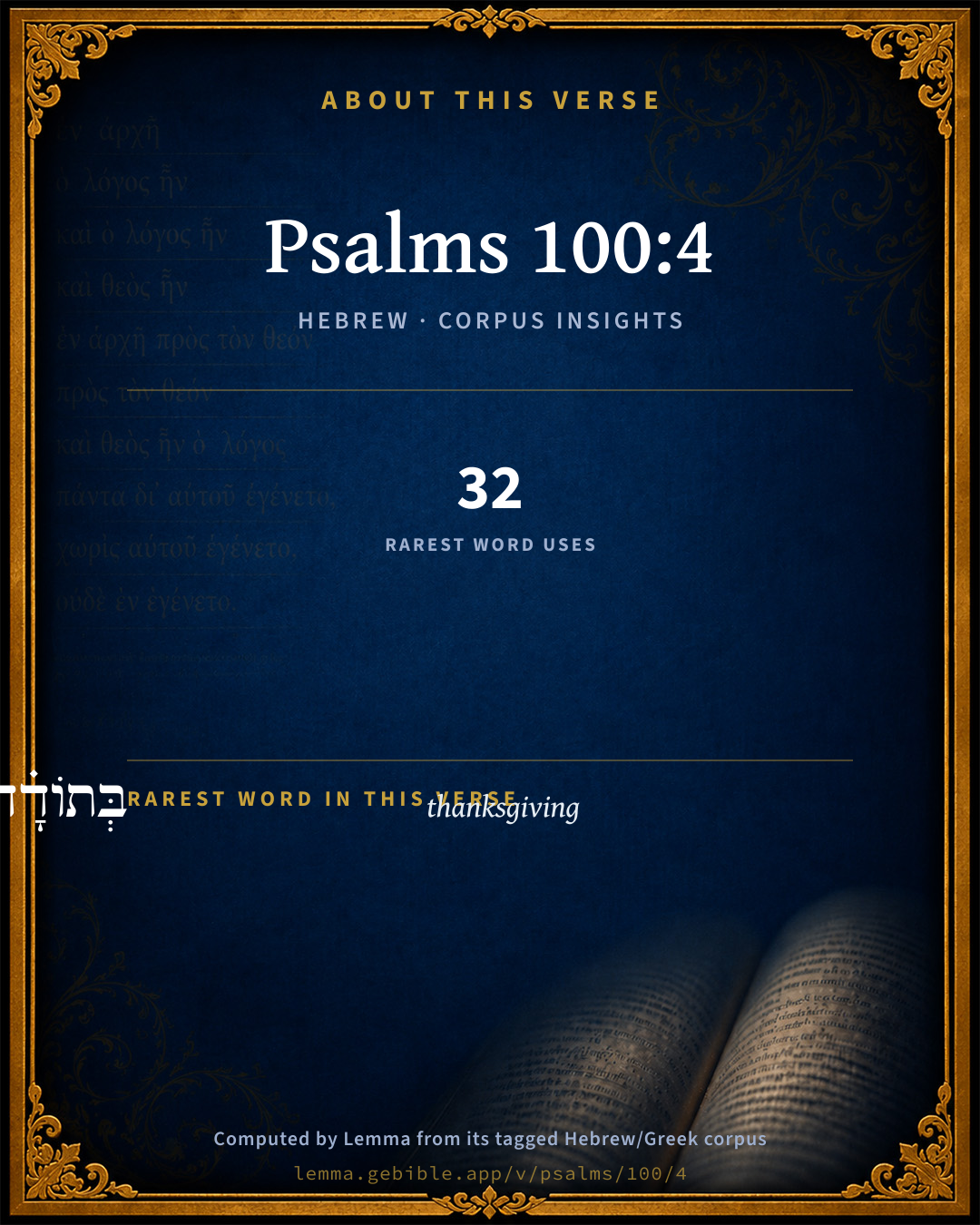
About this verse

These counts appear in no published source. They are computed here, from the morphology-tagged text and Lemma’s own curated glosses. What Lemma adds →

9
words
8
distinct lemmas
Wisdom
section

Shared distinctive vocabulary

בְּתוֹדָ֗ה thanksgiving H8426 occurs in 30 verses of the Hebrew Bible. Also found in:

Grammatical profile

  • 3 verbs
  • 5 nouns
  • 1 preposition

Verb forms

  • בֹּ֤אוּ Qal · Imperative
  • הֽוֹדוּ Hiphil · Imperative
  • בָּרֲכ֥וּ Piel · Imperative

Hebrew & Septuagint length

In English translation the verse runs 19 words from the Hebrew and 18 from the Septuagint (LXX English) — closely comparable.

A rough comparison of the two English renderings, which tokenize alike — not a word-level alignment.

Word counts can differ between the Hebrew and the Greek without any difference in meaning — e.g. the Hebrew direct-object marker אֵת has no separate Greek word, and Greek often adds the article ὁ.

Cross-references

12

Topical passages linked to Psalms 100:4 in the Treasury of Scripture Knowledge — connected by theme and wording, ordered by reader-vote popularity; previews shown in the World English Bible.

  • Colossians 3:16–17 Let the word of Christ dwell in you richly; in all wisdom teaching and admonishing one another with psalms, hymns, and spiritual songs, singing with grace in your heart to the Lord.
  • Hebrews 13:15 Through him, then, let us offer up a sacrifice of praise to God continually, that is, the fruit of lips which make confession to his name.
  • 1 Chronicles 29:13 Now therefore, our God, we thank you, and praise your glorious name.
  • Psalms 103:1–2 Praise Yahweh, my soul! All that is within me, praise his holy name!
  • Psalms 116:17–19 I will offer to you the sacrifice of thanksgiving, And will call on the name of Yahweh.
  • Psalms 66:13 I will come into your temple with burnt offerings. I will pay my vows to you,
  • Psalms 145:1–2 I will exalt you, my God, the King. I will praise your name forever and ever.
  • Psalms 96:2 Sing to Yahweh! Bless his name! Proclaim his salvation from day to day!
  • Isaiah 35:10 and the ransomed of Yahweh shall return, and come with singing to Zion; and everlasting joy shall be on their heads: they shall obtain gladness and joy, and sorrow and sighing shall flee away.
  • Psalms 103:20–22 Praise Yahweh, you angels of his, Who are mighty in strength, who fulfill his word, Obeying the voice of his word.
  • 1 Chronicles 29:20 David said to all the assembly, Now bless Yahweh your God. All the assembly blessed Yahweh, the God of their fathers, and bowed down their heads, and worshiped Yahweh, and the king.
  • Psalms 65:1 Praise waits for you, God, in Zion. To you shall vows be performed.

Cross-references courtesy of OpenBible.info (CC BY 4.0).

Hebrew and Greek witnesses Masoretic Hebrew ↔ Greek Septuagint

The same verse in the two great witnesses to the Old Testament, shown verse-for-verse.

You’re reading Greek Psalm 99 (Hebrew Psalm 100). The Septuagint counts the superscription, so verse numbers can differ from the Hebrew — chapter-level alignment, not verse-by-verse. Numbering follows Rahlfs.

These are two independent witnesses, not word-aligned to each other, and the Septuagint is shown in lemma (dictionary) form.

Hebrew Psalms 100:4 Masoretic · Westminster Leningrad Codex

בֹּ֤אוּ שְׁעָרָ֨יו בְּתוֹדָ֗ה חֲצֵרֹתָ֥יו בִּתְהִלָּ֑ה הֽוֹדוּ ל֝֗וֹ בָּרֲכ֥וּ שְׁמֽוֹ

Enter into his gates with thanksgiving, Into his courts with praise. Give thanks to him, and bless his name.

World English Bible · Public Domain

Greek LXX Greek Psalm 99:4 Septuagint · lemma form

εἰςἔρχομαι εἰς ὁ πύλη αὐτός ἐν ἐξομολόγησις εἰς ὁ αὐλή αὐτός ἐν ὕμνος ἐκὁμολογέω αὐτός αἰνέω ὁ ὄνομα αὐτός

Enter into his gates with thanksgiving, and his courts with hymns; give thanks to him, praise his name.

LXX2012 (modern English Septuagint) · Public Domain

Hebrew: Westminster Leningrad Codex (CC BY 4.0). Greek: Septuagint (public domain); English from LXX2012 (modern English Septuagint) (Public Domain). How the Septuagint differs from the Hebrew →

Commentary

Notes on Psalms 100:4 from classic Christian and Jewish commentators (each source and its license shown beneath its notes). The classic Christian expositions comment on the surrounding passage and are grouped to its opening verse, so a note may address several verses; the Jewish commentaries on the Tanakh (Rashi and others) are per-verse, so they appear only where the commentator wrote on this verse.

Lemma curates 59 commentaries, every one of them public domain or Creative Commons licensed, each selected and text-cleaned for this edition rather than reprinted as found. About our sources →

Trapp's Complete Commentary

John Trapp

Psa 100:4 Enter into his gates with thanksgiving, [and] into his courts with praise: be thankful unto him, [and] bless his name.

Ver. 4. Enter into his gates, &c.] As sheep into his sheepfolds, frequent his public ordinances, wait at the posts of the gates of wisdom; there, as at a heavenly exchange, the smuts present duty, and God confers mercy.

John Trapp, A Commentary or Exposition upon All the Books of the Old and New Testament (1647–1656) — public domain. Text from a community e-Sword module.

The Biblical Illustrator

Joseph S. Exell

Psa_100:4

Enter into His gates with thanksgiving.

Thankfulness

Thankfulness denotes a composite emotion, whose elements are joy for a gift, and love for the giver. It differs from gratitude, not essentially, but only in form; the one being necessarily a feeling only, the other that feeling both existent and expressed.

I. The hindrances which practically interfere with this great moral and Christian duty.

1. The habit of looking too much at other people, and too little at ourselves. If the poor man would go into his own heart, and fling overboard all but his own peculiar cares and troubles, and sit down to feast on the rich viands God has gathered as his sea-stores, then his lightened and relieved bark would float buoyantly on the waters, and answer readily her helm, and with glad songs and bright skies, go on her way rejoicing.

2. Letting the mind dwell too much on the dark side of our experience. The ten thousand daily blessings wherewith God has been surrounding our lives are lost sight of in the occasional clouds of difficulty that may have chequered our pathway. We think more of the one thousand dollars lost, than of the twenty thousand left us. More of the one month of sickness, than the eleven months of health. More of the one beloved friend dead, than of the many beloved yet living.

3. Regarding the first gift of a good thing as alone demanding gratitude, and its subsequent preservation as a natural sequence.

II. The helps to thankfulness.

1. We must entertain just and philosophic views of lifes nature and mission. A man, crossing an ocean on shipboard, is not discontented because he cannot carry with him his sumptuous furniture and equipage; and grumbles not that his state-room hath not the breadth and brilliancy of his palatial pavilions. His very gladness is, that he is in a structure so modelled that it can have speed upon the waters. And just so it is with a man in progress to immortality. What we want is rather a tent that can be pitched and struck at pleasure; and provisions of a kind that can be carried in journeys; than a splendid palace, and ponderous luxuries, incapable of transportation. And so a true appreciation of the real uses of things will go far to render us thankful for the peculiar size and shape of the blessings God gives us.

2. We must dwell much in thought upon these Divine mercies, present and actual. We are too much given to day-dreams amid things possible and future. We lift the glass of imagination to the far hills, that, mellowed by distance and haloed with the purple and gold of the setting sun, look like fairy lands, and grow dissatisfied with the present and possessed. And yet, there is no one in whose present experience there is not enough at least for thankfulness--of comfort and blessing.

3. We must make the best of our misfortunes. What the Germans tell us as a parable, we have all of us--who have gone afield with nature in observant moods--witnessed not unfrequently. Standing by some autumnal and over-matured flower, we have seen the laborious bee come hurrying and humming, and plunging into the flowers cup, where there was not a particle of honey. But what does the bee do? Why, after sucking, and finding no nectar, does it come up from the flowers heart with a disappointed air, as if departing to some other field of labour? Ah no! If there be no sweets at the flowers red core, yet its stamens are full of golden farina, and out of the farina the bee builds its cells; and so it rolls its little legs against these stamens, till they look large and loaded as golden hose, and, thanking the flower as sweetly as if it had been full of honey, gladly humming, it flies home with its wax. Yes, and herein lies Gods moral--If our flowers have no honey, let us be glad of the wax!

4. We must, meanwhile, learn to look upon these very evils as Gods disguised blessings. To every true Christian, they are so, positively, and beyond controversy. As part of the special providence of a wise and loving Father, they cannot be otherwise. It is God that determines the bounds of our habitation; the stations we are to fill; the comforts we are to enjoy; and the trials we are to suffer. And if we have not much of the present world, it is not because our heavenly Father is not able to give us more. It is all to be resolved into the wisdom and kindness of the Divine administration--Gods wisdom discerning how much is best for us--and His love determining to allow us no more.

5. To become truly thankful, we must become Christians--and Christians growing in grace and advancing in knowledge.

(1) Religion makes a man humble; and humility, as a grace, lies at the foundation of contentment.

(2) Religion gives him just views of present things, and of the true relation he sustains to them, in this earthly economy. They never seem to him ends, but only means unto ends. He understands how his present life is a sojourn--an exodus. And, as a true-hearted traveller, he expects not home comforts on a journey, but is content with rude fare and humble hostelries, and can thank God even for rough roads and foul weather, if they hinder not his progress.

(3) Religion, as it is essentially a principle of self-denial, moderates a mans wishes, and so creates happiness. Diogenes was happier in his tub, than Alexander on the throne of his empire. And for a good reason--because the tub held the wishes of the philosopher; but the world was too small for those of the conqueror.

(4) Religion produces trustfulness, and so brings contentment.

III. The reasons of thankfulness.

1. Our circumstances demand it. Just contrast your own condition this day, with that of the exulting pilgrims, when they kept their first thanksgiving festival. See them, amid the solitudes of that great wilderness--the cry of the wild beast, and the roar of the strong wind rising around them--the loved homes of their childhood, and the precious temples of their fathers, far away over the waters--a barren soil beneath their feet; and above, the cold and cheerless azure of a stranger-heaven! And yet singing triumphantly unto God their thanksgiving anthem!

2. For the sake of your own souls, you ought to be thankful. The habit of mournful sadness blinds the eye, and dwarfs the pinions of the soul; renders the heart a nervous and neuralgic thing; eats out a mans piety; weakens every Christian grace; and makes the creature a torture to himself, and a curse to his neighbourhood.

3. As Christians, we ought, for the sake of others, to manifest this abiding spirit of icy and thanksgiving.

4. For your heavenly Fathers sake, you ought to cherish and display this spirit of thanksgiving. A monarch, whose subjects are always complaining of their lot, is set down by the world as a hard and selfish tyrant. A father, whose children walk abroad ever in sadness and tears, is anathematized by all people as a heartless and cruel parent. Shame on us, if, surrounded by such blessings, and hastening onward to such revelations of glory, we go ever with the bowed head, and the mournful footsteps, saying to the world by our pitiful complainings--See how the eternal God is maltreating His loyal subjects! . . . See how our heavenly Father is torturing His children! (C. Wadesworth.)

And into His courts with praise.

Praise

Gods praises must be sung--

I. With the attention of the mind. The words must be considered, as well as heard or read. A person can never be rationally or piously affected with what he sings, except he understands it. Without this, there is no more devotion in him, than there is in an organ or other musical instrument which utters the like sounds. Or if there be anything like devotion excited by mere sounds, it is probably enthusiasm, or something purely animal; a sort of pleasing mechanical sensation, which perhaps some brutes may as strongly feel by sounds suited to the state of their frame.

II. With the melody of the voice. Poetry enlivens praise; and music heightens the powers of poetry, and gives it more force to engage and affect the mind. It puts spirit into every word, and their united influences elevate, compose, and melt the soul. From hence it will follow that the better the poetry is, provided it be intelligible, and the greater harmony there is in uttering it, the greater effect it will have upon the mind, and make the impression of what we sing more deep and lasting. As God hath formed us with voices capable of uttering harmonious sounds, He expects that they be employed in His service.

III. With the devotion of the heart. It is not sufficient to understand what is sung, to attend to it, and join our voices with those of our fellow-worshippers; but our intentions should be upright and good. And they should be these; to glorify God, and to edify ourselves and others.

1. Our intention should be to glorify God; that is, not to make Him more glorious, for neither the praises of men nor angels can do that; but to do Him apparent and public honour; to acknowledge His glory; to proclaim our high veneration and affection for Him, and celebrate and recommend Him as an object worthy the esteem and praises of the whole world (Psa_62:2; Psa_1:23; Psa_69:30).

2. It should be our desire also to edify ourselves and one another (Eph_5:19; Col_3:16). (Job Orton, D.D.)

The Biblical Illustrator, edited by Joseph S. Exell (c. 1880s–1900s) — public domain. Text from a community e-Sword module.

J. A. Alexander on Psalms

Joseph Addison Alexander

4. (Psa 100:4) Enter his gates with thanksgiving and his courts with praise; give thanks unto him, bless his name! Compare Psa 84:2; Psa 92:13; Psa 95:2; Psa 96:2; Psa 96:8; Psa 97:12. The substance of the exhortation is, join in the worship of his people. That the reference to the sanctuary at Jerusalem is merely typical or metaphorical, is clear from the analogy of Isa 66:23, where all mankind are required to come up every sabbath, a command which, if literally understood, is perfectly impracticable. The combination of the verb to thank with its derivative noun may throw some light upon the title, a psalm for thanksgiving.

Joseph Addison Alexander, The Psalms Translated and Explained (1850) — public domain. Text from a community e-Sword module.

Tyndale Open Study Notes

Tyndale Open Resources

100:4 Gates and courts were part of the Temple in Jerusalem.

Tyndale Open Study Notes — © Tyndale Open Resources, licensed CC BY-SA 4.0. Text via the HelloAO Bible API.

Geneva Bible (1599)

Geneva Bible translators

He showeth that God will not be worshipped, but by that means which he hath appointed.

Geneva Bible (1599) marginal notes — public domain. Text via Bolls.life.

Adam Clarke's Commentary

Verse 4. Enter into his gates with thanksgiving] Publicly worship God; and when ye come to the house of prayer, be thankful that you have such a privilege; and when you enter his courts, praise him for the permission.

The word בתודה bethodah, which we render with thanksgiving, is properly with the confession-offering or sacrifice. See on the title. See Clarke on Ps 100:1.

Bless his name.] Bless Jehovah, that he is your Elohim; see Ps 100:3. In our liturgic service we say, "Speak good of his name;" we cannot do otherwise; we have nothing but good to speak of our God.

Adam Clarke's Commentary on the Bible (1810–1826) — public domain. Text from a community e-Sword/MySword module.

John Calvin's Commentaries

4 Enter his gates The conclusion of the psalm is almost the same as the beginning of it, excepting that he adopts a mode of speech which relates to the worship of God which obtained under the law; in which, however, he merely reminds us that believers, in rendering thanks to God, do not discharge their duty aright, unless they also continue in the practice of a steady profession of piety. Meanwhile, under the name of the temple, he signifies that God cannot be otherwise worshipped than in strict accordance with the manner prescribed in his law. And, besides, he adds, that God’s mercy endureth for ever, and that his truth also is everlasting, to point out to us that we can never be at a loss for constant cause of praising him. If, then, God never ceases to deal with us in this manner, it would argue the basest ingratitude on our part, if we wearied in rendering to Him the tribute of praise to which he is entitled. We have elsewhere taken notice of the reason why truth is connected with mercy. For so foolish are we, that we scarcely feel the mercy of God while he openly manifests it, not even in the most palpable displays of it, until he open his holy lips to declare his paternal regard for us.

John Calvin's Commentaries (1540-1563) — public domain. Text from the Calvin Translation Society English edition (1840s-50s) via the Christian Classics Ethereal Library (ccel.org). Calvin's coverage is partial (roughly two-thirds of the Bible); uncommented books and verses are honest gaps, never fabricated. The 19th-century editor's footnotes and remarks are omitted so the notes are faithfully Calvin's own voice.

The Cambridge Bible for Schools and Colleges

gen. ed. J. J. S. Perowne

4. thanksgiving] The parallelism of praise in the next line is decidedly in favour of this rendering: still the parallel in Psa_96:8 justifies the alternative rendering of R.V. marg., a thank offering.

be thankful] Give thanks. Cp. Psa_97:12; and for bless his name, cp. Psa_96:2.

The Cambridge Bible for Schools and Colleges (gen. ed. J. J. S. Perowne; Cambridge University Press, 1878–1918) — public domain. Text from a community e-Sword module.

John Gill's Exposition

Enter into his gates with thanksgiving,.... The same with the gates of Zion, loved by the Lord more than all the dwellings of Jacob; the gates of Jerusalem, within which the feet of the saints stand with pleasure; the gates of Wisdom, or Christ, where his followers watch and wait; the gates into his house, the church, and the public ordinances of it, to be entered into with thankfulness for all mercies, temporal and spiritual; for the Gospel, and Gospel opportunities and ordinances:

and into his courts with praise; with the sacrifice of praise, as in Psa 96:8, of these courts, see Psa 65:4,

be thankful unto him; for all blessings of grace in him and by him; for all things, and at all times:

and bless his name; by ascribing honour, blessing, and glory to him, saying, "blessed be his glorious name for ever", Psa 72:19.

John Gill's Exposition of the Whole Bible (1746–1763) — public domain (CC PDM 1.0). Text via the HelloAO Bible API.

Albert Barnes' Notes on the Bible

Enter into his gates ... - The gates which lead to his temple, or to the place of public worship.

Into his courts ... - The “courts” were literally the open spaces which surrounded the tabernacle or temple. It was in these that worship was celebrated, and not in the tabernacle or temple. See Psa 65:4, note; Psa 84:2, note; Psa 92:13, note.

Be thankful unto him - That is, Offer thanksgiving and praise. Come before him with a grateful heart. See the notes at Psa 50:14.

Bless his name - Bless him; praise him; ascribe honor to him; acknowledge him as God.

Albert Barnes' Notes on the Bible (1834–1885) — public domain. Text from a community e-Sword/MySword module.

Matthew Poole's English Annotations

Enter into his gates; the gates of his courts; for the people might enter no further, and the courts had walls and gates as well as the house.

Matthew Poole's English Annotations on the Holy Bible (1683–1685) — public domain. Text from a community e-Sword/MySword module.

The Treasury of David

Charles H. Spurgeon

Ver. 4. Enter into his gates with thanksgiving. To the occurrence of the word thanksgiving in this place the Psalm probably owes its title. In all our public service the rendering of thanks must abound; it is like the incense of the temple, which filled the whole house with smoke. Expiatory sacrifices are ended, but those of gratitude will never be out of date. So long as we are receivers of mercy we must be givers of thanks. Mercy permits us to enter his gates; let us praise that mercy. What better subjcct for our thoughts in God's own house than the Lord of the house.

And into his courts with praise. Into whatever court of the Lord you may enter, let your admission be the subject of praise: thanks be to God, the innermost court is now open to believers, and we enter into that which is within the veil; it is incumbent upon us that we acknowledge the high privilege by our songs.

Be thankful unto him. Let the praise be in your heart as well as on your tongue, and let it all be for him to whom it all belongs.

And bless his name. He blessed you, bless him in return; bless his name, his character, his person. Whatever he does, be sure that you bless him for it; bless him when he takes away as well as when he gives; bless him as long as you live, under all circumstances; bless him in all his attributes, from whatever point of view you consider him.

Ver. 4. Enter into his gates; for to the most guilty are the gates of his church open. Francis Hill Tucker.

Ver. 4. With thanksgiving. On the word hrwt the word used in Le 7:12 for sacrifices of thanksgivings], Rabbi Menachen remarks: All sacrifices will be abolished; but the sacrifice of thanksgiving will remain. George Phillips.

Ver. 4. The former part of this Psalm may have been chanted by the precentor when the peace-offering was brought to the altar; and this last verse may have been the response, sung by the whole company of singers, at the moment when fire was applied to the offering. Daniel Cresswell.

Ver. 4. A Discourse of Thankfulness which is due to God for his benefits and blessings.

A Sermon by Thomas Goodwin. Works, vol. 9 pp. 499-514. Nichol's edition.

Ver. 4.

1. The privileges of access.

2. The duty of thankfulness.

3. The reasons for enjoying both.

Psalms 100:5*

Charles H. Spurgeon's The Treasury of David (1869–1885) — public domain. Psalms only. Text from a community e-Sword/MySword module.

Whedon's Commentary on the Bible

Daniel D. Whedon

4. Thanksgiving—The word should here also be understood of the zebahh-hatodah, the praise offering under the law. See note on the title of this psalm. But this ground idea anticipates the spiritual and prophetic sense—the ceaseless praise offering of the lips by the universal Church, fully brought out in Heb_13:15; Hos_14:2.

Be thankful unto him—Give thanks to him. As the priest led the victim to the altar, and the people entered the sacred enclosure and drew near to perform their part in worship, and in the religious feast before the Lord, they were to feel and express the gratitude and praise which their peace offering denoted.

Daniel D. Whedon (gen. ed.), Commentary on the Old and New Testaments (1874–1909) — public domain. Text from a community e-Sword module.

The Pulpit Commentary

Enter into his gates with thanksgiving, and into his courts with praise. The mention of" gates" and" courts" points primarily to the temple worship, but the reference may be, as Professor Alexander suggests, "typical or metaphorical" rather than literal, and may extend to all the faithful and to all places of worship. Be thankful unto him; or, give thanks unto him (Revised Version). And bless his Name. (comp. Psa_96:2 Psa_145:21)

Blessing the Divine Name.

"Bless his Name." The name stands for the Being named. It does but gather up and focus his most glorious and gracious attributes. The distinction on which we may dwell is this It is fitting that we render thanks to God, in our loving recognition of what he has done for us. It is fitting that we should bless his Name as we recognize what he must be, who has done for us such good and gracious things. Possibly a distinction may be made between thanking God, as a duty which every one who receives his bounties ought to perform; and blessing God, which is the expression of that personal feeling towards God which only his own redeemed people can cherish. We thank those who do us a kindness; we bless those who evidently show their personal love to us in the kindness they do us.

I RECOGNITION OF THE DIVINE DEALINGS WHICH CALLS FOR THANKSGIVING. See in life the:

1. Divine providings. We have wanted no good thing.

2. Divine guidings. So that we can say, "It has been a good way wherein the Lord our God has led us.

3. Divine overrulings. We can in some measure already see that "all things do work together for good." Since God "giveth us all things richly to enjoy," what should we do but be thankful? Illustrate by Moses calling upon the people to review their wilderness life for forty years, in order that, in renewed thankfulness and trust, they might bind themselves forever to God"s service. (see De 8)

II RECOGNITION OF THE DIVINE LOVE IN THE DIVINE DEALINGS WHICH CALLS FOR BLESSING. This requires the opened, quickened, spiritual vision. Character is shown in all action, but only the thoughtful minds watch for it, and find pleasure in dwelling on it. And so many are quite satisfied with the things God does, and do not concern themselves with the revelations in them of the character of the Door. So they cannot rise up to the height of "blessing his holy Name." But to the spiritually quickened, the reading concerning God himself in his doings is the unceasing delight; and in the revelations of his love made to them they learn to "bless his Name. R.T.

The Pulpit Commentary (1880–1919), ed. H.D.M. Spence-Jones & Joseph S. Exell — public domain. Text from a community e-Sword module.

Keil & Delitzsch

C. F. Keil & F. Delitzsch

Therefore shall the men of all nations enter with thanksgiving into the gates of His Temple and into the courts of His Temple with praise (Psa 96:8), in order to join themselves in worship to His church, which - a creation of Jahve for the good of the whole earth - is congregated about this Temple and has it as the place of its worship. The pilgrimage of all peoples to the holy mountain is an Old Testament dress of the hope for the conversion of all peoples to the God of revelation, and the close union of all with the people of this God. His Temple is open to them all. They may enter, and when they enter they have to look for great things. For the God of revelation (52:11; 54:8) is "good" (Psa 25:8; Psa 34:9), and His loving-kindness and faithfulness endure for ever - the thought that recurs frequently in the later Hallelujah and Hodu Psalms and is become a liturgical formula (Jer 33:11). The mercy of loving-kindness of God is the generosity, and His faithfulness the constancy, of His love.

Keil & Delitzsch — Biblical Commentary on the Old Testament (1861–1891) — public domain (CC PDM 1.0). Text via the HelloAO Bible API. (Old Testament only.)

unfoldingWord translationNotes

Door43 World Missions Community

with thanksgiving

"while thanking him" or "while giving thanks to him"

bless his name

The word "name" is a metonym for Yahweh himself. AT: "bless Yahweh" or "do what makes Yahweh happy" See how "may his glorious name be blessed" is translated in Psalms 72:19. (See: Metonymy)

his covenant faithfulness endures forever

The abstract noun "faithfulness" can be translated with an adjective. AT: "he is faithful to his covenant forever" (See: Abstract Nouns)

his truthfulness through all generations

The verb may be supplied from the previous phrase. The abstract noun "truthfulness" can be translated with an adjective. AT: "his truthfulness endures through all generations" or "he is truthful through all generations" (See: Ellipsis and Abstract Nouns)

through all generations

"generation after generation." See how this is translated in Psalms 89:4.

translationWords

gate

court

praise

bless

name

covenant faithfulness

endure

eternity

true

generation

unfoldingWord translationNotes — © Distant Shores Media and the Door43 World Missions Community, licensed CC BY-SA 4.0. Source: git.door43.org/Door43/en_tn.

Lesson kit

Teaching starters — assembled from the data on this page, not authored interpretation. Every prompt links to the verse data it draws on. Edit before teaching.

Psalms, in the Wisdom, opens this verse with 9 words (8 distinct Hebrew lemmas). Its most distinctive word is tôwdâh (“thanksgiving”). A historical commentator’s framing appears above. Read the whole chapter for the surrounding context.

Discussion questions

  1. The word tôwdâh carries the sense “thanksgiving.” How does it shape the verse?
  2. How does Leviticus 7:12, which shares the word «thanksgiving», read alongside this verse?
  3. These translations render this verse differently. What is at stake in choosing one wording over another?
  4. «בֹּ֤אוּ» is a Qal Imperative verb. How does that grammatical form shape the action described?
  5. Compare how Trapp's Complete Commentary and The Biblical Illustrator read this verse. Where do they agree or differ?

Things to notice

Reading settings

Reading text

Shown beneath each verse's original-language words.

Old Testament
Old Testament edition

Read the OT as the Masoretic Hebrew (MT) or the Greek Septuagint (LXX).

English shown for the Greek Septuagint (in the Hebrew ↔ Greek comparison).

Comparing translations? Open the Compare panel on any verse page to stack up to four side by side.