1 Samuel 13:10

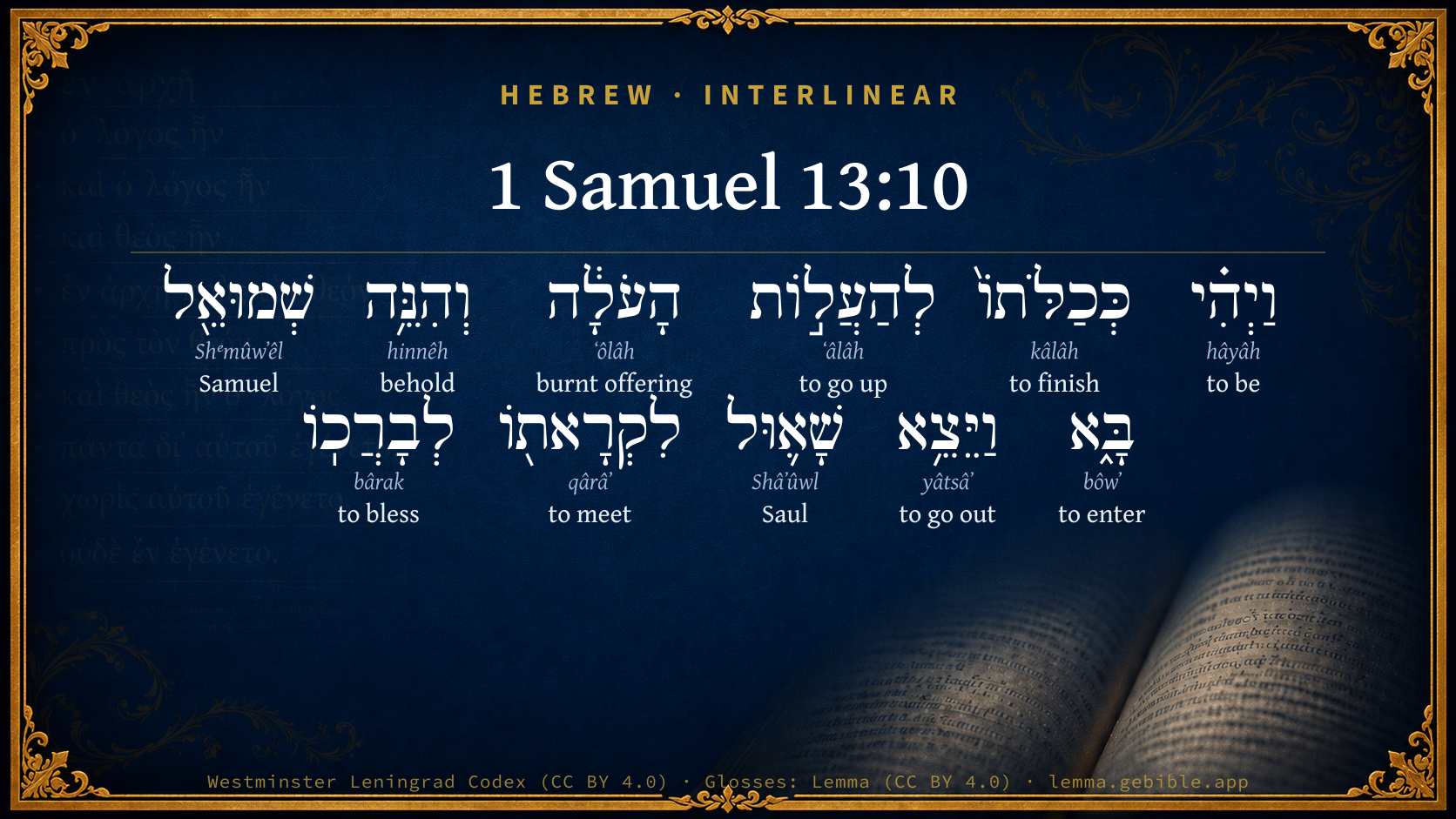
Hebrew (Westminster Leningrad Codex) 1 Samuel 13:10 appears in the Hebrew Old Testament. The text above is from the Westminster Leningrad Codex. Each word links to its Strong’s number, a concise gloss, and parsing drawn from the Open Scriptures Hebrew Bible morphology. Click any word for its full Brown-Driver-Briggs (BDB) entry.
Download image
Cite this verse

1 Samuel 13:10 (World English Bible). Public Domain. Lemma interlinear Bible study tool, https://lemma.gebible.app/v/1-samuel/13/10.

Show BibTeX & RIS
BibTeX
RIS
English Translation
It came to pass that as soon as he had made an end of offering the burnt offering, behold, Samuel came; and Saul went out to meet him, that he might greet him.
World English Bible · Public Domain
Download a study sheet

One document with this verse’s original text, its word-by-word gloss line, the meaning frame, cross-references with their text, attributed commentary, and full source and license credits — printable, and it pastes into notes with its structure intact.

This verse Autodidact and up

Study sheet (.html) Plain text (.txt)

A passage Seminary Student

Up to 50 verses in one chapter. A passage sheet keeps up to 6 commentary sources and 12 cross-references per verse, in the order this page ranks them, and says so on the sheet whenever that leaves anything out. Ask for a single verse and you get the Autodidact verse sheet above.

Everything on this page stays free to read, with no account — the sheet is a download of what is already on screen, not access to it.

Want to remove ads? Support Godless Engineer
Compare translations 3

The same verse in 3 English versions, stacked beneath the original-language interlinear above. Click any original word for its lexicon entry.

Each is an independent rendering of the whole verse — the interlinear is not word-aligned to these translations.

Highlighted words mark where these versions differ — a whole-verse word diff, not a word-by-word alignment.

  • World English Bible Public Domain
    It came to pass that as soon as he had made an end of offering the burnt offering, behold, Samuel came; and Saul went out to meet him, that he might greet him.
  • King James Version Public Domain
    And it came to pass, that as soon as he had made an end of offering the burnt offering, behold, Samuel came; and Saul went out to meet him, that he might salute him.
  • unfoldingWord Literal Text CC BY-SA 4.0
    And it happened, as he finished offering the burnt offering that, behold, Samuel came. And Saul went out to meet him to bless him.

unfoldingWord Literal Text — © unfoldingWord, licensed CC BY-SA 4.0. Word-aligned USFM3 via Door43 (git.door43.org/unfoldingWord/en_ult).

Versions to compare (up to 4)

3 of 4 selected

Show all 18 translations

Every available English version of this verse, each an independent rendering of the whole verse.

  • World English Bible Public Domain
    It came to pass that as soon as he had made an end of offering the burnt offering, behold, Samuel came; and Saul went out to meet him, that he might greet him.
  • Berean Standard Bible Public Domain
    Just as he finished offering the burnt offering, Samuel arrived, and Saul went out to greet him.
  • Majority Standard Bible Public Domain
    Just as he finished offering the burnt offering, Samuel arrived, and Saul went out to greet him.
  • King James Version Public Domain
    And it came to pass, that as soon as he had made an end of offering the burnt offering, behold, Samuel came; and Saul went out to meet him, that he might salute him.
  • American Standard Version (1901) Public Domain
    And it came to pass that, as soon as he had made an end of offering the burnt-offering, behold, Samuel came; and Saul went out to meet him, that he might salute him.
  • Revised Version (1885) Public Domain
    And it came to pass that, as soon as he had made an end of offering the burnt offering, behold, Samuel came; and Saul went out to meet him, that he might salute him.
  • Geneva Bible (1599) Public Domain
    And assoone as hee had made an ende of offering the burnt offering, beholde, Samuel came: and Saul went foorth to meete him, to salute him.
  • Douay-Rheims (1899) Public Domain
    And when he had made an end of offering the holocaust, behold Samuel came: and Saul went forth to meet him and salute him.
  • Young's Literal Translation Public Domain
    And it cometh to pass at his completing to cause the burnt-offering to ascend, that lo, Samuel hath come, and Saul goeth out to meet him, to bless him;
  • Literal Standard Version CC BY-SA 4.0
    And it comes to pass at his completing to cause the burnt-offering to ascend, that behold, Samuel has come, and Saul goes out to meet him, to bless him;
  • Unlocked Literal Bible CC BY-SA 4.0
    As soon as he finished offering the burnt offering Samuel arrived. Saul went out to meet him and to greet him.
  • unfoldingWord Literal Text CC BY-SA 4.0
    And it happened, as he finished offering the burnt offering that, behold, Samuel came. And Saul went out to meet him to bless him.
  • Darby Bible Public Domain
    And it came to pass, as soon as he had ended offering up the burnt-offering, behold, Samuel came; and Saul went out to meet him, that he might salute him.
  • World Messianic Bible Public Domain
    It came to pass that as soon as he had finished offering the burnt offering, behold, Samuel came; and Saul went out to meet him, that he might greet him.
  • Webster's Bible Public Domain
    And it came to pass, that as soon as he had made an end of offering the burnt-offering, behold, Samuel came; and Saul went out to meet him, that he might salute him.
  • Free Bible Version CC BY-SA 4.0
    Just as he finished presenting the burnt offering, he saw Samuel arrive. Saul went over to meet him and say hello.
  • Bible in Basic English Public Domain
    And when the burned offering was ended, Samuel came; and Saul went out to see him and to give him a blessing.
  • JPS Tanakh (1917) Public Domain
    And it came to pass that, as soon as he had made an end of offering the burnt-offering, behold, Samuel came; and Saul went out to meet him, that he might salute him.

Literal Standard Version (2020), Covenant Press — licensed CC BY-SA 4.0. Text via the HelloAO Bible API (eBible.org). Unlocked Literal Bible (unfoldingWord) — licensed CC BY-SA 4.0. Text via the HelloAO Bible API (eBible.org). unfoldingWord Literal Text — © unfoldingWord, licensed CC BY-SA 4.0. Word-aligned USFM3 via Door43 (git.door43.org/unfoldingWord/en_ult). Free Bible Version, Dr. Jonathan Gallagher — licensed CC BY-SA 4.0. Text via the HelloAO Bible API (eBible.org).

Word by word

More ways to search: Search by grammar → Find every occurrence → Compare this word →

Practice this passage: Drill this verse → Learn its vocabulary →

לִקְרָאת֖וֹ
qârâʼ
H7122
“to meet · him”
Preposition + Verb, Qal, Infinitive Construct + Suffix, Personal, 3rd Person, Masculine, Singular
Part of Speech
Preposition + Verb
Stem
Qal
Form
Infinitive Construct
Full BDB Definition

Origin: a primitive root, to encounter, whether accidentally or in a hostile manner

TWOT: 2064

to encounter, befall, meet - (Qal) - to meet, encounter - to befall (figuratively) - (Niphal) to meet, meet unexpectedly - (Hiphil) to cause to meet
  1. וַיְהִ֗י hâyâh H1961 “and · to be” Conjunction + Verb, Qal, Sequential Imperfect, 3rd Person, Masculine, Singular
  2. כְּכַלֹּתוֹ֙ kâlâh H3615 “like/as · to finish · him” Preposition + Verb, Piel, Infinitive Construct + Suffix, Personal, 3rd Person, Masculine, Singular
  3. לְהַעֲל֣וֹת ʻâlâh H5927 “to go up” Preposition + Verb, Hiphil, Infinitive Construct
  4. הָעֹלָ֔ה ʻôlâh H5930 “the · burnt offering” Particle, Definite Article + Noun, Common, Feminine, Singular, Absolute
  5. וְהִנֵּ֥ה hinnêh H2009 “and · behold” Conjunction + Particle, Demonstrative
  6. שְׁמוּאֵ֖ל Shᵉmûwʼêl H8050 “Samuel” Noun, Proper
  7. בָּ֑א bôwʼ H935 “to enter” Verb, Qal, Perfect, 3rd Person, Masculine, Singular
  8. וַיֵּצֵ֥א yâtsâʼ H3318 “and · to go out” Conjunction + Verb, Qal, Sequential Imperfect, 3rd Person, Masculine, Singular
  9. שָׁא֛וּל Shâʼûwl H7586 “Saul” Noun, Proper
  10. לְבָרֲכֽוֹ bârak H1288 “to bless · him” Preposition + Verb, Piel, Infinitive Construct + Suffix, Personal, 3rd Person, Masculine, Singular

About this verse

These counts appear in no published source. They are computed here, from the morphology-tagged text and Lemma’s own curated glosses. What Lemma adds →

11
words
11
distinct lemmas
Historical
section

Shared distinctive vocabulary

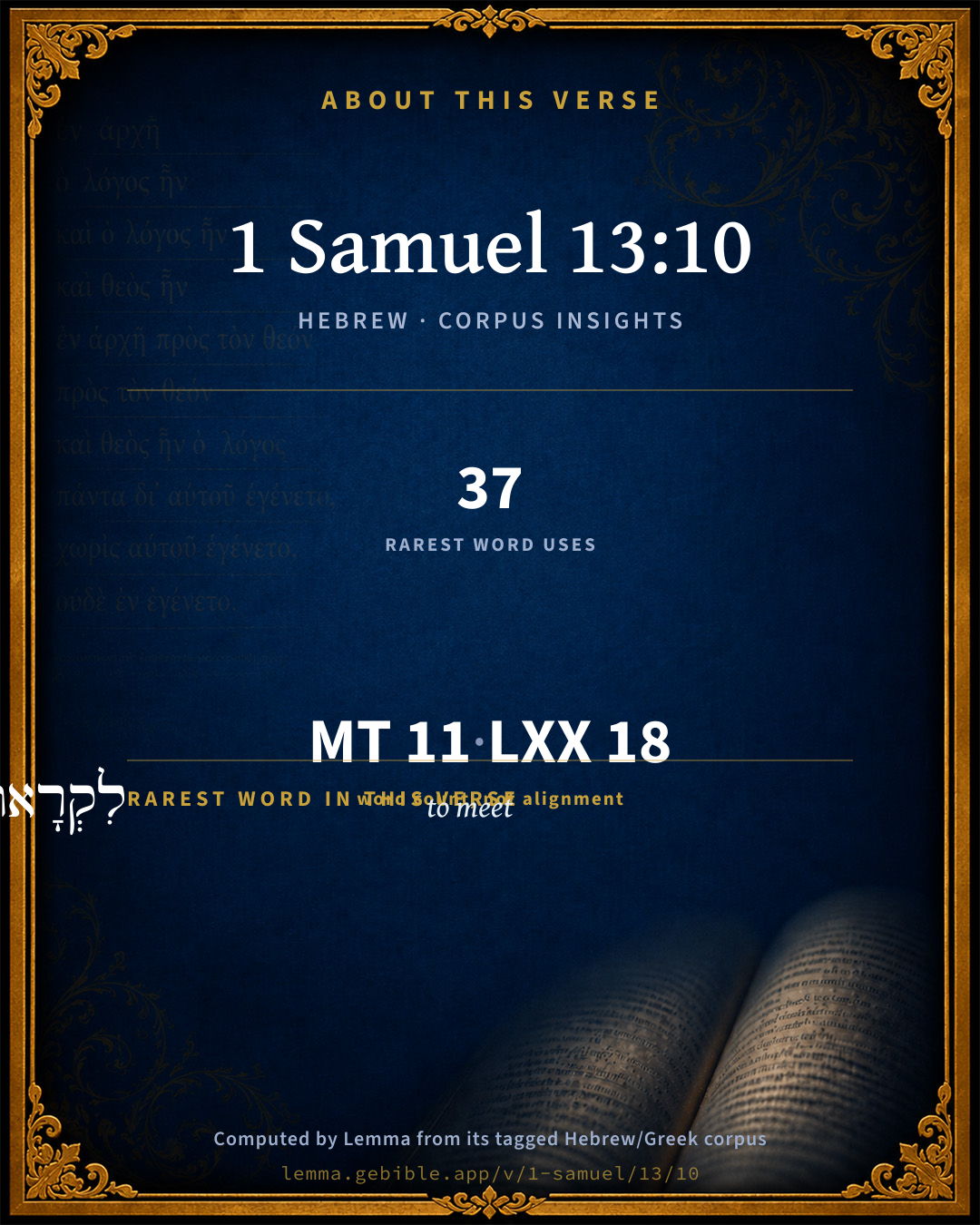
לִקְרָאת֖וֹ to meet H7122 occurs in 35 verses of the Hebrew Bible. Also found in:

Grammatical profile

  • 7 verbs
  • 3 nouns
  • 1 particle

Verb forms

  • וַיְהִ֗י Qal · Sequential Imperfect
  • כְּכַלֹּתוֹ֙ Piel · Infinitive Construct
  • לְהַעֲל֣וֹת Hiphil · Infinitive Construct
  • בָּ֑א Qal · Perfect
  • וַיֵּצֵ֥א Qal · Sequential Imperfect
  • לִקְרָאת֖וֹ Qal · Infinitive Construct
  • לְבָרֲכֽוֹ Piel · Infinitive Construct

Hebrew & Septuagint length

In English translation the verse runs 33 words from the Hebrew and 28 from the Septuagint (LXX English) — closely comparable.

A rough comparison of the two English renderings, which tokenize alike — not a word-level alignment.

Word counts can differ between the Hebrew and the Greek without any difference in meaning — e.g. the Hebrew direct-object marker אֵת has no separate Greek word, and Greek often adds the article ὁ.

In the original languages it is 11 Hebrew tokens and 18 Greek tokens — but the two are counted differently (Hebrew bundles its prefixes and suffixes into one token; the Greek is in lemma form), so that isn’t a like-for-like length.

Cross-references

3

Topical passages linked to 1 Samuel 13:10 in the Treasury of Scripture Knowledge — connected by theme and wording, ordered by reader-vote popularity; previews shown in the World English Bible.

  • 1 Samuel 15:13 Samuel came to Saul; and Saul said to him, Blessed are you by Yahweh: I have performed the commandment of Yahweh.
  • Ruth 2:4 Behold, Boaz came from Bethlehem, and said to the reapers, Yahweh be with you. They answered him, Yahweh bless you.
  • Psalms 129:8 Neither do those who go by say, "The blessing of Yahweh be on you. We bless you in the name of Yahweh."

Cross-references courtesy of OpenBible.info (CC BY 4.0).

Hebrew and Greek witnesses Masoretic Hebrew ↔ Greek Septuagint

The same verse in the two great witnesses to the Old Testament, shown verse-for-verse.

These are two independent witnesses, not word-aligned to each other, and the Septuagint is shown in lemma (dictionary) form.

Hebrew 1 Samuel 13:10 Masoretic · Westminster Leningrad Codex

וַיְהִ֗י כְּכַלֹּתוֹ֙ לְהַעֲל֣וֹת הָעֹלָ֔ה וְהִנֵּ֥ה שְׁמוּאֵ֖ל בָּ֑א וַיֵּצֵ֥א שָׁא֛וּל לִקְרָאת֖וֹ לְבָרֲכֽוֹ

It came to pass that as soon as he had made an end of offering the burnt offering, behold, Samuel came; and Saul went out to meet him, that he might greet him.

World English Bible · Public Domain

Greek LXX 1 Samuel 13:10 Septuagint · lemma form

καί γίγνομαι ὡς συντελέω ἀναφέρω ὁ ὁλοκαύτωσις καί σαμουηλ παραγίγνομαι καί ἐκἔρχομαι σαούλ εἰς ἀπάντησις αὐτός εὐλογέω αὐτός

And it came to pass when he had finished offering the whole burnt offering, that Samuel arrived, and Saul went out to meet him, and to bless him.

LXX2012 (modern English Septuagint) · Public Domain

Hebrew: Westminster Leningrad Codex (CC BY 4.0). Greek: Septuagint (public domain); English from LXX2012 (modern English Septuagint) (Public Domain). How the Septuagint differs from the Hebrew →

Targum (Aramaic paraphrase)

1

The Targum is the ancient Jewish Aramaic paraphrase of the Hebrew Scriptures — an interpretive translation, not the Hebrew text itself. Onkelos (literal) and Pseudo-Jonathan (expansive) render the Torah, and Jonathan the Prophets. Coverage is partial: where no permissively-licensed English translation exists for a verse, only the Aramaic is shown. This is verse-level text, not a word-by-word alignment to the Hebrew.

  1. Targum Jonathan Prophets (Joshua–Malachi)
    וַהֲוָה כְּשֵׁיצָיוּתֵיהּ לְאַסָקָא עֲלָתָא וְהָא שְׁמוּאֵל אָתָא וּנְפַק שָׁאוּל לָקֳדָמוּתֵיהּ לְמִשְׁאַל בִּשְׁלָמֵיהּ:

    (no public-domain English translation for this verse)

    Targum Jonathan — Aramaic: “Mikraot Gedolot” (public domain). English: “Sefaria Community Translation” (CC0 1.0 (public-domain dedication)); “London "Chaldee Paraphrase," 1871” (public domain). Text via Sefaria.

Commentary

Notes on 1 Samuel 13:10 from classic Christian and Jewish commentators (each source and its license shown beneath its notes). The classic Christian expositions comment on the surrounding passage and are grouped to its opening verse, so a note may address several verses; the Jewish commentaries on the Tanakh (Rashi and others) are per-verse, so they appear only where the commentator wrote on this verse.

Lemma curates 59 commentaries, every one of them public domain or Creative Commons licensed, each selected and text-cleaned for this edition rather than reprinted as found. About our sources →

Trapp's Complete Commentary

John Trapp

1Sa 13:10 And it came to pass, that as soon as he had made an end of offering the burnt offering, behold, Samuel came; and Saul went out to meet him, that he might salute him.

Ver. 10. And it came to pass, that as soon, &c.] Vide quid faciat praecipitatio et impatientia. Saul should have held out an hour or two longer, and he had saved his kingdom. The men of Issachar were famous for this, that they had "understanding of the times, to know what Israel ought to do," and when to do it; {1Ch 12:32} therefore they were dear to David: but Saul advised not with them. God had a holy hand in it. See 1Sa 13:8.

And Saul went out to meet him.] So to salve up the matter, if it might have been; for his conscience accused him.

John Trapp, A Commentary or Exposition upon All the Books of the Old and New Testament (1647–1656) — public domain. Text from a community e-Sword module.

Tyndale Open Study Notes

Tyndale Open Resources

13:10 meet and welcome: Saul seemed unaware he had done anything wrong.

Tyndale Open Study Notes — © Tyndale Open Resources, licensed CC BY-SA 4.0. Text via the HelloAO Bible API.

Geneva Bible (1599)

Geneva Bible translators

Hebrew, bless him.

Geneva Bible (1599) marginal notes — public domain. Text via Bolls.life.

Adam Clarke's Commentary

Verse 10. Behold, Samuel came] Samuel was punctual to his appointment; one hour longer of delay would have prevented every evil, and by it no good would have been lost. How often are the effects of precipitation fatal!

Adam Clarke's Commentary on the Bible (1810–1826) — public domain. Text from a community e-Sword/MySword module.

Ellicott's Commentary for English Readers

(10) Behold, Samuel came.—Scarcely does the sacrificial ceremony appear to have been completed when the seer appeared on the scene.

It was the seventh day, according to the solemn injunction given to the king, but Saul, in his impatience, had not waited till the end of the day.

Saul went out to meet him.—The reverence which the king, in spite of his disobedience, felt for Samuel is displayed in his going out to meet him thus publicly. This deep feeling of the king for the great prophet to whom he felt he owed so much existed on Saul’s part all the days of Samuel’s life, and, as we shall see, even after Samuel’s death.

A Bible Commentary for English Readers, edited by Charles John Ellicott (1878–1897) — public domain. Text from a community e-Sword module.

The Cambridge Bible for Schools and Colleges

gen. ed. J. J. S. Perowne

10. Samuel came] Perhaps before Saul had had time to offer the peace-offerings.

The Cambridge Bible for Schools and Colleges (gen. ed. J. J. S. Perowne; Cambridge University Press, 1878–1918) — public domain. Text from a community e-Sword module.

John Gill's Exposition

And it came to pass, that as soon as he had made an end of offering the burn offering,.... And before he could offer the peace offerings:

behold, Samuel came; and it was told Saul that he was come:

and Saul went out to meet him; left off sacrificing, and would proceed no further, leaving the rest for Samuel and out of respect to him, and to prevent a chiding of him, he went forth to meet him:

that he might salute him, or "bless him" (c); congratulate him on his coming, ask of his health and welfare, and wish him all peace and prosperity.

(c) "ad benedicendum ei", Montanus.

John Gill's Exposition of the Whole Bible (1746–1763) — public domain (CC PDM 1.0). Text via the HelloAO Bible API.

Matthew Poole's English Annotations

Behold, Samuel came, i.e. it was told Saul, Behold, Samuel is coming.

Salute him, i.e. congratulate his coming. This he did, partly out of custom; and partly, that by this testimony of his affection and respect to Samuel, he might prevent that rebuke which his guilty conscience made him expect.

Matthew Poole's English Annotations on the Holy Bible (1683–1685) — public domain. Text from a community e-Sword/MySword module.

Whedon's Commentary on the Bible

Daniel D. Whedon

10. That he might salute him — Or, bless him, as the margin has it. Saul held Samuel in the highest esteem, and always showed the greatest reverence for his prophetical office; but his rash and headstrong disposition led him more than once to forget or disregard his counsels.

Daniel D. Whedon (gen. ed.), Commentary on the Old and New Testaments (1874–1909) — public domain. Text from a community e-Sword module.

The Pulpit Commentary

That he might salute him. Literally, "bless him," but the word is often used of a solemn salutation. (2Ki_4:29) It is evident that Samuel came on the seventh day, and that Saul in his impetuosity could not stay the whole day out.

The Pulpit Commentary (1880–1919), ed. H.D.M. Spence-Jones & Joseph S. Exell — public domain. Text from a community e-Sword module.

Lesson kit

Teaching starters — assembled from the data on this page, not authored interpretation. Every prompt links to the verse data it draws on. Edit before teaching.

1 Samuel, in the Historical, opens this verse with 11 words (11 distinct Hebrew lemmas). Its most distinctive word is qârâʼ (“to meet”). A historical commentator’s framing appears above. Read the whole chapter for the surrounding context.

Discussion questions

  1. What does “to meet” (qârâʼ) contribute to the verse as a whole?
  2. How does Genesis 42:4, which shares the word «to meet», read alongside this verse?
  3. These translations render this verse differently; the difference is in the English rendering, not the original. What questions does that raise?
  4. «וַיְהִ֗י» is a Qal Sequential Imperfect verb. How does that grammatical form shape the action described?
  5. Compare how Trapp's Complete Commentary and Tyndale Open Study Notes read this verse. Where do they agree or differ?

Things to notice

Reading settings

Reading text

Shown beneath each verse's original-language words.

Old Testament
Old Testament edition

Read the OT as the Masoretic Hebrew (MT) or the Greek Septuagint (LXX).

English shown for the Greek Septuagint (in the Hebrew ↔ Greek comparison).

Comparing translations? Open the Compare panel on any verse page to stack up to four side by side.