
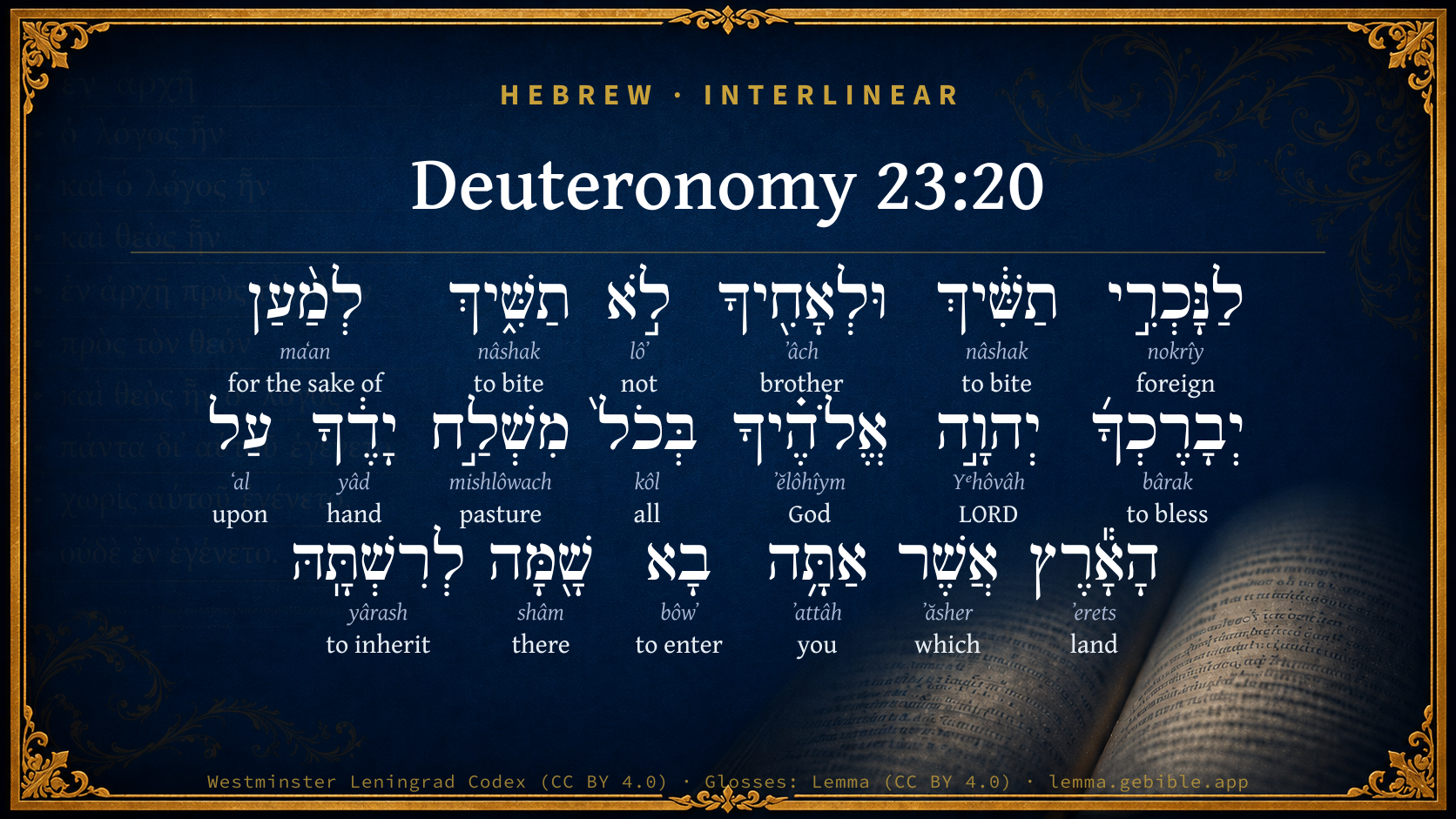
Deuteronomy 23:20

Hebrew (Westminster Leningrad Codex) Deuteronomy 23:20 appears in the Hebrew Old Testament. The text above is from the Westminster Leningrad Codex. Each word links to its Strong’s number, a concise gloss, and parsing drawn from the Open Scriptures Hebrew Bible morphology. Click any word for its full Brown-Driver-Briggs (BDB) entry.
Download image
Cite this verse

Deuteronomy 23:20 (World English Bible). Public Domain. Lemma interlinear Bible study tool, https://lemma.gebible.app/v/deuteronomy/23/20.

Show BibTeX & RIS
BibTeX
RIS
English Translation
to a foreigner you may lend on interest; but to your brother you shall not lend on interest, that Yahweh your God may bless you in all that you put your hand to, in the land where you go in to possess it.
World English Bible · Public Domain
Download a study sheet

One document with this verse’s original text, its word-by-word gloss line, the meaning frame, cross-references with their text, attributed commentary, and full source and license credits — printable, and it pastes into notes with its structure intact.

This verse Autodidact and up

Study sheet (.html) Plain text (.txt)

A passage Seminary Student

Up to 50 verses in one chapter. A passage sheet keeps up to 6 commentary sources and 12 cross-references per verse, in the order this page ranks them, and says so on the sheet whenever that leaves anything out. Ask for a single verse and you get the Autodidact verse sheet above.

Everything on this page stays free to read, with no account — the sheet is a download of what is already on screen, not access to it.

Want to remove ads? Support Godless Engineer
Compare translations 3

The same verse in 3 English versions, stacked beneath the original-language interlinear above. Click any original word for its lexicon entry.

Each is an independent rendering of the whole verse — the interlinear is not word-aligned to these translations.

Highlighted words mark where these versions differ — a whole-verse word diff, not a word-by-word alignment.

  • World English Bible Public Domain
    to a foreigner you may lend on interest; but to your brother you shall not lend on interest, that Yahweh your God may bless you in all that you put your hand to, in the land where you go in to possess it.
  • King James Version Public Domain
    Unto a stranger thou mayest lend upon usury; but unto thy brother thou shalt not lend upon usury: that the LORD thy God may bless thee in all that thou settest thine hand to in the land whither thou goest to possess it.
  • unfoldingWord Literal Text CC BY-SA 4.0
    You may charge interest to a foreigner; but to your brother you shall not charge interest, so that Yahweh your God may bless you in all the sending out of your hand, in the land which you are going into to possess it.

unfoldingWord Literal Text — © unfoldingWord, licensed CC BY-SA 4.0. Word-aligned USFM3 via Door43 (git.door43.org/unfoldingWord/en_ult).

Versions to compare (up to 4)

3 of 4 selected

Show all 18 translations

Every available English version of this verse, each an independent rendering of the whole verse.

  • World English Bible Public Domain
    to a foreigner you may lend on interest; but to your brother you shall not lend on interest, that Yahweh your God may bless you in all that you put your hand to, in the land where you go in to possess it.
  • Berean Standard Bible Public Domain
    You may charge a foreigner interest, but not your brother, so that the LORD your God may bless you in everything to which you put your hand in the land that you are entering to possess.
  • Majority Standard Bible Public Domain
    You may charge a foreigner interest, but not your brother, so that the LORD your God may bless you in everything to which you put your hand in the land that you are entering to possess.
  • King James Version Public Domain
    Unto a stranger thou mayest lend upon usury; but unto thy brother thou shalt not lend upon usury: that the LORD thy God may bless thee in all that thou settest thine hand to in the land whither thou goest to possess it.
  • American Standard Version (1901) Public Domain
    unto a foreigner thou mayest lend upon interest; but unto thy brother thou shalt not lend upon interest, that Jehovah thy God may bless thee in all that thou puttest thy hand unto, in the land whither thou goest in to possess it.
  • Revised Version (1885) Public Domain
    unto a foreigner thou mayest lend upon usury; but unto thy brother thou shalt not lend upon usury: that the LORD thy God may bless thee in all that thou puttest thine hand unto, in the land whither thou goest in to possess it.
  • Geneva Bible (1599) Public Domain
    Vnto a stranger thou mayest lend vpon vsurie, but thou shalt not lend vpon vsurie vnto thy brother, that the Lord thy God may blesse thee in all that thou settest thine hand to, in the land whither thou goest to possesse it.
  • Douay-Rheims (1899) Public Domain
    But to the stranger. To thy brother thou shalt lend that which he wanteth, without usury: that the Lord thy God may bless thee in all thy works in the land, which thou shalt go in to possess.
  • Young's Literal Translation Public Domain
    To a stranger thou mayest lend in usury, and to thy brother thou dost not lend in usury, so that Jehovah thy God doth bless thee in every putting forth of thy hand on the land whither thou goest in to possess it.
  • Literal Standard Version CC BY-SA 4.0
    You may lend in usury to a stranger, but you do not lend in usury to your brother, so that your God YHWH blesses you in every putting forth of your hand on the land to where you go in to possess it.
  • Unlocked Literal Bible CC BY-SA 4.0
    To a foreigner you may lend on interest; but to your fellow Israelite you must not lend on interest, so that Yahweh your God may bless you in all that you put your hand to, in the land which you are going in to possess.
  • unfoldingWord Literal Text CC BY-SA 4.0
    You may charge interest to a foreigner; but to your brother you shall not charge interest, so that Yahweh your God may bless you in all the sending out of your hand, in the land which you are going into to possess it.
  • Darby Bible Public Domain
    of a foreigner thou mayest take interest, but of thy brother thou shalt not take interest; that Jehovah thy God may bless thee in all the business of thy hand in the land whither thou goest to possess it.
  • World Messianic Bible Public Domain
    You may charge a foreigner interest; but you shall not charge your brother interest, that the LORD your God may bless you in all that you put your hand to, in the land where you go in to possess it.
  • Webster's Bible Public Domain
    To a stranger thou mayest lend upon interest; but to thy brother thou shalt not lend upon interest; that the LORD thy God may bless thee in all that thou settest thy hand to in the land whither thou goest to possess it.
  • Free Bible Version CC BY-SA 4.0
    You may charge a foreigner interest, but not an Israelite, so that the Lord your God may bless you in everything you do in the country that you are going in to occupy.
  • Bible in Basic English Public Domain
    From men of other nations you may take interest, but not from an Israelite: so that the blessing of the Lord your God may be on everything to which you put your hand, in the land which you are about to take as your heritage.
  • JPS Tanakh (1917) Public Domain
    (23-21) Unto a foreigner thou mayest lend upon interest; but unto thy brother thou shalt not lend upon interest; that the LORD thy God may bless thee in all that thou puttest thy hand unto, in the land whither thou goest in to possess it.

Literal Standard Version (2020), Covenant Press — licensed CC BY-SA 4.0. Text via the HelloAO Bible API (eBible.org). Unlocked Literal Bible (unfoldingWord) — licensed CC BY-SA 4.0. Text via the HelloAO Bible API (eBible.org). unfoldingWord Literal Text — © unfoldingWord, licensed CC BY-SA 4.0. Word-aligned USFM3 via Door43 (git.door43.org/unfoldingWord/en_ult). Free Bible Version, Dr. Jonathan Gallagher — licensed CC BY-SA 4.0. Text via the HelloAO Bible API (eBible.org).

Word by word

More ways to search: Search by grammar → Find every occurrence → Compare this word →

Practice this passage: Drill this verse → Learn its vocabulary →

מִשְׁלַ֣ח
mishlôwach
H4916
“pasture of”
Noun, Common, Masculine, Singular, Construct
Part of Speech
Noun
Type
Common
Gender
Masculine
Number
Singular
State
Construct
Full BDB Definition

Origin: from H7971

TWOT: 2394d , 2394e

outstretching, sending, sending forth - outstretching, undertaking (that to which one stretches out the hand), place of letting or turning loose, pasture (place where animals are let free)
  1. לַנָּכְרִ֣י nokrîy H5237 “to/for the · foreign” Preposition, Determined + Adjective, Adjective, Masculine, Singular, Absolute
  2. תַשִּׁ֔יךְ nâshak H5391 “to bite” Verb, Hiphil, Imperfect, 2nd Person, Masculine, Singular
  3. וּלְאָחִ֖יךָ ʼâch H251 “and · to/for · brother · your” Conjunction + Preposition + Noun, Common, Masculine, Singular, Construct + Suffix, Personal, 2nd Person, Masculine, Singular
  4. לֹ֣א lôʼ H3808 “not” Particle, Negative
  5. תַשִּׁ֑יךְ nâshak H5391 “to bite” Verb, Hiphil, Imperfect, 2nd Person, Masculine, Singular
  6. לְמַ֨עַן maʻan H4616 “for the sake of” Preposition
  7. יְבָרֶכְךָ֜ bârak H1288 “to bless · you” Verb, Piel, Imperfect, 3rd Person, Masculine, Singular + Suffix, Personal, 2nd Person, Masculine, Singular
  8. יְהוָ֣ה Yᵉhôvâh H3068 “LORD” Noun, Proper
  9. אֱלֹהֶ֗יךָ ʼĕlôhîym H430 “God(s) · your” Noun, Common, Masculine, Plural, Construct + Suffix, Personal, 2nd Person, Masculine, Singular
  10. בְּכֹל֙ kôl H3605 “in/at · all of” Preposition + Noun, Common, Masculine, Singular, Construct
  11. יָדֶ֔ךָ yâd H3027 “hand · your” Noun, Common, Both, Singular, Construct + Suffix, Personal, 2nd Person, Masculine, Singular
  12. עַל ʻal H5921 “upon” Preposition
  13. הָאָ֕רֶץ ʼerets H776 “the · land” Particle, Definite Article + Noun, Common, Both, Singular, Absolute
  14. אֲשֶׁר ʼăsher H834 “which” Particle, Relative
  15. אַתָּ֥ה ʼattâh H859 “you” Pronoun, Personal, 2nd Person, Masculine, Singular
  16. בָא bôwʼ H935 “entering” Verb, Qal, Participle Active, Masculine, Singular, Absolute
  17. שָׁ֖מָּה shâm H8033 “there · toward” Adverb + Suffix, Demonstrative
  18. לְרִשְׁתָּֽהּ yârash H3423 “to inherit · her” Preposition + Verb, Qal, Infinitive Construct + Suffix, Personal, 3rd Person, Feminine, Singular

About this verse

These counts appear in no published source. They are computed here, from the morphology-tagged text and Lemma’s own curated glosses. What Lemma adds →

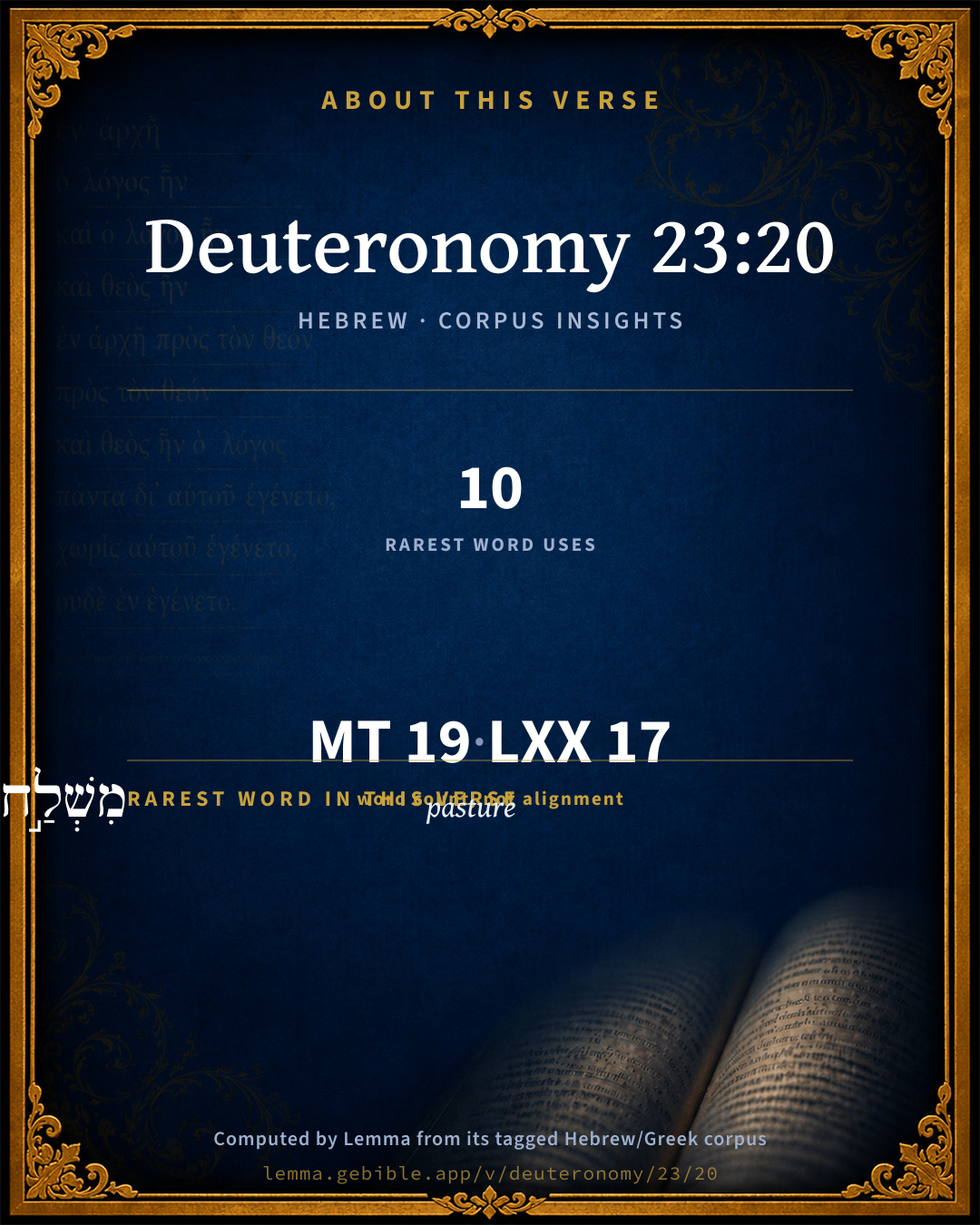
19
words
18
distinct lemmas
Pentateuch
section

Notable vocabulary

The rarest word here is מִשְׁלַ֣ח pasture H4916 — appearing just 10 times in the whole Hebrew Bible.

Shared distinctive vocabulary

מִשְׁלַ֣ח pasture H4916 occurs in 10 verses of the Hebrew Bible. Also found in:

Grammatical profile

  • 5 verbs
  • 7 nouns
  • 1 adjective
  • 1 pronoun
  • 2 prepositions
  • 1 adverb
  • 2 particles

Verb forms

  • תַשִּׁ֔יךְ Hiphil · Imperfect
  • תַשִּׁ֑יךְ Hiphil · Imperfect
  • יְבָרֶכְךָ֜ Piel · Imperfect
  • בָא Qal · Participle Active
  • לְרִשְׁתָּֽהּ Qal · Infinitive Construct

Repetition

A word recurs within this verse — often emphatic in Hebrew:

  • תַשִּׁ֔יךְ to bite H5391 ×2

Hebrew & Septuagint length

In English translation the verse runs 43 words from the Hebrew and 41 from the Septuagint (LXX English) — closely comparable.

A rough comparison of the two English renderings, which tokenize alike — not a word-level alignment.

Word counts can differ between the Hebrew and the Greek without any difference in meaning — e.g. the Hebrew direct-object marker אֵת has no separate Greek word, and Greek often adds the article ὁ.

In the original languages it is 19 Hebrew tokens and 17 Greek tokens — but the two are counted differently (Hebrew bundles its prefixes and suffixes into one token; the Greek is in lemma form), so that isn’t a like-for-like length.

Cross-references

9

Topical passages linked to Deuteronomy 23:20 in the Treasury of Scripture Knowledge — connected by theme and wording, ordered by reader-vote popularity; previews shown in the World English Bible.

  • Deuteronomy 15:10 You shall surely give him, and your heart shall not be grieved when you give to him; because that for this thing Yahweh your God will bless you in all your work, and in all that you put your hand to.
  • Deuteronomy 15:3 Of a foreigner you may exact it: but whatever of your is with your brother your hand shall release.
  • Deuteronomy 14:21 You shall not eat of anything that dies of itself: you may give it to the foreigner living among you who is within your gates, that he may eat it; or you may sell it to a foreigner: for you are a holy people to Yahweh your God. You shall not boil a kid in its mother's milk.
  • Luke 14:14 and you will be blessed, because they don't have the resources to repay you. For you will be repaid in the resurrection of the righteous."
  • 1 Corinthians 15:58 Therefore, my beloved brothers, be steadfast, immovable, always abounding in the Lord's work, because you know that your labor is not in vain in the Lord.
  • Deuteronomy 28:12 Yahweh will open to you his good treasure in the sky, to give the rain of your land in its season, and to bless all the work of your hand: and you shall lend to many nations, and you shall not borrow.
  • Proverbs 19:17 He who has pity on the poor lends to Yahweh; He will reward him.
  • Isaiah 1:19 If you are willing and obedient, You shall eat the good of the land;
  • Leviticus 19:33–34 "'If a stranger lives as a foreigner with you in your land, you shall not do him wrong.

Cross-references courtesy of OpenBible.info (CC BY 4.0).

Hebrew and Greek witnesses Masoretic Hebrew ↔ Greek Septuagint

The same verse in the two great witnesses to the Old Testament, shown verse-for-verse.

These are two independent witnesses, not word-aligned to each other, and the Septuagint is shown in lemma (dictionary) form.

Hebrew Deuteronomy 23:20 Masoretic · Westminster Leningrad Codex

לַנָּכְרִ֣י תַשִּׁ֔יךְ וּלְאָחִ֖יךָ לֹ֣א תַשִּׁ֑יךְ לְמַ֨עַן יְבָרֶכְךָ֜ יְהוָ֣ה אֱלֹהֶ֗יךָ בְּכֹל֙ מִשְׁלַ֣ח יָדֶ֔ךָ עַל הָאָ֕רֶץ אֲשֶׁר אַתָּ֥ה בָא שָׁ֖מָּה לְרִשְׁתָּֽהּ

to a foreigner you may lend on interest; but to your brother you shall not lend on interest, that Yahweh your God may bless you in all that you put your hand to, in the land where you go in to possess it.

World English Bible · Public Domain

Greek LXX Deuteronomy 23:20 Septuagint · lemma form

οὐ ἐκτοκίζω ὁ ἀδελφός σύ τόκος ἀργύριον καί τόκος βρῶμα καί τόκος πᾶς πρᾶγμα ὅς ἄν ἐκδανείζω

You may lend on usury to a stranger, but to your brother you shall not lend on usury; that the Lord your God may bless you in all your works upon the land, into which you are entering to inherit it.

LXX2012 (modern English Septuagint) · Public Domain

Hebrew: Westminster Leningrad Codex (CC BY 4.0). Greek: Septuagint (public domain); English from LXX2012 (modern English Septuagint) (Public Domain). How the Septuagint differs from the Hebrew →

Targum (Aramaic paraphrase)

2

The Targum is the ancient Jewish Aramaic paraphrase of the Hebrew Scriptures — an interpretive translation, not the Hebrew text itself. Onkelos (literal) and Pseudo-Jonathan (expansive) render the Torah, and Jonathan the Prophets. Coverage is partial: where no permissively-licensed English translation exists for a verse, only the Aramaic is shown. This is verse-level text, not a word-by-word alignment to the Hebrew.

  1. Targum Onkelos Torah (Genesis–Deuteronomy)
    לָא תְרַבֵּי לַאֲחוּךְ רִבִּית כְּסַף רִבִּית עִבוּר רִבִּית כָּל מִדַעַם דְמִתְרַבֵּי

    (no public-domain English translation for this verse)

    Targum Onkelos — Aramaic: “Onkelos Genesis” (public domain); “Onkelos Exodus” (public domain); “Onkelos Leviticus” (public domain); “Onkelos Numbers” (public domain); “Onkelos Deuteronomy” (public domain). English: “Sefaria Community Translation” (CC0 1.0 (public-domain dedication)); “J.W. Etheridge. The Targums of Onkelos and Jonathan Ben Uzziel on the Pentateuch. London: Longmans, Green, 1862” (public domain). Text via Sefaria.

  2. Targum Pseudo-Jonathan Torah (Genesis–Deuteronomy)
    לָא תַרְבֵּי מִדִּילָךְ לְחַבְרָךְ עַל מִזְפּוֹ דְּאוֹזְפָךְ לָא עַל מִזְפּוֹ דְּכָסִיף וּמִזְפּוֹ דְּמֵיכְלָא וְלָא עַל מִזְפּוֹ דְּכָל מִדַּעַם דְּמִתְרַבֵּי

    Thou shalt not make usury of that which is thine from thy neighbour upon the loan which thou lendest, either of money, or food, or any thing by which thou mayest make usury.

    Targum Pseudo-Jonathan — Aramaic: “Targum Jonathan on Genesis” (public domain); “Targum Jonathan on Exodus” (public domain); “Targum Jonathan on Leviticus” (public domain); “Targum Jonathan on Numbers” (public domain); “Targum Jonathan on Deuteronomy” (public domain). English: “The Targum of Jonathan ben Uzziel, trans. J. W. Etheridge, London, 1862” (public domain). Text via Sefaria.

Commentary

Notes on Deuteronomy 23:20 from classic Christian and Jewish commentators (each source and its license shown beneath its notes). The classic Christian expositions comment on the surrounding passage and are grouped to its opening verse, so a note may address several verses; the Jewish commentaries on the Tanakh (Rashi and others) are per-verse, so they appear only where the commentator wrote on this verse.

Lemma curates 59 commentaries, every one of them public domain or Creative Commons licensed, each selected and text-cleaned for this edition rather than reprinted as found. About our sources →

Trapp's Complete Commentary

John Trapp

Deu 23:20 Unto a stranger thou mayest lend upon usury; but unto thy brother thou shalt not lend upon usury: that the LORD thy God may bless thee in all that thou settest thine hand to in the land whither thou goest to possess it.

Ver. 20. Unto a stranger thou mayest.] And they do it to purpose at this day in foreign parts where they live, straining up their usury to eighteen in the hundred upon the Christian. This is their chief trade, and this is yielded by some as a reason why the Jews do so stink, Quod plerique omnes mensarii sint, faeneratoriam exercentes, et ita nullis exercitati laboribus, i.e., Because most of them are usurers, lead sedentary lives, and use no bodily exercise. It was the saying of a merry fellow, that in Christendom there were neither scholars enough, gentlemen enough, nor Jews enough. If the first, so many would not be pluralists; if the second, so many peasants would not be reckoned among the gentry; if the third, not so many usurers. {a}

{a} Heyl, Geog.

John Trapp, A Commentary or Exposition upon All the Books of the Old and New Testament (1647–1656) — public domain. Text from a community e-Sword module.

Geneva Bible (1599)

Geneva Bible translators

If thou show thy charity to thy brother, God will declare his love toward thee.

This was permitted for a time for the hardness of their hearts.

Geneva Bible (1599) marginal notes — public domain. Text via Bolls.life.

John Gill's Exposition

Unto a stranger thou mayest lend upon usury,.... To any Gentile, though some Jewish writers except the Edomites and Ishmaelites, as being brethren, and restrain it to the seven nations of Canaan; but it seems to design one that was not an Israelite, or a proselyte of righteousness, and especially to regard such that traded and merchandised, as the Gentiles very much did, and especially their neighbours the Phoenicians; and of such it was lawful to take interest, as it was but reasonable, when they gained much by the money they lent them, and as it is but reasonable should be the case among Christians in such circumstances; this is to be regarded not as a precept, but as a permission:

but unto thy brother thou shalt not lend upon usury; which is repeated, that it might be taken notice of, and carefully observed:

that the Lord thy God may bless thee in all that thou settest thine hand unto, in the land whither thou goest to possess it; for their charity, humanity, and the kind usage of their poor brethren in distress, would not pass unnoticed by the Lord; but he would make the land they tilled fruitful, and their vineyards and oliveyards to produce abundance, and their flocks and their herds to increase greatly, which would be sufficient and more than a recompence for all that they had freely lent unto their brethren, without taking any usury of them.

John Gill's Exposition of the Whole Bible (1746–1763) — public domain (CC PDM 1.0). Text via the HelloAO Bible API.

Haydock's Catholic Bible Commentary

To the stranger. This was a dispensation granted by God to his people, who, being the Lord of all things, can give a right and title to one upon the goods of another. Otherwise the Scripture every where condemns usury as contrary to the law of God, and a crying sin. See Exodus xxii. 25., Leviticus xxv. 36, 37., 2 Esdras v. 7., Psalm xiv. 5., and Ezechiel xviii. 8, 13, &c. (Challoner) --- The stranger means the devoted nations of Chanaan, &c., whom God authorized his people to destroy. "Exact usury of him whom thou mayst kill without a crime," says St. Ambrose., (de Tob. c. 15,) though this principle will not always excuse usury. This practice was always considered as unjustifiable, except when God gave permission to his people to get by this means the possession of the property of the stranger, the right to which he had already given to them; unless we may consider, that he only tolerates this practice towards the stranger, on account of the hard-heartedness of the Jews. Christ has now expressly declared it unlawful for any one. See Exodus xxii. 25. (Calmet)

George Leo Haydock (1774–1849), Haydock's Catholic Family Bible and Commentary, 1859 edition — public domain. Excludes Psalms (Douay-Rheims chapter numbering differs from Protestant) and Deuterocanonical books (Catholic canon only).

Matthew Poole's English Annotations

Unto a stranger, i.e. to a person of any other nation, for so that word is generally used, and therefore they who restrain it to the cursed Canaanitish nations seem to do so without any solid or sufficient grounds. And though the word

brother is ofttimes used in a general sense for every man, yet I think I may affirm that wheresoever the words brother and stranger are opposed in the Jewish law, the brother signifies the Israelite only, and the stranger signifies any person of what nation or religion soever, whether proselyted to the Jewish religion or not, and so it seems to be meant here. And the reason why usury is permitted to a stranger, not to an Israelite, may seem to be this, because the Israelites generally employed themselves in the management of land and cattle, and therefore could not make any advantage of borrowed money to balance the use they should pay for it; and consequently it may be presumed that they would not borrow money upon use, but for want and poverty, and in that case, and principally for that reason, usury seems to be forbidden to them, as may be thought from Lev 25:35,36. But the strangers made use of their money in way of trade and traffic with the Israelites, which was more gainful, and could much better bear the burden of usury, and reap advantage from money so borrowed; and these strangers here spoken of are supposed to be competently rich, and not poor, as may plainly appear by comparing this place with Lev 25:35,36, where they are no less forbidden to take usury of a stranger than of a brother, in case of poverty.

Matthew Poole's English Annotations on the Holy Bible (1683–1685) — public domain. Text from a community e-Sword/MySword module.

Rashi

Rabbi Shlomo Yitzchaki (Rashi)

לא תשיך implies a prohibition addressed to the borrower that he should not pay interest to the creditor (cf. Sifrei Devarim 262:1; Bava Metzia 75b) [and afterwards (Leviticus 25:37) follows the prohibition addressed to the creditor, “thou shalt not give him thy money upon interest”].

Rashi on the Tanakh — English translations: “The Judaica Press complete Tanach with Rashi, translated by A. J. Rosenberg” (CC BY 4.0); “Pentateuch with Rashi's commentary by M. Rosenbaum and A.M. Silbermann, 1929-1934” (public domain); “The Metsudah Tanach series, Lakewood, N.J” (CC BY 4.0); and “The Book of Joshua, Metsudah Publications, 1997” (CC BY 4.0). Text via Sefaria.

Ramban (Nachmanides)

Rabbi Moshe ben Nachman (Ramban / Nachmanides)

LO THASHICH form tashich is understood in a causative sense as meaning: “Thou shalt not cause thy brother to take interest.” See “The Commandments,” Vol. II, pp. 224-225. L’ACHICHA’ (THOU SHALT NOT CAUSE THY BROTHER TO TAKE INTEREST). This also is an explanatory commandment, adding here an admonition to the borrower as well, unlike all civil cases, for if a person wishes to damage his belongings he may do so [and it should, therefore, be permitted to the borrower to give freely to the lender]. However, because of the habitual nature of this sin [of giving interest], Scripture admonishes the borrower as well. And he explained here that a heathen’s interest is permissible. This he did not mention with reference to robbery and theft, as the Rabbis have said. “Theft from a heathen is forbidden.” But borrowing for interest, which is agreed upon by both parties and is done voluntarily, was forbidden [by the Torah] only because of brotherliness and kindness, as He commanded, and thou shalt love thy neighbor as thyself, and as he said, Beware that there be not a base thought in thy heart etc. [and thine eye be evil against thy needy brother, and thou give him nought]. Therefore he said [here], that the Eternal thy G-d may bless thee, for it is an act of mercy and compassion that one does for his brother by lending him without interest, and it will be accounted to him for righteousness. The release of debts [in the Seventh year] is also an act of mercy among brothers, and therefore he said, Of a foreigner thou mayest exact it, and for him [who releases the debt of a brother] he designated a blessing, Verse 4. for Scripture mentions a blessing only in connection with charity and acts of mercy, and not for [the mere abstention from] robbery, theft, and fraud.He mentions interest of money, interest of victuals in order to explain that he who lends one measure of wheat for a measure and a half is [guilty of taking] true interest even if at the time of payment a measure and a half is not worth as much as was the one measure that he lent him. And he further explained, interest of any thing that is lent upon interest, meaning even building-blocks and other articles which are lent. For it might occur to one to think that “interest” applies only to money with which everything can be purchased and to victuals which sustain life, but in other things we should go according to the cash value at the time of the loan and the repayment [therefore Scripture prohibited all such interest expressly]. Now our Rabbis have interpreted 263. See also Ramban above 15:3 where this subject is explained more fully. the verse, Unto a foreigner thou shalt lend upon interest as being a negative commandment derived from a positive commandment [which carries the force of a positive commandment] with respect to lending to an Israelite. [They rendered this interpretation] because the verse is redundant, for he already stated ‘lo thashich’ thy brother [which implies clearly that it is permitted to exact interest from a foreigner; why then the repetition, Unto a foreigner etc.? It was to teach that an interest-bearing loan to an Israelite is in violation of both a negative and a positive commandment].

Ramban (Nachmanides) on the Tanakh — English translation: “Commentary on the Torah by Ramban (Nachmanides). Translated and annotated by Charles B. Chavel. New York, Shilo Pub. House, 1971-1976” (CC BY 4.0). Text via Sefaria.

Lesson kit

Teaching starters — assembled from the data on this page, not authored interpretation. Every prompt links to the verse data it draws on. Edit before teaching.

Deuteronomy, in the Pentateuch, opens this verse with 19 words (18 distinct Hebrew lemmas). Its most distinctive word is mishlôwach (“pasture”). A historical commentator’s framing appears above. Read the whole chapter for the surrounding context.

Discussion questions

  1. The word mishlôwach carries the sense “pasture.” How does it shape the verse?
  2. Deuteronomy 12:7 shares the word «pasture» with this verse. How do the two illuminate each other?
  3. “to bite” occurs 2× in this one verse. What is the effect of the repetition?
  4. These translations render this verse differently; the difference is in the English rendering, not the original. What questions does that raise?
  5. The verb «תַשִּׁ֔יךְ» is Hiphil Imperfect. How does its form color the action?
  6. Reading how Trapp's Complete Commentary and Geneva Bible (1599) read this verse, where do the two commentators agree and where do they part?

Things to notice

Reading settings

Reading text

Shown beneath each verse's original-language words.

Old Testament
Old Testament edition

Read the OT as the Masoretic Hebrew (MT) or the Greek Septuagint (LXX).

English shown for the Greek Septuagint (in the Hebrew ↔ Greek comparison).

Comparing translations? Open the Compare panel on any verse page to stack up to four side by side.