
Genesis 24:48

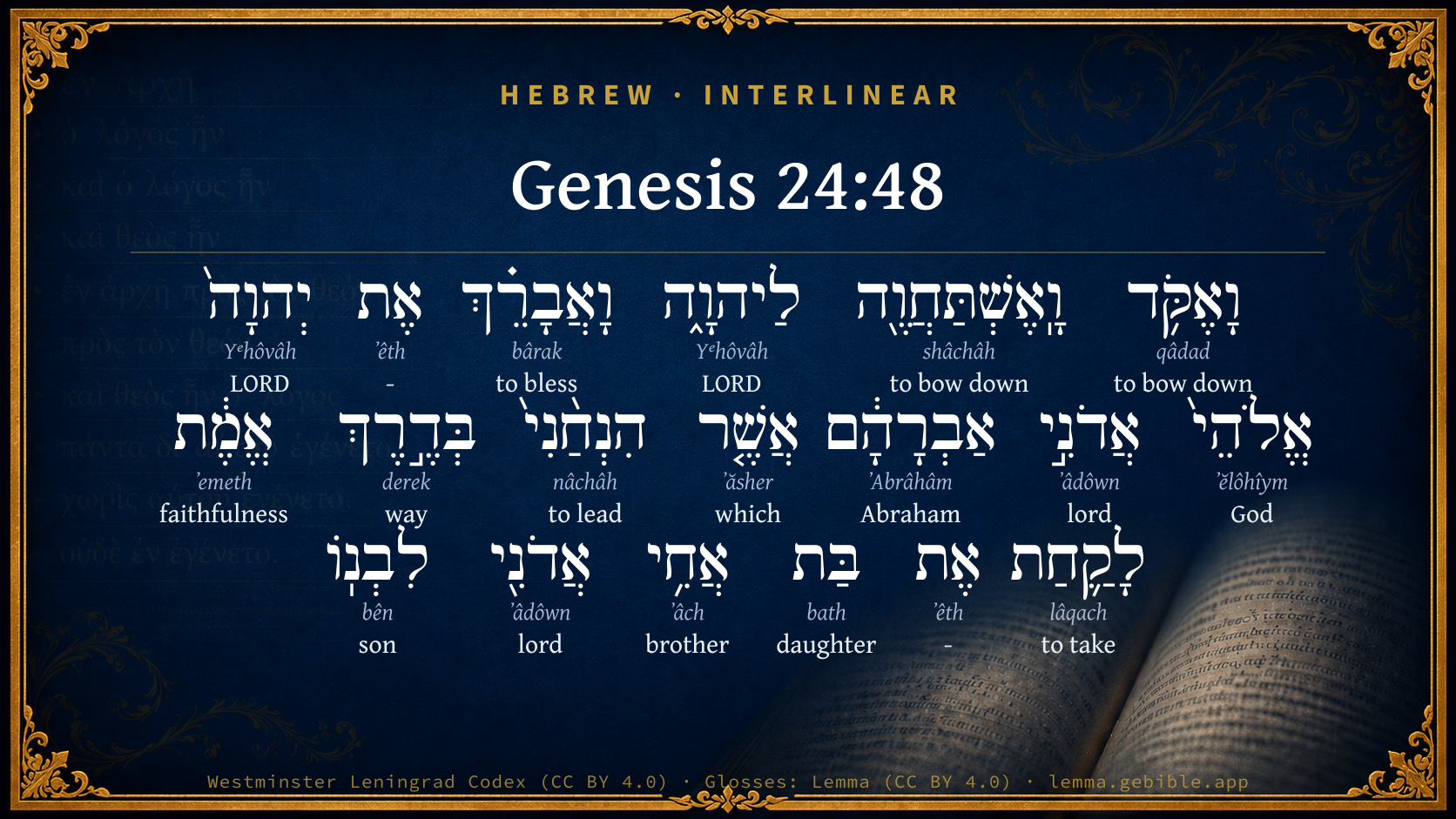
Hebrew (Westminster Leningrad Codex) Genesis 24:48 appears in the Hebrew Old Testament. The text above is from the Westminster Leningrad Codex. Each word links to its Strong’s number, a concise gloss, and parsing drawn from the Open Scriptures Hebrew Bible morphology. Click any word for its full Brown-Driver-Briggs (BDB) entry.
Download image
Cite this verse

Genesis 24:48 (World English Bible). Public Domain. Lemma interlinear Bible study tool, https://lemma.gebible.app/v/genesis/24/48.

Show BibTeX & RIS
BibTeX
RIS
English Translation
I bowed my head, and worshiped Yahweh, and blessed Yahweh, the God of my master Abraham, who had led me in the right way to take my master's brother's daughter for his son.
World English Bible · Public Domain
Download a study sheet

One document with this verse’s original text, its word-by-word gloss line, the meaning frame, cross-references with their text, attributed commentary, and full source and license credits — printable, and it pastes into notes with its structure intact.

This verse Autodidact and up

Study sheet (.html) Plain text (.txt)

A passage Seminary Student

Up to 50 verses in one chapter. A passage sheet keeps up to 6 commentary sources and 12 cross-references per verse, in the order this page ranks them, and says so on the sheet whenever that leaves anything out. Ask for a single verse and you get the Autodidact verse sheet above.

Everything on this page stays free to read, with no account — the sheet is a download of what is already on screen, not access to it.

Want to remove ads? Support Godless Engineer
Compare translations 3

The same verse in 3 English versions, stacked beneath the original-language interlinear above. Click any original word for its lexicon entry.

Each is an independent rendering of the whole verse — the interlinear is not word-aligned to these translations.

Highlighted words mark where these versions differ — a whole-verse word diff, not a word-by-word alignment.

  • World English Bible Public Domain
    I bowed my head, and worshiped Yahweh, and blessed Yahweh, the God of my master Abraham, who had led me in the right way to take my master's brother's daughter for his son.
  • King James Version Public Domain
    And I bowed down my head, and worshipped the LORD, and blessed the LORD God of my master Abraham, which had led me in the right way to take my master's brother's daughter unto his son.
  • unfoldingWord Literal Text CC BY-SA 4.0
    And I bowed down and prostrated myself before Yahweh, and I praised Yahweh, the God of my master Abraham, who led me on the right way to take the daughter of my master’s brother for his son.

unfoldingWord Literal Text — © unfoldingWord, licensed CC BY-SA 4.0. Word-aligned USFM3 via Door43 (git.door43.org/unfoldingWord/en_ult).

Versions to compare (up to 4)

3 of 4 selected

Show all 18 translations

Every available English version of this verse, each an independent rendering of the whole verse.

  • World English Bible Public Domain
    I bowed my head, and worshiped Yahweh, and blessed Yahweh, the God of my master Abraham, who had led me in the right way to take my master's brother's daughter for his son.
  • Berean Standard Bible Public Domain
    Then I bowed down and worshiped the LORD; and I blessed the LORD, the God of my master Abraham, who led me on the right road to take the granddaughter of my master’s brother for his son.
  • Majority Standard Bible Public Domain
    Then I bowed down and worshiped the LORD; and I blessed the LORD, the God of my master Abraham, who led me on the right road to take the granddaughter of my master’s brother for his son.
  • King James Version Public Domain
    And I bowed down my head, and worshipped the LORD, and blessed the LORD God of my master Abraham, which had led me in the right way to take my master's brother's daughter unto his son.
  • American Standard Version (1901) Public Domain
    And I bowed my head, and worshipped Jehovah, and blessed Jehovah, the God of my master Abraham, who had led me in the right way to take my master's brother's daughter for his son.
  • Revised Version (1885) Public Domain
    And I bowed my head, and worshipped the LORD, and blessed the LORD, the God of my master Abraham, which had led me in the right way to take my master’s brother’s daughter for his son.
  • Geneva Bible (1599) Public Domain
    And I bowed downe and worshipped the Lord, and blessed the Lord God of my master Abraham, which had brought me the right way to take my masters brothers daughter vnto his sone.
  • Douay-Rheims (1899) Public Domain
    And falling down I adored the Lord, blessing the Lord God of my master Abraham, who hath brought me the straight way to take the daughter of my master's brother for his son.
  • Young's Literal Translation Public Domain
    and I bow, and do obeisance before Jehovah, and I bless Jehovah, God of my lord Abraham, who hath led me in the true way to receive the daughter of my lord's brother for his son.
  • Literal Standard Version CC BY-SA 4.0
    and I bow, and pay respect before YHWH, and I bless YHWH, God of my lord Abraham, who has led me in the true way to receive the daughter of my lord’s brother for his son.
  • Unlocked Literal Bible CC BY-SA 4.0
    Then I bowed down and worshiped Yahweh, and blessed Yahweh, the God of my master Abraham, who had led me by the right way to find the daughter of my master's relative for his son.
  • unfoldingWord Literal Text CC BY-SA 4.0
    And I bowed down and prostrated myself before Yahweh, and I praised Yahweh, the God of my master Abraham, who led me on the right way to take the daughter of my master’s brother for his son.
  • Darby Bible Public Domain
    And I stooped, and bowed down before Jehovah; and I blessed Jehovah, God of my master Abraham, who has led me the right way to take my master's brother's daughter for his son.
  • World Messianic Bible Public Domain
    I bowed my head, and worshiped the LORD, and blessed the LORD, the God of my master Abraham, who had led me in the right way to take my master’s brother’s daughter for his son.
  • Webster's Bible Public Domain
    And I bowed my head, and worshipped the LORD, and blessed the LORD God of my master Abraham, who had led me in the right way to take my master's brother's daughter for his son.
  • Free Bible Version CC BY-SA 4.0
    Then I kneeled down and bowed in worship to the Lord. I thanked the Lord, the God of my master Abraham, for he led me directly to find my master's niece for his son.
  • Bible in Basic English Public Domain
    And with bent head I gave worship and praise to the Lord, the God of my master Abraham, by whom I had been guided in the right way, to get the daughter of my master's brother for his son.
  • JPS Tanakh (1917) Public Domain
    And I bowed my head, and prostrated myself before the LORD, and blessed the LORD, the God of my master Abraham, who had led me in the right way to take my master's brother's daughter for his son.

Literal Standard Version (2020), Covenant Press — licensed CC BY-SA 4.0. Text via the HelloAO Bible API (eBible.org). Unlocked Literal Bible (unfoldingWord) — licensed CC BY-SA 4.0. Text via the HelloAO Bible API (eBible.org). unfoldingWord Literal Text — © unfoldingWord, licensed CC BY-SA 4.0. Word-aligned USFM3 via Door43 (git.door43.org/unfoldingWord/en_ult). Free Bible Version, Dr. Jonathan Gallagher — licensed CC BY-SA 4.0. Text via the HelloAO Bible API (eBible.org).

Word by word

More ways to search: Search by grammar → Find every occurrence → Compare this word →

Practice this passage: Drill this verse → Learn its vocabulary →

וָאֶקֹּ֥ד
qâdad
H6915
“and · to bow down”
Conjunction + Verb, Qal, Sequential Imperfect, 1st Person, Common, Singular
Part of Speech
Conjunction + Verb
Stem
Qal
Form
Sequential Imperfect
Person
1st Person
Gender
Common
Number
Singular
Full BDB Definition

Origin: a primitive root

TWOT: 1985

(Qal) to bow down
  1. וָֽאֶשְׁתַּחֲוֶ֖ה shâchâh H7812 “and · to bow down” Conjunction + Verb, Hishtaphel, Sequential Imperfect, 1st Person, Common, Singular
  2. לַיהוָ֑ה Yᵉhôvâh H3068 “to/for · LORD” Preposition + Noun, Proper
  3. וָאֲבָרֵ֗ךְ bârak H1288 “and · to bless” Conjunction + Verb, Piel, Sequential Imperfect, 1st Person, Common, Singular
  4. אֶת ʼêth H853 “-” Particle, Direct Object
  5. יְהוָה֙ Yᵉhôvâh H3068 “LORD” Noun, Proper
  6. אֱלֹהֵי֙ ʼĕlôhîym H430 “God(s) of” Noun, Common, Masculine, Plural, Construct
  7. אֲדֹנִ֣י ʼâdôwn H113 “lord · my” Noun, Common, Masculine, Singular, Construct + Suffix, Personal, 1st Person, Common, Singular
  8. אַבְרָהָ֔ם ʼAbrâhâm H85 “Abraham” Noun, Proper
  9. אֲשֶׁ֤ר ʼăsher H834 “which” Particle, Relative
  10. הִנְחַ֨נִי֙ nâchâh H5148 “to lead · me” Verb, Hiphil, Perfect, 3rd Person, Masculine, Singular + Suffix, Personal, 1st Person, Common, Singular
  11. בְּדֶ֣רֶךְ derek H1870 “in/at · way of” Preposition + Noun, Common, Both, Singular, Construct
  12. אֱמֶ֔ת ʼemeth H571 “faithfulness” Noun, Common, Feminine, Singular, Absolute
  13. לָקַ֛חַת lâqach H3947 “to take” Preposition + Verb, Qal, Infinitive Construct
  14. אֶת ʼêth H853 “-” Particle, Direct Object
  15. בַּת bath H1323 “daughter of” Noun, Common, Feminine, Singular, Construct
  16. אֲחִ֥י ʼâch H251 “brother of” Noun, Common, Masculine, Singular, Construct
  17. אֲדֹנִ֖י ʼâdôwn H113 “lord · my” Noun, Common, Masculine, Singular, Construct + Suffix, Personal, 1st Person, Common, Singular
  18. לִבְנֽוֹ bên H1121 “to/for · son · his” Preposition + Noun, Common, Masculine, Singular, Construct + Suffix, Personal, 3rd Person, Masculine, Singular

About this verse

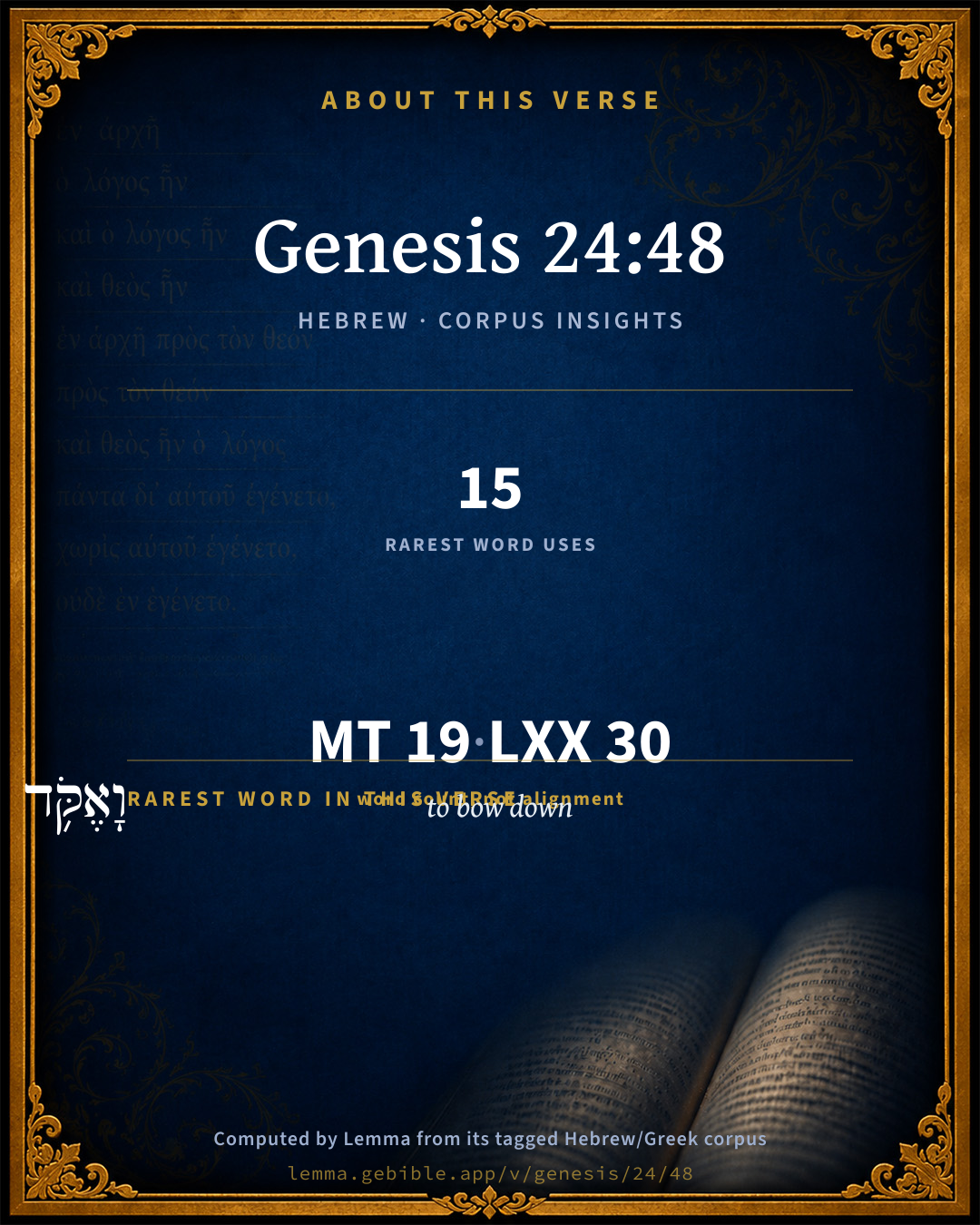
These counts appear in no published source. They are computed here, from the morphology-tagged text and Lemma’s own curated glosses. What Lemma adds →

19
words
16
distinct lemmas
Pentateuch
section

Notable vocabulary

The rarest word here is וָאֶקֹּ֥ד to bow down H6915 — appearing just 15 times in the whole Hebrew Bible.

Shared distinctive vocabulary

וָאֶקֹּ֥ד to bow down H6915 occurs in 15 verses of the Hebrew Bible. Also found in:

Grammatical profile

  • 5 verbs
  • 11 nouns
  • 3 particles

Verb forms

  • וָאֶקֹּ֥ד Qal · Sequential Imperfect
  • וָֽאֶשְׁתַּחֲוֶ֖ה Hishtaphel · Sequential Imperfect
  • וָאֲבָרֵ֗ךְ Piel · Sequential Imperfect
  • הִנְחַ֨נִי֙ Hiphil · Perfect
  • לָקַ֛חַת Qal · Infinitive Construct

Repetition

Words recur within this verse — often emphatic in Hebrew:

  • לַיהוָ֑ה LORD H3068 ×2
  • אֲדֹנִ֣י lord H113 ×2

Hebrew & Septuagint length

In English translation the verse runs 33 words from the Hebrew and 40 from the Septuagint (LXX English) — closely comparable.

A rough comparison of the two English renderings, which tokenize alike — not a word-level alignment.

Word counts can differ between the Hebrew and the Greek without any difference in meaning — e.g. the Hebrew direct-object marker אֵת has no separate Greek word, and Greek often adds the article ὁ.

In the original languages it is 19 Hebrew tokens and 30 Greek tokens — but the two are counted differently (Hebrew bundles its prefixes and suffixes into one token; the Greek is in lemma form), so that isn’t a like-for-like length.

Cross-references

11

Topical passages linked to Genesis 24:48 in the Treasury of Scripture Knowledge — connected by theme and wording, ordered by reader-vote popularity; previews shown in the World English Bible.

  • Genesis 24:26–27 The man bowed his head, and worshiped Yahweh.
  • Proverbs 3:5–6 Trust in Yahweh with all your heart, And don't lean on your own understanding.
  • Psalms 32:8 I will instruct you and teach you in the way which you shall go. I will counsel you with my eye on you.
  • Psalms 48:14 For this God is our God forever and ever. He will be our guide even to death.
  • Genesis 24:52 It happened that when Abraham's servant heard their words, he bowed himself down to the earth to Yahweh.
  • Isaiah 48:17 Thus says Yahweh, your Redeemer, the Holy One of Israel: I am Yahweh your God, who teaches you to profit, who leads you by the way that you should go.
  • Genesis 22:23 Bethuel became the father of Rebekah. These eight Milcah bore to Nahor, Abraham's brother.
  • Exodus 18:20 You shall teach them the statutes and the laws, and shall show them the way in which they must walk, and the work that they must do.
  • Ezra 8:21 Then I proclaimed a fast there, at the river Ahava, that we might humble ourselves before our God, to seek of him a straight way for us, and for our little ones, and for all our substance.
  • Psalms 107:7 He led them also by a straight way, That they might go to a city to live in.
  • Proverbs 4:11 I have taught you in the way of wisdom. I have led you in straight paths.

Cross-references courtesy of OpenBible.info (CC BY 4.0).

Hebrew and Greek witnesses Masoretic Hebrew ↔ Greek Septuagint

The same verse in the two great witnesses to the Old Testament, shown verse-for-verse.

These are two independent witnesses, not word-aligned to each other, and the Septuagint is shown in lemma (dictionary) form.

Hebrew Genesis 24:48 Masoretic · Westminster Leningrad Codex

וָאֶקֹּ֥ד וָֽאֶשְׁתַּחֲוֶ֖ה לַיהוָ֑ה וָאֲבָרֵ֗ךְ אֶת יְהוָה֙ אֱלֹהֵי֙ אֲדֹנִ֣י אַבְרָהָ֔ם אֲשֶׁ֤ר הִנְחַ֨נִי֙ בְּדֶ֣רֶךְ אֱמֶ֔ת לָקַ֛חַת אֶת בַּת אֲחִ֥י אֲדֹנִ֖י לִבְנֽוֹ

I bowed my head, and worshiped Yahweh, and blessed Yahweh, the God of my master Abraham, who had led me in the right way to take my master's brother's daughter for his son.

World English Bible · Public Domain

Greek LXX Genesis 24:48 Septuagint · lemma form

καί εὐδοκέω προςκυνέω κύριος καί εὐλογέω κύριος ὁ θεός ὁ κύριος ἐγώ αβρααμ ὅς εὐοδόω ἐγώ ἐν ὁδός ἀλήθεια λαμβάνω ὁ θυγάτηρ ὁ ἀδελφός ὁ κύριος ἐγώ ὁ υἱός αὐτός

And being well-pleased I worshipped the Lord, and I blessed the Lord the God of my master Abraam, who has prospered me in a true way, so that I should take the daughter of my master's brother for his son.

LXX2012 (modern English Septuagint) · Public Domain

Hebrew: Westminster Leningrad Codex (CC BY 4.0). Greek: Septuagint (public domain); English from LXX2012 (modern English Septuagint) (Public Domain). How the Septuagint differs from the Hebrew →

Targum (Aramaic paraphrase)

2

The Targum is the ancient Jewish Aramaic paraphrase of the Hebrew Scriptures — an interpretive translation, not the Hebrew text itself. Onkelos (literal) and Pseudo-Jonathan (expansive) render the Torah, and Jonathan the Prophets. Coverage is partial: where no permissively-licensed English translation exists for a verse, only the Aramaic is shown. This is verse-level text, not a word-by-word alignment to the Hebrew.

  1. Targum Onkelos Torah (Genesis–Deuteronomy)
    וּכְרָעִית וּסְגָדִית קֳדָם יְיָ וּבָרֵכִית יָת יְיָ אֱלָהֵהּ דְּרִבּוֹנִי אַבְרָהָם דְּדַבְּרַנִּי בְּאוֹרַח קְשׁוֹט לְמִיסַב יָת בַּת אֲחוּהִי דְּרִבּוֹנִי לִבְרֵהּ

    (no public-domain English translation for this verse)

    Targum Onkelos — Aramaic: “Onkelos Genesis” (public domain); “Onkelos Exodus” (public domain); “Onkelos Leviticus” (public domain); “Onkelos Numbers” (public domain); “Onkelos Deuteronomy” (public domain). English: “Sefaria Community Translation” (CC0 1.0 (public-domain dedication)); “J.W. Etheridge. The Targums of Onkelos and Jonathan Ben Uzziel on the Pentateuch. London: Longmans, Green, 1862” (public domain). Text via Sefaria.

  2. Targum Pseudo-Jonathan Torah (Genesis–Deuteronomy)
    וּגְחָנִית וּסְגִידִית קֳדָם יְיָ וּבְרִיכִית יַת יְיָ אֱלָהֵיהּ דְרִיבּוֹנִי אַבְרָהָם דְדַבְּרַנִי בְּאוֹרַח קְשׁוֹט לְמֵיסַב יַת בְּרַת אָחוֹי דְרִבּוֹנִי לִבְרֵיהּ

    and bowed and worshipped before the Lord; and I blessed the Lord, the God of my master Abraham, who had led me in the true way to take the daughter of master's brother for his son.

    Targum Pseudo-Jonathan — Aramaic: “Targum Jonathan on Genesis” (public domain); “Targum Jonathan on Exodus” (public domain); “Targum Jonathan on Leviticus” (public domain); “Targum Jonathan on Numbers” (public domain); “Targum Jonathan on Deuteronomy” (public domain). English: “The Targum of Jonathan ben Uzziel, trans. J. W. Etheridge, London, 1862” (public domain). Text via Sefaria.

Commentary

Notes on Genesis 24:48 from classic Christian and Jewish commentators (each source and its license shown beneath its notes). The classic Christian expositions comment on the surrounding passage and are grouped to its opening verse, so a note may address several verses; the Jewish commentaries on the Tanakh (Rashi and others) are per-verse, so they appear only where the commentator wrote on this verse.

Lemma curates 59 commentaries, every one of them public domain or Creative Commons licensed, each selected and text-cleaned for this edition rather than reprinted as found. About our sources →

Trapp's Complete Commentary

John Trapp

Gen 24:48 And I bowed down my head, and worshipped the LORD, and blessed the LORD God of my master Abraham, which had led me in the right way to take my master’s brother’s daughter unto his son.

Ver. 48. And I bowed down my head.] A good Christian is ever either praying or praising: he drives a constant trade between earth and heaven.

John Trapp, A Commentary or Exposition upon All the Books of the Old and New Testament (1647–1656) — public domain. Text from a community e-Sword module.

Tyndale Open Study Notes

Tyndale Open Resources

24:48 The way that God directed this event from behind the scenes is different than in most of Genesis, but it is true to how the life of faith normally works. Faith, expressed in personal prayer and obedience, looks for evidence of God’s working. Believers usually have to make wise choices and remain faithful to the covenant, trusting that God will guide them through the circumstances of life to accomplish his will.

Tyndale Open Study Notes — © Tyndale Open Resources, licensed CC BY-SA 4.0. Text via the HelloAO Bible API.

Geneva Bible (1599)

Geneva Bible translators

He showeth what is our duty, when we have received any benefit of the Lord.

Hebrew, in the way of truth.

Geneva Bible (1599) marginal notes — public domain. Text via Bolls.life.

The Cambridge Bible for Schools and Colleges

gen. ed. J. J. S. Perowne

48. my master’s brother’s daughter] The servant definitely states the relationship of Rebekah; cf. Gen_22:23. “Brother” may mean “relative” (Gen_13:8, Gen_14:14). Those who think Bethuel’s name in this chapter (Gen_24:15; Gen_24:24; Gen_24:47 [50]) is inserted as a gloss, regard Rebekah as Abraham’s niece, the daughter of Nahor, and refer to Gen_29:5.

The Cambridge Bible for Schools and Colleges (gen. ed. J. J. S. Perowne; Cambridge University Press, 1878–1918) — public domain. Text from a community e-Sword module.

John Gill's Exposition

And the servant brought forth jewels of silver, and jewels of gold,.... Ornaments for women, which he had brought along with him for presents, and which were a proof of the riches of his master, and of his generosity and liberality, who had furnished him with such a profusion of rich things to bestow on the person that should be got for his son's wife:

and raiment, and gave them to Rebekah; costly suits of clothes such as in those times were given to persons at their marriage, or in order to it; and which custom still continues among the Arabs, who, as Dr. Shaw says (p), have the marriage contract previously made between the parents, wherein is express mention made not only of the "saddock", as they call that particular sum which the bridegroom settles on the bride; but of the several changes of raiment, and the quantity of jewels, and the number of slaves that the bride is to be attended with when she first waits upon her husband; a gold and silver "sarmah", he says (q), which is a thin flexible plate of gold or silver, of a triangular shape, artfully cut through and engraven in imitation of lace; one or two sets of earrings bracelets and shekels, a gold chain to hang over their breasts, with half a dozen vests, some of brocades, others of rich silk, were usually the wedding clothes of a lady of fashion. And so in Barbary, the man buys his bride a suit of apparel, earrings, bracelets, a chest, &c. and gives the father a considerable sum of money, according to the qualities and circumstances of the parties (r):

and he gave also to her brother, and to her mother, precious things; things of worth and value, which were part of the good things he brought with him from Abraham, Gen 24:10; the word being sometimes used for fruit, Jarchi interprets it of various kinds of the fruits (s) of the land of Israel; but it is not likely that these should be carried by him on so long a journey; much better Aben Ezra understands by them honourable and costly raiment; and it is observed by some (t), that the word in general signifies everything valuable and excellent, as gold, silver, &c. no mention being made of her father, only of her brother Laban, and of her mother, seems to confirm the notion of Josephus that he was dead; or however he concerned himself no further in this affair than to give his consent to the marriage, and left everything else to his wife and son to take care of, and therefore the presents are only made to them.

(p) Travels, p. 239. (q) Ib. No. 9. p. 229. (r) Ockley's Account of Southwest Barbary, c. 6. p. 76. (s) So R. Sol. Urbin. Ohel Moed. fol. 76. 1. Aruch in voce (t) Ib.

John Gill's Exposition of the Whole Bible (1746–1763) — public domain (CC PDM 1.0). Text via the HelloAO Bible API.

Lesson kit

Teaching starters — assembled from the data on this page, not authored interpretation. Every prompt links to the verse data it draws on. Edit before teaching.

Genesis, in the Pentateuch, opens this verse with 19 words (16 distinct Hebrew lemmas). Its most distinctive word is qâdad (“to bow down”). A historical commentator’s framing appears above. Read the whole chapter for the surrounding context.

Discussion questions

  1. What does “to bow down” (qâdad) contribute to the verse as a whole?
  2. Genesis 24:26 shares the word «to bow down» with this verse. How do the two illuminate each other?
  3. “LORD” occurs 2× in this one verse. What is the effect of the repetition?
  4. These translations render this verse differently. What is at stake in choosing one wording over another?
  5. The verb «וָאֶקֹּ֥ד» is Qal Sequential Imperfect. How does its form color the action?
  6. Reading how Trapp's Complete Commentary and Tyndale Open Study Notes read this verse, where do the two commentators agree and where do they part?

Things to notice

Reading settings

Reading text

Shown beneath each verse's original-language words.

Old Testament
Old Testament edition

Read the OT as the Masoretic Hebrew (MT) or the Greek Septuagint (LXX).

English shown for the Greek Septuagint (in the Hebrew ↔ Greek comparison).

Comparing translations? Open the Compare panel on any verse page to stack up to four side by side.