2 Samuel 21:3

Hebrew (Westminster Leningrad Codex) 2 Samuel 21:3 appears in the Hebrew Old Testament. The text above is from the Westminster Leningrad Codex. Each word links to its Strong’s number, a concise gloss, and parsing drawn from the Open Scriptures Hebrew Bible morphology. Click any word for its full Brown-Driver-Briggs (BDB) entry.
Download image
Cite this verse

2 Samuel 21:3 (World English Bible). Public Domain. Lemma interlinear Bible study tool, https://lemma.gebible.app/v/2-samuel/21/3.

Show BibTeX & RIS
BibTeX
RIS
English Translation
and David said to the Gibeonites, What shall I do for you? And with what shall I make atonement, that you may bless the inheritance of Yahweh?
World English Bible · Public Domain
Download a study sheet

One document with this verse’s original text, its word-by-word gloss line, the meaning frame, cross-references with their text, attributed commentary, and full source and license credits — printable, and it pastes into notes with its structure intact.

This verse Autodidact and up

Study sheet (.html) Plain text (.txt)

A passage Seminary Student

Up to 50 verses in one chapter. A passage sheet keeps up to 6 commentary sources and 12 cross-references per verse, in the order this page ranks them, and says so on the sheet whenever that leaves anything out. Ask for a single verse and you get the Autodidact verse sheet above.

Everything on this page stays free to read, with no account — the sheet is a download of what is already on screen, not access to it.

Want to remove ads? Support Godless Engineer
Compare translations 3

The same verse in 3 English versions, stacked beneath the original-language interlinear above. Click any original word for its lexicon entry.

Each is an independent rendering of the whole verse — the interlinear is not word-aligned to these translations.

Highlighted words mark where these versions differ — a whole-verse word diff, not a word-by-word alignment.

  • World English Bible Public Domain
    and David said to the Gibeonites, What shall I do for you? And with what shall I make atonement, that you may bless the inheritance of Yahweh?
  • King James Version Public Domain
    Wherefore David said unto the Gibeonites, What shall I do for you? and wherewith shall I make the atonement, that ye may bless the inheritance of the LORD?
  • unfoldingWord Literal Text CC BY-SA 4.0
    And David said to the Gibeonites, “What shall I do for you, and with what shall I atone, then bless the inheritance of Yahweh?”

unfoldingWord Literal Text — © unfoldingWord, licensed CC BY-SA 4.0. Word-aligned USFM3 via Door43 (git.door43.org/unfoldingWord/en_ult).

Versions to compare (up to 4)

3 of 4 selected

Show all 18 translations

Every available English version of this verse, each an independent rendering of the whole verse.

  • World English Bible Public Domain
    and David said to the Gibeonites, What shall I do for you? And with what shall I make atonement, that you may bless the inheritance of Yahweh?
  • Berean Standard Bible Public Domain
    So David asked the Gibeonites, “What shall I do for you? How can I make amends so that you may bless the inheritance of the LORD?”
  • Majority Standard Bible Public Domain
    So David asked the Gibeonites, “What shall I do for you? How can I make amends so that you may bless the inheritance of the LORD?”
  • King James Version Public Domain
    Wherefore David said unto the Gibeonites, What shall I do for you? and wherewith shall I make the atonement, that ye may bless the inheritance of the LORD?
  • American Standard Version (1901) Public Domain
    and David said unto the Gibeonites, What shall I do for you? and wherewith shall I make atonement, that ye may bless the inheritance of Jehovah?
  • Revised Version (1885) Public Domain
    and David said unto the Gibeonites, What shall I do for you? and wherewith shall I make atonement, that ye may bless the inheritance of the LORD?
  • Geneva Bible (1599) Public Domain
    And Dauid said vnto the Gibeonites, What shall I doe for you, and wherewith shall I make the atonement, that ye may blesse the inheritance of the Lord?
  • Douay-Rheims (1899) Public Domain
    David therefore said to the Gabaonites: What shall I do for you? and what shall be the atonement for you, that you may bless the inheritance of the Lord?
  • Young's Literal Translation Public Domain
    yea, David saith unto the Gibeonites, `What do I do for you? and with what do I make atonement? and bless ye the inheritance of Jehovah.'
  • Literal Standard Version CC BY-SA 4.0
    indeed, David says to the Gibeonites, “What do I do for you? And with what do I make atonement? And bless the inheritance of YHWH.”
  • Unlocked Literal Bible CC BY-SA 4.0
    So King David called together the Gibeonites and said to them, “What should I do for you? How can I make atonement, so that you may bless the people of Yahweh, who inherit his goodness and promises?”
  • unfoldingWord Literal Text CC BY-SA 4.0
    And David said to the Gibeonites, “What shall I do for you, and with what shall I atone, then bless the inheritance of Yahweh?”
  • Darby Bible Public Domain
    And David said to the Gibeonites, What shall I do for you? and with what shall I make atonement, that ye may bless the inheritance of Jehovah?
  • World Messianic Bible Public Domain
    and David said to the Gibeonites, “What should I do for you? And with what should I make atonement, that you may bless the LORD’s inheritance?”
  • Webster's Bible Public Domain
    Wherefore David said to the Gibeonites, What shall I do for you? and with what shall I make the atonement, that ye may bless the inheritance of the LORD?
  • Free Bible Version CC BY-SA 4.0
    “What can I do for you?” David asked the Gibeonites. “How can I compensate you so that you may bless the Lord's people?”
  • Bible in Basic English Public Domain
    So David said to the Gibeonites, What may I do for you? how am I to make up to you for your wrongs, so that you may give a blessing to the heritage of the Lord?
  • JPS Tanakh (1917) Public Domain
    and David said unto the Gibeonites: 'What shall I do for you? and wherewith shall I make atonement, that ye may bless the inheritance of the LORD?'

Literal Standard Version (2020), Covenant Press — licensed CC BY-SA 4.0. Text via the HelloAO Bible API (eBible.org). Unlocked Literal Bible (unfoldingWord) — licensed CC BY-SA 4.0. Text via the HelloAO Bible API (eBible.org). unfoldingWord Literal Text — © unfoldingWord, licensed CC BY-SA 4.0. Word-aligned USFM3 via Door43 (git.door43.org/unfoldingWord/en_ult). Free Bible Version, Dr. Jonathan Gallagher — licensed CC BY-SA 4.0. Text via the HelloAO Bible API (eBible.org).

Word by word

More ways to search: Search by grammar → Find every occurrence → Compare this word →

Practice this passage: Drill this verse → Learn its vocabulary →

הַגִּבְעֹנִ֔ים
Gibʻônîy
H1393
“the · Gibeonites”
Particle, Definite Article + Noun, Gentilic, Masculine, Plural, Absolute
Part of Speech
Particle + Noun
Type
Gentilic
Gender
Masculine
Number
Plural
State
Absolute
Full BDB Definition

Origin: patrial from H1391

TWOT: None

Gibeonite = "little hill: hilly" - an inhabitant of Gibeon
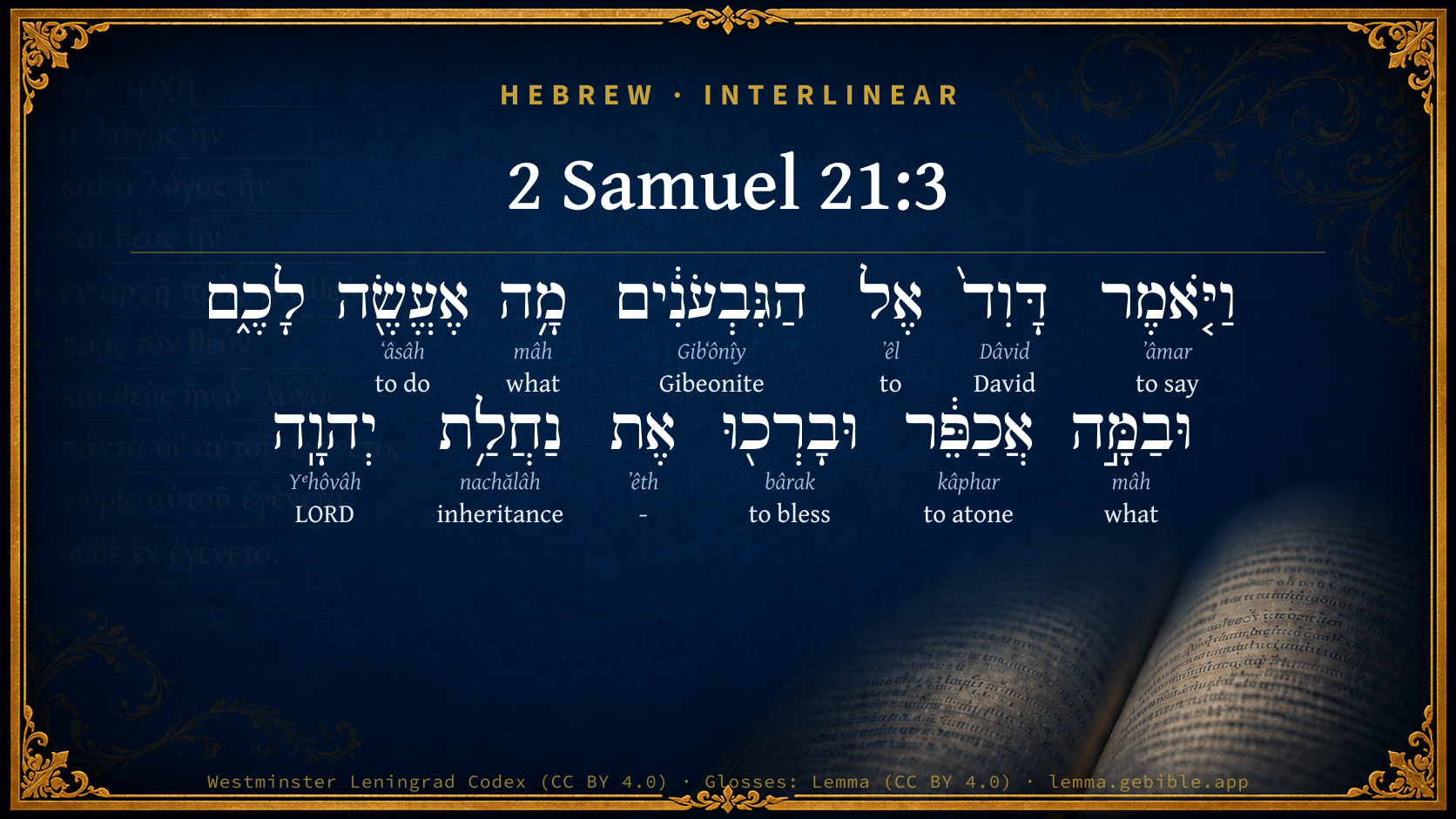
  1. וַיֹּ֤אמֶר ʼâmar H559 “and · to say” Conjunction + Verb, Qal, Sequential Imperfect, 3rd Person, Masculine, Singular
  2. דָּוִד֙ Dâvid H1732 “David” Noun, Proper
  3. אֶל ʼêl H413 “to” Preposition
  4. מָ֥ה mâh H4100 “what” Particle, Interrogative
  5. אֶעֱשֶׂ֖ה ʻâsâh H6213 “to do” Verb, Qal, Imperfect, 1st Person, Common, Singular
  6. וּבַמָּ֣ה mâh H4100 “and · in/at · what” Conjunction + Preposition + Particle, Interrogative
  7. אֲכַפֵּ֔ר kâphar H3722 “to atone” Verb, Piel, Imperfect, 1st Person, Common, Singular
  8. וּבָרְכ֖וּ bârak H1288 “and · bless” Conjunction + Verb, Piel, Imperative, 2nd Person, Masculine, Plural
  9. אֶת ʼêth H853 “-” Particle, Direct Object
  10. נַחֲלַ֥ת nachălâh H5159 “inheritance of” Noun, Common, Feminine, Singular, Construct
  11. יְהוָֽה Yᵉhôvâh H3068 “LORD” Noun, Proper

About this verse

These counts appear in no published source. They are computed here, from the morphology-tagged text and Lemma’s own curated glosses. What Lemma adds →

13
words
11
distinct lemmas
Historical
section

Notable vocabulary

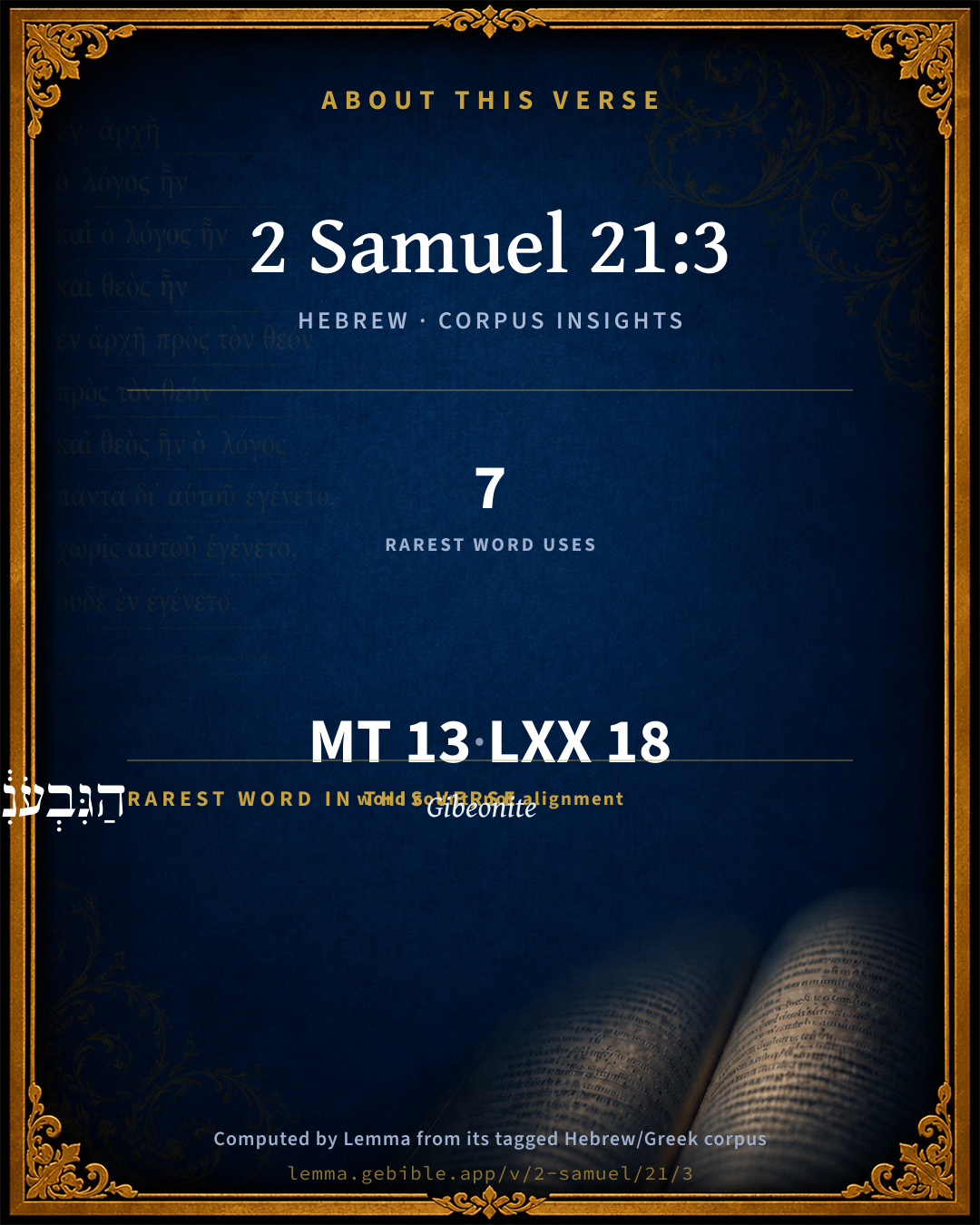
The rarest word here is הַגִּבְעֹנִ֔ים Gibeonite H1393 — appearing just 7 times in the whole Hebrew Bible.

Shared distinctive vocabulary

הַגִּבְעֹנִ֔ים Gibeonite H1393 occurs in 6 verses of the Hebrew Bible. Also found in:

Grammatical profile

  • 4 verbs
  • 4 nouns
  • 2 prepositions
  • 3 particles

Verb forms

  • וַיֹּ֤אמֶר Qal · Sequential Imperfect
  • אֶעֱשֶׂ֖ה Qal · Imperfect
  • אֲכַפֵּ֔ר Piel · Imperfect
  • וּבָרְכ֖וּ Piel · Imperative

Repetition

A word recurs within this verse — often emphatic in Hebrew:

  • מָ֥ה what H4100 ×2

Hebrew & Septuagint length

In English translation the verse runs 27 words from the Hebrew and 27 from the Septuagint (LXX English) — the same length.

A rough comparison of the two English renderings, which tokenize alike — not a word-level alignment.

Word counts can differ between the Hebrew and the Greek without any difference in meaning — e.g. the Hebrew direct-object marker אֵת has no separate Greek word, and Greek often adds the article ὁ.

In the original languages it is 13 Hebrew tokens and 18 Greek tokens — but the two are counted differently (Hebrew bundles its prefixes and suffixes into one token; the Greek is in lemma form), so that isn’t a like-for-like length.

Cross-references

8

Topical passages linked to 2 Samuel 21:3 in the Treasury of Scripture Knowledge — connected by theme and wording, ordered by reader-vote popularity; previews shown in the World English Bible.

  • 2 Samuel 20:19 I am of those who are peaceable and faithful in Israel: you seek to destroy a city and a mother in Israel: why will you swallow up the inheritance of Yahweh?
  • Hebrews 9:22 According to the law, nearly everything is cleansed with blood, and apart from shedding of blood there is no remission.
  • 1 Samuel 26:19 Now therefore, please let my lord the king hear the words of his servant. If it be Yahweh that has stirred you up against me, let him accept an offering: but if it be the children of men, cursed be they before Yahweh: for they have driven me out this day that I shouldn't cling to Yahweh's inheritance, saying, Go, serve other gods.
  • Exodus 32:30 It happened on the next day, that Moses said to the people, "You have sinned a great sin. Now I will go up to Yahweh. Perhaps I shall make atonement for your sin."
  • Leviticus 1:4 He shall lay his hand on the head of the burnt offering, and it shall be accepted for him to make atonement for him.
  • 1 Samuel 2:25 If one man sin against another, God shall judge him; but if a man sin against Yahweh, who shall entreat for him? Notwithstanding, they didn't listen to the voice of their father, because Yahweh was minded to kill them.
  • Micah 6:6–7 How shall I come before Yahweh, And bow myself before the exalted God? Shall I come before him with burnt offerings, With calves a year old?
  • Hebrews 10:4–12 For it is impossible that the blood of bulls and goats should take away sins.

Cross-references courtesy of OpenBible.info (CC BY 4.0).

Hebrew and Greek witnesses Masoretic Hebrew ↔ Greek Septuagint

The same verse in the two great witnesses to the Old Testament, shown verse-for-verse.

These are two independent witnesses, not word-aligned to each other, and the Septuagint is shown in lemma (dictionary) form.

Hebrew 2 Samuel 21:3 Masoretic · Westminster Leningrad Codex

וַיֹּ֤אמֶר דָּוִד֙ אֶל הַגִּבְעֹנִ֔ים מָ֥ה אֶעֱשֶׂ֖ה לָכֶ֑ם וּבַמָּ֣ה אֲכַפֵּ֔ר וּבָרְכ֖וּ אֶת נַחֲלַ֥ת יְהוָֽה

and David said to the Gibeonites, What shall I do for you? And with what shall I make atonement, that you may bless the inheritance of Yahweh?

World English Bible · Public Domain

Greek LXX 2 Samuel 21:3 Septuagint · lemma form

καί εἶπον δαυίδ πρός ὁ γαβαωνίτης τίς ποιέω σύ καί ἐν τίς ἐκἱλάσκομαι καί εὐλογέω ὁ κληρονομία κύριος

And David said to the Gabaonites, What shall I do to you? and wherewithal shall I make atonement, that you⌃ may bless the inheritance of the Lord?

LXX2012 (modern English Septuagint) · Public Domain

Hebrew: Westminster Leningrad Codex (CC BY 4.0). Greek: Septuagint (public domain); English from LXX2012 (modern English Septuagint) (Public Domain). How the Septuagint differs from the Hebrew →

Targum (Aramaic paraphrase)

1

The Targum is the ancient Jewish Aramaic paraphrase of the Hebrew Scriptures — an interpretive translation, not the Hebrew text itself. Onkelos (literal) and Pseudo-Jonathan (expansive) render the Torah, and Jonathan the Prophets. Coverage is partial: where no permissively-licensed English translation exists for a verse, only the Aramaic is shown. This is verse-level text, not a word-by-word alignment to the Hebrew.

  1. Targum Jonathan Prophets (Joshua–Malachi)
    וַאֲמַר דָוִד לְגִבְעוֹנָאֵי מָה אַעְבֵּיד לְכוֹן וּבְמָה אֶתְכַּפַּר וּבָרִיכוּ יַת אַחְסָנַת עַמָא דַיָי:

    (no public-domain English translation for this verse)

    Targum Jonathan — Aramaic: “Mikraot Gedolot” (public domain). English: “Sefaria Community Translation” (CC0 1.0 (public-domain dedication)); “London "Chaldee Paraphrase," 1871” (public domain). Text via Sefaria.

Commentary

Notes on 2 Samuel 21:3 from classic Christian and Jewish commentators (each source and its license shown beneath its notes). The classic Christian expositions comment on the surrounding passage and are grouped to its opening verse, so a note may address several verses; the Jewish commentaries on the Tanakh (Rashi and others) are per-verse, so they appear only where the commentator wrote on this verse.

Lemma curates 59 commentaries, every one of them public domain or Creative Commons licensed, each selected and text-cleaned for this edition rather than reprinted as found. About our sources →

Trapp's Complete Commentary

John Trapp

2Sa 21:3 Wherefore David said unto the Gibeonites, What shall I do for you? and wherewith shall I make the atonement, that ye may bless the inheritance of the LORD?

Ver. 3. Wherefore David said to the Gibeonites.] Who had complained to God of Saul’s cruelty and perfidy; and he had heard them, for he is gracious. {Exo 23:27} Their satisfaction therefore is by David endeavoured, and their prayers for Israel requested. See Job 29:13. This was an evident type, saith Pellican, of the calling of the Gentiles: and that, upon their prayers, God would one day receive the Jews again into grace and favour.

John Trapp, A Commentary or Exposition upon All the Books of the Old and New Testament (1647–1656) — public domain. Text from a community e-Sword module.

Joseph Benson's Commentary

2Sa 21:3. David said unto the Gibeonites, What shall I do for you? — Josephus supposes that when God acquainted David what was the occasion of the famine, he likewise declared that it should be removed if he made the satisfaction which the Gibeonites themselves should require. That ye may bless the inheritance of the Lord — That, atonement being made, and God’s anger being turned away, his inheritance may be blessed, and plenty restored again to Israel.

Joseph Benson's Commentary on the Old and New Testaments (1811–1818) — public domain. Text from a community e-Sword module.

Tyndale Open Study Notes

Tyndale Open Resources

21:3 Saul’s actions had caused the Gibeonites to curse Israel (cp. Rom 2:24); once David had made amends, the Gibeonites would bless the Lord’s people again.

Tyndale Open Study Notes — © Tyndale Open Resources, licensed CC BY-SA 4.0. Text via the HelloAO Bible API.

Geneva Bible (1599)

Geneva Bible translators

Wherewith may your wrath be appeased, that you may pray to God to remove this plague from his people.

Geneva Bible (1599) marginal notes — public domain. Text via Bolls.life.

Adam Clarke's Commentary

Verse 3. Wherewith shall I make the atonement] It is very strange that a choice of this kind should be left to such a people. Why not ask this of God himself?

Adam Clarke's Commentary on the Bible (1810–1826) — public domain. Text from a community e-Sword/MySword module.

Ellicott's Commentary for English Readers

(3) Make the atonement.—This is the same technical word as is used throughout the Law in connection with the propitiatory sacrifices. It means literally, to cover up, and is here used in that literal sense. David asks what he can do to so cover up the sin of Saul as to remove it from the sight of those against whom it had been committed—the Gibeonites as the earthly sufferers from it, and God Himself as the one against whom he had chiefly offended. Then might God’s blessing again return to His people.

A Bible Commentary for English Readers, edited by Charles John Ellicott (1878–1897) — public domain. Text from a community e-Sword module.

John Gill's Exposition

Wherefore David said unto the Gibeonites, what shall I do for you,.... By way of satisfaction for the injuries done them:

and wherewith shall I make the atonement; for the offences committed, that so the wrath that was gone forth against the land in a famine might be appeased:

that ye may bless the inheritance of the Lord? pray for a blessing upon the land which the Lord had chosen for his inheritance, and given as such to the people of Israel, that rain might descend upon it, and make it fruitful.

John Gill's Exposition of the Whole Bible (1746–1763) — public domain (CC PDM 1.0). Text via the HelloAO Bible API.

Haydock's Catholic Bible Commentary

Atonement, to expiate the injury done to you by Saul; (Menochius) and that you may turn your curses into blessings. The ancients were convinced, that God attends to the imprecations of the innocent. (Calmet)

George Leo Haydock (1774–1849), Haydock's Catholic Family Bible and Commentary, 1859 edition — public domain. Excludes Psalms (Douay-Rheims chapter numbering differs from Protestant) and Deuterocanonical books (Catholic canon only).

Matthew Poole's English Annotations

Unto the Gibeonites; to some of the chief of them, who were to impart it to the rest.

What shall I do for you? what satisfaction do you expect or require for the injuries formerly done to you?

That ye may bless the inheritance of the Lord; that by your acknowledgment of satisfaction received, the guilt and curse may be removed from the land and people of God, and by this means, as also by your prayers, God may be reconciled, and may restore his blessing of plenty to us, which hitherto he hath denied us.

Matthew Poole's English Annotations on the Holy Bible (1683–1685) — public domain. Text from a community e-Sword/MySword module.

Whedon's Commentary on the Bible

Daniel D. Whedon

3. Make the atonement — Make the necessary satisfaction.

The inheritance of the Lord — The land and people of Israel.

Daniel D. Whedon (gen. ed.), Commentary on the Old and New Testaments (1874–1909) — public domain. Text from a community e-Sword module.

The Pulpit Commentary

Wherewith shall I make the atonement, etc.? Literally the verb means to "cover up," the idea being that of a veil drawn over the offence to conceal it by means of a gift or offering. Thence gradually it attained to its religious idea of an expiation.

The Pulpit Commentary (1880–1919), ed. H.D.M. Spence-Jones & Joseph S. Exell — public domain. Text from a community e-Sword module.

Scofield Reference Notes

C. I. Scofield

atonement

(See Scofield "Exo 29:33").

The Scofield Reference Bible (1917 edition), notes by C. I. Scofield — public domain. Text from a community e-Sword module.

Rashi

Rabbi Shlomo Yitzchaki (Rashi)

So that you should bless the heritage of Adonoy? Pray for them.

Rashi on the Tanakh — English translations: “The Judaica Press complete Tanach with Rashi, translated by A. J. Rosenberg” (CC BY 4.0); “Pentateuch with Rashi's commentary by M. Rosenbaum and A.M. Silbermann, 1929-1934” (public domain); “The Metsudah Tanach series, Lakewood, N.J” (CC BY 4.0); and “The Book of Joshua, Metsudah Publications, 1997” (CC BY 4.0). Text via Sefaria.

Lesson kit

Teaching starters — assembled from the data on this page, not authored interpretation. Every prompt links to the verse data it draws on. Edit before teaching.

2 Samuel, in the Historical, opens this verse with 13 words (11 distinct Hebrew lemmas). Its most distinctive word is Gibʻônîy (“Gibeonite”). A historical commentator’s framing appears above. Read the whole chapter for the surrounding context.

Discussion questions

  1. What does “Gibeonite” (Gibʻônîy) contribute to the verse as a whole?
  2. How does 2 Samuel 21:1, which shares the word «Gibeonite», read alongside this verse?
  3. What does the repetition of “what” (2× in this one verse) do in this verse?
  4. These translations render this verse differently; the difference is in the English rendering, not the original. What questions does that raise?
  5. «וַיֹּ֤אמֶר» is a Qal Sequential Imperfect verb. How does that grammatical form shape the action described?
  6. Compare how Trapp's Complete Commentary and Joseph Benson's Commentary read this verse. Where do they agree or differ?

Things to notice

Reading settings

Reading text

Shown beneath each verse's original-language words.

Old Testament
Old Testament edition

Read the OT as the Masoretic Hebrew (MT) or the Greek Septuagint (LXX).

English shown for the Greek Septuagint (in the Hebrew ↔ Greek comparison).

Comparing translations? Open the Compare panel on any verse page to stack up to four side by side.