
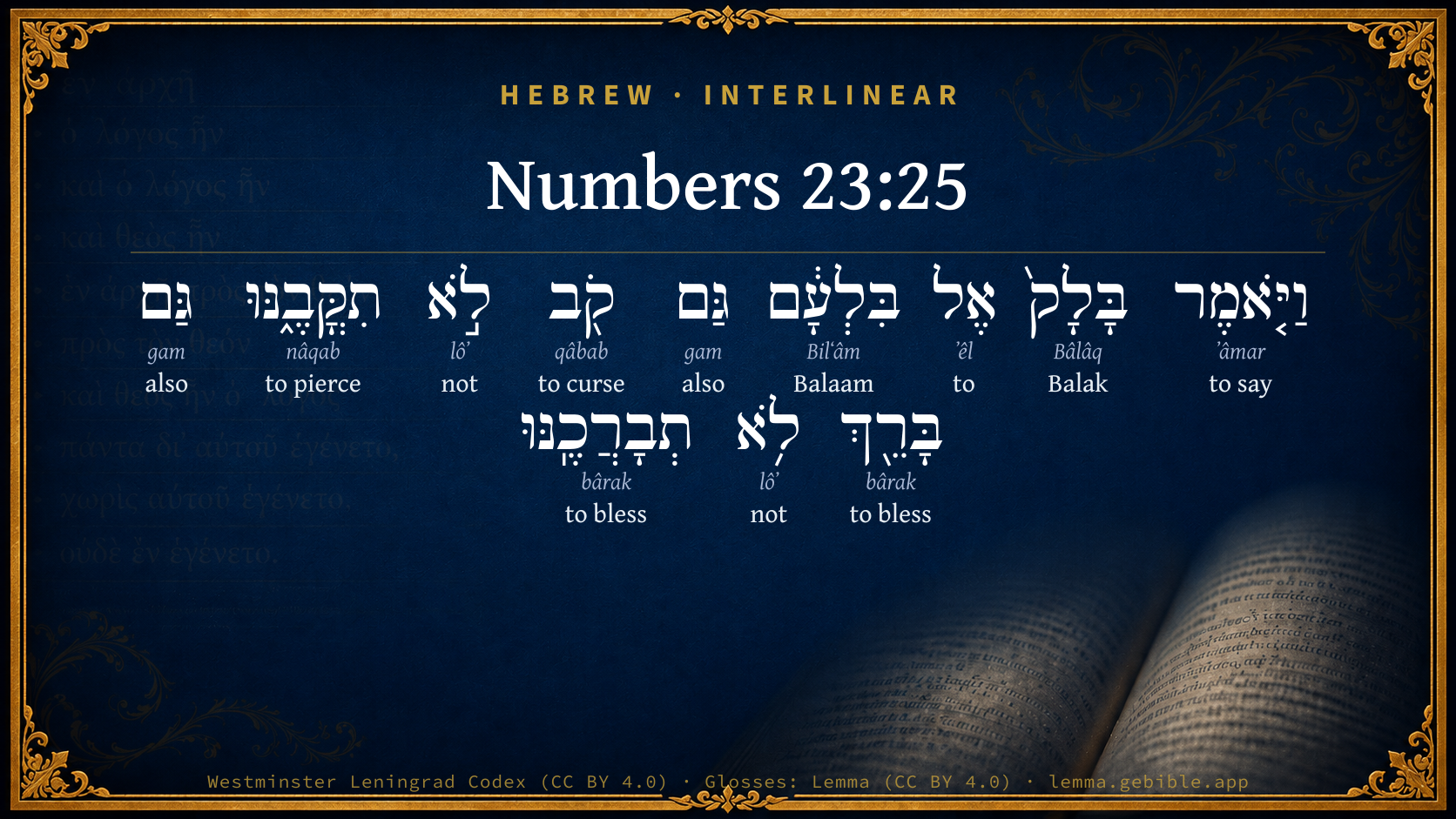
Numbers 23:25

Hebrew (Westminster Leningrad Codex) Numbers 23:25 appears in the Hebrew Old Testament. The text above is from the Westminster Leningrad Codex. Each word links to its Strong’s number, a concise gloss, and parsing drawn from the Open Scriptures Hebrew Bible morphology. Click any word for its full Brown-Driver-Briggs (BDB) entry.
Download image
Cite this verse

Numbers 23:25 (World English Bible). Public Domain. Lemma interlinear Bible study tool, https://lemma.gebible.app/v/numbers/23/25.

Show BibTeX & RIS
BibTeX
RIS
English Translation
Balak said to Balaam, Neither curse them at all, nor bless them at all.
World English Bible · Public Domain
Download a study sheet

One document with this verse’s original text, its word-by-word gloss line, the meaning frame, cross-references with their text, attributed commentary, and full source and license credits — printable, and it pastes into notes with its structure intact.

This verse Autodidact and up

Study sheet (.html) Plain text (.txt)

A passage Seminary Student

Up to 50 verses in one chapter. A passage sheet keeps up to 6 commentary sources and 12 cross-references per verse, in the order this page ranks them, and says so on the sheet whenever that leaves anything out. Ask for a single verse and you get the Autodidact verse sheet above.

Everything on this page stays free to read, with no account — the sheet is a download of what is already on screen, not access to it.

Want to remove ads? Support Godless Engineer
Compare translations 3

The same verse in 3 English versions, stacked beneath the original-language interlinear above. Click any original word for its lexicon entry.

Each is an independent rendering of the whole verse — the interlinear is not word-aligned to these translations.

Highlighted words mark where these versions differ — a whole-verse word diff, not a word-by-word alignment.

  • World English Bible Public Domain
    Balak said to Balaam, Neither curse them at all, nor bless them at all.
  • King James Version Public Domain
    And Balak said unto Balaam, Neither curse them at all, nor bless them at all.
  • unfoldingWord Literal Text CC BY-SA 4.0
    And Balak said to Balaam, “Also cursing, do not curse him! Also blessing, do not bless him!”

unfoldingWord Literal Text — © unfoldingWord, licensed CC BY-SA 4.0. Word-aligned USFM3 via Door43 (git.door43.org/unfoldingWord/en_ult).

Versions to compare (up to 4)

3 of 4 selected

Show all 18 translations

Every available English version of this verse, each an independent rendering of the whole verse.

  • World English Bible Public Domain
    Balak said to Balaam, Neither curse them at all, nor bless them at all.
  • Berean Standard Bible Public Domain
    Now Balak said to Balaam, “Then neither curse them at all nor bless them at all!”
  • Majority Standard Bible Public Domain
    Now Balak said to Balaam, “Then neither curse them at all nor bless them at all!”
  • King James Version Public Domain
    And Balak said unto Balaam, Neither curse them at all, nor bless them at all.
  • American Standard Version (1901) Public Domain
    And Balak said unto Balaam, Neither curse them at all, nor bless them at all.
  • Revised Version (1885) Public Domain
    And Balak said unto Balaam, Neither curse them at all, nor bless them at all.
  • Geneva Bible (1599) Public Domain
    Then Balak sayde vnto Balaam, Neither curse, nor blesse them at all.
  • Douay-Rheims (1899) Public Domain
    And Balac said to Balaam: Neither curse, nor bless him.
  • Young's Literal Translation Public Domain
    And Balak saith unto Balaam, `Neither pierce it at all, nor bless it at all;'
  • Literal Standard Version CC BY-SA 4.0
    And Balak says to Balaam, “Neither pierce it at all, nor bless it at all”;
  • Unlocked Literal Bible CC BY-SA 4.0
    Then Balak said to Balaam, “Do not curse them or bless them at all.”
  • unfoldingWord Literal Text CC BY-SA 4.0
    And Balak said to Balaam, “Also cursing, do not curse him! Also blessing, do not bless him!”
  • Darby Bible Public Domain
    And Balak said to Balaam, Neither curse them at all, nor bless them at all.
  • World Messianic Bible Public Domain
    Balak said to Balaam, “Neither curse them at all, nor bless them at all.”
  • Webster's Bible Public Domain
    And Balak said to Balaam, Neither curse them at all, nor bless them at all.
  • Free Bible Version CC BY-SA 4.0
    Then Balak said to Balaam, “If you can't give them any curses then at least don't give them any blessings!”
  • Bible in Basic English Public Domain
    Then Balak said to Balaam, If you will not put a curse on them, at all events do not give them a blessing.
  • JPS Tanakh (1917) Public Domain
    And Balak said unto Balaam: 'Neither curse them at all, nor bless them at all.'

Literal Standard Version (2020), Covenant Press — licensed CC BY-SA 4.0. Text via the HelloAO Bible API (eBible.org). Unlocked Literal Bible (unfoldingWord) — licensed CC BY-SA 4.0. Text via the HelloAO Bible API (eBible.org). unfoldingWord Literal Text — © unfoldingWord, licensed CC BY-SA 4.0. Word-aligned USFM3 via Door43 (git.door43.org/unfoldingWord/en_ult). Free Bible Version, Dr. Jonathan Gallagher — licensed CC BY-SA 4.0. Text via the HelloAO Bible API (eBible.org).

Word by word

More ways to search: Search by grammar → Find every occurrence → Compare this word →

Practice this passage: Drill this verse → Learn its vocabulary →

About this verse

These counts appear in no published source. They are computed here, from the morphology-tagged text and Lemma’s own curated glosses. What Lemma adds →

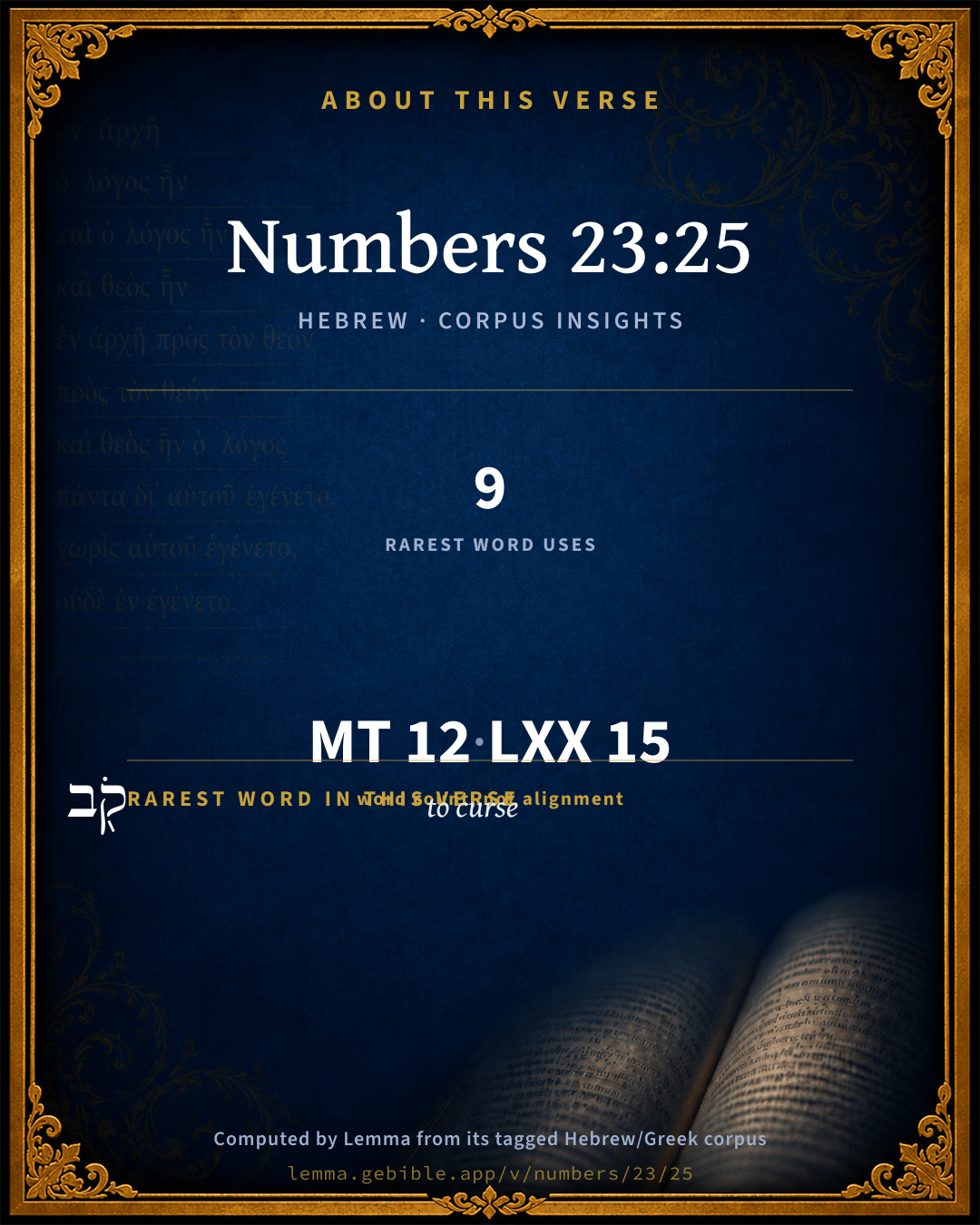
12
words
9
distinct lemmas
Pentateuch
section

Notable vocabulary

The rarest word here is קֹ֖ב to curse H6895 — appearing just 9 times in the whole Hebrew Bible.

Shared distinctive vocabulary

קֹ֖ב to curse H6895 occurs in 9 verses of the Hebrew Bible. Also found in:

Grammatical profile

  • 5 verbs
  • 2 nouns
  • 1 preposition
  • 4 particles

Verb forms

  • וַיֹּ֤אמֶר Qal · Sequential Imperfect
  • קֹ֖ב Qal · Infinitive Absolute
  • תִקֳּבֶ֑נּוּ Qal · Imperfect
  • בָּרֵ֖ךְ Piel · Infinitive Absolute
  • תְבָרֲכֶֽנּוּ Piel · Imperfect

Repetition

Words recur within this verse — often emphatic in Hebrew:

  • גַּם also H1571 ×2
  • בָּרֵ֖ךְ to bless H1288 ×2
  • לֹ֣א not H3808 ×2

Hebrew & Septuagint length

In English translation the verse runs 14 words from the Hebrew and 18 from the Septuagint (LXX English) — closely comparable.

A rough comparison of the two English renderings, which tokenize alike — not a word-level alignment.

Word counts can differ between the Hebrew and the Greek without any difference in meaning — e.g. the Hebrew direct-object marker אֵת has no separate Greek word, and Greek often adds the article ὁ.

In the original languages it is 12 Hebrew tokens and 15 Greek tokens — but the two are counted differently (Hebrew bundles its prefixes and suffixes into one token; the Greek is in lemma form), so that isn’t a like-for-like length.

Cross-references

1

Topical passages linked to Numbers 23:25 in the Treasury of Scripture Knowledge — connected by theme and wording, ordered by reader-vote popularity; previews shown in the World English Bible.

  • Psalms 2:1–3 Why do the nations rage, And the peoples plot a vain thing?

Cross-references courtesy of OpenBible.info (CC BY 4.0).

Hebrew and Greek witnesses Masoretic Hebrew ↔ Greek Septuagint

The same verse in the two great witnesses to the Old Testament, shown verse-for-verse.

These are two independent witnesses, not word-aligned to each other, and the Septuagint is shown in lemma (dictionary) form.

Hebrew Numbers 23:25 Masoretic · Westminster Leningrad Codex

וַיֹּ֤אמֶר בָּלָק֙ אֶל בִּלְעָ֔ם גַּם קֹ֖ב לֹ֣א תִקֳּבֶ֑נּוּ גַּם בָּרֵ֖ךְ לֹ֥א תְבָרֲכֶֽנּוּ

Balak said to Balaam, Neither curse them at all, nor bless them at all.

World English Bible · Public Domain

Greek LXX Numbers 23:25 Septuagint · lemma form

καί εἶπον βαλακ πρός βαλααμ οὔτε κατάρα καταἀράομαι ἐγώ αὐτός οὔτε εὐλογέω μή εὐλογέω αὐτός

And Balac said to Balaam, Neither curse the people at all for me, nor bless them at all.

LXX2012 (modern English Septuagint) · Public Domain

Hebrew: Westminster Leningrad Codex (CC BY 4.0). Greek: Septuagint (public domain); English from LXX2012 (modern English Septuagint) (Public Domain). How the Septuagint differs from the Hebrew →

Targum (Aramaic paraphrase)

2

The Targum is the ancient Jewish Aramaic paraphrase of the Hebrew Scriptures — an interpretive translation, not the Hebrew text itself. Onkelos (literal) and Pseudo-Jonathan (expansive) render the Torah, and Jonathan the Prophets. Coverage is partial: where no permissively-licensed English translation exists for a verse, only the Aramaic is shown. This is verse-level text, not a word-by-word alignment to the Hebrew.

  1. Targum Onkelos Torah (Genesis–Deuteronomy)
    וַאֲמַר בָּלָק לְבִלְעָם אַף מֵילַט לָא תְלוּטִּינוּן אַף בְּרָכָא לָא תְבָרֵכִינוּן

    (no public-domain English translation for this verse)

    Targum Onkelos — Aramaic: “Onkelos Genesis” (public domain); “Onkelos Exodus” (public domain); “Onkelos Leviticus” (public domain); “Onkelos Numbers” (public domain); “Onkelos Deuteronomy” (public domain). English: “Sefaria Community Translation” (CC0 1.0 (public-domain dedication)); “J.W. Etheridge. The Targums of Onkelos and Jonathan Ben Uzziel on the Pentateuch. London: Longmans, Green, 1862” (public domain). Text via Sefaria.

  2. Targum Pseudo-Jonathan Torah (Genesis–Deuteronomy)
    וַאֲמַר בָּלָק לְבִלְעָם אוּף לִטָא לָא תְלוֹטִינוּן אוּף בִּרְכָא לָא תְבָרְכִינוּן

    And Balak said to Bileam, Neither curse them nor bless them.

    Targum Pseudo-Jonathan — Aramaic: “Targum Jonathan on Genesis” (public domain); “Targum Jonathan on Exodus” (public domain); “Targum Jonathan on Leviticus” (public domain); “Targum Jonathan on Numbers” (public domain); “Targum Jonathan on Deuteronomy” (public domain). English: “The Targum of Jonathan ben Uzziel, trans. J. W. Etheridge, London, 1862” (public domain). Text via Sefaria.

Commentary

Notes on Numbers 23:25 from classic Christian and Jewish commentators (each source and its license shown beneath its notes). The classic Christian expositions comment on the surrounding passage and are grouped to its opening verse, so a note may address several verses; the Jewish commentaries on the Tanakh (Rashi and others) are per-verse, so they appear only where the commentator wrote on this verse.

Lemma curates 59 commentaries, every one of them public domain or Creative Commons licensed, each selected and text-cleaned for this edition rather than reprinted as found. About our sources →

Trapp's Complete Commentary

John Trapp

Num 23:25 And Balak said unto Balaam, Neither curse them at all, nor bless them at all.

Ver. 25. Nor bless them at all.] But they are blessed, and they shall be blessed, the one cursing the malice of earth and of hell.

John Trapp, A Commentary or Exposition upon All the Books of the Old and New Testament (1647–1656) — public domain. Text from a community e-Sword module.

Keil & Delitzsch

C. F. Keil & F. Delitzsch

Balaam's Last Words. - Num 23:25-30. Balak was not deterred, however, from making another attempt. At first, indeed, he exclaimed in indignation at these second sayings of Balaam: "Thou shalt neither curse it, nor even bless." The double גּם with לא signifies "neither - nor;" and the rendering, "if thou do not curse it, thou shalt not bless it," must be rejected as untenable. In his vexation at the second failure, he did not want to hear anything more from Balaam. But when he replied again, that he had told him at the very outset that he could do nothing but what God should say to him (cf. Num 22:38), he altered his mind, and resolved to conduct Balaam to another place with this hope: "peradventure it will please God that thou mayest curse me them from thence." Clericus observes upon this passage, "It was the opinion of the heathen, that what was not obtained through the first, second, or third victim, might nevertheless be secured through a fourth;" and he adduces proofs from Suetonius, Curtius, Gellius, and others.

Keil & Delitzsch — Biblical Commentary on the Old Testament (1861–1891) — public domain (CC PDM 1.0). Text via the HelloAO Bible API. (Old Testament only.)

Lange's Commentary on the Holy Scriptures

G.—THE THIRD BLESSING

Num_23:25 to Num_24:9

25And Balak said unto Balaam, Neither curse them at all, nor bless them at all. 26But Balaam answered and said unto Balak, Told not I thee, saying, All that the Lord speaketh, that I must do?

27And Balak said unto Balaam, Come, I pray thee, I will bring thee unto another place; peradventure it will please God that thou mayest curse me them from thence. 28And Balak brought Balaam unto the top of Peor, that looketh toward Jeshimon. 29And Balaam said unto Balak, Build me here seven altars, and prepare me here seven bullocks and seven rams. 30And Balak did as Balaam had said, and offered a bullock and a ram on every altar.

Num_24:1.And when Balaam saw that it pleased the Lord to bless Israel, he went not, as at other times, to seek for1 enchantments, but he set his face toward the wilderness. 2And Balaam lifted up his eyes, and he saw Israel abiding in his tents according to their tribes; and the Spirit of God came upon him.

3     And he took up his parable, and said,

Balaam the son of Beor hath said,

And the man whose eyes are2 open hath said:

4     He hath said, which heard the words of God,

Which saw the vision of the Almighty,

Falling into a trance, but having his eyes open:

5     How goodly are thy tents, O Jacob!

And thy tabernacles, O Israel!

6     As the valleys are they spread forth,

As gardens by the river’s side,

As the trees of lign-aloes which the Lord hath planted,

And as cedar trees beside the waters.

7     He shall pour the water out of his buckets,

And his seed shall be in many waters,

And his king shall be higher than Agag,

And his kingdom shall be exalted.

8     God brought him forth out of Egypt;

He hath as it were the strength of an unicorn:

He shall eat up the nations his enemies,

And shall break their bones,

And pierce them through with his arrows.

9     He couched, he lay down as a lion,

And as a great lion: who shall stir him up?

Blessed is he that blesseth thee,

And cursed is he that curseth thee.

TEXTUAL AND GRAMMATICAL

[Num_24:1. Heb. as time after time.—A. G.].

[Num_24:3. נְאֻם a divine saying used ordinarily with Jehovah, found only here and Pro_30:1; 2Sa_23:1, with the genitive of the human bearer of the saying.—A. G.].

[Num_24:3. Rather closed שָהַם like סָהָם to close, the שׁ being later softened into שׂ or ס. See Hengst., pp. 136–139, and the authorities quoted.—A. G.].

[Num_24:4. Falling down—having his eyes open, i. e., the inward eye. The words are different from those in Num_24:3.—A. G.].

[Num_24:7. The dual form: “personifying the nation as a man carrying two pails overflowing with water.”—A. G.]

[Num_24:8. צָרְיו. Those who beset him round.—A. G.].

[Num_24:8. The suffix in חִאָיו refers to Israel, and the verb is without an expressed object. Hirsch meets the difficulty by making the singular suffix refer to God, as His arrows, the arrows of God, Israel wounds.—A. G.].

EXEGETICAL AND CRITICAL

Balak is betrayed into the greatest confusion, utters things which are self-contradictory—a usual result of such cunningly-laid schemes. At first he says: Thou shalt neither curse them nor bless them, i. e. keep silence with respect to them. But immediately another superstitious idea occurs to him. He had erred perhaps in only letting the “curser” see the extreme limits of the Israelitish camp. Possibly the result might be entirely different if he should overlook the whole camp at one time and in one view. Then perchance his alarm at the sight of this great swarming host would overwhelm him, and so lead him to pronounce the curse. He leads him therefore at once to the top of Mount Peor. This mountain lay nearest the camp of Israel, one of the peaks of the Abarim range and overlooking the whole plain. It was probably not far from the city Beth-Peor. [It was north from Pisgah, and nearly opposite Jericho, six Roman miles higher than Libbias. The locality is important in connection with the prophetic utterances which follow, See Smith’s Bib. Dict., Art. Balaam, Stanley’s Hist. of Jewish Church, p. 213–217. “Behind him lay the vast expanse of desert extending to the shores of his native Assyrian river. On his left were the red mountains of Edom and Seir; opposite were the dwelling-places of the Kenite, in the rocky fastnesses of Engedi; further still was the dim outline of the Arabian wilderness, where ruled the then powerful tribe of Amalek; immediately below him lay the vast encampment of Israel, amongst the Acacia groves of Abel-Shittim—like the water-courses of the mountains—like the hanging gardens beside his own river Euphrates with their aromatic shrubs and their wide-spreading cedars. Beyond them, on the western side of Jordan, rose the hills of Palestine, with glimpses through their valleys of ancient cities towering on their crested heights. And beyond all, though he could not see it with his bodily vision, he knew well that there rolled the deep waters of the great sea, with the Isles of Greece, the Isle of Chittim—a world of which the first beginnings of life were just stirring, of which the very name here first breaks upon our ears.”—A. G.] The same costly sacrifice must be offered again. It could only have been in an ironical temper that Balaam, after his previous utterances, could start upon this new attempt or make these requisitions for it.

He knows now definitely the will of Jehovah, and does not go as before to meet or seek auguries, but turns his back directly towards the wilderness, and surveys the whole people of Israel encamped there. Then the Spirit of God came upon him in a new and higher way. The words are no longer put into his mouth, and uttered under constraint and legal fear; he speaks out now in his ecstatic condition winged words, although we cannot say that they came from the heart. [“He no longer attempted by any magic art to control the purpose of God, but became the organ which God used in the communication of His will. He spake now in the spirit of prophecy” Hirsch. “It was not the mere sight of the ordered camp which formed the subjective preparation for receiving the Spirit of God, but the sight in connection with the previous living conviction that Israel was the blessed people of God.” Hengstenberg.—A. G.]

Num_24:3-4. He begins with a description of his new higher and more exalted state. From his very opening words Balaam himself is conscious for the time of prophetic powers. From Balaam the son of Beor he has become the man who has his inward prophetic eyes opened, since he has passed now into prophetic ecstacy. He first heard the words of (the mighty) God—as hearing usually precedes vision in the miraculous revelation—and then saw the vision (face) of the Almighty, but was so overpowered that he fell down (as Saul, 1Sa_19:24; Daniel, Dan_10:9; the Seer in the Apocalypse, Revelation 1; and as generally the prophets were prostrated in their calling); but with the fall, his spiritual eyes were unveiled, so that he can now make known the divine sayings. [Keil: “He calls his prediction a divine saying, a נְאֻם, for the purpose of designating it as a divine revelation received from the Spirit of God.” The falling to the ground was not necessarily or even generally an attendant upon the prophetic state and calling. There seems to be an intimation in the phrase, is Saul also among the prophets? that this condition was common. But that is a slight basis upon which to build a theory of the prophetic state. It is only in cases like Balaam and Saul, when the Spirit finds an alien condition of will and heart, that His coming is attended by these marks of violence, as if they were overcome and thrown down by a hostile power. As Hengstenberg well says, we are not justified in inferring from these cases that this was the condition with all the prophets. We could scarcely conceive it to have occurred with Samuel, as with Saul. To those whose ordinary states are pervaded by the Spirit He comes as to His own. The falling with David, Ezekiel, John, are not parallel; for in their case it was the splendor and glory of the manifestation which led them to prostrate themselves in reverence and fear. Whose eyes are open, not with the margin: who had his eyes shut, but now open, referring in both cases to his inward eye, but with most modern commentators, as now shut or closed. It is descriptive of his present ecstatic state. His bodily eyes and senses are closed to the external world, while his inner eye is open to the visions which the Spirit gave. The contrast between the third and fourth verses in the original favors this interpretation. It does not follow, however, that every prophet in his prophetic condition, had his bodily eyes closed, or the senses, as it were, suspended, “so far as self-conscious reflection is concerned.” With men like Balaam, whose inner eye was darkened by lusts and passions, it seems necessary; but with those who were spiritually-minded, who were not sunken in the world of the senses and of self, it was not necessary, and probably did not occur.—A. G.] But here again the blessing is richer in its pathetic form than in its contents. The figures used are massed, and sometimes obscure. We meet again not only the image of the swift-rushing buffalo, but of the lion in a modified form. He describes the goodly and splendid appearance of the tent-city, which may be regarded as an unconscious type of the theocracy or the church (Num_24:5-6). In the next place he describes the glorious development of this people (Num_24:7). Then thirdly he celebrates its power—and indeed its destructive power over the heathen (Num_24:8-9). Only a faint glimmer of hope for the nations shines through the closing words: Blessed is he that blesseth thee, and cursed is he that curseth thee.

Num_24:5. How goodly are thy tents, etc.—The word is typically significant, not only in reference to the theocracy, but to the Christian Church. [It is Israel which comes before his mental vision—“the people in its higher nature, in its relation to God,” and therefore all who are Israel, down to the most distant ages.—A. G.]

Num_24:6. From the dwellings to the land. Well-watered valleys spread themselves out in beautiful pictures, and to these the still more beautiful gardens by the river side. The conception of the aloe-groves breathing out their fragrance, and the cedar trees standing in their strength by the water courses, leads us away from the ordinary beauties of nature, to a higher paradisaic nature and culture. As an unconscious typical word, it foretells the Canaan to come, and the wider and succeeding glorification of the earth. [Bible Com. The aloe imported from China and the far distant east furnished to the ancients one of the most fragrant and precious of spices. Comp. Ps. 45:48. “All thy garments smell of myrrh, aloes and cassia,” Psa_7:17. The images of the prophecy seem to have a basis or ground partly in the scene which lay before his natural eyes before the trance—the camp with its wide surroundings, and partly in those with which he was familiar along the banks of his own Euphrates.—A. G.]

Num_24:7. The people are presented under the image of a water carrier, whose two buckets (the dual form) which he carries, are overflowing with water. [He shall pour the water.—He shall not only prosper, have abundance of water, as water was so essential to all fertility, but he shall pour from his overflowing buckets, he shall distribute to others out of his fullness of blessings. In thee shall all families of the earth be blessed, Gen_12:3.—A. G.] His seed, i. e., his progeny (not his sowing corn, as Bunsen), shall be in many waters, i. e., shall spread itself abroad, be cheered with great and varied blessing. His king shall be higher than Agag, i. e., the kings of his ancient enemies, the Amalekites, who were called Agag (the fiery). [Agag seems to have been the common name of the kings of the Amalekites, as Pharaoh of the kings of Egypt, and Abimelech of the kings of the Philistines. And Hengstenberg has shown clearly, from the immediate context, in which Balaam speaks only in general terms of the good which should come to Israel, and from the relation which this third saying has to those which precede it, and that which follows, forming as it were a middle member in the whole prophetic utterance, a transition from the general and ideal, to the particular or individual, that we cannot suppose a reference to any individual king as the Agag overthrown by Saul, 1Sa_15:8. It is only in the fourth saying, and even then in a general way, that he passes on to an individual application of the predictions to particular hostile nations. This is still further confirmed by the fact that his king is not any particular king, as Saul or David, nor even the Messiah exclusively, but his king generally, i.e., the king whom Israel should receive. His king here is equivalent to the kingdom which should be exalted—in and through which the power of Israel should be fully developed and established over all enemies. There is too an historical reason why the Amalekite kingdom should appear here as the representative of the enmity of the world to the kingdom of God (see Exo_17:8). And they were still probably among the most mighty of Israel’s foes, which was not the case at the time of Saul. There is no valid ground therefore for the supposition that this passage indicates a later origin of the book of Numbers. On the contrary, it may be fairly urged as showing how deeply the idea of the kingdom lies imbedded in all conceptions of the people of God as a power in the world, as showing that it is not an idea of late growth, but one with which the people of God, and even Balaam was familiar.—A. G.] His kingdom shall be exalted, i. e., raise itself by its activity, vigor and growth. In the words his king he indicates the establishment of a royal dynasty in Israel, but that the kings of the Amalekites (and not Edom, Assyria, Babylon) are chosen as the type of heathen enmity proves the antiquity of the narrative. The singular greatness of the people corresponds to the singular greatness of the king. There is no verbal and conscious prophecy of the Messiah here (Keil: “The king was neither the Messiah exclusively, nor the earthly kingdom without the Messiah”); for with the conception of the ideal Messiah, which unfolds itself later, out of the natural and generic Messiah, the conception of salvation as extending to all assumes a definite form. The words, however, in a typical sense have an unmistakable significance: the great people of God with its great king overcoming and towering above all heathen kingdoms and kings. [Hengstenberg: “for as Israel only attains the complete realization of its idea in the erection of the kingdom, so the kingdom reaches completely its destination only, with the appearance of the Messiah. In Him first the king of Israel is truly higher than Agag, the representative of the hostile world-power.”—A. G.]

Num_24:8. The repeated reference to Egypt and the Exodus appears to be designed to bring out more vividly the contrast between this poor race of liberated slaves, and its destruction of the heathen nations as its enemies. We explain the latter and difficult clauses thus: he will crush (not gnaw) the bones of his enemies, and then break his own arrows, because the instruments of warfare have become useless. (See Isa_2:4.) It is a strange order surely to say that he will first gnaw the bones of his enemies, and then pierce them with his arrows. We would rather account for the change from the plural to the singular thus: as he will crush the hostile nations, so he will break his (the enemies’) arrows. [Keil renders: “he shall dash them in pieces with his arrows,” making the enemies the object of the verb. The violent alterations in the text suggested by J. D. Michaelis and Knobel are unnecessary. The order may be, from the crushing defeat of Israel’s enemies, to the instruments by which it is secured, arrows standing for the weapons of war. Hirsch: “And as the arrows of God, Israel wounds,” i.e., Israel is the weapon in the hand of God in His warfare with His malignant foes, the enemies of the dominion of His moral law upon the earth, and it is only as the arrow of God that Israel has victorious power over the nations.”—A. G.]

The figure of the lion has a deeper significance than in Num_23:22. There the lion goes in search of his prey; he has not yet lain down; here he appears as a triumphant lion, who has lain down in his majesty, and will injure no more. As to the typical meaning underlying this prediction of the kingdom of Israel conquering and destroying all heathen power, see Psalms 2, 110; Isaiah 9, 11; Dan_2:34-35.

Num_24:9. Comp. Gen_12:3; Gen_27:29; Gen_49:9; Mat_10:40-42.

The last words must lead to a rupture between Balak and Balaam, for their application to themselves, and their opposite purposes, was apparent. Balaam as the blesser felt himself blessed; and since Balak still wished to curse Israel, he was pursued already by the curse. [The future history will scarcely justify the supposition that Balaam felt himself blessed. He was conscious that he did not bless with the heart; it was not a blessing he desired which he utters, and hence he could not feel that he himself was heir to the blessing.—A. G.]

Footnotes:

[1]Marg. To the meeting of enchantments.

[2]Marg. who had his eyes shut but now opened.

Lange's Commentary on the Holy Scriptures (Critical, Doctrinal, and Homiletical), ed. John Peter Lange, English translation edited by Philip Schaff (1864–1880) — public domain. Text from a community e-Sword module.

The Cambridge Bible for Schools and Colleges

gen. ed. J. J. S. Perowne

25, 26. Balak in his anger refuses to allow Balaam to make any further utterances about Israel, either to curse or to bless. Balaam reminds him of his reiterated statement that he could only say what Jehovah commanded him (Num_22:38, Num_23:3; Num_23:12). Balaam’s relations with Balak, therefore, as recorded in E , are now at an end. The sequel (Num_23:27-30; Num_23:24) is not really a sequel, but a parallel account from J .

The Cambridge Bible for Schools and Colleges (gen. ed. J. J. S. Perowne; Cambridge University Press, 1878–1918) — public domain. Text from a community e-Sword module.

John Gill's Exposition

And Balak said unto Balaam, neither curse them at all, nor bless them at all. Signifying that it would be as well or better to do nothing at all, than to do what he did; but the sense is not, that he would not have him curse them, that he could never say, since he had pressed it both before and after this; wherefore the words should be rendered, as they are by some (p), "if in cursing thou dost not curse", or will not curse, "neither in blessing bless", or, however, do not bless: if he could not or would not curse Israel, he would not have him bless them on any account; if he could do him and his people no good in ridding them of their enemies, yet he desires him by no means to do them any harm by discouraging them and encouraging Israel.

(p) So Fagius, Vatablus; with which agree the Arabic version, and Noldius, p. 221. No. 1024.

John Gill's Exposition of the Whole Bible (1746–1763) — public domain (CC PDM 1.0). Text via the HelloAO Bible API.

Haydock's Catholic Bible Commentary

Neither, &c. When infidels cannot prevail upon people to side with them entirely, in their false worship, they endeavour to induce them at least not to bless, nor follow up the true religion. (Worthington)

George Leo Haydock (1774–1849), Haydock's Catholic Family Bible and Commentary, 1859 edition — public domain. Excludes Psalms (Douay-Rheims chapter numbering differs from Protestant) and Deuterocanonical books (Catholic canon only).

Whedon's Commentary on the Bible

Daniel D. Whedon

25. Neither curse… nor bless — This issue of Balak’s machinations against the people of God is only a single instance of the inspired declaration, “The wrath of man shall praise thee,” which has been fulfilled all along the ages. The efforts of infidelity to destroy Christ have all resulted in his exaltation. The stone, the watch, and the seal, intended to keep the crucified Jesus in the tomb, have become strong proofs of the resurrection of our Lord. The assaults of rationalism, by arousing Christian apologists to deeper researches, have contributed to lay bare the immutable foundations of the Gospel of Jesus Christ.

Daniel D. Whedon (gen. ed.), Commentary on the Old and New Testaments (1874–1909) — public domain. Text from a community e-Sword module.

unfoldingWord translationNotes

Door43 World Missions Community

Balak

This is the king of Moab. See how you translated this in Numbers 22:2.

Did I not tell you that I must say all that Yahweh tells me to say?

Balaam uses this rhetorical question to remind Balak that Balaam refused to disobey God even before he came to Balak. It can be translated as a statement. AT: "I told you before that I must say all that Yahweh tells me to say." (See: Rhetorical Question)

translationWords

Balaam

curse

bless

Yahweh

unfoldingWord translationNotes — © Distant Shores Media and the Door43 World Missions Community, licensed CC BY-SA 4.0. Source: git.door43.org/Door43/en_tn.

Rashi

Rabbi Shlomo Yitzchaki (Rashi)

גם קב לא תקבנו NEITHER (גם) CURSE THEM AT ALL [NOR (גם) BLESS THEM AT ALL] — The first גם adds something to the second גם and the second גם something to the first גם, similar to (1 King 3:26): “Neither mine (גם לי) nor thine (גם לך) shall it be”; and similarly (Deuteronomy 32:25): “also youths (גם בכור) also maidens (גם בתולה)” (i.e. both youths and maidens).

Rashi on the Tanakh — English translations: “The Judaica Press complete Tanach with Rashi, translated by A. J. Rosenberg” (CC BY 4.0); “Pentateuch with Rashi's commentary by M. Rosenbaum and A.M. Silbermann, 1929-1934” (public domain); “The Metsudah Tanach series, Lakewood, N.J” (CC BY 4.0); and “The Book of Joshua, Metsudah Publications, 1997” (CC BY 4.0). Text via Sefaria.

Lesson kit

Teaching starters — assembled from the data on this page, not authored interpretation. Every prompt links to the verse data it draws on. Edit before teaching.

Numbers, in the Pentateuch, opens this verse with 12 words (9 distinct Hebrew lemmas). Its most distinctive word is qâbab (“to curse”). A historical commentator’s framing appears above. Read the whole chapter for the surrounding context.

Discussion questions

  1. What does “to curse” (qâbab) contribute to the verse as a whole?
  2. Numbers 22:11 shares the word «to curse» with this verse. How do the two illuminate each other?
  3. “also” occurs 2× in this one verse. What is the effect of the repetition?
  4. These translations render this verse differently; the difference is in the English rendering, not the original. What questions does that raise?
  5. The verb «וַיֹּ֤אמֶר» is Qal Sequential Imperfect. How does its form color the action?
  6. Reading how Trapp's Complete Commentary and Keil & Delitzsch read this verse, where do the two commentators agree and where do they part?

Things to notice

Reading settings

Reading text

Shown beneath each verse's original-language words.

Old Testament
Old Testament edition

Read the OT as the Masoretic Hebrew (MT) or the Greek Septuagint (LXX).

English shown for the Greek Septuagint (in the Hebrew ↔ Greek comparison).

Comparing translations? Open the Compare panel on any verse page to stack up to four side by side.