

1 Chronicles 4:10

Hebrew (Westminster Leningrad Codex) 1 Chronicles 4:10 appears in the Hebrew Old Testament. The text above is from the Westminster Leningrad Codex. Each word links to its Strong’s number, a concise gloss, and parsing drawn from the Open Scriptures Hebrew Bible morphology. Click any word for its full Brown-Driver-Briggs (BDB) entry.
Download image
Cite this verse

1 Chronicles 4:10 (World English Bible). Public Domain. Lemma interlinear Bible study tool, https://lemma.gebible.app/v/1-chronicles/4/10.

Show BibTeX & RIS
BibTeX
RIS
English Translation
Jabez called on the God of Israel, saying, Oh that you would bless me indeed, and enlarge my border, and that your hand might be with me, and that you would keep me from evil, that it not be to my sorrow! God granted him that which he requested.
World English Bible · Public Domain
Download a study sheet

One document with this verse’s original text, its word-by-word gloss line, the meaning frame, cross-references with their text, attributed commentary, and full source and license credits — printable, and it pastes into notes with its structure intact.

This verse Autodidact and up

Study sheet (.html) Plain text (.txt)

A passage Seminary Student

Up to 50 verses in one chapter. A passage sheet keeps up to 6 commentary sources and 12 cross-references per verse, in the order this page ranks them, and says so on the sheet whenever that leaves anything out. Ask for a single verse and you get the Autodidact verse sheet above.

Everything on this page stays free to read, with no account — the sheet is a download of what is already on screen, not access to it.

Want to remove ads? Support Godless Engineer
Compare translations 3

The same verse in 3 English versions, stacked beneath the original-language interlinear above. Click any original word for its lexicon entry.

Each is an independent rendering of the whole verse — the interlinear is not word-aligned to these translations.

Highlighted words mark where these versions differ — a whole-verse word diff, not a word-by-word alignment.

  • World English Bible Public Domain
    Jabez called on the God of Israel, saying, Oh that you would bless me indeed, and enlarge my border, and that your hand might be with me, and that you would keep me from evil, that it not be to my sorrow! God granted him that which he requested.
  • King James Version Public Domain
    And Jabez called on the God of Israel, saying, Oh that thou wouldest bless me indeed, and enlarge my coast, and that thine hand might be with me, and that thou wouldest keep me from evil, that it may not grieve me! And God granted him that which he requested.
  • unfoldingWord Literal Text CC BY-SA 4.0
    And Jabez called to the God of Israel, saying, “If blessing, you would bless me, and you would enlarge my border, and your hand would be with me, and you would act not harm, so as not to pain me!” And God brought what he asked.

unfoldingWord Literal Text — © unfoldingWord, licensed CC BY-SA 4.0. Word-aligned USFM3 via Door43 (git.door43.org/unfoldingWord/en_ult).

Versions to compare (up to 4)

3 of 4 selected

Show all 18 translations

Every available English version of this verse, each an independent rendering of the whole verse.

  • World English Bible Public Domain
    Jabez called on the God of Israel, saying, Oh that you would bless me indeed, and enlarge my border, and that your hand might be with me, and that you would keep me from evil, that it not be to my sorrow! God granted him that which he requested.
  • Berean Standard Bible Public Domain
    And Jabez called out to the God of Israel, “If only You would bless me and enlarge my territory! May Your hand be with me and keep me from harm, so that I will be free from pain.” And God granted the request of Jabez.
  • Majority Standard Bible Public Domain
    And Jabez called out to the God of Israel, “If only You would bless me and enlarge my territory! May Your hand be with me and keep me from harm, so that I will be free from pain.” And God granted the request of Jabez.
  • King James Version Public Domain
    And Jabez called on the God of Israel, saying, Oh that thou wouldest bless me indeed, and enlarge my coast, and that thine hand might be with me, and that thou wouldest keep me from evil, that it may not grieve me! And God granted him that which he requested.
  • American Standard Version (1901) Public Domain
    And Jabez called on the God of Israel, saying, Oh that thou wouldest bless me indeed, and enlarge my border, and that thy hand might be with me, and that thou wouldest keep me from evil, that it be not to my sorrow! And God granted him that which he requested.
  • Revised Version (1885) Public Domain
    And Jabez called on the God of Israel, saying, Oh that thou wouldest bless me indeed, and enlarge my border, and that thine hand might be with me, and that thou wouldest keep me from evil, that it be not to my sorrow! And God granted him that which he requested.
  • Geneva Bible (1599) Public Domain
    And Iabez called on the God of Israel, saying, If thou wilt blesse me in deede, and enlarge my coastes, and if thine hand be with me, and thou wilt cause me to be deliuered from euill, that I be not hurt. And God graunted the thing that he asked.
  • Douay-Rheims (1899) Public Domain
    And Jabes called upon the God of Israel, saying: If blessing thou wilt bless me, and wilt enlarge my borders, and thy hand be with me, and thou save me from being oppressed by evil. And God granted him the things he prayed for.
  • Young's Literal Translation Public Domain
    And Jabez calleth to the God of Israel, saying, `If blessing Thou dost bless me, then Thou hast made great my border, and Thy hand hath been with me, and Thou hast kept `me' from evil -- not to grieve me;' and God bringeth in that which he asked.
  • Literal Standard Version CC BY-SA 4.0
    And Jabez calls to the God of Israel, saying, “If blessing You bless me, then You have made my border great, and Your hand has been with me, and You have kept [me] from evil—not to grieve me”; and God brings in that which he asked.
  • Unlocked Literal Bible CC BY-SA 4.0
    Jabez called out to the God of Israel and said, “If only you would truly bless me, expand my territory, and your hand will be with me. When you do this you will keep me from harm, so that I may be free from pain!” So God granted him his prayer.
  • unfoldingWord Literal Text CC BY-SA 4.0
    And Jabez called to the God of Israel, saying, “If blessing, you would bless me, and you would enlarge my border, and your hand would be with me, and you would act not harm, so as not to pain me!” And God brought what he asked.
  • Darby Bible Public Domain
    And Jabez called on the God of Israel saying, Oh that thou wouldest richly bless me, and enlarge my border, and that thy hand might be with me, and that thou wouldest keep me from evil, that it may not grieve me! And God brought about what he had requested.
  • World Messianic Bible Public Domain
    Jabez called on the God of Israel, saying, “Oh that you would bless me indeed, and enlarge my border! May your hand be with me, and may you keep me from evil, that I may not cause pain!” God granted him that which he requested.
  • Webster's Bible Public Domain
    And Jabez called on the God of Israel, saying, Oh that thou wouldst bless me indeed, and enlarge my border, and that thy hand might be with me, and that thou wouldst keep me from evil, that it may not grieve me! And God granted him that which he requested.
  • Free Bible Version CC BY-SA 4.0
    Jabez begged the God of Israel, “Please bless me and expand my borders! Be with me and keep me safe from harm so I won't have pain.” And God gave him what he asked for.
  • Bible in Basic English Public Domain
    And Jabez made a prayer to the God of Israel, saying, If only you would truly give me a blessing, and make wider the limits of my land, and let your hand be with me, and keep me from evil, so that I may not be troubled by it! And God gave him his desire.
  • JPS Tanakh (1917) Public Domain
    And Jabez called on the God of Israel, saying: 'Oh that Thou wouldest bless me indeed, and enlarge my border, and that Thy hand might be with me, and that Thou wouldest work deliverance from evil, that it may not pain me!' And God granted him that which he requested.

Literal Standard Version (2020), Covenant Press — licensed CC BY-SA 4.0. Text via the HelloAO Bible API (eBible.org). Unlocked Literal Bible (unfoldingWord) — licensed CC BY-SA 4.0. Text via the HelloAO Bible API (eBible.org). unfoldingWord Literal Text — © unfoldingWord, licensed CC BY-SA 4.0. Word-aligned USFM3 via Door43 (git.door43.org/unfoldingWord/en_ult). Free Bible Version, Dr. Jonathan Gallagher — licensed CC BY-SA 4.0. Text via the HelloAO Bible API (eBible.org).

Word by word

More ways to search: Search by grammar → Find every occurrence → Compare this word →

Practice this passage: Drill this verse → Learn its vocabulary →

יַ֠עְבֵּץ
Yaʻbêts
H3258
“Jabez”
Noun, Proper
Part of Speech
Noun
Type
Proper
Full BDB Definition

Origin: from an unused root probably meaning to grieve

TWOT: None

Jabez = "sorrow" - the head of a Calebite family (noun proper masculine) - a town in Judah apparently near Bethlehem (noun proper locative)
  1. וַיִּקְרָ֣א qârâʼ H7121 “and · to call” Conjunction + Verb, Qal, Sequential Imperfect, 3rd Person, Masculine, Singular
  2. לֵאלֹהֵ֨י ʼĕlôhîym H430 “to/for · God(s) of” Preposition + Noun, Common, Masculine, Plural, Construct
  3. יִשְׂרָאֵ֜ל Yisrâʼêl H3478 “Israel” Noun, Proper
  4. לֵאמֹ֗ר ʼâmar H559 “to say” Preposition + Verb, Qal, Infinitive Construct
  5. אִם ʼim H518 “if” Conjunction
  6. בָּרֵ֨ךְ bârak H1288 “to bless” Verb, Piel, Infinitive Absolute
  7. תְּבָרֲכֵ֜נִי bârak H1288 “to bless · me” Verb, Piel, Imperfect, 2nd Person, Masculine, Singular + Suffix, Personal, 1st Person, Common, Singular
  8. וְהִרְבִּ֤יתָ râbâh H7235 “and · to multiply” Conjunction + Verb, Hiphil, Sequential Perfect, 2nd Person, Masculine, Singular
  9. אֶת ʼêth H853 “-” Particle, Direct Object
  10. גְּבוּלִי֙ gᵉbûwl H1366 “border · my” Noun, Common, Masculine, Singular, Construct + Suffix, Personal, 1st Person, Common, Singular
  11. וְהָיְתָ֤ה hâyâh H1961 “and · to be” Conjunction + Verb, Qal, Sequential Perfect, 3rd Person, Feminine, Singular
  12. יָדְךָ֙ yâd H3027 “hand · your” Noun, Common, Both, Singular, Construct + Suffix, Personal, 2nd Person, Masculine, Singular
  13. עִמִּ֔י ʻim H5973 “with · me” Preposition + Suffix, Personal, 1st Person, Common, Singular
  14. וְעָשִׂ֥יתָ ʻâsâh H6213 “and · to do” Conjunction + Verb, Qal, Sequential Perfect, 2nd Person, Masculine, Singular
  15. מֵּרָעָ֖ה raʻ H7451 “from · evil” Preposition + Noun, Common, Feminine, Singular, Absolute
  16. לְבִלְתִּ֣י biltîy H1115 “to/for · except” Preposition + Conjunction
  17. עָצְבִּ֑י ʻâtsab H6087 “to pain · me” Verb, Qal, Infinitive Construct + Suffix, Personal, 1st Person, Common, Singular
  18. וַיָּבֵ֥א bôwʼ H935 “and · to enter” Conjunction + Verb, Hiphil, Sequential Imperfect, 3rd Person, Masculine, Singular
  19. אֱלֹהִ֖ים ʼĕlôhîym H430 “God(s)” Noun, Common, Masculine, Plural, Absolute
  20. אֵ֥ת ʼêth H853 “-” Particle, Direct Object
  21. אֲשֶׁר ʼăsher H834 “which” Particle, Relative
  22. שָׁאָֽל shâʼal H7592 “to ask” Verb, Qal, Perfect, 3rd Person, Masculine, Singular

About this verse

These counts appear in no published source. They are computed here, from the morphology-tagged text and Lemma’s own curated glosses. What Lemma adds →

23
words
20
distinct lemmas
Historical
section

Notable vocabulary

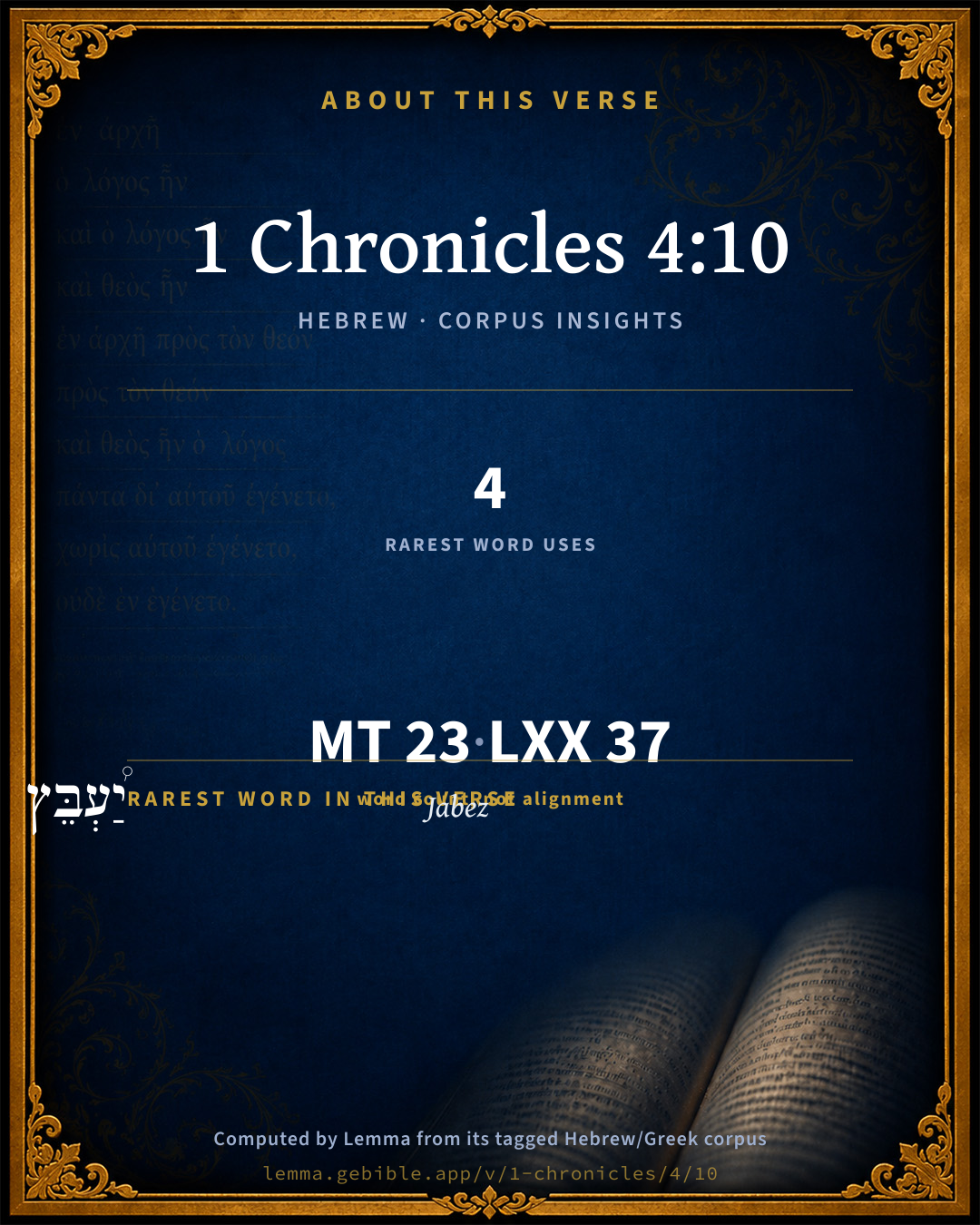
The rarest word here is יַ֠עְבֵּץ Jabez H3258 — appearing just 4 times in the whole Hebrew Bible.

Shared distinctive vocabulary

יַ֠עְבֵּץ Jabez H3258 occurs in 3 verses of the Hebrew Bible. Also found in:

Grammatical profile

  • 10 verbs
  • 7 nouns
  • 1 preposition
  • 2 conjunctions
  • 3 particles

Verb forms

  • וַיִּקְרָ֣א Qal · Sequential Imperfect
  • לֵאמֹ֗ר Qal · Infinitive Construct
  • בָּרֵ֨ךְ Piel · Infinitive Absolute
  • תְּבָרֲכֵ֜נִי Piel · Imperfect
  • וְהִרְבִּ֤יתָ Hiphil · Sequential Perfect
  • וְהָיְתָ֤ה Qal · Sequential Perfect
  • וְעָשִׂ֥יתָ Qal · Sequential Perfect
  • עָצְבִּ֑י Qal · Infinitive Construct
  • וַיָּבֵ֥א Hiphil · Sequential Imperfect
  • שָׁאָֽל Qal · Perfect

Repetition

Words recur within this verse — often emphatic in Hebrew:

  • לֵאלֹהֵ֨י God H430 ×2
  • בָּרֵ֨ךְ to bless H1288 ×2

Hebrew & Septuagint length

In English translation the verse runs 49 words from the Hebrew and 49 from the Septuagint (LXX English) — the same length.

A rough comparison of the two English renderings, which tokenize alike — not a word-level alignment.

Word counts can differ between the Hebrew and the Greek without any difference in meaning — e.g. the Hebrew direct-object marker אֵת has no separate Greek word, and Greek often adds the article ὁ.

In the original languages it is 23 Hebrew tokens and 37 Greek tokens — but the two are counted differently (Hebrew bundles its prefixes and suffixes into one token; the Greek is in lemma form), so that isn’t a like-for-like length.

Cross-references

46

Topical passages linked to 1 Chronicles 4:10 in the Treasury of Scripture Knowledge — connected by theme and wording, ordered by reader-vote popularity; previews shown in the World English Bible.

  • Matthew 7:7–11 "Ask, and it will be given you. Seek, and you will find. Knock, and it will be opened for you.
  • Psalms 116:1–4 I love Yahweh, because he listens to my voice, And my cries for mercy.
  • Proverbs 10:22 Yahweh's blessing brings wealth, And he adds no trouble to it.
  • Jeremiah 33:3 Call to me, and I will answer you, and will show you great things, and difficult, which you don't know.
  • Isaiah 41:10 Don't you be afraid, for I am with you; don't be dismayed, for I am your God; I will strengthen you; yes, I will help you; yes, I will uphold you with the right hand of my righteousness.
  • Ephesians 3:20 Now to him who is able to do exceedingly abundantly above all that we ask or think, according to the power that works in us,
  • 2 Timothy 4:18 And the Lord will deliver me from every evil work, and will preserve me for his heavenly Kingdom; to whom be the glory forever and ever. Amen.
  • Psalms 119:173 Let your hand be ready to help me, For I have chosen your precepts.
  • Psalms 66:19–20 But most assuredly, God has listened. He has heard the voice of my prayer.
  • John 10:28 I give eternal life to them. They will never perish, and no one will snatch them out of my hand.
  • Ephesians 1:3 Blessed be the God and Father of our Lord Jesus Christ, who has blessed us with every spiritual blessing in the heavenly places in Christ;
  • Psalms 21:4 He asked life of you, you gave it to him, Even length of days forever and ever.
  • Psalms 55:16 As for me, I will call on God. Yahweh will save me.
  • Isaiah 41:17 The poor and needy seek water, and there is none, and their tongue fails for thirst; I, Yahweh, will answer them, I, the God of Israel, will not forsake them.
  • Romans 10:12–14 For there is no distinction between Jew and Greek; for the same Lord is Lord of all, and is rich to all who call on him.
  • 1 Corinthians 1:2 to the assembly of God which is at Corinth; those who are sanctified in Christ Jesus, called to be saints, with all who call on the name of our Lord Jesus Christ in every place, both theirs and ours:
  • Genesis 33:20 He erected an altar there, and called it El Elohe Israel.
  • Genesis 12:2 I will make of you a great nation. I will bless you, and make your name great. You will be a blessing.
  • Joshua 17:14–18 The children of Joseph spoke to Joshua, saying, Why have you given me but one lot and one part for an inheritance, seeing I am a great people, because hitherto Yahweh has blessed me?
  • 1 Kings 3:7–13 Now, Yahweh my God, you have made your servant king instead of David my father: and I am but a little child; I don't know how to go out or come in.
  • Genesis 48:16 the angel who has redeemed me from all evil, bless the lads, and let my name be named on them, and the name of my fathers Abraham and Isaac. Let them grow into a multitude in the midst of the earth."
  • Psalms 72:17 His name endures forever. His name continues as long as the sun. Men shall be blessed by him. All nations will call him blessed.
  • Genesis 32:28 He said, "Your name will no longer be called 'Jacob,' but, 'Israel,' for you have fought with God and with men, and have prevailed."
  • Psalms 99:6 Moses and Aaron were among his priests, Samuel among those who call on his name; They called on Yahweh, and he answered them.
  • Genesis 32:26 The man said, "Let me go, for the day breaks." Jacob said, "I won't let you go, unless you bless me."
  • Psalms 65:2 You who hear prayer, To you all men will come.
  • Psalms 51:8 Let me hear joy and gladness, That the bones which you have broken may rejoice.
  • Psalms 51:12 Restore to me the joy of your salvation. Uphold me with a willing spirit.
  • Proverbs 30:8 Remove far from me falsehood and lies. Give me neither poverty nor riches. Feed me with the food that is needful for me;
  • 1 Samuel 1:17 Then Eli answered, Go in peace; and the God of Israel grant your petition that you have asked of him.
  • Job 12:4 I am like one who is a joke to his neighbor, I, who called on God, and he answered. The just, the blameless man is a joke.
  • Genesis 12:8 He left from there to the mountain on the east of Bethel, and pitched his tent, having Bethel on the west, and Ai on the east. There he built an altar to Yahweh, and called on the name of Yahweh.
  • Job 22:27–28 You shall make your prayer to him, and he will hear you. You shall pay your vows.
  • 1 Chronicles 16:8 Oh give thanks to Yahweh, call on his name; Make known his doings among the peoples.
  • Psalms 32:3–4 When I kept silence, my bones wasted away through my groaning all day long.
  • Matthew 6:13 Bring us not into temptation, but deliver us from the evil one. For yours is the Kingdom, the power, and the glory forever. Amen.'
  • Acts 3:26 God, having raised up his servant, Jesus, sent him to you first, to bless you, in turning away everyone of you from your wickedness."
  • Romans 12:9 Let love be without hypocrisy. Abhor that which is evil. Cling to that which is good.
  • 2 Corinthians 2:1–7 But I determined this for myself, that I would not come to you again in sorrow.
  • Judges 1:27–36 Manasseh did not drive out [the inhabitants of] Beth-shean and its towns, nor [of] Taanach and its towns, nor the inhabitants of Dor and its towns, nor the inhabitants of Ibleam and its towns, nor the inhabitants of Megiddo and its towns; but the Canaanites would dwell in that land.
  • Luke 19:42 saying, "If you, even you, had known today the things which belong to your peace! But now, they are hidden from your eyes.
  • Romans 16:19 For your obedience has become known to all. I rejoice therefore over you. But I desire to have you wise in that which is good, but innocent in that which is evil.
  • Revelation 3:19 As many as I love, I reprove and chasten. Be zealous therefore, and repent.
  • Matthew 26:75 Peter remembered the word which Jesus had said to him, "Before the rooster crows, you will deny me three times." He went out and wept bitterly.
  • John 21:17 He said to him the third time, "Simon, son of Jonah, do you have affection for me?" Peter was grieved because he asked him the third time, "Do you have affection for me?" He said to him, "Lord, you know everything. You know that I have affection for you." Jesus said to him, "Feed my sheep.
  • Ephesians 4:30 Don't grieve the Holy Spirit of God, in whom you were sealed for the day of redemption.

Cross-references courtesy of OpenBible.info (CC BY 4.0).

Hebrew and Greek witnesses Masoretic Hebrew ↔ Greek Septuagint

The same verse in the two great witnesses to the Old Testament, shown verse-for-verse.

These are two independent witnesses, not word-aligned to each other, and the Septuagint is shown in lemma (dictionary) form.

Hebrew 1 Chronicles 4:10 Masoretic · Westminster Leningrad Codex

וַיִּקְרָ֣א יַ֠עְבֵּץ לֵאלֹהֵ֨י יִשְׂרָאֵ֜ל לֵאמֹ֗ר אִם בָּרֵ֨ךְ תְּבָרֲכֵ֜נִי וְהִרְבִּ֤יתָ אֶת גְּבוּלִי֙ וְהָיְתָ֤ה יָדְךָ֙ עִמִּ֔י וְעָשִׂ֥יתָ מֵּרָעָ֖ה לְבִלְתִּ֣י עָצְבִּ֑י וַיָּבֵ֥א אֱלֹהִ֖ים אֵ֥ת אֲשֶׁר שָׁאָֽל

Jabez called on the God of Israel, saying, Oh that you would bless me indeed, and enlarge my border, and that your hand might be with me, and that you would keep me from evil, that it not be to my sorrow! God granted him that which he requested.

World English Bible · Public Domain

Greek LXX 1 Chronicles 4:10 Septuagint · lemma form

καί ἐπικαλέω ιγαβης ὁ θεός ἰσραήλ λέγω ἐάν εὐλογέω εὐλογέω ἐγώ καί πληθύνω ὁ ὅριον ἐγώ καί εἰμί ὁ χείρ σύ μετά ἐγώ καί ποιέω γνῶσις ὁ μή ταπεινόω ἐγώ καί ἐπιἄγω ὁ θεός πᾶς ὅσος αἰτέω

And Igabes called on the God of Israel, saying, O that you would indeed bless me, and enlarge my coasts, and that your hand might be with me, and that you would make me know that you will not grieve me! And God granted him all that he asked.

LXX2012 (modern English Septuagint) · Public Domain

Hebrew: Westminster Leningrad Codex (CC BY 4.0). Greek: Septuagint (public domain); English from LXX2012 (modern English Septuagint) (Public Domain). How the Septuagint differs from the Hebrew →

Commentary

Notes on 1 Chronicles 4:10 from classic Christian and Jewish commentators (each source and its license shown beneath its notes). The classic Christian expositions comment on the surrounding passage and are grouped to its opening verse, so a note may address several verses; the Jewish commentaries on the Tanakh (Rashi and others) are per-verse, so they appear only where the commentator wrote on this verse.

Lemma curates 59 commentaries, every one of them public domain or Creative Commons licensed, each selected and text-cleaned for this edition rather than reprinted as found. About our sources →

Ellicott's Commentary for English Readers

(10) Jabez called on the God of Israel.—Comp. Jacob’s vow at Bethel, Gen_28:20-22, and his altar, El-’elohë Israel, “El is the God of Israel,” Gen_33:20. Some have supposed that the peculiar phrase, “God of Israel,” indicates that the original Canaanite population of Jabez proselytised.

Oh that thou wouldest bless me indeed.—Literally, “if indeed thou wilt bless me.”

My coast.—My border or domain (fines).

And that thine hand.—Rather, and if thine hand will be with me, and thou wilt deal without (Heb. away from) evil, that I suffer not !—The prayer is expressed in the form of a condition, with the consequence (“then will I serve thee,” comp. Gen_28:22) suppressed.

The name Jabez is twice explained; in 1Ch_4:9 it is made to mean “he paineth,” in 1Ch_4:10 Jabez prays to be saved from pain. Comp. the frequent allusions in the book of Gen. to the meaning of the name Isaac (Yiçhâq, “he laugheth”); Gen_17:17, Abraham’s daughter; 1Ch_18:12, Sarah’s incredulous laughter; 1Ch_21:6, Sarah’s joy at the birth; 1Ch_26:8, Isaac’s own mirth. These features of likeness to the language and thought of Genesis, prove the originality and antiquity of the section.

And God granted.—Literally, and God brought (caused to come). Hence Jabez was “honoured above his brethren,” 1Ch_4:9. If the Sopherim of Jabez (1Ch_2:55) were, as their name implies, writers or men of letters, we can understand that Jabez, like Kirjath-sepher, was a place of books, and was honoured accordingly. The art of writing among the peoples of Babylonia ascends to an unknown antiquity. The oldest inscription we possess in the Phoenician character is of the ninth century B.C., and the development of that character from its Egyptian prototype must have occupied some centuries. Perhaps this very tradition concerning their founder originally emanated from the “families of the scribes which dwelt at Jabez.”

A Bible Commentary for English Readers, edited by Charles John Ellicott (1878–1897) — public domain. Text from a community e-Sword module.

Trapp's Complete Commentary

John Trapp

1Ch 4:10 And Jabez called on the God of Israel, saying, Oh that thou wouldest bless me indeed, and enlarge my coast, and that thine hand might be with me, and that thou wouldest keep [me] from evil, that it may not grieve me! And God granted him that which he requested.

Ver. 10. And Jabez called on the God of Israel.] Upon the point of some warlike exploit: or in some great exigency. And hence he was "more honourable"; {1Ch 4:9} he prayed earnestly, and sped accordingly.

Oh that thou wouldest bless me indeed.] Heb., If blessing thou wilt bless me: q.d., then shalt thou have mine utmost service, and I will wholly devote myself to thy fear. This was to "pray in the Holy Ghost"; this was to do, as afterwards Christ did, who "being in an agony prayed more earnestly." {Luk 22:44}

And enlarge my coast.] Pray we with like fervency, And enlarge my heart.

And that thine hand might be with me.] He labours in prayer lustily, and followeth his suit close.

“ Una est in trepida mihi re medicina, Iehovae

Cot patrium, os verax, omnipotensque manus. ”

And that thou wouldest keep me from evil.] Or, Cause that evil grieve me not. He seemeth in this request to allude to his own name, q.d., I have my name from sorrow; but I would not be crushed with sorrow. This might be his prayer to God, even while he was fighting against his enemies.

John Trapp, A Commentary or Exposition upon All the Books of the Old and New Testament (1647–1656) — public domain. Text from a community e-Sword module.

Joseph Benson's Commentary

1Ch 4:10. Jabez called on the God of Israel — The living and true God, who alone can hear and answer prayer: and in prayer he had an eye to him as the God of Israel, a God in covenant with his people, the God with whom Jacob wrestled and prevailed, and was thence called Israel. Saying, O that thou wouldest bless me indeed! — He did not say in what respect he desired God to bless him, but leaves that to God, giving him, as it were, a blank paper, that he might write what he pleased. Spiritual blessings are the best blessings, and those are blessed indeed, who are blessed with them. God’s blessings are real things, and produce real effects. We can but wish a blessing: he commands it. And enlarge my coast — Prosper my endeavours for the increase of what has fallen to my lot: drive out these Canaanites, whom thou hast commanded us to root out; and therefore I justly beg and expect thy blessing in the execution of thy command. That thy hand might be with me — The prayer of Moses for this tribe of Judah was, that his own hands might be sufficient for him; but Jabez expects not that, unless he have God’s hand with him, and the presence of his power. God’s hand with us to lead, protect, strengthen us, and to work all our works in and for us, is indeed a hand sufficient for us, yea, all-sufficient. And keep me from evil — The evil of sin, the evil of trouble; all the evil designs of my enemies, and all disastrous events. That it may not grieve me — That it may not oppress and overcome me. He uses this expression in allusion to his name, which signifies grief: as if he had said, Lord, let me not have that grief which my name implies, and which my sin deserves. God granted him that which he requested — Prospered him remarkably in his undertakings, in his worldly business, in his conflicts with the Canaanites, and his endeavours after knowledge, and holiness, and other spiritual blessings.

Joseph Benson's Commentary on the Old and New Testaments (1811–1818) — public domain. Text from a community e-Sword module.

Geneva Bible (1599)

Geneva Bible translators

It is to be understood, that then he would accomplish his vow which he made.

Geneva Bible (1599) marginal notes — public domain. Text via Bolls.life.

Jamieson, Fausset & Brown

Robert Jamieson, A. R. Fausset & David Brown

God granted him that which he requested--Whatever was the kind of undertaking which roused his anxieties, Jabez enjoyed a remarkable degree of prosperity, and God, in this instance, proved that He was not only the hearer, but the answerer of prayer.

Jamieson, Fausset & Brown — Commentary Critical and Explanatory on the Whole Bible (1871) — public domain (CC PDM 1.0). Text via the HelloAO Bible API.

The Cambridge Bible for Schools and Colleges

gen. ed. J. J. S. Perowne

10. my coast] R.V. my border.

that thou wouldest keep me from evil] Lit. that thou wouldest make … from evil. Most probably the Heb. text is defective here, one or two words having fallen out, and we should supply the gap somewhat as follows, that thorn wouldest make [room (merḥâbh) for me, and wouldest redeem (phâdîthâ) me] from evil.

that it may not grieve me] R.V. that it be not to my sorrow; cp. last note.

The Cambridge Bible for Schools and Colleges (gen. ed. J. J. S. Perowne; Cambridge University Press, 1878–1918) — public domain. Text from a community e-Sword module.

John Gill's Exposition

And Jabez called on the God of Israel,.... Or prayed to him, as the Targum; though some understand it as a vow, promising what he would do if God would do thus and thus for him; the Syriac and Arabic versions read in the third person, taking it to be what others, his parents and friends, wished for him:

let him bless thee,.... but they are doubtless his own words, and a supplication of his to the Lord:

saying, oh that thou wouldest bless me indeed; the Targum adds, with children; but he no doubt prayed for greater blessings than any outward or temporal ones are, even spiritual blessings, covenant blessings, the sure mercies of David, which are solid, substantial, durable, and irreversible:

and enlarge my coast; the Targum is,"multiply my borders with disciples.''It may be understood of an enlargement of the borders of his country, by expelling the Canaanites that might dwell in it, and of an increase of his worldly substance for good ends and purposes; or rather of a spiritual enlargement by deliverance from spiritual enemies, and of grace as to exercise; and particularly of spiritual light and knowledge, and of the affections and desires of the soul after divine things, see Psa 4:1.

and that thine hand might be with me; the Targum adds, in business, prospering and succeeding him; the sense may be, that his hand of providence might be with him to protect him, of grace and love to comfort and help him in every time of need, of wisdom to direct him, and of power to keep him:

and that thou wouldest keep me from evil; from the evil of affliction, and especially from the evil of sin, and from the evil one, Satan, and from all evil men and evil company; the Targum is,"and make me companions such as I am:''that it may not grieve me; alluding to his name Jabez, which he had from the sorrow and grief of his mother; and nothing is more grieving to a good man than the evil of sin, so contrary to the nature and will of God, being committed against a God of infinite love, grace, and mercy, whereby the name, ways, and truths of Christ are dishonoured, and the Spirit of God grieved, and saints are bereaved of much comfort; and therefore desire to be kept from it, knowing they cannot keep themselves, but the Lord can and will, at least from the tyranny of it, and destruction by it: the Targum is,"lest the evil figment (or corruption of nature) should move or provoke me:"

and God granted him that which he requested; as he does whatever is asked in faith, according to his will, and will make for his glory, and the good of his people; see Jo1 5:14.

John Gill's Exposition of the Whole Bible (1746–1763) — public domain (CC PDM 1.0). Text via the HelloAO Bible API.

Haydock's Catholic Bible Commentary

For. To reward his piety and vow. Othoniel obtained Cariath-sepher, and Axa, the daugher of Caleb, Josue xv. 17. (Calmet) --- Jabes imitated holy Jacob, (Genesis xxviii.) and both desired temporal blessings, for their advancement in virtue. (Worthington)

George Leo Haydock (1774–1849), Haydock's Catholic Family Bible and Commentary, 1859 edition — public domain. Excludes Psalms (Douay-Rheims chapter numbering differs from Protestant) and Deuterocanonical books (Catholic canon only).

Matthew Poole's English Annotations

Jabez called on the God of Israel, when he was undertaking some great and dangerous service.

Oh that thou wouldst bless me indeed. I trust not to my own or people’s valour, but only to thy blessing and help.

Enlarge my coast; drive out these wicked and cursed Canaanites, whom thou hast commanded us to root out, and therefore I justly beg and expect thy blessing in the execution of thy command.

That thine hand might be with me, to protect and strengthen me against my adversaries.

That thou wouldst keep me from evil, or work with (for so the Hebrew prefix mem is sometimes used, as Son 1:2; 3:9; Isa 5:7,8), i.e. so-restrain and govern it.

That it may not grieve me; that it may not oppress and overcome me, which will be very grievous to me. The consequent put for the antecedent; and more is understood than is expressed. He useth this expression in allusion to his name, which signifies grief: q.d. Lord, let me not have that grief which my name implies, and which my sin deserves.

Matthew Poole's English Annotations on the Holy Bible (1683–1685) — public domain. Text from a community e-Sword/MySword module.

The Pulpit Commentary

When Jabez grew to manhood he has learnt to estimate rightly the value of God"s blessing. He invokes it, and depends upon it. His language implies the confidence that he had in the reality of providential blessing. For the expression, enlarge my coast, see Deu_12:20 Deu_19:8; and though we know nothing as matter of fact about theoccasion of this prayer, we may assume that it was one when not selfishness and greed of larger territory, but just opportunity, had awakened a strong desire for enlargement of borders. It may have been a legitimate occasion of recovering his own, lost or wrongfully taken from him or his predecessors before him, or of expelling successfully from their hold upon it a portion of the original inhabitants of the promised land of God"s people. That thine hand might be with me. Many are the beautiful parallels to be culled from the Word of God for this expression, as e.g. Eze_12:8; Psa_80:17 Psa_119:173 Psa_139:5, Psa_139:10; Isa_42:6. And thatthou wouldest keep me from evil, that it may not grieve me! This, the last entreaty of the prayer, is the largest and most far-seeing. Warned by his own name, forewarned by his mother"s emphasizing of her own pains in him, he thus concludes. Having begun in the evil of pain and excessive sorrow, he prays that he and his career may not so determine and end. He does not necessarily pray to be preserved from all suffering, but from such baneful touch of evil itself, its principle, its tyrannous, merciless hold, as might bring him to real and irreparable grief. Thus closes the whole prayer, each succeeding clause of which has been under the rule of the initial "if," translated with us, Oh that. This well-known Hebrew form of prayer supposes a solemn engagement, and that the answered prayer shall meet with the fulfilment of a vowed promise on the part of the suppliant, according to the pattern of Gen_28:20. In the absence of that engagement here, we may notice, with Keil, the greater grace of the passage, in that it closes with the statement of the readiness to hear, and the abounding readiness to answer, on the part of Divine beneficence: And God granted him that which he requested. Evidently the thing that he asked pleased the Lord; (1Ki_3:10, 1Ki_3:12) although it was in this case some form of riches, and long life for self, and the life of his enemies, that he asked, and was not altogether and in so many words "a wise and understanding heart." Perhaps, also there was in the way of asking, and in the exact occasion, unknown to us, something which quite justified the matter of the prayer, and which thus pleased the Lord. The remarkable and arresting episode could not have closed in more welcome or impressive way than when it is thus briefly but conclusively said, "And God granted him that which he requested.

Ver. 10 (first part).

An example of earnest prayer for earthly things, to be imitated.

Jabez enlarge my coast." No syllable nor whisper is heard by us of the child that cost the mother so much suffering in bringing into the world, from the time that he was named till he is now arrived at manhood. Then he is again introduced with this testimony, that he is "more honourable than his brethren." The probability is that this expression does not refer exclusively to honourableness of moral and religious character. It is an equal probability, considering the remarkably uniform usage of the word in a favourable sense, and the balance of its use in even a high sense, that it does by no means exclude these elements. The intermediate time is left to our imagination to fill up. It was not like that intermediate time of our Saviour"s life, lit up only by the incident of the temple and the discussion with the doctors, when Jesus was but twelve years of age. We are warranted in permitting imagination to depict all that interval as one continuous growth of goodness and display of spotless bollness, and it is for quite other reasons that we there bid imagination learn reverence and caution, and chasten itself. Not so here; in the darkness and the silence of some twenty years or more, we are sure that there mingled error and imperfection and sin, with whatever else there was of redeeming feature in character and conduct. Still maturity finds Jabez an honoured man.

Considering all things, that was not a little thing to say. But better and more to our purpose, it reveals him a man of prayer a man who knew, who believed in, who practised prayer. Nay, there is something in the first opening of his mouth in this prayer which prepossesses us, and invites special consideration. Let us notice

I THE TITLE UNDER WHICH JABEZ APPEALS TO THE OBJECT OF HIS PRAYER. He prays to the "God of Israel." It is true that these words are not found here within the borders of the prayer itself, but it is also true that the historian says that it was to the "God of Israel" that the prayer of Jabez was directed. This descriptive designation of God would mean at least three things with Jabez. The God of Israel is for him,

(1) the God of his fathers;

(2) the God who had often wrought wonderful works of interposition, of deliverance, of victory and conquest, on behalf of his people; and

(3) he is especially the God whose pronounced and most gracious covenant of truth and mercy was with Israel. The aids of memory are great aids for faith. A lively memory of long-past mercies also tends to kindle gratitude. He who comes with gratitude into the Divine presence wins fresh favour, gains fresh gifts. So also to have promises is one thing. These we all have. To take hold of them, avail ourselves of them, grasp them, is another and far greater thing. To live by the light, and in the strength and joy of the covenant, is the grandest privilege any man could possess.

II THE DETERMINED AND EARNEST DIRECTNESS OF THIS PRAYER, It is the prayer of well-defined petition. Jabez wants a blessing, knows the blessing that he wants, asks it with fervour. He asks it with earnest emphasis. All argues his belief in the need of superhuman help, in the reality of such a thing as superhuman help, and in the availing power of prayer to obtain. This constitutes genuine prayer. It is not, indeed, any one of those high forms of spiritual exercise, the meditation of the unseen, the apprehension of Divine realities, the spirit"s communion with the Father of all spirit, and refreshment from his presence. But, on the other hand, it is the prayer which links on earth to heaven, and shows a human hand taking hold, with the free permission of mercy, of God. Jabez goes far on to say, "I will not let thee go, except thou bless me," when he says, "Oh that thou wouldest bless me indeed!" The emphasis "indeed" is the emphasis of importunity, not of distrust. The meaning, as every reader of the Hebrew knows at once, is "Oh that thou wouldest greatly bless me!" As though Jabez meant, "Unworthy as I am, oh that thou wouldest grant me a great blessing!" How often our posture is prayer, our language prayer, our tone prayer, yet the reality, the definiteness, the heart of prayer, is far from us! We ask and have not, because we really know not what our own asking is. In the midst of vague form and heartless performance, nothing is asked.

III The instance we have here, and which we shall not do wrong in drawing into a precedent, of prayer offered, and acceptably offered, the burden of which is temporal good, family and private advantage, substance and possession. These all belong to the very structure and texture of our present human life and character. They much tend to make or mar our character. The way in which we get them, use them, give them again, is often the criterion, and very decisive criterion, of everything with us, for good or for harm. The great man of business and the man of great property are borne on a strong current, are tossed on deceitful, dangerous tides; but it may none the less be that, under certain conditions, they are fulfilling appointed and most important offices in the general scene of the world"s traffic. But how much securer that man must feel who has gained, and gained much, not by sharp practice, chicanery, unscrupulousness, but by clear views, determined wishes, diligent devotion, and the liberal "blessing," the "great" blessing of God l Desire for earthly substance is not necessarily mere earthly desire. It is too true that it is too often this, but not always. Some of the greatest men of business in the world have been, and are to-day, the best men of business in the Church. By their liberality and charity, by their beneficence and philanthropy, the "cords have been lengthened, the stakes strengthened," of the tabernacle of the Lord God of Israel. And their watchfulness, their prayerfulness, their sustained Christian consistency and humility, have been an example far and wide.

The prayer for the hand.

that thine hand might be with me." This amplifying petition follows significantly upon the more definite and specific entreaty of the beginning of the verse. It also takes us into the ancient workshop of language. The countenances of us all, and their infinitely various expression, come from the different combinations of a very few features and other elements. All our words come from the immense number of combinations possible between and among twenty-six letters. And the amazing proportion of the whole vast mass of our language comes from the figurative and the analogic appropriations of what would otherwise be, and once was, a very scanty vocabulary. This is especially observable of our religious and devotional language, though none truer of it than of our ordinary language. The twenty-third psalm, and very many sentences of other psalms, give abundant illustrations of the way in which figurative language at once doubles, but in point of fact far more than doubles, language. And the sentence of the text is one of the most elementary and most plain of all illustrations of the kind. The first uses of a hand, the many uses of a hand, lend a wealth of imagery, and thereby of enrichment, to language. From the suggestion of the prayer of Jabez to the effect that "the hand" of God "might be with" him, let us take opportunity to view some of the chief scriptural representations of the exercise of the Divine hand and of the effects thereof, and thus lead up again to the prayer before us. And we often read of

I THE CREATIVE HAND. Man is spoken of as the work of God"s creative hands: "Thy hands have made me and fashioned me". (Psa_119:73) So also the heavens: "The heavens are the work of thy hands". (Psa_102:25) So, again, the earth and the sea: "The sea is his, and he made it: and his hands formed the dry land". (Psa_95:5) And all living things and things inanimate: "Thou madest him to have dominion over the works of thy hands; thou hast put all things under his feet: all sheep and oxen, yea, and the beasts of the field; the fowl of the air, and the fish of the sea, and whatsoever passeth through the paths of the seas". (Psa_8:5-8) (See also glorious reminiscences to the same effect, Job_10:8 Job_14:15 Job_34:19; Isa_48:13 Isa_64:8)

II THE HAND OF THE SOVEREIGN, ABSOLUTE OWNER. (Job_5:18; 12:10; Dan_5:23; Ecc_9:1; 1Ch_29:12, Psa_31:15)

III THE HAND OF THE PERPETUAL, BOUNTIFUL GIVER. (Psa_95:7 Psa_104:28 Psa_145:16)

IV THE HAND OF ONE THAT DELIVERS, UPLIFTS, AND UPHOLDS. (Exo_32:11; Deu_5:15; Ezr_7:9; Neh_2:8; Psa_44:3 Psa_63:8 Psa_73:23; Isa_51:16)

V THE HAND OF THE CORRECTOR AND CHASTISER. (Psa_32:4 Psa_38:2 Psa_39:10 Psa_106:26; Job_2:10 Job_19:21)

VI THE HAND OF WIDEST SWAY AND SOVEREIGN CONTROL, of power to rule and power to overrule. (Isa_40:12 Isa_48:13; Pro_21:1; Dan_4:35)

VII THE HAND THAT EXALTS TO REAL HONOUR. (See the splendid description of Isa_62:3; Psa_16:11)

VIII THE HAND THAT PLEDGES AND SECURES ABSOLUTE AND EVERLASTING SAFETY. See such passages as more than satisfy the soul; they go far even "to ravish it with the thoughts" of the glory signified. "I have graven thee on the palms of my hand"; (Isa_49:16) "They shall never perish, neither shall any man pluck them out of my hand My Father, which gave them me, is greater than all; and no man is able to pluck them out of my Father"s hand". (Joh_10:28, Joh_10:29) And, as during all our lifetime it had been the lesson to be learnt that our breath is in God"s hands, and all our ways and our times in his sovereign hand, so at last it is permitted us to breathe the spirit into that same mighty, merciful, safe hand: "Into thy hands I commit my spirit" (Psa_31:5) Perhaps it was not all of these powers of the Divine hand that could have been as familiar to Jabez as they may be to us; yet it is evident that he knew and had prized the meaning and the virtue of the hand of God. And he does not ask to know it in one particular way nor in another. He does not dictate or suggest-at least, not beyond a certain very wide margin. He prays that the Divine hand may be "with" him now to help on, now to stop; now to uphold, now, if necessary, to cast down; now to put it on his lips, and to bid his mouth be dumb, and himself wait the sovereign will of a sovereign God patient, content, trustful; now to release those lips and open his mouth, that he might render grateful praise to the bountiful Giver of all good, or the loving and careful Protector of all those who put their trust in him. When Jabez says, "Oh that thine hand might be with me!" he puts himself into that vast and secure hand of God, and wishes nothing more, nothing better for himself, than as the little child, feeble, uncertain, and easily wearying, to take the strong hand of his Father. He had simple faith that the hand, the presence of which "with" him he entreated, would be under all events a "good hand upon" him. The surrender of dependence betokened by the prayer was justly as hopeful as it was trustful. We need nothing more than that the hand of God, in all its varied exercise, should be with us. But when we have thus prayed, we may not forget what our prayer has been. And in great variety of experience on our own part experience of sorrow, and difficulty, and toil, and slowness, as well as in all the converse of these respectively we must remember to trace and acknowledge the tokens of that hand for which we prayed being with us, and not another hand, inferior in goodness and wisdom as well as power. For often the variety and contrasts and reverses of our own mutable state reflect the ever-varying and adapting presence and grace of One who is in himself the Unchanging. How often has our own hand misdone, how often has the hand of others misled or misdirected us! How blessed is he who can say that, for his prayer, God has "beset him behind and before, and has laid his hand upon him!

The prayer of victory over evil.

that thou wouldest.., may not grieve me." This is the last petition of the prayer of Jabez. While the foregoing petition was very comprehensive and wide-reaching in one sense, this is comprehensive and farseeing in another. There could scarcely be a larger or a wiser intreaty than that God would vouchsafe the perpetual presence of his hand the hand that makes, that gives, that leads, that upholds, that shields, that at last saves with an everlasting salvation. Igor, on the other hand, could there easily be offered prayer that should more betoken self-knowledge, self-distrust, and a wise estimate of the constantly endangered position in which any man may justly describe himself as placed in this present world, than the prayer with which Jabez now sums up what he has to say: "And that thou wouldest keep me from evil, that it may not grieve me!" Of the few petitions of our Lord"s Prayer, this forms one, and an emphatic one, "Deliver me from evil." Evil is a large enemy. In one shape or another, it is ever threatening to attack. And if in anything we need superior help, it is in combating a foe so ubiquitous, so persevering, so subtle, and so essentially disastrous. We may observe here

I THAT THERE ARE SIGNS OF A USEFUL LESSON HAVING BEEN LEARNT FROM PAIN. Pain is intrinsically evil in this world. It was no original part of it. It is now utilized in many a direction. It is now overruled to many and high advantages. But it is none the less to be noticed as foreign in itself to the nature of God, to the conception of a perfect creation, to the bliss of man. Yet as things are, and as we are, it is wise to learn from even bodily pain. It is often because we will not learn from other suggestions that we are compelled to learn from the actual experiences of pain. We may probably put down something higher to the credit of Jabez. We do not know as fact that he himself had been called to endure much pain, or any at all noteworthy. But he knew his own name.

He knew what it meant, and how it had come to be given to him. He took the warning of it, and the forewarning of his mother"s method of emphasizing what were her opinions and convictions on the subject. It was not the mark of Cain that was on his open brow. But the name of a mother"s love and anguish mingled was named upon him. And he prays to the Mightier than he, to preserve him so from evil, that it might not bring him to fulfil in his nature what was confessedly his name. Two things may be ever well remembered respecting pain:

(1) that it must faithfully and honestly be ranked among the enemies of God and the antagonists of perfect nature; but

(2) that for a time, and for our present condition, it may be a timely lesson, a source of valuable suggestion, the adapted caution of the hour, the safeguard that may act with the quickness and the certainty of an instinct. Yet, whatever may be said justly and correctly respecting the acquired uses of pain, Jabez offers his petition deprecatory of that evil, the fruit and end of which is mere pain.

II THAT THERE ARE SIGNS OF A CORRECT LESSON HAYING BEEN LEARNT ABOUT EVIL ITSELF. It is evident, from the very words of Jabez"s prayer, that he distinguishes between evil and gratuitous pain, or unrewarding "grief," as it is here expressed. Evil, i.e. suffering, calamity, more or less of occasional adversity, disappointment, are the absolute lot of man here. It would be vain to shut the eyes to the fact, folly to deny it. But there are immense differences within the range and the limits of what is called evil. Jabez had learnt this. He does not pray to be kept from all suffering, vicissitude, adversity, disappointment, though doubtless he would fain be kept from as much of this as may be. But we are to understand that he earnestly deprecates the baneful touch of evil itself. He discerns what its essential principle is. He dreads its tyrannous rule, its merciless hold, its mocking treatment of those who have trusted it, and, if unstayed, its destructive results. He prays, accordingly, to be kept from the evil that would "assault and hurt the soul," and prove the herald of irreparable grief. It is such intrinsic form of evil which the uncompromising petition of our Lord"s Prayer puts upon the lips of all his disciples. How certain and distinct this difference is! How much "evil" there is, through which we all are called to pass! But the deep water does not overflow us. How much disappointed hope and sorrow"s visit there is for the very best of men, by which in part they have been helped to become what they already are, right and excellent and devout, and by which the best of to-day become yet better to-morrow I This is the evil we receive also at the hand of God, as well as" his good. It is chastening, purifying, elevating. But contrast with this the sorrow that worketh death. Contrast-with this the "wounded spirit." Contrast with this the evil that hardens hearts, sears consciences, cradles remorse, and is fruitless of everything else but unavailing regret. And we shall be ready to join to pray, "That thou wouldest keep me from evil, that" its gratuitous "grief" may not be mine.

III THAT A LESSON RESPECTING SELF"S GREAT NEED OF SUPERIOR HELP IN THE PRESENCE OF SOME FOES HAD BEEN WELL LEARNT. There are some passages of life when the best and hardest work is the best and most earnest prayer. Not so here. It is said the sailor always has his enemy before him, and the battle ceases not till the haven is won. And men live in such a scene of evil, such surroundings of evil, such dispositions of evil, such a very atmosphere of evil, men are tossed upon such an ocean of evil, that the danger will prove overmastering in some direction, unless a man "pray always," and pray this prayer of Jabez. No armour of one"s own, no self-knowledge, no vigilance, no pride of foreknowledge, no mere creed of distrust of the vain world, and the wicked heart, and the soul"s chief adversary, will suffice. This living, hearty, earnest prayer will alone command the sure victory in the most critical of warfare.

The gracious benignity of answer to prayer.

God granted him that which he requested." Abruptly as the name and the prayer of Jabez were introduced, with equal abruptness do they vanish from view. Favourably as they were introduced, so favourably do they seem to take leave of us. The naming of Jabez was indeed that of toilsome travail and tears, but therein was that saying fulfilled, that the going forth with weeping and with precious seed shall issue in a rejoicing return with golden sheaves. For that this was the case may be justly read between the lines, when we are informed that "God granted Jabez that which he requested." The words of this prayer and the several petitions of it we have before us, and they speak for themselves, what they are and aim at. But whether the prayer conveys to us the "request" of Jabez, that one desire of his heart which was enwrapt in all the rest, is not quite plain. Probably it does, and if so it must have been "the enlarging of his coasts." This would not be a request out of harmony with his time of day, or with what men of his position sometimes earnestly wished, and even with diviner instincts sought. To have a sure footing and an abundant footing in Canaan, or in whatsoever land most nearly corresponded to Canaan in the time of Jabez, meant very much more than the mere inheritance or purchase of ever so tempting an estate or property in our day. But if this were not the burden of the prayer, and its central subject, we are but relieved in this, as in all the rest of the context, from detail in favour of principles. In the absence of clear information as to what Jabez requested, we may make sure that he did not ask what was contrary to God"s glory to give or to his own good to receive, while on the other hand we are not in want of information as how he made his requests known. We have seen that manner to be characterized by simplicity and fervor, by strong conviction of dependence and by trustful reliance, and these were lighted up by hopefulness. And having watched the dependent suppliant, in sympathy with him, we are now invited to see the other sight. God sees his suppliant, and sees him with gracious eye. He hears his suppliant, and bends a willing ear. He approves his suppliant, and "grants him that which he requested." We have here what we may justly regard in the first two particulars as leading instances, in the last as a fruitful suggestion.

I OF THE EFFICACY OF PRAYER IS GENERAL. The tale is very short, very plain, and, if not true, is simply gratuitously false and misleading. It is the ease of the supplication of a righteous man availing much in its operative effect with God. The person who prayed probably exercised no very important and influential sway over society and his fellow-beings around. The thing for which he prayed probably stood in no very vital or active relation to the well-being of those around. Probably the time was no very critical moment, when great issues might depend on what should seem a very small matter, as affecting primarily but one individual. The person, the thing granted, and the time must have had they always do have their importance and their own inevitable significance; but this was all that they had now. But in the absence of knowledge of details and of surroundings, it is deemed sufficiently important for the Divine page to use this opportunity of showing us God answering the earnest, trusting prayer of his child and servant.

II OF THE ANSWER OF A MAN"S PRAYER, TRUE TO THE EXACT REQUEST OF IT. This is a thing not always possible. We ask and have not, because we ask amiss. The ways of asking amiss are many, almost innumerable. They may be classified, however, under few heads. The amiss may consist in the thing not being good for us; not being for God"s glory to give. The "amiss" may consist in the thing asked not being good for us as yet. The "amiss" may consist in the thing asked not being the best thing for us. How often God withholds the literal answer to give a spiritual substitute I How often, in the very process of gift, short as it is, he substitutes a higher, better prize than that which we asked! How often the very highest mode of answer is found to consist in withholding the solid, material substance, which is what does not last, in order to give the unseen, spiritual substance, which is in its very nature eternal l Sometimes, again, the amiss " may consist in what we ask not being good for others as well as self. Each of us is part of a great whole, and an intrinsic part of it. Fellowship of joy, vicariousness of suffering, combination in toil and work, partnership on the largest scale, in the largest sense, and in the most searching detail, are all radical elements of our human nature and human life. And the clear vision of these, and the prompt recognition of them, are constantly obscured and eclipsed to us simply because we let self-regard slip into selfishness, forget the second great command, and try to famish on a lower principle in place of flourishing on charity. And it is in prayer that we may not unfrequently give the most subtle illustration of this subtle snare of our nature and life. Hence it may be rarely that God can give the answer of prayer true to the exact matter of it. But here we have a grateful and suggestive instance of the kind.

III Of the fact that there is in the sovereign Giver the gracious inclination to give, when possible, according to this rule. His is the disposition full of grace as to the method of giving, as well as of bounty in the matter of what is given. We may often spoil what we give by the manner in which we give; not so he. We may often receive, spoiled by the manner of it, what is given; but never so when the gift is from him. These are some of the chief marks of the grace in giving which is so acceptable to those who ask, or who, without asking, stand in need; and they are all suggested by this history.

1. To give if possible just that which is asked.

2. To give it promptly, and make it thereby twice given.

3. To give it without any reflections on the past.

4. To give without imposing conditions on time to come.

5. Still to give, though it be on the part of the supreme, graciousGiver himself, without reminding there and then of the debt which it involves, of the bounty which it reveals, of the absence of claim, right, merit, in default of all of which nevertheless it is not withheld.

Most gratefully does that one sentence of the sacred page suggest all these thoughts to us, in which it is said, with effective brevity in reference to Jabez, "And God granted him that which he requested.

Jabez"s prayer.

I Mark the first line of his prayer: "Oh that thou wouldest BLESS ME INDEED!" He needs the blessing of his covenant God. He pleads for it. He pleads earnestly. It is real prayer. It is such prayer God bears, such prayer he loves to hear and to answer. But oh there is many a blessing which may not be a blessing indeed. " Of this Jabez is aware. He asks not for a blessing, but a blessing indeed for that which will be a real blessing. He asks not for that which may come in the form of a blessing and in the end

prove a curse. He asks for that to come which will be a real, permanent, abiding blessing. "Let it come in what shape it may. That, Lord, I leave to thee. Let it come in darkness or in light, in suffering and sorrow or in health and gladness, in the abundance of wealth or the desolation of poverty any way as best may seem to thee, Lord; only let it be a blessing to me, a blessing "indeed. Ah, this is prayer, and the right sort of prayer. There was something like it, only in an infinitely higher degree, in the Garden of Gethsemane: "Father, thy will be done." There was just this difference between the Son of God in the bosom of the Father and those who are sons of God only by adoption. He did not need the strengthening angel from heaven to give him that submission of will. It was not till after that submission the angel appeared to strengthen him. The angel was sent, not to produce submission of spirit, but for the weakness of the body, and to carry out the work of redemption. His holy soul was always submissive. It was his nature to be so. With us, however, it is different. We need the strengthening angel to help us to submission to the Father"s will as well as to do the work of God. Our nature is essentially rebellious. We require the discipline of God"s hand to bring us to submit. His holy soul was submission itself. There is a passage in the New Testament which corresponds exactly with this distinction I have drawn in the prayer of Jabez between a blessing and a blessing indeed. " Our Lord said to the, (Joh_8:31, Joh_8:32) "If ye continue in my Word, then are ye my disciples indeed; and ye shall know the truth, and the truth shall make you free." It is one thing to be a "disciple," it is another to be a "disciple indeed. " Many were "disciples" in our Lord"s time; how few were the "disciples indeed"! Many followed him, but from what motives? How few continued in the Word," "knew the truth" with that deeper knowledge of the heart, and were "made free" by that knowledge free" from the bondage of guilt and sin, "free" from the power of sin over their lives, "free" from all that which they felt was contrary to the glory of God! Ah, how little of this freedom there may be with all our discipleship! This is what it is to be a "disciple indeed. " This is what it is to be "blessed indeed. " Reader, are you a "disciple indeed"?

II Mark the next petition: "And wouldest ENLARGE MY COAST." Probably the coast which he prays may be enlarged was some earthly possession. He speaks as one who had to recover from the hand of the enemy his portion of the promised land. For the recovery of this he was about to engage in war. And what a spiritual lesson we learn from it! It is by conflict the child of God obtains more and more of the blessings laid up for him in Christ. The Word of the Lord is to him what it was to Israel of old: Go ye up and possess the land;" There remaineth yet very much land to be possessed. " Oh, what blessings are laid up for us in Christ! Why do we not enter into our inheritance? God has indeed blessed us with all spiritual blessings in heavenly places in Christ," but have we possessed them? Have we drunk deep of these wells of living waters? Are our souls living upon the riches that are hid in Christ for us? Why do we not possess the land which Jesus has won for us? Because, dear reader, there is no conflict. We must fight to enjoy. We must know what it is, hour after hour, to engage in conflict yes, in a bloody conflict with the world, the flesh, and the devil. We must grapple hour after hour with flesh and blood with "the lust of the eye, and the pride of life." We must know keenlywhat it is to pluck out a right eye, and cut off a right hand or a right foot. We must know the struggle with sloth and indulgence, with natural inclinations and desires, with unholy dispositions, and harsh tempers, and unkind words, and a fault-finding spirit. Have we entered into, are we daily engaged in, a conflict like this? Ah, you will never be a disciple indeed" unless you know something of this agony. It is through conflict, through warring a good warfare, that God opens the floodgates of the soul for all the treasures of his grace to flow in. You may know them and talk about them; but have you possessed the good land? Is it not true that there remaineth yet" yes, yet after all these years of Christian disciple ship very much land to be possessed"? Oh I no warfare, no conflict, no struggle; then no deep joy, no sweet peace, no uplifting communion with God, no realized sweetness of the Word, no real growth in grace, no likeness to Christ. Jabez"s coast would never have been enlarged without a deadly struggle with the foe. There will be no enlargement of coast with you, Christian, without this. It is thus we see it in the Lord"s address to the seven Churches. Every promise is made there not to the Christian as such, not to the disciple, but to him that overcometh. " They are made to the disciple indeed to the one who knows something not only of what it is to fight, but to win. Yes, Christian, your soul has been saved by Christ"s finished work; but every inch of the ground beyond must be fought for. You will pass into God"s presence a naked soul just saved. Where are the laurels you have won? Where is the ground around you bedewed with your tears from struggling in prayer? Where is the inward struggle against indolence and sloth, against yielding to natural inclination, against a censorious spirit, against some unkind word at your fireside, against some light or frivolous thought? Where is the holy anxiety to redeem time for God? Where is the agony and bloody sweat against temptation and sin?

Where is the soul"s inward yearning after God? Where is the surrender to him hour after hour the full consecration of self and all things to his glory? Oh, this is the warfare with the foe; and the man who knows something of this alone knows what it is to have enlarge ment of coast." Precious prayer! Lord, "enlarge my coast"! Make more room in my heart, in my life, for thee! I am so narrow, so cramped, so straitened, so wretchedly little! Oh, enlarge this straitened soul of mine! Make more room for thyself in me and in everything about reel Yes, in my time, my pleasures, my duties, my cares, my aims, my household, my children, my servants, in all make more room for thyself! Come, Lord Jesus, "enlarge my coast." And do it now! Let me not wait another day, another hour. Reader, are you ready for this? Will you to-day make this your prayer? Believe it, you will not be a stranger to the joy of the Lord any longer if you will. Oh, make this your prayer and your aim! "Go ye up and possess the land," for "there remaineth yet very much land to be possessed.

III What is the next petition? "That THINE HAND MIGHT BE WITH ME." The band of God is the presence of God. But it is more. It is God in activity. It is God in life and power. It is the psalmist"s holy longing: "My soul thirsteth for God, for the living God." The hand of God is God in power on our behalf. What was the hand of Jesus? What mighty works were done by it! It touched the leper, and all disease fled. It touched the dead, and made it start into life again. It was laid on a sinking disciple, and held him amid the boiling water-floods. It was laid on a loving disciple who had fallen prostrate before the glory of the Son of man, and it raised him to his feet again, and enabled him to stand in the midst of all the unveiled glories of the Apocalypse. Oh, the hand of the God-man Jesus, what power there was in it!

Thus Jabez prays, "That thine hand may be with me. " Thus the child of God may ever pray. It is just what we need him with us in all his glorious power; him to put away our leprous sin; him to raise our dead souls to life; him to uphold our sinking souls amid the storms and tempests of life; him to raise us out of the dust of grovelling earthliness, and make us look into the glory before us; him to bless us; him to do all. "That thine hand may be with me." Reader, it is just what you need a living Jesus at your side from day to day, and hour to hour.

IV Mark the concluding petition: "That thou wouldest KEEP ME FROM EVIL, that it may not grieve me." Observe, reader, it is not a prayer to be kept from evil. It is a prayer to be kept from the effects of evil. "That it may not grieve me." "Have we received good at the hand of the Lord, and shall we not receive evil?" "Shall there be evil in a city, and I have not done it?" The Christian cannot pray to be delivered from evil. He will have sorrow and suffering and trial here. The eye must often weep over sin; the heart must often mourn over its depravity. Temptation must be constantly endured. But this the soul may pray for that the sin within us and the temptations around us may not grieve or hurt the soul. This he may pray for that his evil heart may not draw him from God; that an evil nature may not be yielded to; that an evil spirit may not deaden his soul, and leave him cold and heartless to the Saviour and his glory. There is no exemption from evil here. It is in us and around us on every side. But, blessed be God, we have One dwelling within us, even the Holy Spirit, and through his mighty working evil may be turned into a blessing. It is for this we may pray, we must pray. Your danger is not in possessing an evil heart, but in yielding to it. Your danger is not being on the verge of a precipice, but in being unwatchful there. Oh, pray this prayer, Christian reader! W.

The Pulpit Commentary (1880–1919), ed. H.D.M. Spence-Jones & Joseph S. Exell — public domain. Text from a community e-Sword module.

John Wesley's Explanatory Notes

Called - When he was undertaking some great and dangerous service. Enlarge - Drive out these Canaanites, whom thou hast commanded us to root out. Grieve - That it may not oppress and overcome me: more is understood than is expressed. He useth this expression in allusion to his name, which signifies grief. And God granted, &c. - Prospered him remarkably in his undertakings, in his studies, in his worldly business, and in his conflicts with the Canaanites.

John Wesley, Explanatory Notes Upon the Whole Bible (1754–1765) — public domain. Text via the GEBible commentary corpus.

Keil & Delitzsch

C. F. Keil & F. Delitzsch

And Jabez called on the God of Israel,.... Or prayed to him, as the Targum; though some understand it as a vow, promising what he would do if God would do thus and thus for him; the Syriac and Arabic versions read in the third person, taking it to be what others, his parents and friends, wished for him:

let him bless thee,.... but they are doubtless his own words, and a supplication of his to the Lord:

saying, oh that thou wouldest bless me indeed; the Targum adds, with children; but he no doubt prayed for greater blessings than any outward or temporal ones are, even spiritual blessings, covenant blessings, the sure mercies of David, which are solid, substantial, durable, and irreversible:

and enlarge my coast; the Targum is,"multiply my borders with disciples.''It may be understood of an enlargement of the borders of his country, by expelling the Canaanites that might dwell in it, and of an increase of his worldly substance for good ends and purposes; or rather of a spiritual enlargement by deliverance from spiritual enemies, and of grace as to exercise; and particularly of spiritual light and knowledge, and of the affections and desires of the soul after divine things, see Psa 4:1.

and that thine hand might be with me; the Targum adds, in business, prospering and succeeding him; the sense may be, that his hand of providence might be with him to protect him, of grace and love to comfort and help him in every time of need, of wisdom to direct him, and of power to keep him:

and that thou wouldest keep me from evil; from the evil of affliction, and especially from the evil of sin, and from the evil one, Satan, and from all evil men and evil company; the Targum is,"and make me companions such as I am:''that it may not grieve me; alluding to his name Jabez, which he had from the sorrow and grief of his mother; and nothing is more grieving to a good man than the evil of sin, so contrary to the nature and will of God, being committed against a God of infinite love, grace, and mercy, whereby the name, ways, and truths of Christ are dishonoured, and the Spirit of God grieved, and saints are bereaved of much comfort; and therefore desire to be kept from it, knowing they cannot keep themselves, but the Lord can and will, at least from the tyranny of it, and destruction by it: the Targum is,"lest the evil figment (or corruption of nature) should move or provoke me:"

and God granted him that which he requested; as he does whatever is asked in faith, according to his will, and will make for his glory, and the good of his people; see Jo1 5:14.

Keil & Delitzsch — Biblical Commentary on the Old Testament (1861–1891) — public domain (CC PDM 1.0). Text via the HelloAO Bible API. (Old Testament only.)

Rashi

Rabbi Shlomo Yitzchaki (Rashi)

and increase my border with territories.

and Your hand is with me that You save me from harm if You will be with me and save me from harm. so as not to grieve me that no injury, pain, or sadness befall me, and he vowed whatever he vowed.

and God fulfilled that which he had requested and he paid his vow. From here proof is brought that when people subscribe to a charity (in public) for a certain cause, they should not vow but give without a vow. Its midrashic interpretation is well known.

Rashi on the Tanakh — English translations: “The Judaica Press complete Tanach with Rashi, translated by A. J. Rosenberg” (CC BY 4.0); “Pentateuch with Rashi's commentary by M. Rosenbaum and A.M. Silbermann, 1929-1934” (public domain); “The Metsudah Tanach series, Lakewood, N.J” (CC BY 4.0); and “The Book of Joshua, Metsudah Publications, 1997” (CC BY 4.0). Text via Sefaria.

Lesson kit

Teaching starters — assembled from the data on this page, not authored interpretation. Every prompt links to the verse data it draws on. Edit before teaching.

1 Chronicles, in the Historical, opens this verse with 23 words (20 distinct Hebrew lemmas). Its most distinctive word is Yaʻbêts (“Jabez”). A historical commentator’s framing appears above. Read the whole chapter for the surrounding context.

Discussion questions

  1. How does “Jabez” (Yaʻbêts) shape what this verse is saying?
  2. 1 Chronicles 2:55 shares the word «Jabez» with this verse. How do the two illuminate each other?
  3. “God” occurs 2× in this one verse. What is the effect of the repetition?
  4. These translations render this verse differently; the difference is in the English rendering, not the original. What questions does that raise?
  5. The verb «וַיִּקְרָ֣א» is Qal Sequential Imperfect. How does its form color the action?
  6. Reading how Ellicott's Commentary for English Readers and Trapp's Complete Commentary read this verse, where do the two commentators agree and where do they part?

Things to notice

Reading settings

Reading text

Shown beneath each verse's original-language words.

Old Testament
Old Testament edition

Read the OT as the Masoretic Hebrew (MT) or the Greek Septuagint (LXX).

English shown for the Greek Septuagint (in the Hebrew ↔ Greek comparison).

Comparing translations? Open the Compare panel on any verse page to stack up to four side by side.