
Nehemiah 8:6

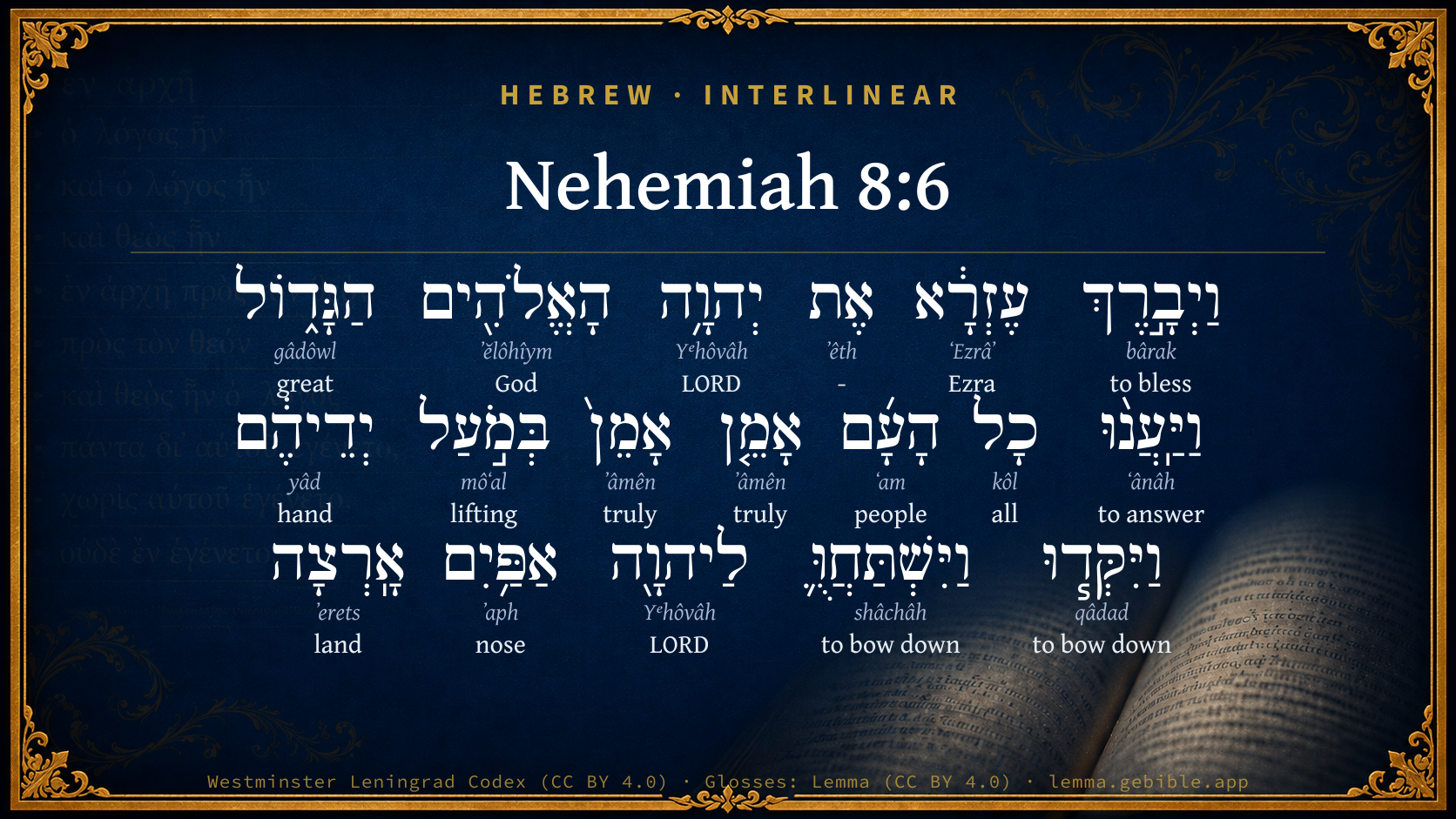
Hebrew (Westminster Leningrad Codex) Nehemiah 8:6 appears in the Hebrew Old Testament. The text above is from the Westminster Leningrad Codex. Each word links to its Strong’s number, a concise gloss, and parsing drawn from the Open Scriptures Hebrew Bible morphology. Click any word for its full Brown-Driver-Briggs (BDB) entry.
Download image
Cite this verse

Nehemiah 8:6 (World English Bible). Public Domain. Lemma interlinear Bible study tool, https://lemma.gebible.app/v/nehemiah/8/6.

Show BibTeX & RIS
BibTeX
RIS
English Translation
and Ezra blessed Yahweh, the great God. All the people answered, Amen, Amen, with the lifting up of their hands: and they bowed their heads, and worshiped Yahweh with their faces to the ground.
World English Bible · Public Domain
Highlights
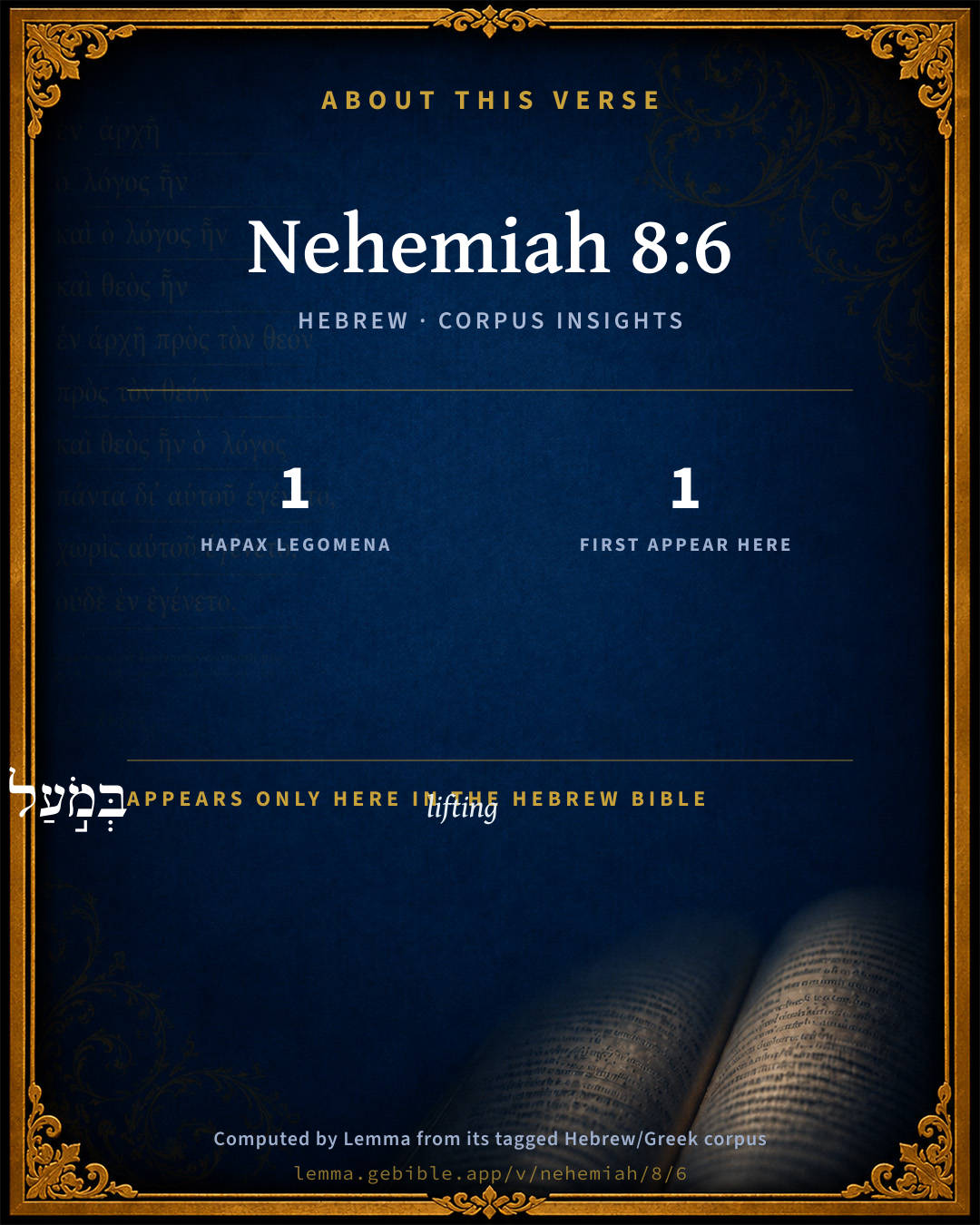
  • 1 hapax legomenon — only here in the Hebrew Bible
  • 1 first appearance in the Hebrew Bible
Full analysis ↓
Download a study sheet

One document with this verse’s original text, its word-by-word gloss line, the meaning frame, cross-references with their text, attributed commentary, and full source and license credits — printable, and it pastes into notes with its structure intact.

This verse Autodidact and up

Study sheet (.html) Plain text (.txt)

A passage Seminary Student

Up to 50 verses in one chapter. A passage sheet keeps up to 6 commentary sources and 12 cross-references per verse, in the order this page ranks them, and says so on the sheet whenever that leaves anything out. Ask for a single verse and you get the Autodidact verse sheet above.

Everything on this page stays free to read, with no account — the sheet is a download of what is already on screen, not access to it.

Want to remove ads? Support Godless Engineer
Compare translations 3

The same verse in 3 English versions, stacked beneath the original-language interlinear above. Click any original word for its lexicon entry.

Each is an independent rendering of the whole verse — the interlinear is not word-aligned to these translations.

Highlighted words mark where these versions differ — a whole-verse word diff, not a word-by-word alignment.

  • World English Bible Public Domain
    and Ezra blessed Yahweh, the great God. All the people answered, Amen, Amen, with the lifting up of their hands: and they bowed their heads, and worshiped Yahweh with their faces to the ground.
  • King James Version Public Domain
    And Ezra blessed the LORD, the great God. And all the people answered, Amen, Amen, with lifting up their hands: and they bowed their heads, and worshipped the LORD with their faces to the ground.
  • unfoldingWord Literal Text CC BY-SA 4.0
    And Ezra blessed Yahweh the great God. And all the people answered, “Amen! Amen!” with their hands uplifted. And they knelt and prostrated themselves to Yahweh, nostrils to the ground.

unfoldingWord Literal Text — © unfoldingWord, licensed CC BY-SA 4.0. Word-aligned USFM3 via Door43 (git.door43.org/unfoldingWord/en_ult).

Versions to compare (up to 4)

3 of 4 selected

Show all 18 translations

Every available English version of this verse, each an independent rendering of the whole verse.

  • World English Bible Public Domain
    and Ezra blessed Yahweh, the great God. All the people answered, Amen, Amen, with the lifting up of their hands: and they bowed their heads, and worshiped Yahweh with their faces to the ground.
  • Berean Standard Bible Public Domain
    Then Ezra blessed the LORD, the great God, and with their hands uplifted, all the people said, “Amen, Amen!” Then they bowed down and worshiped the LORD with their faces to the ground.
  • Majority Standard Bible Public Domain
    Then Ezra blessed the LORD, the great God, and with their hands uplifted, all the people said, “Amen, Amen!” Then they bowed down and worshiped the LORD with their faces to the ground.
  • King James Version Public Domain
    And Ezra blessed the LORD, the great God. And all the people answered, Amen, Amen, with lifting up their hands: and they bowed their heads, and worshipped the LORD with their faces to the ground.
  • American Standard Version (1901) Public Domain
    and Ezra blessed Jehovah, the great God. And all the people answered, Amen, Amen, with the lifting up of their hands: and they bowed their heads, and worshipped Jehovah with their faces to the ground.
  • Revised Version (1885) Public Domain
    and Ezra blessed the LORD, the great God. And all the people answered, Amen, Amen, with the lifting up of their hands: and they bowed their heads, and worshipped the LORD with their faces to the ground.
  • Geneva Bible (1599) Public Domain
    And Ezra praysed the Lord the great God, and all the people answered, Amen, Amen, with lifting vp their handes: and they bowed themselues, and worshipped the Lord with their faces toward the grounde.
  • Douay-Rheims (1899) Public Domain
    And Esdras blessed the Lord the great God: and all the people answered, Amen, amen: lifting up their hands: and they bowed down, and adored God with their faces to the ground.
  • Young's Literal Translation Public Domain
    and Ezra blesseth Jehovah, the great God, and all the people answer, `Amen, Amen,' with lifting up of their hands, and they bow and do obeisance to Jehovah -- faces to the earth.
  • Literal Standard Version CC BY-SA 4.0
    and Ezra blesses YHWH, the great God, and all the people answer, “Amen, Amen,” with lifting up of their hands, and they bow and pay respect to YHWH—faces to the earth.
  • Unlocked Literal Bible CC BY-SA 4.0
    Ezra gave thanks to Yahweh, the great God, and all the people lifted up their hands and answered, “Amen! Amen!” Then they bowed their heads and worshiped Yahweh with their faces to the ground.
  • unfoldingWord Literal Text CC BY-SA 4.0
    And Ezra blessed Yahweh the great God. And all the people answered, “Amen! Amen!” with their hands uplifted. And they knelt and prostrated themselves to Yahweh, nostrils to the ground.
  • Darby Bible Public Domain
    And Ezra blessed Jehovah, the great God; and all the people answered, Amen, Amen! with lifting up of their hands; and they bowed their heads, and worshipped Jehovah with their faces to the ground.
  • World Messianic Bible Public Domain
    Then Ezra blessed the LORD, the great God. All the people answered, “Amen, Amen,” with the lifting up of their hands. They bowed their heads, and worshiped the LORD with their faces to the ground.
  • Webster's Bible Public Domain
    And Ezra blessed the LORD, the great God. And all the people answered, Amen, Amen, with lifting their hands: and they bowed their heads, and worshiped the LORD with their faces to the ground.
  • Free Bible Version CC BY-SA 4.0
    Ezra praised the Lord, the great God, and everyone answered, “Amen! Amen!” as they lifted up their hands. Then they bowed down and worshiped the Lord with their faces to the ground.
  • Bible in Basic English Public Domain
    And Ezra gave praise to the Lord, the great God. And all the people in answer said, So be it, so be it; lifting up their hands; and with bent heads they gave worship to the Lord, going down on their faces to the earth.
  • JPS Tanakh (1917) Public Domain
    And Ezra blessed the LORD, the great God. And all the people answered: 'Amen, Amen', with the lifting up of their hands; and they bowed their heads, and fell down before the LORD with their faces to the ground.

Literal Standard Version (2020), Covenant Press — licensed CC BY-SA 4.0. Text via the HelloAO Bible API (eBible.org). Unlocked Literal Bible (unfoldingWord) — licensed CC BY-SA 4.0. Text via the HelloAO Bible API (eBible.org). unfoldingWord Literal Text — © unfoldingWord, licensed CC BY-SA 4.0. Word-aligned USFM3 via Door43 (git.door43.org/unfoldingWord/en_ult). Free Bible Version, Dr. Jonathan Gallagher — licensed CC BY-SA 4.0. Text via the HelloAO Bible API (eBible.org).

Word by word

More ways to search: Search by grammar → Find every occurrence → Compare this word →

Practice this passage: Drill this verse → Learn its vocabulary →

בְּמֹ֣עַל
môʻal
H4607
“in/at · lifting of”
Preposition + Noun, Common, Masculine, Singular, Construct
Part of Speech
Preposition + Noun
Type
Common
Gender
Masculine
Number
Singular
State
Construct
Full BDB Definition

Origin: from H5927

TWOT: 1624i

lifting
  1. וַיְבָ֣רֶךְ bârak H1288 “and · to bless” Conjunction + Verb, Piel, Sequential Imperfect, 3rd Person, Masculine, Singular
  2. עֶזְרָ֔א ʻEzrâʼ H5830 “Ezra” Noun, Proper
  3. אֶת ʼêth H853 “-” Particle, Direct Object
  4. יְהוָ֥ה Yᵉhôvâh H3068 “LORD” Noun, Proper
  5. הָאֱלֹהִ֖ים ʼĕlôhîym H430 “the · God(s)” Particle, Definite Article + Noun, Common, Masculine, Plural, Absolute
  6. הַגָּד֑וֹל gâdôwl H1419 “the · great” Particle, Definite Article + Adjective, Adjective, Masculine, Singular, Absolute
  7. וַיַּֽעֲנ֨וּ ʻânâh H6030 “and · to answer” Conjunction + Verb, Qal, Sequential Imperfect, 3rd Person, Masculine, Plural
  8. כָל kôl H3605 “all of” Noun, Common, Masculine, Singular, Construct
  9. הָעָ֜ם ʻam H5971 “the · people” Particle, Definite Article + Noun, Common, Masculine, Singular, Absolute
  10. אָמֵ֤ן ʼâmên H543 “truly” Adverb
  11. אָמֵן֙ ʼâmên H543 “truly” Adverb
  12. יְדֵיהֶ֔ם yâd H3027 “hands · their” Noun, Common, Both, Dual, Construct + Suffix, Personal, 3rd Person, Masculine, Plural
  13. וַיִּקְּד֧וּ qâdad H6915 “and · to bow down” Conjunction + Verb, Qal, Sequential Imperfect, 3rd Person, Masculine, Plural
  14. וַיִּשְׁתַּחֲוֻּ֛ shâchâh H7812 “and · to bow down” Conjunction + Verb, Hithpael, Sequential Imperfect, 3rd Person, Masculine, Plural
  15. לַיהוָ֖ה Yᵉhôvâh H3068 “to/for · LORD” Preposition + Noun, Proper
  16. אַפַּ֥יִם ʼaph H639 “nostrils” Noun, Common, Masculine, Dual, Absolute
  17. אָֽרְצָה ʼerets H776 “land · toward” Noun, Common, Both, Singular, Absolute + Suffix, Demonstrative

About this verse

These counts appear in no published source. They are computed here, from the morphology-tagged text and Lemma’s own curated glosses. What Lemma adds →

18
words
16
distinct lemmas
Historical
section

Notable vocabulary

1 hapax legomenon — a word that appears only here in the entire Hebrew Bible:

  • בְּמֹ֣עַל lifting H4607

First appearance in Scripture

This word makes its first canonical appearance in the Hebrew Bible here:

  • בְּמֹ֣עַל lifting H4607

Shared distinctive vocabulary

וַיִּקְּד֧וּ to bow down H6915 occurs in 15 verses of the Hebrew Bible. Also found in:

Grammatical profile

  • 4 verbs
  • 10 nouns
  • 1 adjective
  • 2 adverbs
  • 1 particle

Verb forms

  • וַיְבָ֣רֶךְ Piel · Sequential Imperfect
  • וַיַּֽעֲנ֨וּ Qal · Sequential Imperfect
  • וַיִּקְּד֧וּ Qal · Sequential Imperfect
  • וַיִּשְׁתַּחֲוֻּ֛ Hithpael · Sequential Imperfect

Repetition

Words recur within this verse — often emphatic in Hebrew:

  • יְהוָ֥ה LORD H3068 ×2
  • אָמֵ֤ן truly H543 ×2

Cross-references

25

Topical passages linked to Nehemiah 8:6 in the Treasury of Scripture Knowledge — connected by theme and wording, ordered by reader-vote popularity; previews shown in the World English Bible.

  • 1 Timothy 2:8 I desire therefore that the men in every place pray, lifting up holy hands without wrath and doubting.
  • Lamentations 3:41 Let us lift up our heart with our hands to God in the heavens.
  • Exodus 4:31 The people believed, and when they heard that Yahweh had visited the children of Israel, and that he had seen their affliction, then they bowed their heads and worshiped.
  • 2 Chronicles 20:18 Jehoshaphat bowed his head with his face to the ground; and all Judah and the inhabitants of Jerusalem fell down before Yahweh, worshipping Yahweh.
  • Revelation 7:11 All the angels were standing around the throne, the elders, and the four living creatures; and they fell on their faces before his throne, and worshiped God,
  • Genesis 24:26 The man bowed his head, and worshiped Yahweh.
  • Nehemiah 5:13 Also I shook out my lap, and said, So God shake out every man from his house, and from his labor, that doesn't perform this promise; even thus be he shaken out, and emptied. All the assembly said, Amen, and praised Yahweh. The people did according to this promise.
  • Psalms 134:2 Lift up your hands in the sanctuary. Praise Yahweh!
  • Exodus 12:27 that you shall say, 'It is the sacrifice of Yahweh's Passover, who passed over the houses of the children of Israel in Egypt, when he struck the Egyptians, and spared our houses.'" The people bowed their heads and worshiped.
  • Leviticus 9:24 There came forth fire from before Yahweh, and consumed the burnt offering and the fat upon the altar: and when all the people saw it, they shouted, and fell on their faces.
  • 1 Chronicles 29:20 David said to all the assembly, Now bless Yahweh your God. All the assembly blessed Yahweh, the God of their fathers, and bowed down their heads, and worshiped Yahweh, and the king.
  • Psalms 72:18–19 Praise be to Yahweh God, the God of Israel, Who alone does marvelous deeds.
  • Genesis 14:22 Abram said to the king of Sodom, "I have lifted up my hand to Yahweh, God Most High, possessor of heaven and earth,
  • 2 Chronicles 6:4 He said, Blessed be Yahweh, the God of Israel, who spoke with his mouth to David my father, and has with his hands fulfilled it, saying,
  • 2 Chronicles 29:30 Moreover Hezekiah the king and the princes commanded the Levites to sing praises to Yahweh with the words of David, and of Asaph the seer. They sang praises with gladness, and they bowed their heads and worshiped.
  • Psalms 28:2 Hear the voice of my petitions, when I cry to you, When I lift up my hands toward your Most Holy Place.
  • Psalms 41:13 Blessed be Yahweh, the God of Israel, From everlasting and to everlasting! Amen and amen.
  • Psalms 63:4 So I will bless you while I live. I will lift up my hands in your name.
  • Psalms 141:2 Let my prayer be set before you like incense; The lifting up of my hands like the evening sacrifice.
  • Jeremiah 28:6 even the prophet Jeremiah said, Amen: Yahweh do so; Yahweh perform your words which you have prophesied, to bring again the vessels of Yahweh's house, and all them of the captivity, from Babylon to this place.
  • Matthew 6:13 Bring us not into temptation, but deliver us from the evil one. For yours is the Kingdom, the power, and the glory forever. Amen.'
  • Matthew 26:39 He went forward a little, fell on his face, and prayed, saying, "My Father, if it is possible, let this cup pass away from me; nevertheless, not what I desire, but what you desire."
  • 1 Corinthians 14:16 Otherwise if you bless with the spirit, how will he who fills the place of the unlearned say the "Amen" at your giving of thanks, seeing he doesn't know what you say?
  • Ephesians 1:3 Blessed be the God and Father of our Lord Jesus Christ, who has blessed us with every spiritual blessing in the heavenly places in Christ;
  • 1 Peter 1:3 Blessed be the God and Father of our Lord Jesus Christ, who according to his great mercy became our father again to a living hope through the resurrection of Jesus Christ from the dead,

Cross-references courtesy of OpenBible.info (CC BY 4.0).

Hebrew and Greek witnesses Masoretic Hebrew ↔ Greek Septuagint

The same verse in the two great witnesses to the Old Testament, shown verse-for-verse.

These are two independent witnesses, not word-aligned to each other, and the Septuagint is shown in lemma (dictionary) form.

Hebrew Nehemiah 8:6 Masoretic · Westminster Leningrad Codex

וַיְבָ֣רֶךְ עֶזְרָ֔א אֶת יְהוָ֥ה הָאֱלֹהִ֖ים הַגָּד֑וֹל וַיַּֽעֲנ֨וּ כָל הָעָ֜ם אָמֵ֤ן אָמֵן֙ בְּמֹ֣עַל יְדֵיהֶ֔ם וַיִּקְּד֧וּ וַיִּשְׁתַּחֲוֻּ֛ לַיהוָ֖ה אַפַּ֥יִם אָֽרְצָה

and Ezra blessed Yahweh, the great God. All the people answered, Amen, Amen, with the lifting up of their hands: and they bowed their heads, and worshiped Yahweh with their faces to the ground.

World English Bible · Public Domain

Greek LXX Structure differs

The Septuagint has no separate book of Nehemiah. Its Greek text is the second half of Esdras B (2 Esdras), chapters 11–23; Ezra is the first half (1–10).

A verse-for-verse comparison isn’t shown here because the chapters and verses don’t line up. Switch to the LXX edition with the MT / LXX toggle above to read the Greek directly.

On this verse, Trapp's Complete Commentary discusses the Septuagint’s reading. Read the note in Commentary ↓

Hebrew: Westminster Leningrad Codex (CC BY 4.0). Greek: Septuagint (public domain); English from a public-domain English Septuagint. How the Septuagint differs from the Hebrew →

Commentary

Notes on Nehemiah 8:6 from classic Christian and Jewish commentators (each source and its license shown beneath its notes). The classic Christian expositions comment on the surrounding passage and are grouped to its opening verse, so a note may address several verses; the Jewish commentaries on the Tanakh (Rashi and others) are per-verse, so they appear only where the commentator wrote on this verse.

Lemma curates 59 commentaries, every one of them public domain or Creative Commons licensed, each selected and text-cleaned for this edition rather than reprinted as found. About our sources →

Trapp's Complete Commentary

John Trapp

Neh 8:6 And Ezra blessed the LORD, the great God. And all the people answered, Amen, Amen, with lifting up their hands: and they bowed their heads, and worshipped the LORD with [their] faces to the ground.

Ver. 6. And Ezra blessed the Lord] i.e. He called upon the Lord, who is worthy to be praised, Psa 18:3. He prayed before he read and preached. So ought we to do by his example, as Lyra well noteth; and as is commonly done by all our ministers. Luther’s usual prayer before sermon was this, Confirm, O God, in us what thou hast wrought; and perfect the work that thou hast begun to thy glory. Lord, open our eyes, that we may see the wonders of thy law, &c. Zuinglius began his public lectures thus, O Almighty, everlasting, and merciful God, whose Word is a light to our feet, and a lantern to our paths, open and enlighten our minds, that we may piously and holily understand thine oracles, and be so transformed thereinto, that we may not in anything displease thy majesty, through Jesus Christ our Lord, Amen. The Platonists could say, that the light of our minds whereby we learn all things is no other but God himself, the same that made all things. This made Ezra here bless the Lord, that is, say, with David, Psa 119:12, Blessed be thou, O Lord: teach us thy statutes.

The great God] The true Trismegist, the Fortissimus Maximus, Opt. Max. All whose attributes are in the highest degree, yea, in a degree beyond any superlative.

And all the people answered, Amen, Amen] This word is Hebrew; but used in all languages, in the close of prayers. The doubling of it here importeth their assent, and their assurance. It is the voice of one that believeth and expecteth that he shall have his prayers granted. The Septuagint render it, so be it; or, so it is. The apostle reckoneth it for a great loss when people either say not Amen to public prayers, or not heartily and affectionately, as here, 1Co 14:16, "Else when thou shalt bless with the spirit, how shall he that occupieth the room of the unlearned say, Amen?" The Turks also, when their priest hath said his litany, such as it is, make answer in manner of a shout, Homin, that is, Amen.

With lifting up their hands] And with their hearts, unto God in the heavens, Lam 3:41. This Nazianzen judgeth to be optimum opus manuum, the best work of the hands, sc. in caelos eas extendere, ad precesque expandere, to stretch them towards heaven, and to hold them out in prayer. This way David ennobled his tongue (therefore called his glory), and so men may their hands.

And they bowed their heads] In token of the lowliness of their hearts. These outward gestures, as they issue from the fervency of a good heart, so they reflect upon the affections, and do further inflame them. Only note, that these bodily exercises are not always or absolutely necessary in Divine worship. God looks chiefly at the heart, and hateth all outside service and heartless devotion, Isa 1:11-23; Isa 66:3, and such as is that of the Jews at this day. Their holiness, saith one, is the outward work itself, being a brainless head and soulless body. And the like may be said of the Papist, and of the common Protestant, whoso body is prostrate, but his soul bolt upright within him.

John Trapp, A Commentary or Exposition upon All the Books of the Old and New Testament (1647–1656) — public domain. Text from a community e-Sword module.

The Biblical Illustrator

Joseph S. Exell

Neh_8:6

And all the people answered, Amen, Amen.

Amen in public worship

The subject is: That it is a lawful and laudable practice for people, in the conclusion of public prayer or praising God, to pronounce an amen.

I. I will explain what is meant by amen.

1. There is an amen substantive. And that is God Himself (Rev_3:14).

2. There is an amen affirmative--a phrase used in the beginning of any momentous truth, as an asseveration (Mat_16:28; Luk_9:27).

3. There is an optative amen--Let it be so (Jer_28:6; 1Ki_1:36; Num_5:22; Deu_27:15-26).

II. Show what warrant there is for the practice.

1. Assent to repetitions is essential unto prayer, and it is not signified publicly but by our amen.

2. We have the practice of the Old and New Testament believers for our example. Moses in Numbers and Deuteronomy; David (Psa_51:18; Psa_106:48); Jeremiah (Jer_11:5); Paul (1Co_14:16; Eph_3:21); Christ Himself (Mat_6:9-18; Rev_5:14; Rev_7:11-12; Rev_19:1-6; Rev_22:20).

3. Amen after prayer and praise is the mans consent, judgment, and approbation of what is offered unto God.

4. This vocal amen is, as it were, the epitome and sum of all our petitions and praises to God. It is the centre which all those lines are drawn towards. It is all the duty virtually reduced to one word and point. It is the repeating and echoing, or redoubling of all over again. As the mercury behind the glass, it reverberates the lively image of all preceding devotion, it is the drawing the arrow to the pile by a strong ejaculation in Bellarmines phrase, Whereby the whole heart is darted up to God. It is a stirring up of ourselves to take hold of God (Isa_64:7). It is taking aim, and directing our prayer to Him and looking up (Psa_5:3), as if they would hand up Gods praises to Him, and stand ready to receive His mercies with open hands and mouths. It winds up all together in one bundle.

5. Amen, rightly pronounced, is an intensive act of faith, or it involves a strong faith.

(1) That God is firm and immutably true in Himself and His Word.

(2) That we will not only believe His truth, but trust to His veracity and build upon it (Jer_11:5). The Jews say amen hath three kernels; the one is of an oath, the second of faith, the third of confidence.

6. The unanimous pronunciation of amen is an assurance that God will accept our praises and answer our prayers (Mat_18:19; Mar_11:23).

7. This unanimous amen of faith strikes terror in the enemies of the Church, whether devils or men. When the Romans had conquered Philip and the Grecians, and Flaminius caused peace to be proclaimed to the Grecians, there was such a shout, says Plutarch, that the very crows and other birds fell down to the ground. Our amens must not drop like a cold bullet of lead out of the mouth of a musket, bowing to the ground; but they must be fired by preparations of the heart and warm affections, they must be discharged and shot off with the utmost vehemency of the soul and fervency of the spirit. When Gods people can unite in one voice, God gives His voice with them and for them. (Thomas Woodcock A. M.)

Amen

St. Jerome tells us it was the custom in his days to close up every prayer with such a unanimous consent that their amen rang and echoed in the church, and sounded like the fall of waters or the noise of thunder. The Chinese have no word which will compare with our English word amen. They say instead: Sin yenen ching sing--The heart wishes exactly so.

The Biblical Illustrator, edited by Joseph S. Exell (c. 1880s–1900s) — public domain. Text from a community e-Sword module.

Tyndale Open Study Notes

Tyndale Open Resources

8:6 Ezra praised the Lord: See also 1:5; 9:32; Deut 10:17; Jer 32:18; Dan 9:4. • Amen! A statement of agreement (see Neh 5:13). Lifting hands (Ps 28:2) and bowing in humble worship were signs of reverence for God and submission to his word.

Tyndale Open Study Notes — © Tyndale Open Resources, licensed CC BY-SA 4.0. Text via the HelloAO Bible API.

Adam Clarke's Commentary

Verse 6. Ezra blessed the Lord] In imitation of this, we say, when the gospel for the day is commenced, Glory be to God for his holy Gospel! and conclude this thanksgiving with, Amen.

Adam Clarke's Commentary on the Bible (1810–1826) — public domain. Text from a community e-Sword/MySword module.

Ellicott's Commentary for English Readers

(6) And Ezra blessed the Lord.—The book was formally and solemnly opened in the sight of the people. At this request the multitude arose, and, after a doxology offered by Ezra, they all uttered a double Amen, “with lifting up of their hands,” in token of their most fervent assent; and then “with faces bowed to the ground,” in token of adoration.

The great God is Nehemiah’s expression, not Ezra’s; the sentence used is not reported.

A Bible Commentary for English Readers, edited by Charles John Ellicott (1878–1897) — public domain. Text from a community e-Sword module.

The Cambridge Bible for Schools and Colleges

gen. ed. J. J. S. Perowne

6. the great God] cf. Neh_9:32; Ezr_5:8. In Nehemiah’s own writing it occurs Neh_1:5.

Amen, Amen] The people’s response: see note on Neh_5:13; cf. 1Ch_16:36.

with lifting up their hands] See note on Ezr_9:5. Cf. Psa_134:2, ‘Lift up your hands to the sanctuary (Marg. Or, in holiness) and bless ye the Lord.’ 2Ma_14:34.

worshipped the Lord with their faces to the ground] The phrase ‘with the face to the earth,’ occurs very generally of reverence without the idea of worship; cf. Gen_19:1; Gen_42:6; Gen_48:12; 1Sa_20:41; 1Sa_24:8; 1Ch_21:21. But it is also used of worship before God, as in Num_22:31; 2Ch_7:3; 2Ch_20:18; and compare the expression ‘let us worship and bow down,’ Psa_95:6; Job_1:20. After this united act of worship they resumed their attitude of attention (Neh_8:3).

The Cambridge Bible for Schools and Colleges (gen. ed. J. J. S. Perowne; Cambridge University Press, 1878–1918) — public domain. Text from a community e-Sword module.

John Gill's Exposition

And Ezra blessed the Lord, the great God,.... Before he began to read in the book of the law, he addressed himself to God in a short prayer, wholly in the benedictory way; ascribing blessing, honour, and glory to him, celebrating his being and perfections, setting forth his greatness and his excellency, who was the author and giver of the law he was about to read; and this he the rather did, that what he read might be the more carefully attended to, and come with the greater authority, weight, and influence on those that heard it; and so, Maimonides (o) says, it is the custom with the Jews, in their synagogues, for the reader, after he has opened the book, and looked out the place he reads, to say this blessing,"Blessed art thou, O Lord our God, King of the world, who hath chosen us out of all people, and hath given us his law; blessed art thou, O Lord, who hast given us the law; and all the people answer, Amen;''as they now did, as follows:

and all the people answered, Amen, Amen: repeating the word, to declare their hearty assent to what Ezra had expressed; the Jews have many rules concerning pronouncing the "Amen", that it must not be too quick, curt, and short, nor with too high a voice (p):

with lifting up their hands; a prayer gesture, to which the apostle refers, Ti1 2:8,

and they bowed their heads, and worshipped the Lord with their faces to the ground; expressing hereby the awful sense they had of the Divine Being, and their profound adoration of him.

(o) Hilchot Tephillah, c. 12. sect. 5. (p) Schulchan Aruch, ut supra, (par. 1.) c. 124. sect. 12.

John Gill's Exposition of the Whole Bible (1746–1763) — public domain (CC PDM 1.0). Text via the HelloAO Bible API.

Whedon's Commentary on the Bible

Daniel D. Whedon

6. Ezra blessed the Lord — After the manner of David in 1Ch_29:10-20.

People answered, Amen — Such responses characterized the ancient worship, and ought ever to be retained. They show that not one but all are interested.

Lifting up their hands — An ancient custom in worship, (compare Psa_27:2; Psa_63:4; Lam_3:41; 1Ti_2:8,) as was also the bowing of the head. Comp. marginal references. This latter sign of reverence and respect is the least that can be expected of any attendant upon Divine worship. An irreverent looking around over an assembly engaged in prayer is a mark of ill-breeding, to say nothing of the respectful reverence which all true worship demands.

Daniel D. Whedon (gen. ed.), Commentary on the Old and New Testaments (1874–1909) — public domain. Text from a community e-Sword module.

The Pulpit Commentary

Ezra blessed the Lord. Ezra began by an ascription of praise to Jehovah, as the Levites, probably under his direction, begin in Neh_9:5, and as David began his last address to the congregation. (1Ch_29:10) The great God. The epithet belongs to the writer rather than to Ezra himself, who in his own book never uses it. It recurs in this section, (Neh_9:32) and is also employed by Nehemiah. (Neh_1:5) Amen, Amen. The repetition marks intensity of feeling, as does the lifting up their hands. Compare 2Ki_11:14 Luk_23:21; and for the lifting up of the hands, so natural in prayer, see Psa_134:2 1Ti_2:8, etc . Worshipped the Lord with their faces to the ground. Compare 2Ch_7:3 Ezr_10:2.

The Pulpit Commentary (1880–1919), ed. H.D.M. Spence-Jones & Joseph S. Exell — public domain. Text from a community e-Sword module.

unfoldingWord translationNotes

Door43 World Missions Community

Ezra gave thanks to Yahweh

The abstract noun "thanks" can be translated as a verb. AT: "Ezra thanked Yahweh" (See: Abstract Nouns)

Jeshua, Bani, Sherebiah, Jamin, Akkub, Shabbethai, Hodiah, Maaseiah, Kelita, Azariah, Jozabad, Hanan, Pelaiah

These are all names of men. (See: How to Translate Names)

They read in the book

The word "They" here refers to the Levites.

making it clear with interpretation and giving the meaning

The abstract nouns "interpretation" and "meaning" can be translated as verbs. AT: "clearly interpreting and explaining it" (See: Abstract Nouns)

the reading

"what was read"

translationWords

Ezra

Yahweh

God

amen

bow

worship

face

Levi

law

unfoldingWord translationNotes — © Distant Shores Media and the Door43 World Missions Community, licensed CC BY-SA 4.0. Source: git.door43.org/Door43/en_tn.

Rashi

Rabbi Shlomo Yitzchaki (Rashi)

with the uplifting of their hands with the raising of their hands, meaning that they lifted their hands on high to thank the Holy One, blessed be He, as it is stated: (I Kings 8:22): “...and spread forth his hands towards heaven.”

Rashi on the Tanakh — English translations: “The Judaica Press complete Tanach with Rashi, translated by A. J. Rosenberg” (CC BY 4.0); “Pentateuch with Rashi's commentary by M. Rosenbaum and A.M. Silbermann, 1929-1934” (public domain); “The Metsudah Tanach series, Lakewood, N.J” (CC BY 4.0); and “The Book of Joshua, Metsudah Publications, 1997” (CC BY 4.0). Text via Sefaria.

Lesson kit

Teaching starters — assembled from the data on this page, not authored interpretation. Every prompt links to the verse data it draws on. Edit before teaching.

Nehemiah, in the Historical, opens this verse with 18 words (16 distinct Hebrew lemmas). Its most distinctive word is môʻal (“lifting”). A historical commentator’s framing appears above. Read the whole chapter for the surrounding context.

Discussion questions

  1. The word môʻal carries the sense “lifting.” How does it shape the verse?
  2. 1 word here appears nowhere else in the Hebrew Bible. Why might the author reach for such rare wording?
  3. This is the first place “lifting” appears in Scripture (first appears here). What does its debut here establish?
  4. How does Genesis 24:26, which shares the word «to bow down», read alongside this verse?
  5. What does the repetition of “LORD” (2× in this one verse) do in this verse?
  6. The translations on this page render this verse differently — a whole-verse word diff, not a word-by-word alignment. What might account for the different wordings?
  7. «וַיְבָ֣רֶךְ» is a Piel Sequential Imperfect verb. How does that grammatical form shape the action described?
  8. Compare how Trapp's Complete Commentary and The Biblical Illustrator read this verse. Where do they agree or differ?

Things to notice

  • 1 word in this verse appears nowhere else in the Hebrew Bible.
  • 1 word makes its first canonical appearance in Scripture here.
  • These translations choose different wording for 14 words in this verse.
  • “LORD” occurs 2× in this single verse.
  • 16 distinct Hebrew lemmas span 18 words in this verse.

Reading settings

Reading text

Shown beneath each verse's original-language words.

Old Testament
Old Testament edition

Read the OT as the Masoretic Hebrew (MT) or the Greek Septuagint (LXX).

English shown for the Greek Septuagint (in the Hebrew ↔ Greek comparison).

Comparing translations? Open the Compare panel on any verse page to stack up to four side by side.