
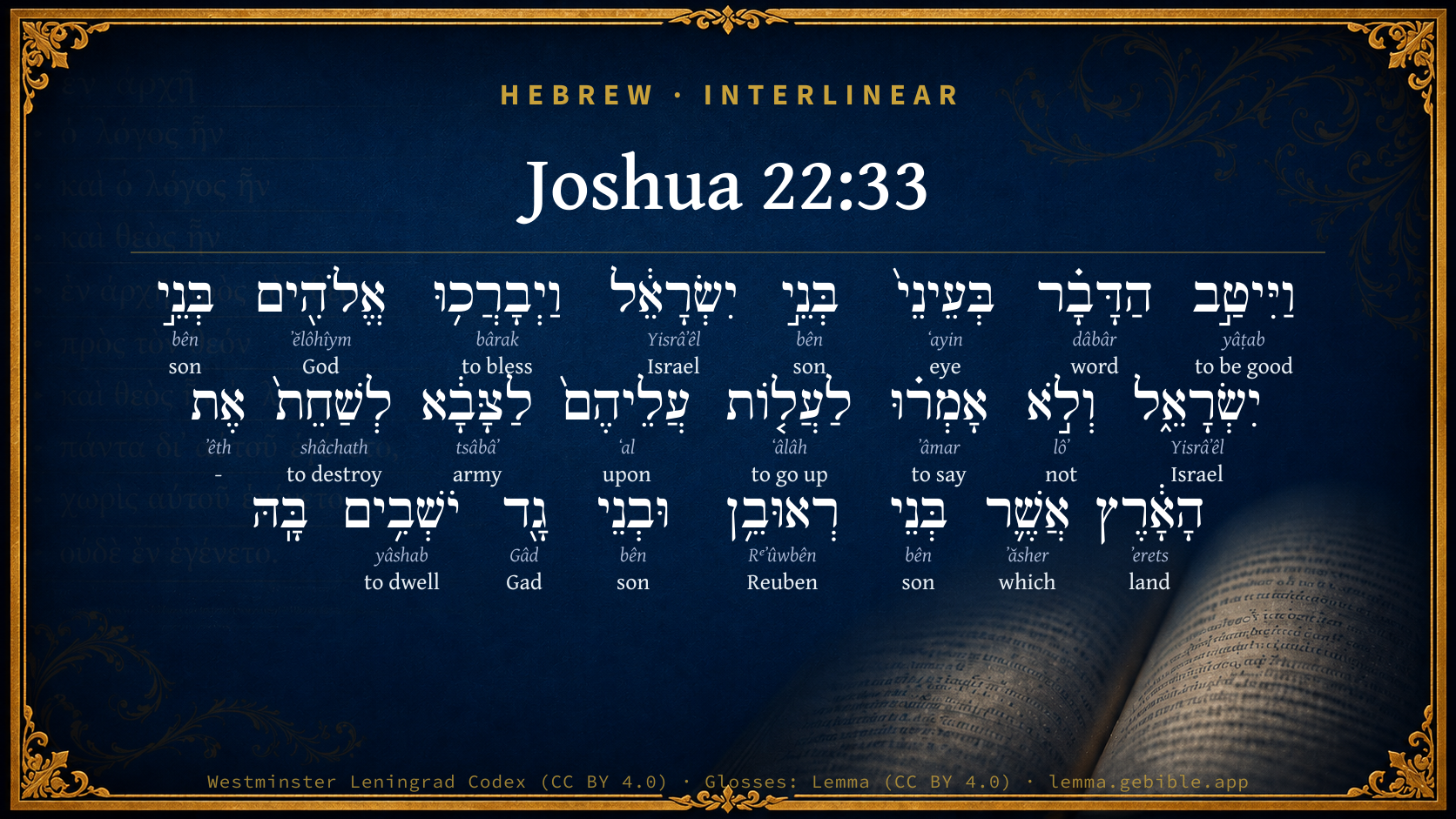
Joshua 22:33

Hebrew (Westminster Leningrad Codex) Joshua 22:33 appears in the Hebrew Old Testament. The text above is from the Westminster Leningrad Codex. Each word links to its Strong’s number, a concise gloss, and parsing drawn from the Open Scriptures Hebrew Bible morphology. Click any word for its full Brown-Driver-Briggs (BDB) entry.
Download image
Cite this verse

Joshua 22:33 (World English Bible). Public Domain. Lemma interlinear Bible study tool, https://lemma.gebible.app/v/joshua/22/33.

Show BibTeX & RIS
BibTeX
RIS
English Translation
The thing pleased the children of Israel; and the children of Israel blessed God, and spoke no more of going up against them to war, to destroy the land in which the children of Reuben and the children of Gad lived.
World English Bible · Public Domain
Download a study sheet

One document with this verse’s original text, its word-by-word gloss line, the meaning frame, cross-references with their text, attributed commentary, and full source and license credits — printable, and it pastes into notes with its structure intact.

This verse Autodidact and up

Study sheet (.html) Plain text (.txt)

A passage Seminary Student

Up to 50 verses in one chapter. A passage sheet keeps up to 6 commentary sources and 12 cross-references per verse, in the order this page ranks them, and says so on the sheet whenever that leaves anything out. Ask for a single verse and you get the Autodidact verse sheet above.

Everything on this page stays free to read, with no account — the sheet is a download of what is already on screen, not access to it.

Want to remove ads? Support Godless Engineer
Compare translations 3

The same verse in 3 English versions, stacked beneath the original-language interlinear above. Click any original word for its lexicon entry.

Each is an independent rendering of the whole verse — the interlinear is not word-aligned to these translations.

Highlighted words mark where these versions differ — a whole-verse word diff, not a word-by-word alignment.

  • World English Bible Public Domain
    The thing pleased the children of Israel; and the children of Israel blessed God, and spoke no more of going up against them to war, to destroy the land in which the children of Reuben and the children of Gad lived.
  • King James Version Public Domain
    And the thing pleased the children of Israel; and the children of Israel blessed God, and did not intend to go up against them in battle, to destroy the land wherein the children of Reuben and Gad dwelt.
  • unfoldingWord Literal Text CC BY-SA 4.0
    And the word was good in the eyes of the sons of Israel. And the sons of Israel blessed God, and they did not speak of going up against them to war to destroy the land in which the sons of Reuben and the sons of Gad dwelling.

unfoldingWord Literal Text — © unfoldingWord, licensed CC BY-SA 4.0. Word-aligned USFM3 via Door43 (git.door43.org/unfoldingWord/en_ult).

Versions to compare (up to 4)

3 of 4 selected

Show all 18 translations

Every available English version of this verse, each an independent rendering of the whole verse.

  • World English Bible Public Domain
    The thing pleased the children of Israel; and the children of Israel blessed God, and spoke no more of going up against them to war, to destroy the land in which the children of Reuben and the children of Gad lived.
  • Berean Standard Bible Public Domain
    The Israelites were satisfied with the report, and they blessed God and spoke no more about going to war against them to destroy the land where the Reubenites and Gadites lived.
  • Majority Standard Bible Public Domain
    The Israelites were satisfied with the report, and they blessed God and spoke no more about going to war against them to destroy the land where the Reubenites and Gadites lived.
  • King James Version Public Domain
    And the thing pleased the children of Israel; and the children of Israel blessed God, and did not intend to go up against them in battle, to destroy the land wherein the children of Reuben and Gad dwelt.
  • American Standard Version (1901) Public Domain
    And the thing pleased the children of Israel; and the children of Israel blessed God, and spake no more of going up against them to war, to destroy the land wherein the children of Reuben and the children of Gad dwelt.
  • Revised Version (1885) Public Domain
    And the thing pleased the children of Israel; and the children of Israel blessed God, and spake no more of going up against them to war, to destroy the land wherein the children of Reuben and the children of Gad dwelt.
  • Geneva Bible (1599) Public Domain
    And the saying pleased the children of Israel: and the children of Israel blessed God, and minded not to goe against them in battell, for to destroy the land, wherein the children of Reuben, and Gad dwelt.
  • Douay-Rheims (1899) Public Domain
    And the saying pleased all that heard it. And the children of Israel praised God, and they no longer said that they would go up against them, and fight, and destroy the land of their possession.
  • Young's Literal Translation Public Domain
    and the thing is good in the eyes of the sons of Israel, and the sons of Israel bless God, and have not said to go up against them to war, to destroy the land which the sons of Reuben, and the sons of Gad, are dwelling in.
  • Literal Standard Version CC BY-SA 4.0
    and the thing is good in the eyes of the sons of Israel, and the sons of Israel bless God, and have not spoken to go up against them to war, to destroy the land which the sons of Reuben, and the sons of Gad, are dwelling in.
  • Unlocked Literal Bible CC BY-SA 4.0
    Their report was good in the eyes of the people of Israel. The people of Israel blessed God and spoke no more about making war against the Reubenites and the Gadites, in order to destroy the land where they had settled.
  • unfoldingWord Literal Text CC BY-SA 4.0
    And the word was good in the eyes of the sons of Israel. And the sons of Israel blessed God, and they did not speak of going up against them to war to destroy the land in which the sons of Reuben and the sons of Gad dwelling.
  • Darby Bible Public Domain
    And the thing was good in the sight of the children of Israel, and the children of Israel blessed God, and no more said that they would go up in warfare against them, to destroy the land in which the children of Reuben and the children of Gad dwelt.
  • World Messianic Bible Public Domain
    The thing pleased the children of Israel; and the children of Israel blessed God, and spoke no more of going up against them to war, to destroy the land in which the children of Reuben and the children of Gad lived.
  • Webster's Bible Public Domain
    And the thing pleased the children of Israel; and the children of Israel blessed God, and did not intend to go up against them in battle, to destroy the land in which the children of Reuben and Gad dwelt.
  • Free Bible Version CC BY-SA 4.0
    The Israelites were pleased with the report and God blessed them. They didn't talk about going to war any more to destroy the land where the tribes of Reuben and Gad were living.
  • Bible in Basic English Public Domain
    And the children of Israel were pleased about this; and they gave praise to God, and had no more thought of going to war against the children of Reuben and the children of Gad for the destruction of their land.
  • JPS Tanakh (1917) Public Domain
    And the thing pleased the children of Israel; and the children of Israel blessed God, and spoke no more of going up against them to war, to destroy the land wherein the children of Reuben and the children of Gad dwelt.

Literal Standard Version (2020), Covenant Press — licensed CC BY-SA 4.0. Text via the HelloAO Bible API (eBible.org). Unlocked Literal Bible (unfoldingWord) — licensed CC BY-SA 4.0. Text via the HelloAO Bible API (eBible.org). unfoldingWord Literal Text — © unfoldingWord, licensed CC BY-SA 4.0. Word-aligned USFM3 via Door43 (git.door43.org/unfoldingWord/en_ult). Free Bible Version, Dr. Jonathan Gallagher — licensed CC BY-SA 4.0. Text via the HelloAO Bible API (eBible.org).

Word by word

More ways to search: Search by grammar → Find every occurrence → Compare this word →

Practice this passage: Drill this verse → Learn its vocabulary →

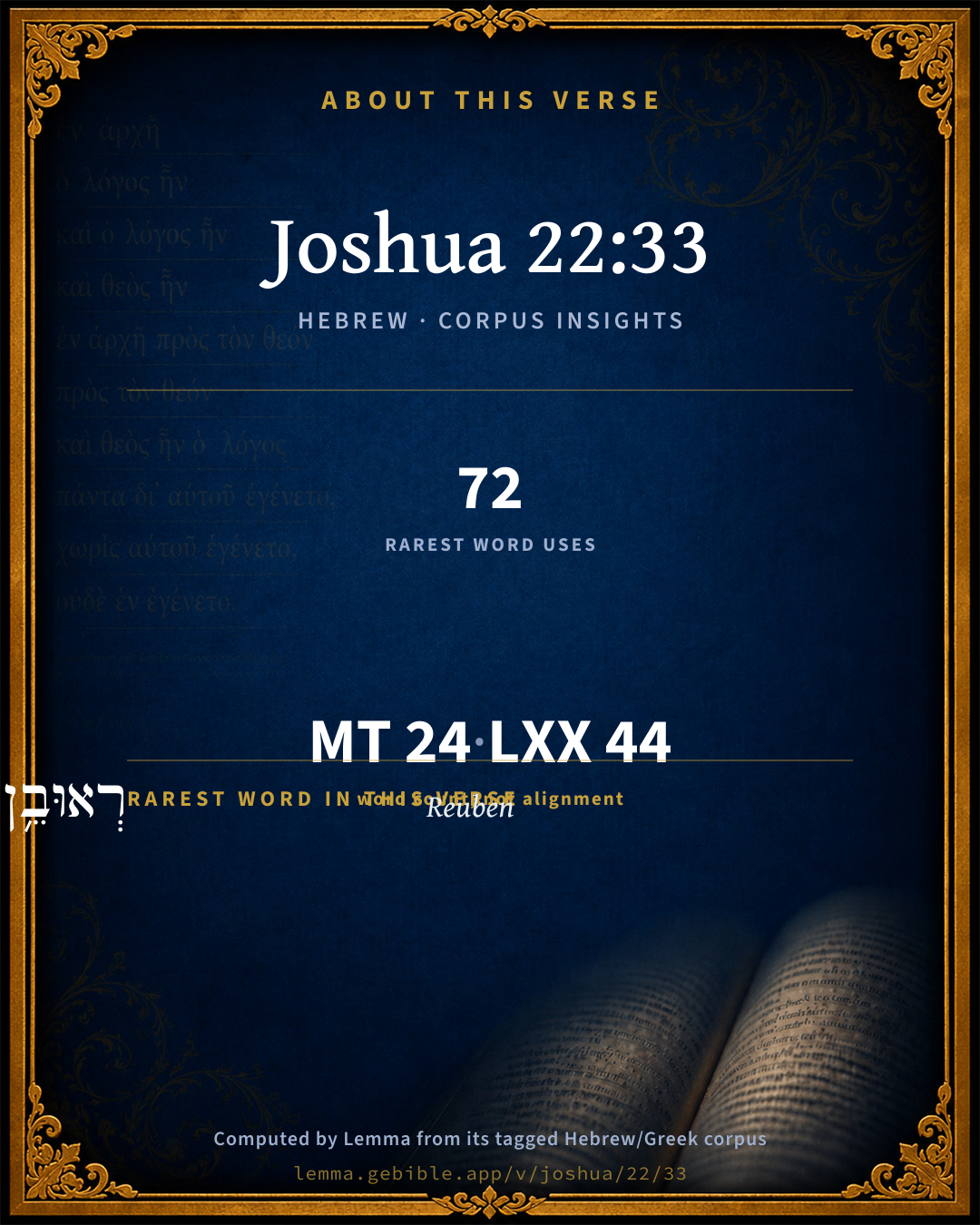
רְאוּבֵ֥ן
Rᵉʼûwbên
H7205
“Reuben”
Noun, Proper
Part of Speech
Noun
Type
Proper
Full BDB Definition

Origin: from the imperative of H7200 and H1121

TWOT: None

Reuben = "behold a son" - the eldest son of Jacob by Leah - the tribe descended from Reuben - the territory inhabited by the tribe of Reuben
  1. וַיִּיטַ֣ב yâṭab H3190 “and · to be good” Conjunction + Verb, Qal, Sequential Imperfect, 3rd Person, Masculine, Singular
  2. הַדָּבָ֗ר dâbâr H1697 “the · word” Particle, Definite Article + Noun, Common, Masculine, Singular, Absolute
  3. בְּעֵינֵי֙ ʻayin H5869 “in/at · eyes of” Preposition + Noun, Common, Both, Dual, Construct
  4. בְּנֵ֣י bên H1121 “sons of” Noun, Common, Masculine, Plural, Construct
  5. יִשְׂרָאֵ֔ל Yisrâʼêl H3478 “Israel” Noun, Proper
  6. וַיְבָרֲכ֥וּ bârak H1288 “and · to bless” Conjunction + Verb, Piel, Sequential Imperfect, 3rd Person, Masculine, Plural
  7. אֱלֹהִ֖ים ʼĕlôhîym H430 “God(s)” Noun, Common, Masculine, Plural, Absolute
  8. בְּנֵ֣י bên H1121 “sons of” Noun, Common, Masculine, Plural, Construct
  9. יִשְׂרָאֵ֑ל Yisrâʼêl H3478 “Israel” Noun, Proper
  10. וְלֹ֣א lôʼ H3808 “and · not” Conjunction + Particle, Negative
  11. אָמְר֗וּ ʼâmar H559 “to say” Verb, Qal, Perfect, 3rd Person, Common, Plural
  12. לַעֲל֤וֹת ʻâlâh H5927 “to go up” Preposition + Verb, Qal, Infinitive Construct
  13. עֲלֵיהֶם֙ ʻal H5921 “upon · them” Preposition + Suffix, Personal, 3rd Person, Masculine, Plural
  14. לַצָּבָ֔א tsâbâʼ H6635 “to/for the · army” Preposition, Determined + Noun, Common, Both, Singular, Absolute
  15. לְשַׁחֵת֙ shâchath H7843 “to destroy” Preposition + Verb, Piel, Infinitive Construct
  16. אֶת ʼêth H853 “-” Particle, Direct Object
  17. הָאָ֔רֶץ ʼerets H776 “the · land” Particle, Definite Article + Noun, Common, Both, Singular, Absolute
  18. אֲשֶׁ֛ר ʼăsher H834 “which” Particle, Relative
  19. בְּנֵי bên H1121 “sons of” Noun, Common, Masculine, Plural, Construct
  20. וּבְנֵי bên H1121 “and · sons of” Conjunction + Noun, Common, Masculine, Plural, Construct
  21. גָ֖ד Gâd H1410 “Gad” Noun, Proper
  22. יֹשְׁבִ֥ים yâshab H3427 “dwelling” Verb, Qal, Participle Active, Masculine, Plural, Absolute

About this verse

These counts appear in no published source. They are computed here, from the morphology-tagged text and Lemma’s own curated glosses. What Lemma adds →

24
words
19
distinct lemmas
Historical
section

Grammatical profile

  • 6 verbs
  • 13 nouns
  • 2 prepositions
  • 3 particles

Verb forms

  • וַיִּיטַ֣ב Qal · Sequential Imperfect
  • וַיְבָרֲכ֥וּ Piel · Sequential Imperfect
  • אָמְר֗וּ Qal · Perfect
  • לַעֲל֤וֹת Qal · Infinitive Construct
  • לְשַׁחֵת֙ Piel · Infinitive Construct
  • יֹשְׁבִ֥ים Qal · Participle Active

Repetition

Words recur within this verse — often emphatic in Hebrew:

  • בְּנֵ֣י son H1121 ×4
  • יִשְׂרָאֵ֔ל Israel H3478 ×2

Hebrew & Septuagint length

In English translation the verse runs 41 words from the Hebrew and 62 from the Septuagint (LXX English) — the Septuagint runs noticeably longer here. See the side-by-side →

A rough comparison of the two English renderings, which tokenize alike — not a word-level alignment.

Word counts can differ between the Hebrew and the Greek without any difference in meaning — e.g. the Hebrew direct-object marker אֵת has no separate Greek word, and Greek often adds the article ὁ.

In the original languages it is 24 Hebrew tokens and 44 Greek tokens — but the two are counted differently (Hebrew bundles its prefixes and suffixes into one token; the Greek is in lemma form), so that isn’t a like-for-like length.

Cross-references

11

Topical passages linked to Joshua 22:33 in the Treasury of Scripture Knowledge — connected by theme and wording, ordered by reader-vote popularity; previews shown in the World English Bible.

  • 1 Chronicles 29:20 David said to all the assembly, Now bless Yahweh your God. All the assembly blessed Yahweh, the God of their fathers, and bowed down their heads, and worshiped Yahweh, and the king.
  • Daniel 2:19 Then was the secret revealed to Daniel in a vision of the night. Then Daniel blessed the God of heaven.
  • Luke 2:28 then he received him into his arms, and blessed God, and said,
  • Joshua 22:30 When Phinehas the priest, and the princes of the congregation, even the heads of the thousands of Israel that were with him, heard the words that the children of Reuben and the children of Gad and the children of Manasseh spoke, it pleased them well.
  • 1 Samuel 25:32–33 David said to Abigail, Blessed be Yahweh, the God of Israel, who sent you this day to meet me:
  • Nehemiah 8:5–6 Ezra opened the book in the sight of all the people; (for he was above all the people;) and when he opened it, all the people stood up:
  • Acts 15:12 All the multitude kept silence, and they listened to Barnabas and Paul reporting what signs and wonders God had done among the Gentiles through them.
  • Acts 15:31 When they had read it, they rejoiced over the encouragement.
  • 2 Corinthians 7:7 and not by his coming only, but also by the comfort with which he was comforted in you, while he told us of your longing, your mourning, and your zeal for me; so that I rejoiced still more.
  • Ephesians 1:3 Blessed be the God and Father of our Lord Jesus Christ, who has blessed us with every spiritual blessing in the heavenly places in Christ;
  • 1 Thessalonians 3:6–8 But when Timothy came just now to us from you, and brought us glad news of your faith and love, and that you have good memories of us always, longing to see us, even as we also long to see you;

Cross-references courtesy of OpenBible.info (CC BY 4.0).

Hebrew and Greek witnesses Masoretic Hebrew ↔ Greek Septuagint

The same verse in the two great witnesses to the Old Testament, shown verse-for-verse.

Here the Septuagint runs noticeably longer than the Hebrew — LXX2012 (modern English Septuagint) 62 words vs World English Bible 41. A rough length comparison of the two English translations, not a word-level alignment — read both below.

These are two independent witnesses, not word-aligned to each other, and the Septuagint is shown in lemma (dictionary) form.

Hebrew Joshua 22:33 Masoretic · Westminster Leningrad Codex

וַיִּיטַ֣ב הַדָּבָ֗ר בְּעֵינֵי֙ בְּנֵ֣י יִשְׂרָאֵ֔ל וַיְבָרֲכ֥וּ אֱלֹהִ֖ים בְּנֵ֣י יִשְׂרָאֵ֑ל וְלֹ֣א אָמְר֗וּ לַעֲל֤וֹת עֲלֵיהֶם֙ לַצָּבָ֔א לְשַׁחֵת֙ אֶת הָאָ֔רֶץ אֲשֶׁ֛ר בְּנֵי רְאוּבֵ֥ן וּבְנֵי גָ֖ד יֹשְׁבִ֥ים בָּֽהּ

The thing pleased the children of Israel; and the children of Israel blessed God, and spoke no more of going up against them to war, to destroy the land in which the children of Reuben and the children of Gad lived.

World English Bible · Public Domain

Greek LXX Joshua 22:33 Septuagint · lemma form

καί ἀρέσκω ὁ υἱός ἰσραήλ καί λαλέω πρός ὁ υἱός ἰσραήλ καί εὐλογέω ὁ θεός υἱός ἰσραήλ καί εἶπον μηκέτι ἀναβαίνω πρός αὐτός εἰς πόλεμος ἐκὀλεθρεύω ὁ γῆ ὁ υἱός ρουβην καί ὁ υἱός γαδ καί ὁ ἥμισυς φυλή μανασσή καί καταοἰκέω ἐπί αὐτός

And it pleased the children of Israel; and they spoke to the children of Israel, and blessed the God of the children of Israel, and told them to go up no more to war against the others to destroy the land of the children of Ruben, and the children of Gad, and the half tribe of Manasse: so they lived upon it.

LXX2012 (modern English Septuagint) · Public Domain

Hebrew: Westminster Leningrad Codex (CC BY 4.0). Greek: Septuagint (public domain); English from LXX2012 (modern English Septuagint) (Public Domain). How the Septuagint differs from the Hebrew →

Targum (Aramaic paraphrase)

1

The Targum is the ancient Jewish Aramaic paraphrase of the Hebrew Scriptures — an interpretive translation, not the Hebrew text itself. Onkelos (literal) and Pseudo-Jonathan (expansive) render the Torah, and Jonathan the Prophets. Coverage is partial: where no permissively-licensed English translation exists for a verse, only the Aramaic is shown. This is verse-level text, not a word-by-word alignment to the Hebrew.

  1. Targum Jonathan Prophets (Joshua–Malachi)
    וּשְׁפַר פִּתְגָמָא בְּעֵינֵי בְּנֵי יִשְׂרָאֵל וְאוֹדִיאוּ קֳדָם יְיָ בְּנֵי יִשְׂרָאֵל וְלָא אֲמַרוּ לְמִיסַק עֲלֵיהוֹן לְחֵילָא לְחַבָּלָא יַת אַרְעָא דִבְנֵי רְאוּבֵן וּבְנֵי גָד יַתְבִין בָּהּ:

    (no public-domain English translation for this verse)

    Targum Jonathan — Aramaic: “Mikraot Gedolot” (public domain). English: “Sefaria Community Translation” (CC0 1.0 (public-domain dedication)); “London "Chaldee Paraphrase," 1871” (public domain). Text via Sefaria.

Commentary

Notes on Joshua 22:33 from classic Christian and Jewish commentators (each source and its license shown beneath its notes). The classic Christian expositions comment on the surrounding passage and are grouped to its opening verse, so a note may address several verses; the Jewish commentaries on the Tanakh (Rashi and others) are per-verse, so they appear only where the commentator wrote on this verse.

Lemma curates 59 commentaries, every one of them public domain or Creative Commons licensed, each selected and text-cleaned for this edition rather than reprinted as found. About our sources →

Joseph Benson's Commentary

Jos 22:33. The children of Israel blessed God — As Phinehas had done, that their brethren had not offended the Divine Majesty as they suspected. And did not intend to go up against them — Laid aside the intention which had been in their minds. To destroy the land — As, by the law of God, they would have been obliged to do, if these two tribes and a half had been guilty of the crime of which they had been suspected, and had persisted in their sin; as afterward they nearly destroyed the tribe of Benjamin for a similar reason.

Joseph Benson's Commentary on the Old and New Testaments (1811–1818) — public domain. Text from a community e-Sword module.

Tyndale Open Study Notes

Tyndale Open Resources

22:33 Both the eastern and western tribes were relieved that the crisis had been averted, and they joyfully praised God to renew their affirmation of national unity in faithfulness to God.

Tyndale Open Study Notes — © Tyndale Open Resources, licensed CC BY-SA 4.0. Text via the HelloAO Bible API.

Geneva Bible (1599)

Geneva Bible translators

Or, praised.

Hebrew, said.

Geneva Bible (1599) marginal notes — public domain. Text via Bolls.life.

Jamieson, Fausset & Brown

Robert Jamieson, A. R. Fausset & David Brown

THE DEPUTIES SATISFIED. (Jos 22:30-34)

the thing pleased the children of Israel--The explanation not only gave perfect satisfaction to the deputies, but elicited from them expressions of unbounded joy and thankfulness. "This day we perceive that the Lord is among us" [Jos 22:31], that is, by His gracious presence and preventing goodness, which has kept you from falling into the suspected sin and rescued the nation from the calamity of a fratricidal war or providential judgments. This episode reflects honor upon all parties and shows that piety and zeal for the honor and worship of God animated the people that entered Canaan to an extent far beyond what was exemplified in many other periods of the history of Israel.

Next: Joshua Chapter 23

Jamieson, Fausset & Brown — Commentary Critical and Explanatory on the Whole Bible (1871) — public domain (CC PDM 1.0). Text via the HelloAO Bible API.

Adam Clarke's Commentary

Verse 33. And did not intend to go up against them in battle] That is, they now relinquished the intention of going against them in battle, as this explanation proved there was no cause for the measure.

Adam Clarke's Commentary on the Bible (1810–1826) — public domain. Text from a community e-Sword/MySword module.

Ellicott's Commentary for English Readers

(33) Did not intend—i.e., they decided not (Heb. they did not say to go up against them).

A Bible Commentary for English Readers, edited by Charles John Ellicott (1878–1897) — public domain. Text from a community e-Sword module.

The Cambridge Bible for Schools and Colleges

gen. ed. J. J. S. Perowne

32–34. Return of the Embassy

33. blessed God] Compare 1Ch_29:20, “And David said to all the congregation, Now bless the Lord your God. And all the congregation blessed the Lord God of their fathers;” Neh_8:6, “And Ezra blessed the Lord, the great God;” Dan_2:19, “Then Daniel blessed the God of heaven;” Luk_2:28, “Then took he Him up in his arms, and blessed God, and said.”

did not intend] i. e. did not carry out their intention of going up to war against them, as they first thought of doing when “they gathered themselves together at Shiloh;” see above Jos_22:12.

The Cambridge Bible for Schools and Colleges (gen. ed. J. J. S. Perowne; Cambridge University Press, 1878–1918) — public domain. Text from a community e-Sword module.

John Gill's Exposition

And the children of Reuben, and the children of Gad, called the altar Ed,.... Which signifies a "witness"; they caused such an inscription to be put upon it, or this word to be engraved on it, that so the intention of erecting it might be known in future time; that it was not for sacrifice, but to be a testimony of their being one with their brethren on the other side Jordan, in worship, faith, and fellowship:

for it shall be a witness between us that the Lord is God; is the one God, the God of them both, of all Israel, whether on the one or the other side of Jordan; to be worshipped by them in one and the same manner, and their sacrifices to be offered to him on his altar before the tabernacle.

Next: Joshua Chapter 23

John Gill's Exposition of the Whole Bible (1746–1763) — public domain (CC PDM 1.0). Text via the HelloAO Bible API.

Matthew Poole's English Annotations

As they were by the law of God obliged to do, if they had been guilty and persisted therein; as afterwards they did they tribe of Benjamin for the same reason.

Matthew Poole's English Annotations on the Holy Bible (1683–1685) — public domain. Text from a community e-Sword/MySword module.

Whedon's Commentary on the Bible

Daniel D. Whedon

33. Did not intend to go up — More literally, They did not talk of going up. This is a Hebraism for saying that they abandoned the purpose of civil war, for which they had assembled at Shiloh.

Daniel D. Whedon (gen. ed.), Commentary on the Old and New Testaments (1874–1909) — public domain. Text from a community e-Sword module.

The Pulpit Commentary

Did not intend. Literally, did not speak. That is, no one, after the explanation, was found to support the proposal which had previously been found to be necessary.

The Pulpit Commentary (1880–1919), ed. H.D.M. Spence-Jones & Joseph S. Exell — public domain. Text from a community e-Sword module.

John Wesley's Explanatory Notes

Destroy the land - As they were by the law of God obliged to do, if they had been guilty and persisted therein; as afterwards they did the tribe of Benjamin for the same reason.

John Wesley, Explanatory Notes Upon the Whole Bible (1754–1765) — public domain. Text via the GEBible commentary corpus.

Rashi

Rabbi Shlomo Yitzchaki (Rashi)

And they the Bnei Yisroel blessed God. The Bnei Yisroel thanked Adonoy.

Rashi on the Tanakh — English translations: “The Judaica Press complete Tanach with Rashi, translated by A. J. Rosenberg” (CC BY 4.0); “Pentateuch with Rashi's commentary by M. Rosenbaum and A.M. Silbermann, 1929-1934” (public domain); “The Metsudah Tanach series, Lakewood, N.J” (CC BY 4.0); and “The Book of Joshua, Metsudah Publications, 1997” (CC BY 4.0). Text via Sefaria.

Lesson kit

Teaching starters — assembled from the data on this page, not authored interpretation. Every prompt links to the verse data it draws on. Edit before teaching.

Joshua, in the Historical, opens this verse with 24 words (19 distinct Hebrew lemmas). Its most distinctive word is Rᵉʼûwbên (“Reuben”). The Greek Septuagint runs longer here. A historical commentator’s framing appears above. Read the whole chapter for the surrounding context.

Discussion questions

  1. How does “Reuben” (Rᵉʼûwbên) shape what this verse is saying?
  2. 1 Chronicles 29:20 shares this passage’s theme. How do the two illuminate each other?
  3. “son” occurs 4× in this one verse. What is the effect of the repetition?
  4. Compared with the Hebrew, the Septuagint runs longer here. What questions does that raise?
  5. These translations render this verse differently; the difference is in the English rendering, not the original. What questions does that raise?
  6. The verb «וַיִּיטַ֣ב» is Qal Sequential Imperfect. How does its form color the action?
  7. Reading how Joseph Benson's Commentary and Tyndale Open Study Notes read this verse, where do the two commentators agree and where do they part?

Things to notice

Reading settings

Reading text

Shown beneath each verse's original-language words.

Old Testament
Old Testament edition

Read the OT as the Masoretic Hebrew (MT) or the Greek Septuagint (LXX).

English shown for the Greek Septuagint (in the Hebrew ↔ Greek comparison).

Comparing translations? Open the Compare panel on any verse page to stack up to four side by side.