
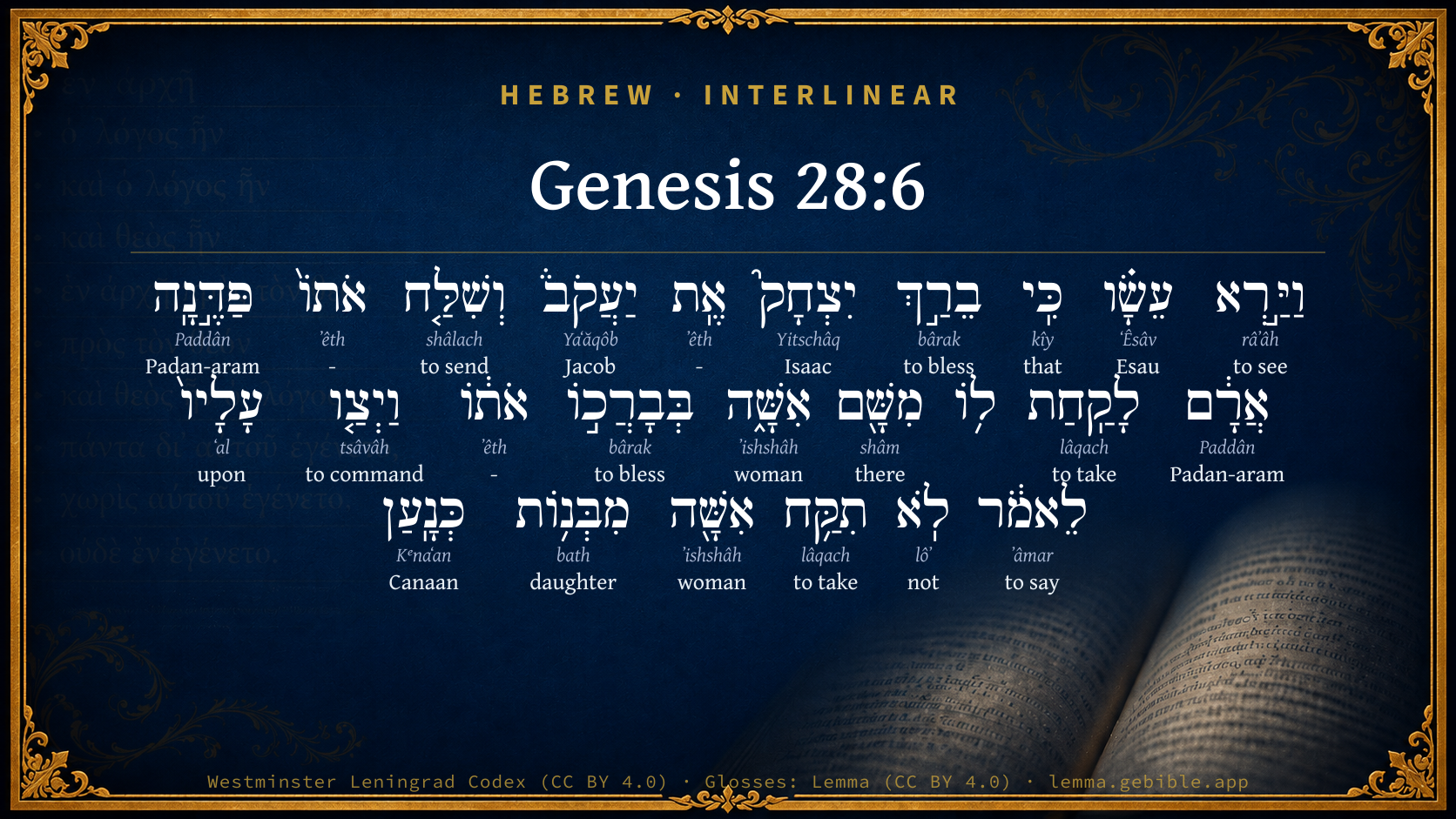
Genesis 28:6

Hebrew (Westminster Leningrad Codex) Genesis 28:6 appears in the Hebrew Old Testament. The text above is from the Westminster Leningrad Codex. Each word links to its Strong’s number, a concise gloss, and parsing drawn from the Open Scriptures Hebrew Bible morphology. Click any word for its full Brown-Driver-Briggs (BDB) entry.
Download image
Cite this verse

Genesis 28:6 (World English Bible). Public Domain. Lemma interlinear Bible study tool, https://lemma.gebible.app/v/genesis/28/6.

Show BibTeX & RIS
BibTeX
RIS
English Translation
Now Esau saw that Isaac had blessed Jacob and sent him away to Paddan Aram, to take him a wife from there, and that as he blessed him he gave him a charge, saying, "You shall not take a wife of the daughters of Canaan,"
World English Bible · Public Domain
Download a study sheet

One document with this verse’s original text, its word-by-word gloss line, the meaning frame, cross-references with their text, attributed commentary, and full source and license credits — printable, and it pastes into notes with its structure intact.

This verse Autodidact and up

Study sheet (.html) Plain text (.txt)

A passage Seminary Student

Up to 50 verses in one chapter. A passage sheet keeps up to 6 commentary sources and 12 cross-references per verse, in the order this page ranks them, and says so on the sheet whenever that leaves anything out. Ask for a single verse and you get the Autodidact verse sheet above.

Everything on this page stays free to read, with no account — the sheet is a download of what is already on screen, not access to it.

Want to remove ads? Support Godless Engineer
Compare translations 3

The same verse in 3 English versions, stacked beneath the original-language interlinear above. Click any original word for its lexicon entry.

Each is an independent rendering of the whole verse — the interlinear is not word-aligned to these translations.

Highlighted words mark where these versions differ — a whole-verse word diff, not a word-by-word alignment.

  • World English Bible Public Domain
    Now Esau saw that Isaac had blessed Jacob and sent him away to Paddan Aram, to take him a wife from there, and that as he blessed him he gave him a charge, saying, "You shall not take a wife of the daughters of Canaan,"
  • King James Version Public Domain
    When Esau saw that Isaac had blessed Jacob, and sent him away to Padanaram, to take him a wife from thence; and that as he blessed him he gave him a charge, saying, Thou shalt not take a wife of the daughters of Canaan;
  • unfoldingWord Literal Text CC BY-SA 4.0
    Now Esau saw that Isaac had blessed Jacob and had sent him to Paddan Aram to take a wife for himself from there, when he blessed him, then he commanded him, saying, “Do not take a wife from the daughters of Canaan,”

unfoldingWord Literal Text — © unfoldingWord, licensed CC BY-SA 4.0. Word-aligned USFM3 via Door43 (git.door43.org/unfoldingWord/en_ult).

Versions to compare (up to 4)

3 of 4 selected

Show all 18 translations

Every available English version of this verse, each an independent rendering of the whole verse.

  • World English Bible Public Domain
    Now Esau saw that Isaac had blessed Jacob and sent him away to Paddan Aram, to take him a wife from there, and that as he blessed him he gave him a charge, saying, "You shall not take a wife of the daughters of Canaan,"
  • Berean Standard Bible Public Domain
    Now Esau learned that Isaac had blessed Jacob and sent him to Paddan-aram to take a wife there, commanding him, “Do not marry a Canaanite woman,”
  • Majority Standard Bible Public Domain
    Now Esau learned that Isaac had blessed Jacob and sent him to Paddan-aram to take a wife there, commanding him, “Do not marry a Canaanite woman,”
  • King James Version Public Domain
    When Esau saw that Isaac had blessed Jacob, and sent him away to Padanaram, to take him a wife from thence; and that as he blessed him he gave him a charge, saying, Thou shalt not take a wife of the daughters of Canaan;
  • American Standard Version (1901) Public Domain
    Now Esau saw that Isaac had blessed Jacob and sent him away to Paddan-aram, to take him a wife from thence. And that as he blessed him he gave him a charge, saying, Thou shalt not take a wife of the daughters of Canaan.
  • Revised Version (1885) Public Domain
    Now Esau saw that Isaac had blessed Jacob and sent him away to Paddan-aram, to take him a wife from thence; and that as he blessed him he gave him a charge, saying, Thou shalt not take a wife of the daughters of Canaan;
  • Geneva Bible (1599) Public Domain
    When Esau sawe that Izhak had blessed Iaakob, and sent him to Padan Aram, to set him a wife thence, and giuen him a charge when he blessed him, saying, Thou shalt not take a wife of the daughters of Canaan,
  • Douay-Rheims (1899) Public Domain
    And Esau seeing that his father had blessed Jacob, and had sent him into Mesopotamia of Syria, to marry a wife thence; and that after the blessing he had charged him, saying: Thou shalt not take a wife of the daughters of Chanaan:
  • Young's Literal Translation Public Domain
    And Esau seeth that Isaac hath blessed Jacob, and hath sent him to Padan-Aram to take to himself from thence a wife -- in his blessing him that he layeth a charge upon him, saying, Thou dost not take a wife from the daughters of Canaan --
  • Literal Standard Version CC BY-SA 4.0
    And Esau sees that Isaac has blessed Jacob, and has sent him to Padan-Aram to take to himself from there a wife—in his blessing him that he lays a charge on him, saying, You must not take a wife from the daughters of Canaan—
  • Unlocked Literal Bible CC BY-SA 4.0
    Now Esau saw that Isaac had blessed Jacob and sent him away to Paddan Aram, to take a wife from there. He also saw that Isaac had blessed him and given him a command, saying, “You must not take a wife from the women of Canaan.”
  • unfoldingWord Literal Text CC BY-SA 4.0
    Now Esau saw that Isaac had blessed Jacob and had sent him to Paddan Aram to take a wife for himself from there, when he blessed him, then he commanded him, saying, “Do not take a wife from the daughters of Canaan,”
  • Darby Bible Public Domain
    And Esau saw that Isaac had blessed Jacob, and sent him away to Padan-Aram, to take a wife thence, blessing him, and giving him a charge saying, Thou shalt not take a wife of the daughters of Canaan;
  • World Messianic Bible Public Domain
    Now Esau saw that Isaac had blessed Jacob and sent him away to Paddan Aram, to take him a wife from there, and that as he blessed him he gave him a command, saying, “You shall not take a wife of the daughters of Canaan;”
  • Webster's Bible Public Domain
    When Esau saw that Isaac had blessed Jacob, and sent him away to Padan-aram, to take him a wife from thence; and that as he blessed him, he gave him a charge, saying, Thou shalt not take a wife of the daughters of Canaan;
  • Free Bible Version CC BY-SA 4.0
    Esau found out that Isaac had blessed Jacob and had sent him to Paddan-aram to find a wife there, and that when he blessed him he ordered him, “Don't marry a Canaanite woman.”
  • Bible in Basic English Public Domain
    So when Esau saw that Isaac had given Jacob his blessing, and sent him away to Paddan-aram to get a wife for himself there, blessing him and saying to him, Do not take a wife from among the women of Canaan;
  • JPS Tanakh (1917) Public Domain
    Now Esau saw that Isaac had blessed Jacob and sent him away to Paddan-aram, to take him a wife from thence; and that as he blessed him he gave him a charge, saying: 'Thou shalt not take a wife of the daughters of Canaan';

Literal Standard Version (2020), Covenant Press — licensed CC BY-SA 4.0. Text via the HelloAO Bible API (eBible.org). Unlocked Literal Bible (unfoldingWord) — licensed CC BY-SA 4.0. Text via the HelloAO Bible API (eBible.org). unfoldingWord Literal Text — © unfoldingWord, licensed CC BY-SA 4.0. Word-aligned USFM3 via Door43 (git.door43.org/unfoldingWord/en_ult). Free Bible Version, Dr. Jonathan Gallagher — licensed CC BY-SA 4.0. Text via the HelloAO Bible API (eBible.org).

Word by word

More ways to search: Search by grammar → Find every occurrence → Compare this word →

Practice this passage: Drill this verse → Learn its vocabulary →

פַּדֶּ֣נָֽה
Paddân
H6307
“Padan-aram · toward”
Noun, Proper + Suffix, Demonstrative
Part of Speech
Noun
Type
Proper
Full BDB Definition

Origin: from an unused root meaning to extend

TWOT: 1735

Padan or Padan-aram = "field" - a plain or tableland in northern Mesopotamia in Aram, a region of Syria
  1. וַיַּ֣רְא râʼâh H7200 “and · to see” Conjunction + Verb, Qal, Sequential Imperfect, 3rd Person, Masculine, Singular
  2. עֵשָׂ֗ו ʻÊsâv H6215 “Esau” Noun, Proper
  3. כִּֽי kîy H3588 “that” Conjunction
  4. בֵרַ֣ךְ bârak H1288 “to bless” Verb, Piel, Perfect, 3rd Person, Masculine, Singular
  5. יִצְחָק֮ Yitschâq H3327 “Isaac” Noun, Proper
  6. אֶֽת ʼêth H853 “-” Particle, Direct Object
  7. יַעֲקֹב֒ Yaʻăqôb H3290 “Jacob” Noun, Proper
  8. וְשִׁלַּ֤ח shâlach H7971 “and · to send” Conjunction + Verb, Piel, Perfect, 3rd Person, Masculine, Singular
  9. אֹתוֹ֙ ʼêth H853 “- · him” Particle, Direct Object + Suffix, Personal, 3rd Person, Masculine, Singular
  10. אֲרָ֔ם Paddân H6307 “Padan-aram” Noun, Proper
  11. לָקַֽחַת lâqach H3947 “to take” Preposition + Verb, Qal, Infinitive Construct
  12. מִשָּׁ֖ם shâm H8033 “from · there” Preposition + Adverb
  13. אִשָּׁ֑ה ʼishshâh H802 “woman” Noun, Common, Feminine, Singular, Absolute
  14. בְּבָרֲכ֣וֹ bârak H1288 “in/at · to bless · him” Preposition + Verb, Piel, Infinitive Construct + Suffix, Personal, 3rd Person, Masculine, Singular
  15. אֹת֔וֹ ʼêth H853 “- · him” Particle, Direct Object + Suffix, Personal, 3rd Person, Masculine, Singular
  16. וַיְצַ֤ו tsâvâh H6680 “and · to command” Conjunction + Verb, Piel, Sequential Imperfect, 3rd Person, Masculine, Singular
  17. עָלָיו֙ ʻal H5921 “upon · him” Preposition + Suffix, Personal, 3rd Person, Masculine, Singular
  18. לֵאמֹ֔ר ʼâmar H559 “to say” Preposition + Verb, Qal, Infinitive Construct
  19. לֹֽא lôʼ H3808 “not” Particle, Negative
  20. תִקַּ֥ח lâqach H3947 “to take” Verb, Qal, Imperfect, 2nd Person, Masculine, Singular
  21. אִשָּׁ֖ה ʼishshâh H802 “woman” Noun, Common, Feminine, Singular, Absolute
  22. מִבְּנ֥וֹת bath H1323 “from · daughters of” Preposition + Noun, Common, Feminine, Plural, Construct
  23. כְּנָֽעַן Kᵉnaʻan H3667 “Canaan” Noun, Proper

About this verse

These counts appear in no published source. They are computed here, from the morphology-tagged text and Lemma’s own curated glosses. What Lemma adds →

25
words
18
distinct lemmas
Pentateuch
section

Notable vocabulary

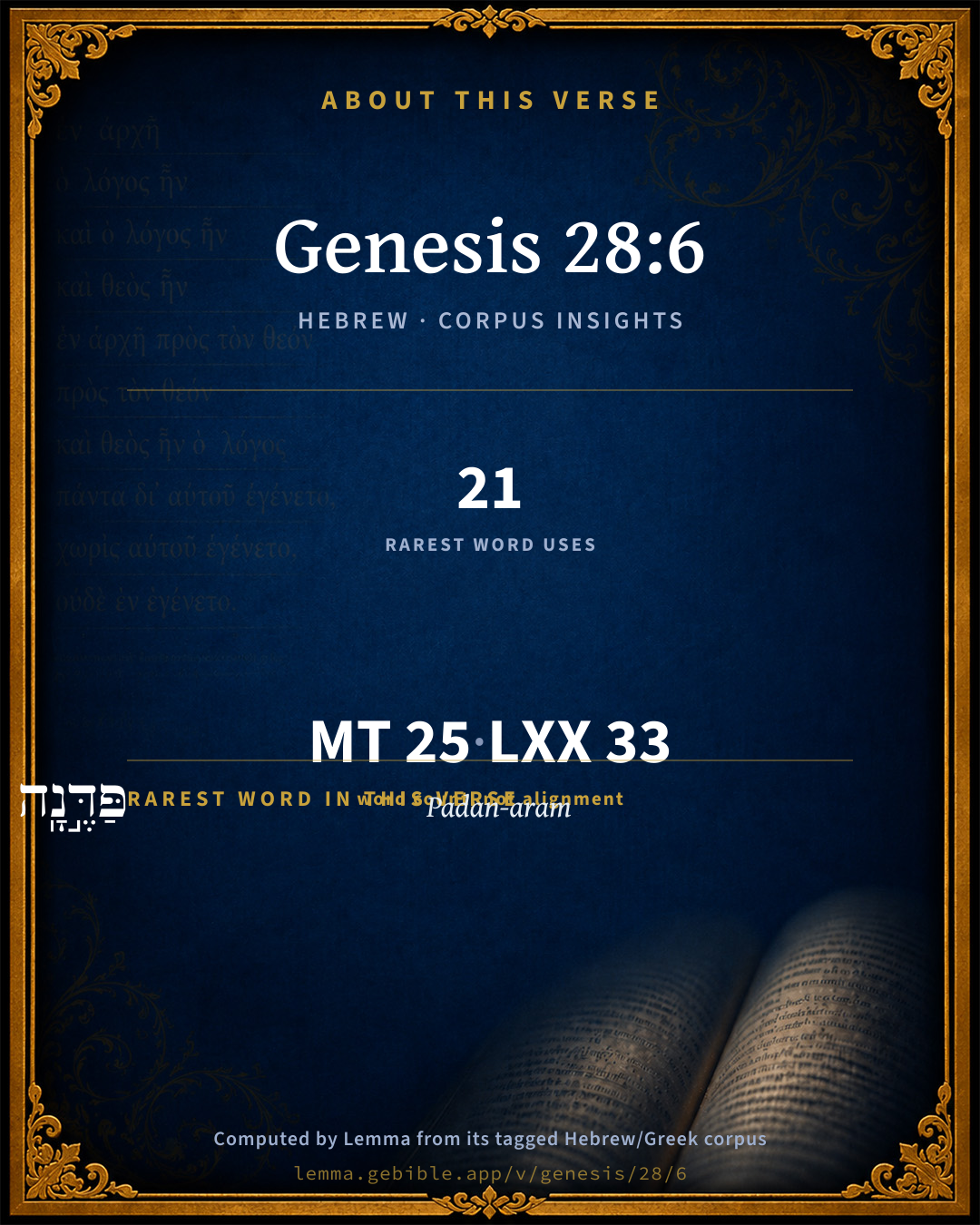
The rarest word here is פַּדֶּ֣נָֽה Padan-aram H6307 — appearing just 21 times in the whole Hebrew Bible.

Shared distinctive vocabulary

פַּדֶּ֣נָֽה Padan-aram H6307 occurs in 11 verses of the Hebrew Bible. Also found in:

Grammatical profile

  • 8 verbs
  • 9 nouns
  • 2 prepositions
  • 1 conjunction
  • 1 adverb
  • 4 particles

Verb forms

  • וַיַּ֣רְא Qal · Sequential Imperfect
  • בֵרַ֣ךְ Piel · Perfect
  • וְשִׁלַּ֤ח Piel · Perfect
  • לָקַֽחַת Qal · Infinitive Construct
  • בְּבָרֲכ֣וֹ Piel · Infinitive Construct
  • וַיְצַ֤ו Piel · Sequential Imperfect
  • לֵאמֹ֔ר Qal · Infinitive Construct
  • תִקַּ֥ח Qal · Imperfect

Repetition

Words recur within this verse — often emphatic in Hebrew:

  • בֵרַ֣ךְ to bless H1288 ×2
  • פַּדֶּ֣נָֽה Padan-aram H6307 ×2
  • לָקַֽחַת to take H3947 ×2
  • אִשָּׁ֑ה woman H802 ×2

Hebrew & Septuagint length

In English translation the verse runs 45 words from the Hebrew and 44 from the Septuagint (LXX English) — closely comparable.

A rough comparison of the two English renderings, which tokenize alike — not a word-level alignment.

Word counts can differ between the Hebrew and the Greek without any difference in meaning — e.g. the Hebrew direct-object marker אֵת has no separate Greek word, and Greek often adds the article ὁ.

In the original languages it is 25 Hebrew tokens and 33 Greek tokens — but the two are counted differently (Hebrew bundles its prefixes and suffixes into one token; the Greek is in lemma form), so that isn’t a like-for-like length.

Cross-references

2

Topical passages linked to Genesis 28:6 in the Treasury of Scripture Knowledge — connected by theme and wording, ordered by reader-vote popularity; previews shown in the World English Bible.

  • Genesis 27:33 Isaac trembled violently, and said, "Who, then, is he who has taken venison, and brought it me, and I have eaten of all before you came, and have blessed him? Yes, he will be blessed."
  • Genesis 28:1 Isaac called Jacob, blessed him, and commanded him, "You shall not take a wife of the daughters of Canaan.

Cross-references courtesy of OpenBible.info (CC BY 4.0).

Hebrew and Greek witnesses Masoretic Hebrew ↔ Greek Septuagint

The same verse in the two great witnesses to the Old Testament, shown verse-for-verse.

These are two independent witnesses, not word-aligned to each other, and the Septuagint is shown in lemma (dictionary) form.

Hebrew Genesis 28:6 Masoretic · Westminster Leningrad Codex

וַיַּ֣רְא עֵשָׂ֗ו כִּֽי בֵרַ֣ךְ יִצְחָק֮ אֶֽת יַעֲקֹב֒ וְשִׁלַּ֤ח אֹתוֹ֙ פַּדֶּ֣נָֽה אֲרָ֔ם לָקַֽחַת ל֥וֹ מִשָּׁ֖ם אִשָּׁ֑ה בְּבָרֲכ֣וֹ אֹת֔וֹ וַיְצַ֤ו עָלָיו֙ לֵאמֹ֔ר לֹֽא תִקַּ֥ח אִשָּׁ֖ה מִבְּנ֥וֹת כְּנָֽעַן

Now Esau saw that Isaac had blessed Jacob and sent him away to Paddan Aram, to take him a wife from there, and that as he blessed him he gave him a charge, saying, "You shall not take a wife of the daughters of Canaan,"

World English Bible · Public Domain

Greek LXX Genesis 28:6 Septuagint · lemma form

ὁράω δέ ησαυ ὅτι εὐλογέω ισαακ ὁ ἰακώβ καί ἀποοἴχομαι εἰς ὁ μεσοποταμία συρία λαμβάνω ἑαυτοῦ ἐκεῖθεν γυνή ἐν ὁ εὐλογέω αὐτός καί ἐντέλλομαι αὐτός λέγω οὐ λαμβάνω γυνή ἀπό ὁ θυγάτηρ χανααν

And Esau saw that Isaac blessed Jacob, and sent him away to Mesopotamia of Syria as he blessed him, to take to himself a wife thence, and that he charged him, saying, You shall not take a wife of the daughters of the Chananites;

LXX2012 (modern English Septuagint) · Public Domain

Hebrew: Westminster Leningrad Codex (CC BY 4.0). Greek: Septuagint (public domain); English from LXX2012 (modern English Septuagint) (Public Domain). How the Septuagint differs from the Hebrew →

Targum (Aramaic paraphrase)

2

The Targum is the ancient Jewish Aramaic paraphrase of the Hebrew Scriptures — an interpretive translation, not the Hebrew text itself. Onkelos (literal) and Pseudo-Jonathan (expansive) render the Torah, and Jonathan the Prophets. Coverage is partial: where no permissively-licensed English translation exists for a verse, only the Aramaic is shown. This is verse-level text, not a word-by-word alignment to the Hebrew.

  1. Targum Onkelos Torah (Genesis–Deuteronomy)
    וַחֲזָא עֵשָׂו אֲרֵי בָרִיךְ יִצְחָק יָת יַעֲקֹב וְשַׁלַּח יָתֵהּ לְפַדַּן אֲרָם לְמִסַּב לֵהּ מִתַּמָּן אִתְּתָא כַּד בָּרִיךְ יָתֵהּ וּפַקֵּיד עֲלוֹהִי לְמֵימַר לָא תִסַּב אִתְּתָא מִבְּנַת כְּנָעַן

    (no public-domain English translation for this verse)

    Targum Onkelos — Aramaic: “Onkelos Genesis” (public domain); “Onkelos Exodus” (public domain); “Onkelos Leviticus” (public domain); “Onkelos Numbers” (public domain); “Onkelos Deuteronomy” (public domain). English: “Sefaria Community Translation” (CC0 1.0 (public-domain dedication)); “J.W. Etheridge. The Targums of Onkelos and Jonathan Ben Uzziel on the Pentateuch. London: Longmans, Green, 1862” (public domain). Text via Sefaria.

  2. Targum Pseudo-Jonathan Torah (Genesis–Deuteronomy)
    וַחֲמָא עֵשָו אֲרוּם בְּרִיךְ יִצְחָק יַת יַעֲקב וְשָׁדַר יָתֵיהּ לְפַדַן אֲרָם לְמֵיסַב לֵיהּ מִתַּמָן אִיתָא כַּד בְּרִיךְ יָתֵיהּ וּפַקֵיד עֲלוֹי לְמֵימָר לָא תִיסַב אִיתָא מִבְּנַתְהוֹן דִכְנַעֲנָאֵי

    And Esau considered that Izhak had blessed Jakob, and had sent him to Padan Aram to take to him from thence a wife, when he blessed him, and commanded him, saying, Thou shalt not take a wife of the daughters of the Kenaanites;

    Targum Pseudo-Jonathan — Aramaic: “Targum Jonathan on Genesis” (public domain); “Targum Jonathan on Exodus” (public domain); “Targum Jonathan on Leviticus” (public domain); “Targum Jonathan on Numbers” (public domain); “Targum Jonathan on Deuteronomy” (public domain). English: “The Targum of Jonathan ben Uzziel, trans. J. W. Etheridge, London, 1862” (public domain). Text via Sefaria.

Commentary

Notes on Genesis 28:6 from classic Christian and Jewish commentators (each source and its license shown beneath its notes). The classic Christian expositions comment on the surrounding passage and are grouped to its opening verse, so a note may address several verses; the Jewish commentaries on the Tanakh (Rashi and others) are per-verse, so they appear only where the commentator wrote on this verse.

Lemma curates 59 commentaries, every one of them public domain or Creative Commons licensed, each selected and text-cleaned for this edition rather than reprinted as found. About our sources →

Trapp's Complete Commentary

John Trapp

Gen 28:6 When Esau saw that Isaac had blessed Jacob, and sent him away to Padanaram, to take him a wife from thence; and that as he blessed him he gave him a charge, saying, Thou shalt not take a wife of the daughters of Canaan;

Ver. 6. When Esau saw, &c.] But he was ever too late (Oψινοος), and therefore what he did was to little purpose. An overlate sight is good neither in piety nor policy. They will find it so that are semper victuri ,{ a} and never can find time to begin till they are shut out of heaven for their trifling. How many have we known taken away in their offers and essays; before they had prepared their hearts to cleave to God!

{a} Seneca.

John Trapp, A Commentary or Exposition upon All the Books of the Old and New Testament (1647–1656) — public domain. Text from a community e-Sword module.

The Biblical Illustrator

Joseph S. Exell

Gen_28:6-9

Then went Esau unto Ishmael

Esau, the type of worldliness and hypocrisy

I.

HIS CONDUCT WAS MERCENARY.

II. HIS CONDUCT WAS ONE-SIDED.

III. HIS CONDUCT WAS FRAMED BY THE PRINCIPLE OF IMITATION. (T. H.Leale.)

Lessons

1. Hypocrites hearing of blessing upon others, pretend to make to it as well as any.

2. Hypocrites hearing Gods charge to accompany His blessing, would seem to observe it (Gen_28:6).

3. Hypocrites seeing the obedience of saints, would seem to imitate it (Gen_28:7).

4. Hypocrites perceiving what is displeasing to God and His servants, would seem to avoid it (Gen_28:8).

5. Hypocrites in all their pretences for God, take their own ways without His counsel.

6. Hypocrites in all their pretended imitations of the saints do but add sin to sin (Gen_28:9). (G. Hughes, B. D.)

Mistaken imitation

See what awkward work is made when men go about to please others, and promote their worldly interests, by imitating that in which they have no delight. Ignorance and error mark every step they take, Esau was in no need of a wife. His parents would not be gratified by his connection with the apostate family of Ishmael. In short, he is out in all his calculations; nor can he discover the principles which influence those who fear the Lord. Thus have we often seen men try to imitate religious people for the sake of gaining esteem, or some way promoting their selfish ends; but instead of succeeding they have commonly made bad worse. That which to a right mind is as plain as the most public highway, to a mind perverted shall appear full of difficulties. The labour of the foolish wearieth every one of them, because he knoweth not how to go to the city (Ecc_10:15). (A. Fuller.)

The Biblical Illustrator, edited by Joseph S. Exell (c. 1880s–1900s) — public domain. Text from a community e-Sword module.

Joseph Benson's Commentary

Gen 28:6. This passage comes in, in the midst of Jacob’s story, to show the influence of good example. Esau now begins to think Jacob the better man, and disdains not to take him for his pattern in this particular instance of marrying a daughter of Abraham.

Joseph Benson's Commentary on the Old and New Testaments (1811–1818) — public domain. Text from a community e-Sword module.

The Preacher's Complete Homiletical Commentary

Joseph S. Exell (gen. ed.)

CRITICAL NOTES.—

Gen_28:9. Then went Esau unto Ishmael.] To his family, and not to Ishmael himself, who had been dead for fourteen years. (Gen_25:17.)—

MAIN HOMILETICS OF THE PARAGRAPH.—Gen_28:6-9

ESAU, THE TYPE OF WORLDLINESS AND HYPOCRISY

Esau attempts to repair the error into which he had fallen by marrying into a heathen family, to the great grief of his parents. He knew that his father had charged Jacob to avoid such a wicked course (Gen_28:1), and that upon this point he would be most accessible. Therefore he resolves to marry into his father’s family. He considered that this would pass with his father as a noble act of filial devotion. But all this is only the wordly policy of the hypocrite. He feigns repentance in order to secure some temporal good or comfort for himself. He is, therefore, the type of hypocrisy and worldliness in religion. He was certainly, all this time, a hypocrite, for he nursed hatred in his heart against his brother, and only waited opportunity to carry out his evil purpose. Such are the characteristics of the religion of hypocrites of all times. What was the case with Esau?

I. His conduct was mercenary. He only cared to win back the temporal advantages of the blessing by any means, even by the pretence of a pious devotion to the wishes of his father. So hypocrites only study their own worldly interests. They are concerned with religion only so far as it will promote these. They are like the multitude who were ready to follow Christ as long as He offered easy blessings, but deserted Him the moment their advantage seemed to lie in another direction. Such men claim to follow Christ as long as they think that their worldly prosperity is promoted by such a profession, but they will barter Him for a consideration when the temptation is strong enough. “What will ye give me, and I will deliver Him unto you.”

II. His conduct was one-sided. Esau wanted to secure the favour and blessing of his father while, at the same time, he was cherishing deadly hatred towards his brother. He wanted to enjoy all the benefits of piety while he wilfully neglected some of its obligations. There are those who would like to secure the favour of God and some of the advantages of religion, while at the same time, they have no respect to all God’s commandments. They wickedly assume a privilege in regard to certain sins. They are willing to serve God in many respects, if only an exception can be made in favour of some particular sin. Such men do not submit themselves to God. They are strangers to the spirit of faith and obedience, and therefore they are not righteous. The servants of God cannot be allowed to choose their own paths of duty by a principle of selfish interest.

III. His conduct was framed by the principle of imitation. Esau presumed to imitate the conduct of his brother, but he was ignorant of the deep grounds upon which it rested. There are many hypocrites in this sense, that they are imitators of the outward conduct and signs of devotion of godly men. Such men deceive themselves. They do not intend to be guilty of a pretence; but are merely imitators of what pious men do and say, though, all the while, they are ignorant of the deep reasons upon which these things are founded. Esau, then, is a type of the worldly man, and of hypocrites who wish to claim some of the advantages of religion without giving themselves up entirely to God, and also of those who imitate the conduct of the truly pious without their deep convictions and felt satisfaction in God. The result of Esau’s conduct is a warning to all whom it may concern. His scheme did not succeed, and he only was landed in worse difficulties. He marries into a family quite outside the pale of the covenant, one which was outlawed and alienated, where even now the pure worship of God had already degenerated. So the hope of the hypocrite shall perish.

SUGGESTIVE COMMENTS ON THE VERSES

Gen_28:6. But he was ever too late, and therefore what he did was to little purpose. An over-late sight is good neither in piety nor policy. How many have we known taken away in their offers and essays, before they had prepared their hearts to cleave to God.—(Trapp.)

Gen_28:7-9. See what awkward work is made when men go about to please others, and promote their worldly interests by imitating that in which they have no delight. Ignorance and error mark every step they take. Esau was in no need of a wife. His parents would not be gratified by his connection with the apostate family of Ishmael. In short, he is out in all his calculations; nor can he discover the principles which influence those who fear the Lord. Thus have we often seen men try to imitate religious people for the sake of gaining esteem, or some way promoting their selfish ends; but instead of succeeding they have commonly made bad worse. That which to a right mind is as plain as the most public highway, to a mind perverted shall appear full of difficulties. “The labour of the foolish wearieth every one of them, because he knoweth not how to go to the city.” (Ecc_10:15.)—(Fuller.)

Hypocrites will needs do something that they may seem to be somebody. But, for the want of an inward principle, they do nothing well. They cement one error with another, as Esau here; and as Herod prevents perjury by murder, thus while they shun the sands they fall into the whirlpool.—(Trapp.)

The Preacher's Complete Homiletical Commentary (gen. ed. Joseph S. Exell; Funk & Wagnalls, c. 1892) — public domain (pre-1929). A full-Bible homiletical/sermon-outline anthology covering 65 of 66 books (2 John is absent from the source module). Text from a community e-Sword module.

Tyndale Open Study Notes

Tyndale Open Resources

28:6-9 Esau, the unchosen son still trying to please his father, married a woman from the unchosen line of Ishmael, which he thought would be more acceptable. He did not understand the uniqueness of the covenant family.

Tyndale Open Study Notes — © Tyndale Open Resources, licensed CC BY-SA 4.0. Text via the HelloAO Bible API.

Matthew Henry's Commentary

This passage concerning Esau comes in in the midst of Jacob's story, either, 1. To show the influence of a good example. Esau, though the greater man, now begins to think Jacob the better man, and disdains not to take him for his pattern in this particular instance of marrying with a daughter of Abraham. The elder children should give to the younger an example of tractableness and obedience; it is bad if they do not: but it is some alleviation if they take the example of it from them, as Esau here did from Jacob. Or, 2. To show the folly of an after-wit. Esau did well, but he did it when it was too late, He saw that the daughters of Canaan pleased not his father, and he might have seen that long ago if he had consulted his father's judgment as much as he did his palate. And how did he now mend the matter? Why, truly, so as to make bad worse. (1.) He married a daughter of Ishmael, the son of the bond-woman, who was cast out, and was not to inherit with Isaac and his seed, thus joining with a family which God had rejected, and seeking to strengthen his own pretensions by the aid of another pretender. (2.) He took a third wife, while, for aught that appears, his other two were neither dead nor divorced. (3.) He did it only to please his father, not to please God. Now that Jacob was sent into a far country Esau would be all in all at home, and he hoped so to humour his father as to prevail with him to make a new will, and entail the promise upon him, revoking the settlement lately made upon Jacob. And thus, [1.] He was wise when it was too late, like Israel that would venture when the decree had gone forth against them (Num 14:40), and the foolish virgins, Mat 25:11. [2.] He rested in a partial reformation, and thought, by pleasing his parents in one thing, to atone for all his other miscarriages. It is not said that when he saw how obedient Jacob was, and how willing to please his parents, he repented of his malicious design against him: no, it appeared afterwards that he persisted in that, and retained his malice. Note, Carnal hearts are apt to think themselves as good as they should be, because perhaps, in some one particular instance, they are not so bad as they have been. Thus Micah retains his idols, but thinks himself happy in having a Levite to be his priest, Jdg 17:13.

Matthew Henry's Commentary on the Whole Bible (1708–1710) — public domain (CC PDM 1.0). Text via the HelloAO Bible API.

Jamieson, Fausset & Brown

Robert Jamieson, A. R. Fausset & David Brown

when Esau saw that Isaac had blessed Jacob, &c.--Desirous to humor his parents and, if possible, get the last will revoked, he became wise when too late (see Mat 25:10), and hoped by gratifying his parents in one thing to atone for all his former delinquencies. But he only made bad worse, and though he did not marry a "wife of the daughters of Canaan," he married into a family which God had rejected. It showed a partial reformation, but no repentance, for he gave no proofs of abating his vindictive purposes against his brother, nor cherishing that pious spirit that would have gratified his father--he was like Micah (see Jdg 17:13).

Jamieson, Fausset & Brown — Commentary Critical and Explanatory on the Whole Bible (1871) — public domain (CC PDM 1.0). Text via the HelloAO Bible API.

John Calvin's Commentaries

6. When Esau saw. A brief narration concerning Esau is here inserted, which it is useful to know; because we learn from it that the wicked, though they exalt themselves against God, and though, in contempt of his grace, they please themselves in obtaining their desires, are yet not able to despise that grace altogether. So now, Esau is penetrated with a desire of the blessing; not that he aspires to it sincerely and from his heart; but perceiving it to be something valuable, he is impelled to seek after it, though with reluctance. A further fault is, that he does not seek it as he ought: for he devises a new and strange method of reconciling God and his father to himself; and therefore all his diligence is without profit. At the same time he does not seem to be careful about pleasing God, so that he may but propitiate his father. Before all things, it was his duty to cast aside his profane disposition, his perverse manners, and his corrupt affections of the flesh, and then to bear with meekness the chastisement inflicted upon him: for genuine repentance would have dictated to him this sentiment, Seeing I have hitherto rendered myself unworthy of the birthright, my brother is deservedly preferred before me. Nothing, therefore, remains for me but to humble myself, and since I am deprived of the honor of being the head, let it suffice me to be at least one of the members of the Church. And, certainly, it would have been more desirable for him to remain in some obscure corner of the Church, than, as one cut off and torn away from the elect people, to shine with a proud preeminence on earth. He aims, however, at nothing of this kind, but attempts, by I know not what prevarications, to appease his father in whatever way he may be able. Moses, in this example, depicts all hypocrites to the life. For as often as the judgment of God urges them, though they are wounded with the pain of their punishment, they yet do not seek a true remedy; for having aimed at offering one kind of satisfaction only, they entirely neglect a simple and real conversion: and even in the satisfaction offered, they only make a pretense. Whereas Esau ought thoroughly to have repented, he only tried to correct the single fault of his marriage; and this too in a most absurd manner. Yet another defect follows: for while he retains the wives who were so hateful to his parents, he supposes he has discharged his duty by marrying a third. But by this method, neither was the trouble of his parents alleviated, nor his house cleansed from guilt. And now truly, whence does he marry his third wife? From the race of Ishmael, whom we know to have been himself degenerate, and whose posterity had departed from the pure worship of God. A remarkable proof of this is discernible at the present day, in the pretended and perfidious intermeddlers, who imagine they can admirably adjust religious differences by simply adorning their too gross corruptions with attractive colors. The actual state of things compels them to confess that the vile errors and abuses of Popery have so far prevailed as to render a Reformation absolutely necessary: but they are unwilling that the filth of this Camarine marsh be stirred; they only desire to conceal its impurities, and even that they do by compulsion. For they had previously called their abominations the sacred worship of God; but since these are now dragged to light by the word of God, they therefore descend to novel artifices. They flatter themselves, however; in vain, seeing they are here condemned by Moses, in the person of Esau. Away, then, with their impure pretended reformation, which has nothing simple nor sincere. Moreover, since it is a disease inherent in the human race, willingly to attempt to deceive God by some fictitious pretext, let us know that we do nothing effectually, until we tear up our sins by the roots, and thoroughly devote ourselves to God.

John Calvin's Commentaries (1540-1563) — public domain. Text from the Calvin Translation Society English edition (1840s-50s) via the Christian Classics Ethereal Library (ccel.org). Calvin's coverage is partial (roughly two-thirds of the Bible); uncommented books and verses are honest gaps, never fabricated. The 19th-century editor's footnotes and remarks are omitted so the notes are faithfully Calvin's own voice.

Ellicott's Commentary for English Readers

ESAU MARRIES A DAUGHTER OF ISHMAEL.

(6) When Esau.—The solemn transfer of the birthright to Jacob, and Isaac’s complete assent thereto, must have been the cause of no little grief to Esau, and evidently it made him feel that he had greatly contributed to this result by his own illegitimate marriages. When, then, he sees Jacob sent away to obtain a wife, in accordance with the rule established by Abraham, he determines also to conform to it, and marries a daughter of Ishmael. She is called Bashe-math in chap 36:3, and described in both places as “the sister of Nebajoth,” in order to show that as Nebajoth “the firstborn” (Gen_25:13) was undoubtedly the son of Ishmael by his first wife, “whom Hagar took for him out of the land of Egypt” (Gen_21:21), so also Mahalath shared in this precedence, and was not the daughter of any of Ishmael’s subsequent wives, or of a concubine.

A Bible Commentary for English Readers, edited by Charles John Ellicott (1878–1897) — public domain. Text from a community e-Sword module.

The Cambridge Bible for Schools and Colleges

gen. ed. J. J. S. Perowne

6. Now Esau saw] The conduct of Esau in this passage is prompted by the desire to obtain a blessing such as Isaac had given Jacob in Gen_28:3-4. In order to propitiate his father, he contracts a marriage with his first cousin, the daughter of Ishmael. Neither in this, nor in the following verse, is there implied any resentment on the part of Esau towards Jacob, or any other reason for Jacob’s journey to Paddan-aram beyond that of marriage with one of his own kindred.

The Cambridge Bible for Schools and Colleges (gen. ed. J. J. S. Perowne; Cambridge University Press, 1878–1918) — public domain. Text from a community e-Sword module.

John Gill's Exposition

And when Esau saw that Isaac had blessed Jacob,.... Had conferred the blessing before given, or had wished him a good journey; which perhaps may be all that Esau understood by it, and so was not so much offended with it:

and sent him away to Padanaram, to take him a wife from thence; which likewise might not be displeasing to him, partly as he understood it to be only on account of taking a wife, and not on account of his ill design upon him, which he might imagine his parents knew nothing of; and partly as he would now be out of the way, and he might find means the easier to ingratiate himself into his father's favour, and get him to revoke the blessing, and settle the inheritance upon him:

and that as he blessed him, he gave him a charge, saying, thou shalt not take a wife of the daughters of Canaan; or of the Canaanites, of any of the tribes or nations that belonged to that people, whether Hittites or others.

John Gill's Exposition of the Whole Bible (1746–1763) — public domain (CC PDM 1.0). Text via the HelloAO Bible API.

The Pulpit Commentary

Vers. 6-9. When (literally, and) Esau saw that Issue had blessed Jacob, and sent him away to Padan-aram, to take him a wife from thence; and that as he blessed him he gave him a charge, literally, in his blessing him (forming a parenthesis), and he commanded him saying, Thou shalt not take a wife of the daughters of Canaan; and that (literally, and) Jacob obeyed his father and his mother, and was gone (or went) to Padan-aram; and Esau seeing that (more correctly, saw that) the daughters of Canaan pleased not (literally, were evil in the eyes of) Isaac his father; then (literally, and) went Esau unto Ishmael (i.e. the family or tribe of Ishmael, aiming in this likely to please his father), and took unto the wives which he had (so that they were neither dead nor divorced) Mahalath (called Bashemath in Gen_36:3) the daughter of Ishmael (and therefore Esau"s half-cousin by the father"s side, Ishmael, who was now dead thirteen years, having been Isaac"s half-brother) Abraham"s son, the sister of Nebajoth, Ishmael"s firstborn (Gen_25:13) to be his wife.

The Pulpit Commentary (1880–1919), ed. H.D.M. Spence-Jones & Joseph S. Exell — public domain. Text from a community e-Sword module.

John Wesley's Explanatory Notes

This passage comes in, in the midst of Jacob's story, to shew the influence of a good example. Esau now begins to think Jacob the better man, and disdains not to take him for his pattern in this particular instance of marrying with a daughter of Abraham.

John Wesley, Explanatory Notes Upon the Whole Bible (1754–1765) — public domain. Text via the GEBible commentary corpus.

unfoldingWord translationNotes

Door43 World Missions Community

General Information:

The story changes from Jacob to Esau

Now

This word is used here to mark a change from the story to background information about Esau. (See: Background Information)

Paddan Aram

This was another name for the region of Mesopotamia, which about the same location as modern Iraq. See how this was translated in Genesis 25:20. (See: How to Translate Names)

to take a wife

"to take a wife for himself"

He also saw that Isaac had blessed him

"Esau also saw that Isaac had blessed Jacob"

You must not take

"Do not take"

women of Canaan

"daughters of Canaan" or "Canaanite women"

translationWords

Esau

Isaac

Jacob

command

Canaan

obey

unfoldingWord translationNotes — © Distant Shores Media and the Door43 World Missions Community, licensed CC BY-SA 4.0. Source: git.door43.org/Door43/en_tn.

Radak

Rabbi David Kimhi (Radak)

וירא, seeing that the sense of sight is a more reliable sense of perception than any of the other 4 senses, the Torah describes Esau’s realisation of what had transpired as being visual.

לקחת לו משם אשה, the fact that Yaakov was fleeing from Esau’s wrath had not become known, everyone thinking he had left to select a bride for himself.

Radak on the Tanakh — English translations: “Sefaria Community Translation” (CC0 1.0 (public-domain dedication)); “Eliyahu Munk, HaChut Hameshulash” (CC BY 4.0); “Rabbi Mike Feuer, Jerusalem Anthology” (CC BY 4.0); and “R. David Kimhi on the first book of Psalms, Translated by R.G. Finch, London, 1919” (public domain). Text via Sefaria.

Lesson kit

Teaching starters — assembled from the data on this page, not authored interpretation. Every prompt links to the verse data it draws on. Edit before teaching.

Genesis, in the Pentateuch, opens this verse with 25 words (18 distinct Hebrew lemmas). Its most distinctive word is Paddân (“Padan-aram”). A historical commentator’s framing appears above. Read the whole chapter for the surrounding context.

Discussion questions

  1. How does “Padan-aram” (Paddân) shape what this verse is saying?
  2. Genesis 25:20 shares the word «Padan-aram» with this verse. How do the two illuminate each other?
  3. “to bless” occurs 2× in this one verse. What is the effect of the repetition?
  4. The translations on this page render this verse differently — a whole-verse word diff, not a word-by-word alignment. What might account for the different wordings?
  5. The verb «וַיַּ֣רְא» is Qal Sequential Imperfect. How does its form color the action?
  6. Reading how Trapp's Complete Commentary and The Biblical Illustrator read this verse, where do the two commentators agree and where do they part?

Things to notice

Reading settings

Reading text

Shown beneath each verse's original-language words.

Old Testament
Old Testament edition

Read the OT as the Masoretic Hebrew (MT) or the Greek Septuagint (LXX).

English shown for the Greek Septuagint (in the Hebrew ↔ Greek comparison).

Comparing translations? Open the Compare panel on any verse page to stack up to four side by side.