Joshua 24:10

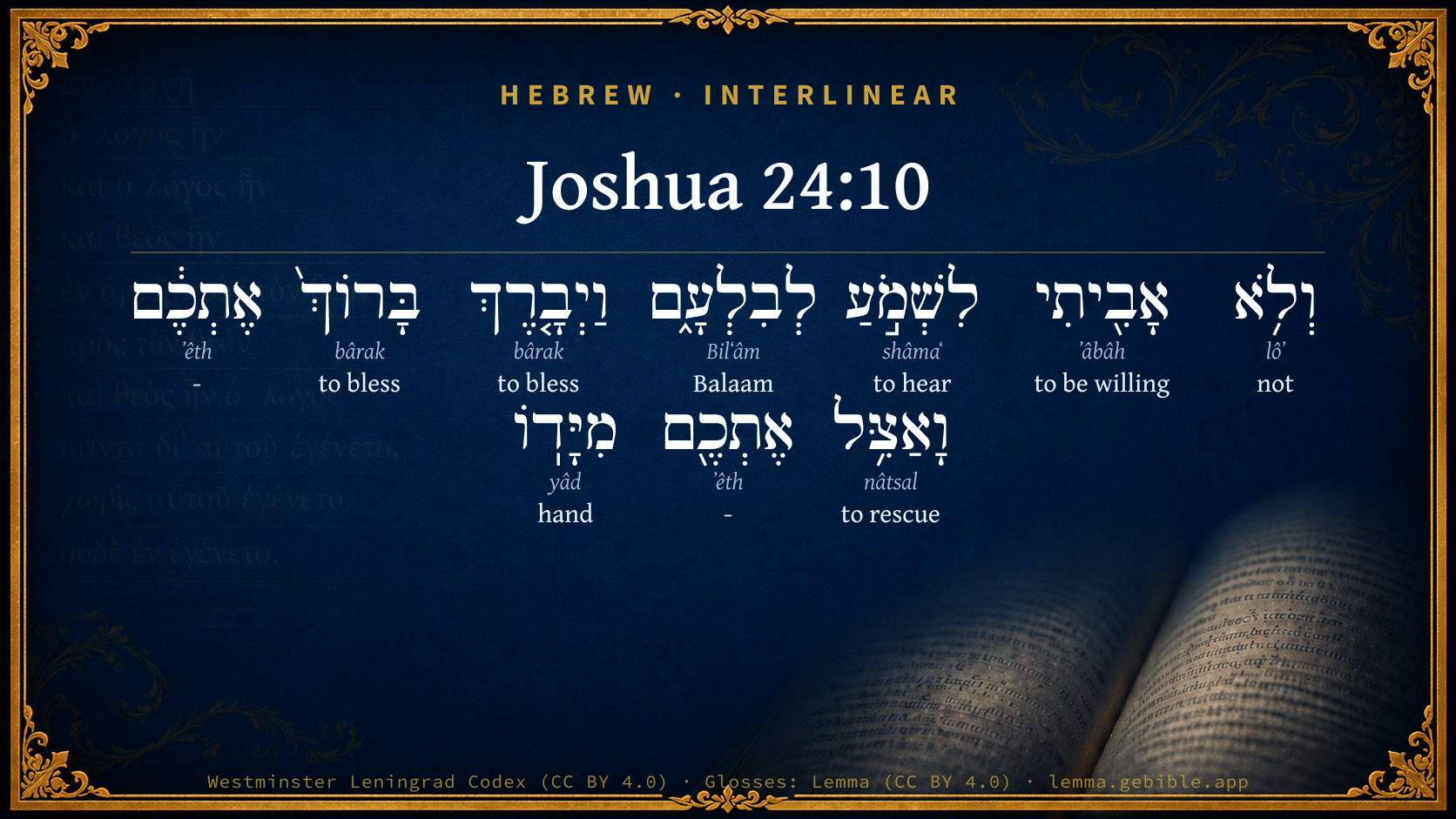
Hebrew (Westminster Leningrad Codex) Joshua 24:10 appears in the Hebrew Old Testament. The text above is from the Westminster Leningrad Codex. Each word links to its Strong’s number, a concise gloss, and parsing drawn from the Open Scriptures Hebrew Bible morphology. Click any word for its full Brown-Driver-Briggs (BDB) entry.
Download image
Cite this verse

Joshua 24:10 (World English Bible). Public Domain. Lemma interlinear Bible study tool, https://lemma.gebible.app/v/joshua/24/10.

Show BibTeX & RIS
BibTeX
RIS
English Translation
but I would not listen to Balaam; therefore he blessed you still: so I delivered you out of his hand.
World English Bible · Public Domain
Download a study sheet

One document with this verse’s original text, its word-by-word gloss line, the meaning frame, cross-references with their text, attributed commentary, and full source and license credits — printable, and it pastes into notes with its structure intact.

This verse Autodidact and up

Study sheet (.html) Plain text (.txt)

A passage Seminary Student

Up to 50 verses in one chapter. A passage sheet keeps up to 6 commentary sources and 12 cross-references per verse, in the order this page ranks them, and says so on the sheet whenever that leaves anything out. Ask for a single verse and you get the Autodidact verse sheet above.

Everything on this page stays free to read, with no account — the sheet is a download of what is already on screen, not access to it.

Want to remove ads? Support Godless Engineer
Compare translations 3

The same verse in 3 English versions, stacked beneath the original-language interlinear above. Click any original word for its lexicon entry.

Each is an independent rendering of the whole verse — the interlinear is not word-aligned to these translations.

Highlighted words mark where these versions differ — a whole-verse word diff, not a word-by-word alignment.

  • World English Bible Public Domain
    but I would not listen to Balaam; therefore he blessed you still: so I delivered you out of his hand.
  • King James Version Public Domain
    But I would not hearken unto Balaam; therefore he blessed you still: so I delivered you out of his hand.
  • unfoldingWord Literal Text CC BY-SA 4.0
    But I was not willing to listen to Balaam. And blessing, he blessed you, and I delivered you from his hand.

unfoldingWord Literal Text — © unfoldingWord, licensed CC BY-SA 4.0. Word-aligned USFM3 via Door43 (git.door43.org/unfoldingWord/en_ult).

Versions to compare (up to 4)

3 of 4 selected

Show all 18 translations

Every available English version of this verse, each an independent rendering of the whole verse.

  • World English Bible Public Domain
    but I would not listen to Balaam; therefore he blessed you still: so I delivered you out of his hand.
  • Berean Standard Bible Public Domain
    but I would not listen to Balaam. So he blessed you again and again, and I delivered you from his hand.
  • Majority Standard Bible Public Domain
    but I would not listen to Balaam. So he blessed you again and again, and I delivered you from his hand.
  • King James Version Public Domain
    But I would not hearken unto Balaam; therefore he blessed you still: so I delivered you out of his hand.
  • American Standard Version (1901) Public Domain
    but I would not hearken unto Balaam; therefore he blessed you still: so I delivered you out of his hand.
  • Revised Version (1885) Public Domain
    but I would not hearken unto Balaam; therefore he blessed you still: so I delivered you out of his hand.
  • Geneva Bible (1599) Public Domain
    But I would not heare Balaam: therefore he blessed you, and I deliuered you out of his hand.
  • Douay-Rheims (1899) Public Domain
    And I would not hear him, but on the contrary I blessed you by him, and I delivered you out of his hand.
  • Young's Literal Translation Public Domain
    and I have not been willing to hearken to Balaam, and he doth greatly bless you, and I deliver you out of his hand.
  • Literal Standard Version CC BY-SA 4.0
    and I have not been willing to listen to Balaam, and he greatly blesses you, and I deliver you out of his hand.
  • Unlocked Literal Bible CC BY-SA 4.0
    But I did not listen to Balaam. Indeed, he blessed you. So I rescued you out of his hand.
  • unfoldingWord Literal Text CC BY-SA 4.0
    But I was not willing to listen to Balaam. And blessing, he blessed you, and I delivered you from his hand.
  • Darby Bible Public Domain
    but I would not hearken unto Balaam, and he blessed you expressly, and I delivered you out of his hand.
  • World Messianic Bible Public Domain
    but I would not listen to Balaam; therefore he blessed you still. So I delivered you out of his hand.
  • Webster's Bible Public Domain
    But I would not hearken to Balaam; therefore he blessed you still: so I delivered you out of his hand.
  • Free Bible Version CC BY-SA 4.0
    But I wasn't willing to listen to Balaam, so instead he blessed you repeatedly, and saved you from Balak.
  • Bible in Basic English Public Domain
    But I did not give ear to Balaam; and so he went on blessing you; and I kept you safe from him.
  • JPS Tanakh (1917) Public Domain
    But I would not hearken unto Balaam; therefore he even blessed you; so I delivered you out of his hand.

Literal Standard Version (2020), Covenant Press — licensed CC BY-SA 4.0. Text via the HelloAO Bible API (eBible.org). Unlocked Literal Bible (unfoldingWord) — licensed CC BY-SA 4.0. Text via the HelloAO Bible API (eBible.org). unfoldingWord Literal Text — © unfoldingWord, licensed CC BY-SA 4.0. Word-aligned USFM3 via Door43 (git.door43.org/unfoldingWord/en_ult). Free Bible Version, Dr. Jonathan Gallagher — licensed CC BY-SA 4.0. Text via the HelloAO Bible API (eBible.org).

Word by word

More ways to search: Search by grammar → Find every occurrence → Compare this word →

Practice this passage: Drill this verse → Learn its vocabulary →

אָבִ֖יתִי
ʼâbâh
H14
“to be willing”
Verb, Qal, Perfect, 1st Person, Common, Singular
Part of Speech
Verb
Stem
Qal
Form
Perfect
Person
1st Person
Gender
Common
Number
Singular
Full BDB Definition

Origin: a primitive root

TWOT: 3

to be willing, consent - (Qal) - to be willing - to consent, yield to, accept - to desire
  1. וְלֹ֥א lôʼ H3808 “and · not” Conjunction + Particle, Negative
  2. לִשְׁמֹ֣עַ shâmaʻ H8085 “to hear” Preposition + Verb, Qal, Infinitive Construct
  3. לְבִלְעָ֑ם Bilʻâm H1109 “to/for · Balaam” Preposition + Noun, Proper
  4. וַיְבָ֤רֶךְ bârak H1288 “and · to bless” Conjunction + Verb, Piel, Sequential Imperfect, 3rd Person, Masculine, Singular
  5. בָּרוֹךְ֙ bârak H1288 “to bless” Verb, Piel, Infinitive Absolute
  6. אֶתְכֶ֔ם ʼêth H853 “- · you” Particle, Direct Object + Suffix, Personal, 2nd Person, Masculine, Plural
  7. וָאַצִּ֥ל nâtsal H5337 “and · to rescue” Conjunction + Verb, Hiphil, Sequential Imperfect, 1st Person, Common, Singular
  8. אֶתְכֶ֖ם ʼêth H853 “- · you” Particle, Direct Object + Suffix, Personal, 2nd Person, Masculine, Plural
  9. מִיָּדֽוֹ yâd H3027 “from · hand · his” Preposition + Noun, Common, Both, Singular, Construct + Suffix, Personal, 3rd Person, Masculine, Singular

About this verse

These counts appear in no published source. They are computed here, from the morphology-tagged text and Lemma’s own curated glosses. What Lemma adds →

10
words
8
distinct lemmas
Historical
section

Shared distinctive vocabulary

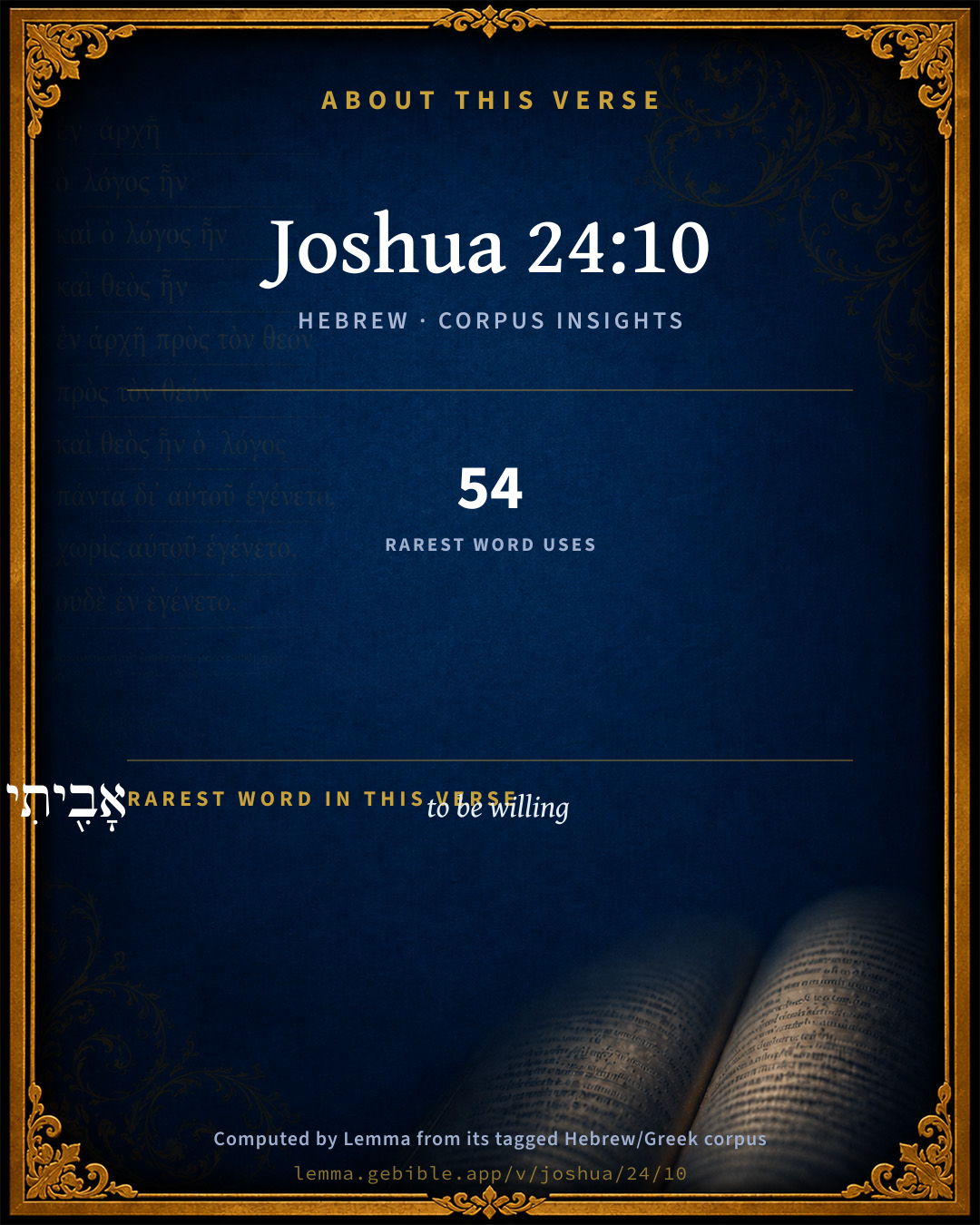
אָבִ֖יתִי to be willing H14 occurs in 52 verses of the Hebrew Bible. Also found in:

Grammatical profile

  • 5 verbs
  • 2 nouns
  • 3 particles

Verb forms

  • אָבִ֖יתִי Qal · Perfect
  • לִשְׁמֹ֣עַ Qal · Infinitive Construct
  • וַיְבָ֤רֶךְ Piel · Sequential Imperfect
  • בָּרוֹךְ֙ Piel · Infinitive Absolute
  • וָאַצִּ֥ל Hiphil · Sequential Imperfect

Repetition

A word recurs within this verse — often emphatic in Hebrew:

  • וַיְבָ֤רֶךְ to bless H1288 ×2

Hebrew & Septuagint length

In English translation the verse runs 20 words from the Hebrew and 26 from the Septuagint (LXX English) — closely comparable.

A rough comparison of the two English renderings, which tokenize alike — not a word-level alignment.

Word counts can differ between the Hebrew and the Greek without any difference in meaning — e.g. the Hebrew direct-object marker אֵת has no separate Greek word, and Greek often adds the article ὁ.

Cross-references

8

Topical passages linked to Joshua 24:10 in the Treasury of Scripture Knowledge — connected by theme and wording, ordered by reader-vote popularity; previews shown in the World English Bible.

  • Numbers 24:5–10 How goodly are your tents, Jacob, Your tents, Israel!
  • Deuteronomy 23:5 Nevertheless Yahweh your God wouldn't listen to Balaam; but Yahweh your God turned the curse into a blessing to you, because Yahweh your God loved you.
  • Isaiah 54:17 No weapon that is formed against you shall prosper; and every tongue that shall rise against you in judgment you shall condemn. This is the heritage of the servants of Yahweh, and their righteousness which is of me, says Yahweh.
  • Numbers 22:11–12 Behold, the people that is come out of Egypt, it covers the surface of the earth: now, come curse me them; peradventure I shall be able to fight against them, and shall drive them out.
  • Numbers 22:35 The angel of Yahweh said to Balaam, Go with the men; but only the word that I shall speak to you, that you shall speak. So Balaam went with the princes of Balak.
  • Numbers 23:3–12 Balaam said to Balak, Stand by your burnt offering, and I will go: perhaps Yahweh will come to meet me; and whatever he shows me I will tell you. He went to a bare height.
  • Numbers 23:15–26 He said to Balak, Stand here by your burnt offering, while I meet [Yahweh] yonder.
  • Numbers 22:18–20 Balaam answered the servants of Balak, If Balak would give me his house full of silver and gold, I can't go beyond the word of Yahweh my God, to do less or more.

Cross-references courtesy of OpenBible.info (CC BY 4.0).

Hebrew and Greek witnesses Masoretic Hebrew ↔ Greek Septuagint

The same verse in the two great witnesses to the Old Testament, shown verse-for-verse.

These are two independent witnesses, not word-aligned to each other, and the Septuagint is shown in lemma (dictionary) form.

Hebrew Joshua 24:10 Masoretic · Westminster Leningrad Codex

וְלֹ֥א אָבִ֖יתִי לִשְׁמֹ֣עַ לְבִלְעָ֑ם וַיְבָ֤רֶךְ בָּרוֹךְ֙ אֶתְכֶ֔ם וָאַצִּ֥ל אֶתְכֶ֖ם מִיָּדֽוֹ

but I would not listen to Balaam; therefore he blessed you still: so I delivered you out of his hand.

World English Bible · Public Domain

Greek LXX Joshua 24:10 Septuagint · lemma form

καί οὐ θέλω κύριος ὁ θεός σύ ἀποὀλλύω σύ καί εὐλογία εὐλογέω σύ καί ἐκαἱρέω σύ ἐκ χείρ αὐτός καί παραδίδωμι αὐτός

But the Lord your God would not destroy you; and he greatly blessed us, and rescued us out of their hands, and delivered them to us.

LXX2012 (modern English Septuagint) · Public Domain

Hebrew: Westminster Leningrad Codex (CC BY 4.0). Greek: Septuagint (public domain); English from LXX2012 (modern English Septuagint) (Public Domain). How the Septuagint differs from the Hebrew →

Targum (Aramaic paraphrase)

1

The Targum is the ancient Jewish Aramaic paraphrase of the Hebrew Scriptures — an interpretive translation, not the Hebrew text itself. Onkelos (literal) and Pseudo-Jonathan (expansive) render the Torah, and Jonathan the Prophets. Coverage is partial: where no permissively-licensed English translation exists for a verse, only the Aramaic is shown. This is verse-level text, not a word-by-word alignment to the Hebrew.

  1. Targum Jonathan Prophets (Joshua–Malachi)
    וְלָא אֲבִיתִי לְקַבָּלָא מִן בִּלְעָם וּבָרִיךְ בְּרָכָא יַתְכוֹן וְשֵׁיזְבוּת יַתְכוֹן מִן יְדֵיהּ:

    (no public-domain English translation for this verse)

    Targum Jonathan — Aramaic: “Mikraot Gedolot” (public domain). English: “Sefaria Community Translation” (CC0 1.0 (public-domain dedication)); “London "Chaldee Paraphrase," 1871” (public domain). Text via Sefaria.

Commentary

Notes on Joshua 24:10 from classic Christian and Jewish commentators (each source and its license shown beneath its notes). The classic Christian expositions comment on the surrounding passage and are grouped to its opening verse, so a note may address several verses; the Jewish commentaries on the Tanakh (Rashi and others) are per-verse, so they appear only where the commentator wrote on this verse.

Lemma curates 59 commentaries, every one of them public domain or Creative Commons licensed, each selected and text-cleaned for this edition rather than reprinted as found. About our sources →

Trapp's Complete Commentary

John Trapp

Jos 24:10 But I would not hearken unto Balaam; therefore he blessed you still: so I delivered you out of his hand.

Ver. 10. Therefore he blessed you still] Though full sore against his mind, as loath to lose so fair a preferment; till at length he resolved to curse, whatever came of it, and therefore went not, as at other times, to his altar, but "set his face toward the wilderness." {Num 24:1-2} "Howbeit our God turned the curse into a blessing," said that good Nehemiah. {Neh 13:2}

John Trapp, A Commentary or Exposition upon All the Books of the Old and New Testament (1647–1656) — public domain. Text from a community e-Sword module.

The Cambridge Bible for Schools and Colleges

gen. ed. J. J. S. Perowne

10. I would not hearken unto Balaam] See Deu_23:5. Twice, across the whole length of the Assyrian desert, the messengers of Balak, with the Oriental bribes of divination in their hands, were sent to conjure forth the prophet from his distant home. Three times the altars were built and the victims slain, but each time the seer found himself unable to comply with the wishes of the king; he could not curse him whom God had not cursed, or defy him whom Jehovah had not defied.

The Cambridge Bible for Schools and Colleges (gen. ed. J. J. S. Perowne; Cambridge University Press, 1878–1918) — public domain. Text from a community e-Sword module.

John Gill's Exposition

But I would not hearken unto Balaam,.... Who was very solicitous to get leave of the Lord to curse Israel, which he knew he could not do without; he had a goodwill to it but could not accomplish it:

therefore he blessed you still; went on blessing Israel to the last, when Balak hoped every time he would have cursed them; and Balaam himself was very desirous of doing it; but could not, being overruled by the Lord, and under his restraint; which shows his power over evil spirits, and their agents:

so I delivered you out of his hands: both out of the hand of Balak, who was intimidated from bringing his forces against them, and out of the hand of Balaam, who was not suffered to curse them.

John Gill's Exposition of the Whole Bible (1746–1763) — public domain (CC PDM 1.0). Text via the HelloAO Bible API.

Matthew Poole's English Annotations

I would not hearken unto Balaam, who hereby appears to have desired of God leave to curse Israel; and therefore it is not strange that God, who permitted him simply to go, was highly angry with him for going with so wicked an intent, Num 22:20,22,32.

Out of his hand, i.e. from Balak’s malicious design against you.

Matthew Poole's English Annotations on the Holy Bible (1683–1685) — public domain. Text from a community e-Sword/MySword module.

Whedon's Commentary on the Bible

Daniel D. Whedon

10. I delivered you out of his hand — Balak’s hand. He designed to harm by Balaam’s curses; but God, in a manner wholly miraculous, and not in harmony with his usual dealings with free agents, interposed, and changed his imprecations to benedictions. This constrained act did not keep Balaam from suffering a violent death while acting with the Midianites against Israel. Num_31:8.

Daniel D. Whedon (gen. ed.), Commentary on the Old and New Testaments (1874–1909) — public domain. Text from a community e-Sword module.

The Pulpit Commentary

But I would not. The Hebrew shows that this is not simply the conditional form of the verb, but that it means I willed not. It was God"s "determinate purpose" that Israel should not be accursed. Blessed yon still . Rather, perhaps, blessed you emphatically. And I delivered you out of his hand. Both here and in the narrative in Numbers 22-30, it is implied that Balaam"s curse had power if he were permitted by God to pronounce it. Wicked as be was, he was regarded as a prophet of the Lord. There is not the slightest shadow of difference between the view of Balaam presented to us in this short paragraph and that in which he appears to us in the more expanded narrative of Moses.

The Pulpit Commentary (1880–1919), ed. H.D.M. Spence-Jones & Joseph S. Exell — public domain. Text from a community e-Sword module.

John Wesley's Explanatory Notes

Unto Balaam - Who hereby appears to have desired of God leave to curse Israel; and therefore it is not strange, that God who permitted him simply to go, was highly angry with him for going with so wicked an intent, Num. xxii, 20, 22, 32. Delivered you - That is, from Balak's malicious design against you.

John Wesley, Explanatory Notes Upon the Whole Bible (1754–1765) — public domain. Text via the GEBible commentary corpus.

Lesson kit

Teaching starters — assembled from the data on this page, not authored interpretation. Every prompt links to the verse data it draws on. Edit before teaching.

Joshua, in the Historical, opens this verse with 10 words (8 distinct Hebrew lemmas). Its most distinctive word is ʼâbâh (“to be willing”). A historical commentator’s framing appears above. Read the whole chapter for the surrounding context.

Discussion questions

  1. How does “to be willing” (ʼâbâh) shape what this verse is saying?
  2. How does Genesis 24:5, which shares the word «to be willing», read alongside this verse?
  3. What does the repetition of “to bless” (2× in this one verse) do in this verse?
  4. These translations render this verse differently; the difference is in the English rendering, not the original. What questions does that raise?
  5. «אָבִ֖יתִי» is a Qal Perfect verb. How does that grammatical form shape the action described?
  6. Compare how Trapp's Complete Commentary and The Cambridge Bible for Schools and Colleges read this verse. Where do they agree or differ?

Things to notice

  • These translations choose different wording for 8 words in this verse.
  • “to bless” occurs 2× in this single verse.
  • 8 distinct Hebrew lemmas span 10 words in this verse.

Reading settings

Reading text

Shown beneath each verse's original-language words.

Old Testament
Old Testament edition

Read the OT as the Masoretic Hebrew (MT) or the Greek Septuagint (LXX).

English shown for the Greek Septuagint (in the Hebrew ↔ Greek comparison).

Comparing translations? Open the Compare panel on any verse page to stack up to four side by side.