1 Kings 8:15

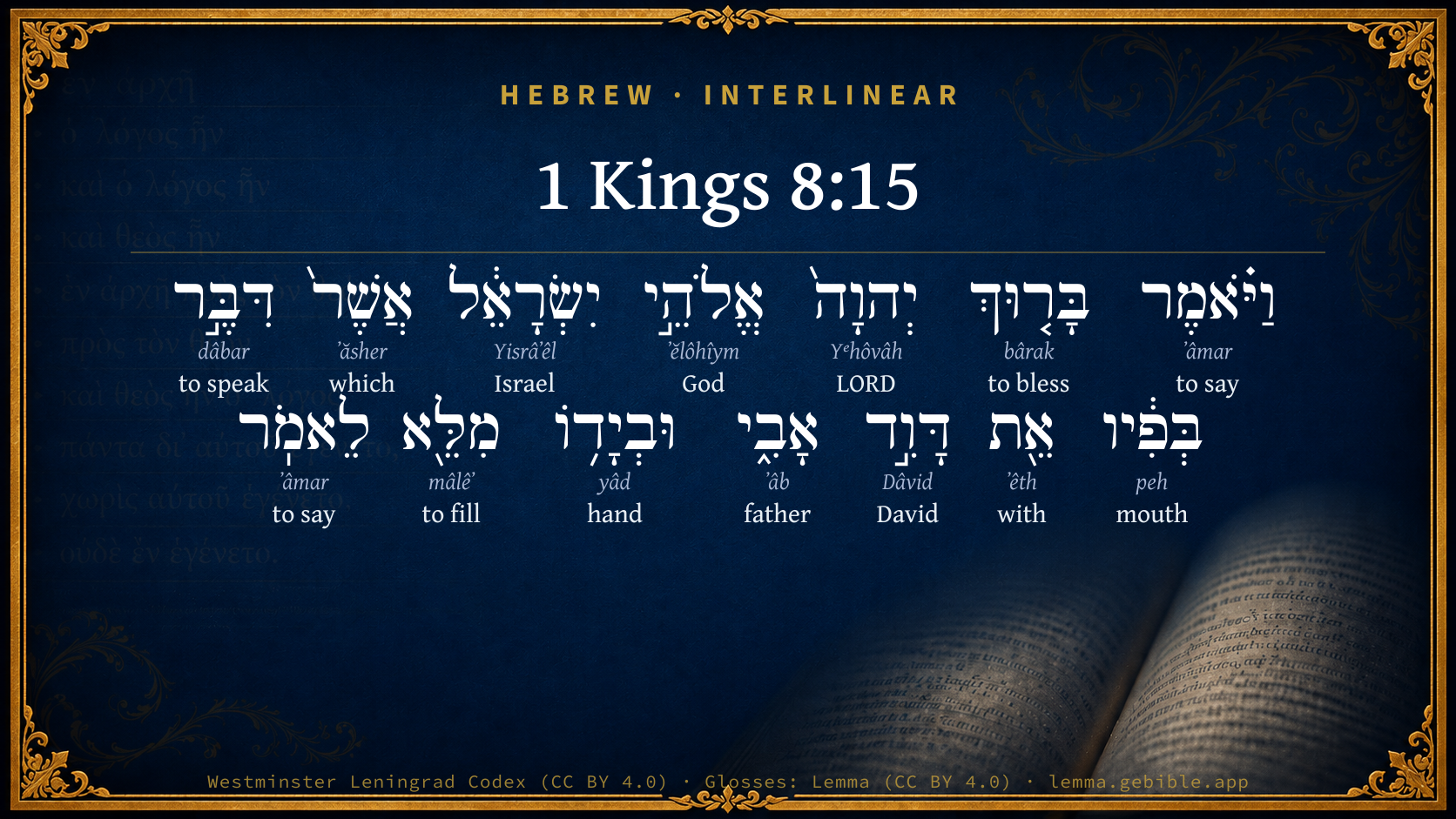
Hebrew (Westminster Leningrad Codex) 1 Kings 8:15 appears in the Hebrew Old Testament. The text above is from the Westminster Leningrad Codex. Each word links to its Strong’s number, a concise gloss, and parsing drawn from the Open Scriptures Hebrew Bible morphology. Click any word for its full Brown-Driver-Briggs (BDB) entry.
Download image
Cite this verse

1 Kings 8:15 (World English Bible). Public Domain. Lemma interlinear Bible study tool, https://lemma.gebible.app/v/1-kings/8/15.

Show BibTeX & RIS
BibTeX
RIS
English Translation
He said, Blessed be Yahweh, the God of Israel, who spoke with his mouth to David your father, and has with his hand fulfilled it, saying,
World English Bible · Public Domain
Download a study sheet

One document with this verse’s original text, its word-by-word gloss line, the meaning frame, cross-references with their text, attributed commentary, and full source and license credits — printable, and it pastes into notes with its structure intact.

This verse Autodidact and up

Study sheet (.html) Plain text (.txt)

A passage Seminary Student

Up to 50 verses in one chapter. A passage sheet keeps up to 6 commentary sources and 12 cross-references per verse, in the order this page ranks them, and says so on the sheet whenever that leaves anything out. Ask for a single verse and you get the Autodidact verse sheet above.

Everything on this page stays free to read, with no account — the sheet is a download of what is already on screen, not access to it.

Want to remove ads? Support Godless Engineer
Compare translations 3

The same verse in 3 English versions, stacked beneath the original-language interlinear above. Click any original word for its lexicon entry.

Each is an independent rendering of the whole verse — the interlinear is not word-aligned to these translations.

Highlighted words mark where these versions differ — a whole-verse word diff, not a word-by-word alignment.

  • World English Bible Public Domain
    He said, Blessed be Yahweh, the God of Israel, who spoke with his mouth to David your father, and has with his hand fulfilled it, saying,
  • King James Version Public Domain
    And he said, Blessed be the LORD God of Israel, which spake with his mouth unto David my father, and hath with his hand fulfilled it, saying,
  • unfoldingWord Literal Text CC BY-SA 4.0
    And he said, “Blessed Yahweh, the God of Israel, who spoke by his mouth to David my father and fulfilled by his hand, saying,

unfoldingWord Literal Text — © unfoldingWord, licensed CC BY-SA 4.0. Word-aligned USFM3 via Door43 (git.door43.org/unfoldingWord/en_ult).

Versions to compare (up to 4)

3 of 4 selected

Show all 18 translations

Every available English version of this verse, each an independent rendering of the whole verse.

  • World English Bible Public Domain
    He said, Blessed be Yahweh, the God of Israel, who spoke with his mouth to David your father, and has with his hand fulfilled it, saying,
  • Berean Standard Bible Public Domain
    and said: “Blessed be the LORD, the God of Israel, who has fulfilled with His own hand what He spoke with His mouth to my father David, saying,
  • Majority Standard Bible Public Domain
    and said: “Blessed be the LORD, the God of Israel, who has fulfilled with His own hand what He spoke with His mouth to my father David, saying,
  • King James Version Public Domain
    And he said, Blessed be the LORD God of Israel, which spake with his mouth unto David my father, and hath with his hand fulfilled it, saying,
  • American Standard Version (1901) Public Domain
    And he said, Blessed be Jehovah, the God of Israel, who spake with his mouth unto David thy father, and hath with his hand fulfilled it, saying,
  • Revised Version (1885) Public Domain
    And he said, Blessed be the LORD, the God of Israel, which spake with his mouth unto David my father, and hath with his hand fulfilled it, saying,
  • Geneva Bible (1599) Public Domain
    And he said, Blessed be the Lord God of Israel, who spake with his mouth vnto Dauid my father, and hath with his hand fulfilled it, saying,
  • Douay-Rheims (1899) Public Domain
    And Solomon said: Blessed be the Lord the God of Israel, who spoke with his mouth to David my father, and with his own hands hath accomplished it, saying:
  • Young's Literal Translation Public Domain
    And he saith, `Blessed `is' Jehovah, God of Israel, who spake by His mouth with David my father, and by His hand hath fulfilled `it', saying,
  • Literal Standard Version CC BY-SA 4.0
    And he says, “Blessed [is] YHWH, God of Israel, who spoke by His mouth with my father David, and by His hand has fulfilled [it], saying,
  • Unlocked Literal Bible CC BY-SA 4.0
    He said, “May Yahweh, the God of Israel, be praised, who spoke to David my father, and has fulfilled it with his own hands, saying,
  • unfoldingWord Literal Text CC BY-SA 4.0
    And he said, “Blessed Yahweh, the God of Israel, who spoke by his mouth to David my father and fulfilled by his hand, saying,
  • Darby Bible Public Domain
    And he said: Blessed be Jehovah the God of Israel, who spoke with his mouth unto David my father, and hath with his hand fulfilled it, saying,
  • World Messianic Bible Public Domain
    He said, “Blessed is the LORD, the God of Israel, who spoke with his mouth to David your father, and has with his hand fulfilled it, saying,
  • Webster's Bible Public Domain
    And he said, Blessed be the LORD God of Israel, who spoke with his mouth to David my father, and hath with his hand fulfilled it, saying,
  • Free Bible Version CC BY-SA 4.0
    saying, “Praise the Lord, the God of Israel, who by his own power has fulfilled the promise he made to my father David when he said,
  • Bible in Basic English Public Domain
    And he said, Praise be to the Lord, the God of Israel, who himself gave his word to David my father, and with his strong hand has made his word come true, saying,
  • JPS Tanakh (1917) Public Domain
    And he said: 'Blessed be the LORD, the God of Israel, who spoke with His mouth unto David my father, and hath with His hand fulfilled it, saying:

Literal Standard Version (2020), Covenant Press — licensed CC BY-SA 4.0. Text via the HelloAO Bible API (eBible.org). Unlocked Literal Bible (unfoldingWord) — licensed CC BY-SA 4.0. Text via the HelloAO Bible API (eBible.org). unfoldingWord Literal Text — © unfoldingWord, licensed CC BY-SA 4.0. Word-aligned USFM3 via Door43 (git.door43.org/unfoldingWord/en_ult). Free Bible Version, Dr. Jonathan Gallagher — licensed CC BY-SA 4.0. Text via the HelloAO Bible API (eBible.org).

Word by word

More ways to search: Search by grammar → Find every occurrence → Compare this word →

Practice this passage: Drill this verse → Learn its vocabulary →

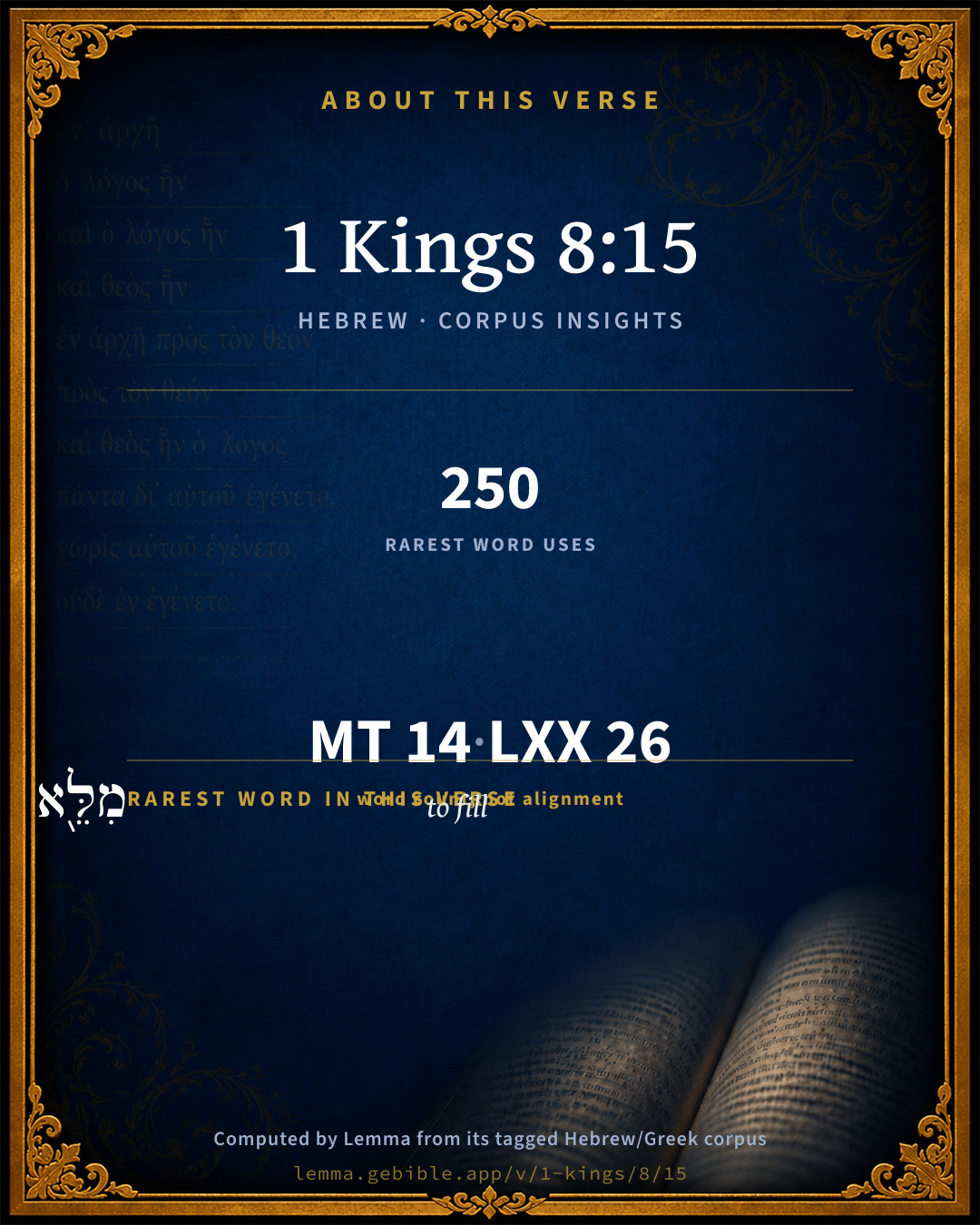
מִלֵּ֖א
mâlêʼ
H4390
“to fill”
Verb, Piel, Perfect, 3rd Person, Masculine, Singular
Part of Speech
Verb
Stem
Piel
Form
Perfect
Person
3rd Person
Gender
Masculine
Number
Singular
Full BDB Definition

Origin: a primitive root

TWOT: 1195

to fill, be full - (Qal) - to be full - fulness, abundance (participle) - to be full, be accomplished, be ended - to consecrate, fill the hand - (Niphal) - to be filled, be armed, be satisfied - to be accomplished, be ended - (Piel) - to fill - to satisfy - to fulfil, accomplish, complete - to confirm - (Pual) to be filled - (Hithpael) to mass themselves against
  1. וַיֹּ֗אמֶר ʼâmar H559 “and · to say” Conjunction + Verb, Qal, Sequential Imperfect, 3rd Person, Masculine, Singular
  2. בָּר֤וּךְ bârak H1288 “blessed” Verb, Qal, Participle Passive, Masculine, Singular, Absolute
  3. יְהוָה֙ Yᵉhôvâh H3068 “LORD” Noun, Proper
  4. אֱלֹהֵ֣י ʼĕlôhîym H430 “God(s) of” Noun, Common, Masculine, Plural, Construct
  5. יִשְׂרָאֵ֔ל Yisrâʼêl H3478 “Israel” Noun, Proper
  6. אֲשֶׁר֙ ʼăsher H834 “which” Particle, Relative
  7. דִּבֶּ֣ר dâbar H1696 “to speak” Verb, Piel, Perfect, 3rd Person, Masculine, Singular
  8. בְּפִ֔יו peh H6310 “in/at · mouth · his” Preposition + Noun, Common, Masculine, Singular, Construct + Suffix, Personal, 3rd Person, Masculine, Singular
  9. אֵ֖ת ʼêth H854 “with” Preposition
  10. דָּוִ֣ד Dâvid H1732 “David” Noun, Proper
  11. אָבִ֑י ʼâb H1 “father · my” Noun, Common, Masculine, Singular, Construct + Suffix, Personal, 1st Person, Common, Singular
  12. וּבְיָד֥וֹ yâd H3027 “and · in/at · hand · his” Conjunction + Preposition + Noun, Common, Both, Singular, Construct + Suffix, Personal, 3rd Person, Masculine, Singular
  13. לֵאמֹֽר ʼâmar H559 “to say” Preposition + Verb, Qal, Infinitive Construct

About this verse

These counts appear in no published source. They are computed here, from the morphology-tagged text and Lemma’s own curated glosses. What Lemma adds →

14
words
13
distinct lemmas
Historical
section

Grammatical profile

  • 5 verbs
  • 7 nouns
  • 1 preposition
  • 1 particle

Verb forms

  • וַיֹּ֗אמֶר Qal · Sequential Imperfect
  • בָּר֤וּךְ Qal · Participle Passive
  • דִּבֶּ֣ר Piel · Perfect
  • מִלֵּ֖א Piel · Perfect
  • לֵאמֹֽר Qal · Infinitive Construct

Repetition

A word recurs within this verse — often emphatic in Hebrew:

  • וַיֹּ֗אמֶר to say H559 ×2

Hebrew & Septuagint length

In English translation the verse runs 26 words from the Hebrew and 28 from the Septuagint (LXX English) — closely comparable.

A rough comparison of the two English renderings, which tokenize alike — not a word-level alignment.

Word counts can differ between the Hebrew and the Greek without any difference in meaning — e.g. the Hebrew direct-object marker אֵת has no separate Greek word, and Greek often adds the article ὁ.

In the original languages it is 14 Hebrew tokens and 26 Greek tokens — but the two are counted differently (Hebrew bundles its prefixes and suffixes into one token; the Greek is in lemma form), so that isn’t a like-for-like length.

Cross-references

25

Topical passages linked to 1 Kings 8:15 in the Treasury of Scripture Knowledge — connected by theme and wording, ordered by reader-vote popularity; previews shown in the World English Bible.

  • Luke 1:68 "Blessed be the Lord, the God of Israel, For he has visited and worked redemption for his people;
  • 1 Chronicles 29:10 Therefore David blessed Yahweh before all the assembly; and David said, You are blessed, Yahweh, the God of Israel our father, forever and ever.
  • 1 Chronicles 29:20 David said to all the assembly, Now bless Yahweh your God. All the assembly blessed Yahweh, the God of their fathers, and bowed down their heads, and worshiped Yahweh, and the king.
  • Nehemiah 9:5 Then the Levites, Jeshua, and Kadmiel, Bani, Hashabneiah, Sherebiah, Hodiah, Shebaniah, [and] Pethahiah, said, Stand up and bless Yahweh your God from everlasting to everlasting; and blessed be your glorious name, which is exalted above all blessing and praise.
  • Joshua 21:45 There failed not anything of any good thing which Yahweh had spoken to the house of Israel; all came to pass.
  • 2 Chronicles 6:4 He said, Blessed be Yahweh, the God of Israel, who spoke with his mouth to David my father, and has with his hands fulfilled it, saying,
  • Psalms 115:18 But we will bless Yah, From this time forth and forevermore. Praise Yah!
  • Luke 1:70 (As he spoke by the mouth of his holy prophets who have been from of old),
  • Joshua 23:15–16 It shall happen, that as all the good things are come on you of which Yahweh your God spoke to you, so will Yahweh bring on you all the evil things, until he have destroyed you from off this good land which Yahweh your God has given you.
  • 2 Samuel 7:5 Go and tell my servant David, Thus says Yahweh, Shall you build me a house for me to dwell in?
  • 2 Samuel 7:12–13 When your days are fulfilled, and you shall sleep with your fathers, I will set up your seed after you, who shall proceed out of your bowels, and I will establish his kingdom.
  • 2 Samuel 7:25 Now, Yahweh God, the word that you have spoken concerning your servant, and concerning his house, confirm you it forever, and do as you have spoken.
  • 2 Samuel 7:28–29 Now, O Lord Yahweh, you are God, and your words are truth, and you have promised this good thing to your servant:
  • 1 Chronicles 17:12 He shall build me a house, and I will establish his throne forever.
  • 2 Chronicles 20:26 On the fourth day they assembled themselves in the valley of Beracah; for there they blessed Yahweh: therefore the name of that place was called The valley of Beracah to this day.
  • Psalms 41:13 Blessed be Yahweh, the God of Israel, From everlasting and to everlasting! Amen and amen.
  • Psalms 72:18–19 Praise be to Yahweh God, the God of Israel, Who alone does marvelous deeds.
  • Psalms 117:1–2 Praise Yahweh, all you nations! Extol him, all you peoples!
  • Psalms 138:2 I will bow down toward your holy temple, And give thanks to your Name for your loving kindness and for your truth; For you have exalted your Name and your Word above all.
  • Isaiah 1:20 But if you refuse and rebel, you shall be devoured with the sword; For the mouth of Yahweh has spoken it."
  • Matthew 24:35 Heaven and earth will pass away, but my words will not pass away.
  • Luke 1:54–55 He has given help to Israel, his servant, that he might remember mercy,
  • Luke 1:72 To show mercy towards our fathers, To remember his holy covenant,
  • Ephesians 1:3 Blessed be the God and Father of our Lord Jesus Christ, who has blessed us with every spiritual blessing in the heavenly places in Christ;
  • 1 Peter 1:3 Blessed be the God and Father of our Lord Jesus Christ, who according to his great mercy became our father again to a living hope through the resurrection of Jesus Christ from the dead,

Cross-references courtesy of OpenBible.info (CC BY 4.0).

Hebrew and Greek witnesses Masoretic Hebrew ↔ Greek Septuagint

The same verse in the two great witnesses to the Old Testament, shown verse-for-verse.

These are two independent witnesses, not word-aligned to each other, and the Septuagint is shown in lemma (dictionary) form.

Hebrew 1 Kings 8:15 Masoretic · Westminster Leningrad Codex

וַיֹּ֗אמֶר בָּר֤וּךְ יְהוָה֙ אֱלֹהֵ֣י יִשְׂרָאֵ֔ל אֲשֶׁר֙ דִּבֶּ֣ר בְּפִ֔יו אֵ֖ת דָּוִ֣ד אָבִ֑י וּבְיָד֥וֹ מִלֵּ֖א לֵאמֹֽר

He said, Blessed be Yahweh, the God of Israel, who spoke with his mouth to David your father, and has with his hand fulfilled it, saying,

World English Bible · Public Domain

Greek LXX 1 Kings 8:15 Septuagint · lemma form

καί εἶπον εὐλογητός κύριος ὁ θεός ἰσραήλ σήμερον ὅς λαλέω ἐν ὁ στόμα αὐτός περί δαυίδ ὁ πατήρ ἐγώ καί ἐν ὁ χείρ αὐτός πληρόω λέγω

and he said, Blessed be the Lord God of Israel today, who spoke by his mouth concerning David my father, and has fulfilled it with his hands, saying,

LXX2012 (modern English Septuagint) · Public Domain

Hebrew: Westminster Leningrad Codex (CC BY 4.0). Greek: Septuagint (public domain); English from LXX2012 (modern English Septuagint) (Public Domain). How the Septuagint differs from the Hebrew →

Targum (Aramaic paraphrase)

1

The Targum is the ancient Jewish Aramaic paraphrase of the Hebrew Scriptures — an interpretive translation, not the Hebrew text itself. Onkelos (literal) and Pseudo-Jonathan (expansive) render the Torah, and Jonathan the Prophets. Coverage is partial: where no permissively-licensed English translation exists for a verse, only the Aramaic is shown. This is verse-level text, not a word-by-word alignment to the Hebrew.

  1. Targum Jonathan Prophets (Joshua–Malachi)
    וַאֲמַר בְּרִיךְ יְיָ אֱלָהָא דְיִשְׂרָאֵל דִי גְזַר בְּמֵימְרֵיהּ עִם דָוִד אַבָּא וּבִרְעוּתֵיהּ קַיֵם לְמֵימָר:

    (no public-domain English translation for this verse)

    Targum Jonathan — Aramaic: “Mikraot Gedolot” (public domain). English: “Sefaria Community Translation” (CC0 1.0 (public-domain dedication)); “London "Chaldee Paraphrase," 1871” (public domain). Text via Sefaria.

Commentary

Notes on 1 Kings 8:15 from classic Christian and Jewish commentators (each source and its license shown beneath its notes). The classic Christian expositions comment on the surrounding passage and are grouped to its opening verse, so a note may address several verses; the Jewish commentaries on the Tanakh (Rashi and others) are per-verse, so they appear only where the commentator wrote on this verse.

Lemma curates 59 commentaries, every one of them public domain or Creative Commons licensed, each selected and text-cleaned for this edition rather than reprinted as found. About our sources →

Trapp's Complete Commentary

John Trapp

1Ki 8:15 And he said, Blessed [be] the LORD God of Israel, which spake with his mouth unto David my father, and hath with his hand fulfilled [it], saying,

Ver. 15. And hath with his hand {a} fulfilled.] He hath powerfully performed his promise to David. Solomon is thankful as well for the promise to his father as the performance to himself. And well he might, for the promises are precious things, {2Pe 1:4} the unsearchable riches of Christ. {Eph 3:8} The patriarchs "saw the promises afar off, and embraced {b} them." {Heb 11:13}

{a} Manu, i.e., liberalitate sua, vel potentia sua - Vatab.

{b} “ασπασαμενοι.”

John Trapp, A Commentary or Exposition upon All the Books of the Old and New Testament (1647–1656) — public domain. Text from a community e-Sword module.

Joseph Benson's Commentary

1Ki 8:15-16. Which spake with his mouth unto David, &c. — He acknowledges the grace and goodness of God in making the promise, and his truth and faithfulness in fulfilling it. I chose no city — Until David’s time; for then he did choose Jerusalem. That my name might be therein — Not only, which should be called by my name, namely, the house of Jehovah: but that my presence, and grace, and worship, and glory, might be there. But I chose David — And in and with him the tribe of Judah, to which he belonged, and Jerusalem, where he dwelt.

Joseph Benson's Commentary on the Old and New Testaments (1811–1818) — public domain. Text from a community e-Sword module.

Ellicott's Commentary for English Readers

(15-21) His address to the people—apparently preceded by a silent blessing with the usual uplifting of the hands—is the counterpart and expansion of the few abrupt words which he had just uttered before God—calling them to bless God with him for the fulfilment of one part of His promise to David, in the present acceptance of the Temple. The record of that promise is given in 2Sa_7:5-16; 1Ch_17:4-14. Here it is freely cited with some variation, so far as it relates to the Temple. It is remarkable that in quoting it, David twice (1Ch_22:8; 1Ch_28:3) adds to it the instructive reason for the prohibition, that (unlike Solomon the Peaceful) he had “shed blood abundantly, and had made great wars.” With much grace of filial piety, Solomon refrains from mention of that reason, though there seems to be some allusion to it in his words to Hiram (1Ki_5:3). On the other hand, he does add—what is not found in the earlier records—the declaration that, though David was not to build the Temple, “he did well that it was in his heart” to build it.

A Bible Commentary for English Readers, edited by Charles John Ellicott (1878–1897) — public domain. Text from a community e-Sword module.

The Cambridge Bible for Schools and Colleges

gen. ed. J. J. S. Perowne

15. the Lord God of Israel] R.V. ‘The Lord, the God of Israel.’ This change, which should be constantly made, will not be further noticed. See chap. 1Ki_1:30.

which spake with his mouth unto David my father] The allusion is to the words of 2Sa_7:5-7, where God by the prophet Nathan forbids David to build Him a house. The prophet is regarded so entirely as the mouthpiece of Jehovah, that Solomon can use words like these both here, and in 1Ki_8:24, ‘Thou spakest also with thy mouth.’

The Cambridge Bible for Schools and Colleges (gen. ed. J. J. S. Perowne; Cambridge University Press, 1878–1918) — public domain. Text from a community e-Sword module.

John Gill's Exposition

And he said, blessed be the Lord God of Israel,.... All praise and glory, honour and blessing, be ascribed to the Lord; who had afresh shown himself to be Israel's covenant God, by taking up his residence among them in the temple he had filled with his glory:

which spake with his mouth to David my father, and hath with his hand fulfilled it; who graciously promised him he should have a son that should build an house for him, and which he had by his power and providence faithfully performed; or rather which spake concerning David, so Noldius (x); for God did not speak with his mouth to David, but to Nathan, of him: saying; as follows.

(x) Ebr. Concord. Part. p. 117. No. 596. So Sept.

John Gill's Exposition of the Whole Bible (1746–1763) — public domain (CC PDM 1.0). Text via the HelloAO Bible API.

Albert Barnes' Notes on the Bible

The exact words of 2 Sam. 7 are not reproduced; only their general sense is given. In 1Ki 8:18, what was merely tacitly implied was regarded as actually “said.”

Albert Barnes' Notes on the Bible (1834–1885) — public domain. Text from a community e-Sword/MySword module.

Haydock's Catholic Bible Commentary

Own hands, or almighty power, (Menochius) hath fulfilled his promise. (Haydock)

George Leo Haydock (1774–1849), Haydock's Catholic Family Bible and Commentary, 1859 edition — public domain. Excludes Psalms (Douay-Rheims chapter numbering differs from Protestant) and Deuterocanonical books (Catholic canon only).

Matthew Poole's English Annotations

Praised be God, both for his grace in making such a promise, and for his goodness and truth in fulfilling it.

Matthew Poole's English Annotations on the Holy Bible (1683–1685) — public domain. Text from a community e-Sword/MySword module.

Whedon's Commentary on the Bible

Daniel D. Whedon

15-21. These verses contain an appropriate narration of the most interesting facts connected with the planning and building of the temple, and without them the services of the dedication would have been incomplete. See notes on 2 Samuel 7.

Daniel D. Whedon (gen. ed.), Commentary on the Old and New Testaments (1874–1909) — public domain. Text from a community e-Sword module.

The Pulpit Commentary

And he said, Blessed be the Lord God of Israel, (1Ki_1:48) which spake with his mouth unto or, concerning; lae after verbs of speaking has the force of de. (Gen_20:2 Jer_40:16 Psa_69:27) David my father The words were really spoken to Nathan, and hath with his hand i.e., power; cf. Job_34:20 Act_4:28 Act_13:11 Ezr_7:6 fulfilled it the spoken word He has fulfilled in deed, saying , The reference is to 2Sa 7., of which Solomon merely gives the substance. Much of what he says here is not recorded there.

The Pulpit Commentary (1880–1919), ed. H.D.M. Spence-Jones & Joseph S. Exell — public domain. Text from a community e-Sword module.

Rashi

Rabbi Shlomo Yitzchaki (Rashi)

Who spoke with His mouth. That He would grant him a son who would build the Beis [Hamikdosh].

And fulfilled it with His hand. He has fulfilled His word with His good power.

Rashi on the Tanakh — English translations: “The Judaica Press complete Tanach with Rashi, translated by A. J. Rosenberg” (CC BY 4.0); “Pentateuch with Rashi's commentary by M. Rosenbaum and A.M. Silbermann, 1929-1934” (public domain); “The Metsudah Tanach series, Lakewood, N.J” (CC BY 4.0); and “The Book of Joshua, Metsudah Publications, 1997” (CC BY 4.0). Text via Sefaria.

Lesson kit

Teaching starters — assembled from the data on this page, not authored interpretation. Every prompt links to the verse data it draws on. Edit before teaching.

1 Kings, in the Historical, opens this verse with 14 words (13 distinct Hebrew lemmas). Its most distinctive word is mâlêʼ (“to fill”). A historical commentator’s framing appears above. Read the whole chapter for the surrounding context.

Discussion questions

  1. How does “to fill” (mâlêʼ) shape what this verse is saying?
  2. How does Luke 1:68, which shares this passage’s theme, read alongside this verse?
  3. What does the repetition of “to say” (2× in this one verse) do in this verse?
  4. These translations render this verse differently. What is at stake in choosing one wording over another?
  5. «וַיֹּ֗אמֶר» is a Qal Sequential Imperfect verb. How does that grammatical form shape the action described?
  6. Compare how Trapp's Complete Commentary and Joseph Benson's Commentary read this verse. Where do they agree or differ?

Things to notice

Reading settings

Reading text

Shown beneath each verse's original-language words.

Old Testament
Old Testament edition

Read the OT as the Masoretic Hebrew (MT) or the Greek Septuagint (LXX).

English shown for the Greek Septuagint (in the Hebrew ↔ Greek comparison).

Comparing translations? Open the Compare panel on any verse page to stack up to four side by side.