Genesis 48:3

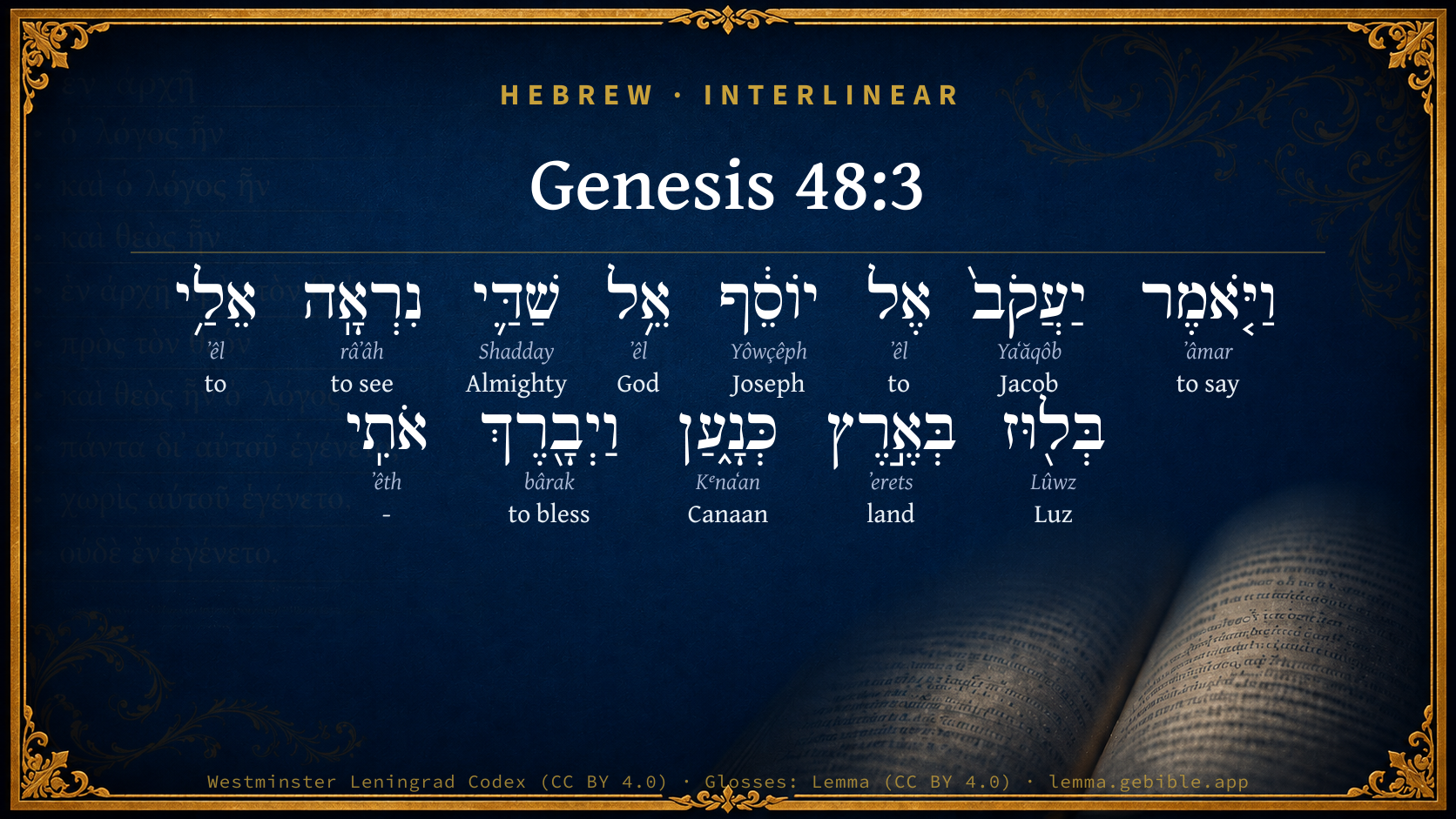
Hebrew (Westminster Leningrad Codex) Genesis 48:3 appears in the Hebrew Old Testament. The text above is from the Westminster Leningrad Codex. Each word links to its Strong’s number, a concise gloss, and parsing drawn from the Open Scriptures Hebrew Bible morphology. Click any word for its full Brown-Driver-Briggs (BDB) entry.
Download image
Cite this verse

Genesis 48:3 (World English Bible). Public Domain. Lemma interlinear Bible study tool, https://lemma.gebible.app/v/genesis/48/3.

Show BibTeX & RIS
BibTeX
RIS
English Translation
Jacob said to Joseph, "God Almighty appeared to me at Luz in the land of Canaan, and blessed me,
World English Bible · Public Domain
Download a study sheet

One document with this verse’s original text, its word-by-word gloss line, the meaning frame, cross-references with their text, attributed commentary, and full source and license credits — printable, and it pastes into notes with its structure intact.

This verse Autodidact and up

Study sheet (.html) Plain text (.txt)

A passage Seminary Student

Up to 50 verses in one chapter. A passage sheet keeps up to 6 commentary sources and 12 cross-references per verse, in the order this page ranks them, and says so on the sheet whenever that leaves anything out. Ask for a single verse and you get the Autodidact verse sheet above.

Everything on this page stays free to read, with no account — the sheet is a download of what is already on screen, not access to it.

Want to remove ads? Support Godless Engineer
Compare translations 3

The same verse in 3 English versions, stacked beneath the original-language interlinear above. Click any original word for its lexicon entry.

Each is an independent rendering of the whole verse — the interlinear is not word-aligned to these translations.

Highlighted words mark where these versions differ — a whole-verse word diff, not a word-by-word alignment.

  • World English Bible Public Domain
    Jacob said to Joseph, "God Almighty appeared to me at Luz in the land of Canaan, and blessed me,
  • King James Version Public Domain
    And Jacob said unto Joseph, God Almighty appeared unto me at Luz in the land of Canaan, and blessed me,
  • unfoldingWord Literal Text CC BY-SA 4.0
    Then Jacob said to Joseph, “God Almighty appeared to me at Luz in the land of Canaan, and he blessed me

unfoldingWord Literal Text — © unfoldingWord, licensed CC BY-SA 4.0. Word-aligned USFM3 via Door43 (git.door43.org/unfoldingWord/en_ult).

Versions to compare (up to 4)

3 of 4 selected

Show all 18 translations

Every available English version of this verse, each an independent rendering of the whole verse.

  • World English Bible Public Domain
    Jacob said to Joseph, "God Almighty appeared to me at Luz in the land of Canaan, and blessed me,
  • Berean Standard Bible Public Domain
    Jacob said to Joseph, “God Almighty appeared to me at Luz in the land of Canaan, and there He blessed me
  • Majority Standard Bible Public Domain
    Jacob said to Joseph, “God Almighty appeared to me at Luz in the land of Canaan, and there He blessed me
  • King James Version Public Domain
    And Jacob said unto Joseph, God Almighty appeared unto me at Luz in the land of Canaan, and blessed me,
  • American Standard Version (1901) Public Domain
    And Jacob said unto Joseph, God Almighty appeared unto me at Luz in the land of Canaan, and blessed me,
  • Revised Version (1885) Public Domain
    And Jacob said unto Joseph, God Almighty appeared unto me at Luz in the land of Canaan, and blessed me,
  • Geneva Bible (1599) Public Domain
    Then Iaakob sayde vnto Ioseph, God almightie appeared vnto me at Luz in the land of Canaan, and blessed me.
  • Douay-Rheims (1899) Public Domain
    And when Joseph was come in to him, he said: God Almighty appeared to me at Lute, which is in the land of Chanaan: and he blessed me,
  • Young's Literal Translation Public Domain
    And Jacob saith unto Joseph, `God Almighty hath appeared unto me, in Luz, in the land of Canaan, and blesseth me,
  • Literal Standard Version CC BY-SA 4.0
    And Jacob says to Joseph, “God Almighty has appeared to me, in Luz, in the land of Canaan, and blesses me,
  • Unlocked Literal Bible CC BY-SA 4.0
    Jacob said to Joseph, “God Almighty appeared to me at Luz in the land of Canaan. He blessed me
  • unfoldingWord Literal Text CC BY-SA 4.0
    Then Jacob said to Joseph, “God Almighty appeared to me at Luz in the land of Canaan, and he blessed me
  • Darby Bible Public Domain
    And Jacob said to Joseph, The Almighty ùGod appeared to me at Luz in the land of Canaan, and blessed me,
  • World Messianic Bible Public Domain
    Jacob said to Joseph, “God Almighty appeared to me at Luz in the land of Canaan, and blessed me,
  • Webster's Bible Public Domain
    And Jacob said to Joseph, God Almighty appeared to me at Luz, in the land of Canaan, and blessed me,
  • Free Bible Version CC BY-SA 4.0
    Jacob said to Joseph, “God Almighty appeared to me at Luz in Canaan, and he blessed me there.
  • Bible in Basic English Public Domain
    And Jacob said to Joseph, God, the Ruler of all, came to me in a vision at Luz in the land of Canaan, and gave me his blessing,
  • JPS Tanakh (1917) Public Domain
    And Jacob said unto Joseph: 'God Almighty appeared unto me at Luz in the land of Canaan, and blessed me,

Literal Standard Version (2020), Covenant Press — licensed CC BY-SA 4.0. Text via the HelloAO Bible API (eBible.org). Unlocked Literal Bible (unfoldingWord) — licensed CC BY-SA 4.0. Text via the HelloAO Bible API (eBible.org). unfoldingWord Literal Text — © unfoldingWord, licensed CC BY-SA 4.0. Word-aligned USFM3 via Door43 (git.door43.org/unfoldingWord/en_ult). Free Bible Version, Dr. Jonathan Gallagher — licensed CC BY-SA 4.0. Text via the HelloAO Bible API (eBible.org).

Word by word

More ways to search: Search by grammar → Find every occurrence → Compare this word →

Practice this passage: Drill this verse → Learn its vocabulary →

בְּל֖וּז
Lûwz
H3870
“in/at · Luz”
Preposition + Noun, Proper
Part of Speech
Preposition + Noun
Type
Proper
Full BDB Definition

Origin: probably from H3869 (as growing there)

TWOT: None

Luz = "almond tree" - the early name of Bethel and probably the name of the town in close proximity to the actual location of the altar and pillar of Jacob - the name of a town in the land of the Hittites; site unknown
  1. וַיֹּ֤אמֶר ʼâmar H559 “and · to say” Conjunction + Verb, Qal, Sequential Imperfect, 3rd Person, Masculine, Singular
  2. יַעֲקֹב֙ Yaʻăqôb H3290 “Jacob” Noun, Proper
  3. אֶל ʼêl H413 “to” Preposition
  4. יוֹסֵ֔ף Yôwçêph H3130 “Joseph” Noun, Proper
  5. אֵ֥ל ʼêl H410 “God of” Noun, Common, Masculine, Singular, Construct
  6. שַׁדַּ֛י Shadday H7706 “Almighty” Noun, Proper
  7. נִרְאָֽה râʼâh H7200 “to see” Verb, Niphal, Perfect, 3rd Person, Masculine, Singular
  8. אֵלַ֥י ʼêl H413 “to · me” Preposition + Suffix, Personal, 1st Person, Common, Singular
  9. בְּאֶ֣רֶץ ʼerets H776 “in/at · land of” Preposition + Noun, Common, Both, Singular, Construct
  10. כְּנָ֑עַן Kᵉnaʻan H3667 “Canaan” Noun, Proper
  11. וַיְבָ֖רֶךְ bârak H1288 “and · to bless” Conjunction + Verb, Piel, Sequential Imperfect, 3rd Person, Masculine, Singular
  12. אֹתִֽי ʼêth H853 “- · me” Particle, Direct Object + Suffix, Personal, 1st Person, Common, Singular

About this verse

These counts appear in no published source. They are computed here, from the morphology-tagged text and Lemma’s own curated glosses. What Lemma adds →

13
words
12
distinct lemmas
Pentateuch
section

Notable vocabulary

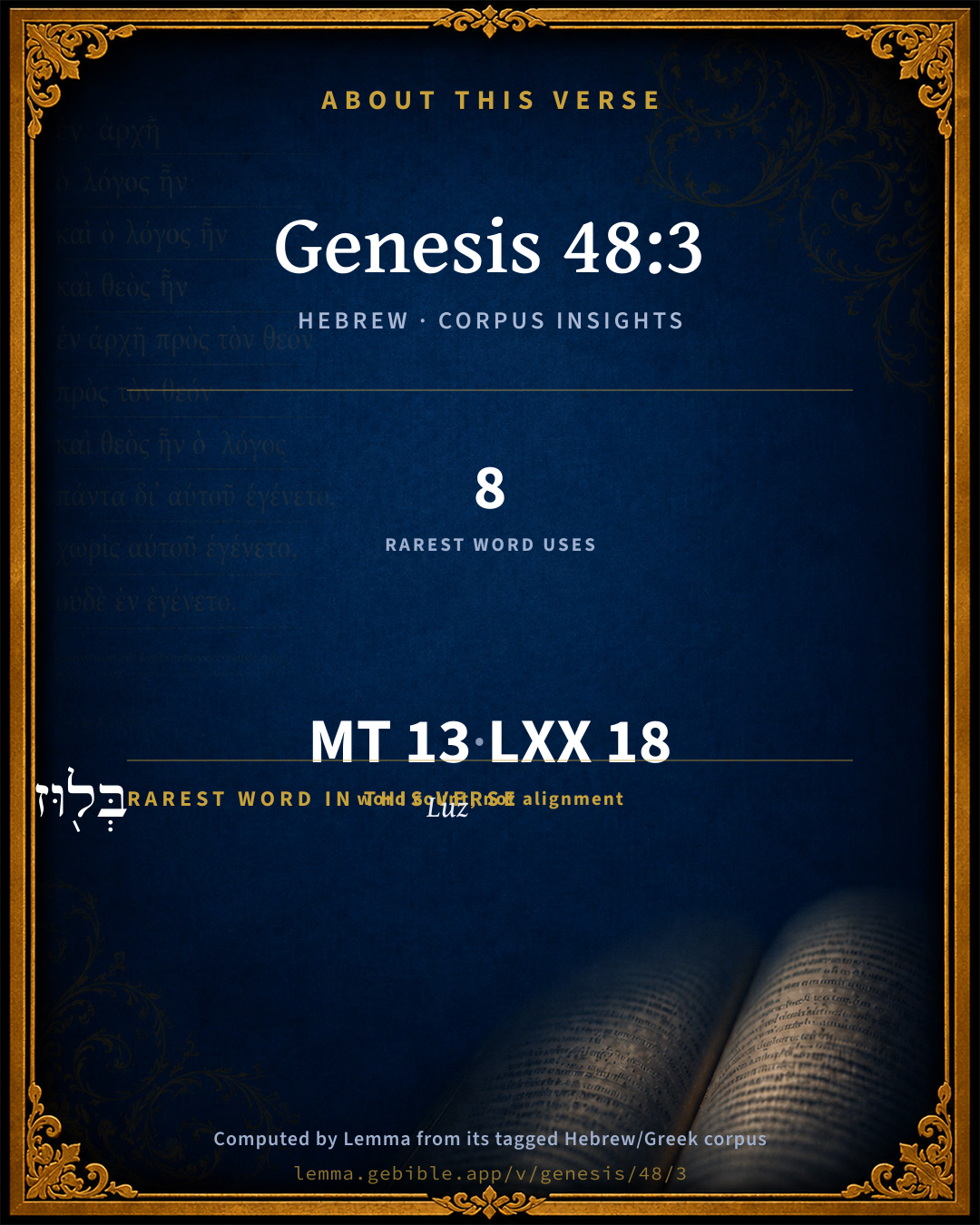
The rarest word here is בְּל֖וּז Luz H3870 — appearing just 8 times in the whole Hebrew Bible.

Shared distinctive vocabulary

בְּל֖וּז Luz H3870 occurs in 7 verses of the Hebrew Bible. Also found in:

Grammatical profile

  • 3 verbs
  • 7 nouns
  • 2 prepositions
  • 1 particle

Verb forms

  • וַיֹּ֤אמֶר Qal · Sequential Imperfect
  • נִרְאָֽה Niphal · Perfect
  • וַיְבָ֖רֶךְ Piel · Sequential Imperfect

Repetition

A word recurs within this verse — often emphatic in Hebrew:

  • אֶל to H413 ×2

Hebrew & Septuagint length

In English translation the verse runs 19 words from the Hebrew and 20 from the Septuagint (LXX English) — closely comparable.

A rough comparison of the two English renderings, which tokenize alike — not a word-level alignment.

Word counts can differ between the Hebrew and the Greek without any difference in meaning — e.g. the Hebrew direct-object marker אֵת has no separate Greek word, and Greek often adds the article ὁ.

In the original languages it is 13 Hebrew tokens and 18 Greek tokens — but the two are counted differently (Hebrew bundles its prefixes and suffixes into one token; the Greek is in lemma form), so that isn’t a like-for-like length.

Cross-references

9

Topical passages linked to Genesis 48:3 in the Treasury of Scripture Knowledge — connected by theme and wording, ordered by reader-vote popularity; previews shown in the World English Bible.

  • Genesis 35:9–12 God appeared to Jacob again, when he came from Paddan Aram, and blessed him.
  • Genesis 17:1 When Abram was ninety-nine years old, Yahweh appeared to Abram, and said to him, "I am God Almighty. Walk before me, and be blameless.
  • Genesis 28:3 May God Almighty bless you, and make you fruitful, and multiply you, that you may be a company of peoples,
  • Exodus 6:3 and I appeared to Abraham, to Isaac, and to Jacob, as God Almighty; but by my name Yahweh I was not known to them.
  • Genesis 28:12–19 He dreamed. Behold, a stairway set up on the earth, and the top of it reached to heaven. Behold, the angels of God ascending and descending on it.
  • Genesis 35:6–7 So Jacob came to Luz, which is in the land of Canaan (the same is Bethel), he and all the people who were with him.
  • Judges 1:23 The house of Joseph sent to spy out Bethel. (Now the name of the city before was Luz.)
  • Hosea 12:4 Indeed, he had power over the angel, and prevailed; He wept, and made supplication to him. He found him at Bethel, and there he spoke with us,
  • Revelation 21:11 having the glory of God. Her light was like a most precious stone, as if it was a jasper stone, clear as crystal;

Cross-references courtesy of OpenBible.info (CC BY 4.0).

Hebrew and Greek witnesses Masoretic Hebrew ↔ Greek Septuagint

The same verse in the two great witnesses to the Old Testament, shown verse-for-verse.

These are two independent witnesses, not word-aligned to each other, and the Septuagint is shown in lemma (dictionary) form.

Hebrew Genesis 48:3 Masoretic · Westminster Leningrad Codex

וַיֹּ֤אמֶר יַעֲקֹב֙ אֶל יוֹסֵ֔ף אֵ֥ל שַׁדַּ֛י נִרְאָֽה אֵלַ֥י בְּל֖וּז בְּאֶ֣רֶץ כְּנָ֑עַן וַיְבָ֖רֶךְ אֹתִֽי

Jacob said to Joseph, "God Almighty appeared to me at Luz in the land of Canaan, and blessed me,

World English Bible · Public Domain

Greek LXX Genesis 48:3 Septuagint · lemma form

καί εἶπον ἰακώβ ὁ ιωσηφ ὁ θεός ἐγώ ὁράω ἐγώ ἐν λουζα ἐν γῆ χανααν καί εὐλογέω ἐγώ

And Jacob said to Joseph, My God appeared to me in Luza, in the land of Chanaan, and blessed me,

LXX2012 (modern English Septuagint) · Public Domain

Hebrew: Westminster Leningrad Codex (CC BY 4.0). Greek: Septuagint (public domain); English from LXX2012 (modern English Septuagint) (Public Domain). How the Septuagint differs from the Hebrew →

Targum (Aramaic paraphrase)

2

The Targum is the ancient Jewish Aramaic paraphrase of the Hebrew Scriptures — an interpretive translation, not the Hebrew text itself. Onkelos (literal) and Pseudo-Jonathan (expansive) render the Torah, and Jonathan the Prophets. Coverage is partial: where no permissively-licensed English translation exists for a verse, only the Aramaic is shown. This is verse-level text, not a word-by-word alignment to the Hebrew.

  1. Targum Onkelos Torah (Genesis–Deuteronomy)
    וַאֲמַר יַעֲקֹב לְיוֹסֵף אֵל שַׁדַּי אִתְגְּלִי לִי בְלוּז בְּאַרְעָא דִכְנָעַן וּבָרִיךְ יָתִי

    (no public-domain English translation for this verse)

    Targum Onkelos — Aramaic: “Onkelos Genesis” (public domain); “Onkelos Exodus” (public domain); “Onkelos Leviticus” (public domain); “Onkelos Numbers” (public domain); “Onkelos Deuteronomy” (public domain). English: “Sefaria Community Translation” (CC0 1.0 (public-domain dedication)); “J.W. Etheridge. The Targums of Onkelos and Jonathan Ben Uzziel on the Pentateuch. London: Longmans, Green, 1862” (public domain). Text via Sefaria.

  2. Targum Pseudo-Jonathan Torah (Genesis–Deuteronomy)
    וַאֲמַר יַעֲקב לְיוֹסֵף אֵל שַׁדַי אִתְגְלִי לִי בְּלוּז בְּאַרְעָא דִכְנָעַן וּבְרִיךְ יָתִי

    And Jakob said to Joseph: El Shadai revealed Himself to me at Luz, in the land of Kenaan, and blessed me.

    Targum Pseudo-Jonathan — Aramaic: “Targum Jonathan on Genesis” (public domain); “Targum Jonathan on Exodus” (public domain); “Targum Jonathan on Leviticus” (public domain); “Targum Jonathan on Numbers” (public domain); “Targum Jonathan on Deuteronomy” (public domain). English: “The Targum of Jonathan ben Uzziel, trans. J. W. Etheridge, London, 1862” (public domain). Text via Sefaria.

Commentary

Notes on Genesis 48:3 from classic Christian and Jewish commentators (each source and its license shown beneath its notes). The classic Christian expositions comment on the surrounding passage and are grouped to its opening verse, so a note may address several verses; the Jewish commentaries on the Tanakh (Rashi and others) are per-verse, so they appear only where the commentator wrote on this verse.

Lemma curates 59 commentaries, every one of them public domain or Creative Commons licensed, each selected and text-cleaned for this edition rather than reprinted as found. About our sources →

Trapp's Complete Commentary

John Trapp

Gen 48:3 And Jacob said unto Joseph, God Almighty appeared unto me at Luz in the land of Canaan, and blessed me,

Ver. 3. God Almighty appeared unto me at Luz.] The truly thankful keep calendars and catalogues of God’s gracious dealings with them, and delight, to their last, to recount and reckon them up; not in the lump only, and by wholesale, as it were, but by particular enumeration upon every good occasion; setting them forth one by one, as here, and ciphering them up, as David’s word is. { ספר, Psa 9:1} We should he like civet boxes, which still retain the scent when the civet is taken out of them. See Psa 145:1-2 Exo 18:8.

John Trapp, A Commentary or Exposition upon All the Books of the Old and New Testament (1647–1656) — public domain. Text from a community e-Sword module.

Tyndale Open Study Notes

Tyndale Open Resources

48:3-4 Jacob rehearsed how God Almighty had appeared to him and had promised him Abraham’s blessing—innumerable descendants dwelling in the land . . . as an everlasting possession (cp. 28:10-22).

Tyndale Open Study Notes — © Tyndale Open Resources, licensed CC BY-SA 4.0. Text via the HelloAO Bible API.

Geneva Bible (1599)

Geneva Bible translators

Or, all sufficient.

Geneva Bible (1599) marginal notes — public domain. Text via Bolls.life.

Jamieson, Fausset & Brown

Robert Jamieson, A. R. Fausset & David Brown

God Almighty appeared unto me at Luz--The object of Jacob, in thus reverting to the memorable vision at Beth-el [Gen 28:10-15] --one of the great landmarks in his history--was to point out the splendid promises in reserve for his posterity--to engage Joseph's interest and preserve his continued connection with the people of God, rather than with the Egyptians.

Jamieson, Fausset & Brown — Commentary Critical and Explanatory on the Whole Bible (1871) — public domain (CC PDM 1.0). Text via the HelloAO Bible API.

Adam Clarke's Commentary

Verse 3. God Almighty] אל שדי El Shaddai, the all-sufficient God, the Outpourer and Dispenser of mercies, (see Ge 17:1), appeared to me at Luz, afterwards called Beth-El; see Ge 28:13; Ge 35:6; Ge 35:9.

Adam Clarke's Commentary on the Bible (1810–1826) — public domain. Text from a community e-Sword/MySword module.

John Calvin's Commentaries

3. And Jacob said unto Joseph. The design of the holy man was to withdraw his son from the wealth and honors of Egypt, and to reunite him to the holy race, from which he had been, for a little while, separated. Moreover, he neither proudly boasts of his own excellence, nor of his present riches, nor of his power, for the sake of inducing his son to comply with his wishes; but simply sets before him the covenant of God. So also it is right, that the grace of adoption, as soon as it is offered to us, should, by filling our thoughts, extinguish our desire for everything splendid and costly in the world. This passage is, doubtless, remarkable. Joseph was possessed of the most exalted dignity; he foresees that the most excellent nobility would pass, through the memory of his name, to his posterity: he is able to leave them an ample patrimony: nor would it be difficult so to advance them in royal favor, that they might obtain rank among the nobles of the kingdom. Too many examples show how easy it is not only to be caught, but altogether fascinated, by such allurements. Yea, the greater part know, by their own experience, that, as soon as the least ray of hope beams upon us, from the world, we are torn away from the Lord, and alienated from the pursuit of the heavenly life. If a very few drops thus inebriate our flesh, how dangerous is it to drink from the full bowl? But to all the riches and honors of Egypt, Jacob opposes the vision in which God had adopted himself and his race, as his own people. Whenever, therefore, Satan shall try to entangle us with the allurements of the world, that he may draw us away from heaven, let us remember for what end we are called; in order that, in comparison with the inestimable treasure of eternal life, all that the flesh would otherwise prefer, may become loathsome. For, if holy Joseph formerly held an obscure vision in such esteem, that, for this sole object, forgetting Egypt, he gladly passed over to the despised flock of the Church; how shameful, at this day, is our folly, how vile our stupor, how detestable our ingratitude, if, at least, we are not equally affected, when our heavenly Father, having opened the gate of his kingdom, with unutterable sweetness invites us to himself? At the same time, however, we must observe, that holy Jacob does not obtrude vain imaginations, for the purpose of alluring his son; but places before him the sure promise of God, on which he may safely rely. Whence we are taught, that our faith is not rightly founded on anything except the sole word of God; and also, that this is a sufficiently firm support of faith, to prevent it from ever being shaken or overthrown by any devices whatever. Wherefore, whenever Satan attempts to draw us hither and thither by his enticements, let us learn to turn our minds to the word of God, and so firmly to rely upon its hidden blessings, that, with a lofty spirit, we may spurn those things which the flesh now sees and touches. Jacob says that God appeared to him in the land of Canaan, in order that Joseph, aspiring after that land, might become alienated in the affection of his heart from the kingdom of Egypt.

And blessed me. In this place the word blessed does not signify the present effect or manifestation of a happy life, in the way in which the Lord is sometimes said to bless his people, when he indeed declares, by the favor with which he follows them, that he openly makes them happy, because they are received under his protection. But Jacob regards himself as blessed, because he, having embraced the grace promised to him, does not doubt of its effect. And, therefore, I take what immediately follows; namely, I will make thee fruitful, etc., as explanatory of what precedes. Now the Lord promised that he would cause an assembly of nations to descend from him: because thirteen tribes, of which the whole body of the nation consisted, were, in a sense, so many nations. But since this was nothing more than a prelude to that greatness which should afterwards follow, when God, having scattered seed over the whole world, should gather together a church for himself, out of all nations; we may, while we recognize the accomplishment of the benediction under the old dispensation, yet allow that it refers to something greater. When therefore the people increased to so great a multitude, and thirteen populous tribes flowed from the twelve patriarchs, Jacob began already to grow to an assembly of nations. But from the time that the spiritual Israel was diffused through all quarters of the world, and various nations were congregated into one Church, this multiplication tended towards its completion. Wherefore, it is no wonder that holy Jacob should so highly estimate this most distinguished mark of divine favor, though, indeed, it was deeply hidden from carnal perception. But inasmuch as the Lord had held him long in suspense, profane men have said, that the old man was in his dotage. Few indeed are to be found, in this age, like Joseph, who disregarding the enjoyment of pleasures which are at hand, yield entire submission to the plain declaration of God’s word. But as Jacob, relying in confidence on invisible grace, had overcome every kind of temptation: so now his son, and the true heir of his faith, regards with reverence the oracles of the Lord; esteeming more highly the promise which he was persuaded had come down from heaven, though it was in the form of a dream, than all the riches of Egypt which he enjoyed.

For an everlasting possession. We have elsewhere shown the meaning of this expression: namely, that the Israelites should be perpetual heirs of the land until the coming of Christ, by which the world was renewed. The Hebrew word עולם (olam) is by some taken merely for a long time, by others for eternity: but seeing that Christ prolongs, to the end of time, the grace which was previously shadowed forth to the patriarchs; the phrase, in my judgment, refers to eternity. For that portion of land was promised to the ancient people of God, until the renovation introduced by Christ: and now, ever since the Lord has assigned the whole world to his people, a fuller fruition of the inheritance belongs to us.

John Calvin's Commentaries (1540-1563) — public domain. Text from the Calvin Translation Society English edition (1840s-50s) via the Christian Classics Ethereal Library (ccel.org). Calvin's coverage is partial (roughly two-thirds of the Bible); uncommented books and verses are honest gaps, never fabricated. The 19th-century editor's footnotes and remarks are omitted so the notes are faithfully Calvin's own voice.

Ellicott's Commentary for English Readers

(3) God Almighty.—Heb., El Shaddai. The act recorded in this chapter is grounded by Jacob upon the promise made to him at Bethel on his return from Padan-aram; and it was under the old covenant name by which God had revealed Himself to Abram (Gen_17:1) that he was there made the heir of the Abrahamic promises. (See Note on Gen_35:11.)

Luz.—This use of the old name shows how very slowly the new titles of places, derived from incidents in the history of a small tribe, took the place of their native and original appellations. In a similar manner in the recent exploration of Palestine, it has been found that the high-sounding titles given by the Seleucidæ and Romans to towns there have never been adopted by the peasantry, who still call them by their old names.

A Bible Commentary for English Readers, edited by Charles John Ellicott (1878–1897) — public domain. Text from a community e-Sword module.

The Cambridge Bible for Schools and Colleges

gen. ed. J. J. S. Perowne

3. God Almighty] Heb. El Shaddai: see note on Gen_17:1. This title for the Deity and the phrases “make fruitful and multiply” (cf. Gen_1:28), “a company of peoples” (cf. Gen_28:3, Gen_35:11), “an everlasting possession” (cf. Gen_17:8), are characteristic of the style of P. “Appeared”: the appearance referred to is that of Gen_35:9-13.

Luz] See Gen_28:19, Gen_35:6; Gen_35:9.

The Cambridge Bible for Schools and Colleges (gen. ed. J. J. S. Perowne; Cambridge University Press, 1878–1918) — public domain. Text from a community e-Sword module.

John Gill's Exposition

And Jacob said unto Joseph,.... Being come into his bedchamber, and sitting by him, or standing before him:

God Almighty appeared unto at Luz in the land of Canaan; the same with Bethel, where God appeared, both at his going to Padanaram, and at his return from thence, Gen 28:11; which of those times is here referred to is not certain; very likely he refers to them both, since the same promises were made to him at both times, as after mentioned:

and blessed me; promised he would bless him, both with temporal and spiritual blessings, as he did as follows.

John Gill's Exposition of the Whole Bible (1746–1763) — public domain (CC PDM 1.0). Text via the HelloAO Bible API.

Whedon's Commentary on the Bible

Daniel D. Whedon

3. God Almighty — “EL SHADDAI, the name by which God manifested himself at Bethel to Jacob, (Gen_35:16,) in revelation of the fulness of his power to perform what seemed incredible.” — Newhall.

Daniel D. Whedon (gen. ed.), Commentary on the Old and New Testaments (1874–1909) — public domain. Text from a community e-Sword module.

The Pulpit Commentary

Vers. 3, 4. And Jacob said unto Joseph, recalling the experiences of early daysGod Almighty El Shaddai (vide Gen_17:1) appeared unto me at Luzi.e. Bethel (vide Gen_28:17, 19 35:6, 15) in the land of Canaan, and blessed me, and said unto me, Behold, I will make thee fruitful, and multiply thee, and I will make of thee a multitude of people; and will give this land to thy seed after thee for an everlasting possession. It is obvious that Jacob principally has in his mind the theophany at Bethel on his return from Padan-aram.

The Pulpit Commentary (1880–1919), ed. H.D.M. Spence-Jones & Joseph S. Exell — public domain. Text from a community e-Sword module.

John Wesley's Explanatory Notes

God blessed me - And let that blessing be entailed upon them. God had promised him two things, a numerous issue, and Canaan for an inheritance. And Joseph's sons, pursuant hereunto, should each of them multiply into a tribe, and each of them have a distinct lot in Canaan, equal with Jacob's own sons. See how he blessed them by faith in that which God had said to him Heb. xi, 21.

John Wesley, Explanatory Notes Upon the Whole Bible (1754–1765) — public domain. Text via the GEBible commentary corpus.

Keil & Delitzsch

C. F. Keil & F. Delitzsch

Referring to the promise which the Almighty God had given him at Bethel (Gen 35:10. cf. Gen 38:13.), Israel said to Joseph (Gen 48:5): "And now thy two sons, which were born to thee in the land of Egypt, until (before) I came to thee into Egypt...let them be mine; Ephraim and Manasseh, like Reuben and Simeon (my first and second born), let them be mine." The promise which Jacob had received empowered the patriarch to adopt the sons of Joseph in the place of children. Since the Almighty God had promised him the increase of his seed into a multitude of peoples, and Canaan as an eternal possession to that seed, he could so incorporate into the number of his descendants the two sons of Joseph who were born in Egypt before his arrival, and therefore outside the range of his house, that they should receive an equal share in the promised inheritance with his own eldest sons. But this privilege was to be restricted to the two first-born sons of Joseph. "Thy descendants," he proceeds in Gen 48:6, "which thou hast begotten since them, shall be thine; by the name of their brethren shall they be called in their inheritance;" i.e., they shall not form tribes of their own with a separate inheritance, but shall be reckoned as belonging to Ephraim and Manasseh, and receive their possessions among these tribes, and in their inheritance. These other sons of Joseph are not mentioned anywhere; but their descendants are at any rate included in the families of Ephraim and Manasseh mentioned in Num 26:28-37; 1 Chron 7:14-29. By this adoption of his two eldest sons, Joseph was placed in the position of the first-born, so far as the inheritance was concerned (Ch1 5:2). Joseph's mother, who had died so early, was also honoured thereby. And this explains the allusion made by Jacob in Gen 48:7 to his beloved Rachel, the wife of his affections, and to her death-how she died by his side (עלי), on his return from Padan (for Padan-Aram, the only place in which it is so called, cf. Gen 25:20), without living to see her first-born exalted to the position of a saviour to the whole house of Israel.

Keil & Delitzsch — Biblical Commentary on the Old Testament (1861–1891) — public domain (CC PDM 1.0). Text via the HelloAO Bible API. (Old Testament only.)

unfoldingWord translationNotes

Door43 World Missions Community

Luz

This is the name of a city. See how you translated the name of this city in Genesis 28:19. (See: How to Translate Names)

in the land of Canaan. He blessed me and said to me

This can be translated with the new sentence starting in a different place. AT: "in the land of Canaan, and he blessed me. And he said to me"

blessed

This refers to God pronouncing a formal blessing on someone.

said to me, 'Behold, I will make you fruitful, and multiply you. I will make of you an assembly of nations. I will give this land to your descendants as an everlasting possession.'

This is a quotation within a quotation. It can be stated as an indirect quotation. AT: "said to me that he would make me fruitful and multiply me. And, he said that he would make me an assembly of nations and he would give this land to my descendants as an everlasting possession." (See: Quotes Within Quotes and Direct and Indirect Quotations)

Behold

God used the word "behold" here to alert Jacob to pay attention to what he was about to tell him.

I will make you fruitful, and multiply you

The phrase "multiply you" explains how God would make Jacob "fruitful." AT: "I will give you very many descendants" (See: Doublet and Idiom)

I will make of you an assembly of nations

Here "you" refers to Jacob, but it stands for Jacob's descendants. AT: "I will make your descendants into many nations" (See: Metonymy)

an everlasting possession

"a permanent possession"

translationWords

God

Almighty

Canaan

bless

fruit

multiply

assembly

nation

descend

eternity

possess

unfoldingWord translationNotes — © Distant Shores Media and the Door43 World Missions Community, licensed CC BY-SA 4.0. Source: git.door43.org/Door43/en_tn.

Radak

Rabbi David Kimhi (Radak)

א-ל שדי נראה אלי בלוז, that was the location where G’d had introduced Himself to Yaakov with His attribute of Shaddai. He had blessed him saying: “be fruitful and multiply. (35,10-11)

Radak on the Tanakh — English translations: “Sefaria Community Translation” (CC0 1.0 (public-domain dedication)); “Eliyahu Munk, HaChut Hameshulash” (CC BY 4.0); “Rabbi Mike Feuer, Jerusalem Anthology” (CC BY 4.0); and “R. David Kimhi on the first book of Psalms, Translated by R.G. Finch, London, 1919” (public domain). Text via Sefaria.

Lesson kit

Teaching starters — assembled from the data on this page, not authored interpretation. Every prompt links to the verse data it draws on. Edit before teaching.

Genesis, in the Pentateuch, opens this verse with 13 words (12 distinct Hebrew lemmas). Its most distinctive word is Lûwz (“Luz”). A historical commentator’s framing appears above. Read the whole chapter for the surrounding context.

Discussion questions

  1. How does “Luz” (Lûwz) shape what this verse is saying?
  2. How does Genesis 28:19, which shares the word «Luz», read alongside this verse?
  3. What does the repetition of “to” (2× in this one verse) do in this verse?
  4. «וַיֹּ֤אמֶר» is a Qal Sequential Imperfect verb. How does that grammatical form shape the action described?
  5. Compare how Trapp's Complete Commentary and Tyndale Open Study Notes read this verse. Where do they agree or differ?

Things to notice

Reading settings

Reading text

Shown beneath each verse's original-language words.

Old Testament
Old Testament edition

Read the OT as the Masoretic Hebrew (MT) or the Greek Septuagint (LXX).

English shown for the Greek Septuagint (in the Hebrew ↔ Greek comparison).

Comparing translations? Open the Compare panel on any verse page to stack up to four side by side.