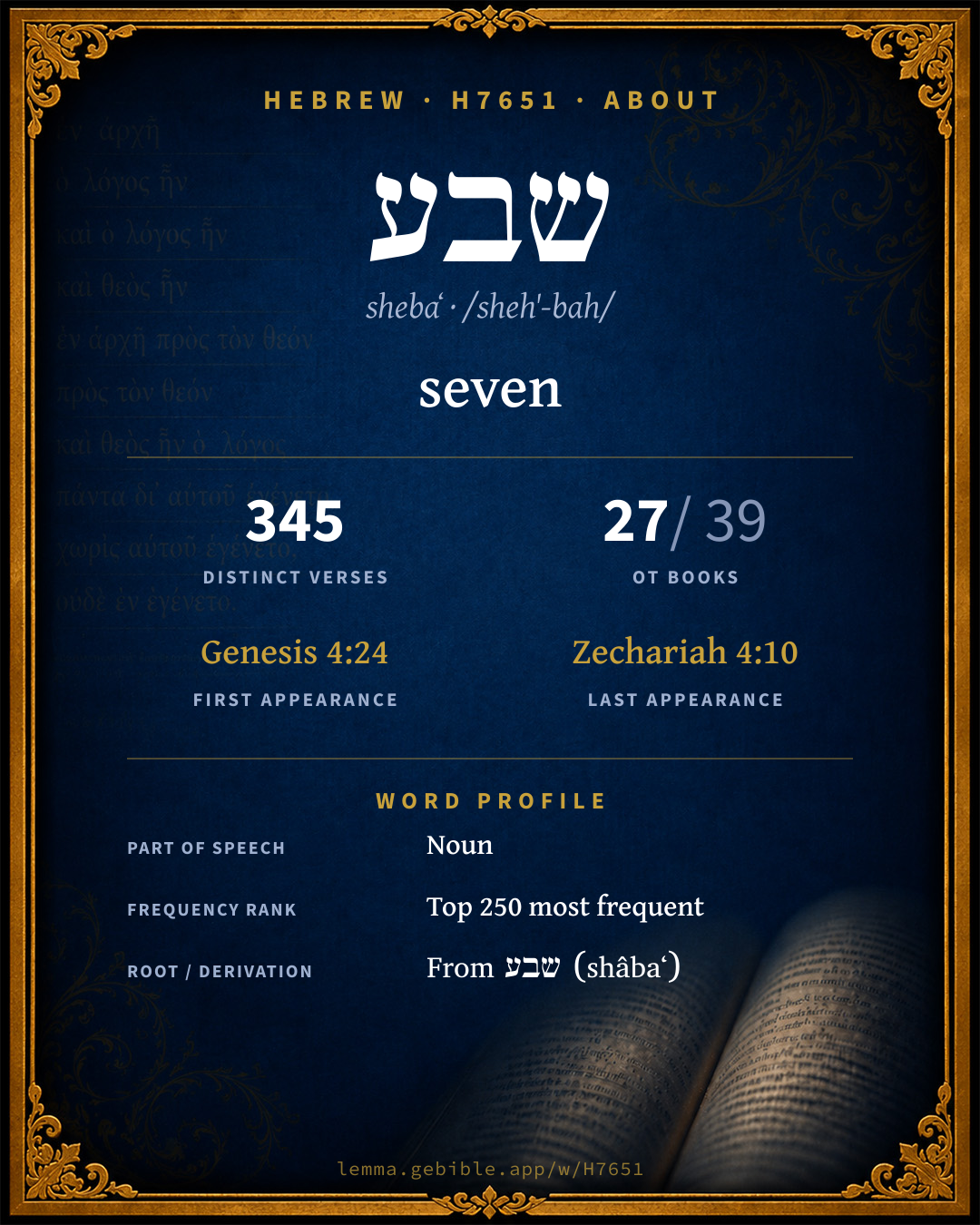
שֶׁ֫בַע
seven
‘seven’ is one of 3 main senses fuller range ↓
Full lexicon entry — Brown-Driver-Briggs (BDB)
From Brown-Driver-Briggs (BDB)
Where this word appears
See every Absolute-state word in the Hebrew Bible →
Grammar key — what these labels mean
Part of speech
- Adjective
- A word that describes or qualifies a noun.
State
- Absolute
- The independent form of a noun, not bound to a following word.
- Construct
- A noun bound to a following noun in a possessive / “of” relationship (the construct chain).
Gender
- Feminine
- Grammatically feminine.
- Masculine
- Grammatically masculine.
Number
- Singular
- One.
- Dual
- Exactly two — for natural pairs and some measures of time.
Grammatical forms
- Adjective, Cardinal number, Feminine, Singular, Absolute 166 times (42%)
- Adjective, Cardinal number, Masculine, Singular, Construct 123 times (31%)
- Adjective, Cardinal number, Masculine, Singular, Absolute 105 times (27%)
- Adjective, Cardinal number, Feminine, Dual, Absolute 1 time (0%)
Parsed forms decoded from the imported morphology (morphhb / Westminster Leningrad Codex — WLC text public domain, morphhb tagging CC BY 4.0), counted across 395 parsed occurrences — not distinct verses.
Page 1 of 2 — showing verses 1–200 of 345 distinct verses where H7651 appears, across 27 books. Click any verse to open its interlinear word-by-word view. Verse text shown in the World English Bible for context — . Each verse’s Hebrew form is shown with its reference; the English is not keyword-highlighted, since the data carries no word-level English alignment. Use “Compare translations” on any verse to read it across multiple English versions. This concordance covers the Hebrew Bible; Septuagint (Greek Old Testament) occurrences are not indexed here.
Genesis 52 verses
- Genesis 4:24 וְ/שִׁבְעָֽה conj + Adjective Cardinal number ms If Cain will be avenged seven times, Truly Lamech seventy-seven times."
- Genesis 5:7 שֶׁ֣בַע adj Cardinal number fs Seth lived after he became the father of Enosh eight hundred seven years, and became the father of sons and daughters.
- Genesis 5:25 שֶׁ֧בַע adj Cardinal number fs Methuselah lived one hundred eighty-seven years, and became the father of Lamech.
- Genesis 5:26 וּ/שְׁבַ֥ע conj + Adjective Cardinal number fs Methuselah lived after he became the father of Lamech seven hundred eighty-two years, and became the father of sons and daughters.
- Genesis 5:31 שֶׁ֤בַע וּ/שְׁבַ֥ע adj Cardinal number fs conj + Adjective Cardinal number fs All the days of Lamech were seven hundred seventy-seven years, then he died.
- Genesis 7:2 שִׁבְעָ֥ה שִׁבְעָ֖ה adj Cardinal number ms adj Cardinal number ms You shall take seven pairs of every clean animal with you, the male and his female. Of the animals that are not clean, take two, the male and his female.
- Genesis 7:3 שִׁבְעָ֥ה שִׁבְעָ֖ה adj Cardinal number ms adj Cardinal number ms Also of the birds of the sky, seven and seven, male and female, to keep seed alive on the surface of all the earth.
- Genesis 7:4 שִׁבְעָ֗ה adj Cardinal number ms In seven days, I will cause it to rain on the earth for forty days and forty nights. Every living thing that I have made, I will destroy from the surface of the ground."
- Genesis 7:10 לְ/שִׁבְעַ֣ת prep + Adjective Cardinal number ms cs It happened after the seven days, that the waters of the flood came on the earth.
- Genesis 7:11 בְּ/שִׁבְעָֽה prep + Adjective Cardinal number ms In the six hundredth year of Noah's life, in the second month, on the seventeenth day of the month, on the same day all the fountains of the great deep were burst open, and the sky's windows were opened.
- Genesis 8:4 בְּ/שִׁבְעָה prep + Adjective Cardinal number ms The ark rested in the seventh month, on the seventeenth day of the month, on Ararat's mountains.
- Genesis 8:10 שִׁבְעַ֥ת adj Cardinal number ms cs He stayed yet another seven days; and again he sent forth the dove out of the ark.
- Genesis 8:12 שִׁבְעַ֥ת adj Cardinal number ms cs He stayed yet another seven days, and sent forth the dove; and she didn't return to him any more.
- Genesis 8:14 בְּ/שִׁבְעָ֧ה prep + Adjective Cardinal number ms In the second month, on the twenty-seventh day of the month, the earth was dry.
- Genesis 11:21 שֶׁ֥בַע adj Cardinal number fs Reu lived after he became the father of Serug two hundred seven years, and became the father of sons and daughters.
- Genesis 21:28 שֶׁ֛בַע adj Cardinal number fs Abraham set seven ewe lambs of the flock by themselves.
- Genesis 21:29 שֶׁ֤בַע adj Cardinal number fs Abimelech said to Abraham, "What do these seven ewe lambs which you have set by themselves mean?"
- Genesis 21:30 שֶׁ֣בַע adj Cardinal number fs He said, "You shall take these seven ewe lambs from my hand, that it may be a witness to me, that I have dug this well."
- Genesis 23:1 וְ/שֶׁ֣בַע conj + Adjective Cardinal number fs Sarah lived one hundred twenty-seven years. These were the years of Sarah's life.
- Genesis 25:17 וְ/שֶׁ֣בַע conj + Adjective Cardinal number fs These are the years of the life of Ishmael: one hundred thirty-seven years. He gave up the spirit and died, and was gathered to his people.
- Genesis 29:18 שֶׁ֣בַע adj Cardinal number fs Jacob loved Rachel. He said, "I will serve you seven years for Rachel, your younger daughter."
- Genesis 29:20 שֶׁ֣בַע adj Cardinal number fs Jacob served seven years for Rachel. They seemed to him but a few days, for the love he had for her.
- Genesis 29:27 שֶֽׁבַע adj Cardinal number fs Fulfill the week of this one, and we will give you the other also for the service which you will serve with me yet seven other years."
- Genesis 29:30 שֶֽׁבַע adj Cardinal number fs He went in also to Rachel, and he loved also Rachel more than Leah, and served with him yet seven other years.
- Genesis 31:23 שִׁבְעַ֣ת adj Cardinal number ms cs He took his relatives with him, and pursued after him seven days' journey. He overtook him in the mountain of Gilead.
- Genesis 33:3 שֶׁ֣בַע adj Cardinal number fs He himself passed over in front of them, and bowed himself to the ground seven times, until he came near to his brother.
- Genesis 37:2 שְׁבַֽע adj Cardinal number fs This is the history of the generations of Jacob. Joseph, being seventeen years old, was feeding the flock with his brothers. He was a boy with the sons of Bilhah and Zilpah, his father's wives. Joseph brought an evil report of them to their father.
- Genesis 41:2 שֶׁ֣בַע adj Cardinal number fs Behold, there came up out of the river seven cattle, well-favored and fat-fleshed, and they fed in the reed-grass.
- Genesis 41:3 שֶׁ֧בַע adj Cardinal number fs Behold, seven other cattle came up after them out of the river, ill-favored and lean-fleshed, and stood by the other cattle on the brink of the river.
- Genesis 41:4 שֶׁ֣בַע adj Cardinal number fs The ill-favored and lean-fleshed cattle ate up the seven well-favored and fat cattle. So Pharaoh awoke.
- Genesis 41:5 שֶׁ֣בַע adj Cardinal number fs He slept and dreamed a second time: and, behold, seven heads of grain came up on one stalk, healthy and good.
- Genesis 41:6 שֶׁ֣בַע adj Cardinal number fs Behold, seven heads of grain, thin and blasted with the east wind, sprung up after them.
- Genesis 41:7 שֶׁ֣בַע adj Cardinal number fs The thin heads of grain swallowed up the seven healthy and full ears. Pharaoh awoke, and, behold, it was a dream.
- Genesis 41:18 שֶׁ֣בַע adj Cardinal number fs and, behold, there came up out of the river seven cattle, fat-fleshed and well-favored. They fed in the reed-grass,
- Genesis 41:19 שֶֽׁבַע adj Cardinal number fs and, behold, seven other cattle came up after them, poor and very ill-favored and lean-fleshed, such as I never saw in all the land of Egypt for ugliness.
- Genesis 41:20 שֶׁ֧בַע adj Cardinal number fs The lean and ill-favored cattle ate up the first seven fat cattle,
- Genesis 41:22 שֶׁ֣בַע adj Cardinal number fs I saw in my dream, and, behold, seven heads of grain came up on one stalk, full and good:
- Genesis 41:23 שֶׁ֣בַע adj Cardinal number fs and, behold, seven heads of grain, withered, thin, and blasted with the east wind, sprung up after them.
- Genesis 41:24 שֶׁ֥בַע adj Cardinal number fs The thin heads of grain swallowed up the seven good heads of grain. I told it to the magicians; but there was no one who could explain it to me."
- Genesis 41:26 שֶׁ֧בַע שֶׁ֤בַע וְ/שֶׁ֤בַע שֶׁ֥בַע adj Cardinal number fs adj Cardinal number fs conj + Adjective Cardinal number fs adj Cardinal number fs The seven good cattle are seven years; and the seven good heads of grain are seven years. The dream is one.
- Genesis 41:27 וְ/שֶׁ֣בַע שֶׁ֤בַע וְ/שֶׁ֤בַע שֶׁ֖בַע conj + Adjective Cardinal number fs adj Cardinal number fs conj + Adjective Cardinal number fs adj Cardinal number fs The seven lean and ill-favored cattle that came up after them are seven years, and also the seven empty heads of grain blasted with the east wind; they will be seven years of famine.
- Genesis 41:29 שֶׁ֥בַע adj Cardinal number fs Behold, there come seven years of great plenty throughout all the land of Egypt.
- Genesis 41:30 שֶׁ֜בַע adj Cardinal number fs There will arise after them seven years of famine, and all the plenty will be forgotten in the land of Egypt. The famine will consume the land,
- Genesis 41:34 בְּ/שֶׁ֖בַע prep + Adjective Cardinal number fs Let Pharaoh do this, and let him appoint overseers over the land, and take up the fifth part of the land of Egypt's produce in the seven plenteous years.
- Genesis 41:36 לְ/שֶׁ֨בַע֙ prep + Adjective Cardinal number fs The food will be for a store to the land against the seven years of famine, which will be in the land of Egypt; that the land not perish through the famine."
- Genesis 41:47 בְּ/שֶׁ֖בַע prep + Adjective Cardinal number fs In the seven plenteous years the earth brought forth abundantly.
- Genesis 41:48 שֶׁ֣בַע adj Cardinal number fs He gathered up all the food of the seven years which were in the land of Egypt, and laid up the food in the cities: the food of the field, which was round about every city, he laid up in the same.
- Genesis 41:53 שֶׁ֖בַע adj Cardinal number fs The seven years of plenty, that was in the land of Egypt, came to an end.
- Genesis 41:54 שֶׁ֣בַע adj Cardinal number fs The seven years of famine began to come, just as Joseph had said. There was famine in all lands, but in all the land of Egypt there was bread.
- Genesis 46:25 שִׁבְעָֽה adj Cardinal number ms These are the sons of Bilhah, whom Laban gave to Rachel, his daughter, and these she bore to Jacob: all the souls were seven.
- Genesis 47:28 שְׁבַ֥ע שֶׁ֣בַע adj Cardinal number fs adj Cardinal number fs Jacob lived in the land of Egypt seventeen years. So the days of Jacob, the years of his life, were one hundred forty-seven years.
- Genesis 50:10 שִׁבְעַ֥ת adj Cardinal number ms cs They came to the threshing floor of Atad, which is beyond the Jordan, and there they lamented with a very great and sore lamentation. He mourned for his father seven days.
Exodus 19 verses
- Exodus 2:16 שֶׁ֣בַע adj Cardinal number fs Now the priest of Midian had seven daughters. They came and drew water, and filled the troughs to water their father's flock.
- Exodus 6:16 שֶׁ֧בַע adj Cardinal number fs These are the names of the sons of Levi according to their generations: Gershon, and Kohath, and Merari; and the years of the life of Levi were one hundred thirty-seven years.
- Exodus 6:20 שֶׁ֧בַע adj Cardinal number fs Amram took Jochebed his father's sister to himself as wife; and she bore him Aaron and Moses: and the years of the life of Amram were a hundred and thirty-seven years.
- Exodus 7:25 שִׁבְעַ֣ת adj Cardinal number ms cs Seven days were fulfilled, after Yahweh had struck the river.
- Exodus 12:15 שִׁבְעַ֤ת adj Cardinal number ms cs Seven days shall you eat unleavened bread; even the first day you shall put away yeast out of your houses, for whoever eats leavened bread from the first day until the seventh day, that soul shall be cut off from Israel.
- Exodus 12:19 שִׁבְעַ֣ת adj Cardinal number ms cs Seven days shall there be no yeast found in your houses, for whoever eats that which is leavened, that soul shall be cut off from the congregation of Israel, whether he be a foreigner, or one who is born in the land.
- Exodus 13:6 שִׁבְעַ֥ת adj Cardinal number ms cs Seven days you shall eat unleavened bread, and in the seventh day shall be a feast to Yahweh.
- Exodus 13:7 שִׁבְעַ֣ת adj Cardinal number ms cs Unleavened bread shall be eaten throughout the seven days; and no leavened bread shall be seen with you, neither shall there be yeast seen with you, in all your borders.
- Exodus 22:30 שִׁבְעַ֤ת adj Cardinal number ms cs You shall do likewise with your oxen and with your sheep. Seven days it shall be with its mother, then on the eighth day you shall give it me.
- Exodus 23:15 שִׁבְעַ֣ת adj Cardinal number ms cs You shall observe the feast of unleavened bread. Seven days you shall eat unleavened bread, as I commanded you, at the time appointed in the month Abib (for in it you came out from Egypt), and no one shall appear before me empty.
- Exodus 25:37 שִׁבְעָ֑ה adj Cardinal number ms You shall make its lamps seven, and they shall light its lamps to give light to the space in front of it.
- Exodus 29:30 שִׁבְעַ֣ת adj Cardinal number ms cs Seven days shall the son who is priest in his place put them on, when he comes into the tent of meeting to minister in the holy place.
- Exodus 29:35 שִׁבְעַ֥ת adj Cardinal number ms cs "Thus shall you do to Aaron, and to his sons, according to all that I have commanded you. Seven days shall you consecrate them.
- Exodus 29:37 שִׁבְעַ֣ת adj Cardinal number ms cs Seven days you shall make atonement for the altar, and sanctify it: and the altar shall be most holy; whatever touches the altar shall be holy.
- Exodus 34:18 שִׁבְעַ֨ת adj Cardinal number ms cs "You shall keep the feast of unleavened bread. Seven days you shall eat unleavened bread, as I commanded you, at the time appointed in the month Abib; for in the month Abib you came out from Egypt.
- Exodus 37:23 שִׁבְעָ֑ה adj Cardinal number ms He made its seven lamps, and its snuffers, and its snuff dishes, of pure gold.
- Exodus 38:24 וּ/שְׁבַ֨ע conj + Adjective Cardinal number fs All the gold that was used for the work in all the work of the sanctuary, even the gold of the offering, was twenty-nine talents, and seven hundred thirty shekels, after the shekel of the sanctuary.
- Exodus 38:25 וּ/שְׁבַ֨ע conj + Adjective Cardinal number fs The silver of those who were numbered of the congregation was one hundred talents, and one thousand seven hundred seventy-five shekels, after the shekel of the sanctuary:
- Exodus 38:28 וּ/שְׁבַ֤ע conj + Adjective Cardinal number fs Of the one thousand seven hundred seventy-five shekels he made hooks for the pillars, overlaid their capitals, and made fillets for them.
Leviticus 42 verses
- Leviticus 4:6 שֶׁ֤בַע adj Cardinal number fs The priest shall dip his finger in the blood, and sprinkle some of the blood seven times before Yahweh, before the veil of the sanctuary.
- Leviticus 4:17 שֶׁ֤בַע adj Cardinal number fs and the priest shall dip his finger in the blood, and sprinkle it seven times before Yahweh, before the veil.
- Leviticus 8:11 שֶׁ֣בַע adj Cardinal number fs He sprinkled it on the altar seven times, and anointed the altar and all its vessels, and the basin and its base, to sanctify them.
- Leviticus 8:33 שִׁבְעַ֣ת שִׁבְעַ֣ת adj Cardinal number ms cs adj Cardinal number ms cs You shall not go out from the door of the Tent of Meeting seven days, until the days of your consecration are fulfilled: for he shall consecrate you seven days.
- Leviticus 8:35 שִׁבְעַ֣ת adj Cardinal number ms cs At the door of the Tent of Meeting you shall stay day and night seven days, and keep the charge of Yahweh, that you don't die: for so I am commanded."
- Leviticus 12:2 שִׁבְעַ֣ת adj Cardinal number ms cs "Speak to the children of Israel, saying, 'If a woman conceives, and bears a male child, then she shall be unclean seven days; as in the days of her monthly period she shall be unclean.
- Leviticus 13:4 שִׁבְעַ֥ת adj Cardinal number ms cs If the bright spot is white in the skin of his body, and the appearance of it isn't deeper than the skin, and the hair of it hasn't turned white, then the priest shall isolate the infected person for seven days.
- Leviticus 13:5 שִׁבְעַ֥ת adj Cardinal number ms cs The priest shall examine him on the seventh day, and, behold, if in his eyes the plague is arrested, and the plague hasn't spread in the skin, then the priest shall isolate him for seven more days.
- Leviticus 13:21 שִׁבְעַ֥ת adj Cardinal number ms cs But if the priest examines it, and, behold, there are no white hairs in it, and it isn't deeper than the skin, but is dim, then the priest shall isolate him seven days.
- Leviticus 13:26 שִׁבְעַ֥ת adj Cardinal number ms cs But if the priest examines it, and, behold, there is no white hair in the bright spot, and it isn't lower than the skin, but is faded; then the priest shall isolate him seven days.
- Leviticus 13:31 שִׁבְעַ֥ת adj Cardinal number ms cs If the priest examines the plague of itching, and, behold, its appearance isn't deeper than the skin, and there is no black hair in it, then the priest shall isolate him the person infected with itching seven days.
- Leviticus 13:33 שִׁבְעַ֥ת adj Cardinal number ms cs then he shall be shaved, but he shall not shave the itch; and the priest shall shut him up who has the itch seven more days.
- Leviticus 13:50 שִׁבְעַ֥ת adj Cardinal number ms cs The priest shall examine the plague, and isolate the plague seven days.
- Leviticus 13:54 שִׁבְעַת adj Cardinal number ms cs then the priest shall command that they wash the thing in which the plague is, and he shall isolate it seven more days.
- Leviticus 14:7 שֶׁ֣בַע adj Cardinal number fs He shall sprinkle on him who is to be cleansed from the leprosy seven times, and shall pronounce him clean, and shall let the living bird go into the open field.
- Leviticus 14:8 שִׁבְעַ֥ת adj Cardinal number ms cs "He who is to be cleansed shall wash his clothes, and shave off all his hair, and bathe himself in water; and he shall be clean. After that he shall come into the camp, but shall dwell outside his tent seven days.
- Leviticus 14:16 שֶׁ֥בַע adj Cardinal number fs The priest shall dip his right finger in the oil that is in his left hand, and shall sprinkle some of the oil with his finger seven times before Yahweh.
- Leviticus 14:27 שֶׁ֥בַע adj Cardinal number fs and the priest shall sprinkle with his right finger some of the oil that is in his left hand seven times before Yahweh.
- Leviticus 14:38 שִׁבְעַ֥ת adj Cardinal number ms cs then the priest shall go out of the house to the door of the house, and shut up the house seven days.
- Leviticus 14:51 שֶׁ֥בַע adj Cardinal number fs He shall take the cedar wood, and the hyssop, and the scarlet, and the living bird, and dip them in the blood of the slain bird, and in the running water, and sprinkle the house seven times.
- Leviticus 15:13 שִׁבְעַ֥ת adj Cardinal number ms cs "'When he who has a discharge is cleansed of his discharge, then he shall count to himself seven days for his cleansing, and wash his clothes; and he shall bathe his flesh in running water, and shall be clean.
- Leviticus 15:19 שִׁבְעַ֤ת adj Cardinal number ms cs "'If a woman has a discharge, and her discharge in her flesh is blood, she shall be in her impurity seven days: and whoever touches her shall be unclean until the evening.
- Leviticus 15:24 שִׁבְעַ֣ת adj Cardinal number ms cs "'If any man lies with her, and her monthly flow is on him, he shall be unclean seven days; and every bed whereon he lies shall be unclean.
- Leviticus 15:28 שִׁבְעַ֥ת adj Cardinal number ms cs "'But if she is cleansed of her discharge, then she shall count to herself seven days, and after that she shall be clean.
- Leviticus 16:14 שֶֽׁבַע adj Cardinal number fs He shall take some of the blood of the bull, and sprinkle it with his finger on the mercy seat on the east; and before the mercy seat he shall sprinkle some of the blood with his finger seven times.
- Leviticus 16:19 שֶׁ֣בַע adj Cardinal number fs He shall sprinkle some of the blood on it with his finger seven times, and cleanse it, and make it holy from the uncleanness of the children of Israel.
- Leviticus 22:27 שִׁבְעַ֥ת adj Cardinal number ms cs "When a bull, or a sheep, or a goat, is born, then it shall remain seven days with its mother; and from the eighth day and thenceforth it shall be accepted for the offering of an offering made by fire to Yahweh.
- Leviticus 23:6 שִׁבְעַ֥ת adj Cardinal number ms cs On the fifteenth day of the same month is the feast of unleavened bread to Yahweh. Seven days you shall eat unleavened bread.
- Leviticus 23:8 שִׁבְעַ֣ת adj Cardinal number ms cs But you shall offer an offering made by fire to Yahweh seven days. In the seventh day is a holy convocation: you shall do no regular work.'"
- Leviticus 23:15 שֶׁ֥בַע adj Cardinal number fs "'You shall count from the next day after the Sabbath, from the day that you brought the sheaf of the wave offering; seven Sabbaths shall be completed:
- Leviticus 23:18 שִׁבְעַ֨ת adj Cardinal number ms cs You shall present with the bread seven lambs without blemish a year old, one young bull, and two rams. Yhey shall be a burnt offering to Yahweh, with their meal offering, and their drink offerings, even an offering made by fire, of a sweet aroma to Yahweh.
- Leviticus 23:34 שִׁבְעַ֥ת adj Cardinal number ms cs "Speak to the children of Israel, and say, 'On the fifteenth day of this seventh month is the feast of tents for seven days to Yahweh.
- Leviticus 23:36 שִׁבְעַ֣ת adj Cardinal number ms cs Seven days you shall offer an offering made by fire to Yahweh. On the eighth day shall be a holy convocation to you; and you shall offer an offering made by fire to Yahweh. It is a solemn assembly; you shall do no regular work.
- Leviticus 23:39 שִׁבְעַ֣ת adj Cardinal number ms cs "'So on the fifteenth day of the seventh month, when you have gathered in the fruits of the land, you shall keep the feast of Yahweh seven days: on the first day shall be a solemn rest, and on the eighth day shall be a solemn rest.
- Leviticus 23:40 שִׁבְעַ֥ת adj Cardinal number ms cs You shall take on the first day the fruit of goodly trees, branches of palm trees, and boughs of thick trees, and willows of the brook; and you shall rejoice before Yahweh your God seven days.
- Leviticus 23:41 שִׁבְעַ֥ת adj Cardinal number ms cs You shall keep it a feast to Yahweh seven days in the year: it is a statute forever throughout your generations; you shall keep it in the seventh month.
- Leviticus 23:42 שִׁבְעַ֣ת adj Cardinal number ms cs You shall dwell in booths seven days. All who are native-born in Israel shall dwell in booths,
- Leviticus 25:8 שֶׁ֚בַע שֶׁ֥בַע שֶׁ֣בַע שֶׁ֚בַע adj Cardinal number fs adj Cardinal number fs adj Cardinal number fs adj Cardinal number fs "'You shall count off seven Sabbaths of years, seven times seven years; and there shall be to you the days of seven Sabbaths of years, even forty-nine years.
- Leviticus 26:18 שֶׁ֖בַע adj Cardinal number fs "'If you in spite of these things will not listen to me, then I will chastise you seven times more for your sins.
- Leviticus 26:21 שֶׁ֖בַע adj Cardinal number fs "'If you walk contrary to me, and won't listen to me, then I will bring seven times more plagues on you according to your sins.
- Leviticus 26:24 שֶׁ֖בַע adj Cardinal number fs then I will also walk contrary to you; and I will strike you, even I, seven times for your sins.
- Leviticus 26:28 שֶׁ֖בַע adj Cardinal number fs then I will walk contrary to you in wrath; and I also will chastise you seven times for your sins.
Numbers 41 verses
- Numbers 1:31 שִׁבְעָ֧ה adj Cardinal number ms those who were numbered of them, of the tribe of Zebulun, were fifty-seven thousand four hundred.
- Numbers 1:39 וּ/שְׁבַ֥ע conj + Adjective Cardinal number fs those who were numbered of them, of the tribe of Dan, were sixty-two thousand seven hundred.
- Numbers 2:8 שִׁבְעָ֧ה adj Cardinal number ms His division, and those who were numbered of it, were fifty-seven thousand four hundred.
- Numbers 2:26 וּ/שְׁבַ֥ע conj + Adjective Cardinal number fs His division, and those who were numbered of them, were sixty-two thousand seven hundred.
- Numbers 2:31 וְ/שִׁבְעָ֧ה conj + Adjective Cardinal number ms "All who were numbered of the camp of Dan were one hundred fifty-seven thousand six hundred. They shall set out last by their standards."
- Numbers 3:22 שִׁבְעַ֥ת adj Cardinal number ms cs Those who were numbered of them, according to the number of all the males, from a month old and upward, even those who were numbered of them were seven thousand five hundred.
- Numbers 4:36 שְׁבַ֥ע adj Cardinal number fs Those who were numbered of them by their families were two thousand seven hundred fifty.
- Numbers 8:2 שִׁבְעַ֥ת adj Cardinal number ms cs "Speak to Aaron, and tell him, 'When you light the lamps, the seven lamps shall give light in front of the lampstand.'"
- Numbers 12:14 שִׁבְעַ֣ת שִׁבְעַ֤ת adj Cardinal number ms cs adj Cardinal number ms cs Yahweh said to Moses, If her father had but spit in her face, shouldn't she be ashamed seven days? let her be shut up outside of the camp seven days, and after that she shall be brought in again.
- Numbers 12:15 שִׁבְעַ֣ת adj Cardinal number ms cs Miriam was shut up outside of the camp seven days: and the people didn't travel until Miriam was brought in again.
- Numbers 13:22 שֶׁ֤בַע adj Cardinal number fs They went up by the South, and came to Hebron; and Ahiman, Sheshai, and Talmai, the children of Anak, were there. (Now Hebron was built seven years before Zoan in Egypt.)
- Numbers 16:49 וּ/שְׁבַ֣ע conj + Adjective Cardinal number fs Now those who died by the plague were fourteen thousand and seven hundred, besides those who died about the matter of Korah.
- Numbers 19:4 שֶׁ֥בַע adj Cardinal number fs and Eleazar the priest shall take of her blood with his finger, and sprinkle her blood toward the front of the tent of meeting seven times.
- Numbers 19:11 שִׁבְעַ֥ת adj Cardinal number ms cs He who touches the dead body of any man shall be unclean seven days:
- Numbers 19:14 שִׁבְעַ֥ת adj Cardinal number ms cs This is the law when a man dies in a tent: everyone who comes into the tent, and everyone who is in the tent, shall be unclean seven days.
- Numbers 19:16 שִׁבְעַ֥ת adj Cardinal number ms cs Whoever in the open field touches one who is slain with a sword, or a dead body, or a bone of a man, or a grave, shall be unclean seven days.
- Numbers 23:1 שִׁבְעָ֣ה שִׁבְעָ֥ה וְ/שִׁבְעָ֥ה adj Cardinal number ms adj Cardinal number ms conj + Adjective Cardinal number ms Balaam said to Balak, Build me here seven altars, and prepare me here seven bulls and seven rams.
- Numbers 23:4 שִׁבְעַ֤ת adj Cardinal number ms cs God met Balaam: and he said to him, I have prepared the seven altars, and I have offered up a bull and a ram on every altar.
- Numbers 23:14 שִׁבְעָ֣ה adj Cardinal number ms He took him into the field of Zophim, to the top of Pisgah, and built seven altars, and offered up a bull and a ram on every altar.
- Numbers 23:29 שִׁבְעָ֣ה שִׁבְעָ֥ה וְ/שִׁבְעָ֥ה adj Cardinal number ms adj Cardinal number ms conj + Adjective Cardinal number ms Balaam said to Balak, Build me here seven altars, and prepare me here seven bulls and seven rams.
- Numbers 26:7 וּ/שְׁבַ֥ע conj + Adjective Cardinal number fs These are the families of the Reubenites; and those who were numbered of them were forty-three thousand seven hundred thirty.
- Numbers 26:34 וּ/שְׁבַ֥ע conj + Adjective Cardinal number fs These are the families of Manasseh; and those who were numbered of them were fifty-two thousand seven hundred.
- Numbers 26:51 שְׁבַ֥ע adj Cardinal number fs These are those who were numbered of the children of Israel, six hundred one thousand seven hundred thirty.
- Numbers 28:11 שִׁבְעָ֖ה adj Cardinal number ms In the beginnings of your months you shall offer a burnt offering to Yahweh: two young bulls, and one ram, seven he-lambs a year old without blemish;
- Numbers 28:17 שִׁבְעַ֣ת adj Cardinal number ms cs On the fifteenth day of this month shall be a feast: seven days shall unleavened bread be eaten.
- Numbers 28:19 וְ/שִׁבְעָ֤ה conj + Adjective Cardinal number ms but you shall offer an offering made by fire, a burnt offering to Yahweh: two young bulls, and one ram, and seven he-lambs a year old; they shall be to you without blemish;
- Numbers 28:21 לְ/שִׁבְעַ֖ת prep + Adjective Cardinal number ms cs a tenth part shall you offer for every lamb of the seven lambs;
- Numbers 28:24 שִׁבְעַ֣ת adj Cardinal number ms cs After this manner you shall offer daily, for seven days, the food of the offering made by fire, of a sweet savor to Yahweh: it shall be offered besides the continual burnt offering, and the drink-offering of it.
- Numbers 28:27 שִׁבְעָ֥ה adj Cardinal number ms but you shall offer a burnt offering for a sweet savor to Yahweh: two young bulls, one ram, seven he-lambs a year old;
- Numbers 28:29 לְ/שִׁבְעַ֖ת prep + Adjective Cardinal number ms cs a tenth part for every lamb of the seven lambs;
- Numbers 29:2 שִׁבְעָ֖ה adj Cardinal number ms You shall offer a burnt offering for a sweet savor to Yahweh: one young bull, one ram, seven he-lambs a year old without blemish;
- Numbers 29:4 לְ/שִׁבְעַ֖ת prep + Adjective Cardinal number ms cs and one tenth part for every lamb of the seven lambs;
- Numbers 29:8 שִׁבְעָ֔ה adj Cardinal number ms but you shall offer a burnt offering to Yahweh for a sweet savor: one young bull, one ram, seven he-lambs a year old; they shall be to you without blemish;
- Numbers 29:10 לְ/שִׁבְעַ֖ת prep + Adjective Cardinal number ms cs a tenth part for every lamb of the seven lambs:
- Numbers 29:12 שִׁבְעַ֥ת adj Cardinal number ms cs On the fifteenth day of the seventh month you shall have a holy convocation; you shall do no servile work, and you shall keep a feast to Yahweh seven days:
- Numbers 29:32 שִׁבְעָ֖ה adj Cardinal number ms On the seventh day seven bulls, two rams, fourteen he-lambs a year old without blemish;
- Numbers 29:36 שִׁבְעָ֖ה adj Cardinal number ms but you shall offer a burnt offering, an offering made by fire, of a sweet savor to Yahweh: one bull, one ram, seven he-lambs a year old without blemish;
- Numbers 31:19 שִׁבְעַ֣ת adj Cardinal number ms cs Encamp you outside of the camp seven days: whoever has killed any person, and whoever has touched any slain, purify yourselves on the third day and on the seventh day, you and your captives.
- Numbers 31:36 וְ/שִׁבְעַ֥ת conj + Adjective Cardinal number ms cs The half, which was the portion of those who went out to war, was in number three hundred thirty-seven thousand five hundred sheep:
- Numbers 31:43 שִׁבְעַ֥ת adj Cardinal number ms cs (now the congregation's half was three hundred thirty-seven thousand five hundred sheep,
- Numbers 31:52 שְׁבַע adj Cardinal number fs All the gold of the heave-offering that they offered up to Yahweh, of the captains of thousands, and of the captains of hundreds, was sixteen thousand seven hundred fifty shekels.
Deuteronomy 11 verses
- Deuteronomy 7:1 שִׁבְעָ֣ה adj Cardinal number ms When Yahweh your God shall bring you into the land where you go to possess it, and shall cast out many nations before you, the Hittite, and the Girgashite, and the Amorite, and the Canaanite, and the Perizzite, and the Hivite, and the Jebusite, seven nations greater and mightier than you;
- Deuteronomy 15:1 שֶֽׁבַע adj Cardinal number fs At the end of every seven years you shall make a release.
- Deuteronomy 15:9 הַ/שֶּׁבַע֮ ptcl def.art + Adjective Cardinal number fs Beware that there not be a base thought in your heart, saying, The seventh year, the year of release, is at hand; and your eye be evil against your poor brother, and you give him nothing; and he cry to Yahweh against you, and it be sin to you.
- Deuteronomy 16:3 שִׁבְעַ֥ת adj Cardinal number ms cs You shall eat no leavened bread with it; seven days shall you eat unleavened bread therewith, even the bread of affliction; for you came forth out of the land of Egypt in haste: that you may remember the day when you came forth out of the land of Egypt all the days of your life.
- Deuteronomy 16:4 שִׁבְעַ֣ת adj Cardinal number ms cs There shall be no yeast seen with you in all your borders seven days; neither shall any of the flesh, which you sacrifice the first day at even, remain all night until the morning.
- Deuteronomy 16:9 שִׁבְעָ֥ה שִׁבְעָ֖ה adj Cardinal number ms adj Cardinal number ms Seven weeks shall you number to you: from the time you begin to put the sickle to the standing grain shall you begin to number seven weeks.
- Deuteronomy 16:13 שִׁבְעַ֣ת adj Cardinal number ms cs You shall keep the feast of tents seven days, after that you have gathered in from your threshing floor and from your winepress:
- Deuteronomy 16:15 שִׁבְעַ֣ת adj Cardinal number ms cs Seven days shall you keep a feast to Yahweh your God in the place which Yahweh shall choose; because Yahweh your God will bless you in all your increase, and in all the work of your hands, and you shall be altogether joyful.
- Deuteronomy 28:7 וּ/בְ/שִׁבְעָ֥ה conj + prep + Adjective Cardinal number ms Yahweh will cause your enemies who rise up against you to be struck before you: they shall come out against you one way, and shall flee before you seven ways.
- Deuteronomy 28:25 וּ/בְ/שִׁבְעָ֥ה conj + prep + Adjective Cardinal number ms Yahweh will cause you to be struck before your enemies; you shall go out one way against them, and shall flee seven ways before them: and you shall be tossed back and forth among all the kingdoms of the earth.
- Deuteronomy 31:10 שֶׁ֣בַע adj Cardinal number fs Moses commanded them, saying, At the end of [every] seven years, in the set time of the year of release, in the feast of tents,
Joshua 9 verses
- Joshua 6:4 וְ/שִׁבְעָ֣ה שִׁבְעָ֨ה שֶׁ֣בַע conj + Adjective Cardinal number ms adj Cardinal number ms adj Cardinal number fs Seven priests shall bear seven trumpets of rams' horns before the ark: and the seventh day you shall compass the city seven times, and the priests shall blow the trumpets.
- Joshua 6:6 וְ/שִׁבְעָ֣ה שִׁבְעָ֤ה conj + Adjective Cardinal number ms adj Cardinal number ms Joshua the son of Nun called the priests, and said to them, Take up the ark of the covenant, and let seven priests bear seven trumpets of rams' horns before the ark of Yahweh.
- Joshua 6:8 וְ/שִׁבְעָ֣ה שִׁבְעָ֨ה conj + Adjective Cardinal number ms adj Cardinal number ms It was so, that when Joshua had spoken to the people, the seven priests bearing the seven trumpets of rams' horns before Yahweh passed on, and blew the trumpets: and the ark of the covenant of Yahweh followed them.
- Joshua 6:13 וְ/שִׁבְעָ֣ה שִׁבְעָ֨ה conj + Adjective Cardinal number ms adj Cardinal number ms The seven priests bearing the seven trumpets of rams' horns before the ark of Yahweh went on continually, and blew the trumpets: and the armed men went before them; and the rearward came after the ark of Yahweh, [the priests] blowing the trumpets as they went.
- Joshua 6:15 שֶׁ֣בַע שֶׁ֥בַע adj Cardinal number fs adj Cardinal number fs It happened on the seventh day, that they rose early at the dawning of the day, and compassed the city after the same manner seven times: only on the day they compassed the city seven times.
- Joshua 18:2 שִׁבְעָ֖ה adj Cardinal number ms There remained among the children of Israel seven tribes, which had not yet divided their inheritance.
- Joshua 18:5 לְ/שִׁבְעָ֣ה prep + Adjective Cardinal number ms They shall divide it into seven portions: Judah shall abide in his border on the south, and the house of Joseph shall abide in their border on the north.
- Joshua 18:6 שִׁבְעָ֣ה adj Cardinal number ms You shall describe the land into seven portions, and bring [the description] here to me; and I will cast lots for you here before Yahweh our God.
- Joshua 18:9 לְ/שִׁבְעָ֥ה prep + Adjective Cardinal number ms The men went and passed through the land, and described it by cities into seven portions in a book; and they came to Joshua to the camp at Shiloh.
Judges 13 verses
- Judges 6:1 שֶׁ֥בַע adj Cardinal number fs The children of Israel did that which was evil in the sight of Yahweh: and Yahweh delivered them into the hand of Midian seven years.
- Judges 6:25 שֶׁ֣בַע adj Cardinal number fs It happened the same night, that Yahweh said to him, Take your father's bull, even the second bull seven years old, and throw down the altar of Baal that your father has, and cut down the Asherah that is by it;
- Judges 8:14 וְ/שִׁבְעָ֖ה conj + Adjective Cardinal number ms He caught a young man of the men of Succoth, and inquired of him: and he described for him the princes of Succoth, and the elders of it, seventy-seven men.
- Judges 8:26 וּ/שְׁבַע conj + Adjective Cardinal number fs The weight of the golden ear-rings that he requested was one thousand and seven hundred [shekels] of gold, besides the crescents, and the pendants, and the purple clothing that was on the kings of Midian, and besides the chains that were about their camels' necks.
- Judges 12:9 שֶׁ֥בַע adj Cardinal number fs He had thirty sons; and thirty daughters he sent abroad, and thirty daughters he brought in from abroad for his sons. He judged Israel seven years.
- Judges 14:12 שִׁבְעַ֨ת adj Cardinal number ms cs Samson said to them, Let me now put forth a riddle to you: if you can declare it to me within the seven days of the feast, and find it out, then I will give you thirty linen garments and thirty changes of clothing;
- Judges 14:17 שִׁבְעַ֣ת adj Cardinal number ms cs She wept before him the seven days, while their feast lasted: and it happened on the seventh day, that he told her, because she pressed him sore; and she told the riddle to the children of her people.
- Judges 16:7 בְּ/שִׁבְעָ֛ה prep + Adjective Cardinal number ms Samson said to her, If they bind me with seven green cords that were never dried, then shall I become weak, and be as another man.
- Judges 16:8 שִׁבְעָ֛ה adj Cardinal number ms Then the lords of the Philistines brought up to her seven green cords which had not been dried, and she bound him with them.
- Judges 16:13 שֶׁ֛בַע adj Cardinal number fs Delilah said to Samson, Hitherto you have mocked me, and told me lies: tell me with which you might be bound. He said to her, If you weave the seven locks of my head with the web.
- Judges 16:19 שֶׁ֖בַע adj Cardinal number fs She made him sleep on her knees; and she called for a man, and shaved off the seven locks of his head; and she began to afflict him, and his strength went from him.
- Judges 20:15 שְׁבַ֥ע adj Cardinal number fs The children of Benjamin were numbered on that day out of the cities twenty-six thousand men who drew the sword, besides the inhabitants of Gibeah, who were numbered seven hundred chosen men.
- Judges 20:16 שְׁבַ֤ע adj Cardinal number fs Among all this people there were seven hundred chosen men left-handed; everyone could sling stones at a hair-breadth, and not miss.
Ruth 1 verse
1 Samuel 7 verses
- 1 Samuel 2:5 שִׁבְעָ֔ה adj Cardinal number ms Those who were full have hired out themselves for bread; Those who were hungry have ceased [to hunger]: Yes, the barren has borne seven; She who has many children languishes.
- 1 Samuel 6:1 שִׁבְעָ֥ה adj Cardinal number ms The ark of Yahweh was in the country of the Philistines seven months.
- 1 Samuel 10:8 שִׁבְעַ֨ת adj Cardinal number ms cs You shall go down before me to Gilgal; and, behold, I will come down to you, to offer burnt offerings, and to sacrifice sacrifices of peace-offerings: seven days shall you wait, until I come to you, and show you what you shall do.
- 1 Samuel 11:3 שִׁבְעַ֣ת adj Cardinal number ms cs The elders of Jabesh said to him, Give us seven days' respite, that we may send messengers to all the borders of Israel; and then, if there be none to save us, we will come out to you.
- 1 Samuel 13:8 שִׁבְעַ֣ת adj Cardinal number ms cs He stayed seven days, according to the set time that Samuel [had appointed]: but Samuel didn't come to Gilgal; and the people were scattered from him.
- 1 Samuel 16:10 שִׁבְעַ֥ת adj Cardinal number ms cs Jesse made seven of his sons to pass before Samuel. Samuel said to Jesse, Yahweh has not chosen these.
- 1 Samuel 31:13 שִׁבְעַ֥ת adj Cardinal number ms cs They took their bones, and buried them under the tamarisk tree in Jabesh, and fasted seven days.
2 Samuel 8 verses
- 2 Samuel 2:11 שֶׁ֥בַע adj Cardinal number fs The time that David was king in Hebron over the house of Judah was seven years and six months.
- 2 Samuel 5:5 שֶׁ֥בַע adj Cardinal number fs In Hebron he reigned over Judah seven years and six months; and in Jerusalem he reigned thirty-three years over all Israel and Judah.
- 2 Samuel 8:4 וּ/שְׁבַע conj + Adjective Cardinal number fs David took from him one thousand seven hundred horsemen, and twenty thousand footmen: and David hamstrung all the chariot horses, but reserved of them for one hundred chariots.
- 2 Samuel 10:18 שְׁבַ֤ע adj Cardinal number fs The Syrians fled before Israel; and David killed of the Syrians [the men of] seven hundred chariots, and forty thousand horsemen, and struck Shobach the captain of their host, so that he died there.
- 2 Samuel 21:6 שִׁבְעָ֤ה adj Cardinal number ms let seven men of his sons be delivered to us, and we will hang them up to Yahweh in Gibeah of Saul, the chosen of Yahweh. The king said, I will give them.
About this entry
At a glance — auto-summarized from this page’s data, not written by a person. Every figure links to its source below. This summary describes the numbers; it doesn’t interpret them.
At its core, שבע (shebaʻ) means “seven.” First canonically at Genesis 4:24, it enters the text early. It appears 345 verses across 27 books of the Hebrew Bible, among its common vocabulary. Carrying more than one sense, it rewards its full sense range. It shares a root with שבע, שבוע and שבועה. Dig into 345-verse concordance and the renderings breakdown below.
Gloss history
Strong's 1890 vs modern scholarship
About this word
Strong's H7651 catalogs a Hebrew word from the Hebrew Old Testament.
These counts are not copied from any lexicon or concordance. They are computed here, from the morphology-tagged Hebrew Old Testament. What Lemma adds →
- 345
- distinct verses
- The word appears in 345 distinct verses.
- 27 / 39
- OT books
- The word appears in 27 of 39 Old Testament books.
- #128
- by frequency
- Top 250 most frequent Hebrew words (rank 128 of 8,640 Hebrew words by occurrence).
View all 345 occurrences in the concordance →
By section of the Old Testament
By traditional corpus
Conventional, traditional groupings — biblical authorship is debated, so this is a traditional corpus grouping, not an authorship claim. Each share is this word’s portion of its verses in that division of the Hebrew canon. Each figure is a share of the word’s 345 distinct verses.
- Torah (Pentateuch) 165 verses · 48%
- Prophets (Nevi'im) 99 verses · 29%
- Writings (Ketuvim) 81 verses · 23%
How translations render this word
Counts come from each version’s own published word-to-Strong’s tagging or interlinear alignment — an approximate guide to how each version renders this word, not a word-level alignment the data otherwise carries. Because each total is that version’s own tagged count, the per-version totals vary from one another and need not match the appearance or distinct-verse counts above. These counts may also differ from a printed concordance because Lemma counts each distinctly tagged rendering and does not collapse phrase taggings into a single head-word total. This is a fixed set of word-tagged versions (KJV, ASV, BSB, ULT) and does not change with the reading translation you choose elsewhere. Each version’s license is shown beside its name below (and on Sources).
BDB lists this Strong’s number as 4 distinct words (homographs). Each count above pools all of them and is not split by sense — see the Senses section below. A low-frequency rendering may belong to a different one of those words, not the primary meaning.
- King James Version†: Seven 280×, Seventh 12×, Were seven 8×
- American Standard Version†: Seven 265×, Seventh 11×, Were seven 9×
- Berean Standard Bible†: Seven 234×, Seventh 9×, Seventeenth 6×
- unfoldingWord Literal Text†: Seven 254×, Were 23×, And 11×
King James Version Public Domain
Renders H7651 across 388† tagged occurrences — most commonly:
Plus other, less common renderings. Plus 32 renderings that appear only once — usually multi-word phrases or single function words the recovered tagging swept in, not distinct renderings. Not rendered by a distinct English word in 6 further occurrences.
American Standard Version Public Domain
Renders H7651 across 389† tagged occurrences — most commonly:
Plus other, less common renderings. Plus 49 renderings that appear only once — usually multi-word phrases or single function words the recovered tagging swept in, not distinct renderings.
Berean Standard Bible Public Domain
Renders H7651 across 311† tagged occurrences — most commonly:
Plus other, less common renderings. Plus 27 renderings that appear only once — usually multi-word phrases or single function words the recovered tagging swept in, not distinct renderings. Not rendered by a distinct English word in 80 further occurrences.
unfoldingWord Literal Text CC BY-SA 4.0
Renders H7651 across 355† tagged occurrences — most commonly:
Plus other, less common renderings. Plus 18 renderings that appear only once — usually multi-word phrases or single function words the recovered tagging swept in, not distinct renderings. Not rendered by a distinct English word in 58 further occurrences.
15 senses and sub-senses in the full BDB
What do BDB’s symbols mean?
BDB uses these scholarly abbreviations:
| Symbol | Meaning |
|---|---|
| 𝔊 | the Septuagint (the ancient Greek translation, LXX) |
| 𝔙 | the Vulgate (the Latin translation) |
| 𝔖 | the Syriac version (the Peshitta) |
| 𝔗 | the Targum (the Aramaic translation) |
| ψ | the Psalms |
| √ | root (the underlying root or stem) |
| ‖ | parallel passage (a synonymous or contrasted parallel) |
| † | the dagger: every passage where the word occurs is cited |
The 15 senses and sub-senses the full Brown-Driver-Briggs lexicon distinguishes for this word, in lexicon order (not ranked by frequency), with BDB’s own verbatim wording and sub-sense lettering. Shown in Hebrew script with BDB’s own scholarly abbreviations. The condensed entry is in the Lexicon Entry tab. See also the Forms in the corpus table below.
שבע I f. seven (NH id., MI16 שבעת
- 1. without other num.:
- a. שֶׁבַע, before n.fpl. Gn 21:28 (J), Ju 16:13; Is 4:1 + 80 times, especially שׁ׳ שָׁנִים Gn 29:18 (E) + 32 times (but read שׁלוֹשׁ for שֶׁבַע 2 S 24:13a, cf. v b, c, also 𝔊 and ‖ 1 Ch 21:12; so Th We Dr Bu HPS Now), שׁ׳ פְּעָמִים Gn 33:3 (J), Lv 4:6 (P) + 17 times; שׁ׳ בָּאַמָּה רָחְבָּתּ 1 K 6:6; after noun Ez 40:20, 26; n. om. Jb 5:19; Pr 6:16, + (= שׁ׳ פְּעָמִים) Lv 26:18, 21, 24, 28 (H), ψ 119:164 Pr 24:16. e.g. Genesis 21:28
- b. שִׁבְעָה, before n.mpl. Nu 23:1(×3) (E) + 40 times + Jb 42:13 (read שׁ׳ for שִׁבְעָ֫נָה Ges§ 97 c and most); + (distrib.) שׁ׳ וְשׁ׳ Zc 4:2; after n. Gn 7:4 (J), Ex 25:37 (P) + 12 times (P Ch Dn Pr); n. om. 1 S 2:5 + 9 times, incl. שׁ׳ as ordinal, v. infr.; but read שְׂבָכָה for שִׁבְעָה 1 K 7:17(×2) 𝔊 Th Kmp Klo Benz Kit Bur; also שׁ׳ שׁ׳ distrib. = 7 each Gn 7:2, 3 (J); as pred. Gn 46:25 (P). e.g. Numbers 23:1
- c. שִׁבְעַת, before n.pl. Nu 23:4 (E), 8:2 (P), Ez 45:23(×2); Jb 2:13(×2) + 97 times, incl. שׁ׳ יָמִים Gn 8:10 (J), + 88 times + Ez 45:21 (read שִׁבְעַת for שְׁבֻעוֹת, Vrss and mod.). e.g. Numbers 23:4
- d. = ordinal, שְׁנַת (הַ)שֶּׁבַע Dt 15:9; 2 K 12:2 + 3 times, בְּשִׁבְעָה לַחֹדֶשׁ Ez 30:20, cf. 45:20; לְשִׁבְעַת הַיָּמִים Gn 7:10 (J), 1 Ch 9:25. e.g. Deuteronomy 15:9
- 2.
- a. שְׁבַע עֶשְׂרֵה שָׁנָה 17 years Gn 37:2 + 3 times + 1 K 14:21 (וּשְׁבַע וגו׳), also as ordin. בִּשְׁנַת שׁ׳ עֶשׂ׳ 1 K 22:52, בִּשְׁנַת שׁ׳ עֶשׂ׳ שָׁנָה 2 K 16:1. e.g. Genesis 37:2
- b. שִׁבְעָה עֶשָׂר (sc. הַגּוֹרָל lot) 1 Ch 24:15; 25:24 (cf. also, + other num., 7:11 Ezr 2:39 Ne 7:42), + יוֹם 17th day Gn 7:11; 8:4; unusual is שׁ׳ שְׁקָלִים וַעֲשָׂרָה הַכֶּסֶף Je 32:9 7 shekels and 10 the silver. e.g. 1 Chronicles 24:15
- 3. שְׁבַע מֵאוֹת = 700 Ju 8:26 + 39 times (but Ne 7:68 om. Mass. Baer Gi q.v.). e.g. Judges 8:26
- 4. שִׁבְעָה אֶלֶף = 7000 1 K 20:30 + 2 times; שִׁבְעַת אֲלָפִים = id. 1 K 20:15 + 15 times; 57,000 is 7 + 50 × 1000 Nu 1:31; 2:8, 31. e.g. 1 Kings 20:30
- 5. שׁ׳ + other num.:
- a. שׁ׳ follows 18 times: (1) n. s. after שׁ׳ Ju 8:14; also, (= ord. num.) Ez 29:17 + 2 times, שְׁנַת שְׁלשִׁים וָשׁ׳ שָׁנָה 2 K 13:10, cf. 15:1; (2) n.pl. before other num. Ezr 8:35; Ne 7:[72], 71; (3) n. s. cstr. precedes בִּשְׁנַת עֶשְׂרִים רָשׁ׳ 1 K 16:10, 15 (ordin.); (4) n. after each num. Gn 23:1; 25:17 (both P), etc. e.g. Judges 8:14
- b. שׁ׳ precedes 10 times (P and Est): (1) n. s. after other num. Gn 8:14; Ex 6:16, 20 + 3 times Est; (2) n. repeated Gn 5:7; 11:21; 47:28, cf. 5:25, 31 e.g. Genesis 8:14
- c. 1000 + 17 Ezr 2:39 = Ne 7:42.—שׁ׳ often c. sacred signif.: Gn 21:28 ff. (J), Ex 37:23 Lv 4:6, 17; 8:11; 14:27 + (P); as round number Gn 4:24 (song in J), 29:18 ff.; 31:23; 41:2 ff. (all E), etc.; on bowing 7 times 33:3 (J; in great humility), cf. WklTelAm. nos. 143, 230, 246 NeMar. 11 f.; all these prob. originating with week of seven days; cf. especially KöHast.DB number, 562 f., 565. e.g. Ezra 2:39
שבע II
- 1. in Benj., בֶּן־בִּכְרִי 2 S 20:1, 2, 6, 7, 10, 13, 21, 22; Σαβεε. e.g. 2 Samuel 20:1
- 2. in Gad 1 Ch 5:13; Σεβεε, A Σωβαφε, 𝔊L Σαβεε. e.g. 1 Chronicles 5:13
שבע III si vera l. n.pr.loc. in Simeon, בְּאֵר־שֶׁבַע וְשֶׁבַע Jos 19
Senses from the full Brown-Driver-Briggs lexicon (Brown, Driver, Briggs; Oxford 1906 — public domain), digitized via Sefaria, supplemented by the OpenScriptures HebrewLexicon (CC BY 4.0). Full attribution on Sources.
Word origin
I. n.m. et f. seven (NH id., MI16 שבעת; Assyrian sibi, sibittu (DlGr. § 65, 6; s = שׁ), Arabic سَبْعٌ, سَبْعَةٌ Sab. סבע HomChr 47, 124, Ethiopic ሰብዑ: ሰብዐቱ: Ph. (Pun.) שבע, Nab. שבע, שבעה, Palm. שבעא, שבעה; Aramaic שִׁבְעָא,שְׁבַע, ܫܒܰܥ, ܫܰܒܥܳܐ; on etym. cf. LagBN 37 f.);—m. (c. n.f.) abs. שֶׁבַע Gn 41:2 + 115 times; cstr. שְׁבַע 5:26 + 47 times, especially P (15 times) and Chr (20 times), וּשֲׁבַע 1 K 14:21. f. (c. n.m.) abs. שִׁבְעָה Gn 4:24 + 100 times; cstr. שִׁבְעַת 7:10 + 120 times; sf. שְׁבַעְתָּם 2 S 21:9 Qr (so Vrss and mod.; v. Dr; > Kt שִׁבְעָתַיִם);—seven:
I. si vera l. n.pr.loc. in Simeon, בְּאֵר־שֶׁבַע וְשֶׁבַע Jos 19:2; Σαμαα, 𝔊L Σαβε; prob. del. וְשׁ׳ Di al. (om. ‖ 1 Ch 4:23).—בְּאֵר שׁ׳ v. p. 92a.
II. v. in cpds. אֱלִישֶׁבַע, (בַּת־שֶׁבַע), יְהוֹשֶׁבַע.
— Brown-Driver-Briggs (Oxford 1906, public domain), digitized via Sefaria, supplemented by the OpenScriptures HebrewLexicon (CC BY 4.0). See Sources.
Derived from שבע (shâbaʻ) (H7650) — to swear.
Jastrow Dictionary
A second Hebrew/Aramaic lexicon for comparison, covering Aramaic and post-biblical (Talmudic, Targumic, Midrashic) usage that the biblical-Hebrew BDB does not. Matched by lemma rather than by Strong’s number, so a lemma may carry more than one Jastrow headword (shown separately below), and the entries cover usage well beyond the Bible.
שֶׁבַע
- (b. h.) seven. Snh. V, 1, v. חֲקִירָה. Ib. 3 בש׳ (sub שעות) at seven hours of the day. Ab. V, 7. Lam. R. introd. (R. Josh. 2) ש׳ מש׳ seven times seven; a. v. fr.—בנות ש׳, ברת ש׳, v. בַּת I a. בְּרַת I.—Esp. שִׁבְעָה (sub. ימים) Shib ah, the seven days of mourning for a near relative. M. Kat. 20ᵃ, v. שְׁלֹשָׁה; a. fr.—Y. M. Kat. III, 82ᶜ; v. שָׁמַר.—Pl. שִׁבְעִים seventy. Snh. V, 5 עד ש׳ ואחד (add to the members of the court,) until they number seventy-one. Ab. Zar. 11ᵇ אחת לש׳ שנה once every seventy years; a. v. fr.
שְׁבַע
- Targ. Gen. V, 7. Ib. IV, 24 (O. ed. Vien. שִׁבְעָה). Ib. XXIX, 27. Targ. Y. II, Num. XI, 26 שׁוֹבְעָתֵי; a. fr.—Y. Kil. IV, beg. 29ᵃ חמש שורין מן שו׳ שו׳ five rows of seven trees each. Y. Sabb. I, 3ᶜ bot. אלו שגזרו … שובעה אינון those laws which they decreed by majority of votes, were seven; a. fr.—Pl. שַׁבְעִין, שִׁבְ׳, שׁוּבְ׳ seventy. Targ. Gen. V, 12; a. fr.
שָׁבַע
- , Nif. נִשְׁבַּע (b. h.) to be sworn, to swear. Shebu. III, 6 נ׳ לבטל וכ׳ if a person swears that he will omit to perform a commandment. Ib. VI, 4 אין נִשְׁבָּעִין על וכ׳ no oath is imposed in refutation of a claim of a deaf and mute, or of an insane person, or of a minor, nor do we administer an oath to a (claimant) minor, אבל נשבעין לקטן וכ׳ but you must make oath when suing a minor or the sacred treasury. Ib. 7 ומי נ׳ מי … שמא יִשָּׁבַע זה וכ׳ which of them is first admitted to an oath? He with whom the (lost) pledge was deposited, lest this one (the debtor) swear (to the value of the pledge), and the other produce the pledge (and prove him a perjurer). Ib. VII, 1 כל הנשבעין שבתורה נשבעין וכ׳ all those bound to swear according to Biblical law swear and are free from payment, but the following swear and receive (are awarded their claim). Ib. 32ᵇ ואינו יכול לִישָּׁבֵעַ, v. שְׁבוּעָה; a. fr.
- to adjure; to impose, administer an oath. Ib. IV, 3 אמרו אין אנו … מַשְׁבִּיעַ אני עליכם וכ׳ if they say, we know no testimony in thy case, (and he says,) I adjure you, and they say, Amen: they are guilty (if they could testify). Ib. ה׳ עליהן … חוץ וכ׳ if he adjured them five times out of court, and coming before court they confess (that they know testimony), they are acquitted. Ib. VIII, 2 מַשְׁבִּיעֲךָ אני וכ׳ I adjure thee, and he says, Amen. Ib. 29ᵃ; 39ᵃ, a. e. וכשמַשְׁבִּיעִין אותו … אנו משביעין אותך וכ׳ and when the court administers an oath to him, they say to him, know that we cause thee to swear not in thy sense, but in the sense of God and in the sense of the court; a. fr.—Part. pass. מוּשְׁבָּע; pl. מוּשְׁבָּעִין. Ib. 31ᵃ מ׳ מפי עצמו one who is sworn on his own demand (in his own case); מ׳ מפי אחרים one who is sworn on other people’s demands (as a supposed witness that claims ignorance). Ib. III, 6 הרשות שאינו מ׳ עליה מהר סיני a religiously indifferent act, on which he is not sworn from Mount Sinai; מצוה שהוא מ׳ וכ׳ a religious act on which he is sworn &c. Ib. 21ᵇ; 22ᵇ, v. סִינַי; a. fr.
שְׁבַע II
- Ithpa. אִשְׁתַּבַּע, Ithpe. אִשְׁתְּבַע, אִישְּׁבַע as preced. Nif. Targ. Lev. V, 22; 24. Targ. Jer. V, 2; a. fr.— Shebu. 29ᵃ ודילמא … וכי קא מִשְׁתַּבַּע אדעתא דיריה א׳ perhaps that man saw a huge bird and called it gamla (camel), and when he swore (that he saw a camel fly in the air), he swore in his sense. Ib. דכי קא משתבע … קא משתבע so that when he swears (that he has paid the money), he swears to the truth in his sense (having given him tokens, v. אִיסְקוּנְדְּרֵי). Ib. 32ᵇ אי … הוה מִשְׁתַּבַּעְנָא וכ if thou hadst come and testified for me, I should have been assigned an oath and received my claim; מי יימר דמִשְׁתַּבְּעַת who can say that thou wouldst have made oath? Ib. לִישְׁתַּבַּע shall he be admitted to an oath? Ib. 26ᵃ ואנא בשיקרא אִישְׁתַּבְּעִי and have I sworn falsely?; a. fr.
- as preced. Hif. Targ. Y. II, Ex. XIII, 19 [read:] מִשְׁבָּע אַשְׁבַּע. Targ. Cant. II, 7. Targ. Cant. II, 4; a. e.—Shebu. 36ᵃ אַשְׁבְּעִינְהוּ ולייטינהו he made them swear, and also pronounced a curse upon them. Ib. 41ᵃ לא מַשְׁבְּעִינָן ליה we do not put him to an oath; a. fr.
שָׂבֵעַ I
- next w.) sated, filled, satisfied. Gitt. 56ᵃ יוצא כשהוא ש׳, v. רָעֵב I. Lev. R. s. 34 לשְׂבֵעוֹ וכ׳, v. רָעֵב I; a. fr.—Pl. שְׂבֵעִים, שְׂבֵעִין, שְׂבֵי׳. Joma 74ᵇ סומין … ואינו ש׳ blind persons eat and are not satisfied. Taan. 10ᵇ אל תראו עצמיכם בפני בני עשו … כאילו אתם ש׳ Ms. M. (v. Rabb. D. S. a. l. note) make no show of your plenty before the sons of Esau or of Ishmael, lest they envy you; Yalk. Gen. 148; a. e.—Fem. שְׂבֵעָה, שְׂבֵי׳. Y. Ab. Zar. III, 42ᶜ top the Lord allows the righteous in this world to see their (future) reward, ונפשם ש׳ וכ׳ and they feel satisfied and go to sleep; a. e.—Pl. שְׂבֵעוֹת, שְׂבֵי׳. Midr. Sam. ch. XIII (ref. to I Sam. IX, 12, sq.) וכל האורך הזה … ולא היו ש׳ ממנו why this lengthy speech? It intimates that they looked at the beauty of Saul and could not see enough of it; a. e. e.g. 1 Samuel 9:12
שָׂבֵעַ II
- to be filled, to have plenty, be satisfied. Sabb. 113ᵇ (ref. to Ruth II, 14) ותאכל בעולם הזה ותִשְׂבַּע וכ׳ she (Israel) will eat in this world, will have plenty in the Messianic days, and leave over for the hereafter. Succ. 52ᵇ, v. רָעֵב II; a. e. e.g. Ruth 2:14
- to satisfy. Gen. R. s. 76, end כדי להַשְׂבִּיעַ עיניו וכ׳ in order to satisfy the eyes of the wicked man. Y. Keth. V, 30ᵇ הִשְׂבִּיעָתוֹ; Succ. l. c. מַשְׂבִּיעוֹ, v. רָעֵב II. Snh. 100ᵃ; a. fr.—Ib. 29ᵇ אדם עשוי שלא להשביע את עצמו man is wont not to declare himself wealthy (to disclaim wealth, by saying that he is in debt, even if he is not); כשם שאדם … שלא להשביע את בניו as man is wont to disclaim wealth for himself, so is he likely to disclaim it for his heirs (therefore an ante-mortem confession of indebtedness does not establish a claim against heirs).
- same.—Part. pass. מְשׂוּבָּע. Lev. R. s. 29 (play on השביעי, Lev. XXIII, 24) שהוא מש׳ בכל וכ׳ a month which is plentiful in every thing &c. e.g. Leviticus 23:24
- to be satiated, sick. Num. R. s. 14 עתיד להִשְׂתַּבּעַ, v. סִיג I.
שְׂבַע
- , to be satisfied, saturated. Targ. O. Ex. XVI, 8 למִיסְבַּע ed. Berl. (ed. Amst. למִישְׂ׳); Y. למִשְׂבּוֹעַ. Targ. Ps. CIV, 16 (Ms. ס׳); a. fr.—Part. שְׂבִיעַ, שְׂבַע, סְ׳; f. שָׂבְעָא, סָ׳. Targ. Prov. XXX, 22 דשביע ed. Lag. (Ms. דסביע; ed. Wil. דיִשְׂבַּע). Targ. Job XLII, 17. Targ. Gen. XXV, 8. Targ. Prov. XXVII, 7; a. fr.—Pesik. R. s. 16; Pesik. Eth Korb., p. 57ᵇ, a. e., v. רְוֵי; a. e.
- ; Af. אַשְׂבַּע, אַסְ׳ to satisfy. Targ. Ps. XC, 14. Ib. CVII, 9; a. fr.—Taan. 24ᵃ רחמנא לִישַׂבְּעָךְ … דאַשְׂבְּעָן ברך the Lord satisfy thee, as thy son has satisfied us. Yoma 79ᵇ שַׂבּוּעֵי מְשַׂבְּעא is enough to satisfy the appetite. Gitt. 70ᵃ תמרי מְשַׂבְּעַן וכ׳ dates satisfy, heat &c.; Keth. 10ᵇ; a. e.
- (cmp. צָבָה) to be swollen. Esth. R. to III, 14 א׳ קרסוליה (omitted in Yalk. ib. 1056) his ankle was swollen.
שָׂבָע
- , v. שׂוֹבַע, שׂוֹבְעָא, a. סִבְעָא.
שׂוֹבַע
- plenty, satiation. Ber. 55ᵃ שלשה דברים … רעב וש׳ וכ׳ three things does the Lord himself announce: famine, plenty, and a good leader. Tosef. Pes. V, 3 חגיגה … פסח נאכל בש׳ (Var. על הש׳) the pilgrim’s sacrifice … must be eaten first, so that the Passover offering be eaten after the appetite is satisfied; Y. ib. VI, 33ᶜ לָשׂבַע; Bab. ib. 70ᵃ על השבע. Gen. R. s. 91 שני השָ׳ the years of plenty. Snh. 97ᵃ ש׳ ואינו ש׳ plenty and no plenty (partial plenty); ש׳ גדול general plenty; a. fr.
A Dictionary of the Targumim, the Talmud Babli and Yerushalmi, and the Midrashic Literature (Marcus Jastrow; London, Luzac, 1903) — Public Domain. Digitized via Sefaria. Digitized via Sefaria. Full attribution on Sources.
Forms in the corpus
The 90 distinct written forms H7651 takes in the Hebrew Bible, most frequent first — each parse links to that state’s occurrences in the concordance. Hebrew forms include their vowel points and cantillation, so a single lemma takes many written forms.
The 60 most common forms are shown; 30 rarer forms follow in the full concordance.
Same root — word family
Other BDB entries built from the same root as H7651, grouped by Strong’s listed origin. These share a root / origin per the lexicon — not necessarily a shared meaning. Each links to that word’s own entry.
Derives from
Shares the same root
Derived from this word
- שבעה shibʻâh H7655 seven
- שבעים shibʻîym H7657 seventy
- שבענה shibʻânâh H7658 seven
- שבעתים shibʻâthayim H7659 sevenfold
Proper names from this root
People and places named from this root — a name, not an additional meaning of the word.
Compare all same-root words → Showing 4 of 11 — not the complete family. 3 of the same-root words are proper names (people or places). They share a root, not necessarily a meaning.
Septuagint verse parallels
This word appears in 320 verses that also exist in the Greek Old Testament (Septuagint), out of the 345 Hebrew verses it occurs in. You can read those verses in Greek by switching the Old Testament edition to the Septuagint.
Read these verses in the Septuagint
- Genesis 4:24
- Exodus 2:16
- Leviticus 4:6
- Numbers 1:31
- Deuteronomy 7:1
- Joshua 6:6
- Judges 6:1
- Ruth 4:15
- 1 Samuel 2:5
- 2 Samuel 2:11
- 1 Kings 2:11
- 2 Kings 3:9
This is a verse-level parallel only — the same verses exist in both the Hebrew and Greek Old Testaments. No word-level Hebrew↔Greek correspondence is claimed: the data carries no such alignment, so no Greek word is shown as this Hebrew word’s translation. Coverage is not total — the Septuagint omits the deuterocanon and renumbers the Psalms, so some Hebrew verses have no direct Greek parallel.