

Ruth 2:14

Hebrew (Westminster Leningrad Codex) Ruth 2:14 appears in the Hebrew Old Testament. The text above is from the Westminster Leningrad Codex. Each word links to its Strong’s number, a concise gloss, and parsing drawn from the Open Scriptures Hebrew Bible morphology. Click any word for its full Brown-Driver-Briggs (BDB) entry.
Download image
Cite this verse

Ruth 2:14 (World English Bible). Public Domain. Lemma interlinear Bible study tool, https://lemma.gebible.app/v/ruth/2/14.

Show BibTeX & RIS
BibTeX
RIS
English Translation
At meal-time Boaz said to her, Come here, and eat of the bread, and dip your morsel in the vinegar. She sat beside the reapers, and they reached her parched grain, and she ate, and was sufficed, and left of it.
World English Bible · Public Domain
Highlights
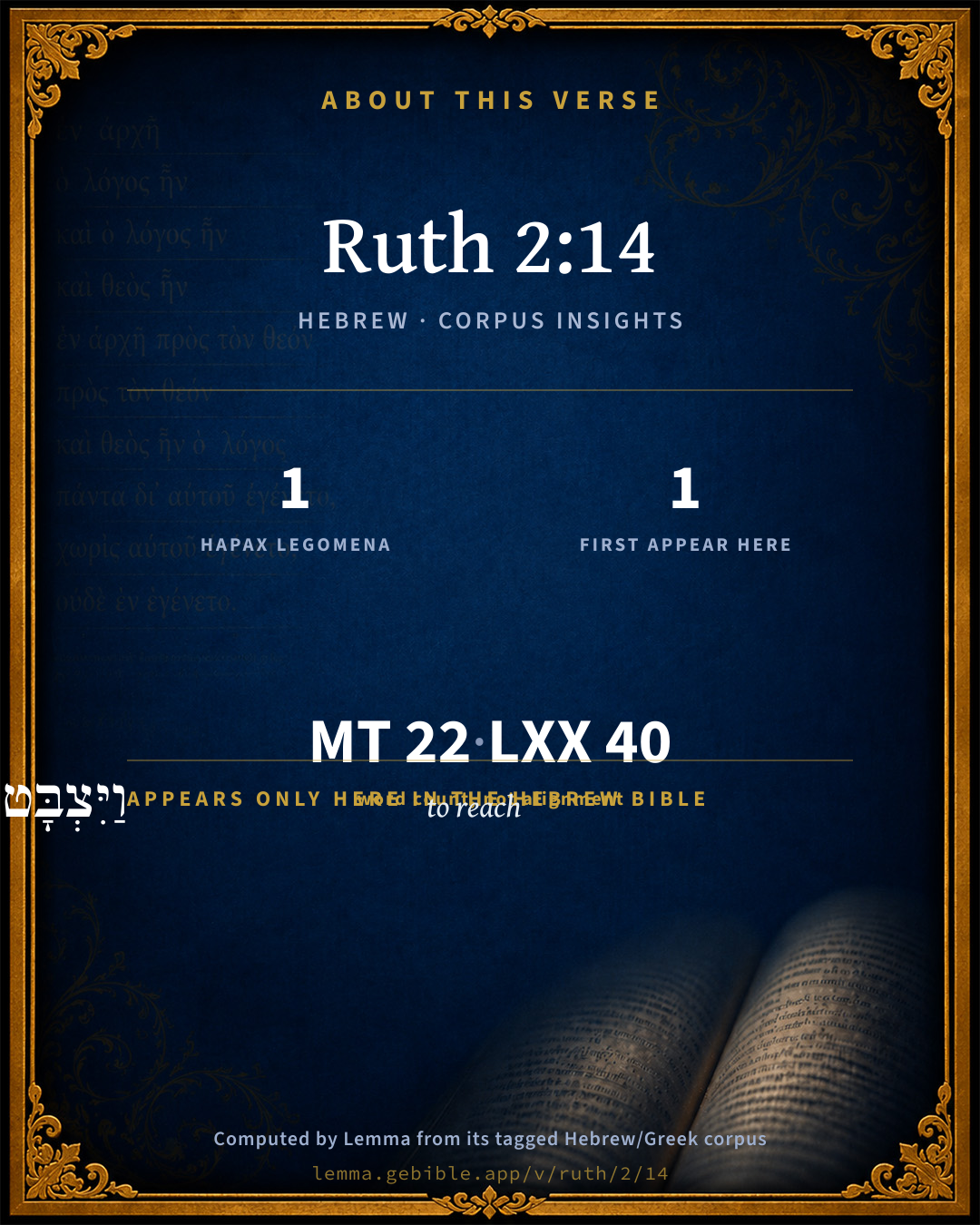
  • 1 hapax legomenon — only here in the Hebrew Bible
  • 1 first appearance in the Hebrew Bible
Full analysis ↓
Download a study sheet

One document with this verse’s original text, its word-by-word gloss line, the meaning frame, cross-references with their text, attributed commentary, and full source and license credits — printable, and it pastes into notes with its structure intact.

This verse Autodidact and up

Study sheet (.html) Plain text (.txt)

A passage Seminary Student

Up to 50 verses in one chapter. A passage sheet keeps up to 6 commentary sources and 12 cross-references per verse, in the order this page ranks them, and says so on the sheet whenever that leaves anything out. Ask for a single verse and you get the Autodidact verse sheet above.

Everything on this page stays free to read, with no account — the sheet is a download of what is already on screen, not access to it.

Want to remove ads? Support Godless Engineer
Compare translations 3

The same verse in 3 English versions, stacked beneath the original-language interlinear above. Click any original word for its lexicon entry.

Each is an independent rendering of the whole verse — the interlinear is not word-aligned to these translations.

Highlighted words mark where these versions differ — a whole-verse word diff, not a word-by-word alignment.

  • World English Bible Public Domain
    At meal-time Boaz said to her, Come here, and eat of the bread, and dip your morsel in the vinegar. She sat beside the reapers, and they reached her parched grain, and she ate, and was sufficed, and left of it.
  • King James Version Public Domain
    And Boaz said unto her, At mealtime come thou hither, and eat of the bread, and dip thy morsel in the vinegar. And she sat beside the reapers: and he reached her parched corn, and she did eat, and was sufficed, and left.
  • unfoldingWord Literal Text CC BY-SA 4.0
    Then, at the time of the meal, Boaz said to her, “Come here and eat from the bread, and dip your piece in the vinegar.” So she sat beside the reapers, and he offered to her some roasted grain. And she ate and she was satisfied, and she had some left over.

unfoldingWord Literal Text — © unfoldingWord, licensed CC BY-SA 4.0. Word-aligned USFM3 via Door43 (git.door43.org/unfoldingWord/en_ult).

Versions to compare (up to 4)

3 of 4 selected

Show all 18 translations

Every available English version of this verse, each an independent rendering of the whole verse.

  • World English Bible Public Domain
    At meal-time Boaz said to her, Come here, and eat of the bread, and dip your morsel in the vinegar. She sat beside the reapers, and they reached her parched grain, and she ate, and was sufficed, and left of it.
  • Berean Standard Bible Public Domain
    At mealtime Boaz said to her, “Come over here; have some bread and dip it into the vinegar sauce.” So she sat down beside the harvesters, and he offered her roasted grain, and she ate and was satisfied and had some left over.
  • Majority Standard Bible Public Domain
    At mealtime Boaz said to her, “Come over here; have some bread and dip it into the vinegar sauce.” So she sat down beside the harvesters, and he offered her roasted grain, and she ate and was satisfied and had some left over.
  • King James Version Public Domain
    And Boaz said unto her, At mealtime come thou hither, and eat of the bread, and dip thy morsel in the vinegar. And she sat beside the reapers: and he reached her parched corn, and she did eat, and was sufficed, and left.
  • American Standard Version (1901) Public Domain
    And at meal-time Boaz said unto her, Come hither, and eat of the bread, and dip thy morsel in the vinegar. And she sat beside the reapers, and they reached her parched grain, and she did eat, and was sufficed, and left thereof.
  • Revised Version (1885) Public Domain
    And at meal-time Boaz said unto her, Come hither, and eat of the bread, and dip thy morsel in the vinegar. And she sat beside the reapers: and they reached her parched corn, and she did eat, and was sufficed, and left thereof.
  • Geneva Bible (1599) Public Domain
    And Boaz said vnto her, At the meale time come thou hither, and eat of the bread, and dippe thy morsell in the vineger. And she sate beside the reapers, and hee reached her parched corne: and shee did eate, and was sufficed, and left thereof.
  • Douay-Rheims (1899) Public Domain
    And Booz said to her: At mealtime come thou hither, and eat of the bread, and dip thy morsel in the vinegar. So she sat at the side of the reapers, and she heaped to herself frumenty, and ate and was filled, and took the leavings.
  • Young's Literal Translation Public Domain
    And Boaz saith to her, `At meal-time come nigh hither, and thou hast eaten of the bread, and dipped thy morsel in the vinegar.' And she sitteth at the side of the reapers, and he reacheth to her roasted corn, and she eateth, and is satisfied, and leaveth.
  • Literal Standard Version CC BY-SA 4.0
    And Boaz says to her, “At meal-time come near here, and you have eaten of the bread, and dipped your morsel in the vinegar.” And she sits at the side of the reapers, and he reaches to her roasted grain, and she eats, and is satisfied, and leaves.
  • Unlocked Literal Bible CC BY-SA 4.0
    At mealtime Boaz said to Ruth, “Come here, and eat some of the bread, and dip your morsel in the wine vinegar.” She sat beside the reapers, and he offered her some roasted grain. She ate until she was satisfied and left the rest of it.
  • unfoldingWord Literal Text CC BY-SA 4.0
    Then, at the time of the meal, Boaz said to her, “Come here and eat from the bread, and dip your piece in the vinegar.” So she sat beside the reapers, and he offered to her some roasted grain. And she ate and she was satisfied, and she had some left over.
  • Darby Bible Public Domain
    And Boaz said to her at mealtime, Come hither and eat of the bread, and dip thy morsel in the vinegar. And she sat beside the reapers; and he reached her parched corn, and she ate and was sufficed, and reserved [some].
  • World Messianic Bible Public Domain
    At meal time Boaz said to her, “Come here, and eat some bread, and dip your morsel in the vinegar.” She sat beside the reapers, and they passed her parched grain. She ate, was satisfied, and left some of it.
  • Webster's Bible Public Domain
    And Boaz said to her, At meal-time come thou hither, and eat of the bread, and dip thy morsel in the vinegar. And she sat beside the reapers: and he reached her parched corn, and she ate, and was satisfied, and left.
  • Free Bible Version CC BY-SA 4.0
    When it was time to eat, Boaz called her over. “Come here,” he said. “Take some bread and dip it in wine vinegar.” So she sat down with the workers and Boaz passed her some roasted grain to eat. She ate until she'd had enough with some left over.
  • Bible in Basic English Public Domain
    And at meal-time Boaz said to her, Come here, and take some of the bread, and put your bit into the wine. And she took her seat among the grain-cutters: and he gave her dry grain, and she took it, and there was more than enough for her meal.
  • JPS Tanakh (1917) Public Domain
    And Boaz said unto her at meal-time: 'Come hither, and eat of the bread, and dip thy morsel in the vinegar.' And she sat beside the reapers; and they reached her parched corn, and she did eat and was satisfied, and left thereof.

Literal Standard Version (2020), Covenant Press — licensed CC BY-SA 4.0. Text via the HelloAO Bible API (eBible.org). Unlocked Literal Bible (unfoldingWord) — licensed CC BY-SA 4.0. Text via the HelloAO Bible API (eBible.org). unfoldingWord Literal Text — © unfoldingWord, licensed CC BY-SA 4.0. Word-aligned USFM3 via Door43 (git.door43.org/unfoldingWord/en_ult). Free Bible Version, Dr. Jonathan Gallagher — licensed CC BY-SA 4.0. Text via the HelloAO Bible API (eBible.org).

Word by word

More ways to search: Search by grammar → Find every occurrence → Compare this word →

Practice this passage: Drill this verse → Learn its vocabulary →

וַיִּצְבָּט
tsâbaṭ
H6642
“and · to reach”
Conjunction + Verb, Qal, Sequential Imperfect, 3rd Person, Masculine, Singular
Part of Speech
Conjunction + Verb
Stem
Qal
Form
Sequential Imperfect
Person
3rd Person
Gender
Masculine
Number
Singular
Full BDB Definition

Origin: a primitive root

TWOT: 1871

(Qal) to reach, hold out
  1. וַיֹּאמֶר֩ ʼâmar H559 “and · to say” Conjunction + Verb, Qal, Sequential Imperfect, 3rd Person, Masculine, Singular
  2. בֹ֜עַז Bôʻaz H1162 “Boaz” Noun, Proper
  3. לְעֵ֣ת ʻêth H6256 “to/for · time of” Preposition + Noun, Common, Both, Singular, Construct
  4. הָאֹ֗כֶל ʼôkel H400 “the · food” Particle, Definite Article + Noun, Common, Masculine, Singular, Absolute
  5. גֹּ֤שִֽׁי nâgash H5066 “approach” Verb, Qal, Imperative, 2nd Person, Feminine, Singular
  6. הֲלֹם֙ hălôm H1988 “here” Adverb
  7. וְאָכַ֣לְתְּ ʼâkal H398 “and · to eat” Conjunction + Verb, Qal, Sequential Perfect, 2nd Person, Feminine, Singular
  8. מִן min H4480 “from” Preposition
  9. הַלֶּ֔חֶם lechem H3899 “the · bread” Particle, Definite Article + Noun, Common, Both, Singular, Absolute
  10. וְטָבַ֥לְתְּ ṭâbal H2881 “and · to dip” Conjunction + Verb, Qal, Sequential Perfect, 2nd Person, Feminine, Singular
  11. פִּתֵּ֖ךְ path H6595 “morsel · your” Noun, Common, Feminine, Singular, Construct + Suffix, Personal, 2nd Person, Feminine, Singular
  12. בַּחֹ֑מֶץ chômets H2558 “in/at the · vinegar” Preposition, Determined + Noun, Common, Masculine, Singular, Absolute
  13. וַתֵּ֨שֶׁב֙ yâshab H3427 “and · to dwell” Conjunction + Verb, Qal, Sequential Imperfect, 3rd Person, Feminine, Singular
  14. מִצַּ֣ד tsad H6654 “from · side of” Preposition + Noun, Common, Masculine, Singular, Construct
  15. הַקּֽוֹצְרִ֔ים qâtsar H7114 “the · being short” Particle, Definite Article + Verb, Qal, Participle Active, Masculine, Plural, Absolute
  16. קָלִ֔י qâlîy H7039 “parched grain” Noun, Common, Masculine, Singular, Absolute
  17. וַתֹּ֥אכַל ʼâkal H398 “and · to eat” Conjunction + Verb, Qal, Sequential Imperfect, 3rd Person, Feminine, Singular
  18. וַתִּשְׂבַּ֖ע sâbaʻ H7646 “and · to be satisfied” Conjunction + Verb, Qal, Sequential Imperfect, 3rd Person, Feminine, Singular
  19. וַתֹּתַֽר yâthar H3498 “and · to remain” Conjunction + Verb, Hiphil, Sequential Imperfect, 3rd Person, Feminine, Singular

About this verse

These counts appear in no published source. They are computed here, from the morphology-tagged text and Lemma’s own curated glosses. What Lemma adds →

22
words
19
distinct lemmas
Historical
section

Notable vocabulary

1 hapax legomenon — a word that appears only here in the entire Hebrew Bible:

  • וַיִּצְבָּט to reach H6642

First appearance in Scripture

This word makes its first canonical appearance in the Hebrew Bible here:

  • וַיִּצְבָּט to reach H6642

Shared distinctive vocabulary

בַּחֹ֑מֶץ vinegar H2558 occurs in 5 verses of the Hebrew Bible. Also found in:

Grammatical profile

  • 10 verbs
  • 8 nouns
  • 3 prepositions
  • 1 adverb

Verb forms

  • וַיֹּאמֶר֩ Qal · Sequential Imperfect
  • גֹּ֤שִֽׁי Qal · Imperative
  • וְאָכַ֣לְתְּ Qal · Sequential Perfect
  • וְטָבַ֥לְתְּ Qal · Sequential Perfect
  • וַתֵּ֨שֶׁב֙ Qal · Sequential Imperfect
  • הַקּֽוֹצְרִ֔ים Qal · Participle Active
  • וַיִּצְבָּט Qal · Sequential Imperfect
  • וַתֹּ֥אכַל Qal · Sequential Imperfect
  • וַתִּשְׂבַּ֖ע Qal · Sequential Imperfect
  • וַתֹּתַֽר Hiphil · Sequential Imperfect

Repetition

A word recurs within this verse — often emphatic in Hebrew:

  • וְאָכַ֣לְתְּ to eat H398 ×2

Hebrew & Septuagint length

In English translation the verse runs 41 words from the Hebrew and 51 from the Septuagint (LXX English) — closely comparable.

A rough comparison of the two English renderings, which tokenize alike — not a word-level alignment.

Word counts can differ between the Hebrew and the Greek without any difference in meaning — e.g. the Hebrew direct-object marker אֵת has no separate Greek word, and Greek often adds the article ὁ.

In the original languages it is 22 Hebrew tokens and 40 Greek tokens — but the two are counted differently (Hebrew bundles its prefixes and suffixes into one token; the Greek is in lemma form), so that isn’t a like-for-like length.

Cross-references

15

Topical passages linked to Ruth 2:14 in the Treasury of Scripture Knowledge — connected by theme and wording, ordered by reader-vote popularity; previews shown in the World English Bible.

  • Ruth 2:18 She took it up, and went into the city; and her mother-in-law saw what she had gleaned: and she brought forth and gave to her that which she had left after she was sufficed.
  • Deuteronomy 8:10 You shall eat and be full, and you shall bless Yahweh your God for the good land which he has given you.
  • 2 Kings 4:43–44 His servant said, What, should I set this before a hundred men? But he said, Give the people, that they may eat; for thus says Yahweh, They shall eat, and shall leave of it.
  • Matthew 14:20 They all ate, and were filled. They took up twelve baskets full of that which remained left over from the broken pieces.
  • Luke 14:12–14 He also said to the one who had invited him, "When you make a dinner or a supper, don't call your friends, nor your brothers, nor your kinsmen, nor rich neighbors, or perhaps they might also return the favor, and pay you back.
  • Deuteronomy 11:15 I will give grass in your fields for your cattle, and you shall eat and be full.
  • 1 Samuel 17:17 Jesse said to David his son, Take now for your brothers an ephah of this parched grain, and these ten loaves, and carry [them] quickly to the camp to your brothers;
  • 1 Samuel 25:18 Then Abigail made haste, and took two hundred loaves, and two bottles of wine, and five sheep ready dressed, and five measures of parched grain, and one hundred clusters of raisins, and two hundred cakes of figs, and laid them on donkeys.
  • 2 Samuel 17:28 brought beds, and basins, and earthen vessels, and wheat, and barley, and meal, and parched [grain], and beans, and lentils, and parched [pulse],
  • Job 31:16–22 "If I have withheld the poor from their desire, Or have caused the eyes of the widow to fail,
  • Psalms 23:5 You prepare a table before me in the presence of my enemies. You anoint my head with oil. My cup runs over.
  • Proverbs 11:24–25 There is one who scatters, and increases yet more. There is one who withholds more than is appropriate, but gains poverty.
  • Isaiah 32:8 But the noble devises noble things; and in noble things shall he continue.
  • Isaiah 58:7 Isn't it to deal your bread to the hungry, and that you bring the poor who are cast out to your house? when you see the naked, that you cover him; and that you not hide yourself from your own flesh?
  • Isaiah 58:10–11 and if you draw out your soul to the hungry, and satisfy the afflicted soul: then shall your light rise in darkness, and your obscurity be as the noonday;

Cross-references courtesy of OpenBible.info (CC BY 4.0).

Hebrew and Greek witnesses Masoretic Hebrew ↔ Greek Septuagint

The same verse in the two great witnesses to the Old Testament, shown verse-for-verse.

These are two independent witnesses, not word-aligned to each other, and the Septuagint is shown in lemma (dictionary) form.

Hebrew Ruth 2:14 Masoretic · Westminster Leningrad Codex

וַיֹּאמֶר֩ לָ֨ה בֹ֜עַז לְעֵ֣ת הָאֹ֗כֶל גֹּ֤שִֽׁי הֲלֹם֙ וְאָכַ֣לְתְּ מִן הַלֶּ֔חֶם וְטָבַ֥לְתְּ פִּתֵּ֖ךְ בַּחֹ֑מֶץ וַתֵּ֨שֶׁב֙ מִצַּ֣ד הַקּֽוֹצְרִ֔ים וַיִּצְבָּט לָ֣הּ קָלִ֔י וַתֹּ֥אכַל וַתִּשְׂבַּ֖ע וַתֹּתַֽר

At meal-time Boaz said to her, Come here, and eat of the bread, and dip your morsel in the vinegar. She sat beside the reapers, and they reached her parched grain, and she ate, and was sufficed, and left of it.

World English Bible · Public Domain

Greek LXX Ruth 2:14 Septuagint · lemma form

καί εἶπον αὐτός βοος ἤδη ὥρα ὁ ἐσθίω προςἔρχομαι ὧδε καί ἐσθίω ὁ ἄρτος καί βάπτω ὁ ψωμός σύ ἐν ὁ ὄξος καί καταἵζω ρουθ ἐκ πλάγιος ὁ θερίζω καί βουνίζω αὐτός βοος ἄλφιτον καί ἐσθίω καί ἐνπίμπλημι καί καταλείπω

And Booz said to her, Now it is time to eat; come here, and you shall eat of the bread, and you shall dip your morsel in the vinegar: and Ruth sat by the side of the reapers: and Booz handed her meal, and she ate, and was satisfied, and left.

LXX2012 (modern English Septuagint) · Public Domain

On this verse, John Gill's Exposition discusses the Septuagint’s reading. Read the note in Commentary ↓

Hebrew: Westminster Leningrad Codex (CC BY 4.0). Greek: Septuagint (public domain); English from LXX2012 (modern English Septuagint) (Public Domain). How the Septuagint differs from the Hebrew →

Commentary

Notes on Ruth 2:14 from classic Christian and Jewish commentators (each source and its license shown beneath its notes). The classic Christian expositions comment on the surrounding passage and are grouped to its opening verse, so a note may address several verses; the Jewish commentaries on the Tanakh (Rashi and others) are per-verse, so they appear only where the commentator wrote on this verse.

Lemma curates 59 commentaries, every one of them public domain or Creative Commons licensed, each selected and text-cleaned for this edition rather than reprinted as found. About our sources →

Trapp's Complete Commentary

John Trapp

Rth 2:14 And Boaz said unto her, At mealtime come thou hither, and eat of the bread, and dip thy morsel in the vinegar. And she sat beside the reapers: and he reached her parched [corn], and she did eat, and was sufficed, and left.

Ver. 14. And Boaz said unto her.] Here gratiarum actio erat ad plus dandum invitatio. Ruth’s thankfulness was rewarded with more kindness. Efficacissimum genus est rogandi, gratias agere, saith Pliny. {a} As a little water poured into the pump when the springs lie low, bringeth up a great deal more together with it; so is it here.

And eat of the bread, and dip thy morsel in the vinegar.] Here was plain fare. Nature is content with a little; and hunger hunteth not after delicates.

And she sat beside the reapers.] She sat to a side, and did not thrust in saucily amongst them, though favoured.

And he reached {b} her parched corn.] Which was great dainties in those days (1Sa 17:17 2Sa 17:28). Now-a-days, what marvel is it that we die so fast? saith Seneca, qui tot mortibus vivimus, who do live by the death of so many other creatures.

{a} In Panegyr.

{b} Sept., εβουνισεν αυτη, He reached unto her by heaps.

John Trapp, A Commentary or Exposition upon All the Books of the Old and New Testament (1647–1656) — public domain. Text from a community e-Sword module.

The Biblical Illustrator

Joseph S. Exell

Rth_2:14

At mealtime come thou hither.

The common meal

1. It should indicate the Divine hand in providing it.

2. It should minister to the calm contentment of our hearts.

3. It should indicate a self-respect before men.

4. It should prepare for the next duties in life. (E. Price.)

Mealtime in the cornfields

I. that gods reapers have their mealtimes. The reapers in Jesus fields shall not only receive a blessed reward at the last, but they shall have plenteous comforts by the way.

1. God has ordained certain mealtimes for His reapers; and He has appointed that one of these shall be when they come together to listen to the Word preached. When the Lord blesses the provisions of His house, no matter how many thousands there may be, all His poor shall be filled with bread.

2. Often, too, our gracious Lord appoints us mealtimes in our private readings and meditations. Here it is that His paths drop fatness. No wonder that men grow so slowly, when they meditate so little. We must take the truth, and turn it over and over again in the inward parts of our spirit, and so shall we extract suitable nourishment therefrom.

3. Let us not forget that there is one specially ordained mealtime which ought to occur at least once in the week--I mean the Supper of the Lord. There you have literally, as well as spiritually, a meal.

4. Besides these regular mealtimes, there are others which God gives us, at seasons when, perhaps, we little expect them. You have been walking the street, and suddenly you have felt a holy flowing out of your soul toward God; or in the middle of business your heart has been melted with love and made to dance for joy, even as the brooks, which have been bound with winters ice, leap to feel the touch of spring. You have been groaning, dull, and earthbound; but the sweet love of Jesus has enwrapped your heart when you scarce thought of it. Seasons, too, we have had on our sick-beds.

5. Let me observe that, while these mealtimes come, we know not exactly when, there are certain seasons when we may expect them. The Eastern reapers generally sit down under the shelter of a tree, or a booth, to take refreshment during the heat of the day. And certain I am, that when trouble, affliction, persecution, and bereavement become the most painful to us, it is then that the Lord hands out to us the sweetest comforts. Again, these mealtimes frequently occur before a trial. Sweet cordials prepare for stern conflicts. Times of refreshing also occur after trouble or arduous service. Christ was tempted of the devil, and afterwards angels came and ministered unto Him. After conflict, content; after battle, banquet. When thou hast waited on thy Lord, then thou shalt sit down, and thy Master will gird Himself and wait upon thee.

II. to these meals the gleaner is affectionately invited. That is to say, the poor trembling stranger who has not strength enough to reap, who has no right to be in the field except the right of charity--the poor, trembling sinner, conscious of his own demerit, and feeling but little hope and little joy, is invited to the feast of love.

1. In the text the gleaner is invited to come: At mealtime come thou hither. We trust none of you will be kept away from the place of holy feasting by any shame on account of your dress, or your personal character, or your poverty; nay, nor even on account of your physical infirmities.

2. Moreover, she was bidden not only to come, but to eat. Whatever there is sweet and comfortable in the Word of God, ye that are of a broken and contrite spirit are invited to partake of it. You are saying in your heart, Oh, that I could eat the childrens bread! You may eat it. You say, I have no right. But the Lord gives you the invitation! Come without any other right than the right of His invitation.

3. Note further, that she was not only invited to eat the bread, but to dip her morsel in the vinegar. The Lords reapers have sauce with their bread; they have not merely doctrines, but the holy unction which is the essence of doctrines; they have not merely truths, but a hallowed delight accompanies the truths.

III. boaz reaches her the parched corn. None but the Lord of the harvest can hand out the choicest refreshments of spiritual minds. How does He do this?

1. By His gracious Spirit He first of all inspires your faith.

2. Having done this, the Saviour does more; He sheds abroad the love of God in your heart.

3. But Jesus does more than this: He reaches the parched corn with His own hand, when He gives us close communion with Himself.

4. Yet once more let me add, the Lord Jesus is pleased to reach the parched corn, in the best sense, when the Spirit gives us the infallible witness within that we are born of God. Philip de Morny, who lived in the time of Prince Henry of Navarre, was wont to say that the Holy Spirit had made his own salvation to him as clear a point as a problem demonstrated in Euclid. The sun in the heavens is not more clear to the eye than his present salvation to an assured believer; such a man could as soon doubt his own existence as suspect his possession of eternal life.

IV. After Boaz had reached the parched corn, we are told that she did eat, and was sufficed, and left. So shall it be with every Ruth. Sooner or later every penitent shall become a believer, every mourner a singer.

1. She did eat, and was sufficed. Your head shall be satisfied with the precious truth which Christ reveals; your heart shall be content with Jesus, as the altogether lovely object of affection; your hope shall be filled, for whom have you in heaven but Christ? Your desire shall be satiated, for what can even your desire hunger for more than to know Christ, and to be found in Him? You shall find Jesus charm your conscience, till it is at perfect peace; He shall content your judgment, till you know the certainty of His teachings; He shall supply your memory with recollections of what He did, and gratify your imagination with the prospects of what He is yet to do.

2. She was sufficed, and left. Some of us have had deep draughts of love; we have thought that we could take in all of Christ, but when we have done our best, we have had to leave a vast remainder. There are certain sweet things in the Word of God which you and I have not enjoyed yet, and which we cannot enjoy yet; and these we are obliged to leave for a while, till we are better prepared to receive them. Did not our Lord say, I have yet many things to say unto you, but ye cannot bear them now? There is a special knowledge to which we have not attained, a place of intimate fellowship with Christ which we have not yet occupied. There is yet a beyond, and there will be for ever.

3. A verse or two further on we are told what Ruth did with her leavings. It is very wrong, I believe, at feasts to carry anything home with you; but she was not under any such regulation, for that which was left she took home and gave to Naomi. So it shall be even with you, poor tremblers, who think you have no right to a morsel for yourselves; you shall be allowed to eat, and when you are quite sufficed, you shall have courage to bear away a portion to others who are hungering at home. When you hear a sermon you think, My poor mother cannot get out to-day; how I wish she could have been here, for that sentence would have comforted her. If I forget everything else, I will tell her that. Cultivate an unselfish spirit. Seek to love as you have been loved. (C. H. Spurgeon.)

The Biblical Illustrator, edited by Joseph S. Exell (c. 1880s–1900s) — public domain. Text from a community e-Sword module.

Joseph Benson's Commentary

Rth 2:14. Eat of the bread, and dip thy morsel in the vinegar — In the term bread is comprehended all the provision which was made for the reapers, with which they had vinegar for sauce, it being very cooling and refreshing in hot seasons, as the time of harvest there was. He reached her parched corn — Which was a usual and no mean food in those countries, as appears from 2Sa 17:28. Either Boaz, or the servant set over the reapers, gave her this. It is no disparagement to the finest hand to be reached out to the needy. And she sat by the reapers — Not with or among them, but at some little distance, as one inferior to them.

Joseph Benson's Commentary on the Old and New Testaments (1811–1818) — public domain. Text from a community e-Sword module.

Keil & Delitzsch

C. F. Keil & F. Delitzsch

This unassuming humility on the part of Ruth made Boaz all the more favourably disposed towards her, so that at meal-time he called her to eat along with his people (לה without Mappik, as in Num 32:42; Zac 5:11; cf. Ewald, 94, b. 3). "Dip thy morsel in the vinegar." Chomez, a sour beverage composed of vinegar (wine vinegar or sour wine) mixed with oil; a very refreshing drink, which is still a favourite beverage in the East (see Rosenmller, A. and N. Morgenland, iv. p. 68, and my Bibl. Archologie, ii. p. 16). "And he reached her parched corn." The subject is Boaz, who, judging from the expression "come hither," either joined in the meal, or at any rate was present at it. קלי are roasted grains of wheat (see at Lev 2:14, and my Bibl. Arch. ii. p. 14), which are still eaten by the reapers upon the harvest field, and also handed to strangers.

(Note: Thus Robinson (Pal. ii. p. 394) gives the following description of a harvest scene in the neighbourhood of Kubeibeh: "In one field nearly two hundred reapers and gleaners were at work, the latter being nearly as numerous as the former. A few were taking their refreshment, and offered us some of their 'parched corn.' In the season of harvest, the grains of wheat not yet fully dry and hard, are roasted in a pan or on an iron plate, and constitute a very palatable article of food; this is eaten along with bread, or instead of it.")

Boaz gave her an abundant supply of it, so that she was not only satisfied, but left some, and was able to take it home to her mother (Rut 2:18.)

Keil & Delitzsch — Biblical Commentary on the Old Testament (1861–1891) — public domain (CC PDM 1.0). Text via the HelloAO Bible API. (Old Testament only.)

Tyndale Open Study Notes

Tyndale Open Resources

2:14 By sharing his meal with Ruth, Boaz extended hospitality far beyond the call of duty.

Tyndale Open Study Notes — © Tyndale Open Resources, licensed CC BY-SA 4.0. Text via the HelloAO Bible API.

Geneva Bible (1599)

Geneva Bible translators

Which she brought home to her mother-in-law.

Geneva Bible (1599) marginal notes — public domain. Text via Bolls.life.

Jamieson, Fausset & Brown

Robert Jamieson, A. R. Fausset & David Brown

he reached her parched corn, and she did eat, and was sufficed, and left--some of the new grain, roasted on the spot, and fit for use after being rubbed in the hands--a favorite viand in the East. He gave her so much, that after satisfying her own wants, she had some (Rut 2:18) in reserve for her mother-in-law.

Jamieson, Fausset & Brown — Commentary Critical and Explanatory on the Whole Bible (1871) — public domain (CC PDM 1.0). Text via the HelloAO Bible API.

Adam Clarke's Commentary

Verse 14. Dip thy morsel in the vinegar.] The חמץ chomets, which we here translate vinegar, seems to have been some refreshing kind of acid sauce used by the reapers to dip their bread in, which both cooled and refreshed them. Vinegar, rob of fruits, c., are used for this purpose in the East to the present day and the custom of the Arabs, according to Dr. Shaw, is to dip the bread and hand together into these cooling and refreshing articles.

Parched corn] This was a frequent repast among the ancients in almost all countries; see the notes on Le 2:1-14.

Adam Clarke's Commentary on the Bible (1810–1826) — public domain. Text from a community e-Sword/MySword module.

Ellicott's Commentary for English Readers

(14) At meal-time.—This should apparently be joined to what precedes: Boaz now shows a fresh act of kindness.

Vinegar.—By this term is to be understood wine which had become sour (Pro_10:26). As such, Nazarites were forbidden to use it (Num_6:3). Similar to this was the vinegar of the Gospel narrative, a sour wine generally mixed with water, which was offered to our Saviour (Mat_27:48, &c.).

Left.—Had to spare. In Rth_2:18, we find that this superfluity was put by for her mother-in-law.

A Bible Commentary for English Readers, edited by Charles John Ellicott (1878–1897) — public domain. Text from a community e-Sword module.

The Cambridge Bible for Schools and Colleges

gen. ed. J. J. S. Perowne

14. in the vinegar] i.e. sour wine. It is said to be still used in Palestine by the harvesters as relish with bread.

parched corn] i.e. grain taken from the newly reaped corn and roasted in a pan, and eaten with bread or as a substitute for bread.

The Cambridge Bible for Schools and Colleges (gen. ed. J. J. S. Perowne; Cambridge University Press, 1878–1918) — public domain. Text from a community e-Sword module.

John Gill's Exposition

And Boaz said, at mealtime come thou hither,.... This looks as if she was now in the booth, or house in the field, where the reapers used to retire to eat their food, or rest themselves, or take shelter from the heat of the sun. This meal was very likely dinner, the time of which was not yet come, but would soon, and to which Boaz invited Ruth:

and eat of the bread; his servants did, that is, partake of the provisions they should have; bread being put for all. So Homer (a) speaks of a large ox slain for such a meal for the reapers, besides the "polenta" afterwards mentioned, which the women prepared, and who uses the same word for it the Septuagint does here: "to dip thy morsel in the vinegar"; which was used because of the heat of the season, as Jarchi and Aben Ezra remark, for cooling and refreshment; and such virtues Pliny (b) ascribes to vinegar, as being refreshing to the spirits, binding and bracing the nerves, and very corroborating and strengthening; and it is at this day used in Italy, it is said, in harvest time, when it is hot; where they also use wine mixed with vinegar and water, as Lavater says (c); and who from a learned physician (d) observes, that reapers, instead of wine, use vinegar mixed with a great deal of water, which they call household wine, allayed with water; to which if oil and bread be put, it makes a cooling meal, good for workmen and travellers in the heat of the sun; and the Targum calls it pottage boiled in vinegar. The Romans had an "embamma", or sauce, made of vinegar, in which they dipped their food (e); and Theocritus (f) makes mention of vinegar as used by reapers: in the Syriac version it is bread dipped in milk; and in the Arabic version milk poured upon it. The Midrash (g) gives an allegorical sense of these words, and applies them to the Messiah and his kingdom, and interprets the bread of the bread of the kingdom, and the vinegar of the chastisements and afflictions of the Messiah, as it is said, "he was wounded for our transgressions", &c. Isa 53:5 which, by the way, is a concession that the prophecy in that chapter relates to him:

and she sat beside the reapers; the women reapers; she did not sit along with them, or in thee midst of them, in the row with them, as ranking with them, but on one side of them, which was an instance of her great modesty:

and he reached her parched corn; either Boaz himself, or he that was set over the reapers. This parched corn seems to be the new barley they were reaping, which they fried in a pan and ate. Galen says (h), the parched corn which is best is made of new barley moderately dried and parched; and that it was the custom of some to drink the same with new sweet wine, or wine mixed with honey, in the summertime, before they went into the bath, who say they feel themselves by this drink freed from thirst. But this seems to be a kind of food, what is sometimes called "polenta", which is barley flour dried at the fire, and fried after it hath been soaking in water one night; so Lavater says, they dry the barley, having been soaked one night in water, the next day they dry it, and then grind it in mills; some dress new barley beaten out of green ears, and make it while moist into balls, and being cleansed, grind it; and thus dressed with twenty pound of barley, they put three pound of linseed, half a pound of coriander seed, and of salt, all being dried before, are mingled in a mill; and if to be kept, are put into new earthen vessels with the meal and bran: but a later writer (i) takes this "Kali", rendered parched corn, not to be anyone certain species, but something made of corn and pulse, as lentiles, beans, &c. and especially fried or parched vetches, of all which together was this kali or pulse; and he refutes the notion of some, who take it to be "coffee", since that has only been in use since the beginning of the sixteenth century, and at first in Arabia; and is not of the kind of pulse, but is the fruit of a certain tree, of which a liquor is made, something to drink; whereas this was food, and was ate, as follows, see Sa2 17:28.

and she did eat, and was sufficed, and left; she had such a plentiful share given her, that she had more than she could eat, and was obliged to leave some, and which it seems she carried home to her mother-in-law, Rut 2:18.

(a) Iliad. 18. ver. 559, 560. (b) Nat. Hist. l. 23. c. 1. (c) In loc. (d) Christophor. "a Vega de arte Medendi", l. 2. apud ib. (e) Salmuth in Pancirol, par. 2. tit. 2. p. 83. (f) Idyll, 10. ver. 13. (g) Melrash Ruth, fol. 33. 2. (h) De Aliment. Facult. l. 1. apud Lavater. in loc. (i) Neumann. apud Rambachium in loc.

John Gill's Exposition of the Whole Bible (1746–1763) — public domain (CC PDM 1.0). Text via the HelloAO Bible API.

Albert Barnes' Notes on the Bible

To dip the morsel, or sop, whether it were bread or meat, in the dish containing the vinegar (compare Mat 26:23; Mar 14:20 : Exo 25:29; Num 7:13) was, and still is, the common custom in the East.

Parched or “roasted” corn - Grain was the common food of the country then (compare 1Sa 17:17; 1Sa 25:18; 2Sa 17:28) as it is now.

And left - Or “reserved” Rth 2:18. Rather, “had some over” (compare Luk 15:17). Rth 2:18 tells us that she took to her mother-in-law what she had left over.

Albert Barnes' Notes on the Bible (1834–1885) — public domain. Text from a community e-Sword/MySword module.

Haydock's Catholic Bible Commentary

Vinegar, or small wine, made on purpose for working people. Some think that such was presented to our Saviour. Yet vinegar was very frequently mixed with other things, and was esteemed particularly refreshing. (Pliny, [Natural History?] xxiii. 1.) (Calmet) --- Side. Not in front, that they might not stare at her. (Menochius) --- And she, &c. Hebrew, "and he gave her frumenty, or parched corn." A little oil might be poured upon it. See Leviticus ii. 14., and 2 Kings xxvi. 28. (Haydock) --- Travellers in Ethiopia only take parched barley with them. (Calmet) --- The leavings, to Noemi. "Learn, says Seneca, (ep. 110,) to be content with a little." Septuagint, "and Booz heaped up food before her, and she ate and was filled, and left a part." (Haydock) --- But it appears that she afterwards took it home, ver. 18. (Menochius) --- The vinegar and corn which were given to Ruth were very refreshing. The Spaniards still drink posca, or water and vinegar. (Tirinus)

George Leo Haydock (1774–1849), Haydock's Catholic Family Bible and Commentary, 1859 edition — public domain. Excludes Psalms (Douay-Rheims chapter numbering differs from Protestant) and Deuterocanonical books (Catholic canon only).

Matthew Poole's English Annotations

Bread in those simple and frugal times was the usual food of servants and the meaner sort, at least when they were engaged in such works as this, which required speed, and therefore must be quick in their eating, as well as in their work. Or bread may be here put for any food, as it oft is.

Vinegar; either simple vinegar, in which the poorer sort used to dip their bread, and so eat it in hot countries, as they did not only in Canaan, but afterwards in Italy; it being very proper, especially in those parts, for cooling them in those hot seasons, for strengthening their sinews, &c.; or vinegar mixed with other things to make some kind of sauce.

Beside the reapers; not with or among them, but at some little distance from them, and as one inferior to them, as she had acknowledged before in words, and now showeth it by her actions.

Parched corn; a food in frequent use and some esteem with them. See 2Sa 17:28.

Matthew Poole's English Annotations on the Holy Bible (1683–1685) — public domain. Text from a community e-Sword/MySword module.

Whedon's Commentary on the Bible

Daniel D. Whedon

14. At mealtime — At the time of the noontide lunch. The principal meal was taken after the labours of the day were over. Rth_3:7.

Come thou hither — Into the house (Rth_2:7) or tent which was pitched in the harvest field for the accommodation of the reapers, and in which they kept their provisions and ate their meals.

Bread — A generic word for provisions. The meaning is, Come and take of the provisions here in store.

Vinegar — Wine or strong drink of some kind turned sour, which would form a nauseous draught if taken in any considerable quantity alone, (Psa_69:21,) but served a useful purpose as a sop. “Pliny describes it as being refreshing to the spirits, binding and bracing the nerves, and very sustaining and strengthening for labour. The use of vinegar by reapers is alluded to by Theocritus in his tenth idyl.” — Kitto.

She sat beside the reapers — From this we may not infer that the two sexes ordinarily took their meals together, for this noontide lunch in the harvest field is no proper example of the ordinary domestic customs of the ancient families in Israel. Ruth came to this lunch by special invitation from Boaz.

He reached her parched corn — In passing from Gaza to Hebron in May, 1838, Dr. Robinson saw nearly two hundred reapers and gleaners at work in one field. He saw some taking their refreshment, and as he passed they offered him some parched corn. The manner of its preparation, according to Dr. Thomson, is this: “A quantity of the best ears, not too ripe, are plucked, with the stalks attached. These are tied into small parcels, a blazing fire is kindled with dry grass and thorn bushes, and the corn heads are held in it until the chaff is mostly burned off. The grain is thus sufficiently roasted to be eaten, and it is a favourite article all over the country.” Mr. Tristram gives a similar description of the parching of grain which he witnessed in northern Palestine in May of 1864. He and his party were invited to partake, and he adds: “We found the dish by no means unpalatable. The green ears had become half-charred by the roasting, and there was a pleasant mingling of milky wheat and a fresh crust flavour as we chewed the parched corn.”

Daniel D. Whedon (gen. ed.), Commentary on the Old and New Testaments (1874–1909) — public domain. Text from a community e-Sword module.

The Pulpit Commentary

And Boaz, at meal-time, said to her, Come along hither. Luther, Coverdale, and King"s James"s English translators took the expression "at meal-time" as part of the report of Boaz"s words: "And Boaz said, At meal-time come along hither." But it is evidently to be taken, in accordance with the Masoretic punctuation, as the historical statement of the narrator: "At meal-time, Boaz said, Come along hither." At meal-time Boaz rejoined Ruth, and said to her, "Come along hither." Then they would walk along in company, till they reached the siesta-hut, And eat of the bread, that is going, and dip thy morsel in the vinegar, or the sour wine that was quite a favorite beverage with out-door workers. It had a peculiarly cooling and refreshing effect. It corresponded to the posed used by the Roman soldiery, and would, according to circumstances and individual taste, be taken either "neat" or diluted with water. And she sat by the side of the reapers. Probably along with the other young women, although the refer-once to them is accidentally overlapped by the specification of the male workers. And he prepared for her a bunch of parched corn. fBxyi is only conjecturally rendered "reached" in King James"s version, and by many other translators. The rendering is given under the leadership of the Chaldee Paraphrast, who explains the word by fyviwa, which is a pure Chaldee word for "reached." But light is thrown on the old Hebrew word by both Arabic and Sanscrit cognates, as well as by the Septuagint version (ebounise ). It meant to bind into a bunch or bunches (see Furst and Raabe). The word is illustrated by modern Oriental usage. Dr. W. M. Thomson says, "Harvest is the time for parched corn. It is made thus: A quantity of the best ears, not too ripe, are plucked with the stalks attached. These are tied into small parcels; a blazing fire is kindled with dry grass and thorn bushes, and the corn-heads are held in it until the chaff is mostly burnt off. The grain is thus sufficiently roasted to be eaten, and it is a favorite article all over the country" ("The Land and the Book," p. 648). Mr. Legh, in like manner, states, in MacMichael"s Journey, 1819, that, traveling in harvest-time in the country cast of the Dead Sea, they one day rested near some cornfields, "where one of the Arabs, having plucked some green ears of corn, parched them for us by putting them into the fire, and then, when roasted, rubbing out the grain in his hands" (Kitto"s "Pictorial Bible," in loc.). Sometimes, however, the parched corn is otherwise prepared. Dr. Robinson says, In one field, as we approached Kubeibeh, nearly 200 reapers and gleaners were at work; the latter being nearly as numerous as the former. A few were taking their refreshment, and offered us some of their "parched corn." In the season of harvest the grains of wheat, not yet fully dry and hard, are roasted in a pan or on an iron plate, and constitute a very palatable article of food. This is eaten with bread, or instead of it. Indeed, the use of it is so common at this time among the laboring classes, that this parched wheat is sold in the markets; and it was among our list of articles to be purchased at Hebron for our journey to Wady Musa. The Arabs, it was said, prefer it to rice; but this we did not find to be the case. The whole scene of the reapers and gleaners, and their "parched corn," gave us a lively representation of the story of Ruth and the ancient harvest-time in the fields of Boaz" ("Biblical Researches," vol. 2. p. 394, ed. 1841). Boaz had given Ruth a kind of Benjamin"s portion of parched corn. She could not use it all. And she ate, and was satisfied, and left over. Carefully reserving, however, and "basketing up" the liberal surplus.

The Pulpit Commentary (1880–1919), ed. H.D.M. Spence-Jones & Joseph S. Exell — public domain. Text from a community e-Sword module.

John Wesley's Explanatory Notes

She sat - Not with or among them, but at some little distance from them, as one inferior to them. It is no disparagement to the finest hand, to be reached forth to the needy.

John Wesley, Explanatory Notes Upon the Whole Bible (1754–1765) — public domain. Text via the GEBible commentary corpus.

unfoldingWord translationNotes

Door43 World Missions Community

At mealtime

This refers to the noontime meal.

dip your morsel in the wine vinegar

This was a simple meal eaten in the field. People would sit on the ground around a cloth that had a bowl of wine vinegar on it and plates of broken bread. They would dip their bread in the vinegar bowl to wet it and add flavor before they ate it.

wine vinegar

a sauce that bread was dipped in. The Israelites further fermented some of their wine to make vinegar.

translationWords

Boaz

Ruth

bread

wine

reap

grain

unfoldingWord translationNotes — © Distant Shores Media and the Door43 World Missions Community, licensed CC BY-SA 4.0. Source: git.door43.org/Door43/en_tn.

Rashi

Rabbi Shlomo Yitzchaki (Rashi)

and dip your morsel in the vinegar From here [we derive] that vinegar is beneficial for a heatwave.

and he handed her parched grain Heb. וַיִצְבָּט, and he handed her. There is no similar word in the Bible, but in the language of the Mishnah (Hagigah 3:1): “the back, the interior, and the handle (בֵּית הַצְבִיטָה).”

Rashi on the Tanakh — English translations: “The Judaica Press complete Tanach with Rashi, translated by A. J. Rosenberg” (CC BY 4.0); “Pentateuch with Rashi's commentary by M. Rosenbaum and A.M. Silbermann, 1929-1934” (public domain); “The Metsudah Tanach series, Lakewood, N.J” (CC BY 4.0); and “The Book of Joshua, Metsudah Publications, 1997” (CC BY 4.0). Text via Sefaria.

Ibn Ezra

Rabbi Abraham ibn Ezra

In the vinegar. Because of the heat.

And left. Because it is the end of the verse, like in "remember war, do not add."

And he reached. It has no parallel, and its meaning is similar to "giving."

Ibn Ezra on the Tanakh — English translations: “Sefaria Community Translation” (CC0 1.0 (public-domain dedication)); “Yalkut, Sifsei Chachomim Chumash, Metsudah Publications, 2009” (CC BY 4.0); and “Commentary of Ibn Ezra on Isaiah - trans. by M. Friedlander, 1873” (public domain). Text via Sefaria.

Lesson kit

Teaching starters — assembled from the data on this page, not authored interpretation. Every prompt links to the verse data it draws on. Edit before teaching.

Ruth, in the Historical, opens this verse with 22 words (19 distinct Hebrew lemmas). Its most distinctive word is tsâbaṭ (“to reach”). A historical commentator’s framing appears above. Read the whole chapter for the surrounding context.

Discussion questions

  1. What does “to reach” (tsâbaṭ) contribute to the verse as a whole?
  2. This verse holds 1 word here found nowhere else in the Hebrew Bible. What might the rare word draw attention to?
  3. The word “to reach” first appears here in Scripture. What is being introduced at this debut?
  4. Numbers 6:3 shares the word «vinegar» with this verse. How do the two illuminate each other?
  5. “to eat” occurs 2× in this one verse. What is the effect of the repetition?
  6. These translations render this verse differently; the difference is in the English rendering, not the original. What questions does that raise?
  7. The verb «וַיֹּאמֶר֩» is Qal Sequential Imperfect. How does its form color the action?
  8. Reading how Trapp's Complete Commentary and The Biblical Illustrator read this verse, where do the two commentators agree and where do they part?

Things to notice

  • 1 word in this verse appears nowhere else in the Hebrew Bible.
  • 1 word makes its first canonical appearance in Scripture here.
  • This verse counts 22 Hebrew ↔ 40 Greek words.
  • These translations choose different wording for 21 words in this verse.
  • “to eat” occurs 2× in this single verse.

Reading settings

Reading text

Shown beneath each verse's original-language words.

Old Testament
Old Testament edition

Read the OT as the Masoretic Hebrew (MT) or the Greek Septuagint (LXX).

English shown for the Greek Septuagint (in the Hebrew ↔ Greek comparison).

Comparing translations? Open the Compare panel on any verse page to stack up to four side by side.