Deuteronomy 31:10

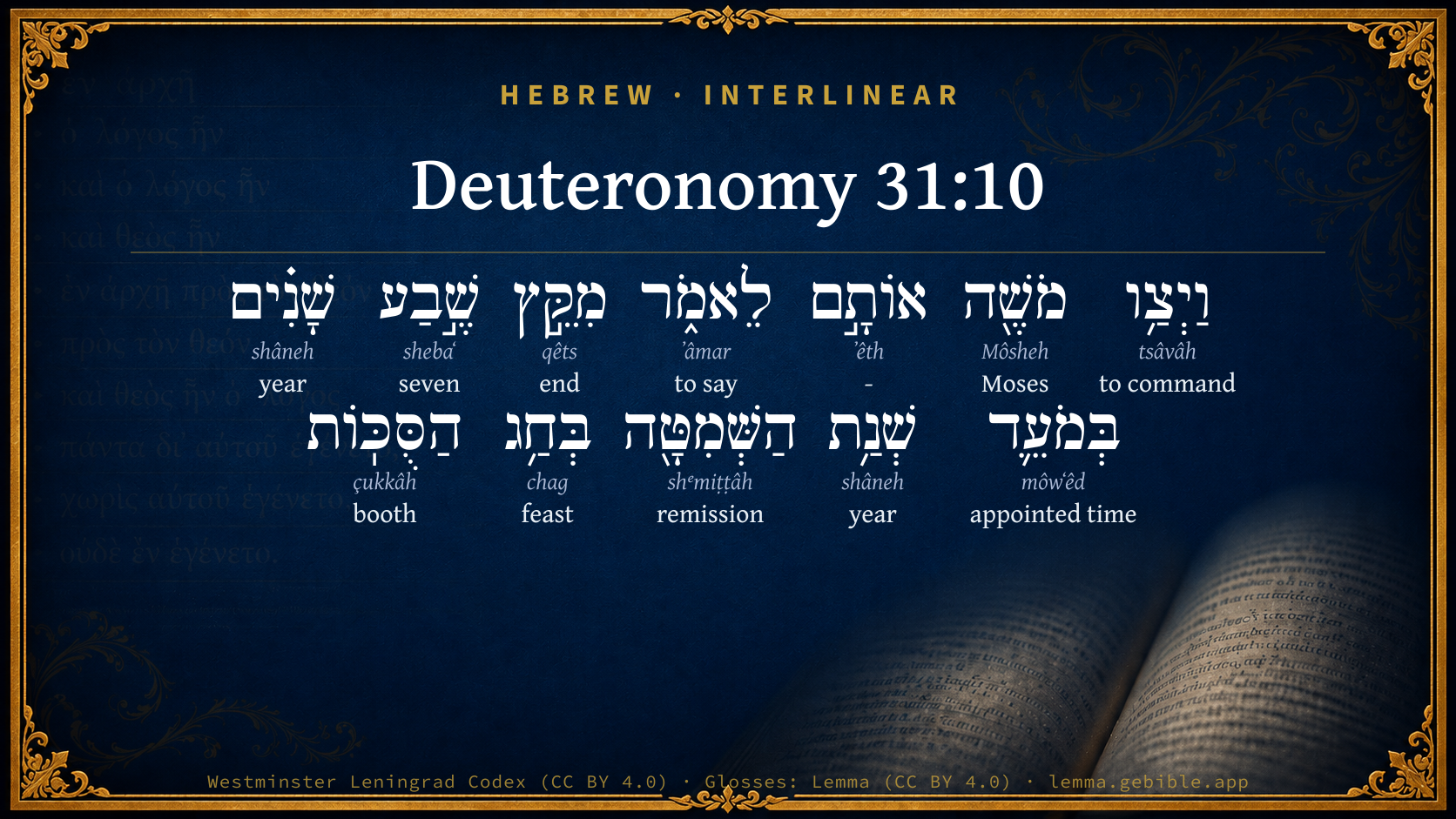
Hebrew (Westminster Leningrad Codex) Deuteronomy 31:10 appears in the Hebrew Old Testament. The text above is from the Westminster Leningrad Codex. Each word links to its Strong’s number, a concise gloss, and parsing drawn from the Open Scriptures Hebrew Bible morphology. Click any word for its full Brown-Driver-Briggs (BDB) entry.
Download image
Cite this verse

Deuteronomy 31:10 (World English Bible). Public Domain. Lemma interlinear Bible study tool, https://lemma.gebible.app/v/deuteronomy/31/10.

Show BibTeX & RIS
BibTeX
RIS
English Translation
Moses commanded them, saying, At the end of [every] seven years, in the set time of the year of release, in the feast of tents,
World English Bible · Public Domain
Download a study sheet

One document with this verse’s original text, its word-by-word gloss line, the meaning frame, cross-references with their text, attributed commentary, and full source and license credits — printable, and it pastes into notes with its structure intact.

This verse Autodidact and up

Study sheet (.html) Plain text (.txt)

A passage Seminary Student

Up to 50 verses in one chapter. A passage sheet keeps up to 6 commentary sources and 12 cross-references per verse, in the order this page ranks them, and says so on the sheet whenever that leaves anything out. Ask for a single verse and you get the Autodidact verse sheet above.

Everything on this page stays free to read, with no account — the sheet is a download of what is already on screen, not access to it.

Want to remove ads? Support Godless Engineer
Compare translations 3

The same verse in 3 English versions, stacked beneath the original-language interlinear above. Click any original word for its lexicon entry.

Each is an independent rendering of the whole verse — the interlinear is not word-aligned to these translations.

Highlighted words mark where these versions differ — a whole-verse word diff, not a word-by-word alignment.

  • World English Bible Public Domain
    Moses commanded them, saying, At the end of [every] seven years, in the set time of the year of release, in the feast of tents,
  • King James Version Public Domain
    And Moses commanded them, saying, At the end of every seven years, in the solemnity of the year of release, in the feast of tabernacles,
  • unfoldingWord Literal Text CC BY-SA 4.0
    And Moses commanded them, saying, “At the end of seven years, at the appointed time of year of the remission, during the Festival of Huts,

unfoldingWord Literal Text — © unfoldingWord, licensed CC BY-SA 4.0. Word-aligned USFM3 via Door43 (git.door43.org/unfoldingWord/en_ult).

Versions to compare (up to 4)

3 of 4 selected

Show all 18 translations

Every available English version of this verse, each an independent rendering of the whole verse.

  • World English Bible Public Domain
    Moses commanded them, saying, At the end of [every] seven years, in the set time of the year of release, in the feast of tents,
  • Berean Standard Bible Public Domain
    Then Moses commanded them, “At the end of every seven years, at the appointed time in the year of remission of debt, during the Feast of Tabernacles,
  • Majority Standard Bible Public Domain
    Then Moses commanded them, “At the end of every seven years, at the appointed time in the year of remission of debt, during the Feast of Tabernacles,
  • King James Version Public Domain
    And Moses commanded them, saying, At the end of every seven years, in the solemnity of the year of release, in the feast of tabernacles,
  • American Standard Version (1901) Public Domain
    And Moses commanded them, saying, At the end of `every' seven years, in the set time of the year of release, in the feast of tabernacles,
  • Revised Version (1885) Public Domain
    And Moses commanded them, saying, At the end of every seven years, in the set time of the year of release, in the feast of tabernacles,
  • Geneva Bible (1599) Public Domain
    And Moses commanded them, saying, Euery seuenth yeere when the yeere of freedome shalbe in the feast of the Tabernacles:
  • Douay-Rheims (1899) Public Domain
    And he commanded them, saying: After seven years, in the year of remission, in the feast of tabernacles,
  • Young's Literal Translation Public Domain
    and Moses commandeth them, saying, `At the end of seven years, in the appointed time, the year of release, in the feast of booths,
  • Literal Standard Version CC BY-SA 4.0
    and Moses commands them, saying, “At the end of seven years, in the appointed time, the year of release, in the Celebration of Shelters,
  • Unlocked Literal Bible CC BY-SA 4.0
    Moses commanded them and said, “At the end of every seven years, at the time fixed for the cancellation of debts, during the Festival of Shelters,
  • unfoldingWord Literal Text CC BY-SA 4.0
    And Moses commanded them, saying, “At the end of seven years, at the appointed time of year of the remission, during the Festival of Huts,
  • Darby Bible Public Domain
    And Moses commanded them, saying, At the end of every seven years, at the set time of the year of release, at the feast of tabernacles,
  • World Messianic Bible Public Domain
    Moses commanded them, saying, “At the end of every seven years, in the set time of the year of release, in the feast of booths,
  • Webster's Bible Public Domain
    And Moses commanded them, saying, At the end of every seven years, in the solemnity of the year of release, in the feast of tabernacles,
  • Free Bible Version CC BY-SA 4.0
    Moses gave them these orders, “At the end of every seven years, the year when debts are canceled during the Festival of Shelters,
  • Bible in Basic English Public Domain
    And Moses said to them, At the end of every seven years, at the time fixed for the ending of debts, at the feast of tents,
  • JPS Tanakh (1917) Public Domain
    And Moses commanded them, saying: 'At the end of every seven years, in the set time of the year of release, in the feast of tabernacles,

Literal Standard Version (2020), Covenant Press — licensed CC BY-SA 4.0. Text via the HelloAO Bible API (eBible.org). Unlocked Literal Bible (unfoldingWord) — licensed CC BY-SA 4.0. Text via the HelloAO Bible API (eBible.org). unfoldingWord Literal Text — © unfoldingWord, licensed CC BY-SA 4.0. Word-aligned USFM3 via Door43 (git.door43.org/unfoldingWord/en_ult). Free Bible Version, Dr. Jonathan Gallagher — licensed CC BY-SA 4.0. Text via the HelloAO Bible API (eBible.org).

Word by word

More ways to search: Search by grammar → Find every occurrence → Compare this word →

Practice this passage: Drill this verse → Learn its vocabulary →

הַשְּׁמִטָּ֖ה
shᵉmiṭṭâh
H8059
“the · remission”
Particle, Definite Article + Noun, Common, Feminine, Singular, Absolute
Part of Speech
Particle + Noun
Type
Common
Gender
Feminine
Number
Singular
State
Absolute
Full BDB Definition

Origin: from H8058

TWOT: 2408a

letting drop of exactions, (temporary) remitting, release (from debt)
  1. וַיְצַ֥ו tsâvâh H6680 “and · to command” Conjunction + Verb, Piel, Sequential Imperfect, 3rd Person, Masculine, Singular
  2. מֹשֶׁ֖ה Môsheh H4872 “Moses” Noun, Proper
  3. אוֹתָ֣ם ʼêth H853 “- · them” Particle, Direct Object + Suffix, Personal, 3rd Person, Masculine, Plural
  4. לֵאמֹ֑ר ʼâmar H559 “to say” Preposition + Verb, Qal, Infinitive Construct
  5. מִקֵּ֣ץ qêts H7093 “from · end of” Preposition + Noun, Common, Masculine, Singular, Construct
  6. שֶׁ֣בַע shebaʻ H7651 “seven” Adjective, Cardinal number, Feminine, Singular, Absolute
  7. שָׁנִ֗ים shâneh H8141 “years” Noun, Common, Feminine, Plural, Absolute
  8. בְּמֹעֵ֛ד môwʻêd H4150 “in/at · appointed time of” Preposition + Noun, Common, Masculine, Singular, Construct
  9. שְׁנַ֥ת shâneh H8141 “year of” Noun, Common, Feminine, Singular, Construct
  10. בְּחַ֥ג chag H2282 “in/at · feast of” Preposition + Noun, Common, Masculine, Singular, Construct
  11. הַסֻּכּֽוֹת çukkâh H5521 “the · booths” Particle, Definite Article + Noun, Common, Feminine, Plural, Absolute

About this verse

These counts appear in no published source. They are computed here, from the morphology-tagged text and Lemma’s own curated glosses. What Lemma adds →

12
words
11
distinct lemmas
Pentateuch
section

Notable vocabulary

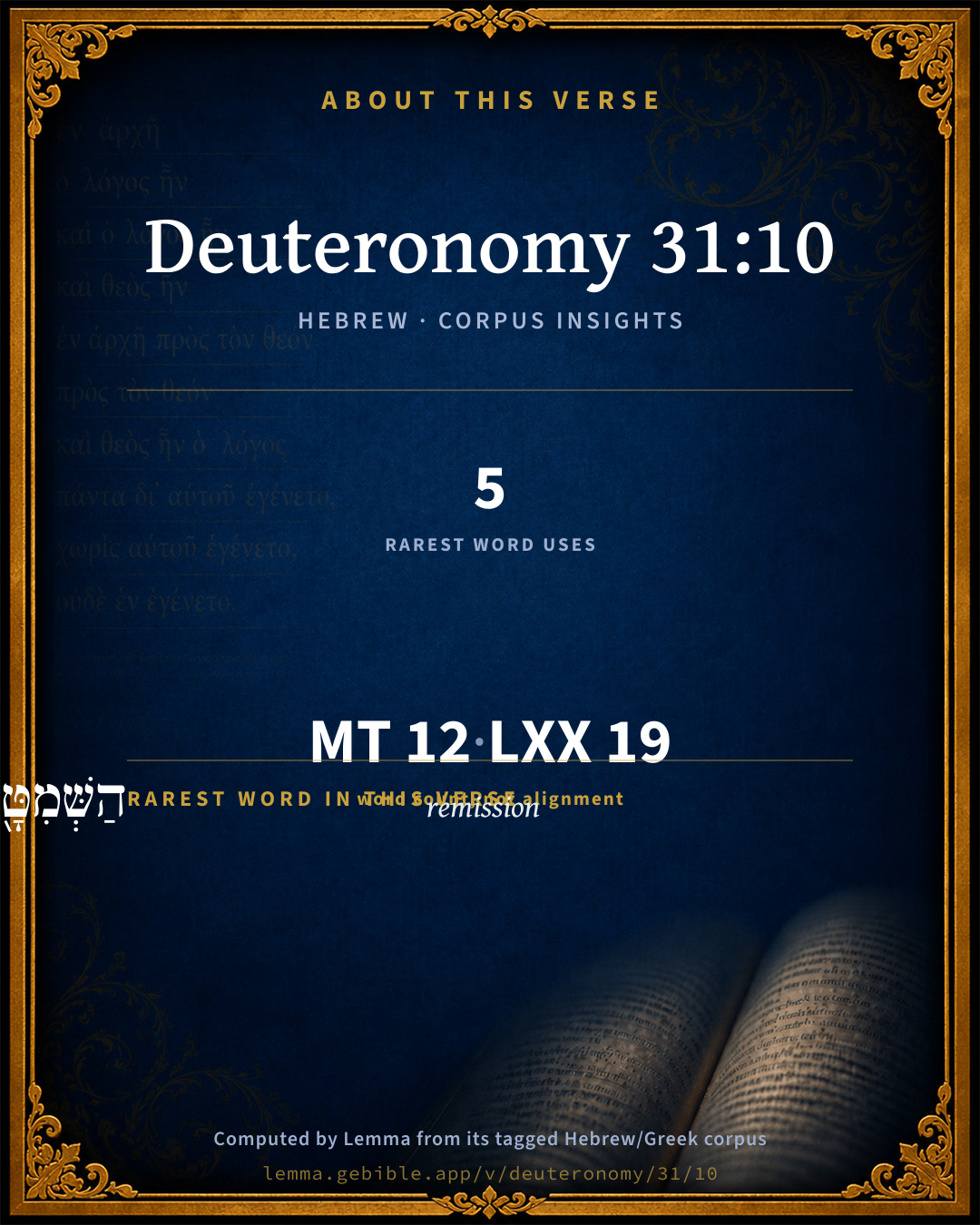
The rarest word here is הַשְּׁמִטָּ֖ה remission H8059 — appearing just 5 times in the whole Hebrew Bible.

Shared distinctive vocabulary

הַשְּׁמִטָּ֖ה remission H8059 occurs in 4 verses of the Hebrew Bible. Also found in:

Grammatical profile

  • 2 verbs
  • 8 nouns
  • 1 adjective
  • 1 particle

Verb forms

  • וַיְצַ֥ו Piel · Sequential Imperfect
  • לֵאמֹ֑ר Qal · Infinitive Construct

Repetition

A word recurs within this verse — often emphatic in Hebrew:

  • שָׁנִ֗ים year H8141 ×2

Hebrew & Septuagint length

In English translation the verse runs 25 words from the Hebrew and 24 from the Septuagint (LXX English) — closely comparable.

A rough comparison of the two English renderings, which tokenize alike — not a word-level alignment.

Word counts can differ between the Hebrew and the Greek without any difference in meaning — e.g. the Hebrew direct-object marker אֵת has no separate Greek word, and Greek often adds the article ὁ.

In the original languages it is 12 Hebrew tokens and 19 Greek tokens — but the two are counted differently (Hebrew bundles its prefixes and suffixes into one token; the Greek is in lemma form), so that isn’t a like-for-like length.

Cross-references

2

Topical passages linked to Deuteronomy 31:10 in the Treasury of Scripture Knowledge — connected by theme and wording, ordered by reader-vote popularity; previews shown in the World English Bible.

  • Leviticus 23:34–43 "Speak to the children of Israel, and say, 'On the fifteenth day of this seventh month is the feast of tents for seven days to Yahweh.
  • Deuteronomy 15:1–2 At the end of every seven years you shall make a release.

Cross-references courtesy of OpenBible.info (CC BY 4.0).

Hebrew and Greek witnesses Masoretic Hebrew ↔ Greek Septuagint

The same verse in the two great witnesses to the Old Testament, shown verse-for-verse.

These are two independent witnesses, not word-aligned to each other, and the Septuagint is shown in lemma (dictionary) form.

Hebrew Deuteronomy 31:10 Masoretic · Westminster Leningrad Codex

וַיְצַ֥ו מֹשֶׁ֖ה אוֹתָ֣ם לֵאמֹ֑ר מִקֵּ֣ץ שֶׁ֣בַע שָׁנִ֗ים בְּמֹעֵ֛ד שְׁנַ֥ת הַשְּׁמִטָּ֖ה בְּחַ֥ג הַסֻּכּֽוֹת

Moses commanded them, saying, At the end of [every] seven years, in the set time of the year of release, in the feast of tents,

World English Bible · Public Domain

Greek LXX Deuteronomy 31:10 Septuagint · lemma form

καί ἐντέλλομαι αὐτός μωυσῆς ἐν ὁ ἡμέρα ἐκεῖνος λέγω μετά ἑπτά ἔτος ἐν καιρός ἐνιαυτός ἄφεσις ἐν ἑορτή σκηνοπηγία

And Moses charged them in that day, saying, After seven years, in the time of the year of release, in the feast of tabernacles,

LXX2012 (modern English Septuagint) · Public Domain

Hebrew: Westminster Leningrad Codex (CC BY 4.0). Greek: Septuagint (public domain); English from LXX2012 (modern English Septuagint) (Public Domain). How the Septuagint differs from the Hebrew →

Targum (Aramaic paraphrase)

2

The Targum is the ancient Jewish Aramaic paraphrase of the Hebrew Scriptures — an interpretive translation, not the Hebrew text itself. Onkelos (literal) and Pseudo-Jonathan (expansive) render the Torah, and Jonathan the Prophets. Coverage is partial: where no permissively-licensed English translation exists for a verse, only the Aramaic is shown. This is verse-level text, not a word-by-word alignment to the Hebrew.

  1. Targum Onkelos Torah (Genesis–Deuteronomy)
    וּפַקִיד מֹשֶׁה יָתְהוֹן לְמֵימָר מִסוֹף שְׁבַע שְׁנִין בִּזְמַן שַׁתָּא דִשְׁמִטְתָא בְּחַגָא דְמְטַלַיָא

    (no public-domain English translation for this verse)

    Targum Onkelos — Aramaic: “Onkelos Genesis” (public domain); “Onkelos Exodus” (public domain); “Onkelos Leviticus” (public domain); “Onkelos Numbers” (public domain); “Onkelos Deuteronomy” (public domain). English: “Sefaria Community Translation” (CC0 1.0 (public-domain dedication)); “J.W. Etheridge. The Targums of Onkelos and Jonathan Ben Uzziel on the Pentateuch. London: Longmans, Green, 1862” (public domain). Text via Sefaria.

  2. Targum Pseudo-Jonathan Torah (Genesis–Deuteronomy)
    וּפַקֵיד משֶׁה יַתְהוֹן לְמֵימָר בְּסוֹף שְׁבַע שְׁנִין בְּאִשׁוֹנֵי שַׁתָּא דִשְׁמִיטָתָא בְּחַגָא דִמְטָלַיָא

    And Mosheh commanded them, saying: At the end of seven years in the time of the year of remission at the feast of Tabernacles,

    Targum Pseudo-Jonathan — Aramaic: “Targum Jonathan on Genesis” (public domain); “Targum Jonathan on Exodus” (public domain); “Targum Jonathan on Leviticus” (public domain); “Targum Jonathan on Numbers” (public domain); “Targum Jonathan on Deuteronomy” (public domain). English: “The Targum of Jonathan ben Uzziel, trans. J. W. Etheridge, London, 1862” (public domain). Text via Sefaria.

Commentary

Notes on Deuteronomy 31:10 from classic Christian and Jewish commentators (each source and its license shown beneath its notes). The classic Christian expositions comment on the surrounding passage and are grouped to its opening verse, so a note may address several verses; the Jewish commentaries on the Tanakh (Rashi and others) are per-verse, so they appear only where the commentator wrote on this verse.

Lemma curates 59 commentaries, every one of them public domain or Creative Commons licensed, each selected and text-cleaned for this edition rather than reprinted as found. About our sources →

The Biblical Illustrator

Joseph S. Exell

Deu_31:10-12

Thou shalt read this law.

The public reading of the law

Directions here given for public reading of the law.

1. To be read at the feast of tabernacles, the greatest of all their festivals, when, harvest and vintage being completed, they had most leisure to attend to it. This feast was celebrated in the year of release, the most proper time that could be chosen for reading the law; for then the people were freed from debts, troubles, and cares of a worldly nature, and at liberty to attend to it without distraction.

2. The law was to be read by Joshua, chief governor, and by others who had the charge of instructing the people. Thus Joshua himself read to the congregation (Jos_8:34-35); Josiah and Ezra (2Ch_34:30; Neh_8:2). But Jehoshaphat employed priests and Levites (2Ch_17:9). This public reading was in part the duty of the king, the Jews say, who began it, and that afterwards it was taken up by the priests.

3. The law was to be read in the hearing of all Israel (verse 11).

(1) Pious Jews who had copies doubtless read in their own houses.

(2) Some portion was read in the synagogue every Sabbath day (Act_15:21).

(3) In Jehoshaphats time it was read by his command in the different cities of Judah, and the people were instructed out of it by the priests and Levites, but at every year of release the law was read, not only publicly to all the people, but throughout, and read from an original copy, which served as a standard by which all other copies were tried.

4. The whole congregation must assemble to hear the law.

Hence learn--

1. That when our debts are remitted, and we are brought into the liberty of Gods children, we shall then delight to hear and obey our delivering Lord in every call of duty.

2. The Word of God, being our only rule, should be read and known of all; how cruel the attempt, and how contrary to the Divine will, to keep it locked up from the people in an unknown tongue, and to establish ignorance by law!

3. Nothing should engage us more solicitously than the early instruction of our children in the knowledge of the Holy Scriptures, which alone can make them wise unto salvation. (J. Wilson.)

The Biblical Illustrator, edited by Joseph S. Exell (c. 1880s–1900s) — public domain. Text from a community e-Sword module.

Joseph Benson's Commentary

Deu 31:10-11. The year of release — The most proper time that could be chosen for the purpose, when they were freed from debts, and troubles, and cares of a worldly nature, and at liberty to attend to the reading of it without distraction; and when all Israel were required to appear before the Lord, even the women and children, Deu 31:12. Thou shall read — The chief governor was either to do it himself, or take care that it was done by the priests and others who had the charge of instructing the people. Thus, Joshua himself read all the words of the law before all the congregation of Israel, with the women, and the little ones, and the strangers, Jos 8:34; Josiah and Ezra did the same, 2Ch 34:30; Neh 8:2. But Jehoshaphat employed the priests and Levites to do it, 2Ch 17:9. This law before all Israel in their hearing — It was to be read from this original copy, for the greater solemnity of the action, and that it might make a deeper and more lasting impression on their minds. The pious Jews who had copies of the law, doubtless read it frequently in their houses. Some portion of it was read in the synagogues every sabbath day, Act 15:21. In Jehoshaphat’s time it was read by his command in the different cities of Judah, and the people were instructed out of it by the priests and Levites; but at every year of release it was to be read, not only publicly, to all the people, but throughout.

Joseph Benson's Commentary on the Old and New Testaments (1811–1818) — public domain. Text from a community e-Sword module.

Tyndale Open Study Notes

Tyndale Open Resources

31:10 The Year of Release was the seventh year of the calendar, not the seventh year of a given transaction between individuals. All debts were to be cancelled and Hebrew bond servants released from obligation to their creditors (see 15:1-3). • Festival of Shelters (also known as the Feast of Tabernacles): The people observed this celebration in the seventh month (Tishri, September/October) of every year to commemorate God’s miraculous preservation of Israel in the wilderness. It also celebrated the fall harvest (see 16:13-15).

Tyndale Open Study Notes — © Tyndale Open Resources, licensed CC BY-SA 4.0. Text via the HelloAO Bible API.

Jamieson, Fausset & Brown

Robert Jamieson, A. R. Fausset & David Brown

At the end of every seven years, . . . thou shalt read this law--At the return of the sabbatic year and during the feast of tabernacles, the law was to be publicly read. This order of Moses was a future and prospective arrangement; for the observance of the sabbatic year did not commence till the conquest and peaceful occupation of Canaan. The ordinance served several important purposes. For, while the people had opportunities of being instructed in the law every Sabbath and daily in their own homes, this public periodical rehearsal at meetings in the courts of the sanctuary, where women and children of twelve years were present (as they usually were at the great festivals), was calculated to produce good and pious impressions of divine truth amid the sacred associations of the time and place. Besides, it formed a public guarantee for the preservation, integrity, and faithful transmission of the Sacred Book to successive ages.

Jamieson, Fausset & Brown — Commentary Critical and Explanatory on the Whole Bible (1871) — public domain (CC PDM 1.0). Text via the HelloAO Bible API.

Adam Clarke's Commentary

Verse 10. - 11. At the end of every seven years-thou shalt read this law] Every seventh year was a year of release, De 15:1, at which time the people's minds, being under a peculiar degree of solemnity, were better disposed to hear and profit by the words of God. I suppose on this ground also that the whole book of Deuteronomy is meant, as it alone contains an epitome of the whole Pentateuch. And in this way some of the chief Jewish rabbins understand this place.

It is strange that this commandment, relative to a public reading of the law every seven years, should have been rarely attended to. It does not appear that from the time mentioned Jos 8:30, at which time this public reading first took place, till the reign of Jehoshaphat 2Ch 17:7, there was any public seventh year reading - a period of 530 years. The next seventh year reading was not till the eighteenth year of the reign of Josiah, 2Ch 34:30, a space of two hundred and eighty-two years. Nor do we flnd any other publicly mentioned from this time till the return from the Babylonish captivity, Ne 8:2. Nor is there any other on record from that time to the destruction of Jerusalem. See Dodd.

Adam Clarke's Commentary on the Bible (1810–1826) — public domain. Text from a community e-Sword/MySword module.

The Cambridge Bible for Schools and Colleges

gen. ed. J. J. S. Perowne

10. At the end of every seven years … the year of release] See Deu_15:1 ff. set time] Heb. mo‘ed, in Deu_16:6 of a fixed hour of day; here as in Exo_23:15 (see Dri.’s note) of a season fixed for a sacred festival; for another application see Deu_31:14.

the feast of Booths] See Deu_16:13-15.

The Cambridge Bible for Schools and Colleges (gen. ed. J. J. S. Perowne; Cambridge University Press, 1878–1918) — public domain. Text from a community e-Sword module.

John Gill's Exposition

When all Israel is come to appear before the Lord thy God,.... As all the males were obliged to do three times in the year, and one of those times was the feast of tabernacles, and so a proper season for the reading of the law; see Exo 23:14;

in the place which the Lord shall choose; the city of Jerusalem, and the temple there:

thou shall read this law before all Israel in their hearing; the book of Deuteronomy, as Jarchi, or it may be the whole Pentateuch: who were to read it is not expressly said; the speech seems to be directed to the priests and elders, to whom the law written by Moses was delivered, Deu 31:9; and who were either to read it themselves, or take care that it should be read. Josephus (x) ascribes this service to the high priest; he says, standing in an high pulpit (or on an high bench),"from whence he may be heard, he must read the laws to all;''but the Jewish writers commonly allot this work to the king, or supreme governor, who at least was to read some parts of it; so Jarchi says, the king at first read Deuteronomy, as it is said in the Misnah (y);"he read from the beginning of Deuteronomy to Deu 6:4; hear, O Israel, &c. and then added Deu 11:13; then Deu 14:22; after that Deu 26:12; then the section of the king, Deu 17:14; next the blessings and the curses, Deu 27:15, with which he finished the whole section;''and so we find that Joshua, the governor of the people after Moses, read all his laws, Jos 8:35; and so did King Josiah at the finding of the book of the law, Kg2 23:2, and Ezra, Neh 8:3. The king received the book from the high priest standing, and read it sitting; but King Agrippa stood and read, for which he was praised.

(x) Antiqu. l. 4. c. 8. sect. 12. (y) Sotah, ut supra. (c. 7. sect. 8.)

John Gill's Exposition of the Whole Bible (1746–1763) — public domain (CC PDM 1.0). Text via the HelloAO Bible API.

Haydock's Catholic Bible Commentary

Years commenced. Hebrew, "at the extremity of seven years." The sabbatic years began at the expiration of every six years, (Haydock) after the land of Chanaan was conquered, (Calmet) or perhaps after the passage of the Jordan, which took place soon after this discourse was made. Josue spent above six years in the conquest of the country, and then divided it among the tribes. The seventh year was the first year of remission; as the Israelites, particularly on the east side of the Jordan, had already enjoyed the benefits of the country for a considerable time. If they had been required to wait till the whole had been conquered, no sabbatical year would have been of obligation before the reign of Solomon, as he had still some of the devoted nations to subdue. See Exodus xxiii., and Leviticus xxv. (Salien, in the year before Christ 1463) At this time, the ark was removed from Galgala to Silo, where it remained about 350 years, Josue xviii. (Haydock)

George Leo Haydock (1774–1849), Haydock's Catholic Family Bible and Commentary, 1859 edition — public domain. Excludes Psalms (Douay-Rheims chapter numbering differs from Protestant) and Deuterocanonical books (Catholic canon only).

Matthew Poole's English Annotations

The year of release; when they were freed from debts and troubles, and cares of worldly matters, and thereby fitter to attend upon God and his service.

Matthew Poole's English Annotations on the Holy Bible (1683–1685) — public domain. Text from a community e-Sword/MySword module.

Whedon's Commentary on the Bible

Daniel D. Whedon

10. The end of every seven years — At the return of the sabbatic year and during the feast of tabernacles, which was kept to commemorate the wilderness journey, this law was to be repeated.

Daniel D. Whedon (gen. ed.), Commentary on the Old and New Testaments (1874–1909) — public domain. Text from a community e-Sword module.

The Pulpit Commentary

Vers. 10-13. Reading the Law.

(For an example of fulfillment of this command, see Ne 8). Observe

I IT WAS TO BE READ AT A RELIGIOUS FEAST. On an occasion of solemnity at the Feast of Tabernacles (ver. 10). Our feelings in reading the Scriptures, or in hearing them read, ought always to be of a solemn and reverential kind. But it is well to avail ourselves of every aid which may lend solemnity and impressiveness to the reading of words so sacred.

II IT WAS TO BE READ AT A TIME OF GENERAL LEISURE. In the sabbatical year" the year of release." Leisure hours cannot be better employed than in making ourselves acquainted with "what God the Lord will speak". (Psa_85:8) We should avail ourselves of the leisure of others to endeavor to instruct them.

III IT WAS TO BE READ PUBLICLY. (Ver. 11.) The private reading of the Law would doubtless be attended to in many pious homes. But the practice would not be general (scarcity and expensiveness of manuscripts, want of education, religious indifference). The Levites were to teach Israel the Law (Deu_33:10; Lev_10:11; Mal_2:7) but they might not do so, or the people might not wait on their instructions. The public reading of the Law, even once in seven years, was thus calculated to be of great advantage. As long as the practice was observed, multitudes would derive benefit from it. The reading was of the nature of a public testimony, but also, as we see in Nehemiah 8., for purposes of real instruction. The public reading of Scripture, with or without comment, is an important means of edification. Read with intelligence and judgment, the Word commends itself. And such readings are necessary. Many have Bibles, yet do not read them; many read and do not understand.

IV IT WAS TO BE READ FOR THE BENEFIT OF OLD AND YOUNG. (Ver. 12.) All are interested in listening to the Word of God. Men and women, little children, strangers, no class but has a concern-in it. None but may be edified by it. Children ought to be more recognized than they are in religious services. Need for making them feel that they too are interested in what is being said; that the Bible has a message for them as well as for their elders.

V THE END OF READING GOD"S WORD IS THAT WE MAY BE ENABLED TO OBEY IT, (Ver. 13.) J.O.

The Pulpit Commentary (1880–1919), ed. H.D.M. Spence-Jones & Joseph S. Exell — public domain. Text from a community e-Sword module.

John Wesley's Explanatory Notes

The year of release - When they were freed from debts and troubles, and cares of worldly matters, and thereby fitter to attend on God and his service.

John Wesley, Explanatory Notes Upon the Whole Bible (1754–1765) — public domain. Text via the GEBible commentary corpus.

Rashi

Rabbi Shlomo Yitzchaki (Rashi)

מקץ שבע שנים AT THE END OF EVERY SEVEN YEARS [AT THE APPOINTED SEASON OF THE SHEMITTAH YEAR] — This means in the first year of the new Shemittah-period — in the eighth year (Sotah 41a). But why does Scripture call it the “Shemittah-year”, which name usually implies the seventh year? Because the law of the “seventh year” still applies to it, viz., in connection with the harvest of the seventh year’s produce that actually goes forth into (takes place in) the year following the seventh year (the eighth year) (Rosh Hashanah 12b; cf. Rashi on Exodus 34:21).

Rashi on the Tanakh — English translations: “The Judaica Press complete Tanach with Rashi, translated by A. J. Rosenberg” (CC BY 4.0); “Pentateuch with Rashi's commentary by M. Rosenbaum and A.M. Silbermann, 1929-1934” (public domain); “The Metsudah Tanach series, Lakewood, N.J” (CC BY 4.0); and “The Book of Joshua, Metsudah Publications, 1997” (CC BY 4.0). Text via Sefaria.

Lesson kit

Teaching starters — assembled from the data on this page, not authored interpretation. Every prompt links to the verse data it draws on. Edit before teaching.

Deuteronomy, in the Pentateuch, opens this verse with 12 words (11 distinct Hebrew lemmas). Its most distinctive word is shᵉmiṭṭâh (“remission”). A historical commentator’s framing appears above. Read the whole chapter for the surrounding context.

Discussion questions

  1. What does “remission” (shᵉmiṭṭâh) contribute to the verse as a whole?
  2. Deuteronomy 15:1 shares the word «remission» with this verse. How do the two illuminate each other?
  3. “year” occurs 2× in this one verse. What is the effect of the repetition?
  4. These translations render this verse differently; the difference is in the English rendering, not the original. What questions does that raise?
  5. The verb «וַיְצַ֥ו» is Piel Sequential Imperfect. How does its form color the action?
  6. Reading how The Biblical Illustrator and Joseph Benson's Commentary read this verse, where do the two commentators agree and where do they part?

Things to notice

Reading settings

Reading text

Shown beneath each verse's original-language words.

Old Testament
Old Testament edition

Read the OT as the Masoretic Hebrew (MT) or the Greek Septuagint (LXX).

English shown for the Greek Septuagint (in the Hebrew ↔ Greek comparison).

Comparing translations? Open the Compare panel on any verse page to stack up to four side by side.