Numbers 31:36

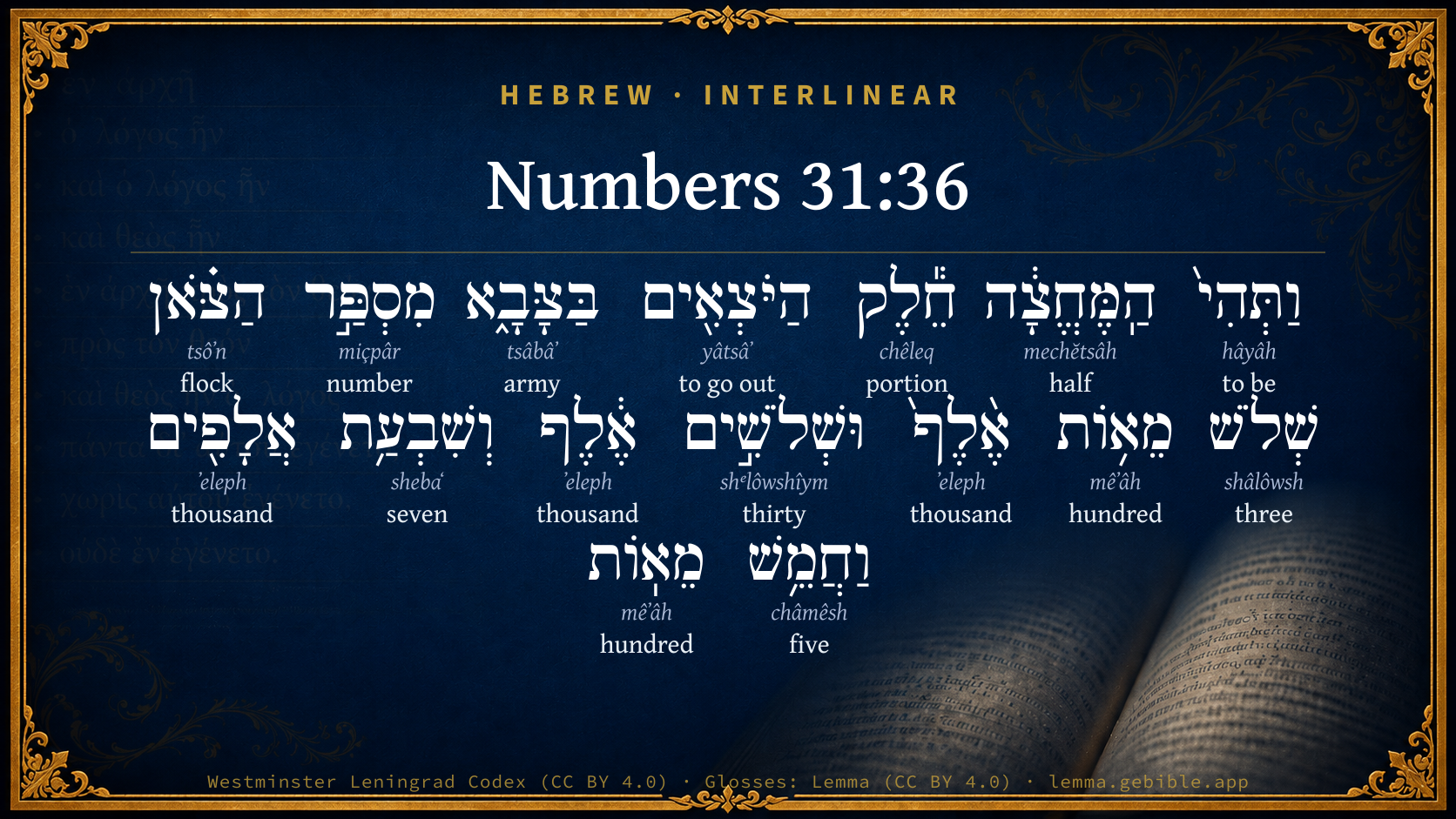
Hebrew (Westminster Leningrad Codex) Numbers 31:36 appears in the Hebrew Old Testament. The text above is from the Westminster Leningrad Codex. Each word links to its Strong’s number, a concise gloss, and parsing drawn from the Open Scriptures Hebrew Bible morphology. Click any word for its full Brown-Driver-Briggs (BDB) entry.
Download image
Cite this verse

Numbers 31:36 (World English Bible). Public Domain. Lemma interlinear Bible study tool, https://lemma.gebible.app/v/numbers/31/36.

Show BibTeX & RIS
BibTeX
RIS
English Translation
The half, which was the portion of those who went out to war, was in number three hundred thirty-seven thousand five hundred sheep:
World English Bible · Public Domain
Highlights
  • 1 first appearance in the Hebrew Bible
Full analysis ↓
Download a study sheet

One document with this verse’s original text, its word-by-word gloss line, the meaning frame, cross-references with their text, attributed commentary, and full source and license credits — printable, and it pastes into notes with its structure intact.

This verse Autodidact and up

Study sheet (.html) Plain text (.txt)

A passage Seminary Student

Up to 50 verses in one chapter. A passage sheet keeps up to 6 commentary sources and 12 cross-references per verse, in the order this page ranks them, and says so on the sheet whenever that leaves anything out. Ask for a single verse and you get the Autodidact verse sheet above.

Everything on this page stays free to read, with no account — the sheet is a download of what is already on screen, not access to it.

Want to remove ads? Support Godless Engineer
Compare translations 3

The same verse in 3 English versions, stacked beneath the original-language interlinear above. Click any original word for its lexicon entry.

Each is an independent rendering of the whole verse — the interlinear is not word-aligned to these translations.

Highlighted words mark where these versions differ — a whole-verse word diff, not a word-by-word alignment.

  • World English Bible Public Domain
    The half, which was the portion of those who went out to war, was in number three hundred thirty-seven thousand five hundred sheep:
  • King James Version Public Domain
    And the half, which was the portion of them that went out to war, was in number three hundred thousand and seven and thirty thousand and five hundred sheep:
  • unfoldingWord Literal Text CC BY-SA 4.0
    And the half of the portion of the ones who went out with the army: the number of the sheep was 337, 500.

unfoldingWord Literal Text — © unfoldingWord, licensed CC BY-SA 4.0. Word-aligned USFM3 via Door43 (git.door43.org/unfoldingWord/en_ult).

Versions to compare (up to 4)

3 of 4 selected

Show all 18 translations

Every available English version of this verse, each an independent rendering of the whole verse.

  • World English Bible Public Domain
    The half, which was the portion of those who went out to war, was in number three hundred thirty-seven thousand five hundred sheep:
  • Berean Standard Bible Public Domain
    This was the half portion for those who had gone to war: 337,500 sheep,
  • Majority Standard Bible Public Domain
    This was the half portion for those who had gone to war: 337,500 sheep,
  • King James Version Public Domain
    And the half, which was the portion of them that went out to war, was in number three hundred thousand and seven and thirty thousand and five hundred sheep:
  • American Standard Version (1901) Public Domain
    And the half, which was the portion of them that went out to war, was in number three hundred thousand and thirty thousand and seven thousand and five hundred sheep:
  • Revised Version (1885) Public Domain
    And the half, which was the portion of them that went out to war, was in number three hundred thousand and thirty thousand and seven thousand and five hundred sheep:
  • Geneva Bible (1599) Public Domain
    And the halfe, to wit, the part of them that went out to warre touching the nomber of sheepe, was three hundreth seuen and thirtie thousand, and fiue hundreth.
  • Douay-Rheims (1899) Public Domain
    And one half was given to them that had been in the battle, to wit, three hundred thirty-seven thousand five hundred sheep:
  • Young's Literal Translation Public Domain
    And the half -- the portion of those who go out into the host -- the number of the flock is three hundred thousand, and thirty thousand, and seven thousand and five hundred.
  • Literal Standard Version CC BY-SA 4.0
    And the half, the portion of those who go out into the war, is [in] number three hundred thousand and thirty thousand and seven thousand and five hundred of the flock.
  • Unlocked Literal Bible CC BY-SA 4.0
    The half that was kept for the soldiers numbered 337,000 sheep.
  • unfoldingWord Literal Text CC BY-SA 4.0
    And the half of the portion of the ones who went out with the army: the number of the sheep was 337, 500.
  • Darby Bible Public Domain
    And the half, the portion of them that had gone out to the war, was in number three hundred and thirty-seven thousand five hundred sheep,
  • World Messianic Bible Public Domain
    The half, which was the portion of those who went out to war, was in number three hundred thirty-seven thousand five hundred sheep;
  • Webster's Bible Public Domain
    And the half which was the portion of them that went out to war, was in number three hundred thousand and seven and thirty thousand and five hundred sheep:
  • Free Bible Version CC BY-SA 4.0
    This was the half share for those who had gone to fight: 337,500 sheep,
  • Bible in Basic English Public Domain
    And the half given as their part to the men who went to the war, was three hundred and thirty-seven thousand, five hundred sheep,
  • JPS Tanakh (1917) Public Domain
    And the half, which was the portion of them that went out to war, was in number three hundred thousand and thirty thousand and seven thousand and five hundred sheep.

Literal Standard Version (2020), Covenant Press — licensed CC BY-SA 4.0. Text via the HelloAO Bible API (eBible.org). Unlocked Literal Bible (unfoldingWord) — licensed CC BY-SA 4.0. Text via the HelloAO Bible API (eBible.org). unfoldingWord Literal Text — © unfoldingWord, licensed CC BY-SA 4.0. Word-aligned USFM3 via Door43 (git.door43.org/unfoldingWord/en_ult). Free Bible Version, Dr. Jonathan Gallagher — licensed CC BY-SA 4.0. Text via the HelloAO Bible API (eBible.org).

Word by word

More ways to search: Search by grammar → Find every occurrence → Compare this word →

Practice this passage: Drill this verse → Learn its vocabulary →

הַֽמֶּחֱצָ֔ה
mechĕtsâh
H4275
“the · half”
Particle, Definite Article + Noun, Common, Feminine, Singular, Absolute
Part of Speech
Particle + Noun
Type
Common
Gender
Feminine
Number
Singular
State
Absolute
Full BDB Definition

Origin: from H2673

TWOT: 719d

half - of spoils
  1. וַתְּהִי֙ hâyâh H1961 “and · to be” Conjunction + Verb, Qal, Sequential Imperfect, 3rd Person, Feminine, Singular
  2. חֵ֕לֶק chêleq H2506 “portion of” Noun, Common, Masculine, Singular, Construct
  3. הַיֹּצְאִ֖ים yâtsâʼ H3318 “the · going out” Particle, Definite Article + Verb, Qal, Participle Active, Masculine, Plural, Absolute
  4. בַּצָּבָ֑א tsâbâʼ H6635 “in/at the · army” Preposition, Determined + Noun, Common, Both, Singular, Absolute
  5. מִסְפַּ֣ר miçpâr H4557 “number of” Noun, Common, Masculine, Singular, Construct
  6. הַצֹּ֗אן tsôʼn H6629 “the · flock” Particle, Definite Article + Noun, Common, Both, Singular, Absolute
  7. שְׁלֹשׁ shâlôwsh H7969 “three” Adjective, Cardinal number, Feminine, Singular, Absolute
  8. מֵא֥וֹת mêʼâh H3967 “hundred” Adjective, Cardinal number, Both, Plural, Absolute
  9. אֶ֨לֶף֙ ʼeleph H505 “thousand” Adjective, Cardinal number, Both, Singular, Absolute
  10. וּשְׁלֹשִׁ֣ים shᵉlôwshîym H7970 “and · thirty” Conjunction + Adjective, Cardinal number, Both, Plural, Absolute
  11. אֶ֔לֶף ʼeleph H505 “thousand” Adjective, Cardinal number, Both, Singular, Absolute
  12. וְשִׁבְעַ֥ת shebaʻ H7651 “and · seven” Conjunction + Adjective, Cardinal number, Masculine, Singular, Construct
  13. אֲלָפִ֖ים ʼeleph H505 “thousand” Adjective, Cardinal number, Both, Plural, Absolute
  14. וַחֲמֵ֥שׁ châmêsh H2568 “and · five” Conjunction + Adjective, Cardinal number, Feminine, Singular, Absolute
  15. מֵאֽוֹת mêʼâh H3967 “hundred” Adjective, Cardinal number, Both, Plural, Absolute

About this verse

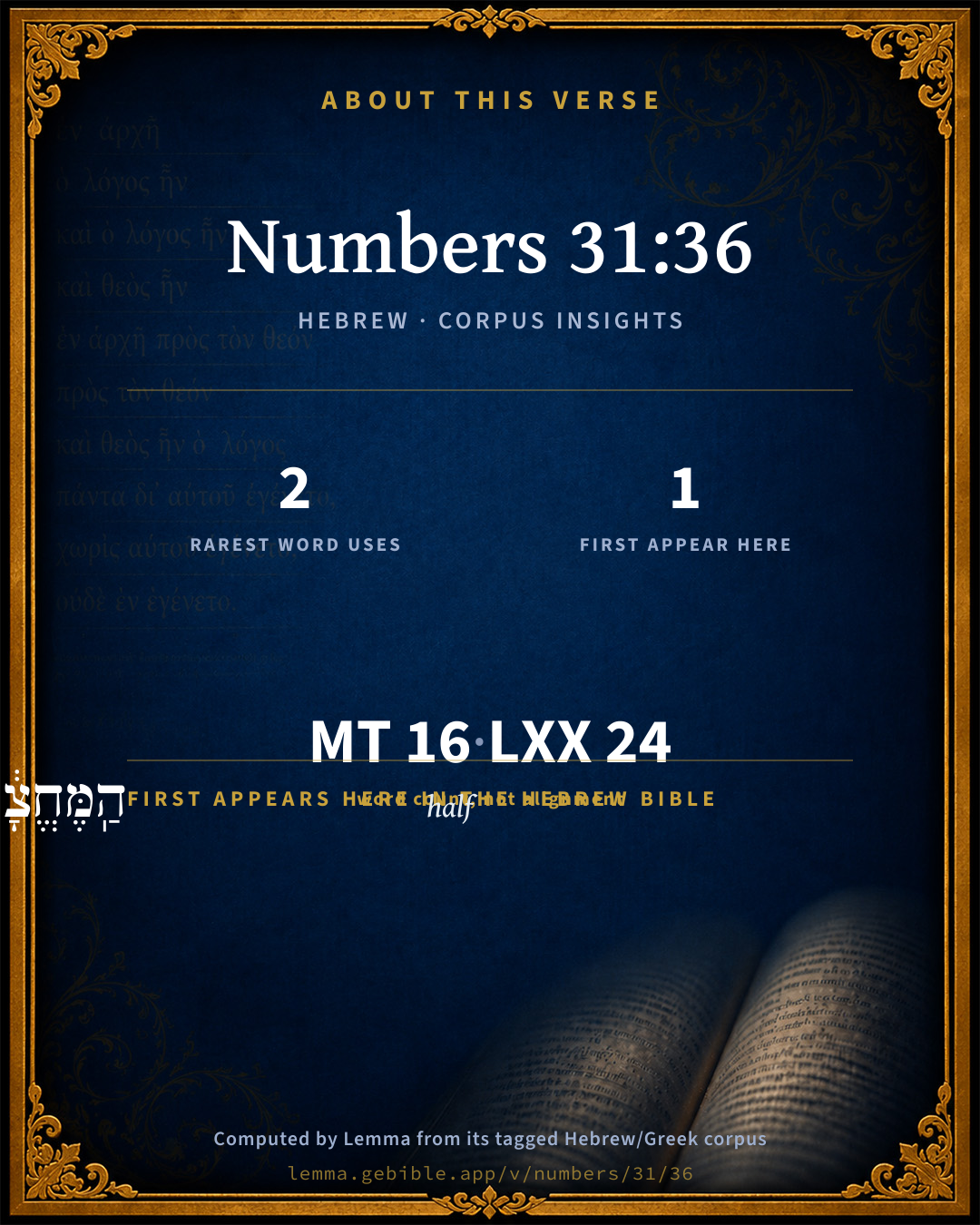
These counts appear in no published source. They are computed here, from the morphology-tagged text and Lemma’s own curated glosses. What Lemma adds →

16
words
13
distinct lemmas
Pentateuch
section

Notable vocabulary

The rarest word here is הַֽמֶּחֱצָ֔ה half H4275 — appearing just 2 times in the whole Hebrew Bible.

First appearance in Scripture

This word makes its first canonical appearance in the Hebrew Bible here:

  • הַֽמֶּחֱצָ֔ה half H4275

Shared distinctive vocabulary

הַֽמֶּחֱצָ֔ה half H4275 occurs in 2 verses of the Hebrew Bible. Also found in:

Grammatical profile

  • 2 verbs
  • 5 nouns
  • 9 adjectives

Verb forms

  • וַתְּהִי֙ Qal · Sequential Imperfect
  • הַיֹּצְאִ֖ים Qal · Participle Active

Repetition

Words recur within this verse — often emphatic in Hebrew:

  • אֶ֨לֶף֙ thousand H505 ×3
  • מֵא֥וֹת hundred H3967 ×2

Hebrew & Septuagint length

In English translation the verse runs 23 words from the Hebrew and 28 from the Septuagint (LXX English) — closely comparable.

A rough comparison of the two English renderings, which tokenize alike — not a word-level alignment.

Word counts can differ between the Hebrew and the Greek without any difference in meaning — e.g. the Hebrew direct-object marker אֵת has no separate Greek word, and Greek often adds the article ὁ.

In the original languages it is 16 Hebrew tokens and 24 Greek tokens — but the two are counted differently (Hebrew bundles its prefixes and suffixes into one token; the Greek is in lemma form), so that isn’t a like-for-like length.

Hebrew and Greek witnesses Masoretic Hebrew ↔ Greek Septuagint

The same verse in the two great witnesses to the Old Testament, shown verse-for-verse.

These are two independent witnesses, not word-aligned to each other, and the Septuagint is shown in lemma (dictionary) form.

Hebrew Numbers 31:36 Masoretic · Westminster Leningrad Codex

וַתְּהִי֙ הַֽמֶּחֱצָ֔ה חֵ֕לֶק הַיֹּצְאִ֖ים בַּצָּבָ֑א מִסְפַּ֣ר הַצֹּ֗אן שְׁלֹשׁ מֵא֥וֹת אֶ֨לֶף֙ וּשְׁלֹשִׁ֣ים אֶ֔לֶף וְשִׁבְעַ֥ת אֲלָפִ֖ים וַחֲמֵ֥שׁ מֵאֽוֹת

The half, which was the portion of those who went out to war, was in number three hundred thirty-seven thousand five hundred sheep:

World English Bible · Public Domain

Greek LXX Numbers 31:36 Septuagint · lemma form

καί γίγνομαι ὁ ἡμίσευμα ὁ μερίς ὁ ἐκπορεύομαι εἰς ὁ πόλεμος ἐκ ὁ ἀριθμός ὁ πρόβατον τριακόσιοι καί τριάκοντα χιλιάς καί ἑπτακισχίλιοι καί πεντακόσιοι

And the half, even the portion of them that went out to war, from the number of the sheep, was three hundred and thirty-seven thousand and five hundred.

LXX2012 (modern English Septuagint) · Public Domain

Hebrew: Westminster Leningrad Codex (CC BY 4.0). Greek: Septuagint (public domain); English from LXX2012 (modern English Septuagint) (Public Domain). How the Septuagint differs from the Hebrew →

Targum (Aramaic paraphrase)

2

The Targum is the ancient Jewish Aramaic paraphrase of the Hebrew Scriptures — an interpretive translation, not the Hebrew text itself. Onkelos (literal) and Pseudo-Jonathan (expansive) render the Torah, and Jonathan the Prophets. Coverage is partial: where no permissively-licensed English translation exists for a verse, only the Aramaic is shown. This is verse-level text, not a word-by-word alignment to the Hebrew.

  1. Targum Onkelos Torah (Genesis–Deuteronomy)
    וַהֲוַת פַלְגוּתָא חוּלַק גוּבְרַיָא דִנְפָקוּ לְחֵילָא מִנְיַן עָנָא תְּלַת מְאָה וּתְלָתִין וּשְׁבַע אַלְפִין וַחֲמֵשׁ מְאָה

    (no public-domain English translation for this verse)

    Targum Onkelos — Aramaic: “Onkelos Genesis” (public domain); “Onkelos Exodus” (public domain); “Onkelos Leviticus” (public domain); “Onkelos Numbers” (public domain); “Onkelos Deuteronomy” (public domain). English: “Sefaria Community Translation” (CC0 1.0 (public-domain dedication)); “J.W. Etheridge. The Targums of Onkelos and Jonathan Ben Uzziel on the Pentateuch. London: Longmans, Green, 1862” (public domain). Text via Sefaria.

  2. Targum Pseudo-Jonathan Torah (Genesis–Deuteronomy)
    וַהֲוַת פַּלְגוּתָא חוּלַק גוּבְרַיָא דִי נְפָקוּ לְחֵילָא סְכוּם עָנָא תְּלַת מְאָה וּתְלָתִין וְשׁוּבְעָא אַלְפִין וַחֲמֵשׁ מְאָה

    And the half of the portion for the men who had gone to the war, the number of the sheep was three hundred and thirty-seven thousand five hundred;

    Targum Pseudo-Jonathan — Aramaic: “Targum Jonathan on Genesis” (public domain); “Targum Jonathan on Exodus” (public domain); “Targum Jonathan on Leviticus” (public domain); “Targum Jonathan on Numbers” (public domain); “Targum Jonathan on Deuteronomy” (public domain). English: “The Targum of Jonathan ben Uzziel, trans. J. W. Etheridge, London, 1862” (public domain). Text via Sefaria.

Commentary

Notes on Numbers 31:36 from classic Christian and Jewish commentators (each source and its license shown beneath its notes). The classic Christian expositions comment on the surrounding passage and are grouped to its opening verse, so a note may address several verses; the Jewish commentaries on the Tanakh (Rashi and others) are per-verse, so they appear only where the commentator wrote on this verse.

Lemma curates 59 commentaries, every one of them public domain or Creative Commons licensed, each selected and text-cleaned for this edition rather than reprinted as found. About our sources →

Tyndale Open Study Notes

Tyndale Open Resources

31:36-47 The plunder was distributed according to the principles established in 31:25-30.

Tyndale Open Study Notes — © Tyndale Open Resources, licensed CC BY-SA 4.0. Text via the HelloAO Bible API.

unfoldingWord translationNotes

Door43 World Missions Community

General Information:

Moses is listing the plunder that goes to the soldiers and the tax that goes to Yahweh. (See: Numbers)

The half that was kept for the soldiers

This can be stated in active form. AT: "The soldiers' part of the sheep" (See: Active or Passive)

337,000 sheep

"three hundred and thirty-seven thousand sheep" (See: Numbers)

was 675

"was six hundred and seventy-five" (See: Numbers)

thirty-six thousand

36,000 (See: Numbers)

seventy-two

72 (See: Numbers)

translationWords

Yahweh

tax

unfoldingWord translationNotes — © Distant Shores Media and the Door43 World Missions Community, licensed CC BY-SA 4.0. Source: git.door43.org/Door43/en_tn.

Ramban (Nachmanides)

Rabbi Moshe ben Nachman (Ramban / Nachmanides)

AND THE HALF, WHICH WAS THE PORTION OF THEM THAT WENT OUT TO WAR, WAS IN NUMBER etc. Scripture had to enumerate [the spoil] in such detail, mentioning how much was the half [of these who went to war] and how much was the tribute [given to the priests and Levites, although both these figures can be worked out from the total figures mentioned], in order to inform us that from the day that they took this booty until they counted and halved it, set aside the tribute and gave it to Eleazar the priest, not one of all this great herd died. This was a miracle. This is also [the reason why Scripture mentions] the half [given] to the congregation [of Israel who did not fight, and the amount that they gave] to the Levites.

Ramban (Nachmanides) on the Tanakh — English translation: “Commentary on the Torah by Ramban (Nachmanides). Translated and annotated by Charles B. Chavel. New York, Shilo Pub. House, 1971-1976” (CC BY 4.0). Text via Sefaria.

Lesson kit

Teaching starters — assembled from the data on this page, not authored interpretation. Every prompt links to the verse data it draws on. Edit before teaching.

Numbers, in the Pentateuch, opens this verse with 16 words (13 distinct Hebrew lemmas). Its most distinctive word is mechĕtsâh (“half”). A historical commentator’s framing appears above. Read the whole chapter for the surrounding context.

Discussion questions

  1. What does “half” (mechĕtsâh) contribute to the verse as a whole?
  2. This is the first place “half” appears in Scripture (first appears here). What does its debut here establish?
  3. How does Numbers 31:43, which shares the word «half», read alongside this verse?
  4. What does the repetition of “thousand” (3× in this one verse) do in this verse?
  5. These translations render this verse differently; the difference is in the English rendering, not the original. What questions does that raise?
  6. «וַתְּהִי֙» is a Qal Sequential Imperfect verb. How does that grammatical form shape the action described?
  7. Compare how Tyndale Open Study Notes and unfoldingWord translationNotes read this verse. Where do they agree or differ?

Things to notice

Reading settings

Reading text

Shown beneath each verse's original-language words.

Old Testament
Old Testament edition

Read the OT as the Masoretic Hebrew (MT) or the Greek Septuagint (LXX).

English shown for the Greek Septuagint (in the Hebrew ↔ Greek comparison).

Comparing translations? Open the Compare panel on any verse page to stack up to four side by side.