Ezekiel 30:20

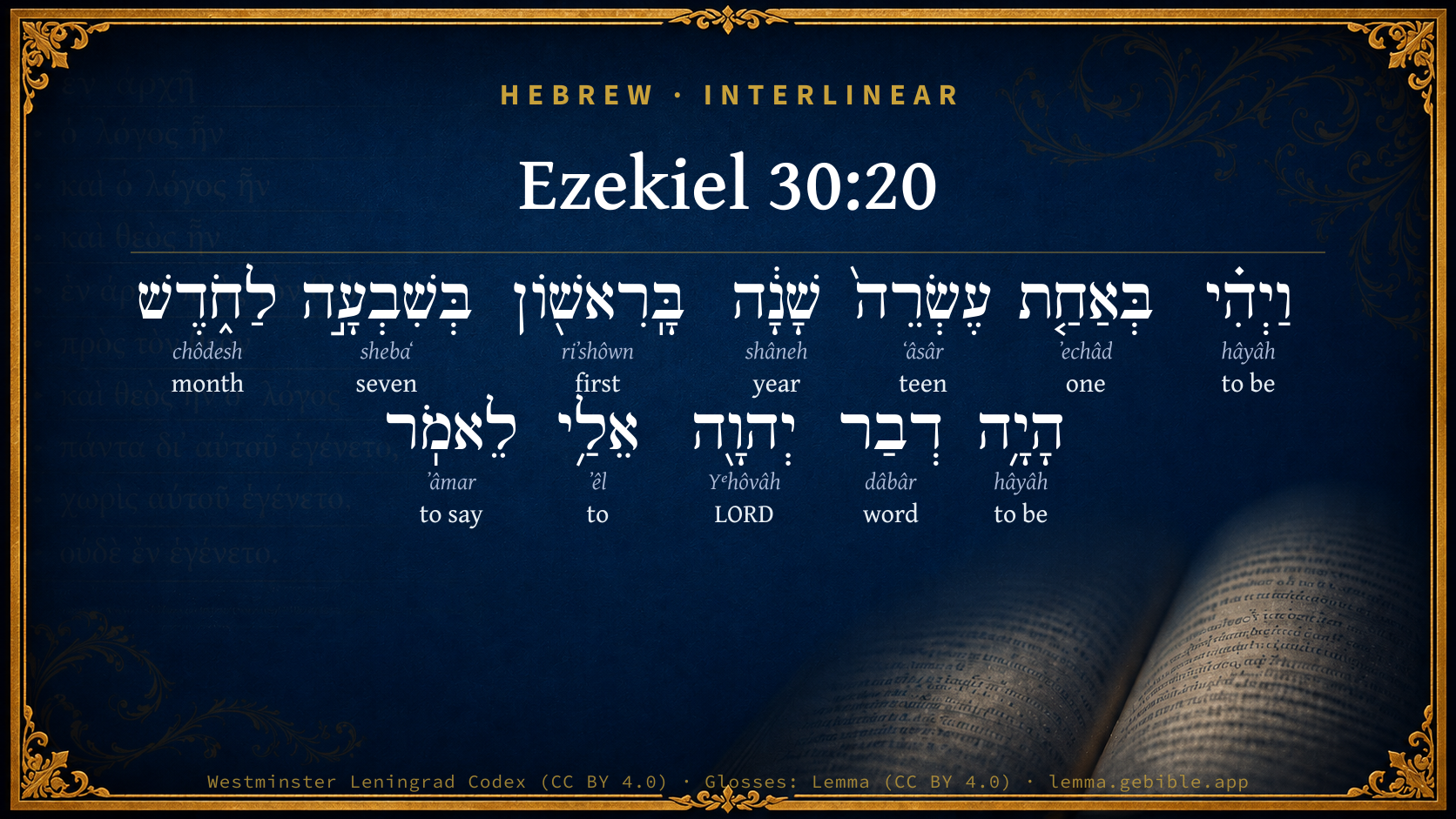
Hebrew (Westminster Leningrad Codex) Ezekiel 30:20 appears in the Hebrew Old Testament. The text above is from the Westminster Leningrad Codex. Each word links to its Strong’s number, a concise gloss, and parsing drawn from the Open Scriptures Hebrew Bible morphology. Click any word for its full Brown-Driver-Briggs (BDB) entry.
Download image
Cite this verse

Ezekiel 30:20 (World English Bible). Public Domain. Lemma interlinear Bible study tool, https://lemma.gebible.app/v/ezekiel/30/20.

Show BibTeX & RIS
BibTeX
RIS
English Translation
It happened in the eleventh year, in the first [month], in the seventh [day] of the month, that the word of Yahweh came to me, saying,
World English Bible · Public Domain
Download a study sheet

One document with this verse’s original text, its word-by-word gloss line, the meaning frame, cross-references with their text, attributed commentary, and full source and license credits — printable, and it pastes into notes with its structure intact.

This verse Autodidact and up

Study sheet (.html) Plain text (.txt)

A passage Seminary Student

Up to 50 verses in one chapter. A passage sheet keeps up to 6 commentary sources and 12 cross-references per verse, in the order this page ranks them, and says so on the sheet whenever that leaves anything out. Ask for a single verse and you get the Autodidact verse sheet above.

Everything on this page stays free to read, with no account — the sheet is a download of what is already on screen, not access to it.

Want to remove ads? Support Godless Engineer
Compare translations 3

The same verse in 3 English versions, stacked beneath the original-language interlinear above. Click any original word for its lexicon entry.

Each is an independent rendering of the whole verse — the interlinear is not word-aligned to these translations.

Highlighted words mark where these versions differ — a whole-verse word diff, not a word-by-word alignment.

  • World English Bible Public Domain
    It happened in the eleventh year, in the first [month], in the seventh [day] of the month, that the word of Yahweh came to me, saying,
  • King James Version Public Domain
    And it came to pass in the eleventh year, in the first month, in the seventh day of the month, that the word of the LORD came unto me, saying,
  • unfoldingWord Literal Text CC BY-SA 4.0
    Then it came about in the eleventh year, in the first month, in the seventh day of the month, that the word of Yahweh came to me, saying,

unfoldingWord Literal Text — © unfoldingWord, licensed CC BY-SA 4.0. Word-aligned USFM3 via Door43 (git.door43.org/unfoldingWord/en_ult).

Versions to compare (up to 4)

3 of 4 selected

Show all 18 translations

Every available English version of this verse, each an independent rendering of the whole verse.

  • World English Bible Public Domain
    It happened in the eleventh year, in the first [month], in the seventh [day] of the month, that the word of Yahweh came to me, saying,
  • Berean Standard Bible Public Domain
    In the eleventh year, on the seventh day of the first month, the word of the LORD came to me, saying,
  • Majority Standard Bible Public Domain
    In the eleventh year, on the seventh day of the first month, the word of the LORD came to me, saying,
  • King James Version Public Domain
    And it came to pass in the eleventh year, in the first month, in the seventh day of the month, that the word of the LORD came unto me, saying,
  • American Standard Version (1901) Public Domain
    And it came to pass in the eleventh year, in the first `month', in the seventh `day' of the month, that the word of Jehovah came unto me, saying,
  • Revised Version (1885) Public Domain
    And it came to pass in the eleventh year, in the first month, in the seventh day of the month, that the word of the LORD came unto me, saying,
  • Geneva Bible (1599) Public Domain
    And in the eleuenth yeere, in the first moneth, and in the seuenth day of the moneth, the worde of the Lord came vnto me, saying,
  • Douay-Rheims (1899) Public Domain
    And it came to pass in the eleventh year, in the first month, in the seventh day of the month, that the word of the Lord came to me, saying:
  • Young's Literal Translation Public Domain
    And it cometh to pass, in the eleventh year, in the first `month', in the seventh of the month, hath a word of Jehovah been unto me, saying: `Son of man,
  • Literal Standard Version CC BY-SA 4.0
    And it comes to pass, in the eleventh year, in the first [month], on the seventh of the month, a word of YHWH has been to me, saying, “Son of man,
  • Unlocked Literal Bible CC BY-SA 4.0
    Then it came about in the eleventh year, in the first month, in the seventh day of the month, that the word of Yahweh came to me, saying,
  • unfoldingWord Literal Text CC BY-SA 4.0
    Then it came about in the eleventh year, in the first month, in the seventh day of the month, that the word of Yahweh came to me, saying,
  • Darby Bible Public Domain
    And it came to pass in the eleventh year, in the first [month], on the seventh of the month, the word of Jehovah came unto me, saying,
  • World Messianic Bible Public Domain
    In the eleventh year, in the first month, in the seventh day of the month, the LORD’s word came to me, saying,
  • Webster's Bible Public Domain
    And it came to pass in the eleventh year, in the first month, in the seventh day of the month, that the word of the LORD came to me, saying,
  • Free Bible Version CC BY-SA 4.0
    On the seventh day of the first month of the eleventh year, a message from the Lord came to me, saying,
  • Bible in Basic English Public Domain
    Now in the eleventh year, in the first month, on the seventh day of the month, the word of the Lord came to me, saying,
  • JPS Tanakh (1917) Public Domain
    And it came to pass in the eleventh year, in the first month, in the seventh day of the month, that the word of the LORD came unto me, saying:

Literal Standard Version (2020), Covenant Press — licensed CC BY-SA 4.0. Text via the HelloAO Bible API (eBible.org). Unlocked Literal Bible (unfoldingWord) — licensed CC BY-SA 4.0. Text via the HelloAO Bible API (eBible.org). unfoldingWord Literal Text — © unfoldingWord, licensed CC BY-SA 4.0. Word-aligned USFM3 via Door43 (git.door43.org/unfoldingWord/en_ult). Free Bible Version, Dr. Jonathan Gallagher — licensed CC BY-SA 4.0. Text via the HelloAO Bible API (eBible.org).

Word by word

More ways to search: Search by grammar → Find every occurrence → Compare this word →

Practice this passage: Drill this verse → Learn its vocabulary →

בָּֽרִאשׁ֖וֹן
riʼshôwn
H7223
“in/at the · first”
Preposition, Determined + Adjective, Adjective, Masculine, Singular, Absolute
Part of Speech
Preposition + Adjective
Type
Adjective
Gender
Masculine
Number
Singular
State
Absolute
Full BDB Definition

Origin: from H7221

TWOT: 2097c

first, primary, former (adjective) - former (of time) - ancestors - former things - foremost (of location) - first (in time) - first, chief (in degree) - first, before, formerly, at first (adverb)
  1. וַיְהִ֗י hâyâh H1961 “and · to be” Conjunction + Verb, Qal, Sequential Imperfect, 3rd Person, Masculine, Singular
  2. בְּאַחַ֤ת ʼechâd H259 “in/at · one” Preposition + Adjective, Cardinal number, Feminine, Singular, Absolute
  3. עֶשְׂרֵה֙ ʻâsâr H6240 “teen” Adjective, Cardinal number, Feminine, Singular, Absolute
  4. שָׁנָ֔ה shâneh H8141 “year” Noun, Common, Feminine, Singular, Absolute
  5. בְּשִׁבְעָ֣ה shebaʻ H7651 “in/at · seven” Preposition + Adjective, Cardinal number, Masculine, Singular, Absolute
  6. לַחֹ֑דֶשׁ chôdesh H2320 “to/for the · month” Preposition, Determined + Noun, Common, Masculine, Singular, Absolute
  7. הָיָ֥ה hâyâh H1961 “to be” Verb, Qal, Perfect, 3rd Person, Masculine, Singular
  8. דְבַר dâbâr H1697 “word of” Noun, Common, Masculine, Singular, Construct
  9. יְהוָ֖ה Yᵉhôvâh H3068 “LORD” Noun, Proper
  10. אֵלַ֥י ʼêl H413 “to · me” Preposition + Suffix, Personal, 1st Person, Common, Singular
  11. לֵאמֹֽר ʼâmar H559 “to say” Preposition + Verb, Qal, Infinitive Construct

About this verse

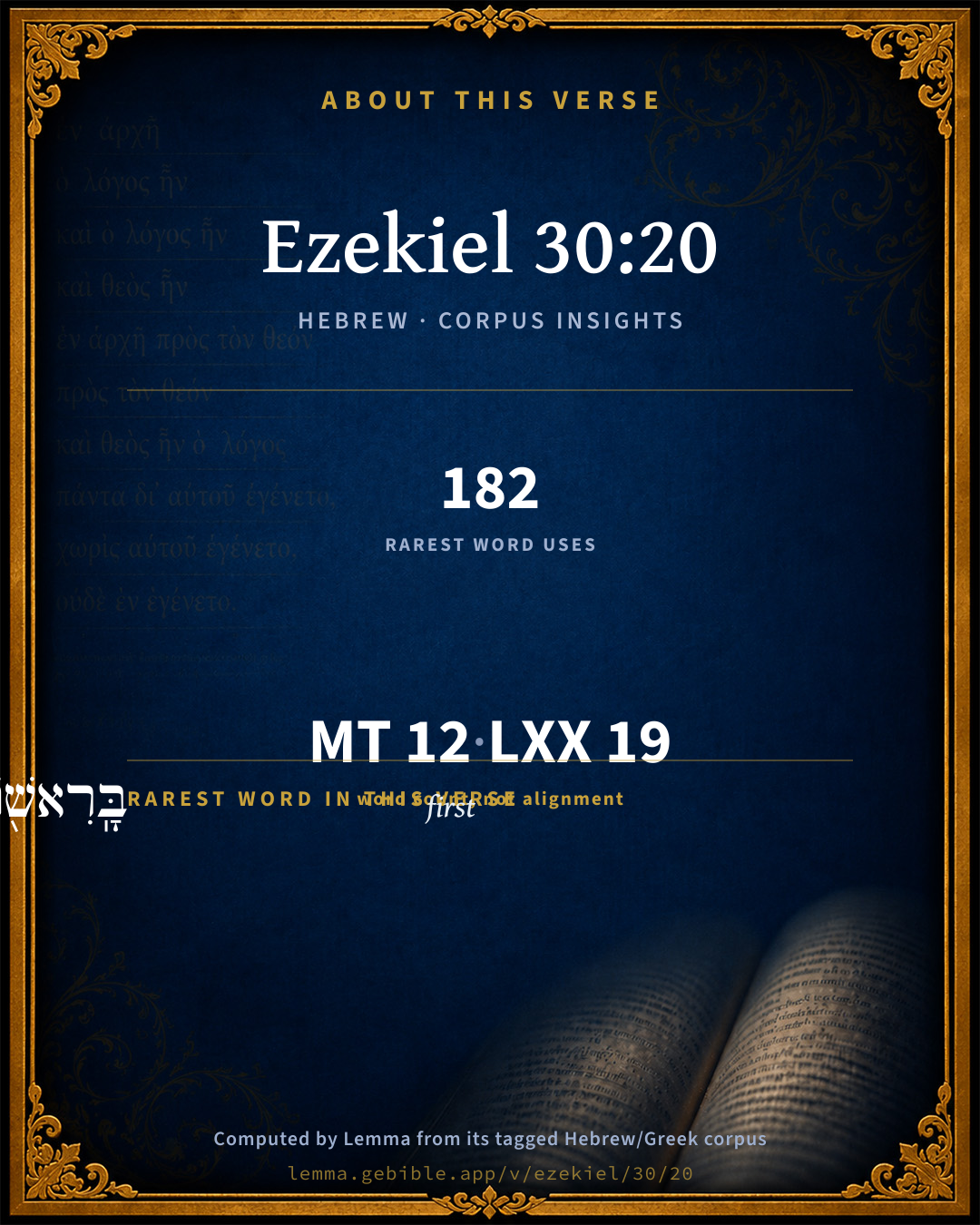
These counts appear in no published source. They are computed here, from the morphology-tagged text and Lemma’s own curated glosses. What Lemma adds →

12
words
11
distinct lemmas
Prophets
section

Grammatical profile

  • 3 verbs
  • 4 nouns
  • 4 adjectives
  • 1 preposition

Verb forms

  • וַיְהִ֗י Qal · Sequential Imperfect
  • הָיָ֥ה Qal · Perfect
  • לֵאמֹֽר Qal · Infinitive Construct

Repetition

A word recurs within this verse — often emphatic in Hebrew:

  • וַיְהִ֗י to be H1961 ×2

Hebrew & Septuagint length

In English translation the verse runs 26 words from the Hebrew and 29 from the Septuagint (LXX English) — closely comparable.

A rough comparison of the two English renderings, which tokenize alike — not a word-level alignment.

Word counts can differ between the Hebrew and the Greek without any difference in meaning — e.g. the Hebrew direct-object marker אֵת has no separate Greek word, and Greek often adds the article ὁ.

In the original languages it is 12 Hebrew tokens and 19 Greek tokens — but the two are counted differently (Hebrew bundles its prefixes and suffixes into one token; the Greek is in lemma form), so that isn’t a like-for-like length.

Cross-references

5

Topical passages linked to Ezekiel 30:20 in the Treasury of Scripture Knowledge — connected by theme and wording, ordered by reader-vote popularity; previews shown in the World English Bible.

  • Ezekiel 26:1 It happened in the eleventh year, in the first [day] of the month, that the word of Yahweh came to me, saying,
  • Ezekiel 29:17 It came to pass in the seven and twentieth year, in the first [month], in the first [day] of the month, the word of Yahweh came to me, saying,
  • Ezekiel 29:1 In the tenth year, in the tenth [month], in the twelfth [day] of the month, the word of Yahweh came to me, saying,
  • Ezekiel 1:2 In the fifth [day] of the month, which was the fifth year of king Jehoiachin's captivity,
  • Ezekiel 31:1 It happened in the eleventh year, in the third [month], in the first [day] of the month, that the word of Yahweh came to me, saying,

Cross-references courtesy of OpenBible.info (CC BY 4.0).

Hebrew and Greek witnesses Masoretic Hebrew ↔ Greek Septuagint

The same verse in the two great witnesses to the Old Testament, shown verse-for-verse.

These are two independent witnesses, not word-aligned to each other, and the Septuagint is shown in lemma (dictionary) form.

Hebrew Ezekiel 30:20 Masoretic · Westminster Leningrad Codex

וַיְהִ֗י בְּאַחַ֤ת עֶשְׂרֵה֙ שָׁנָ֔ה בָּֽרִאשׁ֖וֹן בְּשִׁבְעָ֣ה לַחֹ֑דֶשׁ הָיָ֥ה דְבַר יְהוָ֖ה אֵלַ֥י לֵאמֹֽר

It happened in the eleventh year, in the first [month], in the seventh [day] of the month, that the word of Yahweh came to me, saying,

World English Bible · Public Domain

Greek LXX Ezekiel 30:20 Septuagint · lemma form

καί γίγνομαι ἐν ὁ ἑνδέκατος ἔτος ἐν ὁ πρῶτος μήν ἕβδομος ὁ μήν γίγνομαι λόγος κύριος πρός ἐγώ λέγω

And it came to pass in the eleventh year, in the first month, on the seventh day of the month, the word of the Lord came to me, saying,

LXX2012 (modern English Septuagint) · Public Domain

On this verse, Keil & Delitzsch discusses the Septuagint’s reading. Read the note in Commentary ↓

Hebrew: Westminster Leningrad Codex (CC BY 4.0). Greek: Septuagint (public domain); English from LXX2012 (modern English Septuagint) (Public Domain). How the Septuagint differs from the Hebrew →

Targum (Aramaic paraphrase)

1

The Targum is the ancient Jewish Aramaic paraphrase of the Hebrew Scriptures — an interpretive translation, not the Hebrew text itself. Onkelos (literal) and Pseudo-Jonathan (expansive) render the Torah, and Jonathan the Prophets. Coverage is partial: where no permissively-licensed English translation exists for a verse, only the Aramaic is shown. This is verse-level text, not a word-by-word alignment to the Hebrew.

  1. Targum Jonathan Prophets (Joshua–Malachi)
    וַהֲוָה בַּחֲדָא עַשְׂרֵי שְׁנִין בְּקַדְמָאָה בְּשַׁבְעָא לְיַרְחָא הֲוָה פִתְגַם נְבוּאָה מִן קֳדָם יְיָ עִמִי לְמֵימָר:

    (no public-domain English translation for this verse)

    Targum Jonathan — Aramaic: “Mikraot Gedolot” (public domain). English: “Sefaria Community Translation” (CC0 1.0 (public-domain dedication)); “London "Chaldee Paraphrase," 1871” (public domain). Text via Sefaria.

Commentary

Notes on Ezekiel 30:20 from classic Christian and Jewish commentators (each source and its license shown beneath its notes). The classic Christian expositions comment on the surrounding passage and are grouped to its opening verse, so a note may address several verses; the Jewish commentaries on the Tanakh (Rashi and others) are per-verse, so they appear only where the commentator wrote on this verse.

Lemma curates 59 commentaries, every one of them public domain or Creative Commons licensed, each selected and text-cleaned for this edition rather than reprinted as found. About our sources →

Ellicott's Commentary for English Readers

(20) The eleventh year.—This was the year of the fall of Jerusalem, and the present prophecy (Eze_30:20-26) was uttered a little more than three months and a half before its destruction. Very likely this prophecy had its occasion in the temporary raising of the siege of Jerusalem by Pharaoh-Hophra, and Nebuchadnezzar’s driving him away, the news of which would have been some months in reaching Chaldæa.

A Bible Commentary for English Readers, edited by Charles John Ellicott (1878–1897) — public domain. Text from a community e-Sword module.

Trapp's Complete Commentary

John Trapp

Eze 30:20 And it came to pass in the eleventh year, in the first [month], in the seventh [day] of the month, [that] the word of the LORD came unto me, saying,

Ver. 20. In the eleventh year.] The year wherein Jerusalem was destroyed, notwithstanding Pharaoh’s fair promises and proffers to relieve her.

John Trapp, A Commentary or Exposition upon All the Books of the Old and New Testament (1647–1656) — public domain. Text from a community e-Sword module.

Joseph Benson's Commentary

Eze 30:20-26. It came to pass in the eleventh year, &c. — It seems this prophecy was delivered soon after the Egyptian army had marched out of Egypt to relieve Jerusalem when besieged by Nebuchadnezzar, but had returned without effecting any thing, (see notes on Jer 37:5; Jer 37:7,) and some months before that city was taken, that is, more than sixteen years before the preceding prophecies. I have broken the arm of Pharaoh — I have begun to break, or will break, Pharaoh’s strength, so that he shall not be able to recover his former power. Calmet’s interpretation is, “I will break Pharaoh by the revolt of his subjects, by the war which Amasis shall bring upon him, and afterward by that of Nebuchadnezzar; and this in the space of fourteen or fifteen years.” It is usual for the prophets to speak of a thing future as if it was already accomplished. It shall not be bound up to be healed — His calamity shall be so far from being lessened, that it shall increase more and more every day. And will break his arms, the strong, and that which was broken — Or, rather, the firm one, as well as the broken, or infirm one. The king of Babylon had before dispossessed the king of Egypt of all his new conquests, from the river of Egypt to the river Euphrates, 2Ki 24:7. So that this part of his strength was already taken away, and never to be recovered; and now God threatens to destroy the remainder of his power, namely, the kingdom of Egypt itself. And I will cause the sword to fall out of his hand — He shall have no more strength to defend himself than a man hath to use his sword when his arm is broken. And he shall groan with the groanings of a deadly-wounded man — His strength and power shall fail, and he shall groan with anguish as a man who is dying of his wounds. I will scatter the Egyptians among the nations — See note on Eze 29:12-13.

Joseph Benson's Commentary on the Old and New Testaments (1811–1818) — public domain. Text from a community e-Sword module.

Keil & Delitzsch

C. F. Keil & F. Delitzsch

Destruction of the Might of Pharaoh by Nebuchadnezzar

According to the heading in Eze 30:20, "In the eleventh year, in the first (month), on the seventh of the month, the word of Jehovah came to me, saying," this short word of threatening against Egypt falls in the second year of the siege of Jerusalem by the Chaldeans, and, as Eze 30:21 clearly shows, after the army of Pharaoh Hophra, which marched to the relief of Jerusalem, had been defeated by the Chaldeans who turned to meet it (Jer 37:5, Jer 37:7). If we compare with this the date of the first prophecy against Egypt in Eze 29:1, the prophecy before us was separated from the former by an interval of three months. But as there is no allusion whatever in Ezekiel 29 to Pharaoh's attempt to come to the relief of the besieged city of Jerusalem, or to his repulse, the arrival of the Egyptian army in Palestine, its defeat, and its repulse by the Chaldeans, seems to have occurred in the interval between these two prophecies, towards the close of the tenth year.

Eze 30:21-26

Eze 30:21. son of man, the arm of Pharaoh the king of Egypt have I broken; and, behold, it will no more be bound up, to apply remedies, to put on a bandage to bind it up, that it may grow strong to grasp the sword. Eze 30:22. Therefore thus saith the Lord Jehovah, Behold, I will deal with Pharaoh the king of Egypt, and will break both his arms, the strong one and the broken one, and will cause the sword to fall out of his hand. Eze 30:23. And I will scatter the Egyptians among the nations and disperse them in the lands, Eze 30:24. And will strengthen the arms of the king of Babylon, and give my sword into his hand, and will break the arms of Pharaoh, so that he shall groan the groanings of a pierced one before him. Eze 30:25. I will strengthen the arms of the king of Babylon, and the arms of Pharaoh will fall; and they shall know that I am Jehovah, when I give my sword into the hand of the king of Babylon, that he may stretch it against the land of Egypt. Eze 30:26. I will scatter the Egyptians among the nations, and disperse them in the lands; and they shall know that I am Jehovah. - The perfect שׁברתּי in Eze 30:21 is not a prophetic utterance of the certainty of the future, but a pure preterite. This may be seen "both from the allusion in Eze 30:21 to the condition resulting from the shbr שׁבר, and also to the obviously antithetical relation of Eze 30:22, in which future events are predicted" (Hitzig). The arm is a figurative expression for power, here for military power, as it wields the sword. God broke the arm of Pharaoh by the defeat which the Chaldeans inflicted upon Pharaoh Hophra, when he was marching to the relief of besieged Jerusalem. חבּשׁה is a present, as is apparent from the infinitive clauses ('לתת וגו) which follow, altogether apart from הנּה; and חבשׁ signifies to bind up, for the purpose of healing a broken limb, that remedies may be applied and a bandage put on. לחזקהּ, that it may become strong or sound, is subordinate to the preceding clause, and governs the infinitive which follows. The fact that the further judgment which is to fall upon Pharaoh is introduced with לכן (therefore) here (Eze 30:22), notwithstanding the fact that it has not been preceded by any enumeration of the guilt which occasioned it, may be accounted for on the ground that the causal לכן forms a link with the concluding clause of Eze 30:21 : the arm shall not be healed, so as to be able to grasp or hold the sword. Because Pharaoh is not to attain any more to victorious power, therefore God will shatter both of his arms, the strong, i.e., the sound one and the broken one, that is to say, will smite it so completely, that the sword will fall from his hand. The Egyptians are to be scattered among the nations, as is repeated in Eze 30:23 verbatim from Eze 29:12. God will give the sword into the hand of the king of Babylon, and equip and strengthen him to destroy the might of Pharaoh, that the latter may groan before him like one who is pierced with the sword. This thought is repeated in Eze 30:25 and Eze 30:26 with an intimation of the purpose of this divine procedure. That purpose it: that men may come to recognise Jehovah as God the Lord. The subject to וידעוּ is indefinite; and the rendering of the lxx is a very good one, καὶ γνώσονται πάντες.

Keil & Delitzsch — Biblical Commentary on the Old Testament (1861–1891) — public domain (CC PDM 1.0). Text via the HelloAO Bible API. (Old Testament only.)

Tyndale Open Study Notes

Tyndale Open Resources

30:20-26 This fourth message against Egypt shows that God had already begun to act against his old enemy.

30:20-26 Jerusalem was under siege by the Babylonians, but this message rules out even the faintest hope of assistance from the Egyptians.

Tyndale Open Study Notes — © Tyndale Open Resources, licensed CC BY-SA 4.0. Text via the HelloAO Bible API.

Geneva Bible (1599)

Geneva Bible translators

Of the captivity of Jeconiah, or of Zedekiah’s reign.

Geneva Bible (1599) marginal notes — public domain. Text via Bolls.life.

Matthew Henry's Commentary

This short prophecy of the weakening of the power of Egypt was delivered about the time that the army of the Egyptians, which attempted to raise the siege of Jerusalem, was frustrated in its enterprises, and returned re infect - without accomplishing their purpose; whereupon the king of Babylon renewed the siege and carried his point. The kingdom of Egypt was very ancient, and had been for many ages considerable. That of Babylon had but lately arrived at its great pomp and power, being built upon the ruins of the kingdom of Assyria. Now it is with them as it is with families and states, some are growing up, others are declining and going back; one must increase and the others must of course decrease.

I. It is here foretold that the king of Egypt shall grow weaker and weaker. The extent of his territories shall be abridged, his wealth and power shall be diminished, and he shall become less able than ever to help either himself or his friend. 1. This was in part done already (Eze 30:21): I have broken the arm of Pharaoh, some time ago. One arm of that kingdom might well be reckoned broken when the king of Babylon routed the forces of Pharaoh-Necho at Carchemish (Jer 46:2), and made himself master of all that pertained to Egypt from the river of Egypt to Euphrates, Kg2 24:7. Egypt had been long in gathering strength and extending its dominions, and therefore, that there may be a proportion observed in providence, it loses its strength slowly and by degrees. It was soon after the king of Egypt slew good king Josiah, and in the same reign, that its arm was thus broken, and it received that fatal blow which it never recovered. Before Egypt's heart and neck were broken its arm was. God's judgments come upon a people by steps, that they may meet him repenting. When the arm of Egypt is broken it shall not be bound up to be healed, for none can heal the wounds that God gives but he himself. Those whom he disarms, whom he disables, cannot again hold the sword. 2. This was to be done again. One arm was broken before, and something was done towards the setting of it, towards the healing of the deadly wound that was given to the beast. But now (Eze 30:22), I am against Pharaoh, and will break both his arms, both the strong and that which was broken and set again. Note, If less judgments do not prevail to humble and reform sinners, God will send greater. Now God will cause the sword to fall out of his hand, which he caught hold of as thinking himself strong enough to hold it. It is repeated (Eze 30:24), I will break Pharaoh's arms. He had been a cruel oppressor to the people of God formerly, and of late the staff of a broken rod to them; and now God by breaking his arms reckons with him for both. God justly breaks that power which is abused either to put wrongs upon people or to put cheats upon them. But this is not all; (1.) The king of Egypt shall be dispirited when he finds himself in danger of the king of Babylon's forces: he shall groan before him with the groaning of a deadly wounded man. Note, It is common for those that are most elated in their prosperity to be most dejected and disheartened in their adversity. Pharaoh, even before the sword touches him, shall groan as if he had received his death's wound. (2.) The people of Egypt shall be dispersed (Eze 30:23 and again Eze 30:26): I will scatter them among the nations. Other nations had mingled with them (Eze 30:5); now they shall be mingled with other nations, and seek shelter in them, and so be made to know that the Lord is righteous.

II. It is here foretold that the king of Babylon shall grow stronger and stronger, Eze 30:24, Eze 30:25. Put strength into the king of Babylon's arms, that he may be able to go through the service he is designed for. 2. That he will put a sword, his sword, into the king of Babylon's hand, which signified his giving him a commission and furnishing him with arms for carrying on a war, particularly against Egypt. Note, As judges on the bench, like Pilate (Joh 19:11), so generals in the field, like Nebuchadnezzar, have no power but what is given them from above.

Matthew Henry's Commentary on the Whole Bible (1708–1710) — public domain (CC PDM 1.0). Text via the HelloAO Bible API.

Jamieson, Fausset & Brown

Robert Jamieson, A. R. Fausset & David Brown

Here begins the earlier vision, not long after that in the twenty-ninth chapter, about three months before the taking of Jerusalem, as to Pharaoh and his kingdom.

Jamieson, Fausset & Brown — Commentary Critical and Explanatory on the Whole Bible (1871) — public domain (CC PDM 1.0). Text via the HelloAO Bible API.

Adam Clarke's Commentary

Verse 20. In the eleventh year, in the first month, in the seventh day] This was the eleventh year of the captivity of Jeconiah, and the date here answers to April 26, A.M. 3416; a prophecy anterior by several years to that already delivered. In collecting the writings of Ezekiel, more care was taken to put all that related to one subject together, than to attend to chronological arrangement.

Adam Clarke's Commentary on the Bible (1810–1826) — public domain. Text from a community e-Sword/MySword module.

The Cambridge Bible for Schools and Colleges

gen. ed. J. J. S. Perowne

20–26. A new prophecy against Egypt, four months before the fall of Jerusalem

Pharaoh seems to have quite recently suffered a defeat (Eze_30:21), and a complete disaster to his power is threatened (Eze_30:22). This idea is expressed in a figure: one of his arms has been irremediably broken, it cannot be healed so as again to grasp the sword (Eze_30:21). But both arms shall be broken, the strong one as well as the disabled one, and the sword shall fall out of his hand (Eze_30:22). But Jehovah will make strong the arms of Nebuchadnezzar, and put his own sword into his hand, which he shall stretch out over Egypt. It is Jehovah’s sword that Neb: wields, and Egypt shall be scattered among the nations.

The Cambridge Bible for Schools and Colleges (gen. ed. J. J. S. Perowne; Cambridge University Press, 1878–1918) — public domain. Text from a community e-Sword module.

John Gill's Exposition

And it came to pass in the eleventh year,.... Of Zedekiah's reign, and Jehoiachin's captivity; some little time after the prophecy in Eze 19:1, here the prophecies come into their order again, being interrupted by those of a much later date, at the end of the preceding chapter, and the former part of this:

in the first month, in the seventh day of the month; the month Nisan, which answers to part of March, and part of April; the seventh day must be about the twenty ninth of March; but, according to Bishop Usher (m), it was on the twenty sixth of April, on the third day of the week (Tuesday), in 3416 A.M. or before Christ 588: this was given out three months and two days before Jerusalem was taken:

that the word of the Lord came unto me, saying; as follows:

(m) Annales Vet. Test. A. M. 3416.

John Gill's Exposition of the Whole Bible (1746–1763) — public domain (CC PDM 1.0). Text via the HelloAO Bible API.

Albert Barnes' Notes on the Bible

Fourth prophecy against Egypt spoken three months before the capture of Jerusalem Eze 26:1, and three months after the prophecy of Eze 29:1. Meantime, Pharaoh-Hophra’s attempt on Jerusalem had been foiled, and the Egyptians driven back into their own country (Jer 37:5 note).

Eze 30:21

I have broken - Especially by the defeat at Carchemish.

A roller - Or, a bandage.

Eze 30:22

The strong - Such power as Egypt yet retained at home and abroad.

That which was broken - The power which Egypt aimed at ineffectually, the conquest of Palestine and Syria.

Albert Barnes' Notes on the Bible (1834–1885) — public domain. Text from a community e-Sword/MySword module.

Haydock's Catholic Bible Commentary

Year, in which Jerusalem was taken. Pharao lost a battle. His country was afterwards invaded, (Calmet) and his subjects rebelled, ver. 21. (Haydock) --- Part of the kingdom had been already subdued, 4 Kings xxiv. 7. (Worthington)

George Leo Haydock (1774–1849), Haydock's Catholic Family Bible and Commentary, 1859 edition — public domain. Excludes Psalms (Douay-Rheims chapter numbering differs from Protestant) and Deuterocanonical books (Catholic canon only).

Matthew Poole's English Annotations

The eleventh year of Jeconiah’s captivity, three months and two days before Jerusalem was taken, Jer 52:4.

In the first month; the fourth day of our April.

Matthew Poole's English Annotations on the Holy Bible (1683–1685) — public domain. Text from a community e-Sword/MySword module.

Dummelow's Commentary on the Holy Bible

J. R. Dummelow

The Breaking of Pharaoh's Arms

This prophecy appears to have been occasioned by some reverse sustained by Pharaoh shortly before the fall of Jerusalem. Probably the reference is to the failure of his attempt to raise the siege (Jer_37:5-11). The disaster is metaphorically described as the breaking of one of Pharaoh's arms. Ezekiel predicts that God will break the other arm also, so that Pharaoh will drop his sword. The king of Babylon's arms will be strengthened. God's sword will be put into his hand, that it may be stretched over Egypt. The Egyptians will be scattered in other lands.

20. The eleventh year.. the first month] March-April, 586 b.c., about four months before the fall of Jerusalem.

21. Roller] bandage.

J. R. Dummelow, A Commentary on the Holy Bible (Macmillan, 1909) — public domain. Text from a community e-Sword module.

The Pulpit Commentary

In the eleventh year, etc. Assuming that the whole section, Eze_29:17-21; Eze_30:1-19, were a later insertion, that which follows was written in April, B.C. 586. Its contents show that it was written at or about the time of the abortive attempt of Pharaoh-Hophra to come to the relief of Jerusalem. (Jer_34:21 Jer_37:5-7) This was the breaking of the arm of Egypt, of which the next verse speaks.

Vers. 20-26. Broken arms.

Pharaoh"s arms are to be broken, while the arms of the King of Babylon are to be strengthened. This metaphor describes the condition of the great empires that is consequent on the shock of conflict. The broken arm is suggestive of loss of power.

I IT IS A CALAMITY TO LOSE POWER. This is felt to be so physically. So it is spiritually; for there are broken-armed Churches and broken-armed souls.

1. Men suffer great inconvenience who have broken arms. They cannot work. They are helplessly dependent on others. What can be a more pitiable picture of helplessness than a man with both arms broken? Weak Churches are helpless; i.e. when spiritual activity fails. Weak souls are in a miserable plight.

2. Broken arms may be found on healthy men. There is no disease, only the result of an act of violence or of an accident. Spiritual failure may be suddenly brought about, possibly by a sudden fall into temptation.

3. Broken arms may be seen on strong men. The muscle is stout, but the bone has snapped. So there are men who display great energy and resources. But they lack stamina. They cannot hold up against any strain. They have plenty of spiritual muscle, but the spiritual bones are brittle. Hence they sink into worse than a molluscous state.

II THE LOSS OF POWER MAY COME AS A DIVINE JUDGMENT. Egypt is not only robbed of honor, possessions, etc. Her arms are broken. She loses power. This must be a bitter trouble for a great, proud people. God punishes nations by crippling their resources. If they have not used their powers well, these are taken from them. Thus the Roman empire was weakened in its corruption. It is the same with individuals. The misused talent is taken away. Sin destroys a man"s best powers. It weakens the soul; often it weakens the mind also. This result may be quite unexpected a sudden outbreak of war, a sudden attack of paralysis, a sudden failureof spiritual power.

III POWER GROWS WITH USE. The arms of the King of Babylon are strengthened. Muscles become stout and tough with exercise. Brains grow strong with thinking. Souls become vigorous by service. The battles of the Lord are not cruel and desolating like those of man. The soldier of Jesus Christ leaves no ruins in his wake. The martial virtues of spiritual service are without alloy. It is well to gain renown and strength in the noble warfare against the world"s sin and misery. If Nebuchadnezzar, doing God"s will unwittingly, is still rewarded for the service, much more shall God"s true, willing servants not fail of their recompense. The best reward is not to lie on beds of ease, but to receive more strength for more arduous service and sterner warfare in the future. The wages of God"s servant is to have his arms strengthened.

Vers. 20-24. One strengthened and another weakened.

Historians chronicle the events which take place among the nations, and especially those which bring about the transference of supremacy, hegemony, from one people to another. The great empires of antiquity succeeded one another in a movement both picturesque and instructive. Ezekiel, in this passage, describes the defeat and humiliation of Egypt, and the victory and exaltation of Babylon. But he does more than this; as a religious teacher and prophet he affords us an insight into the moral, the religious, principles which underlie all political changes.

I THERE IS NO SUCH THING AS CHANCE IN HISTORY. Men often suppose themselves to account for events when they attribute them to fortune, to caprice, to chance. But chance is no cause, it is the name for our ignorance of causes a useful name if its signification is not transformed, and if in its use men do not impose upon themselves.

II THE OPERATION OF DIVINELY INSTITUTED LAWS EFFECTS CHANGES IN THE PROSPERITY AND POWER OF NATIONS. Some of these laws are physical, some intellectual, others moral. They are of the greatest interest to the historian, who traces their action and interaction, their cooperation and conflict, as these are manifested in the rapid or gradual, the unobserved or conspicuous, changes which take place in the relations of great communities, and in the succession of one people to another in the development of the great drama of humanity.

III YET TO THE THOUGHTFUL MIND LAW IN ITSELF IS INSUFFICIENT TO ACCOUNT FOR HISTORY. The mind craves, not indeed for something competing with law, but for something behind law, expressing itself by means of law. Law in its phenomenal manifestations is mere uniformity. Now, just as our actions may be accounted for on their phenomenal side by physical laws, whilst yet we know that purpose, intention, thought, do really and in the highest sense govern our actions, and that we are therefore moral and responsible beings; so in human history religion teaches us to look through facts and laws to Mind beyond them all, controlling, inspiring, and governing them all, in a word, accounting for them all. That is to say, we are taught by the prophet to see God in history. And reflection shows us how reasonable and justifiable is this view.

IV A GENERAL DIVINE PURPOSE RUNS THROUGHOUT HUMAN HISTORY. It is God who raises one nation and humiliates another. These changes may for the most part be justified by the well-informed and thoughtful student. It is admitted that there are cases which occasion us the greatest perplexity. But the obscure must be interpreted by the plain. We should never forget that we are ignorant, short-sighted, and very fallible beings, and should avoid dogmatizing upon individual cases. But the reflecting and pious man will make a point of recognizing the Divine hand in the affairs of nations, and in the continuity of human history. This lesson has been taught most effectively by modern philosophers of history, from Herder to Hegel, and from Hegel to Bunsen.

V OUR ACCEPTANCE OF THIS PRINCIPLE DOES NOT INVOLVE THE APPROVAL OF HUMAN PASSIONS WHICH IMPEL TO MANY HISTORICAL CHANGES, OR THE DELIGHT IN HUMAN SUFFERINGS WHICH FOLLOW UPON THEM. As a matter of fact, God in his wisdom makes use of many agencies and instrumentalities of a character which cannot be approved. The ambitions, jealousies, envies, etc., which animate nations and rulers are overruled by the Lord of all to secure ends which appear good and desirable to him. "He maketh the wrath of man to praise him." It is not for a moment to be supposed that the King of heaven takes any delight in the bereavements and desolations which befall the innocent as a consequence of those wars which are incident to the achievement of great, historically important ends. We can only reconcile much that happens with our highest view of the Divine character by remembering that God has a higher end before him than human enjoyment, and that in the execution of his purposes he is not limited by the horizon of time.

VI ALL THE EVENTS WHICH TRANSPIRE AMONG THE NATIONS SHALL ULTIMATELY BE SEEN TO SUBSERVE MORAL AND RELIGIOUS ENDS, ESPECIALLY THE GLORY OF DIVINE RIGHTEOUSNESS. This is the faith of the godly, and is encouraged by revelation. Faith shall be justified. "The day shall declare it. T.

Vers. 20-26. The broken arm.

It is marvelous that men do not realize as a fact how completely dependent they are upon the unseen God. In theory, the bulk of men are theists; in practice, atheists. It would produce a blessed revolution in society if believers in God"s nearness lived up to their beliefs. How differently would kings and statesmen act, compared with their ordinary conduct! What a scene of order and quietness would our earth become!

I THAT A CONFLICT BETWEEN NATIONS MAY BE REGARDED AS A PERSONAL COMBAT. The bulk of an army are tools, who, for considerations of pay, fight the battles of their sovereign king. It would often be more just, and more advantageous, if the persons who pick a national quarrel would personally and singly fight it out. Yet even the military equipment of a king is simply his arm magnified. Hence we call weapons of war arms. They are the artificial arm of the monarch. In almost every ease the cause of war is a personal matter between two sovereigns, or their representatives. The nation is expected to identify itself, willingly or unwillingly, with their sovereign, and act as his confederates.

II THAT IN SUCH PERSONAL COMBAT THE ARM IS AN ESSENTIAL INSTRUMENT. As many animals are furnished by God with weapons of defense, so the human arm, so skillfully constructed, is man"s chief instrument in battle. Without question, it was designed to serve other purposes. It is more adapted for industrial pursuits than for martial engagements. Yet, as self-existence is a law of nature, the right arm has an unspeakable value in defending one"s self against a foe. In armament it is man"s masterpiece. Shield and sword are reduced to uselessness unless there be a brawny arm.

III THAT THE CREATOR OF MAN CAN WEAKEN OR STRENGTHEN MAN"S ARM AT PLEASURE. No part of man"s nature has been constructed by himself. No part can be maintained in vigor by himself. He is, in every part and through every moment, dependent on his Maker. As man cannot make an arm, neither can he maintain its life and energy. The strength of that arm depends on occult forces of nerve and ligament, that mail knows little about. He is just discovering some of the channels and laws through which his Divine Creator works: so far he can act with God; but still the Fourth of life is in God alone. Wisely did King David recognize that it was God who "taught his hands to war, and his fingers to fight." The maintenance of vitality rests with God. Every increment of strength is due to him. His favor invigorates us; his frown makes us weak. The man of giant strength is but an infant in God"s hands. Without his upholding power our arms would fall at once, paralyzed at our side.

IV THAT IF GOD BREAKS THE ARM OF ANY COMBATANTS DEFEAT ENSUES. How completely is God the Arbiter in every battle! Very clearly, we are told, God inter poses, in a hundred different ways, to decide the wage of war. If a spirit of timidity or fear fills the hearts of rank-and-file, the arm on which the monarch depended is broken. If treachery lurks in any department of the military service, or even in one man"s breast, the arm of the king is broken. On the other hand, God has a sword of his own, and there are times when he places this in the hand of a combatant. There are times when God gives extraordinary strength, or skill, to a human arm. For wise reasons his assistance is not seen, his action is not discovered. Men put down the result to chance or to the fortunes of war. It is a common failing to forget God. We may always have God"s strength in our arm if we will. If we keep closely at his side, and calmly do his will, he will surely be on our side if we are forced into battle. Then we shall feel that the battle is not ours; it is the Lord"s. D.

The Pulpit Commentary (1880–1919), ed. H.D.M. Spence-Jones & Joseph S. Exell — public domain. Text from a community e-Sword module.

John Wesley's Explanatory Notes

The eleventh year - Of Jeconiah's captivity, three months and two days before Jerusalem was taken, about the time that the Egyptians attempted to raise the siege of Jerusalem.

John Wesley, Explanatory Notes Upon the Whole Bible (1754–1765) — public domain. Text via the GEBible commentary corpus.

Scofield Reference Notes

C. I. Scofield

first month

i.e. April.

The Scofield Reference Bible (1917 edition), notes by C. I. Scofield — public domain. Text from a community e-Sword module.

Kretzmann's Popular Commentary

Paul E. Kretzmann

The Power of Pharaoh Destroyed

v. 20. And it came to pass in the eleventh year, this vision thus being placed about three months before the capture of Jerusalem, in the first month, in the seventh day of the month, that the word of the Lord came unto me, saying,

v. 21. Son of man, I have broken the arm of Pharaoh, king of Egypt, and therewith all the strength of his army, upon which he depended; and, lo, it shall not be bound up to be healed, not return to its former power, to put a roller, that is, a fillet, or splints, to bind it, to make it strong to hold the sword, so that he would at all recover his former position.

v. 22. Therefore, thus saith the Lord God, Behold, I am against Pharaoh, king of Egypt, and will break his arms, the strong, and that which was broken, the power which he had tried and would try to mend in order to regain his lost prestige; and I will cause the sword to fall out of his hand.

v. 23. And I will scatter the Egyptians among the nations, in an exile like that of Israel, and will disperse them through the countries.

v. 24. And I will strengthen the arms of the king of Babylon, who with his army was God’s weapon of punishment upon Egypt, and put my sword in his hand; but I will break Pharaoh’s arms, rendering him helpless before the invaders, and he shall groan before him, moaning before the conquering host, with the groanings of a deadly wounded man.

v. 25. But I will strengthen the arms of the king of Babylon, the same statement being repeated in various forms, in order to strengthen the effect of the inevitable disaster, and the arms of Pharaoh shall fall down, in helpless weakness; and they shall know that I am the Lord when I shall put My sword into the hand of the king of Babylon, and he shall stretch it out upon the land of Egypt, in token of the destruction to be brought upon the whole land.

v. 26. And I will scatter the Egyptians among the nations and disperse them among the countries; and they shall know that I am the Lord. The entire passage impresses the reader with the sense of the mighty majesty of God in dealing with those who have refused to heed His warnings.

Paul E. Kretzmann, Popular Commentary of the Bible (1921–1924) — public domain. Text from a community e-Sword module.

unfoldingWord translationNotes

Door43 World Missions Community

General Information:

God speaks of making Pharaoh's army weak as if he were to break Pharaoh's arm, and of the army not being able to become strong again as if Pharaoh's arm could not be healed. (See: Parables)

Then it came about

This phrase is used here to mark the beginning of a new part of the story. If your language has a way for doing this, you could consider using it here. (See: Introduction of a New Event)

in the eleventh year

This is the eleventh year after King Jehoiachin was taken into exile in Babylon. See how you translated this in Ezekiel 26:1.

in the first month, in the seventh day of the month

"in the seventh day of the first month." This is the first month of the Hebrew calendar. The seventh day is near the beginning of April on Western calendars. (See: Hebrew Months and Ordinal Numbers)

the word of Yahweh came

This is an idiom that is used to introduce something that God told his prophets or his people. See how you translated this in Ezekiel 3:16. AT: "Yahweh spoke this message" or "Yahweh spoke these words" (See: Idiom)

Son of man

"Son of a human being" or "Son of humanity." God calls Ezekiel this to emphasize that Ezekiel is only a human being. God is eternal and powerful, but humans are not. See how you translated this in Ezekiel 2:1. AT: "Mortal person" or "Human"

I have broken the arm of Pharaoh

Here "arm" represents the powerful army of a king. (See: Parables and Metaphor)

Behold

"Pay attention, because what I am about to say is both true and important"

It has not been bound up

This can be stated in active form. AT: "No one has bound up his arm" or "No one has wrapped up his arm" (See: Active or Passive)

or set to heal with a bandage

Here "set to heal with a bandage" refers to the arm being wrapped tightly in a bandage so that the parts of the bone will stay together and heal.

translationWords

year

day

Pharaoh

king

unfoldingWord translationNotes — © Distant Shores Media and the Door43 World Missions Community, licensed CC BY-SA 4.0. Source: git.door43.org/Door43/en_tn.

Lesson kit

Teaching starters — assembled from the data on this page, not authored interpretation. Every prompt links to the verse data it draws on. Edit before teaching.

Ezekiel, in the Prophets, opens this verse with 12 words (11 distinct Hebrew lemmas). Its most distinctive word is riʼshôwn (“first”). A historical commentator’s framing appears above. Read the whole chapter for the surrounding context.

Discussion questions

  1. The word riʼshôwn carries the sense “first.” How does it shape the verse?
  2. Ezekiel 26:1 shares this passage’s theme. How do the two illuminate each other?
  3. “to be” occurs 2× in this one verse. What is the effect of the repetition?
  4. These translations render this verse differently. What is at stake in choosing one wording over another?
  5. The verb «וַיְהִ֗י» is Qal Sequential Imperfect. How does its form color the action?
  6. Reading how Ellicott's Commentary for English Readers and Trapp's Complete Commentary read this verse, where do the two commentators agree and where do they part?

Things to notice

Reading settings

Reading text

Shown beneath each verse's original-language words.

Old Testament
Old Testament edition

Read the OT as the Masoretic Hebrew (MT) or the Greek Septuagint (LXX).

English shown for the Greek Septuagint (in the Hebrew ↔ Greek comparison).

Comparing translations? Open the Compare panel on any verse page to stack up to four side by side.