Genesis 8:4

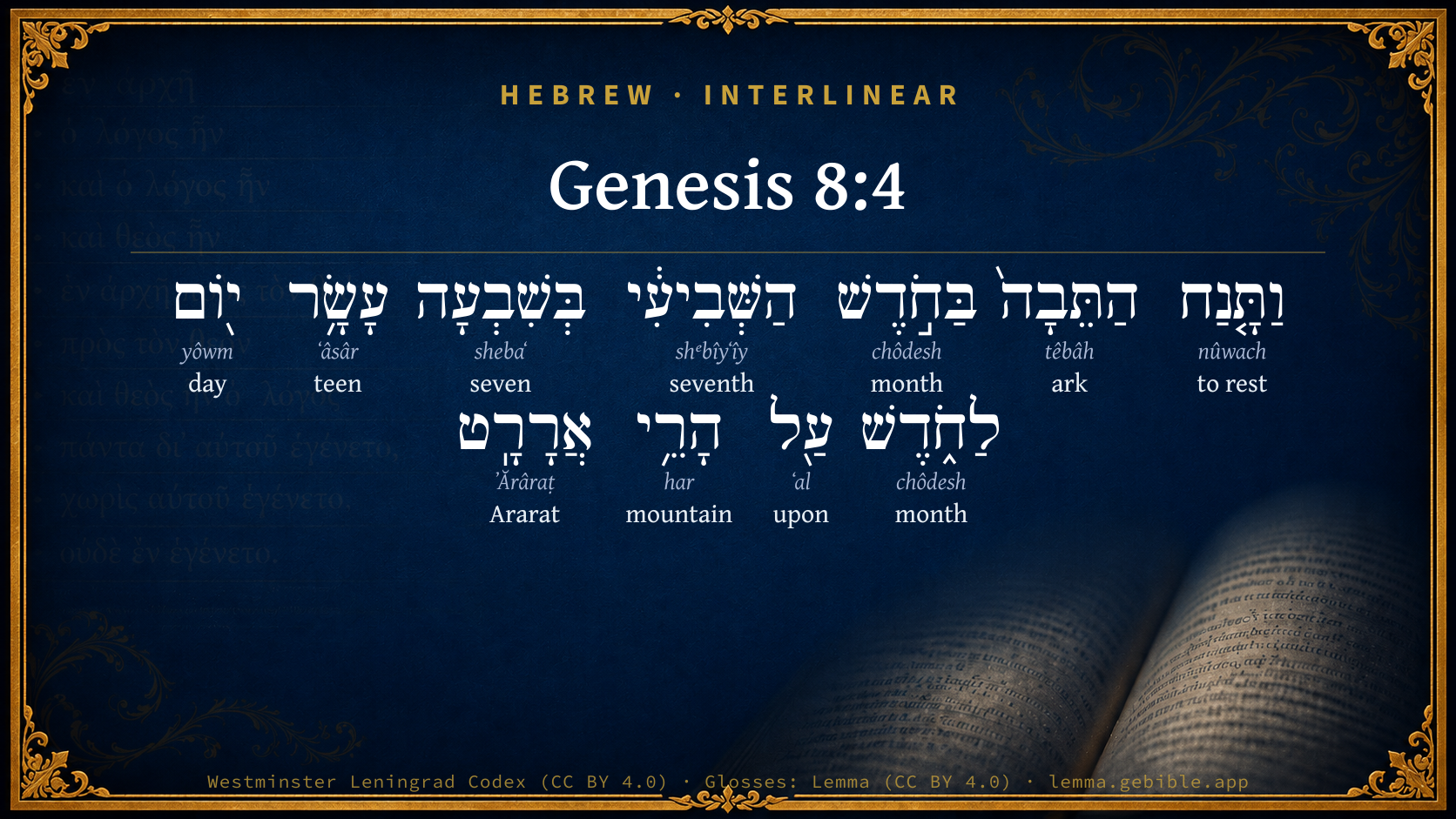
Hebrew (Westminster Leningrad Codex) Genesis 8:4 appears in the Hebrew Old Testament. The text above is from the Westminster Leningrad Codex. Each word links to its Strong’s number, a concise gloss, and parsing drawn from the Open Scriptures Hebrew Bible morphology. Click any word for its full Brown-Driver-Briggs (BDB) entry.
Download image
Cite this verse

Genesis 8:4 (World English Bible). Public Domain. Lemma interlinear Bible study tool, https://lemma.gebible.app/v/genesis/8/4.

Show BibTeX & RIS
BibTeX
RIS
English Translation
The ark rested in the seventh month, on the seventeenth day of the month, on Ararat's mountains.
World English Bible · Public Domain
Highlights Full analysis ↓
Download a study sheet

One document with this verse’s original text, its word-by-word gloss line, the meaning frame, cross-references with their text, attributed commentary, and full source and license credits — printable, and it pastes into notes with its structure intact.

This verse Autodidact and up

Study sheet (.html) Plain text (.txt)

A passage Seminary Student

Up to 50 verses in one chapter. A passage sheet keeps up to 6 commentary sources and 12 cross-references per verse, in the order this page ranks them, and says so on the sheet whenever that leaves anything out. Ask for a single verse and you get the Autodidact verse sheet above.

Everything on this page stays free to read, with no account — the sheet is a download of what is already on screen, not access to it.

Want to remove ads? Support Godless Engineer
Compare translations 3

The same verse in 3 English versions, stacked beneath the original-language interlinear above. Click any original word for its lexicon entry.

Each is an independent rendering of the whole verse — the interlinear is not word-aligned to these translations.

Highlighted words mark where these versions differ — a whole-verse word diff, not a word-by-word alignment.

  • World English Bible Public Domain
    The ark rested in the seventh month, on the seventeenth day of the month, on Ararat's mountains.
  • King James Version Public Domain
    And the ark rested in the seventh month, on the seventeenth day of the month, upon the mountains of Ararat.
  • unfoldingWord Literal Text CC BY-SA 4.0
    so that in the seventh month, on the seventeenth day of the month, the ark rested on the mountains of Ararat.

unfoldingWord Literal Text — © unfoldingWord, licensed CC BY-SA 4.0. Word-aligned USFM3 via Door43 (git.door43.org/unfoldingWord/en_ult).

Versions to compare (up to 4)

3 of 4 selected

Show all 18 translations

Every available English version of this verse, each an independent rendering of the whole verse.

  • World English Bible Public Domain
    The ark rested in the seventh month, on the seventeenth day of the month, on Ararat's mountains.
  • Berean Standard Bible Public Domain
    On the seventeenth day of the seventh month, the ark came to rest on the mountains of Ararat.
  • Majority Standard Bible Public Domain
    On the seventeenth day of the seventh month, the ark came to rest on the mountains of Ararat.
  • King James Version Public Domain
    And the ark rested in the seventh month, on the seventeenth day of the month, upon the mountains of Ararat.
  • American Standard Version (1901) Public Domain
    And the ark rested in the seventh month, on the seventeenth day of the month, upon the mountains of Ararat.
  • Revised Version (1885) Public Domain
    And the ark rested in the seventh month, on the seventeenth day of the month, upon the mountains of Ararat.
  • Geneva Bible (1599) Public Domain
    And in the seuenth moneth, in the seuenteenth day of the moneth, the Arke rested vpon the mountaines of Ararat.
  • Douay-Rheims (1899) Public Domain
    And the ark rested in the seventh month, the seven and twentieth day of the month, upon the mountains of Armenia.
  • Young's Literal Translation Public Domain
    And the ark resteth, in the seventh month, in the seventeenth day of the month, on mountains of Ararat;
  • Literal Standard Version CC BY-SA 4.0
    And the Ark rests, in the seventh month, on the seventeenth day of the month, on mountains of Ararat;
  • Unlocked Literal Bible CC BY-SA 4.0
    The ark came to rest in the seventh month, on the seventeenth day of the month, upon the mountains of Ararat.
  • unfoldingWord Literal Text CC BY-SA 4.0
    so that in the seventh month, on the seventeenth day of the month, the ark rested on the mountains of Ararat.
  • Darby Bible Public Domain
    And the ark rested in the seventh month, on the seventeenth day of the month, on the mountains of Ararat.
  • World Messianic Bible Public Domain
    The ship rested in the seventh month, on the seventeenth day of the month, on Ararat’s mountains.
  • Webster's Bible Public Domain
    And the ark rested in the seventh month, on the seventeenth day of the month, upon the mountains of Ararat.
  • Free Bible Version CC BY-SA 4.0
    the ark grounded on the mountains of Ararat. This happened on the seventeenth day of the seventh month.
  • Bible in Basic English Public Domain
    And on the seventeenth day of the seventh month the ark came to rest on the mountains of Ararat.
  • JPS Tanakh (1917) Public Domain
    And the ark rested in the seventh month, on the seventeenth day of the month, upon the mountains of Ararat.

Literal Standard Version (2020), Covenant Press — licensed CC BY-SA 4.0. Text via the HelloAO Bible API (eBible.org). Unlocked Literal Bible (unfoldingWord) — licensed CC BY-SA 4.0. Text via the HelloAO Bible API (eBible.org). unfoldingWord Literal Text — © unfoldingWord, licensed CC BY-SA 4.0. Word-aligned USFM3 via Door43 (git.door43.org/unfoldingWord/en_ult). Free Bible Version, Dr. Jonathan Gallagher — licensed CC BY-SA 4.0. Text via the HelloAO Bible API (eBible.org).

Word by word

More ways to search: Search by grammar → Find every occurrence → Compare this word →

Practice this passage: Drill this verse → Learn its vocabulary →

אֲרָרָֽט
ʼĂrâraṭ
H780
“Ararat”
Noun, Proper
Part of Speech
Noun
Type
Proper
Full BDB Definition

Origin: of foreign origin

TWOT: 169

Ararat = "the curse reversed: precipitation of curse" - a mountainous region of eastern Armenia, between the river Araxes and the lakes Van and Oroomiah, the site where Noah's ark came to rest - (TWOT) the mountain where Noah's ark came to rest
  1. וַתָּ֤נַח nûwach H5117 “and · to rest” Conjunction + Verb, Qal, Sequential Imperfect, 3rd Person, Feminine, Singular
  2. הַתֵּבָה֙ têbâh H8392 “the · ark” Particle, Definite Article + Noun, Common, Feminine, Singular, Absolute
  3. בַּחֹ֣דֶשׁ chôdesh H2320 “in/at the · month” Preposition, Determined + Noun, Common, Masculine, Singular, Absolute
  4. הַשְּׁבִיעִ֔י shᵉbîyʻîy H7637 “the · seventh” Particle, Definite Article + Adjective, Ordinal number, Masculine, Singular, Absolute
  5. בְּשִׁבְעָה shebaʻ H7651 “in/at · seven” Preposition + Adjective, Cardinal number, Masculine, Singular, Absolute
  6. עָשָׂ֥ר ʻâsâr H6240 “teen” Adjective, Cardinal number, Masculine, Singular, Absolute
  7. י֖וֹם yôwm H3117 “day” Noun, Common, Masculine, Singular, Absolute
  8. לַחֹ֑דֶשׁ chôdesh H2320 “to/for the · month” Preposition, Determined + Noun, Common, Masculine, Singular, Absolute
  9. עַ֖ל ʻal H5921 “upon” Preposition
  10. הָרֵ֥י har H2022 “mountains of” Noun, Common, Masculine, Plural, Construct

About this verse

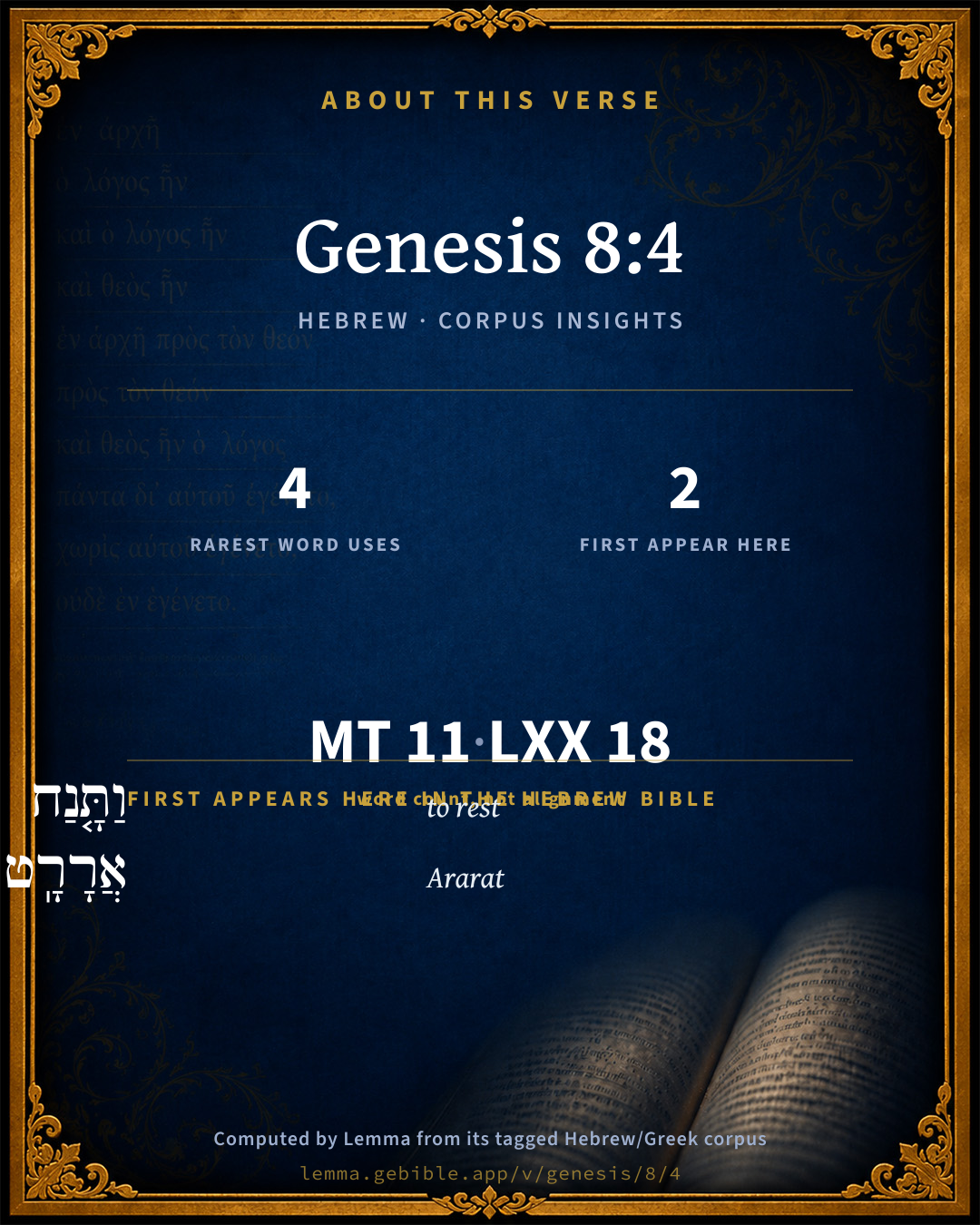
These counts appear in no published source. They are computed here, from the morphology-tagged text and Lemma’s own curated glosses. What Lemma adds →

11
words
10
distinct lemmas
Pentateuch
section

Notable vocabulary

The rarest word here is אֲרָרָֽט Ararat H780 — appearing just 4 times in the whole Hebrew Bible.

First appearance in Scripture

These words make their first canonical appearance in the Hebrew Bible here:

  • וַתָּ֤נַח to rest H5117
  • אֲרָרָֽט Ararat H780

Shared distinctive vocabulary

אֲרָרָֽט Ararat H780 occurs in 4 verses of the Hebrew Bible. Also found in:

Grammatical profile

  • 1 verb
  • 6 nouns
  • 3 adjectives
  • 1 preposition

Verb forms

  • וַתָּ֤נַח Qal · Sequential Imperfect

Repetition

A word recurs within this verse — often emphatic in Hebrew:

  • בַּחֹ֣דֶשׁ month H2320 ×2

Hebrew & Septuagint length

In English translation the verse runs 17 words from the Hebrew and 10 from the Septuagint (LXX English) — the Septuagint runs noticeably shorter here. See the side-by-side →

A rough comparison of the two English renderings, which tokenize alike — not a word-level alignment.

Word counts can differ between the Hebrew and the Greek without any difference in meaning — e.g. the Hebrew direct-object marker אֵת has no separate Greek word, and Greek often adds the article ὁ.

In the original languages it is 11 Hebrew tokens and 18 Greek tokens — but the two are counted differently (Hebrew bundles its prefixes and suffixes into one token; the Greek is in lemma form), so that isn’t a like-for-like length.

Cross-references

4

Topical passages linked to Genesis 8:4 in the Treasury of Scripture Knowledge — connected by theme and wording, ordered by reader-vote popularity; previews shown in the World English Bible.

  • 2 Kings 19:37 It happened, as he was worshipping in the house of Nisroch his god, that Adrammelech and Sharezer struck him with the sword: and they escaped into the land of Ararat. Esar Haddon his son reigned in his place.
  • Isaiah 37:38 It happened, as he was worshipping in the house of Nisroch his god, that Adrammelech and Sharezer his sons struck him with the sword; and they escaped into the land of Ararat. Esar Haddon his son reigned in his place.
  • Jeremiah 51:27 Set up a standard in the land, blow the trumpet among the nations, prepare the nations against her, call together against her the kingdoms of Ararat, Minni, and Ashkenaz: appoint a marshal against her; cause the horses to come up as the rough canker-worm.
  • Genesis 7:17–19 The flood was forty days on the earth. The waters increased, and lifted up the ark, and it was lifted up above the earth.

Cross-references courtesy of OpenBible.info (CC BY 4.0).

Hebrew and Greek witnesses Masoretic Hebrew ↔ Greek Septuagint

The same verse in the two great witnesses to the Old Testament, shown verse-for-verse.

Here the Septuagint runs noticeably shorter than the Hebrew — LXX2012 (modern English Septuagint) 10 words vs World English Bible 17. A rough length comparison of the two English translations, not a word-level alignment — read both below.

These are two independent witnesses, not word-aligned to each other, and the Septuagint is shown in lemma (dictionary) form.

Hebrew Genesis 8:4 Masoretic · Westminster Leningrad Codex

וַתָּ֤נַח הַתֵּבָה֙ בַּחֹ֣דֶשׁ הַשְּׁבִיעִ֔י בְּשִׁבְעָה עָשָׂ֥ר י֖וֹם לַחֹ֑דֶשׁ עַ֖ל הָרֵ֥י אֲרָרָֽט

The ark rested in the seventh month, on the seventeenth day of the month, on Ararat's mountains.

World English Bible · Public Domain

Greek LXX Genesis 8:4 Septuagint · lemma form

καί καταἵζω ὁ κιβωτός ἐν μήν ὁ ἕβδομος ἕβδομος καί εἰκάς ὁ μήν ἐπί ὁ ὄρος ὁ αραρατ

And the water continued to decrease until the tenth month.

LXX2012 (modern English Septuagint) · Public Domain

On this verse, John Gill's Exposition discusses the Septuagint’s reading. Read the note in Commentary ↓

Hebrew: Westminster Leningrad Codex (CC BY 4.0). Greek: Septuagint (public domain); English from LXX2012 (modern English Septuagint) (Public Domain). How the Septuagint differs from the Hebrew →

Targum (Aramaic paraphrase)

2

The Targum is the ancient Jewish Aramaic paraphrase of the Hebrew Scriptures — an interpretive translation, not the Hebrew text itself. Onkelos (literal) and Pseudo-Jonathan (expansive) render the Torah, and Jonathan the Prophets. Coverage is partial: where no permissively-licensed English translation exists for a verse, only the Aramaic is shown. This is verse-level text, not a word-by-word alignment to the Hebrew.

  1. Targum Onkelos Torah (Genesis–Deuteronomy)
    וְנָחַת תֵּבוֹתָא בְּיַרְחָא שְׁבִיעָאָה בְּשִׁבְעַת עֲשַׂר יוֹמָא לְיַרְחָא עַל טוּרֵי קַרְדּוּ

    And the ark rested on the seventh month, on the seventeenth day of the month, upon the mountains of Kardu.

    Targum Onkelos — Aramaic: “Onkelos Genesis” (public domain); “Onkelos Exodus” (public domain); “Onkelos Leviticus” (public domain); “Onkelos Numbers” (public domain); “Onkelos Deuteronomy” (public domain). English: “Sefaria Community Translation” (CC0 1.0 (public-domain dedication)); “J.W. Etheridge. The Targums of Onkelos and Jonathan Ben Uzziel on the Pentateuch. London: Longmans, Green, 1862” (public domain). Text via Sefaria.

  2. Targum Pseudo-Jonathan Torah (Genesis–Deuteronomy)
    וּנְחַת תֵּיבוּתָא בְּיַרְחָא שְׁבִיעָאָה הוּא יַרְחָא דְנִיסָן בְּשֶׁבְסְרֵי יוֹמִין לְיַרְחָא עַל טַוְורֵי דְקַדְרוֹן שׁוּם טַוְורָא חַד קַרְדַנְיָא וְשׁוּם טַוְורָא חַד אַרְמִינְיָא וְתַּמָן מִתְבַּנְיָא קַרְתָּא דְאַרְמַנְיָא בְּאַרְעָא מַדִינְחָא

    And the ark rested in the seventh month, which is the month of Nisan, in the seventeenth day of the month, upon the mountains of Qadron; the name of the one mountain is Qardania, and the name of the other mountain Irmenia; and there was builded the city of Armenia in the land of the east.

    Targum Pseudo-Jonathan — Aramaic: “Targum Jonathan on Genesis” (public domain); “Targum Jonathan on Exodus” (public domain); “Targum Jonathan on Leviticus” (public domain); “Targum Jonathan on Numbers” (public domain); “Targum Jonathan on Deuteronomy” (public domain). English: “The Targum of Jonathan ben Uzziel, trans. J. W. Etheridge, London, 1862” (public domain). Text via Sefaria.

Commentary

Notes on Genesis 8:4 from classic Christian and Jewish commentators (each source and its license shown beneath its notes). The classic Christian expositions comment on the surrounding passage and are grouped to its opening verse, so a note may address several verses; the Jewish commentaries on the Tanakh (Rashi and others) are per-verse, so they appear only where the commentator wrote on this verse.

Lemma curates 59 commentaries, every one of them public domain or Creative Commons licensed, each selected and text-cleaned for this edition rather than reprinted as found. About our sources →

Trapp's Complete Commentary

John Trapp

Gen 8:4 And the ark rested in the seventh month, on the seventeenth day of the month, upon the mountains of Ararat.

Ver. 4. Mountains of Ararat.] On the tops of the Gordaean mountains (where Noah’s ark rested) we find many ruins and huge foundations (saith the Preacher in his travels), {a} of which no reason can be rendered but that which Josephus gives: {b} that they that escaped the flood were so astonished and amazed that they dared not descend into the plains and low countries, but kept on the tops of those mountains, and there built.

{a} The Preacher’s Travels, by John Cartwright, p. 32.

{b} Joseph. Antiq, lib. i. cap. 5.

John Trapp, A Commentary or Exposition upon All the Books of the Old and New Testament (1647–1656) — public domain. Text from a community e-Sword module.

Tyndale Open Study Notes

Tyndale Open Resources

8:4 The mountains of Ararat might be in the region of Ararat (Urartu) southeast of the Black Sea near Lake Van, which touches parts of eastern Turkey, Armenia, and Iran. There is a Mount Ararat (Agri Dag) in Turkey, but this verse only identifies the region, not a specific mountain.

Tyndale Open Study Notes — © Tyndale Open Resources, licensed CC BY-SA 4.0. Text via the HelloAO Bible API.

Geneva Bible (1599)

Geneva Bible translators

Or, Armenia.

Or, stayed.

Which contained part of September, and part of October.

Geneva Bible (1599) marginal notes — public domain. Text via Bolls.life.

Matthew Henry's Commentary

Here we have the effects and evidences of the ebbing of the waters. 1. The ark rested. This was some satisfaction to Noah, to feel the house he was in upon firm ground, and no longer movable. It rested upon a mountain, whither it was directed, not by Noah's prudence (he did not steer it), but by the wise and gracious providence of God, that it might rest the sooner. Note, God has times and places of rest for his people after their tossings; and many a time he provides for their seasonable and comfortable settlement without their own contrivance and quite beyond their own foresight. The ark of the church, though sometimes tossed with tempests, and not comforted (Isa 54:11), yet has its rests, Act 9:31. 2. The tops of the mountains were seen, like little islands, appearing above the water. We must suppose that they were seen by Noah and his sons; for there were none besides to see them. It is probable that they had looked through the window of the ark every day, like the longing mariners, after a tedious voyage, to see if they could discover land, or as the prophet's servant (Kg1 18:43, Kg1 18:44), and at length they spy ground, and enter the day of the discovery in their journal. They felt ground above forty days before they saw it, according to Dr. Lightfoot's computation, whence he infers that, if the waters decreased proportionably, the ark drew eleven cubits in water.

Matthew Henry's Commentary on the Whole Bible (1708–1710) — public domain (CC PDM 1.0). Text via the HelloAO Bible API.

Jamieson, Fausset & Brown

Robert Jamieson, A. R. Fausset & David Brown

seventh month--of the year--not of the flood--which lasted only five months.

rested--evidently indicating a calm and gentle motion.

upon the mountains of Ararat--or Armenia, as the word is rendered (Kg2 19:37; Isa 37:38). The mountain which tradition points to as the one on which the ark rested is now called Ara Dagh, the "finger mountain." Its summit consists of two peaks, the higher of which is 17,750 feet and the other 13,420 above the level of the sea.

Jamieson, Fausset & Brown — Commentary Critical and Explanatory on the Whole Bible (1871) — public domain (CC PDM 1.0). Text via the HelloAO Bible API.

Adam Clarke's Commentary

Verse 4. The mountains of Ararat.] That Ararat was a mountain of Armenia is almost universally agreed. What is commonly thought to be the Ararat of the Scriptures, has been visited by many travellers, and on it there are several monasteries. For a long time the world has been amused with reports that the remains of the ark were still visible there; but Mr. Tournefort, a famous French naturalist, who was on the spot, assures us that nothing of the kind is there to be seen. As there is a great chain of mountains which are called by this name, it is impossible to determine on what part of them the ark rested; but the highest part, called by some the finger mountain, has been fixed on as the most likely place. These things we must leave, and they are certainly of very little consequence.

From the circumstance of the resting of the ark on the 17th of the seventh month, Dr. Light. foot draws this curious conclusion: That the ark drew exactly eleven cubits of water. On the first day of the month Ab the mountain tops were first seen, and then the waters had fallen fifteen cubits; for so high had they prevailed above the tops of the mountains. This decrease in the waters took up sixty days, namely, from the first of Sivan; so that they appear to have abated in the proportion of one cubit in four days. On the 16th of Sivan they had abated but four cubits; and yet on the next day the ark rested on one of the hills, when the waters must have been as yet eleven cubits above it. Thus it appears that the ark drew eleven cubits of water.

Adam Clarke's Commentary on the Bible (1810–1826) — public domain. Text from a community e-Sword/MySword module.

Ellicott's Commentary for English Readers

(4) The seventh month, on the seventeenth day of the month.—As the months had each thirty days (see Note on Gen_8:14), this makes exactly 150 days (see Gen_7:11). The seventh civil month would be Abib; and the Speaker’s Commentary notices the following remarkable coincidences:—“On the 17th day of Abib the ark rested on Mount Ararat; on the 17th day of Abib the Israelites passed over the Red Sea; on the 17th day of Abib, Christ, our Lord, rose again from the dead.”

Ararat.—If in Gen_11:2 the Authorised Version is right in saying that the descendants of Noah travelled “from the east” to Shinar, this could not be the Ararat of Armenia. Moreover, we are told that the word in, Assyrian means “highland,” and thus may signify any hilly country. In the Chaldean Genesis the ark rests upon Nizir, a region to the east of Assyria, the highest peak of which, now named Elwend, is called in the cuneiform texts “the mountain of the world” ( Chaldean Genesis, p. 307). The rendering, however, “from the east,” is by no means certain, and many translate “eastward,” and even the Authorised Version renders the word east, that is, eastward, in Gen_13:11. In 2Ki_19:37 “Ararat” is translated Armenia; but it is more correctly described in Jer_51:27 as a country near Minni, that is, near Armenia. There are in this region two mountains of great altitude, the Aghri-Dagh and the Kara-Dagh, the highest of which is 17,260 feet above the sea-level; and naturally legend chooses this as the place where the ark settled. But the inspired narrative says that it rested “upon the mountains of Ararat,” upon some chain of hills there, and seventy-three days afterwards Noah found himself surrounded by an amphitheatre of mountains, the word used in Gen_8:5 being emphatic, and signifying “the tops of the mountains became distinctly visible,” and not that they had just begun to emerge. For, doubtless, after so vast a flood, mists and vapours would for a long time prevail, and shut out the surrounding world from Noah’s view.

The Targum of Onkelos and the Syriac translate “on the mountains of Carduchia.” This range, which separates Armenia from Kurdistan, is regarded by many authorities as the hills really meant, because, as they are nearer the place whence the ark started, the difficulty regarding the course taken by it is not so insuperable.

A Bible Commentary for English Readers, edited by Charles John Ellicott (1878–1897) — public domain. Text from a community e-Sword module.

The Cambridge Bible for Schools and Colleges

gen. ed. J. J. S. Perowne

4. the seventh month, &c.] The Flood had begun on the 17th day of the 2nd month (see Gen_7:11): the highest point of the Flood is reached on the 17th day of the 7th month. Five months have elapsed. Probably the 150 days were reckoned as five months of 30 days each.

the mountains of Ararat] Ararat is not a mountain, but a district mentioned in Isa_37:38; Jer_51:27. It is the country which appears in the Assyrian inscriptions as “Urartu.” It lies between the river Araxes and Lake Van. It comprises a large portion of Armenia. There were high mountains in Ararat; and the loftiest among them, called in the present day Mount Ararat, is over 16,000 ft. high.

Assuming that the tradition referred to this mountain as the highest known, and that the water was said to have covered it by 15 cubits (Gen_7:20), the very existence of mountains of the altitude of Mount Everest (31,000 ft. high) was not contemplated. It is more probable that a well-known name like Ararat was accepted, in the Hebrew version of the story, for some similarly-sounding, but less familiar, name of hills in the neighbourhood of the Tigris.

The Cambridge Bible for Schools and Colleges (gen. ed. J. J. S. Perowne; Cambridge University Press, 1878–1918) — public domain. Text from a community e-Sword module.

John Gill's Exposition

And the ark rested in the seventh month, on the seventeenth day of the month,.... That is, five months after the flood began, and when the waters began to decrease; for this is not the seventh month of the flood, but of the year, which being reckoned from Tisri, or the autumnal equinox, must be the month Nisan, which answers to part of our March, and part of April; and so the Targum of Jonathan explains it,"this is the month Nisan;''but Jarchi makes it to be the month Sivan, which answers to part of May, and part of June, taking it to be the seventh month from Cisleu, when the forty days' rain ceased; in which he is followed by Dr. Lightfoot (u); and according to Bishop Usher (w) the seventeenth day of the seventh month, on which the ark rested, was Wednesday the sixth of May: and then it rested

upon the mountains of Ararat; that is, on one of them, for Ararat is said to be a long ridge of mountains like the Alps, or the Pyrenean mountains; which, as Sir Walter Raleigh (x) thinks, are the same which run through Armenia, Mesopotamia, Assyria, &c. and are by Pliny (y) called Taurus. But what is now called Ararat, and by the Armenians Messis or Macis, and by the Turks Augri-daugh or Agrida, is a single mountain, and is so high that it overtops all the mountains thereabout; and that which makes it seem so very high is, that it stands by itself in the form of a sugar loaf, in the middle of one of the greatest plains one can see; it has two tops, one greater, and the smaller is most sharp pointed of the two (z). The Vulgate Latin version renders it the mountains of Armenia; and so Ararat in the Septuagint of Isa 37:38 is rendered Armenia, and in our version also; and it is the more commonly received opinion, that Ararat was a mountain there; and this agrees with the testimonies of various Heathen writers, which are produced by Josephus and Eusebius. Berosus the Chaldean (a) says,"it is reported that in Armenia, on a mountain of the Cordyaeans, there is part of a ship, the pitch of which some take off, and carry about with them, and use it as an amulet to avert evils.''And Nicholas of Damascus (b) relates, that in Minyas in Armenia is an huge mountain called Baris, to which, as the report is, many fled at the flood, and were saved; and that a certain person, carried in an ark or chest, struck upon the top of it, and that the remains of the timber were preserved a long time after; and, adds he, perhaps he may be the same that Moses, the lawgiver of the Jews, writes of. Now this mountain seems plainly to have its name from the ark of Noah, for a boat, or ship, is, with the Egyptians, called Baris. Herodotus (c) gives a large account of ships they call by this name; and the boat in which Charon is said to carry the dead bodies over the lake Acherusia, near Memphis, is said by Diodorus Siculus (d) to have the same name. Abydenus the Assyrian (e) tells us, that"Saturn having foretold to Sisithrus, that there would be a vast quantity of rain on the fifteenth of the month Daesius, he immediately sailed to the Armenians; and that the ship being driven to Armenia, the inhabitants made amulets of the wood of it, which they carried about their necks, as antidotes against diseases.''And hence Melo (f), who wrote against the Jews, suggests, as if the deluge did not reach Armenia; for he says,"at the deluge a man that had escaped with his sons went from Armenia, being driven out of his possession by those of the country, and passing over the intermediate region, came into the mountainous part of Syria, which was desolate.''And with what Berosus says of a mountain of the Cordyaeans, in Armenia, agree the Targums of Onkelos and Jonathan, and the Syriac and Arabic versions, who all render the words here the mountains of Cardu or Carda: from the resting of the ark on this day on the mountains of Ararat, Jarchi concludes, and Dr. Lightfoot (g) after him, that the ark drew eleven cubits water, which, according to them, thus appears; on the first day of the month Ab, the mountain tops were first seen, and then the waters had fallen fifteen cubits, which they had been sixty days in doing, namely, from the first day of Sivan, and so they had abated the proportion of one cubit in four days: by this account we find, that on the sixteenth day of Sivan they had abated but four cubits, and yet on the next day, the seventeenth, the ark resteth on a hill, where the waters yet lay eleven cubits above it.

(u) Works. vol. 1. p. 8. (w) Annales Vet. Test. p. 4. (x) History of the World, B. 1. ch. 7. sect. 13. (y) Nat. Hist. l. 5. c. 27. (z) Cartwright's Preacher's Travels, p. 32. Tournefort's Voyage to the Levant, vol. 3. p. 177, 183, 186. (a) Apud Joseph. Antiqu. l. 1. c. 3. sect. 6. (b) Apud ib. (c) Euterpe sive, l. 2. c. 96. (d) Bibliothec. l. 1. p. 87. (e) Apud Euseb. Evangel. Praepar. l. 9. c. 12. p. 414, 415. (f) Apud ib. c. 19. p. 420. (g) Ut supra, (Works. vol. 1.) p. 8.

John Gill's Exposition of the Whole Bible (1746–1763) — public domain (CC PDM 1.0). Text via the HelloAO Bible API.

Haydock's Catholic Bible Commentary

And the ark rested on the mountains of Armenia. The Hebrew word is Ararat, which also occurs in the 37th chap. of Isaias, and the 51st of Jeremias; for in these places our interpreter retained the Hebrew word, but in the 4th book of Kings, xix. 37, where the same history is related, it is translated by the land of the Armenians. (Estius) --- Seventh month, of the year, not of the deluge, as appears from ver. 13, &c. (Menochius). --- Seven and twentieth. So also the Septuagint, but the Hebrew, &c. have the 17th. It is not easy to decide which is right. On the seventeenth the waters only began to decrease, and some hence argue for the Vulgate, as they say it is not probable the ark would stop that very day. (Calmet) --- This, however, might be the only mean by which Noe could discern that the waters were abating. (Haydock) --- The ark being about fourteen cubits sunk in the water, might soon touch the summit of the highest mountains, such as Mt. Taurus, of which the Ararat, here mentioned in the Hebrew, a mountain of Armenia, forms a part, according to St. Jerome. The Armenians still boast that they have the remains of the ark. Berosus, the Pagan historian, says bitumen was taken from it as a preservative. (Josephus, Antiquities i. 3; Eusebius, præp. ix. 4.) The Chaldee has Cordu for Ararat, whence some have supposed, that the ark rested on the Cordyean or Gordiean mountains. The Armenians call the mountain near Erivan, Mesesonsar, or the mountain of the ark. (Calmet)

George Leo Haydock (1774–1849), Haydock's Catholic Family Bible and Commentary, 1859 edition — public domain. Excludes Psalms (Douay-Rheims chapter numbering differs from Protestant) and Deuterocanonical books (Catholic canon only).

Matthew Poole's English Annotations

In the seventh month, from the beginning, not of the flood, but of the year, as appears by comparing Gen 7:11, and Gen 8:13-14,

the ark rested upon one of the mountains of Ararat; by a frequent enallage of the number, as Jdg 12:7; Mat 21:5. And by Ararat is here commonly and rightly understood Armenia, as appears both by comparing Isa 37:38; Jer 51:27, and by the testimony of ancient writers, produced by Josephus and others to this purpose; and by the great height of those mountains, and by its nearness to the place where the first men lived; this great vessel not being fitted for sailing to remote places, but only for the receipt and preservation of men and other creatures in it.

Matthew Poole's English Annotations on the Holy Bible (1683–1685) — public domain. Text from a community e-Sword/MySword module.

Whedon's Commentary on the Bible

Daniel D. Whedon

4. The ark rested — Here is the reason of the statement made in the previous verse; at the end of five months, or one hundred and fifty days, it is known that the waters had begun to diminish, because the ark, which had hitherto floated freely, now caught ground, and finally rested. It is not likely that the year of the flood was reckoned from Abib, the beginning of the sacred year as established at the Exodus; but, as the Speaker’s Commentary observes, about the autumnal equinox. “If so, the seventeenth day of the second month (Gen_7:11) would bring us to the middle of November, the beginning of the wintry or rainy season.… With regard to the forty days’ rain, it seems pretty certain that these were not additional to, but part of, the one hundred and fifty days of the prevalence of the flood. Supposing the above calculation to be correct, we have the very remarkable coincidences that on the seventeenth day of Abib (five months later than November) the ark rested on Ararat; on the seventeenth of Abib the Israelites passed the Red Sea, and on the seventeenth of Abib our Lord rose from the dead.”

Upon the mountains of Ararat — Not the mount or double peak now called Ararat, which from its height, steepness, ruggedness, and cold (the summit is higher than Mont Blanc) would have been totally unsuited for the ark’s resting-place, but the highlands of the country or district of Ararat, probably the central province of Armenia. Von Raumer has shown that this was the most suitable spot in the world for the cradle of the human race. “A cool, airy, well-watered mountain-island in the midst of the old continent,” whence the waters descend toward the Black, Caspian, and Mediterranean Seas and the Persian Gulf. At the center of the longest land-line of the ancient world from Behring Straits to the Cape of Good Hope, it stood in the great highways of colonization, near the seats of the greatest nations of antiquity.

Daniel D. Whedon (gen. ed.), Commentary on the Old and New Testaments (1874–1909) — public domain. Text from a community e-Sword module.

The Pulpit Commentary

And the ark rested. Not stopped sailing or floating, got becalmed, and remained suspended over (Kitto"s "Cyclop.," art. Ararat), but actually grounded and settled on (Tayler Lewis) the place indicated by (cf. ver. 9; also Exo_10:14; Num_10:36 Num_11:25, Num_11:26; Isa_11:2) In the seventh month, on the seventeenth day of the month. Ie. exactly 150 days from the commencement of the forty days" rain, reckoning thirty days to a month, which seems to confirm the opinion expressed (Gen_7:24) that the forty days were included in the 150.

Supposing the Flood to have begun in Marchesvan, the second month of the civil year (about the beginning of November), "we have then the remarkable coincidences that on the 17th day of Abib (about the beginning of April) the ark rested on Mount Ararat, the Israelites passed over the Red Sea, and our Lord rose again from the dead" ("Speaker"s Commentary"). Upon the mountains. Ie. one of the mountains. "Pluralis numerus pro singulari ponitur" (of. Gen_21:7 Gen_46:7; Jud_1:12:7; vide Glass., "Philoh Seer. Tract.," 1. cap. 14. p. 866). Of Ararat.

1. It is agreed by all that the term Ararat describes a region.

2. This region has been supposed to be the island of Ceylon (Samaritan), Aryavarta, the sacred land to the north of India (Van Bohlen, arguing from; (Gen_11:2) but "it is evident that these and such like theories have been framed in forgetfulness of what the Bible has recorded respecting the locality" (Kitto"s "Cyclopedia," art. Ararat).

3. The locality which appears to have the countenance of Scripture is the region of Armenia. (of 2Ki_19:37; Isa_37:38; Jer_51:27; Aquila, Symmachus, Theodotion, Vulgate)

4. In Armenia three different mountains have been selected as the site on which the ark grounded.

(1) The modern Ararat, which rises in Northern Armenia, about twelve miles south of Erivan, in the form of two majestic cones, the one 16, 254, and the ether 12, 284 feet (Parisian) in height above the level of the sea (Hierony. mus, Furst, Kalisch, Keil, Delitzsch, and Lange). All but universal tradition has decided that the loftiest of these two peaks (called Macis in Armenian; Aghri-Dagh, i.e. the difficult or steep mountain, by the Turks; Kuchi Nuch, i.e. the mountain of Noah, by the Persians) was the spot where the sacred vessel first felt the solid land. Travelers describe the appearance of this amazing elevation as of incomparable and overpowering splendor. "It appeared as if the highest mountains in the world had been piled upon each other to form this one sublime immensity of earth and rocks and snow. The icy peaks of its double head rose majestically into the clear and cloudless heavens; the sun blazed bright upon them, and the reflection sent forth a radiance equal to other suns" (Ker Porters "Travels, 1:132; 2:636). "Nothing can be more beautiful than its shape, more awful than its height. All the surrounding mountains sink into insignificance when compared to it. It is perfect in all its parts; no hard, rugged feature, no unnatural prominences; everything is in harmony, and all combines to render it one of the sublimest objects in nature" (Morier"s "Journey," 1:16; 2:312, 345). The ascent of the Kara Dagh, or Greater Ararat, which the Armenians believe to be guarded by angels from the profane foot of man, after two unsuccessful attempts, was accomplished in 1829 by Professor Parrot, a German, and five years later, in 1834, by the Russian traveler Automonoff. In 1856 five English travelers, Majors Stewart and Frazer, Roy. Walter Thursby, Messrs. Thee-bald and Evans, performed the herculean task. The latest successful attempt was that of Prof. Bryce of Oxford in 1876 (vide "Transcaucasia and Ararat:" London: Macmillan and Co., 1877).

(2) An unknown mountain in Central Armenia between the Araxes and lakes Van and Urumiah (Vulgate, super mantes Armeniae; Gesenius, Murphy, Wordsworth, Bush, "Speaker"s Commentary").

(3) A peak in the Gordyaean mountains, or Carduchian range, separating Armenia on the south from Kurdistan (Chaldea Paraphrase, Onkelos, Syriac, Calvin), near which is a town called Naxuana, the city of Noah (Ptolemy), Idshenan (Moses Chorenensis), and Nachid-shenan, the first place of descent (the Armenians), which Josephus translates by ajporathrion, or the place of descent. Against the first is the inaccessible height of the mountain; in favor of the third is the proximity of the region to the starting-place of the ark.

Vers. 4, 18.

Mount Ararat, or the landing of the ark.

That disembarkment on the mountain heights of Ararat was an emblem of another landing which shall yet take place, when the great gospel ship of the Christian Church shall plant its living freight of redeemed souls upon the hills of heaven. Everything that Mount Ararat witnessed on that eventful day will yet be more conspicuously displayed in the sight of God"s believing people who shall be counted worthy of eternal life.

I SIN PUNISHED. Mount Ararat was a solemn witness to the severity of Goads judgments upon a guilty world. Never had the world looked on such a vindication of the insulted holiness and offended justice of Almighty God, and never will it look upon another till the hour strikes when "the heavens, being on fire, shall dissolve", (2Pe_3:10) and "the Lord himself shall be revealed in flaming fire". (2Th_1:7)

II GRACE REVEALED. Mount Ararat saw Divine grace displayed to sinful mere. Pre-eminently Noah and his family were debtors to Divine grace that day when they stepped forth from the ark; add who can doubt that a sense of the richness of Divine grace in saving them will be one of the first feelings to take possession of the souls of the ransomed on reaching heaven?

III SALVATION ENJOYED. Mount Ararat beheld salvation enjoyed by believing sinners. The deliverance of Noah and his family was a type of the salvation of the saints, which, however, is immeasurably grander than that of Noah.

1. In kind, as being a spiritual, and not merely a temporal, deliverance.

2. In degree, as being complete; whereas Noah"s was at the best an imperfect deliverance a deliverance from the Flood, but not from that which caused the Flood sin.

3. In duration. Noah"s deliverance was only for a time in the end he descended to the grave; the deliverance of the saints is for ever. (Luk_20:36)

IV GRATITUDE EXPRESSED. Mount Ararat heard the adorations and thanksgivings of a redeemed family. In Noah"s sacrifice was a wonderful commingling of ideas and emotions,

(1) faith,

(2) penitence,

(3) thanksgiving,

(4) consecration,

all of which will have a place within the bosoms of the ransomed host who yet shall sit upon the sea of glass. If not the offering up of sacrificial victims, as the expression of the soul"s faith, there will be

(1) in the midst of the throne a Lamb as it had been slain;

(2) the continual offering up of broken and of contrite hearts;

(3) the chanting of perpetual hosannas and hallelujahs; and

(4) the eternal consecration of our redeemed hearts to God.

V SAFETY CONFIRMED. Mount Ararat listened to the voice of God confirming the salvation of his people. In two ways was it confirmed.

(1) By a voice, and

(2) by a sign the rainbow. And so is the eternal happiness of God"s believing people secured

(1) by the sure word of promise (Rev_21:3) and

(2) by the covenant of grace. (Rev_4:3)

The Pulpit Commentary (1880–1919), ed. H.D.M. Spence-Jones & Joseph S. Exell — public domain. Text from a community e-Sword module.

John Wesley's Explanatory Notes

And the ark rested - upon the mountains of Ararat - Or, Armenia, whether it was directed, not by Noah's prudence, but the wise providence of God.

John Wesley, Explanatory Notes Upon the Whole Bible (1754–1765) — public domain. Text via the GEBible commentary corpus.

Scofield Reference Notes

C. I. Scofield

seventh month i.e. October.

Ararat Lit. holy ground, answering to the "heavenly" of Eph 2:4-6 for the Church, and to the "new heavens and new earth" for Israel.; Isa 65:17-19; Isa 66:22; Rev 21:1.

The Scofield Reference Bible (1917 edition), notes by C. I. Scofield — public domain. Text from a community e-Sword module.

unfoldingWord translationNotes

Door43 World Missions Community

came to rest

"landed" or "stopped on solid ground"

in the seventh month, on the seventeenth day of the month ... tenth month

Because Moses wrote this book, it is possible he is referring to the seventh month and tenth month of the Hebrew calendar, but this is uncertain. (See: Hebrew Months and Ordinal Numbers)

On the first day of the month

"On the first day of the tenth month"

appeared

This can be made more explicit: "appeared above the surface of the water." (See: Assumed Knowledge and Implicit Information)

translationWords

ark

day

Ararat

unfoldingWord translationNotes — © Distant Shores Media and the Door43 World Missions Community, licensed CC BY-SA 4.0. Source: git.door43.org/Door43/en_tn.

Rashi

Rabbi Shlomo Yitzchaki (Rashi)

בחדש השביעי IN THE SEVENTH MONTH — viz., Sivan, which is the seventh from Kislev in which the rains stopped falling.

בשבעה עשר יום ON THE SEVENTEENTH DAY — From here you may infer that the Ark was submerged in the water to a depth of eleven cubits. For it is written (next verse) “In the tenth month on the first day of the month the tops of the mountains were seen” and this was Ab which is the tenth month after Cheshvan — after the rain began to fall. Now the waters were 15 cubits high above the mountains so that they subsided from the first of Sivan to the first of Ab 15 cubits for those 60 intervening days, which is one cubit each four days. Consequently by the sixteenth of Sivan they had subsided only 4 cubits, and since the Ark rested on Ararat on the next day, you may learn that it was submerged eleven cubits in the waters which were then still above the mountain tops (Genesis Rabbah 33:7).

Rashi on the Tanakh — English translations: “The Judaica Press complete Tanach with Rashi, translated by A. J. Rosenberg” (CC BY 4.0); “Pentateuch with Rashi's commentary by M. Rosenbaum and A.M. Silbermann, 1929-1934” (public domain); “The Metsudah Tanach series, Lakewood, N.J” (CC BY 4.0); and “The Book of Joshua, Metsudah Publications, 1997” (CC BY 4.0). Text via Sefaria.

Ramban (Nachmanides)

Rabbi Moshe ben Nachman (Ramban / Nachmanides)

AND THE ARK RESTED IN THE SEVENTH MONTH, ON THE SEVENTEENTH DAY OF THE MONTH. Rashi wrote: “From here you may infer that the ark was submerged in the water to a depth of eleven cubits.” This he wrote on the basis of the calculation written in his commentaries, and it is so found in Bereshith Rabbah. But since in certain places Rashi minutely examines Midrashic traditions and for the same verses also takes the trouble to explain the simple meanings of Scripture, he has thus given us permission to do likewise for there are seventy ways of interpreting the Torah, and there are many differing Midrashim among the words of the Sages. And so I say that this calculation which they have mentioned does not fit into the language of Scripture unless we bear with that which explains And the ark rested in the seventh month as referring to that day mentioned above [in Verses 2-3] when the rain was withheld and the waters receded from the earth and decreased continually. [This interpretation of the seventh month is] unlike the counting of the second month mentioned in the beginning of the section, [which Rashi explains there as being “the second month” of the creation calendar], and unlike the counting stated at the end of the section [in Verse 13: in the first month, which Rashi similarly explains as being “the first month” of the creation calendar]! And how is it possible that in the second verse Scripture should immediately retract [from using the withholding of the rain as a reference point for counting] and state, until the tenth month, and proceed to another reference point, counting it, as Rashi explains, as the tenth month with reference to the coming of the rains!The evidence Rashi brings from the submergence of the ark in the waters is no proof for he attributes an equal decrease of water to each of the days — namely, a cubit every four days — and it is known in nature concerning the decrease of water that a great river which decreases at first a cubit every four days will at the end decrease four cubits in a day. Thus according to this calculation of Rashi, on the first day of the month of Ab the tops of the mountains were seen, and on the first day of Tishri the earth dried. Thus in sixty days the waters decreased the entire height of the high mountains consisting of many thousands of cubits, [surely a greater rate than four cubits a day, as Rashi would have it]! Besides, when Noah sent forth the dove on the seventeenth day of the month of Ellul, the waters were yet on the face of the entire earth, and the trees were covered, and in a matter of twelve days the whole earth dried! And by way of reason, if the ark was submerged in the waters eleven cubits, that being more than a third of its height [which was thirty cubits], it would have sunk because it was wide at the bottom and finished to a cubit at the top, Verse 16. contrary to the structure of ships, and there was also in it great weight!From the simple interpretation of Scripture it appears that the hundred and fifty days mentioned in connection with the prevailing of the waters include the forty days of the coming down of the rains, Verse 12. since the main increase and prevailing of the waters took place during these days. Thus the waters began decreasing on the seventeenth day of Nisan, and thirty days later — the seventeenth day of the month Iyar, which was the seventh month from the time the rain began to fall — the ark rested upon the mountains of Ararat. Seventy-three days later, on the first of Ab, which was the tenth month from the time the rain began to fall, the tops of the mountains were seen. We have thus made a small correction in the interpretation of the language of Scripture, [namely, that all counting begins from the time the rain began to fall].But the correct interpretation appears to me to be that the hundred and fifty days were from the seventeenth day of the second month, namely, the month of Marcheshvan, to the seventeenth day of the seventh month, namely, the month of Nisan, and that was the day when the ark rested on the mountains of Ararat. For then G-d caused a strong east wind to pass all the night and made the waters dry land, meaning that they decreased very much, and the ark rested. The proof for this is that Scripture does not say here, “and the waters decreased on such a month and on such a day and the waters decreased continually until the seventh month, and the ark rested, etc.,” as it said concerning the other decrease when the tops of the mountains were seen, for on the very day the waters began decreasing, the ark rested. The order of events in this matter was thus: on the day the rain began to fall all the fountains of the great deep were broken up, and the windows of the heavens were opened and the rain came down for forty days. During that time the waters prevailed fifteen cubits above [the summits of all the mountains]. The rain stopped at the end of forty days, but “the fountains of the deep” and “the windows of the heavens” remained open. The atmosphere was very damp, and the whole earth was full of water, not like waters poured down a precipice, nor ever to become dried. And they stood thus in their power until one hundred and fifty days from the day the rain began were completed. Then G-d caused a very powerful wind to pass through the heavens and over the earth, and the fountains of the deep were stopped for the water that flowed from them returned to its place until the deep filled up as it was before the flood, and the openings of its fountains were locked, as were “the windows of the heavens.” And the air was dried very much by a drying wind, and the water on the earth was licked up. Thus the waters decreased exceedingly on that day, and the ark, which was submerged in the waters about two to three cubits, rested. Seventy-three days after that — on the first day of the tenth month, namely, the month of Tammuz — the tops of the mountains were seen. At the end of forty additional days — on the tenth day of the eleventh month, Ab — Noah opened the window of the ark, and three weeks later the dove left him; thirty days later, he removed the covering of the ark.

AND G-D MADE A WIND TO PASS OVER THE EARTH. This means that there was a great and powerful wind coming out from the bowels of the earth over the face of the deep and hovering over the waters, and the fountains of the deep were stopped thereby. This is so since Scripture does not say, “and G-d made a wind to pass over the waters.”

AND THE WATERS ASSUAGED (‘VAYASHOKU’). This means that the waters which were flowing from the deep subsided. It is the same expression as, Then the king’s wrath ‘shachachah’ (assuaged), meaning that his anger subsided. Or it may be that this is an expression of a thing being concealed and swallowed up. Thus the verse teaches that the waters of the deep were swallowed up in their place. And so did the Rabbis say in Seder Olam: “The waters that went up were dried by the wind, and those that went down were swallowed in their place.”

AND THE RAINS FROM THE HEAVENS WERE WITHHELD. This means that no more rain came down until they [Noah and his family and all living creatures] went out of the ark for by this wind [which G-d made to pass over the earth] the heavens became as iron. Neither dew nor rain came down, the air lost its moisture, and the waters dried up for the rain of the flood completely stopped after the fortieth day.

AND THE WATERS RETURNED FROM OFF THE EARTH CONTINUALLY. The verse states that the waters decreased gradually until the face of the ground was dried up. And after the end of a hundred and fifty days the waters decreased. This is connected with the following verse, And the ark rested, thus stating that on that day there was a great decrease in the waters which enabled the ark to rest [on the mountains of Ararat], as I have explained.

Ramban (Nachmanides) on the Tanakh — English translation: “Commentary on the Torah by Ramban (Nachmanides). Translated and annotated by Charles B. Chavel. New York, Shilo Pub. House, 1971-1976” (CC BY 4.0). Text via Sefaria.

Radak

Rabbi David Kimhi (Radak)

ותנח התבה בחדש השביעי, this is the month of Sivan being the seventh month counting from the end of the rain descending which occurred in Kislev. Even though, as we know, the rains had begun to fall in the month of Marcheshvan, the Torah speaks here of a count beginning in Kislev seeing that the end of the rains and the end of the ark floating around have something in common in terms of stages of the deluge ending. על הרי אררט, perhaps those were the tallest mountain range, or it happened that the ark was in that region on the day in question. At any event, the mountain range of Ararat is one of the highest mountain ranges that we know of. What is clear is that lower mountain ranges on earth did not become visible to people in the ark until the tenth month. The meaning of the line is that the process of the waters diminishing continued progressively until at the beginning of the tenth month the tops of the mountains became visible. These “mountains” were actually only hills. The process continued unabated. The “tenth” month mentioned here was the month of Av, seeing it was the tenth month counting from the month during which the rains had started, Marcheshvan.

Radak on the Tanakh — English translations: “Sefaria Community Translation” (CC0 1.0 (public-domain dedication)); “Eliyahu Munk, HaChut Hameshulash” (CC BY 4.0); “Rabbi Mike Feuer, Jerusalem Anthology” (CC BY 4.0); and “R. David Kimhi on the first book of Psalms, Translated by R.G. Finch, London, 1919” (public domain). Text via Sefaria.

Lesson kit

Teaching starters — assembled from the data on this page, not authored interpretation. Every prompt links to the verse data it draws on. Edit before teaching.

Genesis, in the Pentateuch, opens this verse with 11 words (10 distinct Hebrew lemmas). Its most distinctive word is ʼĂrâraṭ (“Ararat”). The Greek Septuagint runs shorter here. A historical commentator’s framing appears above. Read the whole chapter for the surrounding context.

Discussion questions

  1. The word ʼĂrâraṭ carries the sense “Ararat.” How does it shape the verse?
  2. 2 words here appear for the first time in Scripture. What is being introduced at this debut?
  3. 2 Kings 19:37 shares the word «Ararat» with this verse. How do the two illuminate each other?
  4. “month” occurs 2× in this one verse. What is the effect of the repetition?
  5. Compared with the Hebrew, the Septuagint runs shorter here. What questions does that raise?
  6. The translations on this page render this verse differently — a whole-verse word diff, not a word-by-word alignment. What might account for the different wordings?
  7. The verb «וַתָּ֤נַח» is Qal Sequential Imperfect. How does its form color the action?
  8. Reading how Trapp's Complete Commentary and Tyndale Open Study Notes read this verse, where do the two commentators agree and where do they part?

Things to notice

Reading settings

Reading text

Shown beneath each verse's original-language words.

Old Testament
Old Testament edition

Read the OT as the Masoretic Hebrew (MT) or the Greek Septuagint (LXX).

English shown for the Greek Septuagint (in the Hebrew ↔ Greek comparison).

Comparing translations? Open the Compare panel on any verse page to stack up to four side by side.