Exodus 29:30

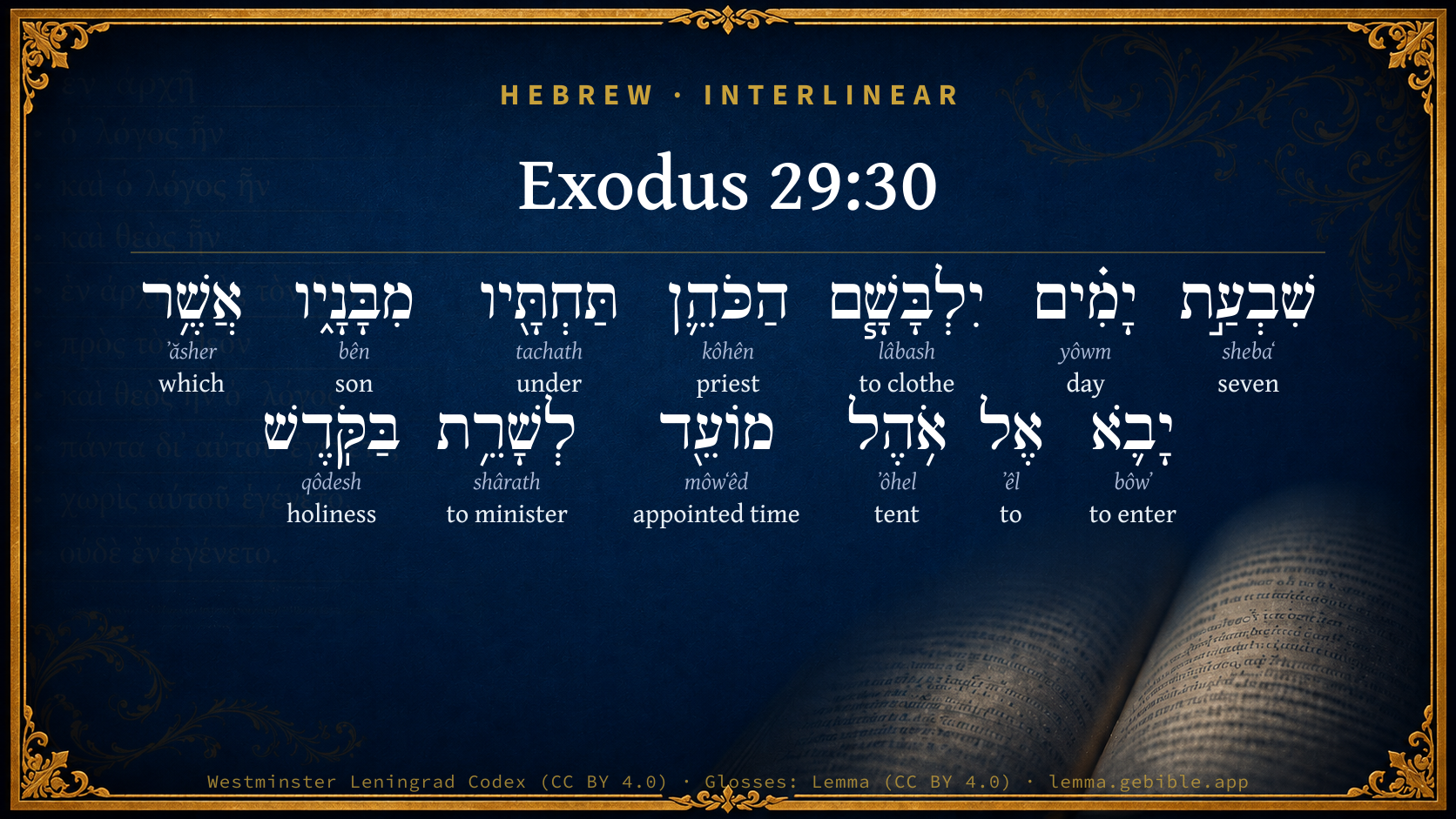
Hebrew (Westminster Leningrad Codex) Exodus 29:30 appears in the Hebrew Old Testament. The text above is from the Westminster Leningrad Codex. Each word links to its Strong’s number, a concise gloss, and parsing drawn from the Open Scriptures Hebrew Bible morphology. Click any word for its full Brown-Driver-Briggs (BDB) entry.
Download image
Cite this verse

Exodus 29:30 (World English Bible). Public Domain. Lemma interlinear Bible study tool, https://lemma.gebible.app/v/exodus/29/30.

Show BibTeX & RIS
BibTeX
RIS
English Translation
Seven days shall the son who is priest in his place put them on, when he comes into the tent of meeting to minister in the holy place.
World English Bible · Public Domain
Download a study sheet

One document with this verse’s original text, its word-by-word gloss line, the meaning frame, cross-references with their text, attributed commentary, and full source and license credits — printable, and it pastes into notes with its structure intact.

This verse Autodidact and up

Study sheet (.html) Plain text (.txt)

A passage Seminary Student

Up to 50 verses in one chapter. A passage sheet keeps up to 6 commentary sources and 12 cross-references per verse, in the order this page ranks them, and says so on the sheet whenever that leaves anything out. Ask for a single verse and you get the Autodidact verse sheet above.

Everything on this page stays free to read, with no account — the sheet is a download of what is already on screen, not access to it.

Want to remove ads? Support Godless Engineer
Compare translations 3

The same verse in 3 English versions, stacked beneath the original-language interlinear above. Click any original word for its lexicon entry.

Each is an independent rendering of the whole verse — the interlinear is not word-aligned to these translations.

Highlighted words mark where these versions differ — a whole-verse word diff, not a word-by-word alignment.

  • World English Bible Public Domain
    Seven days shall the son who is priest in his place put them on, when he comes into the tent of meeting to minister in the holy place.
  • King James Version Public Domain
    And that son that is priest in his stead shall put them on seven days, when he cometh into the tabernacle of the congregation to minister in the holy place.
  • unfoldingWord Literal Text CC BY-SA 4.0
    The priest who succeeds him from among his sons, who comes into the tent of meeting to serve in the Holy Place, shall wear them for seven days.

unfoldingWord Literal Text — © unfoldingWord, licensed CC BY-SA 4.0. Word-aligned USFM3 via Door43 (git.door43.org/unfoldingWord/en_ult).

Versions to compare (up to 4)

3 of 4 selected

Show all 18 translations

Every available English version of this verse, each an independent rendering of the whole verse.

  • World English Bible Public Domain
    Seven days shall the son who is priest in his place put them on, when he comes into the tent of meeting to minister in the holy place.
  • Berean Standard Bible Public Domain
    The son who succeeds him as priest and enters the Tent of Meeting to minister in the Holy Place must wear them for seven days.
  • Majority Standard Bible Public Domain
    The son who succeeds him as priest and enters the Tent of Meeting to minister in the Holy Place must wear them for seven days.
  • King James Version Public Domain
    And that son that is priest in his stead shall put them on seven days, when he cometh into the tabernacle of the congregation to minister in the holy place.
  • American Standard Version (1901) Public Domain
    Seven days shall the son that is priest in his stead put them on, when he cometh into the tent of meeting to minister in the holy place.
  • Revised Version (1885) Public Domain
    Seven days shall the son that is priest in his stead put them on, when he cometh into the tent of meeting to minister in the holy place.
  • Geneva Bible (1599) Public Domain
    That sonne that shalbe Priest in his steade, shall put them on seuen dayes, when he commeth into the Tabernacle of the Congregation to minister in the holy place.
  • Douay-Rheims (1899) Public Domain
    He of his sons that shall be appointed high priest in his stead, and that shall enter into the tabernacle of the testimony to minister in the sanctuary, shall wear it seven days.
  • Young's Literal Translation Public Domain
    seven days doth the priest in his stead (of his sons) put them on, when he goeth in unto the tent of meeting, to minister in the sanctuary.
  • Literal Standard Version CC BY-SA 4.0
    [for] seven days the priest in his stead (of his sons) puts them on when he goes into the Tent of Meeting to minister in the holy place.
  • Unlocked Literal Bible CC BY-SA 4.0
    The priest who succeeds him from among his sons, who comes into the tent of meeting to serve me in the holy place, is to wear those garments for seven days.
  • unfoldingWord Literal Text CC BY-SA 4.0
    The priest who succeeds him from among his sons, who comes into the tent of meeting to serve in the Holy Place, shall wear them for seven days.
  • Darby Bible Public Domain
    The son that is priest in his stead shall put them on seven days, when he cometh into the tent of meeting to serve in the sanctuary.
  • World Messianic Bible Public Domain
    Seven days shall the son who is priest in his place put them on, when he comes into the Tent of Meeting to minister in the holy place.
  • Webster's Bible Public Domain
    And that son, that is priest in his stead, shall put them on seven days, when he cometh into the tabernacle of the congregation to minister in the holy place.
  • Free Bible Version CC BY-SA 4.0
    The descendant who succeeds him as priest and enters the Tent of Meeting to serve in the Holy Place must wear them for the seven days of his ordination.
  • Bible in Basic English Public Domain
    For seven days the son who becomes priest in his place will put them on when he comes into the Tent of meeting to do the work of the holy place.
  • JPS Tanakh (1917) Public Domain
    Seven days shall the son that is priest in his stead put them on, even he who cometh into the tent of meeting to minister in the holy place.

Literal Standard Version (2020), Covenant Press — licensed CC BY-SA 4.0. Text via the HelloAO Bible API (eBible.org). Unlocked Literal Bible (unfoldingWord) — licensed CC BY-SA 4.0. Text via the HelloAO Bible API (eBible.org). unfoldingWord Literal Text — © unfoldingWord, licensed CC BY-SA 4.0. Word-aligned USFM3 via Door43 (git.door43.org/unfoldingWord/en_ult). Free Bible Version, Dr. Jonathan Gallagher — licensed CC BY-SA 4.0. Text via the HelloAO Bible API (eBible.org).

Word by word

More ways to search: Search by grammar → Find every occurrence → Compare this word →

Practice this passage: Drill this verse → Learn its vocabulary →

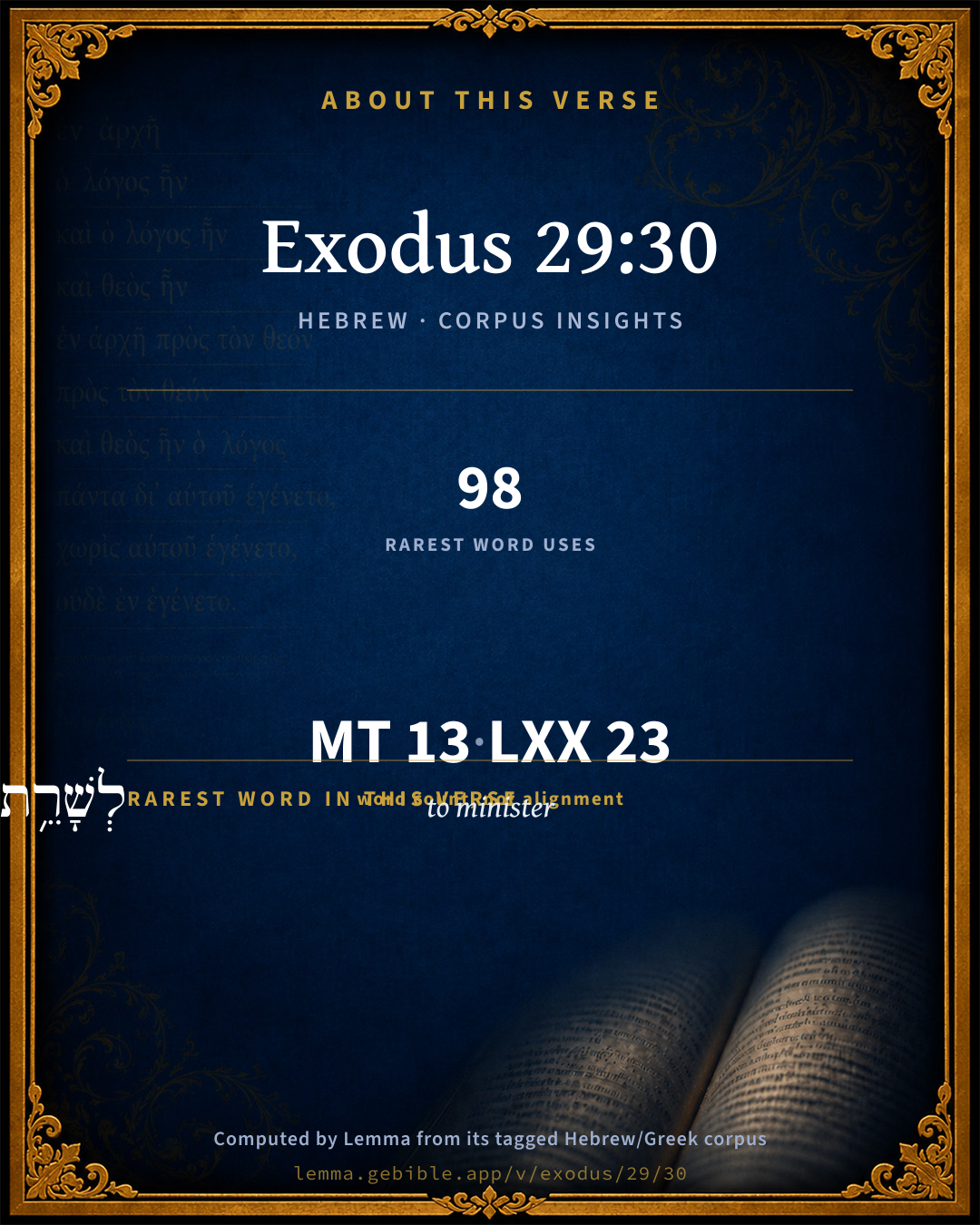
לְשָׁרֵ֥ת
shârath
H8334
“to minister”
Preposition + Verb, Piel, Infinitive Construct
Part of Speech
Preposition + Verb
Stem
Piel
Form
Infinitive Construct
Full BDB Definition

Origin: a primitive root

TWOT: 2472

(Piel) to minister, serve, minister to
  1. שִׁבְעַ֣ת shebaʻ H7651 “seven” Adjective, Cardinal number, Masculine, Singular, Construct
  2. יָמִ֗ים yôwm H3117 “days” Noun, Common, Masculine, Plural, Absolute
  3. יִלְבָּשָׁ֧ם lâbash H3847 “to clothe · them” Verb, Qal, Imperfect, 3rd Person, Masculine, Singular + Suffix, Personal, 3rd Person, Masculine, Plural
  4. הַכֹּהֵ֛ן kôhên H3548 “the · priest” Particle, Definite Article + Noun, Common, Masculine, Singular, Absolute
  5. תַּחְתָּ֖יו tachath H8478 “under · him” Preposition + Suffix, Personal, 3rd Person, Masculine, Singular
  6. מִבָּנָ֑יו bên H1121 “from · sons · his” Preposition + Noun, Common, Masculine, Plural, Construct + Suffix, Personal, 3rd Person, Masculine, Singular
  7. אֲשֶׁ֥ר ʼăsher H834 “which” Particle, Relative
  8. יָבֹ֛א bôwʼ H935 “to enter” Verb, Qal, Imperfect, 3rd Person, Masculine, Singular
  9. אֶל ʼêl H413 “to” Preposition
  10. אֹ֥הֶל ʼôhel H168 “tent of” Noun, Common, Masculine, Singular, Construct
  11. מוֹעֵ֖ד môwʻêd H4150 “appointed time” Noun, Common, Masculine, Singular, Absolute
  12. בַּקֹּֽדֶשׁ qôdesh H6944 “in/at the · holiness” Preposition, Determined + Noun, Common, Masculine, Singular, Absolute

About this verse

These counts appear in no published source. They are computed here, from the morphology-tagged text and Lemma’s own curated glosses. What Lemma adds →

13
words
13
distinct lemmas
Pentateuch
section

Grammatical profile

  • 3 verbs
  • 6 nouns
  • 1 adjective
  • 2 prepositions
  • 1 particle

Verb forms

  • יִלְבָּשָׁ֧ם Qal · Imperfect
  • יָבֹ֛א Qal · Imperfect
  • לְשָׁרֵ֥ת Piel · Infinitive Construct

Hebrew & Septuagint length

In English translation the verse runs 28 words from the Hebrew and 27 from the Septuagint (LXX English) — closely comparable.

A rough comparison of the two English renderings, which tokenize alike — not a word-level alignment.

Word counts can differ between the Hebrew and the Greek without any difference in meaning — e.g. the Hebrew direct-object marker אֵת has no separate Greek word, and Greek often adds the article ὁ.

In the original languages it is 13 Hebrew tokens and 23 Greek tokens — but the two are counted differently (Hebrew bundles its prefixes and suffixes into one token; the Greek is in lemma form), so that isn’t a like-for-like length.

Cross-references

14

Topical passages linked to Exodus 29:30 in the Treasury of Scripture Knowledge — connected by theme and wording, ordered by reader-vote popularity; previews shown in the World English Bible.

  • Numbers 20:28 Moses stripped Aaron of his garments, and put them on Eleazar his son; and Aaron died there on the top of the mountain: and Moses and Eleazar came down from the mountain.
  • Genesis 8:10 He stayed yet another seven days; and again he sent forth the dove out of the ark.
  • Genesis 8:12 He stayed yet another seven days, and sent forth the dove; and she didn't return to him any more.
  • Exodus 12:15 Seven days shall you eat unleavened bread; even the first day you shall put away yeast out of your houses, for whoever eats leavened bread from the first day until the seventh day, that soul shall be cut off from Israel.
  • Exodus 29:35 "Thus shall you do to Aaron, and to his sons, according to all that I have commanded you. Seven days shall you consecrate them.
  • Leviticus 8:33–35 You shall not go out from the door of the Tent of Meeting seven days, until the days of your consecration are fulfilled: for he shall consecrate you seven days.
  • Leviticus 9:1 It happened on the eighth day, that Moses called Aaron and his sons, and the elders of Israel;
  • Leviticus 9:8 So Aaron drew near to the altar, and killed the calf of the sin offering, which was for himself.
  • Leviticus 12:2–3 "Speak to the children of Israel, saying, 'If a woman conceives, and bears a male child, then she shall be unclean seven days; as in the days of her monthly period she shall be unclean.
  • Leviticus 13:5 The priest shall examine him on the seventh day, and, behold, if in his eyes the plague is arrested, and the plague hasn't spread in the skin, then the priest shall isolate him for seven more days.
  • Joshua 6:14–15 The second day they compassed the city once, and returned into the camp: so they did six days.
  • Ezekiel 43:26 Seven days shall they make atonement for the altar and purify it; so shall they consecrate it.
  • Acts 20:6–7 We sailed away from Philippi after the days of Unleavened Bread, and came to them at Troas in five days, where we stayed seven days.
  • Hebrews 7:26 For such a high priest was fitting for us: holy, guiltless, undefiled, separated from sinners, and made higher than the heavens;

Cross-references courtesy of OpenBible.info (CC BY 4.0).

Hebrew and Greek witnesses Masoretic Hebrew ↔ Greek Septuagint

The same verse in the two great witnesses to the Old Testament, shown verse-for-verse.

These are two independent witnesses, not word-aligned to each other, and the Septuagint is shown in lemma (dictionary) form.

Hebrew Exodus 29:30 Masoretic · Westminster Leningrad Codex

שִׁבְעַ֣ת יָמִ֗ים יִלְבָּשָׁ֧ם הַכֹּהֵ֛ן תַּחְתָּ֖יו מִבָּנָ֑יו אֲשֶׁ֥ר יָבֹ֛א אֶל אֹ֥הֶל מוֹעֵ֖ד לְשָׁרֵ֥ת בַּקֹּֽדֶשׁ

Seven days shall the son who is priest in his place put them on, when he comes into the tent of meeting to minister in the holy place.

World English Bible · Public Domain

Greek LXX Exodus 29:30 Septuagint · lemma form

ἑπτά ἡμέρα ἐνδύω αὐτός ὁ ἱερεύς ὁ ἀντί αὐτός ὁ υἱός αὐτός ὅς εἰςἔρχομαι εἰς ὁ σκηνή ὁ μαρτύριον λειτουργέω ἐν ὁ ἅγιος

The priest his successor from among his sons who shall go into the tabernacle of witness to minister in the holies, shall put them on seven days.

LXX2012 (modern English Septuagint) · Public Domain

Hebrew: Westminster Leningrad Codex (CC BY 4.0). Greek: Septuagint (public domain); English from LXX2012 (modern English Septuagint) (Public Domain). How the Septuagint differs from the Hebrew →

Targum (Aramaic paraphrase)

2

The Targum is the ancient Jewish Aramaic paraphrase of the Hebrew Scriptures — an interpretive translation, not the Hebrew text itself. Onkelos (literal) and Pseudo-Jonathan (expansive) render the Torah, and Jonathan the Prophets. Coverage is partial: where no permissively-licensed English translation exists for a verse, only the Aramaic is shown. This is verse-level text, not a word-by-word alignment to the Hebrew.

  1. Targum Onkelos Torah (Genesis–Deuteronomy)
    שִׁבְעַת יוֹמִין יַלְבֵּשִׁנוּן כַּהֲנָא תְּחוֹתוֹהִי מִבְּנוֹהִי דִי יֵעוֹל לְמַשְׁכַּן זִמְנָא לְשַׁמָשָׁא בְקוּדְשָׁא:

    (no public-domain English translation for this verse)

    Targum Onkelos — Aramaic: “Onkelos Genesis” (public domain); “Onkelos Exodus” (public domain); “Onkelos Leviticus” (public domain); “Onkelos Numbers” (public domain); “Onkelos Deuteronomy” (public domain). English: “Sefaria Community Translation” (CC0 1.0 (public-domain dedication)); “J.W. Etheridge. The Targums of Onkelos and Jonathan Ben Uzziel on the Pentateuch. London: Longmans, Green, 1862” (public domain). Text via Sefaria.

  2. Targum Pseudo-Jonathan Torah (Genesis–Deuteronomy)
    שׁוּבְעָא יוֹמִין יַלְבְּשִׁינוּן כַּהֲנָא דִיקוּם בַּתְרוֹי מִן בְּנוֹי וְלָא מִן לֵיוָאֵי בִּזְמַן דִּיעוֹלִין לְמַשְׁכַּן זִימְנָא לְשַׁמָּשָׁא בְּקוּדְשָׁא

    Seven days shall the priest wear them, who ariseth after him from his sons, but not from the Levites, at the time when he entereth into the tabernacle of ordinance to minister in the sanctuary.

    Targum Pseudo-Jonathan — Aramaic: “Targum Jonathan on Genesis” (public domain); “Targum Jonathan on Exodus” (public domain); “Targum Jonathan on Leviticus” (public domain); “Targum Jonathan on Numbers” (public domain); “Targum Jonathan on Deuteronomy” (public domain). English: “The Targum of Jonathan ben Uzziel, trans. J. W. Etheridge, London, 1862” (public domain). Text via Sefaria.

Commentary

Notes on Exodus 29:30 from classic Christian and Jewish commentators (each source and its license shown beneath its notes). The classic Christian expositions comment on the surrounding passage and are grouped to its opening verse, so a note may address several verses; the Jewish commentaries on the Tanakh (Rashi and others) are per-verse, so they appear only where the commentator wrote on this verse.

Lemma curates 59 commentaries, every one of them public domain or Creative Commons licensed, each selected and text-cleaned for this edition rather than reprinted as found. About our sources →

Trapp's Complete Commentary

John Trapp

Exo 29:30 [And] that son that is priest in his stead shall put them on seven days, when he cometh into the tabernacle of the congregation to minister in the holy [place].

Ver. 30. And that son.] There were garments but for one: there is but one Mediator, the man Christ Jesus.

John Trapp, A Commentary or Exposition upon All the Books of the Old and New Testament (1647–1656) — public domain. Text from a community e-Sword module.

Tyndale Open Study Notes

Tyndale Open Resources

29:30 The descendant who succeeds him: Each succeeding high priest was to be ordained in the same way.

Tyndale Open Study Notes — © Tyndale Open Resources, licensed CC BY-SA 4.0. Text via the HelloAO Bible API.

Adam Clarke's Commentary

Verse 30. Seven days] The priest in his consecration was to abide seven days and nights at the door of the tabernacle, keeping the Lord's watch. See Le 8:33, c. The number seven is what is called among the Hebrews a number of perfection and it is often used to denote the completion, accomplishment, fulness, or perfection of a thing, as this period contained the whole course of that time in which God created the world, and appointed the day of rest. As this act of consecration lasted seven days, it signified a perfect consecration: and intimated to the priest that his whole body and soul, his time and talents, should be devoted to the service of God and his people.

The number seven, which was a sacred number among the Hebrews, was conveyed from them down to the Greeks by means of the Egyptian philosophy, from which they borrowed most of their mysteries; and it is most likely that the opinion which the Greeks give is the same that the original framers of the idea had. That there was some mystical idea attached to it, is evident from its being made the number of perfection among the Hebrews. Philo and Josephus say that the Essenes, an ancient sect of the Jews, held it sacred "because it results from the side of a square added to those of a triangle." But what meaning does this convey? A triangle, or triad, according to the Pythagoreans, who borrowed their systems from the Egyptians, who borrowed from the Jews, was the emblem of wisdom, as consisting of beginning (Monad,) middle (Duad,) and end (Triad itself;) so wisdom consists of three parts - experience of the past, attention to the present, and judgment of the future. It is also the most penetrating of all forms, as being the shape of the wedge; and indestructibility is essential to it, as a triangle can never be destroyed. From those three properties it was the emblem of spirit. The square, solid, and tetrad, by the same system were interchangeable signs. Now a square is the representation of a solid or matter, and thus the number seven contains within itself the properties of both the triangle or solid, and the square or tetrad, i.e., is all emblem of body and spirit; comprehends both the intellectual and natural world; embraces the idea of GOD, the chief of spirits or essences; and all nature, the result of his power; thus a very fit emblem of perfection. It is perhaps in this way that we must explain what CICERO, Tusc. Quest., lib. i., cap. 10, says of the number seven, where he calls it the knot and cement of all things; as being that by which the natural and spiritual world are comprehended in one idea. Thus the ancient philosophers spoke of numbers, themselves being the best judges of their own meaning.

Adam Clarke's Commentary on the Bible (1810–1826) — public domain. Text from a community e-Sword/MySword module.

The Cambridge Bible for Schools and Colleges

gen. ed. J. J. S. Perowne

30. Seven days] to be explained from v. 35.

when he cometh] i.e. first cometh. More clearly, who is to come.

The Cambridge Bible for Schools and Colleges (gen. ed. J. J. S. Perowne; Cambridge University Press, 1878–1918) — public domain. Text from a community e-Sword module.

John Gill's Exposition

And that son that is priest in his stead,.... The Targum of Jonathan is,"who shall rise after him of his sons, not of the Levites;''for the high priest was to be of the family of Aaron, a descendant of his; it was not enough that he was of the tribe of Levi, but he must descend from Aaron, either in the line of Eleazar or of Ithamar:

shall put them on seven days; the next successor was to wear the garments seven days running:

when he cometh into the tabernacle of the congregation to minister in the holy place; to offer sacrifice in the court of the tabernacle, on the altar of burnt offering, and to offer incense on the altar of incense, and to trim the lamps of the candlestick, and to put the shewbread on the table.

John Gill's Exposition of the Whole Bible (1746–1763) — public domain (CC PDM 1.0). Text via the HelloAO Bible API.

Haydock's Catholic Bible Commentary

Days. During which he could not leave the sanctuary, Leviticus viii. 33. On each day, the aforesaid ceremonies were to be repeated, ver. 35.

George Leo Haydock (1774–1849), Haydock's Catholic Family Bible and Commentary, 1859 edition — public domain. Excludes Psalms (Douay-Rheims chapter numbering differs from Protestant) and Deuterocanonical books (Catholic canon only).

Matthew Poole's English Annotations

For so long the solemnity of the consecration lasted, Exo 29:35.

In the holy place; both that strictly so called, and in the most holy place; for as none could go into the most holy place except the high priest, so there were some things to be done in the holy place which none but he could do. See Lev 4:7,8.

Matthew Poole's English Annotations on the Holy Bible (1683–1685) — public domain. Text from a community e-Sword/MySword module.

Rashi

Rabbi Shlomo Yitzchaki (Rashi)

שבעת ימים SEVEN DAYS in succession, on such a High Priest’s installation,

ילבשם הכהן THE PRIEST SHALL PUT THEM ON — i. e. he who, from among his sons, will rise up in his stead in the high-priesthood at the time when they will appoint him to be High Priest.

אשר יבא אל אהל מועד WHO WILL COME INTO THE APPOINTED TENT — These words qualify the word הכהן so that it refers to that priest who is designated to enter into the innermost part (the words לפני ולפנים in the Rashi text correspond to בקדש in the Biblical text) of the Sanctuary on the Day of Atonement — and this must mean the High Priest, since the sacrificial service on the Day of Atonement was not valid unless performed by him (Yoma 73a).

תחתיו מבניו IN HIS STEAD FROM AMONG HIS SONS — This informs us that if the High Priest has a son who can fill his place they shall appoint him High Priest in his stead (Sifra, Acharei Mot, Chapter 8 5; cf. Rashi on Yoma 72b).

[הכהן תחתיו מבניו — From here (from this phraseology) we have a proof that the word הכהן is everywhere a participle — meaning “he who is actually acting as the officiant”; therefore the tonic accent תביר on the word הכהן connects it with the word following it.].

Rashi on the Tanakh — English translations: “The Judaica Press complete Tanach with Rashi, translated by A. J. Rosenberg” (CC BY 4.0); “Pentateuch with Rashi's commentary by M. Rosenbaum and A.M. Silbermann, 1929-1934” (public domain); “The Metsudah Tanach series, Lakewood, N.J” (CC BY 4.0); and “The Book of Joshua, Metsudah Publications, 1997” (CC BY 4.0). Text via Sefaria.

Lesson kit

Teaching starters — assembled from the data on this page, not authored interpretation. Every prompt links to the verse data it draws on. Edit before teaching.

Exodus, in the Pentateuch, opens this verse with 13 words (13 distinct Hebrew lemmas). Its most distinctive word is shârath (“to minister”). A historical commentator’s framing appears above. Read the whole chapter for the surrounding context.

Discussion questions

  1. What does “to minister” (shârath) contribute to the verse as a whole?
  2. Numbers 20:28 shares this passage’s theme. How do the two illuminate each other?
  3. These translations render this verse differently; the difference is in the English rendering, not the original. What questions does that raise?
  4. The verb «יִלְבָּשָׁ֧ם» is Qal Imperfect. How does its form color the action?
  5. Reading how Trapp's Complete Commentary and Tyndale Open Study Notes read this verse, where do the two commentators agree and where do they part?

Things to notice

Reading settings

Reading text

Shown beneath each verse's original-language words.

Old Testament
Old Testament edition

Read the OT as the Masoretic Hebrew (MT) or the Greek Septuagint (LXX).

English shown for the Greek Septuagint (in the Hebrew ↔ Greek comparison).

Comparing translations? Open the Compare panel on any verse page to stack up to four side by side.