Exodus 13:7

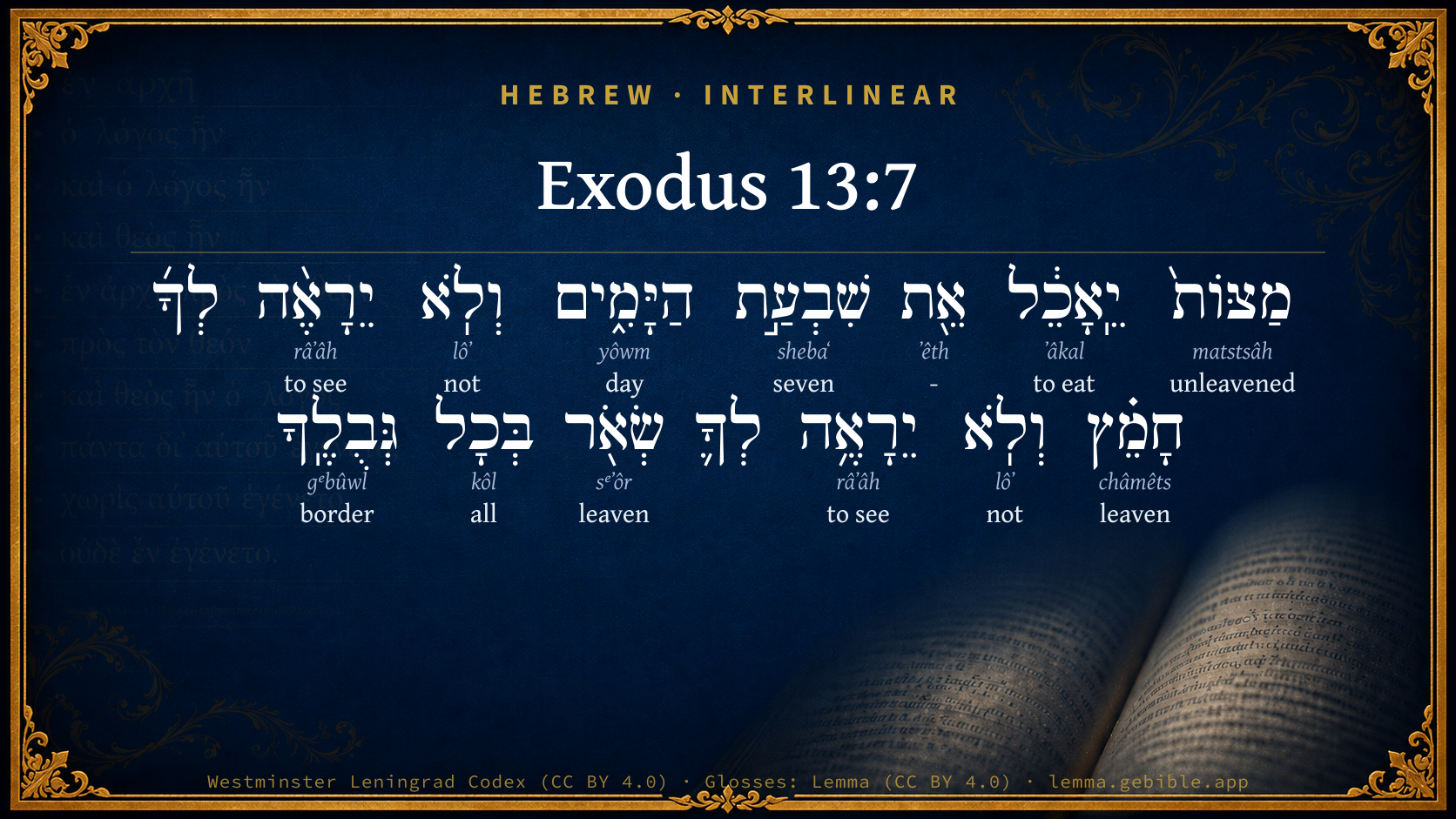
Hebrew (Westminster Leningrad Codex) Exodus 13:7 appears in the Hebrew Old Testament. The text above is from the Westminster Leningrad Codex. Each word links to its Strong’s number, a concise gloss, and parsing drawn from the Open Scriptures Hebrew Bible morphology. Click any word for its full Brown-Driver-Briggs (BDB) entry.
Download image
Cite this verse

Exodus 13:7 (World English Bible). Public Domain. Lemma interlinear Bible study tool, https://lemma.gebible.app/v/exodus/13/7.

Show BibTeX & RIS
BibTeX
RIS
English Translation
Unleavened bread shall be eaten throughout the seven days; and no leavened bread shall be seen with you, neither shall there be yeast seen with you, in all your borders.
World English Bible · Public Domain
Download a study sheet

One document with this verse’s original text, its word-by-word gloss line, the meaning frame, cross-references with their text, attributed commentary, and full source and license credits — printable, and it pastes into notes with its structure intact.

This verse Autodidact and up

Study sheet (.html) Plain text (.txt)

A passage Seminary Student

Up to 50 verses in one chapter. A passage sheet keeps up to 6 commentary sources and 12 cross-references per verse, in the order this page ranks them, and says so on the sheet whenever that leaves anything out. Ask for a single verse and you get the Autodidact verse sheet above.

Everything on this page stays free to read, with no account — the sheet is a download of what is already on screen, not access to it.

Want to remove ads? Support Godless Engineer
Compare translations 3

The same verse in 3 English versions, stacked beneath the original-language interlinear above. Click any original word for its lexicon entry.

Each is an independent rendering of the whole verse — the interlinear is not word-aligned to these translations.

Highlighted words mark where these versions differ — a whole-verse word diff, not a word-by-word alignment.

  • World English Bible Public Domain
    Unleavened bread shall be eaten throughout the seven days; and no leavened bread shall be seen with you, neither shall there be yeast seen with you, in all your borders.
  • King James Version Public Domain
    Unleavened bread shall be eaten seven days; and there shall no leavened bread be seen with thee, neither shall there be leaven seen with thee in all thy quarters.
  • unfoldingWord Literal Text CC BY-SA 4.0
    Unleavened bread shall be eaten throughout the seven days, and leavened bread may not be seen among you. And yeast may not be seen among you within any of your borders.

unfoldingWord Literal Text — © unfoldingWord, licensed CC BY-SA 4.0. Word-aligned USFM3 via Door43 (git.door43.org/unfoldingWord/en_ult).

Versions to compare (up to 4)

3 of 4 selected

Show all 18 translations

Every available English version of this verse, each an independent rendering of the whole verse.

  • World English Bible Public Domain
    Unleavened bread shall be eaten throughout the seven days; and no leavened bread shall be seen with you, neither shall there be yeast seen with you, in all your borders.
  • Berean Standard Bible Public Domain
    Unleavened bread shall be eaten during those seven days. Nothing leavened may be found among you, nor shall leaven be found anywhere within your borders.
  • Majority Standard Bible Public Domain
    Unleavened bread shall be eaten during those seven days. Nothing leavened may be found among you, nor shall leaven be found anywhere within your borders.
  • King James Version Public Domain
    Unleavened bread shall be eaten seven days; and there shall no leavened bread be seen with thee, neither shall there be leaven seen with thee in all thy quarters.
  • American Standard Version (1901) Public Domain
    Unleavened bread shall be eaten throughout the seven days; and there shall no leavened bread be seen with thee, neither shall there be leaven seen with thee, in all thy borders.
  • Revised Version (1885) Public Domain
    Unleavened bread shall be eaten throughout the seven days; and there shall no leavened bread be seen with thee, neither shall there be leaven seen with thee, in all thy borders.
  • Geneva Bible (1599) Public Domain
    Vnleauened bread shall bee eaten seuen dayes, and there shall no leauened bread be seene with thee, nor yet leauen be seene with thee in all thy quarters.
  • Douay-Rheims (1899) Public Domain
    Unleavened bread shall you eat seven days: there shall not be seen any thing leavened with thee, nor in all thy coasts.
  • Young's Literal Translation Public Domain
    unleavened things are eaten the seven days, and any thing fermented is not seen with thee; yea, leaven is not seen with thee in all thy border.
  • Literal Standard Version CC BY-SA 4.0
    unleavened things are eaten the seven days, and anything fermented is not seen with you; indeed, leaven is not seen with you in all your border.
  • Unlocked Literal Bible CC BY-SA 4.0
    Bread without yeast must be eaten throughout the seven days; no bread with yeast may be seen among you. No yeast may be seen with you within any of your borders.
  • unfoldingWord Literal Text CC BY-SA 4.0
    Unleavened bread shall be eaten throughout the seven days, and leavened bread may not be seen among you. And yeast may not be seen among you within any of your borders.
  • Darby Bible Public Domain
    Unleavened bread shall be eaten the seven days; and leavened bread shall not be seen with thee, neither shall there be leaven seen with thee in all thy borders.
  • World Messianic Bible Public Domain
    Unleavened bread shall be eaten throughout the seven days; and no leavened bread shall be seen with you. No yeast shall be seen with you, within all your borders.
  • Webster's Bible Public Domain
    Unleavened bread shall be eaten seven days: and there shall no leavened bread be seen with thee, neither shall there be leaven seen with thee in all thy quarters.
  • Free Bible Version CC BY-SA 4.0
    Only bread without yeast is to be eaten during those seven days. You are not to have any yeast, in fact there is to be no yeast in any place where you live.
  • Bible in Basic English Public Domain
    Unleavened cakes are to be your food through all the seven days; let no leavened bread be seen among you, or any leaven, in any part of your land.
  • JPS Tanakh (1917) Public Domain
    Unleavened bread shall be eaten throughout the seven days; and there shall no leavened bread be seen with thee, neither shall there be leaven seen with thee, in all thy borders.

Literal Standard Version (2020), Covenant Press — licensed CC BY-SA 4.0. Text via the HelloAO Bible API (eBible.org). Unlocked Literal Bible (unfoldingWord) — licensed CC BY-SA 4.0. Text via the HelloAO Bible API (eBible.org). unfoldingWord Literal Text — © unfoldingWord, licensed CC BY-SA 4.0. Word-aligned USFM3 via Door43 (git.door43.org/unfoldingWord/en_ult). Free Bible Version, Dr. Jonathan Gallagher — licensed CC BY-SA 4.0. Text via the HelloAO Bible API (eBible.org).

Word by word

More ways to search: Search by grammar → Find every occurrence → Compare this word →

Practice this passage: Drill this verse → Learn its vocabulary →

שְׂאֹ֖ר
sᵉʼôr
H7603
“leaven”
Noun, Common, Masculine, Singular, Absolute
Part of Speech
Noun
Type
Common
Gender
Masculine
Number
Singular
State
Absolute
Full BDB Definition

Origin: from H7604

TWOT: 2229a

leaven
  1. מַצּוֹת֙ matstsâh H4682 “unleavened bread” Noun, Common, Feminine, Plural, Absolute
  2. יֵֽאָכֵ֔ל ʼâkal H398 “to eat” Verb, Niphal, Imperfect, 3rd Person, Masculine, Singular
  3. אֵ֖ת ʼêth H853 “-” Particle, Direct Object
  4. שִׁבְעַ֣ת shebaʻ H7651 “seven” Adjective, Cardinal number, Masculine, Singular, Construct
  5. הַיָּמִ֑ים yôwm H3117 “the · days” Particle, Definite Article + Noun, Common, Masculine, Plural, Absolute
  6. וְלֹֽא lôʼ H3808 “and · not” Conjunction + Particle, Negative
  7. יֵרָאֶ֨ה râʼâh H7200 “to see” Verb, Niphal, Imperfect, 3rd Person, Masculine, Singular
  8. חָמֵ֗ץ châmêts H2557 “leaven” Noun, Common, Masculine, Singular, Absolute
  9. וְלֹֽא lôʼ H3808 “and · not” Conjunction + Particle, Negative
  10. יֵרָאֶ֥ה râʼâh H7200 “to see” Verb, Niphal, Imperfect, 3rd Person, Masculine, Singular
  11. בְּכָל kôl H3605 “in/at · all of” Preposition + Noun, Common, Masculine, Singular, Construct
  12. גְּבֻלֶֽךָ gᵉbûwl H1366 “border · your” Noun, Common, Masculine, Singular, Construct + Suffix, Personal, 2nd Person, Masculine, Singular

About this verse

These counts appear in no published source. They are computed here, from the morphology-tagged text and Lemma’s own curated glosses. What Lemma adds →

15
words
11
distinct lemmas
Pentateuch
section

Notable vocabulary

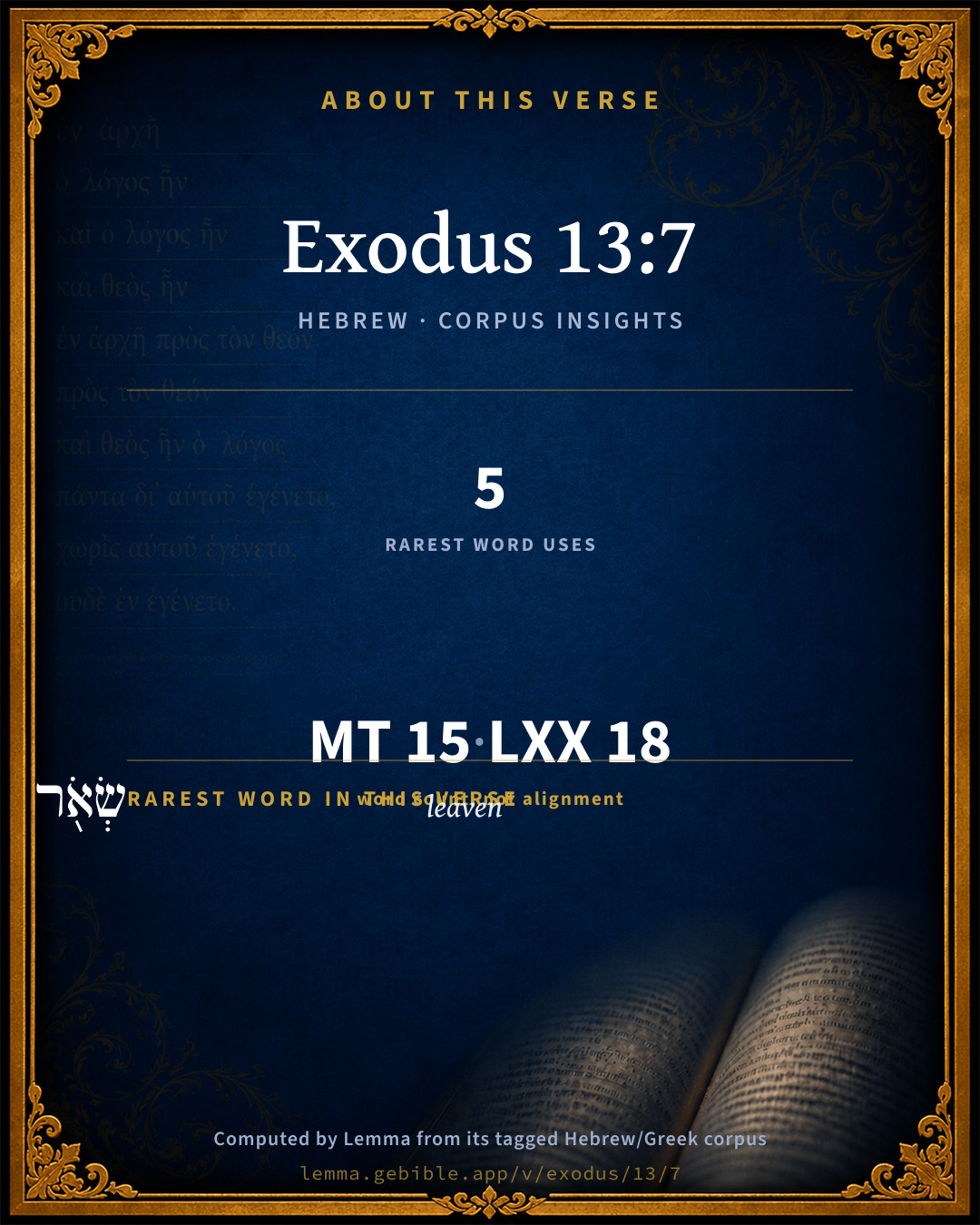
The rarest word here is שְׂאֹ֖ר leaven H7603 — appearing just 5 times in the whole Hebrew Bible.

Shared distinctive vocabulary

שְׂאֹ֖ר leaven H7603 occurs in 5 verses of the Hebrew Bible. Also found in:

Grammatical profile

  • 3 verbs
  • 6 nouns
  • 1 adjective
  • 2 prepositions
  • 3 particles

Verb forms

  • יֵֽאָכֵ֔ל Niphal · Imperfect
  • יֵרָאֶ֨ה Niphal · Imperfect
  • יֵרָאֶ֥ה Niphal · Imperfect

Repetition

Words recur within this verse — often emphatic in Hebrew:

  • יֵרָאֶ֨ה to see H7200 ×2
  • וְלֹֽא not H3808 ×2

Hebrew & Septuagint length

In English translation the verse runs 30 words from the Hebrew and 23 from the Septuagint (LXX English) — closely comparable.

A rough comparison of the two English renderings, which tokenize alike — not a word-level alignment.

Word counts can differ between the Hebrew and the Greek without any difference in meaning — e.g. the Hebrew direct-object marker אֵת has no separate Greek word, and Greek often adds the article ὁ.

In the original languages it is 15 Hebrew tokens and 18 Greek tokens — but the two are counted differently (Hebrew bundles its prefixes and suffixes into one token; the Greek is in lemma form), so that isn’t a like-for-like length.

Cross-references

2

Topical passages linked to Exodus 13:7 in the Treasury of Scripture Knowledge — connected by theme and wording, ordered by reader-vote popularity; previews shown in the World English Bible.

  • Exodus 12:19 Seven days shall there be no yeast found in your houses, for whoever eats that which is leavened, that soul shall be cut off from the congregation of Israel, whether he be a foreigner, or one who is born in the land.
  • Matthew 16:6 Jesus said to them, "Take heed and beware of the yeast of the Pharisees and Sadducees."

Cross-references courtesy of OpenBible.info (CC BY 4.0).

Hebrew and Greek witnesses Masoretic Hebrew ↔ Greek Septuagint

The same verse in the two great witnesses to the Old Testament, shown verse-for-verse.

These are two independent witnesses, not word-aligned to each other, and the Septuagint is shown in lemma (dictionary) form.

Hebrew Exodus 13:7 Masoretic · Westminster Leningrad Codex

מַצּוֹת֙ יֵֽאָכֵ֔ל אֵ֖ת שִׁבְעַ֣ת הַיָּמִ֑ים וְלֹֽא יֵרָאֶ֨ה לְךָ֜ חָמֵ֗ץ וְלֹֽא יֵרָאֶ֥ה לְךָ֛ שְׂאֹ֖ר בְּכָל גְּבֻלֶֽךָ

Unleavened bread shall be eaten throughout the seven days; and no leavened bread shall be seen with you, neither shall there be yeast seen with you, in all your borders.

World English Bible · Public Domain

Greek LXX Exodus 13:7 Septuagint · lemma form

ἄζυμος ἐσθίω ὁ ἑπτά ἡμέρα οὐ ὁράω σύ ζυμωτός οὐδέ εἰμί σύ ζύμη ἐν πᾶς ὁ ὅριον σύ

Seven days shall you⌃ eat unleavened bread; nothing leavened shall be seen with you, neither shall you have leaven in all your borders.

LXX2012 (modern English Septuagint) · Public Domain

Hebrew: Westminster Leningrad Codex (CC BY 4.0). Greek: Septuagint (public domain); English from LXX2012 (modern English Septuagint) (Public Domain). How the Septuagint differs from the Hebrew →

Targum (Aramaic paraphrase)

2

The Targum is the ancient Jewish Aramaic paraphrase of the Hebrew Scriptures — an interpretive translation, not the Hebrew text itself. Onkelos (literal) and Pseudo-Jonathan (expansive) render the Torah, and Jonathan the Prophets. Coverage is partial: where no permissively-licensed English translation exists for a verse, only the Aramaic is shown. This is verse-level text, not a word-by-word alignment to the Hebrew.

  1. Targum Onkelos Torah (Genesis–Deuteronomy)
    פַּטִיר יִתְאֲכֵל יָת שִׁבְעַת יוֹמִין וְלָא יִתְחֲזֵי לָךְ חֲמִיעַ וְלָא יִתְחֲזֵי לָךְ חֲמִיר בְּכָל תְּחוּמָךְ:

    (no public-domain English translation for this verse)

    Targum Onkelos — Aramaic: “Onkelos Genesis” (public domain); “Onkelos Exodus” (public domain); “Onkelos Leviticus” (public domain); “Onkelos Numbers” (public domain); “Onkelos Deuteronomy” (public domain). English: “Sefaria Community Translation” (CC0 1.0 (public-domain dedication)); “J.W. Etheridge. The Targums of Onkelos and Jonathan Ben Uzziel on the Pentateuch. London: Longmans, Green, 1862” (public domain). Text via Sefaria.

  2. Targum Pseudo-Jonathan Torah (Genesis–Deuteronomy)
    פַּטִּירֵי יִתְאָכֵיל יַת שׁוּבְעָא יוֹמִין וְלָא יִתְחָמֵי לָךְ חָמִיעַ וְלָא יִתְחָמֵי לָךְ חֲמִיר בְּכָל תְּחוּמָךְ

    Unleavened cakes shall be eaten seven days, and nothing leavened shall be seen with thee, nor leaven itself be seen with thee in all thy borders.

    Targum Pseudo-Jonathan — Aramaic: “Targum Jonathan on Genesis” (public domain); “Targum Jonathan on Exodus” (public domain); “Targum Jonathan on Leviticus” (public domain); “Targum Jonathan on Numbers” (public domain); “Targum Jonathan on Deuteronomy” (public domain). English: “The Targum of Jonathan ben Uzziel, trans. J. W. Etheridge, London, 1862” (public domain). Text via Sefaria.

Commentary

Notes on Exodus 13:7 from classic Christian and Jewish commentators (each source and its license shown beneath its notes). The classic Christian expositions comment on the surrounding passage and are grouped to its opening verse, so a note may address several verses; the Jewish commentaries on the Tanakh (Rashi and others) are per-verse, so they appear only where the commentator wrote on this verse.

Lemma curates 59 commentaries, every one of them public domain or Creative Commons licensed, each selected and text-cleaned for this edition rather than reprinted as found. About our sources →

Trapp's Complete Commentary

John Trapp

Exo 13:7 Unleavened bread shall be eaten seven days; and there shall no leavened bread be seen with thee, neither shall there be leaven seen with thee in all thy quarters.

Ver. 7. {See Trapp on "Exo 12:19"} {See Trapp on "Exo 12:20"}

John Trapp, A Commentary or Exposition upon All the Books of the Old and New Testament (1647–1656) — public domain. Text from a community e-Sword module.

John Gill's Exposition

Unleavened bread shall be eaten seven days,.... From the evening of the fourteenth day, to the evening of the twenty first, Exo 12:18, this is very express as before, that not only they were to abstain from leaven, but that they were obliged to eat unleavened bread; and as for the cakes of eggs and sugar the Jews now use, these, as Leo Modeua says (z), are for those that are dainty and of tender stomachs and such as are sick, who eat unleavened bread also:

and there shall no leavened bread be seen with thee, neither shall there be leaven seen with thee in all thy quarters: See Gill on Exo 12:15 and the above mentioned writer says (a),"they begin before the passover, with all the diligence and care they can, to put away all leaven, or anything that hath had leaven in it, out of their houses, and out of their power; searching all their cupboards and bins, and cleansing the whole house and whiting it all over; and they provide themselves also of new utensils for their kitchen and table; or else they new make the old again, and scour them well; or else they have a select number of vessels set apart for the use of the passover only, that so they may be certainly assured that they use not anything during those eight days, that hath had leaven in it:''and Aben Ezra upon the place says, that the sense of it is, that the Israelites ought not to suffer any to sojourn in any place subject to them, but on this condition, that they abstain from leavened bread at the time of the passover, and this he takes to be the meaning of the phrase, "in all thy quarters or borders".

(z) History of the Rites, &c. of the Jews, par. 3. c. 3. sect. 5. (a) Ib. sect. 4.

John Gill's Exposition of the Whole Bible (1746–1763) — public domain (CC PDM 1.0). Text via the HelloAO Bible API.

The Pulpit Commentary

Here again the injunctions are mere repetitious of commands already given in ch. 12. (See verses 15 and 19.) Repetition was no doubt had recourse to in order to deepen the impression.

The Pulpit Commentary (1880–1919), ed. H.D.M. Spence-Jones & Joseph S. Exell — public domain. Text from a community e-Sword module.

John Wesley's Explanatory Notes

There shall no leavened bread be seen in all thy quarters - Accordingly the Jews usage was, before the feast of the passover, to cast all the leavened bread out of their houses; either they burnt it, or buried it, or broke it small, and threw it into the wind; they searched diligently with lighted candles in all the corners of their houses, lest any leaven should remain. The strictness enjoined in this matter was designed,

1. To make the feast the more solemn, and consequently the more taken notice of by the children, who would ask, why is so much ado made?

2. To teach us how solicitous we should be to put away from us all sin.

John Wesley, Explanatory Notes Upon the Whole Bible (1754–1765) — public domain. Text via the GEBible commentary corpus.

Lesson kit

Teaching starters — assembled from the data on this page, not authored interpretation. Every prompt links to the verse data it draws on. Edit before teaching.

Exodus, in the Pentateuch, opens this verse with 15 words (11 distinct Hebrew lemmas). Its most distinctive word is sᵉʼôr (“leaven”). A historical commentator’s framing appears above. Read the whole chapter for the surrounding context.

Discussion questions

  1. What does “leaven” (sᵉʼôr) contribute to the verse as a whole?
  2. How does Exodus 12:15, which shares the word «leaven», read alongside this verse?
  3. What does the repetition of “to see” (2× in this one verse) do in this verse?
  4. The translations on this page render this verse differently — a whole-verse word diff, not a word-by-word alignment. What might account for the different wordings?
  5. «יֵֽאָכֵ֔ל» is a Niphal Imperfect verb. How does that grammatical form shape the action described?
  6. Compare how Trapp's Complete Commentary and John Gill's Exposition read this verse. Where do they agree or differ?

Things to notice

Reading settings

Reading text

Shown beneath each verse's original-language words.

Old Testament
Old Testament edition

Read the OT as the Masoretic Hebrew (MT) or the Greek Septuagint (LXX).

English shown for the Greek Septuagint (in the Hebrew ↔ Greek comparison).

Comparing translations? Open the Compare panel on any verse page to stack up to four side by side.