
Joshua 6:13

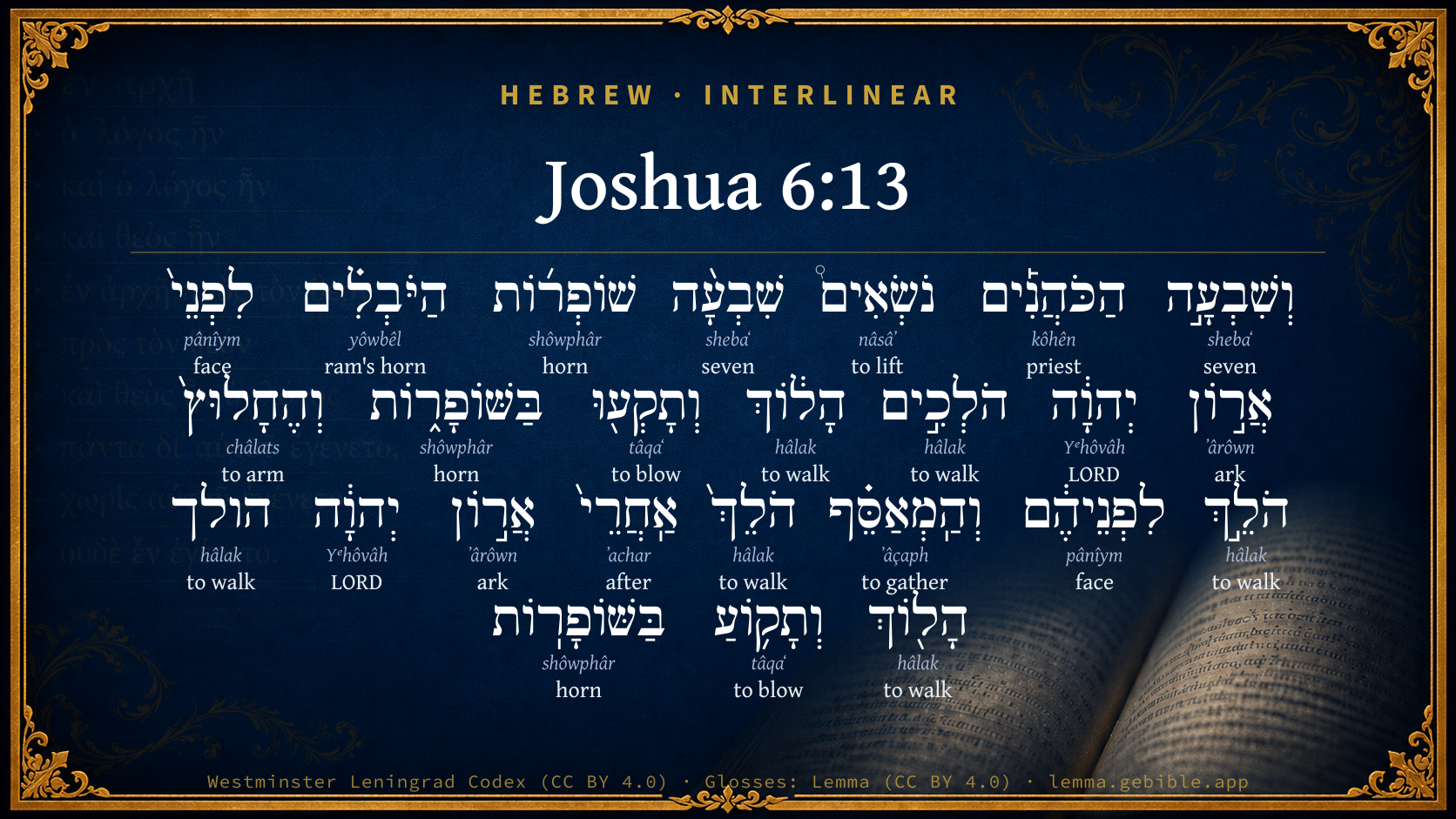
Hebrew (Westminster Leningrad Codex) Joshua 6:13 appears in the Hebrew Old Testament. The text above is from the Westminster Leningrad Codex. Each word links to its Strong’s number, a concise gloss, and parsing drawn from the Open Scriptures Hebrew Bible morphology. Click any word for its full Brown-Driver-Briggs (BDB) entry.
Download image
Cite this verse

Joshua 6:13 (World English Bible). Public Domain. Lemma interlinear Bible study tool, https://lemma.gebible.app/v/joshua/6/13.

Show BibTeX & RIS
BibTeX
RIS
English Translation
The seven priests bearing the seven trumpets of rams' horns before the ark of Yahweh went on continually, and blew the trumpets: and the armed men went before them; and the rearward came after the ark of Yahweh, [the priests] blowing the trumpets as they went.
World English Bible · Public Domain
Download a study sheet

One document with this verse’s original text, its word-by-word gloss line, the meaning frame, cross-references with their text, attributed commentary, and full source and license credits — printable, and it pastes into notes with its structure intact.

This verse Autodidact and up

Study sheet (.html) Plain text (.txt)

A passage Seminary Student

Up to 50 verses in one chapter. A passage sheet keeps up to 6 commentary sources and 12 cross-references per verse, in the order this page ranks them, and says so on the sheet whenever that leaves anything out. Ask for a single verse and you get the Autodidact verse sheet above.

Everything on this page stays free to read, with no account — the sheet is a download of what is already on screen, not access to it.

Want to remove ads? Support Godless Engineer
Compare translations 3

The same verse in 3 English versions, stacked beneath the original-language interlinear above. Click any original word for its lexicon entry.

Each is an independent rendering of the whole verse — the interlinear is not word-aligned to these translations.

Highlighted words mark where these versions differ — a whole-verse word diff, not a word-by-word alignment.

  • World English Bible Public Domain
    The seven priests bearing the seven trumpets of rams' horns before the ark of Yahweh went on continually, and blew the trumpets: and the armed men went before them; and the rearward came after the ark of Yahweh, [the priests] blowing the trumpets as they went.
  • King James Version Public Domain
    And seven priests bearing seven trumpets of rams' horns before the ark of the LORD went on continually, and blew with the trumpets: and the armed men went before them; but the rearward came after the ark of the LORD, the priests going on, and blowing with the trumpets.
  • unfoldingWord Literal Text CC BY-SA 4.0
    And the seven priests carrying the seven shofars of rams to the face of the Box of Yahweh walking, walking, and they blew on the shofars. And the armed walking to their faces, and the rearguard walking behind the Box of Yahweh, walking and blowing on the shofars.

unfoldingWord Literal Text — © unfoldingWord, licensed CC BY-SA 4.0. Word-aligned USFM3 via Door43 (git.door43.org/unfoldingWord/en_ult).

Versions to compare (up to 4)

3 of 4 selected

Show all 18 translations

Every available English version of this verse, each an independent rendering of the whole verse.

  • World English Bible Public Domain
    The seven priests bearing the seven trumpets of rams' horns before the ark of Yahweh went on continually, and blew the trumpets: and the armed men went before them; and the rearward came after the ark of Yahweh, [the priests] blowing the trumpets as they went.
  • Berean Standard Bible Public Domain
    And the seven priests carrying seven rams’ horns kept marching ahead of the ark of the LORD and blowing the horns. The armed troops went in front of them and the rear guard followed the ark of the LORD, while the horns kept sounding.
  • Majority Standard Bible Public Domain
    And the seven priests carrying seven rams’ horns kept marching ahead of the ark of the LORD and blowing the horns. The armed troops went in front of them and the rear guard followed the ark of the LORD, while the horns kept sounding.
  • King James Version Public Domain
    And seven priests bearing seven trumpets of rams' horns before the ark of the LORD went on continually, and blew with the trumpets: and the armed men went before them; but the rearward came after the ark of the LORD, the priests going on, and blowing with the trumpets.
  • American Standard Version (1901) Public Domain
    And the seven priests bearing the seven trumpets of rams' horns before the ark of Jehovah went on continually, and blew the trumpets: and the armed men went before them; and the rearward came after the ark of Jehovah, `the priests' blowing the trumpets as they went.
  • Revised Version (1885) Public Domain
    And the seven priests bearing the seven trumpets of rams’ horns before the ark of the LORD went on continually, and blew with the trumpets; and the armed men went before them; and the rearward came after the ark of the LORD, the priests blowing with the trumpets as they went.
  • Geneva Bible (1599) Public Domain
    Also seuen Priests bare seuen trumpets of rams hornes, and went before the Arke of the Lord, and going blewe with the trumpets: and the men of armes went before them, but the gathering hoste came after the Arke of the Lord, as they went and blewe the trumpets.
  • Douay-Rheims (1899) Public Domain
    And seven of them seven trumpets, which are used in the jubilee: and they went before the ark of the Lord walking and sounding the trumpets: and the armed men went before them, and the rest of the common people followed the ark, and they blew the trumpets.
  • Young's Literal Translation Public Domain
    and seven priests bearing seven trumpets of the jubilee before the ark of Jehovah are walking, going on, and they have blown with the trumpets -- and he who is armed is going before them, and he who is gathering up is going behind the ark of Jehovah -- going on and blowing with the trumpets.
  • Literal Standard Version CC BY-SA 4.0
    and seven priests carrying seven horns of the rams before the Ark of YHWH are walking, going on, and they have blown with the horns—and he who is armed is going before them, and he who is gathering up is going behind the Ark of YHWH—going on and blowing with the horns.
  • Unlocked Literal Bible CC BY-SA 4.0
    The seven priests, who were carrying the seven trumpets of rams' horns in front of the ark of Yahweh, walked steadily and gave blasts on the trumpets. Armed soldiers were walking in front of them. But when the rear guard walked after the ark of Yahweh, then the trumpets gave out continual blasts.
  • unfoldingWord Literal Text CC BY-SA 4.0
    And the seven priests carrying the seven shofars of rams to the face of the Box of Yahweh walking, walking, and they blew on the shofars. And the armed walking to their faces, and the rearguard walking behind the Box of Yahweh, walking and blowing on the shofars.
  • Darby Bible Public Domain
    And the seven priests carrying the seven blast-trumpets before the ark of Jehovah went on and blew continually with the trumpets; and the armed men went before them, and the rearguard went after the ark of Jehovah; they blew with the trumpets in marching.
  • World Messianic Bible Public Domain
    The seven priests bearing the seven shofars of rams’ horns in front of the LORD’s ark went on continually, and blew the shofars. The armed men went in front of them. The rear guard came after the LORD’s ark. The shofars sounded as they went.
  • Webster's Bible Public Domain
    And seven priests bearing seven trumpets of rams' horns before the ark of the LORD went on continually, and blew with the trumpets: and the armed men went before them; but the rear-guard came after the ark of the LORD, the priests going on, and blowing with the trumpets.
  • Free Bible Version CC BY-SA 4.0
    The seven priests with the seven rams' horns went ahead of the Ark of the Lord, blowing the horns. The armed men went before them and behind the Ark of the Lord, the horns being blown continually.
  • Bible in Basic English Public Domain
    And the seven priests with their seven horns went on before the ark of the Lord, blowing their horns: the armed men went before them, and the mass of the people went after the ark of the Lord, blowing their horns.
  • JPS Tanakh (1917) Public Domain
    And the seven priests bearing the seven rams' horns before the ark of the LORD went on continually, and blew with the horns; and the armed men went before them; and the rearward came after the ark of the LORD, the priests blowing with the horns continually.

Literal Standard Version (2020), Covenant Press — licensed CC BY-SA 4.0. Text via the HelloAO Bible API (eBible.org). Unlocked Literal Bible (unfoldingWord) — licensed CC BY-SA 4.0. Text via the HelloAO Bible API (eBible.org). unfoldingWord Literal Text — © unfoldingWord, licensed CC BY-SA 4.0. Word-aligned USFM3 via Door43 (git.door43.org/unfoldingWord/en_ult). Free Bible Version, Dr. Jonathan Gallagher — licensed CC BY-SA 4.0. Text via the HelloAO Bible API (eBible.org).

Word by word

More ways to search: Search by grammar → Find every occurrence → Compare this word →

Practice this passage: Drill this verse → Learn its vocabulary →

הַיֹּבְלִ֗ים
yôwbêl
H3104
“the · ram's horns”
Particle, Definite Article + Noun, Common, Masculine, Plural, Absolute
Part of Speech
Particle + Noun
Type
Common
Gender
Masculine
Number
Plural
State
Absolute
Full BDB Definition

Origin: apparently from H2986

TWOT: 835e

ram, ram's horn, trumpet, cornet - ram (only in combination) - ram's horn, trumpet - jubilee year (marked by the blowing of cornets) (metonymy)
  1. וְשִׁבְעָ֣ה shebaʻ H7651 “and · seven” Conjunction + Adjective, Cardinal number, Masculine, Singular, Absolute
  2. הַכֹּהֲנִ֡ים kôhên H3548 “the · priests” Particle, Definite Article + Noun, Common, Masculine, Plural, Absolute
  3. נֹשְׂאִים֩ nâsâʼ H5375 “lifting” Verb, Qal, Participle Active, Masculine, Plural, Absolute
  4. שִׁבְעָ֨ה shebaʻ H7651 “seven” Adjective, Cardinal number, Masculine, Singular, Absolute
  5. שׁוֹפְר֜וֹת shôwphâr H7782 “horns of” Noun, Common, Masculine, Plural, Construct
  6. לִפְנֵי֙ pânîym H6440 “to/for · face(s) of” Preposition + Noun, Common, Both, Plural, Construct
  7. אֲר֣וֹן ʼârôwn H727 “ark of” Noun, Common, Both, Singular, Construct
  8. יְהוָ֔ה Yᵉhôvâh H3068 “LORD” Noun, Proper
  9. הֹלְכִ֣ים hâlak H1980 “walking” Verb, Qal, Participle Active, Masculine, Plural, Absolute
  10. הָל֔וֹךְ hâlak H1980 “to walk” Verb, Qal, Infinitive Absolute
  11. וְתָקְע֖וּ tâqaʻ H8628 “and · to blow” Conjunction + Verb, Qal, Sequential Perfect, 3rd Person, Common, Plural
  12. בַּשּׁוֹפָר֑וֹת shôwphâr H7782 “in/at the · horns” Preposition, Determined + Noun, Common, Masculine, Plural, Absolute
  13. וְהֶחָלוּץ֙ châlats H2502 “and · the · armed” Conjunction + Particle, Definite Article + Verb, Qal, Participle Passive, Masculine, Singular, Absolute
  14. הֹלֵ֣ךְ hâlak H1980 “walking” Verb, Qal, Participle Active, Masculine, Singular, Absolute
  15. לִפְנֵיהֶ֔ם pânîym H6440 “to/for · face(s) · their” Preposition + Noun, Common, Both, Plural, Construct + Suffix, Personal, 3rd Person, Masculine, Plural
  16. וְהַֽמְאַסֵּ֗ף ʼâçaph H622 “and · the · gathering” Conjunction + Particle, Definite Article + Verb, Piel, Participle Active, Masculine, Singular, Absolute
  17. הֹלֵךְ֙ hâlak H1980 “walking” Verb, Qal, Participle Active, Masculine, Singular, Absolute
  18. אַֽחֲרֵי֙ ʼachar H310 “after” Preposition
  19. אֲר֣וֹן ʼârôwn H727 “ark of” Noun, Common, Both, Singular, Construct
  20. יְהוָ֔ה Yᵉhôvâh H3068 “LORD” Noun, Proper
  21. הולך hâlak H1980 “walking” Verb, Qal, Participle Active, Masculine, Singular, Absolute
  22. הָל֖וֹךְ hâlak H1980 “to walk” Verb, Qal, Infinitive Absolute
  23. וְתָק֥וֹעַ tâqaʻ H8628 “and · to blow” Conjunction + Verb, Qal, Infinitive Absolute
  24. בַּשּׁוֹפָרֽוֹת shôwphâr H7782 “in/at the · horns” Preposition, Determined + Noun, Common, Masculine, Plural, Absolute

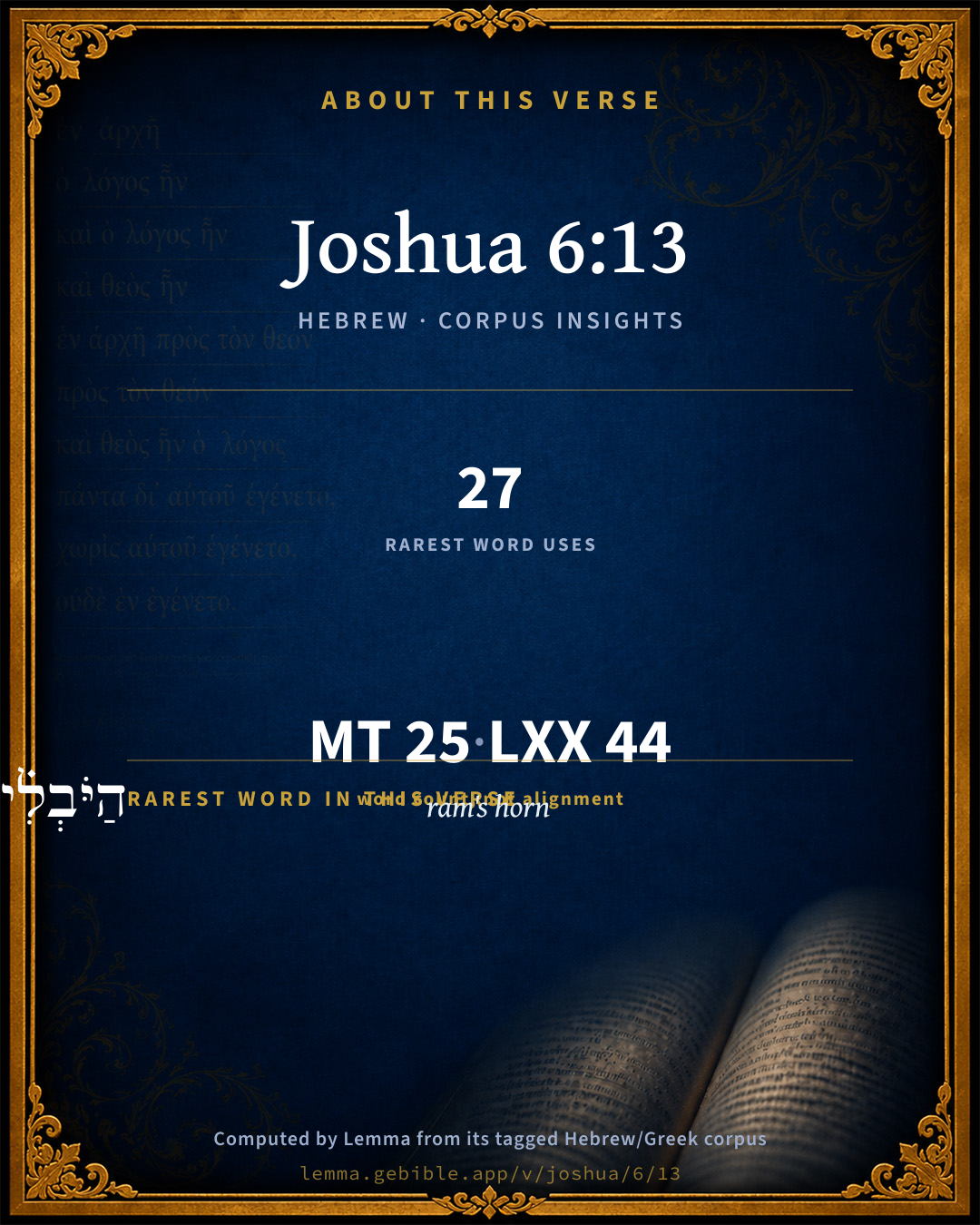
About this verse

These counts appear in no published source. They are computed here, from the morphology-tagged text and Lemma’s own curated glosses. What Lemma adds →

25
words
13
distinct lemmas
Historical
section

Shared distinctive vocabulary

הַיֹּבְלִ֗ים ram's horn H3104 occurs in 25 verses of the Hebrew Bible. Also found in:

Grammatical profile

  • 11 verbs
  • 11 nouns
  • 2 adjectives
  • 1 preposition

Verb forms

  • נֹשְׂאִים֩ Qal · Participle Active
  • הֹלְכִ֣ים Qal · Participle Active
  • הָל֔וֹךְ Qal · Infinitive Absolute
  • וְתָקְע֖וּ Qal · Sequential Perfect
  • וְהֶחָלוּץ֙ Qal · Participle Passive
  • הֹלֵ֣ךְ Qal · Participle Active
  • וְהַֽמְאַסֵּ֗ף Piel · Participle Active
  • הֹלֵךְ֙ Qal · Participle Active
  • הולך Qal · Participle Active
  • הָל֖וֹךְ Qal · Infinitive Absolute
  • וְתָק֥וֹעַ Qal · Infinitive Absolute

Repetition

Words recur within this verse — often emphatic in Hebrew:

  • הֹלְכִ֣ים to walk H1980 ×6
  • שׁוֹפְר֜וֹת horn H7782 ×3
  • וְשִׁבְעָ֣ה seven H7651 ×2
  • לִפְנֵי֙ face H6440 ×2
  • אֲר֣וֹן ark H727 ×2
  • יְהוָ֔ה LORD H3068 ×2
  • וְתָקְע֖וּ to blow H8628 ×2

Hebrew & Septuagint length

In English translation the verse runs 46 words from the Hebrew and 44 from the Septuagint (LXX English) — closely comparable.

A rough comparison of the two English renderings, which tokenize alike — not a word-level alignment.

Word counts can differ between the Hebrew and the Greek without any difference in meaning — e.g. the Hebrew direct-object marker אֵת has no separate Greek word, and Greek often adds the article ὁ.

In the original languages it is 25 Hebrew tokens and 44 Greek tokens — but the two are counted differently (Hebrew bundles its prefixes and suffixes into one token; the Greek is in lemma form), so that isn’t a like-for-like length.

Cross-references

3

Topical passages linked to Joshua 6:13 in the Treasury of Scripture Knowledge — connected by theme and wording, ordered by reader-vote popularity; previews shown in the World English Bible.

  • Galatians 6:9 Let us not be weary in doing good, for we will reap in due season, if we don't give up.
  • Matthew 24:13 But he who endures to the end, the same will be saved.
  • 1 Chronicles 15:26 It happened, when God helped the Levites who bore the ark of the covenant of Yahweh, that they sacrificed seven bulls and seven rams.

Cross-references courtesy of OpenBible.info (CC BY 4.0).

Hebrew and Greek witnesses Masoretic Hebrew ↔ Greek Septuagint

The same verse in the two great witnesses to the Old Testament, shown verse-for-verse.

These are two independent witnesses, not word-aligned to each other, and the Septuagint is shown in lemma (dictionary) form.

Hebrew Joshua 6:13 Masoretic · Westminster Leningrad Codex

וְשִׁבְעָ֣ה הַכֹּהֲנִ֡ים נֹשְׂאִים֩ שִׁבְעָ֨ה שׁוֹפְר֜וֹת הַיֹּבְלִ֗ים לִפְנֵי֙ אֲר֣וֹן יְהוָ֔ה הֹלְכִ֣ים הָל֔וֹךְ וְתָקְע֖וּ בַּשּׁוֹפָר֑וֹת וְהֶחָלוּץ֙ הֹלֵ֣ךְ לִפְנֵיהֶ֔ם וְהַֽמְאַסֵּ֗ף הֹלֵךְ֙ אַֽחֲרֵי֙ אֲר֣וֹן יְהוָ֔ה הולך הָל֖וֹךְ וְתָק֥וֹעַ בַּשּׁוֹפָרֽוֹת

The seven priests bearing the seven trumpets of rams' horns before the ark of Yahweh went on continually, and blew the trumpets: and the armed men went before them; and the rearward came after the ark of Yahweh, [the priests] blowing the trumpets as they went.

World English Bible · Public Domain

Greek LXX Joshua 6:13 Septuagint · lemma form

καί ὁ ἑπτά ἱερεύς ὁ φέρω ὁ σάλπιγξ ὁ ἑπτά προπορεύομαι ἐναντίον κύριος καί μετά οὗτος εἰςπορεύομαι ὁ μάχιμος καί ὁ λοιπός ὄχλος ὄπισθε ὁ κιβωτός ὁ διαθήκη κύριος καί ὁ ἱερεύς σαλπίζω ὁ σάλπιγξ καί ὁ λοιπός ὄχλος ἅπας περικυκλόω ὁ πόλις ἐγγύθεν

And the seven priests bearing the seven trumpets went on before the Lord; and afterwards the men of war went on, and the remainder of the multitude went after the ark of the covenant of the Lord, and the priests sounded with the trumpets.

LXX2012 (modern English Septuagint) · Public Domain

On this verse, The Pulpit Commentary discusses the Septuagint’s reading. Read the note in Commentary ↓

Hebrew: Westminster Leningrad Codex (CC BY 4.0). Greek: Septuagint (public domain); English from LXX2012 (modern English Septuagint) (Public Domain). How the Septuagint differs from the Hebrew →

Targum (Aramaic paraphrase)

1

The Targum is the ancient Jewish Aramaic paraphrase of the Hebrew Scriptures — an interpretive translation, not the Hebrew text itself. Onkelos (literal) and Pseudo-Jonathan (expansive) render the Torah, and Jonathan the Prophets. Coverage is partial: where no permissively-licensed English translation exists for a verse, only the Aramaic is shown. This is verse-level text, not a word-by-word alignment to the Hebrew.

  1. Targum Jonathan Prophets (Joshua–Malachi)
    וְשִׁבְעָא כַהֲנַיָא נְסִיבוּ שִׁבְעָא שׁוֹפָרַיָא דְקֶרֶן דִכְרַיָא קֳדָם אֲרוֹנָא דַייָ אָזְלִין מֵיזַל וְתָקְעִין בְּשׁוֹפָרַיָא וּמְזָרְזֵי חֵילָא אָזְלִין קֳדָמֵיהוֹן וְשִׁבְטָא דְבֵית דָן אָזֵיל בָּתַר אֲרוֹנָא דַייָ וְכַהֲנַיָא אָזְלִין וְתָקְעִין בְּשׁוֹפָרַיָא:

    (no public-domain English translation for this verse)

    Targum Jonathan — Aramaic: “Mikraot Gedolot” (public domain). English: “Sefaria Community Translation” (CC0 1.0 (public-domain dedication)); “London "Chaldee Paraphrase," 1871” (public domain). Text via Sefaria.

Commentary

Notes on Joshua 6:13 from classic Christian and Jewish commentators (each source and its license shown beneath its notes). The classic Christian expositions comment on the surrounding passage and are grouped to its opening verse, so a note may address several verses; the Jewish commentaries on the Tanakh (Rashi and others) are per-verse, so they appear only where the commentator wrote on this verse.

Lemma curates 59 commentaries, every one of them public domain or Creative Commons licensed, each selected and text-cleaned for this edition rather than reprinted as found. About our sources →

Trapp's Complete Commentary

John Trapp

Jos 6:13 And seven priests bearing seven trumpets of rams’ horns before the ark of the LORD went on continually, and blew with the trumpets: and the armed men went before them; but the rereward came after the ark of the LORD, [the priests] going on, and blowing with the trumpets.

Ver. 13. And seven priests bearing seven trumpets.] Here were many sevens, as also in the Revelation. Many mysteries throughout the Scriptures are set forth by this number: the Hebrew word signifieth fulness.

John Trapp, A Commentary or Exposition upon All the Books of the Old and New Testament (1647–1656) — public domain. Text from a community e-Sword module.

Geneva Bible (1599)

Geneva Bible translators

The tribe of Dan was so called, because it marched last and gathered up whatsoever was left of others.

Geneva Bible (1599) marginal notes — public domain. Text via Bolls.life.

Ellicott's Commentary for English Readers

(13) The priests going on.—Literally, with a going, and a blowing with the trumpets.” The priests” is inserted by the Targum.

A Bible Commentary for English Readers, edited by Charles John Ellicott (1878–1897) — public domain. Text from a community e-Sword module.

John Gill's Exposition

And seven priests bearing seven trumpets of rams' horns before the ark of the Lord,.... See Gill on Jos 6:4,

went on continually; or, "going they went" (b): kept on going, making no stop at all, until they had compassed the city:

and blew with the trumpets; as they went along:

and the armed men went before them, but the rereward came after the ark of the Lord; which the Targum paraphrases as on Jos 6:9,

the priests going on, and blowing with the trumpets; See Gill on Jos 6:9.

(b) "euntes eundo", Montanus.

John Gill's Exposition of the Whole Bible (1746–1763) — public domain (CC PDM 1.0). Text via the HelloAO Bible API.

The Pulpit Commentary

The rereward. (see Jos_5:9) Literally, the gathering together and then the body of troops which collects the stragglers, the rear guard, as in Num_10:25 Isa_52:12 Isa_58:8. Calvin renders here by quia cogebat agmen. But the LXX and Vulgate render by o loipo and vulgus reliquum. So Luther, der Haufe. The LXX, however, in ver. 9 translates the same word by ouragountev , i.e., " qui extremum agmen ducunt, et quasi caudam efficiunt" (Rosenmuller). The word is not the same as that translated rereward in 1Sa_29:2, the only other place where our version has "rereward," where there can be no question of the rendering being correct, since the literal meaning there is the hindermost.

The Pulpit Commentary (1880–1919), ed. H.D.M. Spence-Jones & Joseph S. Exell — public domain. Text from a community e-Sword module.

Rashi

Rabbi Shlomo Yitzchaki (Rashi)

The rearmost. This refers to the tribe of Dan that traveled last and gathered all those who lagged behind.

Rashi on the Tanakh — English translations: “The Judaica Press complete Tanach with Rashi, translated by A. J. Rosenberg” (CC BY 4.0); “Pentateuch with Rashi's commentary by M. Rosenbaum and A.M. Silbermann, 1929-1934” (public domain); “The Metsudah Tanach series, Lakewood, N.J” (CC BY 4.0); and “The Book of Joshua, Metsudah Publications, 1997” (CC BY 4.0). Text via Sefaria.

Lesson kit

Teaching starters — assembled from the data on this page, not authored interpretation. Every prompt links to the verse data it draws on. Edit before teaching.

Joshua, in the Historical, opens this verse with 25 words (13 distinct Hebrew lemmas). Its most distinctive word is yôwbêl (“ram's horn”). A historical commentator’s framing appears above. Read the whole chapter for the surrounding context.

Discussion questions

  1. What does “ram's horn” (yôwbêl) contribute to the verse as a whole?
  2. Exodus 19:13 shares the word «ram's horn» with this verse. How do the two illuminate each other?
  3. “to walk” occurs 6× in this one verse. What is the effect of the repetition?
  4. The translations on this page render this verse differently — a whole-verse word diff, not a word-by-word alignment. What might account for the different wordings?
  5. The verb «נֹשְׂאִים֩» is Qal Participle Active. How does its form color the action?
  6. Reading how Trapp's Complete Commentary and Geneva Bible (1599) read this verse, where do the two commentators agree and where do they part?

Things to notice

Reading settings

Reading text

Shown beneath each verse's original-language words.

Old Testament
Old Testament edition

Read the OT as the Masoretic Hebrew (MT) or the Greek Septuagint (LXX).

English shown for the Greek Septuagint (in the Hebrew ↔ Greek comparison).

Comparing translations? Open the Compare panel on any verse page to stack up to four side by side.