
2 Kings 3:9

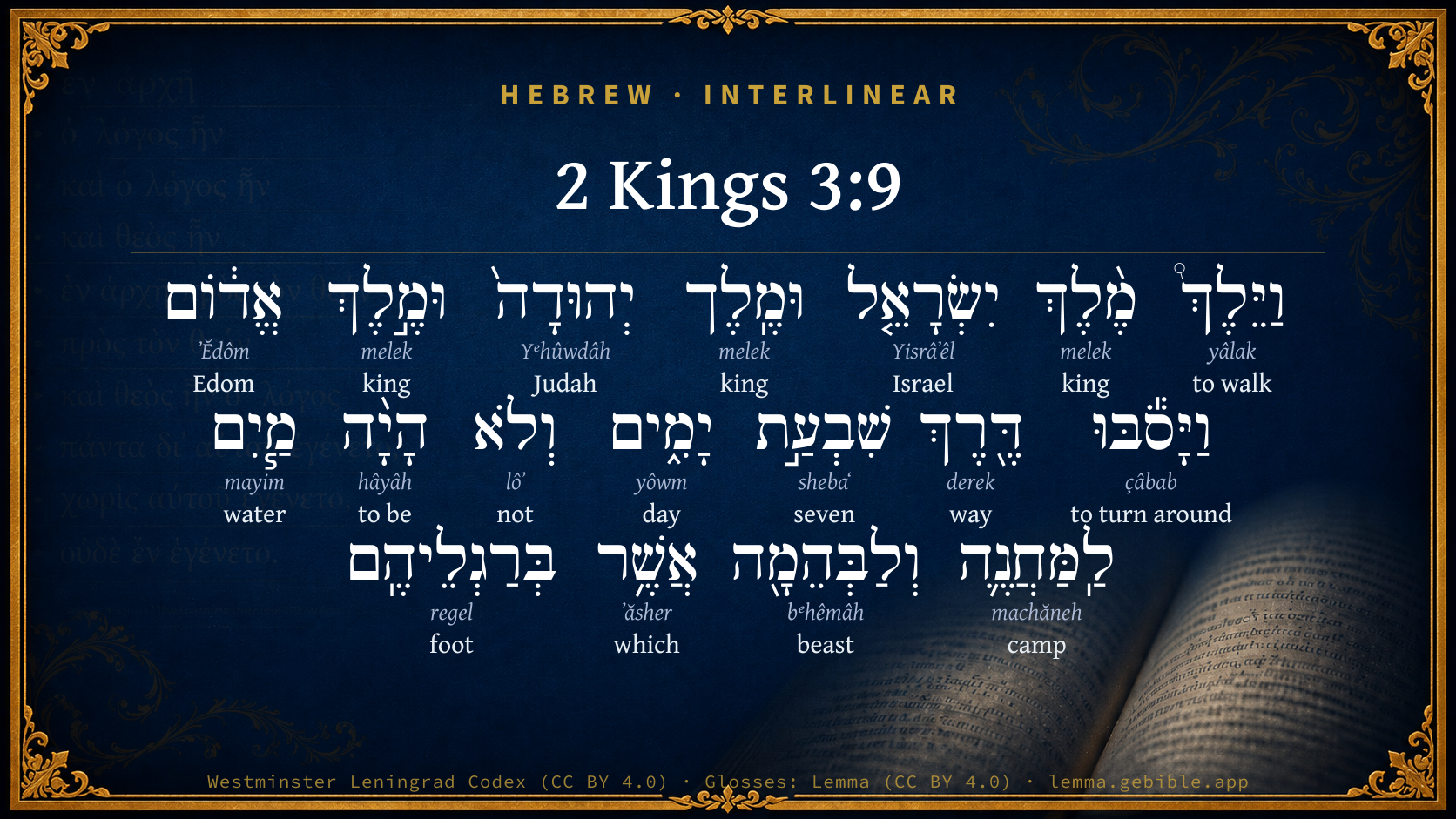
Hebrew (Westminster Leningrad Codex) 2 Kings 3:9 appears in the Hebrew Old Testament. The text above is from the Westminster Leningrad Codex. Each word links to its Strong’s number, a concise gloss, and parsing drawn from the Open Scriptures Hebrew Bible morphology. Click any word for its full Brown-Driver-Briggs (BDB) entry.
Download image
Cite this verse

2 Kings 3:9 (World English Bible). Public Domain. Lemma interlinear Bible study tool, https://lemma.gebible.app/v/2-kings/3/9.

Show BibTeX & RIS
BibTeX
RIS
English Translation
So the king of Israel went, and the king of Judah, and the king of Edom; and they made a circuit of seven days' journey: and there was no water for the host, nor for the animals that followed them.
World English Bible · Public Domain
Download a study sheet

One document with this verse’s original text, its word-by-word gloss line, the meaning frame, cross-references with their text, attributed commentary, and full source and license credits — printable, and it pastes into notes with its structure intact.

This verse Autodidact and up

Study sheet (.html) Plain text (.txt)

A passage Seminary Student

Up to 50 verses in one chapter. A passage sheet keeps up to 6 commentary sources and 12 cross-references per verse, in the order this page ranks them, and says so on the sheet whenever that leaves anything out. Ask for a single verse and you get the Autodidact verse sheet above.

Everything on this page stays free to read, with no account — the sheet is a download of what is already on screen, not access to it.

Want to remove ads? Support Godless Engineer
Compare translations 3

The same verse in 3 English versions, stacked beneath the original-language interlinear above. Click any original word for its lexicon entry.

Each is an independent rendering of the whole verse — the interlinear is not word-aligned to these translations.

Highlighted words mark where these versions differ — a whole-verse word diff, not a word-by-word alignment.

  • World English Bible Public Domain
    So the king of Israel went, and the king of Judah, and the king of Edom; and they made a circuit of seven days' journey: and there was no water for the host, nor for the animals that followed them.
  • King James Version Public Domain
    So the king of Israel went, and the king of Judah, and the king of Edom: and they fetched a compass of seven days' journey: and there was no water for the host, and for the cattle that followed them.
  • unfoldingWord Literal Text CC BY-SA 4.0
    And, the king of Israel, went with the king of Judah and the king of Edom, and they went around, a journey of seven days. But water was not for the camp or for the animals that at their feet.

unfoldingWord Literal Text — © unfoldingWord, licensed CC BY-SA 4.0. Word-aligned USFM3 via Door43 (git.door43.org/unfoldingWord/en_ult).

Versions to compare (up to 4)

3 of 4 selected

Show all 18 translations

Every available English version of this verse, each an independent rendering of the whole verse.

  • World English Bible Public Domain
    So the king of Israel went, and the king of Judah, and the king of Edom; and they made a circuit of seven days' journey: and there was no water for the host, nor for the animals that followed them.
  • Berean Standard Bible Public Domain
    So the king of Israel, the king of Judah, and the king of Edom set out, and after they had traveled a roundabout route for seven days, they had no water for their army or for their animals.
  • Majority Standard Bible Public Domain
    So the king of Israel, the king of Judah, and the king of Edom set out, and after they had traveled a roundabout route for seven days, they had no water for their army or for their animals.
  • King James Version Public Domain
    So the king of Israel went, and the king of Judah, and the king of Edom: and they fetched a compass of seven days' journey: and there was no water for the host, and for the cattle that followed them.
  • American Standard Version (1901) Public Domain
    So the king of Israel went, and the king of Judah, and the king of Edom; and they made a circuit of seven days' journey: and there was no water for the host, nor for the beasts that followed them.
  • Revised Version (1885) Public Domain
    So the king of Israel went, and the king of Judah, and the king of Edom: and they made a circuit of seven days’ journey: and there was no water for the host, nor for the beasts that followed them.
  • Geneva Bible (1599) Public Domain
    So went the King of Israel and the king of Iudah, and the King of Edom, and when they had compassed the way seuen dayes, they had no water for the hoste, nor for the cattell that followed them.
  • Douay-Rheims (1899) Public Domain
    So the king of Israel, and the king of Juda, and the king of Edom went, and they fetched a compass of seven days' journey, and there was no water for the army, and for the beasts, that followed them.
  • Young's Literal Translation Public Domain
    And the king of Israel goeth, and the king of Judah, and the king of Edom, and they turn round the way seven days, and there hath been no water for the camp, and for the cattle that `are' at their feet,
  • Literal Standard Version CC BY-SA 4.0
    And the king of Israel goes, and the king of Judah, and the king of Edom, and they turn around the way seven days, and there has been no water for the camp, and for the livestock that [are] at their feet,
  • Unlocked Literal Bible CC BY-SA 4.0
    So the king of Israel went with the king of Judah and the king of Edom. They wandered around for seven days, and then there was no water for the army or for the animals that followed them.
  • unfoldingWord Literal Text CC BY-SA 4.0
    And, the king of Israel, went with the king of Judah and the king of Edom, and they went around, a journey of seven days. But water was not for the camp or for the animals that at their feet.
  • Darby Bible Public Domain
    And the king of Israel went, and the king of Judah, and the king of Edom, and they made a circuit of seven days' journey. And there was no water for the army, and for the cattle that followed them.
  • World Messianic Bible Public Domain
    So the king of Israel went with the king of Judah and the king of Edom, and they marched for seven days along a circuitous route. There was no water for the army or for the animals that followed them.
  • Webster's Bible Public Domain
    So the king of Israel went, and the king of Judah, and the king of Edom: and they fetched a compass of seven days' journey: and there was no water for the army, and for the cattle that followed them.
  • Free Bible Version CC BY-SA 4.0
    So the king of Israel, the king of Judah, and the king of Edom set off. Having followed an indirect route for seven days, they ran out of water for their army and for their animals.
  • Bible in Basic English Public Domain
    So the king of Israel went with the king of Judah and the king of Edom by a roundabout way for seven days: and there was no water for the army or for the beasts they had with them.
  • JPS Tanakh (1917) Public Domain
    So the king of Israel went, and the king of Judah, and the king of Edom; and they made a circuit of seven days' journey; and there was no water for the host, nor for the beasts that followed them.

Literal Standard Version (2020), Covenant Press — licensed CC BY-SA 4.0. Text via the HelloAO Bible API (eBible.org). Unlocked Literal Bible (unfoldingWord) — licensed CC BY-SA 4.0. Text via the HelloAO Bible API (eBible.org). unfoldingWord Literal Text — © unfoldingWord, licensed CC BY-SA 4.0. Word-aligned USFM3 via Door43 (git.door43.org/unfoldingWord/en_ult). Free Bible Version, Dr. Jonathan Gallagher — licensed CC BY-SA 4.0. Text via the HelloAO Bible API (eBible.org).

Word by word

More ways to search: Search by grammar → Find every occurrence → Compare this word →

Practice this passage: Drill this verse → Learn its vocabulary →

אֱד֔וֹם
ʼĔdôm
H123
“Edom”
Noun, Proper
Part of Speech
Noun
Type
Proper
Full BDB Definition

Origin: from H122

TWOT: 26e

Edom = "red" - Edom - Edomite, Idumean - descendants of Esau - land of Edom, Idumea - land south and south east of Palestine
  1. וַיֵּלֶךְ֩ yâlak H3212 “and · to walk” Conjunction + Verb, Qal, Sequential Imperfect, 3rd Person, Masculine, Singular
  2. מֶ֨לֶךְ melek H4428 “king of” Noun, Common, Masculine, Singular, Construct
  3. יִשְׂרָאֵ֤ל Yisrâʼêl H3478 “Israel” Noun, Proper
  4. וּמֶֽלֶך melek H4428 “and · king of” Conjunction + Noun, Common, Masculine, Singular, Construct
  5. יְהוּדָה֙ Yᵉhûwdâh H3063 “Judah” Noun, Proper
  6. וּמֶ֣לֶךְ melek H4428 “and · king of” Conjunction + Noun, Common, Masculine, Singular, Construct
  7. וַיָּסֹ֕בּוּ çâbab H5437 “and · to turn around” Conjunction + Verb, Qal, Sequential Imperfect, 3rd Person, Masculine, Plural
  8. דֶּ֖רֶךְ derek H1870 “way of” Noun, Common, Both, Singular, Construct
  9. שִׁבְעַ֣ת shebaʻ H7651 “seven” Adjective, Cardinal number, Masculine, Singular, Construct
  10. יָמִ֑ים yôwm H3117 “days” Noun, Common, Masculine, Plural, Absolute
  11. וְלֹא lôʼ H3808 “and · not” Conjunction + Particle, Negative
  12. הָיָ֨ה hâyâh H1961 “to be” Verb, Qal, Perfect, 3rd Person, Masculine, Singular
  13. מַ֧יִם mayim H4325 “water(s)” Noun, Common, Masculine, Plural, Absolute
  14. לַֽמַּחֲנֶ֛ה machăneh H4264 “to/for the · camp” Preposition, Determined + Noun, Common, Both, Singular, Absolute
  15. וְלַבְּהֵמָ֖ה bᵉhêmâh H929 “and · to/for the · beast” Conjunction + Preposition, Determined + Noun, Common, Feminine, Singular, Absolute
  16. אֲשֶׁ֥ר ʼăsher H834 “which” Particle, Relative
  17. בְּרַגְלֵיהֶֽם regel H7272 “in/at · feet · their” Preposition + Noun, Common, Feminine, Dual, Construct + Suffix, Personal, 3rd Person, Masculine, Plural

About this verse

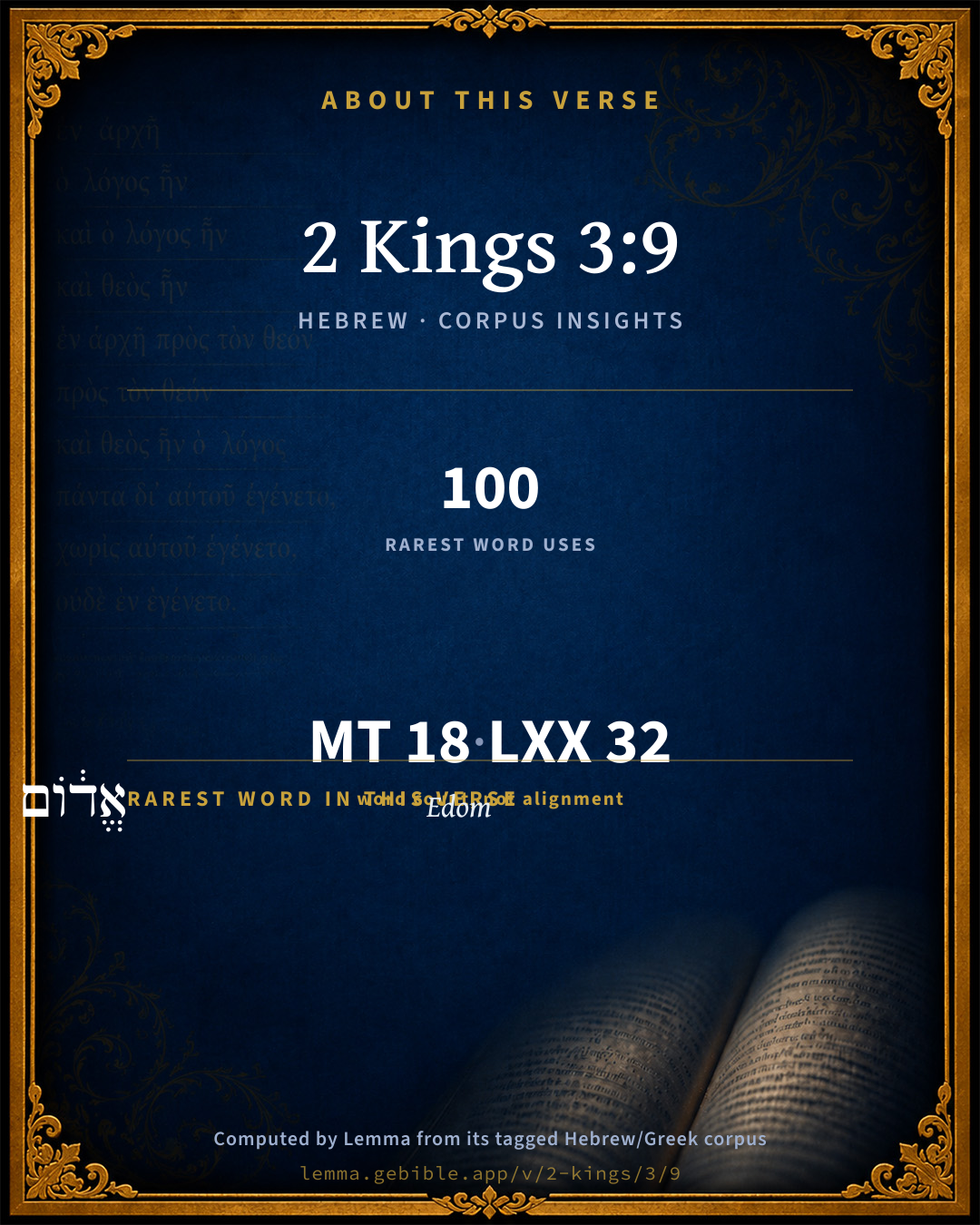
These counts appear in no published source. They are computed here, from the morphology-tagged text and Lemma’s own curated glosses. What Lemma adds →

18
words
16
distinct lemmas
Historical
section

Grammatical profile

  • 3 verbs
  • 12 nouns
  • 1 adjective
  • 2 particles

Verb forms

  • וַיֵּלֶךְ֩ Qal · Sequential Imperfect
  • וַיָּסֹ֕בּוּ Qal · Sequential Imperfect
  • הָיָ֨ה Qal · Perfect

Repetition

A word recurs within this verse — often emphatic in Hebrew:

  • מֶ֨לֶךְ king H4428 ×3

Hebrew & Septuagint length

In English translation the verse runs 40 words from the Hebrew and 41 from the Septuagint (LXX English) — closely comparable.

A rough comparison of the two English renderings, which tokenize alike — not a word-level alignment.

Word counts can differ between the Hebrew and the Greek without any difference in meaning — e.g. the Hebrew direct-object marker אֵת has no separate Greek word, and Greek often adds the article ὁ.

In the original languages it is 18 Hebrew tokens and 32 Greek tokens — but the two are counted differently (Hebrew bundles its prefixes and suffixes into one token; the Greek is in lemma form), so that isn’t a like-for-like length.

Cross-references

10

Topical passages linked to 2 Kings 3:9 in the Treasury of Scripture Knowledge — connected by theme and wording, ordered by reader-vote popularity; previews shown in the World English Bible.

  • 1 Kings 22:47 There was no king in Edom: a deputy was king.
  • Exodus 11:8 All these your servants shall come down to me, and bow down themselves to me, saying, 'Get out, and all the people who follow you; and after that I will go out.'" He went out from Pharaoh in hot anger.
  • Exodus 15:22 Moses led Israel onward from the Red Sea, and they went out into the wilderness of Shur; and they went three days in the wilderness, and found no water.
  • Exodus 17:1 All the congregation of the children of Israel traveled from the wilderness of Sin, by their journeys, according to Yahweh's commandment, and encamped in Rephidim; but there was no water for the people to drink.
  • Numbers 20:2 There was no water for the congregation: and they assembled themselves together against Moses and against Aaron.
  • Numbers 20:4 Why have you brought the assembly of Yahweh into this wilderness, that we should die there, we and our animals?
  • Numbers 21:5 The people spoke against God, and against Moses, Why have you brought us up out of Egypt to die in the wilderness? for there is no bread, and there is no water; and our soul loathes this light bread.
  • Numbers 33:14 They traveled from Alush, and encamped in Rephidim, where was no water for the people to drink.
  • Judges 4:10 Barak called Zebulun and Naphtali together to Kedesh; and there went up ten thousand men at his feet: and Deborah went up with him.
  • 1 Kings 22:27 and say, Thus says the king, Put this fellow in the prison, and feed him with bread of affliction and with water of affliction, until I come in peace.

Cross-references courtesy of OpenBible.info (CC BY 4.0).

Hebrew and Greek witnesses Masoretic Hebrew ↔ Greek Septuagint

The same verse in the two great witnesses to the Old Testament, shown verse-for-verse.

These are two independent witnesses, not word-aligned to each other, and the Septuagint is shown in lemma (dictionary) form.

Hebrew 2 Kings 3:9 Masoretic · Westminster Leningrad Codex

וַיֵּלֶךְ֩ מֶ֨לֶךְ יִשְׂרָאֵ֤ל וּמֶֽלֶך יְהוּדָה֙ וּמֶ֣לֶךְ אֱד֔וֹם וַיָּסֹ֕בּוּ דֶּ֖רֶךְ שִׁבְעַ֣ת יָמִ֑ים וְלֹא הָיָ֨ה מַ֧יִם לַֽמַּחֲנֶ֛ה וְלַבְּהֵמָ֖ה אֲשֶׁ֥ר בְּרַגְלֵיהֶֽם

So the king of Israel went, and the king of Judah, and the king of Edom; and they made a circuit of seven days' journey: and there was no water for the host, nor for the animals that followed them.

World English Bible · Public Domain

Greek LXX 2 Kings 3:9 Septuagint · lemma form

καί πορεύομαι ὁ βασιλεύς ἰσραήλ καί ὁ βασιλεύς ιουδα καί ὁ βασιλεύς εδωμ καί κυκλόω ὁδός ἑπτά ἡμέρα καί οὐ εἰμί ὕδωρ ὁ παρεμβολή καί ὁ κτῆνος ὁ ἐν ὁ πούς αὐτός

And the king of Israel went, and the king of Juda, and the king of Edom: and they fetched a compass of seven days' journey; and there was no water for the army, and for the cattle that went with them.

LXX2012 (modern English Septuagint) · Public Domain

Hebrew: Westminster Leningrad Codex (CC BY 4.0). Greek: Septuagint (public domain); English from LXX2012 (modern English Septuagint) (Public Domain). How the Septuagint differs from the Hebrew →

Targum (Aramaic paraphrase)

1

The Targum is the ancient Jewish Aramaic paraphrase of the Hebrew Scriptures — an interpretive translation, not the Hebrew text itself. Onkelos (literal) and Pseudo-Jonathan (expansive) render the Torah, and Jonathan the Prophets. Coverage is partial: where no permissively-licensed English translation exists for a verse, only the Aramaic is shown. This is verse-level text, not a word-by-word alignment to the Hebrew.

  1. Targum Jonathan Prophets (Joshua–Malachi)
    וַאֲזַל מַלְכָּא דְיִשְׂרָאֵל וּמֶלֶךְ שִׁבְטָא דְבֵית יְהוּדָה וּמַלְכָּא דֶאֱדוֹם וְאַסְחָרוּ מַהֲלַךְ שַׁבְעָא יוֹמִין וְלָא הֲוָה מַיָא לְמַשְׁרִיתָא וְלִבְעִירָא דְעִמְהוֹן:

    (no public-domain English translation for this verse)

    Targum Jonathan — Aramaic: “Mikraot Gedolot” (public domain). English: “Sefaria Community Translation” (CC0 1.0 (public-domain dedication)); “London "Chaldee Paraphrase," 1871” (public domain). Text via Sefaria.

Commentary

Notes on 2 Kings 3:9 from classic Christian and Jewish commentators (each source and its license shown beneath its notes). The classic Christian expositions comment on the surrounding passage and are grouped to its opening verse, so a note may address several verses; the Jewish commentaries on the Tanakh (Rashi and others) are per-verse, so they appear only where the commentator wrote on this verse.

Lemma curates 59 commentaries, every one of them public domain or Creative Commons licensed, each selected and text-cleaned for this edition rather than reprinted as found. About our sources →

Trapp's Complete Commentary

John Trapp

2Ki 3:9 So the king of Israel went, and the king of Judah, and the king of Edom: and they fetched a compass of seven days’ journey: and there was no water for the host, and for the cattle that followed them.

Ver. 9. Of seven days’ journey.] This was a long while for such an army to be without water; and should have been sooner seen to. Prevision is the best means of prevention. This was a check to Jehoshaphat’s rashness.

John Trapp, A Commentary or Exposition upon All the Books of the Old and New Testament (1647–1656) — public domain. Text from a community e-Sword module.

Joseph Benson's Commentary

2Ki 3:9. The king of Edom — Properly speaking, there was no king at this time in Edom, as we read in the last chapter of the foregoing book, 1Ki 22:47; but the viceroy, under Jehoshaphat, is here called king, that word being often used for any prince or chief ruler. Of seven days’ journey — Because they made a great army, which could move but slowly; and they fetched a greater compass than usual, that they might come upon the backs of the Moabites, where they did not expect them, or for some other advantage which they hoped to reap by it. There was no water for the host — A frequent want in those parts; and now, it seems, increased by the extraordinary heat and dryness of the season. And for the cattle that followed them — Which drew their carriages.

Joseph Benson's Commentary on the Old and New Testaments (1811–1818) — public domain. Text from a community e-Sword module.

Geneva Bible (1599)

Geneva Bible translators

Meaning, the viceroy, or lieutenant of the king of Judah, read 1 Kings 22:47.

Hebrew, that were at their feet.

Geneva Bible (1599) marginal notes — public domain. Text via Bolls.life.

Adam Clarke's Commentary

Verse 9. A compass of seven days' journey] By taking a circuitous route, to go round the southern part of the Dead Sea, they probably intended to surprise the Moabites; but it appears their journey was ill planned, as they at last got into a country in which it was impossible to obtain water, and they were brought in consequence to the utmost extremity.

Adam Clarke's Commentary on the Bible (1810–1826) — public domain. Text from a community e-Sword/MySword module.

Ellicott's Commentary for English Readers

(9) The king of Edom.—A vassal king appointed by Jehoshaphat (1Ki_22:48).

They fetched a compass.—Went round (scil., the Dead Sea) a journey of seven days. The confederates appear to have lost their way among the mountains of Seir. They would, in any case, be greatly delayed by the cattle which it was necessary to take with them for subsistence. It is evident from the context that the distress began after the Edomite contingent had joined.

For the host, and for the cattle that followed them.—The stopping is wrong. It should be, and there was not water for the army and for the cattle which followed them. “Them,” i.e., the kings. (Comp. Jdg_5:15.) “The cattle,” i.e., the herds and flocks for the maintenance of the army.

The allies appear to have marched through the deep, rocky glen of El-Ahsy (or El-Qurâhy), between Moab and Edom. They expected to find water there, as is usually the case, even in the dry season; but on this occasion the water failed.

A Bible Commentary for English Readers, edited by Charles John Ellicott (1878–1897) — public domain. Text from a community e-Sword module.

The Cambridge Bible for Schools and Colleges

gen. ed. J. J. S. Perowne

9. So the king of Israel went] Josephus (Ant. IX. 3. 1) tells how Jehoram and his army were hospitably and magnificently received in Jerusalem before they started on their march.

and the king of Edom] The same author says that along with his own promise of help, Jehoshaphat had pledged himself to compel the king of Edom, his subject, to take part in the expedition. So by going this way the army not only found an uninterrupted line of march but additional forces also.

and they fetcht a compass [R.V. made a circuit] of seven days’ journey] This old English phrase for taking a roundabout road is found here and 2Sa_5:23; Act_28:13. It is not easy to see why they should have gone so long a way about, when the country through which they were passing belonged to one of the allied kings. It might perhaps be necessary for the sake of finding provender. Josephus says that their guides led them wrong, but this is highly improbable. There must have been many persons among the Edomites who were familiar enough with all the ways into the neighbouring country of Moab.

and for the cattle] R.V. beasts. This change is made that there may be uniformity of rendering between this verse and verse 17.

The Cambridge Bible for Schools and Colleges (gen. ed. J. J. S. Perowne; Cambridge University Press, 1878–1918) — public domain. Text from a community e-Sword module.

John Gill's Exposition

But Jehoshaphat said, is there not here a prophet of the Lord, that we may inquire of the Lord by him?.... This the good king should have done before be set out, but had neglected it; however, it was not too late:

and one of the king of Israel's servants answered and said; who might be one that feared the Lord, and was intimate with Elisha, or however had knowledge of him, as appears by what follows:

here is Elisha the son of Shaphat, which poured water on the hands of Elijah; or ministered to him, as the Targum; was his menial servant, waited on him, and assisted him when he washed his hands (g); some Jewish writers understand it of his pouring water on the hand of Elijah at Carmel, when the altar and trench were filled with it, and when a miracle was wrought, as they fancy, and the fingers of Elijah became as fountains of water.

(g) See the like phrase of the business of a servant in Homer, Iliad. 3. ver. 270, & Iliad. 9. ver. 174. Odyss. 1. ver. 147. & Odyss. 3. ver. 388. & Odyss. 4. ver. 258, 261. & passim.

John Gill's Exposition of the Whole Bible (1746–1763) — public domain (CC PDM 1.0). Text via the HelloAO Bible API.

Albert Barnes' Notes on the Bible

Seven days’ journey - The distance of the route probably followed is not much more than 100 miles. But the difficulties of the way are great; and the army might not be able to move along it at a faster rate than about 15 miles a day.

No water - The kings had probably expected to find sufficient water for both men and baggage animals in the Wady-el-Ahsy, which divides Edom from Moab, and which has a stream that is now regarded as perennial. But it was dried up - quite a possible occurrence with any of the streams of this region.

Albert Barnes' Notes on the Bible (1834–1885) — public domain. Text from a community e-Sword/MySword module.

Matthew Poole's English Annotations

The king of Edom, i.e. the viceroy under Jehoshaphat, 1Ki 22:47, here called king; either because he was so called and accounted by his own people, or because that word is sometimes used for any prince or chief ruler. See Deu 33:5; Jdg 18:1; 21:25; 1Ki 20:1.

They fetched a compass, because they made a great army, which could move but slowly; and they fetched a greater compass than was usual, for some advantage which they expected by it.

There was no water; a frequent want in those hot and desert parts; and now, as it seems, increased by the extraordinary heat and dryness of the season.

Matthew Poole's English Annotations on the Holy Bible (1683–1685) — public domain. Text from a community e-Sword/MySword module.

Whedon's Commentary on the Bible

Daniel D. Whedon

9. And the king of Edom — One further object of journeying by the way of Edom may have been to secure the co-operation of this king, who was now at peace and in league with Judah, but who might have been strongly tempted to revolt if he had been ignored in this war for the subjugation of Moab.

No water for the host — A calamity very likely to overtake a vast army in that desolate and barren section of the land.

Daniel D. Whedon (gen. ed.), Commentary on the Old and New Testaments (1874–1909) — public domain. Text from a community e-Sword module.

The Pulpit Commentary

So the King of Israel went as leader of the expedition, he is placed firstand the King of Judah the second in importance, therefore placed secondand the King of Edom the third in importance, therefore placed last. It is to be remarked that, when Edom was last mentioned, she was ruled by a "deputy," who received his appointment from the King of Judah. (1Ki_22:47) Now, apparently, she has her own native "king." The change is, perhaps, to be connected with the temporary revolt of Edom hinted at in 2Ch_20:22. And they fetched a compass of seven days" journey. The distance from Jerusalem, where the forces of Israel and Judah probably united, to the southern borders of Moab by way of Hebron, Malatha, and Thamara, which is the best-watered route, and would probably be the route taken, does not much exceed a hundred miles; but its difficulties are great, and it is quite probable that the march of an army along it would not average more than fifteen miles a day. And there was no water for the host. The confederate army had reached the border of Moab, where they had probably expected to find water in the Wady-el-Ahsy, which is reckoned a perennial stream (Robinson, "Researches," vol. it. p. 488) but it was dry at the time. All the streams of these parts fail occasionally, when there has been no rain for a long time. And for the cattle that followed them; rather,. for the beasts that followed them (see the Revised Version). The baggage-animals are intended (see ver. 17).

Vers. 9-17, 20.

Man"s extremity is God"s opportunity.

This expedition, begun without consulting God, soon landed the allies in dire straits.

I THE STRAITS OF THE ARMY.

1. The failure of water. The host must have been a large one, and they had much cattle with them for sustenance. For some reason, the journey occupied seven days, and the desert was waterless. They were in the same distress that the Israelites were in centuries before under Moses (Exo_17:1-3; Num_20:1-5) but they had not the same right to rely on Divine help. When, at the end of seven days, they arrived at a valley where water might be looked for probably "the brook Zered" (Deu_2:13) their condition became desperate.

2. God"s hand recognized. Jehoram recognized, when it was too late, that it was not Moab who was fighting against him in this expedition, hut God. "Alas! that the Lord hath called these three kings together, to deliver them into the hand of Moab!

(1) How readily God can humble man"s pride, and bring to nothing his best-laid schemes! We are reminded of Napoleon"s march against Moscow, and of the annihilation of his army by the severities of a Russian winter.

(2) God"s hand is often recognized in trouble, when it is not in prosperity.

(3) God frequently leads men into distress, that they may be convinced of their folly in neglecting him, and may be led to seek his help. (Ps 107)

II THE APPEAL TO ELISHA.

1. Jehoshaphats inquiry. The King of Israel abandoned himself to despair, but Jehoshaphat asked, "Is there not here a prophet of the Lord, that we may inquire of the Lord by him?" Had he inquired of the Lord at the beginning, he would not now have been in this difficulty. But:

(1) It was better to inquire late if haply it might not be too late than not to inquire at all A good man only needs to be convinced of his errors to endeavor to repair them. A touch of the rod of chastisement turns back his heart to God, whom he may have been forgetting. To whom else shall he go? God alone can help.

(2) Even the sinner, if convinced that God is contending with him, should not delay repentance through remembrance of past sins. If he has never prayed before, let him do it now. But, alas! repentances of this kind are too often insincere the mere fruit of present fear and are not followed up by change of life.

2. The three kings and the prophet.

(1) Jehoshaphat"s question elicited the fact that Elisha the son of Shaphat was in the camp or near it. It was a servant of the King of Israel that gave this information, so that even in this ungodly king"s household there were some true worshippers (cf. 1Ki_18:3, 1Ki_18:4) This servant, though in a humble position, did the greatest service possible to his king and nation. But for his information, the armies of three kingdoms might have been annihilated. In like manner, it was "a little captive maid" who directed Naaman to the prophet. (2Ki_5:2, 2Ki_5:3)

(2) Jehoshaphat felt at once they had the right man word of the Lord is with him." Pretenders, false prophets, hypocrites, are of no avail when real trouble comes. It is the genuine prophet that is needed then. Elisha must have followed the camp by Divine direction, to give this aid in the hour of extremity another evidence that the events of this expedition, like all other events, were being shaped by an overruling Providence.

(3) The kings at once repair to Elisha. They did not ask him to come to them, but, as suppliants, "went down" to him. It was a strange sight the three kings standing before this prophet of the Lord, whom, at other times, two of them at least would have disdained to consult. But it was now felt that Elisha alone stood between them and death. He, the man of God, was, like his master before him chariot of Israel, and the horsemen thereof under God, the protector and salvation of the nation. There come seasons when religion gets the homage paid to it, which its importance at all times deserves.

3. Help only for the sake of Jehoshaphat. Elisha"s spirit seems to have been strangely perturbed by the visit of these three kings. He was roused in part by scorn at a king like Jehoram, who ordinarily paid no respect to religion, coming to ask his aid in the pinch of physical distress. It is Elijah"s fire which glows in him for the moment, as he sternly asks, "What have I to do with thee?" and bids the humbled monarch get him to the prophets of his father (the calves-prophets) and the prophets of his mother (the Baal-prophets), to see what they could do for him. But Jehoram knew that the prophets of the calves or of Baal could in that extremity give him little help. He deprecates Elisha"s anger, only to he told that, but for the sake of Jehoshaphat, the prophet would neither look towards him nor see him.

(1) It is character, not rank, which God regards. Jehoram harps upon the string that, if nothing is done, "three kings" will perish. He seems to fancy, with the French lady, that God will think twice before casting off persons of that quality. But Elisha undeceives him. Only because the good Jehoshaphat is in the company will God show any mercy to him.

(2) The ungodly often reap great benefits from association with the good. Jehoram now found this to his advantage.

(3) There will come a time of exposure for all "refuges of lies." Elisha laid bare the folly of trusting to the idol-prophets, and Jehoram felt the truth of his rebuke. So will it be with all vain imaginations. (Isa_28:14-18)

III THE DIVINE DELIVERANCE.

1. Holy minstrelsy. The discomposed state of Elisha"s mind was not fitted for the reception of "revelations of the Lord." If God would speak, passion must be stilled. To this end, he called for a minstrel, that by the soothing, subduing effect of sacred melody, his soul might be restored to a calm condition. It is a wonderful power that resides in music; we do well in God"s service to take advantage of it. "The noblest passages in " Paradise Lost" were composed as Milton"s daughter played to her father on the organ." Music gives wings to the soul, reveals to it the existence of a world of harmony, touches and harmonizes it to like "fine issues.

2. A labor of faith. As the minstrel played, the hand of the Lord came upon Elisha, and he gave directions to make the valley full of trenches. As yet there was not the slightest sign of water, nor would there be any. The work was to be done in entire dependence on the word of God that water would be sent. This is faith acting on God"s bare word of promise. All that night the laborers toiled, and when the morning came, the valley was seamed with trenches, and studded with pits, to hold the yet invisible supply of the life-giving water.

3. Streams from Edom. In the morning, true to the Divine promise, the wished-for water came.

(1) It came without visible sign. The people who looked for it saw neither wind nor rain, but simply "there came wafer by the way of Edom, and the country was filled with water." Yet there is no necessity for supposing a supernatural creation of water, for God does not work without means, when means are available. The bursting of a waterspout, or heavy rains, at some distance, would give rise to the phenomenon. There was doubtless a providential preparation for the deliverance, as there was a providential design in the distress.

(2) It came at the time of the morning oblation. The deliverance was thus connected with the service in the temple Jehovah"s true sanctuary. As it was for Jehoshaphat"s sake the deliverance was granted, so a token was now given that it was the religion of Judah to which God had respect. The hours of prayer are fit seasons for the conferring of blessing (cf. Dan_9:21)

(3) It came in great abundance. When God gives he gives plentifully. "The country was filled with water." It is so with the supply God has given for the thirst of the world those living waters of which we do so wisely to. (Joh_7:37, Joh_7:38) Such events as these pledge to us the fulfillment of Divine promises. (Isa_44:3) The psalmist says, "The rain alsofilleth the pools". (Psa_84:6) J.O.

The Pulpit Commentary (1880–1919), ed. H.D.M. Spence-Jones & Joseph S. Exell — public domain. Text from a community e-Sword module.

John Wesley's Explanatory Notes

King of Edom - That is, the vice-roy under Jehosaphat, 1 Kings xxii, 47, here called king: because that word is sometimes used for any prince or chief ruler. Seven days - Because they made a great army, which could move but slowly; and they fetched a greater compass than was usual, for some advantage which they expected by it. No water - A frequent want in those parts; and now, it seems, increased by the extraordinary heat and dryness of the season.

John Wesley, Explanatory Notes Upon the Whole Bible (1754–1765) — public domain. Text via the GEBible commentary corpus.

Kretzmann's Popular Commentary

Paul E. Kretzmann

The Miracle in the Wilderness

v. 9. So the king of Israel went, and the king of Judah, and the king of Edom, the governor under the overlordship of Judah being given the title of king by courtesy, 1Ki 22:48; and they fetched a compass of seven days’ journey, marching down near the western shore of the Dead Sea. And there was no water for the host and for the cattle that followed them, used as provisions for the army. They had ventured too far from their water supply.

v. 10. And the king of Israel, immediately abandoning himself to despair, said, Alas, that the Lord hath called these three kings together to deliver them into the hand of Moab! Being without faith in Jehovah, he saw nothing but death and destruction before his eyes.

v. 11. But Jehoshaphat, having confidence in the Lord, said, Is there not here a prophet of the Lord that we may enquire of the Lord by him? Cf 1Ki 22:7. He wanted the advice of a true prophet, of one in the service of Jehovah. And one of the king of Israel’s servants answered and said, Here is Elisha, the son of Shaphat, which poured water on the hands of Elijah, namely, in the capacity of servant and disciple.

v. 12. And Jehoshaphat, who had heard of this new prophet, said, The word of the Lord is with him, he is a genuine prophet. So the king of Israel and Jehoshaphat and the king of Edom went down to him, from the elevation on which their tents were placed to the valley where Elisha remained with the host.

v. 13. And Elisha said unto the king of Israel, taking this opportunity to reprove him and to work a wholesome sorrow for his sins in his heart, What have I to do with thee? What business could they have together, since Jehoram was addicted to idolatry? Get thee to the prophets of thy father and to the prophets of thy mother; for he still permitted the priests of Baal to continue in his land. And the king of Israel, with at least some show of humility, said unto him, Nay; for the Lord hath called these three kings together to deliver them into the hand of Moab. So his appeal for help was based upon the fact that the lives and armies of three kings were at stake.

v. 14. And Elisha said, As the Lord of hosts, Jehovah Sabaoth, the mighty Ruler of the heavenly armies, liveth, before whom I stand, surely, were it not that I regard the presence of Jehoshaphat, the king of Judah, I would not look toward thee nor see thee, he would have ignored both him and his request.

v. 15. But now bring me a minstrel, a harp-player, his intention being by means of the soothing influence of music to withdraw his mind from the outer world and prepare for any Revelation which the Lord might give him. And it came to pass, when the minstrel played, that the hand of the Lord came upon him, he became a mouthpiece of Jehovah.

v. 16. And he said, Thus saith the Lord, Make this valley full of ditches, with cisterns for holding an abundance of water.

v. 17. For thus saith the Lord, Ye shall not see wind, neither shall ye see rain, there would be no rainstorm in or near their camp;yet that valley shall be filled with water that ye may drink, both ye and your cattle and your beasts, the former being the animals intended for food, the latter those bearing burdens.

v. 18. And this is but a light thing in the sight of the Lord, it was a small matter to Jehovah to supply the army with drinking-water; He will deliver the Moabites also into your hand, granting them a glorious victory over the enemy.

v. 19. And ye shall smite every fenced city, those with strong fortifications, and every choice city, and shall fell every good tree, even the fruit-trees not being excepted in this case, and stop all wells of water, and mar every good piece of land with stones, by so covering it with stones that it would no longer be fit for cultivation.

v. 20. And it came to pass in the morning, when the meat-offering was offered, at the time of the morning sacrifice, shortly after sunrise, that, behold, there came water by the way of Edom, and the country was filled with water. The Lord had sent a heavy rain or a cloudburst in the hills of Edom during the night, and the water now came rushing down the canyons into the valley where the combined armies were encamped. It was a miracle of God’s mercy, one of whose objects was to turn the hearts of all the men to Him.

Paul E. Kretzmann, Popular Commentary of the Bible (1921–1924) — public domain. Text from a community e-Sword module.

unfoldingWord translationNotes

Door43 World Missions Community

the king of Israel went with the king of Judah and the king of Edom

This refers to the kings accompanied by their armies. AT: "the king of Israel and his army went with the king of Judah and his army and the king of Edom and his army" (See: Synecdoche)

They wandered around

Possible meanings are 1) the kings were not sure where they were going, and so they changed direction often or 2) the kings knew where they were going and they walked around Moab (2 Kings 3:08).

What is this? Has Yahweh called three kings to give them into the hand of Moab?

The king uses a rhetorical question to emphasize how ridiculous and terrible their situation is. This can be written as a statement. AT: "It looks like Yahweh will allow all three of us to be captured by Moab!" (See: Rhetorical Question)

to give them into the hand of Moab

Here "Moab" refers to its army. Also, "the hand of Moab" refers to the "control" of Moab's army. AT: "to give us over to Moab's control" or "so the army of Moab will defeat us" (See: Synecdoche and Metonymy)

translationWords

king

kingdom of Israel

kingdom of Judah

Yahweh

call

unfoldingWord translationNotes — © Distant Shores Media and the Door43 World Missions Community, licensed CC BY-SA 4.0. Source: git.door43.org/Door43/en_tn.

Lesson kit

Teaching starters — assembled from the data on this page, not authored interpretation. Every prompt links to the verse data it draws on. Edit before teaching.

2 Kings, in the Historical, opens this verse with 18 words (16 distinct Hebrew lemmas). Its most distinctive word is ʼĔdôm (“Edom”). A historical commentator’s framing appears above. Read the whole chapter for the surrounding context.

Discussion questions

  1. How does “Edom” (ʼĔdôm) shape what this verse is saying?
  2. 1 Kings 22:47 shares this passage’s theme. How do the two illuminate each other?
  3. “king” occurs 3× in this one verse. What is the effect of the repetition?
  4. These translations render this verse differently; the difference is in the English rendering, not the original. What questions does that raise?
  5. The verb «וַיֵּלֶךְ֩» is Qal Sequential Imperfect. How does its form color the action?
  6. Reading how Trapp's Complete Commentary and Joseph Benson's Commentary read this verse, where do the two commentators agree and where do they part?

Things to notice

Reading settings

Reading text

Shown beneath each verse's original-language words.

Old Testament
Old Testament edition

Read the OT as the Masoretic Hebrew (MT) or the Greek Septuagint (LXX).

English shown for the Greek Septuagint (in the Hebrew ↔ Greek comparison).

Comparing translations? Open the Compare panel on any verse page to stack up to four side by side.