
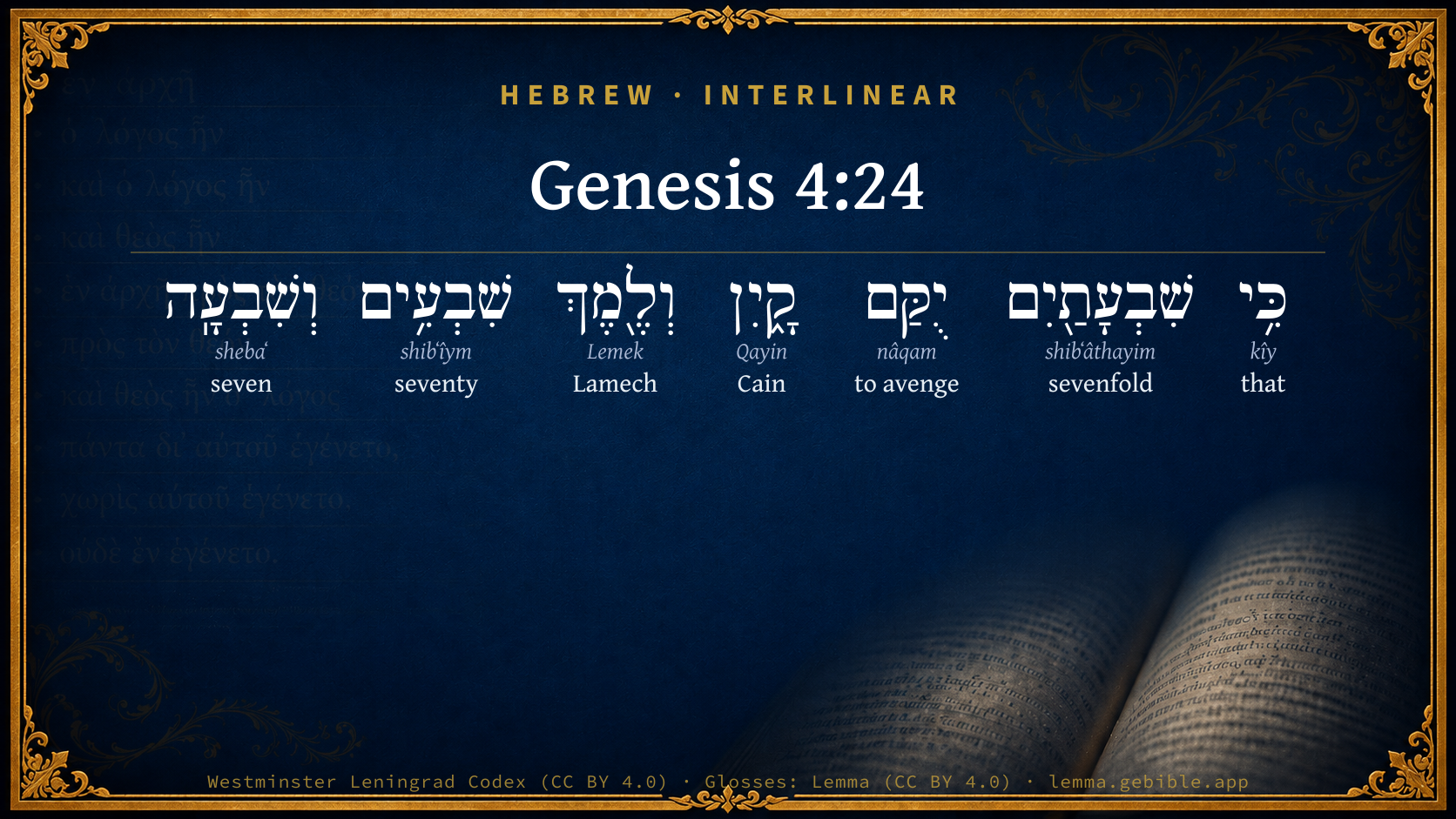
Genesis 4:24

Hebrew (Westminster Leningrad Codex) Genesis 4:24 appears in the Hebrew Old Testament. The text above is from the Westminster Leningrad Codex. Each word links to its Strong’s number, a concise gloss, and parsing drawn from the Open Scriptures Hebrew Bible morphology. Click any word for its full Brown-Driver-Briggs (BDB) entry.
Download image
Cite this verse

Genesis 4:24 (World English Bible). Public Domain. Lemma interlinear Bible study tool, https://lemma.gebible.app/v/genesis/4/24.

Show BibTeX & RIS
BibTeX
RIS
English Translation
If Cain will be avenged seven times, Truly Lamech seventy-seven times."
World English Bible · Public Domain
Highlights Full analysis ↓
Download a study sheet

One document with this verse’s original text, its word-by-word gloss line, the meaning frame, cross-references with their text, attributed commentary, and full source and license credits — printable, and it pastes into notes with its structure intact.

This verse Autodidact and up

Study sheet (.html) Plain text (.txt)

A passage Seminary Student

Up to 50 verses in one chapter. A passage sheet keeps up to 6 commentary sources and 12 cross-references per verse, in the order this page ranks them, and says so on the sheet whenever that leaves anything out. Ask for a single verse and you get the Autodidact verse sheet above.

Everything on this page stays free to read, with no account — the sheet is a download of what is already on screen, not access to it.

Want to remove ads? Support Godless Engineer
Compare translations 3

The same verse in 3 English versions, stacked beneath the original-language interlinear above. Click any original word for its lexicon entry.

Each is an independent rendering of the whole verse — the interlinear is not word-aligned to these translations.

Highlighted words mark where these versions differ — a whole-verse word diff, not a word-by-word alignment.

  • World English Bible Public Domain
    If Cain will be avenged seven times, Truly Lamech seventy-seven times."
  • King James Version Public Domain
    If Cain shall be avenged sevenfold, truly Lamech seventy and sevenfold.
  • unfoldingWord Literal Text CC BY-SA 4.0
    If Cain is avenged seven times, then Lamech seventy-seven times!” Seth and His Son Enosh 4:25-26

unfoldingWord Literal Text — © unfoldingWord, licensed CC BY-SA 4.0. Word-aligned USFM3 via Door43 (git.door43.org/unfoldingWord/en_ult).

Versions to compare (up to 4)

3 of 4 selected

Show all 18 translations

Every available English version of this verse, each an independent rendering of the whole verse.

  • World English Bible Public Domain
    If Cain will be avenged seven times, Truly Lamech seventy-seven times."
  • Berean Standard Bible Public Domain
    If Cain is avenged sevenfold, then Lamech seventy-sevenfold.”
  • Majority Standard Bible Public Domain
    If Cain is avenged sevenfold, then Lamech seventy-sevenfold.”
  • King James Version Public Domain
    If Cain shall be avenged sevenfold, truly Lamech seventy and sevenfold.
  • American Standard Version (1901) Public Domain
    If Cain shall be avenged sevenfold, Truly Lamech seventy and sevenfold.
  • Revised Version (1885) Public Domain
    If Cain shall be avenged sevenfold, Truly Lamech seventy and sevenfold.
  • Geneva Bible (1599) Public Domain
    If Kain shalbe auenged seuen folde, truely Lamech, seuentie times seuen folde.
  • Douay-Rheims (1899) Public Domain
    Sevenfold vengeance shall be taken for Cain: but for Lamech seventy times sevenfold.
  • Young's Literal Translation Public Domain
    For sevenfold is required for Cain, And for Lamech seventy and sevenfold.'
  • Literal Standard Version CC BY-SA 4.0
    For sevenfold is required for Cain, || And for Lamech seventy-sevenfold.”
  • Unlocked Literal Bible CC BY-SA 4.0
    If Cain is avenged seven times, then Lamech will be avenged seventy-seven times.”
  • unfoldingWord Literal Text CC BY-SA 4.0
    If Cain is avenged seven times, then Lamech seventy-seven times!” Seth and His Son Enosh 4:25-26
  • Darby Bible Public Domain
    If Cain shall be avenged seven-fold; Lemech seventy and seven fold.
  • World Messianic Bible Public Domain
    If Cain will be avenged seven times, truly Lamech seventy-seven times.”
  • Webster's Bible Public Domain
    If Cain shall be avenged seven-fold, truly Lamech seventy and seven-fold.
  • Free Bible Version CC BY-SA 4.0
    If the sentence for killing Cain was to be punished seven times over, then if someone kills me, Lamech, the punishment should be seventy-seven times.”
  • Bible in Basic English Public Domain
    If seven lives are to be taken as punishment for Cain's death, seventy-seven will be taken for Lamech's.
  • JPS Tanakh (1917) Public Domain
    If Cain shall be avenged sevenfold, truly Lamech seventy and sevenfold.

Literal Standard Version (2020), Covenant Press — licensed CC BY-SA 4.0. Text via the HelloAO Bible API (eBible.org). Unlocked Literal Bible (unfoldingWord) — licensed CC BY-SA 4.0. Text via the HelloAO Bible API (eBible.org). unfoldingWord Literal Text — © unfoldingWord, licensed CC BY-SA 4.0. Word-aligned USFM3 via Door43 (git.door43.org/unfoldingWord/en_ult). Free Bible Version, Dr. Jonathan Gallagher — licensed CC BY-SA 4.0. Text via the HelloAO Bible API (eBible.org).

Word by word

More ways to search: Search by grammar → Find every occurrence → Compare this word →

Practice this passage: Drill this verse → Learn its vocabulary →

About this verse

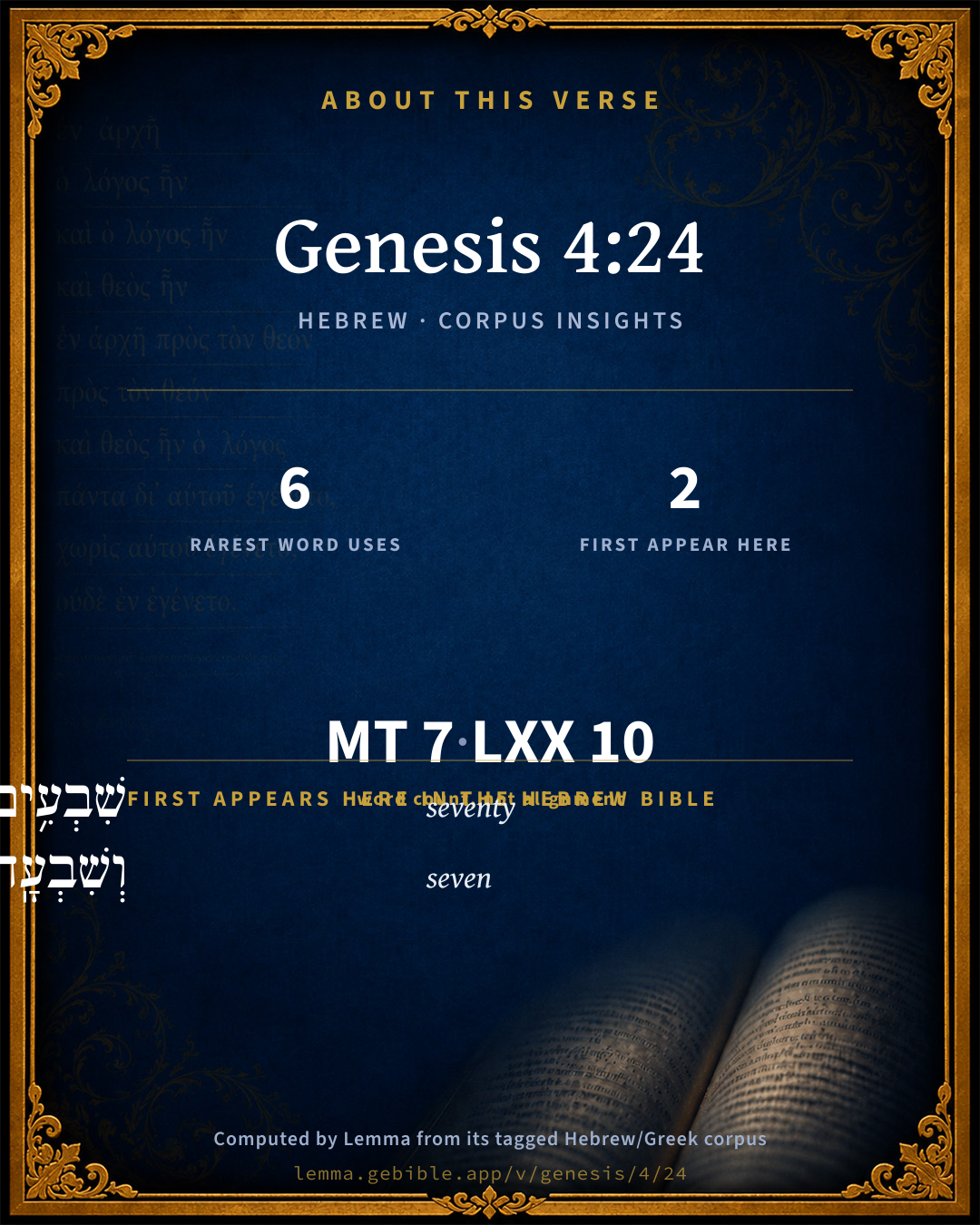
These counts appear in no published source. They are computed here, from the morphology-tagged text and Lemma’s own curated glosses. What Lemma adds →

7
words
7
distinct lemmas
Pentateuch
section

Notable vocabulary

The rarest word here is שִׁבְעָתַ֖יִם sevenfold H7659 — appearing just 6 times in the whole Hebrew Bible.

First appearance in Scripture

These words make their first canonical appearance in the Hebrew Bible here:

  • שִׁבְעִ֥ים seventy H7657
  • וְשִׁבְעָֽה seven H7651

Shared distinctive vocabulary

שִׁבְעָתַ֖יִם sevenfold H7659 occurs in 6 verses of the Hebrew Bible. Also found in:

Grammatical profile

  • 1 verb
  • 3 nouns
  • 2 adjectives
  • 1 conjunction

Verb forms

  • יֻקַּם Hophal · Imperfect

Hebrew & Septuagint length

In English translation the verse runs 11 words from the Hebrew and 18 from the Septuagint (LXX English) — the Septuagint runs noticeably longer here. See the side-by-side →

A rough comparison of the two English renderings, which tokenize alike — not a word-level alignment.

Word counts can differ between the Hebrew and the Greek without any difference in meaning — e.g. the Hebrew direct-object marker אֵת has no separate Greek word, and Greek often adds the article ὁ.

In the original languages it is 7 Hebrew tokens and 10 Greek tokens — but the two are counted differently (Hebrew bundles its prefixes and suffixes into one token; the Greek is in lemma form), so that isn’t a like-for-like length.

Cross-references

2

Topical passages linked to Genesis 4:24 in the Treasury of Scripture Knowledge — connected by theme and wording, ordered by reader-vote popularity; previews shown in the World English Bible.

  • Matthew 18:22 Jesus said to him, "I don't tell you until seven times, but, until seventy times seven.
  • Genesis 4:15 Yahweh said to him, "Therefore whoever slays Cain, vengeance will be taken on him sevenfold." Yahweh appointed a sign for Cain, lest any finding him should strike him.

Cross-references courtesy of OpenBible.info (CC BY 4.0).

Hebrew and Greek witnesses Masoretic Hebrew ↔ Greek Septuagint

The same verse in the two great witnesses to the Old Testament, shown verse-for-verse.

Here the Septuagint runs noticeably longer than the Hebrew — LXX2012 (modern English Septuagint) 18 words vs World English Bible 11. A rough length comparison of the two English translations, not a word-level alignment — read both below.

These are two independent witnesses, not word-aligned to each other, and the Septuagint is shown in lemma (dictionary) form.

Hebrew Genesis 4:24 Masoretic · Westminster Leningrad Codex

כִּ֥י שִׁבְעָתַ֖יִם יֻקַּם קָ֑יִן וְלֶ֖מֶךְ שִׁבְעִ֥ים וְשִׁבְעָֽה

If Cain will be avenged seven times, Truly Lamech seventy-seven times."

World English Bible · Public Domain

Greek LXX Genesis 4:24 Septuagint · lemma form

ὅτι ἑπτάκις ἐκδικέω ἐκ καιν ἐκ δέ λαμεχ ἑβδομηκοντάκις ἑπτά

Because vengeance has been exacted seven times on Cain's behalf, on Lamech's it shall be seventy times seven.

LXX2012 (modern English Septuagint) · Public Domain

Hebrew: Westminster Leningrad Codex (CC BY 4.0). Greek: Septuagint (public domain); English from LXX2012 (modern English Septuagint) (Public Domain). How the Septuagint differs from the Hebrew →

Targum (Aramaic paraphrase)

2

The Targum is the ancient Jewish Aramaic paraphrase of the Hebrew Scriptures — an interpretive translation, not the Hebrew text itself. Onkelos (literal) and Pseudo-Jonathan (expansive) render the Torah, and Jonathan the Prophets. Coverage is partial: where no permissively-licensed English translation exists for a verse, only the Aramaic is shown. This is verse-level text, not a word-by-word alignment to the Hebrew.

  1. Targum Onkelos Torah (Genesis–Deuteronomy)
    אֲרֵי שַׁבְעָא דָּרִין אִיתְלִאוּ לְקָיִן הֲלָא לְלֶמֶךְ בְּרֵהּ שַׁבְעִין וְשַׁבְעָא

    (no public-domain English translation for this verse)

    Targum Onkelos — Aramaic: “Onkelos Genesis” (public domain); “Onkelos Exodus” (public domain); “Onkelos Leviticus” (public domain); “Onkelos Numbers” (public domain); “Onkelos Deuteronomy” (public domain). English: “Sefaria Community Translation” (CC0 1.0 (public-domain dedication)); “J.W. Etheridge. The Targums of Onkelos and Jonathan Ben Uzziel on the Pentateuch. London: Longmans, Green, 1862” (public domain). Text via Sefaria.

  2. Targum Pseudo-Jonathan Torah (Genesis–Deuteronomy)
    אֲרוּם קַיִן דְחַב וְתַב בִּתְיוּבְתָּא עַד שׁוּבְעָא דָרִין אִתְלִיוּ לֵיהּ וְלֶמֶךְ בַּר בְּרֵיהּ דְלָא חַב דִינָא הוּא דְיִתְלֵי לֵיהּ עַד שׁוּבְעִין וְשַׁבְעָא

    For Kain who sinned and was converted by repentance (had protection) unto seven generations extended to him: and to Lemek, the son of his son, who hath not sinned, it is just that it shall be extended unto seventy and seven.

    Targum Pseudo-Jonathan — Aramaic: “Targum Jonathan on Genesis” (public domain); “Targum Jonathan on Exodus” (public domain); “Targum Jonathan on Leviticus” (public domain); “Targum Jonathan on Numbers” (public domain); “Targum Jonathan on Deuteronomy” (public domain). English: “The Targum of Jonathan ben Uzziel, trans. J. W. Etheridge, London, 1862” (public domain). Text via Sefaria.

Commentary

Notes on Genesis 4:24 from classic Christian and Jewish commentators (each source and its license shown beneath its notes). The classic Christian expositions comment on the surrounding passage and are grouped to its opening verse, so a note may address several verses; the Jewish commentaries on the Tanakh (Rashi and others) are per-verse, so they appear only where the commentator wrote on this verse.

Lemma curates 59 commentaries, every one of them public domain or Creative Commons licensed, each selected and text-cleaned for this edition rather than reprinted as found. About our sources →

Trapp's Complete Commentary

John Trapp

Gen 4:24 If Cain shall be avenged sevenfold, truly Lamech seventy and sevenfold.

Ver. 24. If Cain shall be avenged sevenfold, &c.] Boastful Lamech brags, and goes on to outdare God himself. For it is as if he should say, If God will take vengeance on them that condemn him, why may not I on those that condemn me, wives or other? Nay, though God will forgive evils against him, yet will not I evils against me. I’ll have the odds of him, seventy to seven; so Junius interprets it. A desperate expression, and somewhat like that of Pope Julius III., above mentioned, in the last note upon the former chapter; whereunto may here be added, {a} that the same Pope being forbidden by his physician to eat swine’s flesh, as being harmful and bad for his gout, he called for his steward in a great rage, and said, Bring me my pork flesh, al despito di Dio , in despite of God. O wretch!

{a} Act. and Mon., fol. 1417.

John Trapp, A Commentary or Exposition upon All the Books of the Old and New Testament (1647–1656) — public domain. Text from a community e-Sword module.

Geneva Bible (1599)

Geneva Bible translators

He mocked at God’s sufferance in Cain, jesting as though God would suffer none to punish him and yet give him license to murder others.

Geneva Bible (1599) marginal notes — public domain. Text via Bolls.life.

John Calvin's Commentaries

24. Cain shall be avenged sevenfold. It is not my intention to relate the ravings or the dreams of every writer, nor would I have the reader to expect this from me; here and there I allude to them, though sparingly, especially if there be any color of deception; that readers, being often admonished, may learn to take heed unto themselves. Therefore, with respect to this passages which has been variously tortured, I will not record what one or another may have delivered, but will content myself with a true exposition of it. God had intended that Cain should be a horrible example to warn others against the commission of murder; and for this end had marked him with a shameful stigma. Yet lest any one should imitate his crime, He declared whosoever killed him should be punished with sevenfold severity. Lamech, impiously perverting this divine declaration, mocks its severity; for he hence takes greater license to sin, as if God had granted some singular privilege to murderers; not that he seriously thinks so, but being destitute of all sense of piety, he promises himself impunity, and in the meantime jestingly uses the name of God as an excuse: just as Dionysus did, who boasted that the gods favor sacrilegious persons, for the sake of obliterating the infamy which he had contracted. Moreover, as the number seven in Scripture designates a multitudes so sevenfold is taken for a very great increase. Such is the meaning of the declaration of Christ,

‘I do not say that thou shalt remit the offense seven times, but seventy times seven,’ (Matthew 18:22.)

John Calvin's Commentaries (1540-1563) — public domain. Text from the Calvin Translation Society English edition (1840s-50s) via the Christian Classics Ethereal Library (ccel.org). Calvin's coverage is partial (roughly two-thirds of the Bible); uncommented books and verses are honest gaps, never fabricated. The 19th-century editor's footnotes and remarks are omitted so the notes are faithfully Calvin's own voice.

The Cambridge Bible for Schools and Colleges

gen. ed. J. J. S. Perowne

24. seventy and sevenfold] Cf. Gen_4:15. Lamech boasts that seventy and seven deaths should be the penalty of revenge if he were slain.

The first note of warfare is sounded in this fierce exultation in a deed which has exceeded the limits of self-defence and passed into the region of the blood-feud. The possession of new weapons and the lust of revenge are here recorded as the typical elements of the war spirit. “Although, technically, the law of Vengeance was satisfied by a ‘life for a life,’ yet in practice the avenging of blood was often carried to the utmost length of ruthless ferocity. For one life many were taken, the murderer and his kinsfolk together.” (Gordon, Early Traditions of Genesis, p. 204.)

The Cambridge Bible for Schools and Colleges (gen. ed. J. J. S. Perowne; Cambridge University Press, 1878–1918) — public domain. Text from a community e-Sword module.

John Gill's Exposition

And to Seth, to him also there was born a son,.... When he was an hundred and five years old, Gen 5:6 and this is mentioned as a further proof and instance of God's goodness to Adam's family in this line, that there was a succession in it, where the true worship of God was kept, and from whence the Messiah was to arise, and as a pledge and confirmation of it:

and he called his name Enos; which is generally interpreted a weak, feeble, frail, mortal, miserable man; which Seth being sensible of, and observing the sorrows of human life, and especially an increase of them among good men through the growing corruptions of the age, gave this name to his son; though it may be observed, that the derivation of this name may be from the Arabic word "anas" (o), to be sociable and familiar; man being a sociable creature, not only in civil but in religious things, and so a reason of the name may be taken from what follows:

then began men to call upon the name of the Lord; not but that Adam and Abel, and all good men, had called upon the name of the Lord, and prayed to him, or worshipped him before this time personally, and in their families; but now the families of good men being larger, and more numerous, they joined together in social and public worship: or since it may be thought there were public assemblies for religious worship before this time, though it may be they had been neglected, and now were revived with more zeal and vigour; seeing the Cainites incorporating themselves, and joining families together, and building cities, and carrying on their civil and religious affairs among themselves, they also formed themselves into distinct bodies; and not only separated from them, but called themselves by a different name; for so the words may be rendered: "then began men to call themselves", or "to be called by the name of the Lord" (p); the sons of God, as distinct from the sons of men; which distinction may be observed in Gen 6:2 and has been retained more or less ever since: some choose to translate the words, "then began men to call in the name of the Lord" (q); that is, to call upon God in the name of the Messiah, the Mediator between God and man; having now, since the birth of Seth, and especially of Enos, clearer notions of the promised seed, and of the use of him, and his name, in their addresses to God; see Joh 14:13. The Jews give a very different sense of these words; the Targum of Onkelos is,"then in his days the children of men ceased from praying in the name of the Lord;''and the Targum of Jonathan is,"this was the age, in the days of which they began to err, and they made themselves idols, and surnamed their idols by the name of the Word of the Lord;''with which agrees the note of Jarchi,"then they began to call the names of men, and the names of herbs, by the name of the blessed God, to make idols of them:''and some of them say, particularly Maimonides (r), that Enos himself erred, and fell into idolatry, and was the first inventor of images, by the mediation of which men prayed to God: but all this seems to be without foundation, and injurious to the character of this antediluvian patriarch; nor does it appear that idolatry obtained in the posterity of Seth, or among the people of God so early; nor is such an account agreeable to the history which Moses is giving of the family of Seth, in opposition to that of Cain; wherefore one or other of the former senses is best.

(o) "Consuevit, assuevit, et familiaris evasit", Golius, col. 169. (p) "vocari de nomine Jehovae", Piscator. (q) "Ad invocandum in nomine Domini", Montanus, "vel vocare in nomine Domini", Cartwright. (r) Hilchot Obede Cochabim, c. 1. sect. 1. R, Gedaliah, Shalshalet Hakabala, fol. 74. 2. Juchasin, fol. 134. 2.

Next: Genesis Chapter 5

John Gill's Exposition of the Whole Bible (1746–1763) — public domain (CC PDM 1.0). Text via the HelloAO Bible API.

Haydock's Catholic Bible Commentary

Seventy times. A similar expression occurs, Matthew xviii. 22, to denote a great but indefinite number. God had promised to revenge the murder of Cain seven fold, though he had sinned voluntarily; so Lamech hopes that, as he had acted by mistake, and blinded by passion, in striking the stripling, the son of Tubalcain, he would deserve to be protected still more from falling a prey to the fury of any other. But many reject this tradition as fabulous, unknown to Philo, Josephus, &c. Moses no where mentions the death of Cain. Some, therefore, understand this passage with an interrogation; as if, to convince his wives that his sin was not so enormous as was supposed, he should say, Do not think of leaving me. What! have I killed a young man, as Cain did Abel, and still he is suffered to live unmolested; or have I beaten any one so that I should be punished? Onkelos, in effect, puts a negation to the same purport, "I have not killed, &c.:" (Calmet) others understand this passage, as if Lamech considered his crimes as much more grievous than even those of Cain. (Tirinus)

George Leo Haydock (1774–1849), Haydock's Catholic Family Bible and Commentary, 1859 edition — public domain. Excludes Psalms (Douay-Rheims chapter numbering differs from Protestant) and Deuterocanonical books (Catholic canon only).

Matthew Poole's English Annotations

If the slaughter of Cain shall be punished in him that shall kill him, whosoever he be, my death shall be much more certainly and severely revenged by God upon any man that shall murder me. These words may be either,

1. A profane scoff: q.d. Since Cain, my father and pattern in murder, was so far from being punished by the hand of God, that he had a special protection from him that no man should dare to touch him, I (whose murder is not so heinous as his was) shall not fare worse than he, and therefore have no reason to fear either God or men. Or,

2. An argument or ground of his security: q.d. I am not only secured by my own puissance, but by God’s providence; which certainly will be more watchful over me, who have not committed any such horrid crime, than over him that killed his own innocent brother.

Matthew Poole's English Annotations on the Holy Bible (1683–1685) — public domain. Text from a community e-Sword/MySword module.

Rashi

Rabbi Shlomo Yitzchaki (Rashi)

כי שבעתים יקם קין IF CAIN SHALL BE AVENGED SEVENFOLD — (according to Rashi, as previously explained, it signifies “If vengeance shall be taken on Cain after seven generations”). If in the case of Cain who killed with premeditation the punishment was suspended for him until the seventh generation, in the case of myself who slew inadvertently does it not necessarily follow that it should be suspended for me until many seven generations?

שבעים ושבעה SEVENTY AND SEVEN — He uses a term that denotes many periods of seven generations. Thus did R. Tanchuma 1:1:11 explain this passage; but the Midrash Rabbah (Genesis Rabbah 23:4) does not mention that Lamech slew anyone at all, and only states that his wives had lived apart from him after they had born children, because God’s decree had been issued that Cain’s descendants should be exterminated after seven generations. They said, “Why should we bear children only to be destroyed? Soon the Flood will come and will sweep everyone away!” Lamech then said unto them, “Did ‘I’ slay a man ‘לפצע for my wounding” (i.e. that I should be wounded — punished)? Did “I” slay Abel who was a man in height but a child in years, that my descendants should be exterminated on account of this sin (the sin of Cain who killed Abel)? If Cain who did kill had his punishment suspended until the seventh generation, I who have not killed — does it not necessarily follow that my punishment) should be suspended for many seven generations? This, however, is an absurd argument a fortiori, for if so, the Holy One, blessed be He, could never exact his debt nor fulfil his word.

Rashi on the Tanakh — English translations: “The Judaica Press complete Tanach with Rashi, translated by A. J. Rosenberg” (CC BY 4.0); “Pentateuch with Rashi's commentary by M. Rosenbaum and A.M. Silbermann, 1929-1934” (public domain); “The Metsudah Tanach series, Lakewood, N.J” (CC BY 4.0); and “The Book of Joshua, Metsudah Publications, 1997” (CC BY 4.0). Text via Sefaria.

Radak

Rabbi David Kimhi (Radak)

כי שבעתים, this has already been explained in the previous verse. The purpose of the Torah recording all this for all posterity is to demonstrate that in former times, even during the era of idolatry which began with Enosh, people were convinced that G’d supervises the personal fates of His creatures here on earth, meting out punishment to the wicked and reward to the deserving.

Radak on the Tanakh — English translations: “Sefaria Community Translation” (CC0 1.0 (public-domain dedication)); “Eliyahu Munk, HaChut Hameshulash” (CC BY 4.0); “Rabbi Mike Feuer, Jerusalem Anthology” (CC BY 4.0); and “R. David Kimhi on the first book of Psalms, Translated by R.G. Finch, London, 1919” (public domain). Text via Sefaria.

Lesson kit

Teaching starters — assembled from the data on this page, not authored interpretation. Every prompt links to the verse data it draws on. Edit before teaching.

Genesis, in the Pentateuch, opens this verse with 7 words (7 distinct Hebrew lemmas). Its most distinctive word is shibʻâthayim (“sevenfold”). The Greek Septuagint runs longer here. A historical commentator’s framing appears above. Read the whole chapter for the surrounding context.

Discussion questions

  1. The word shibʻâthayim carries the sense “sevenfold.” How does it shape the verse?
  2. 2 words here appear for the first time in Scripture. What is being introduced at this debut?
  3. Genesis 4:15 shares the word «sevenfold» with this verse. How do the two illuminate each other?
  4. Compared with the Hebrew, the Septuagint runs longer here. What questions does that raise?
  5. The translations on this page render this verse differently — a whole-verse word diff, not a word-by-word alignment. What might account for the different wordings?
  6. The verb «יֻקַּם» is Hophal Imperfect. How does its form color the action?
  7. Reading how Trapp's Complete Commentary and Geneva Bible (1599) read this verse, where do the two commentators agree and where do they part?

Things to notice

Reading settings

Reading text

Shown beneath each verse's original-language words.

Old Testament
Old Testament edition

Read the OT as the Masoretic Hebrew (MT) or the Greek Septuagint (LXX).

English shown for the Greek Septuagint (in the Hebrew ↔ Greek comparison).

Comparing translations? Open the Compare panel on any verse page to stack up to four side by side.