
Exodus 38:25

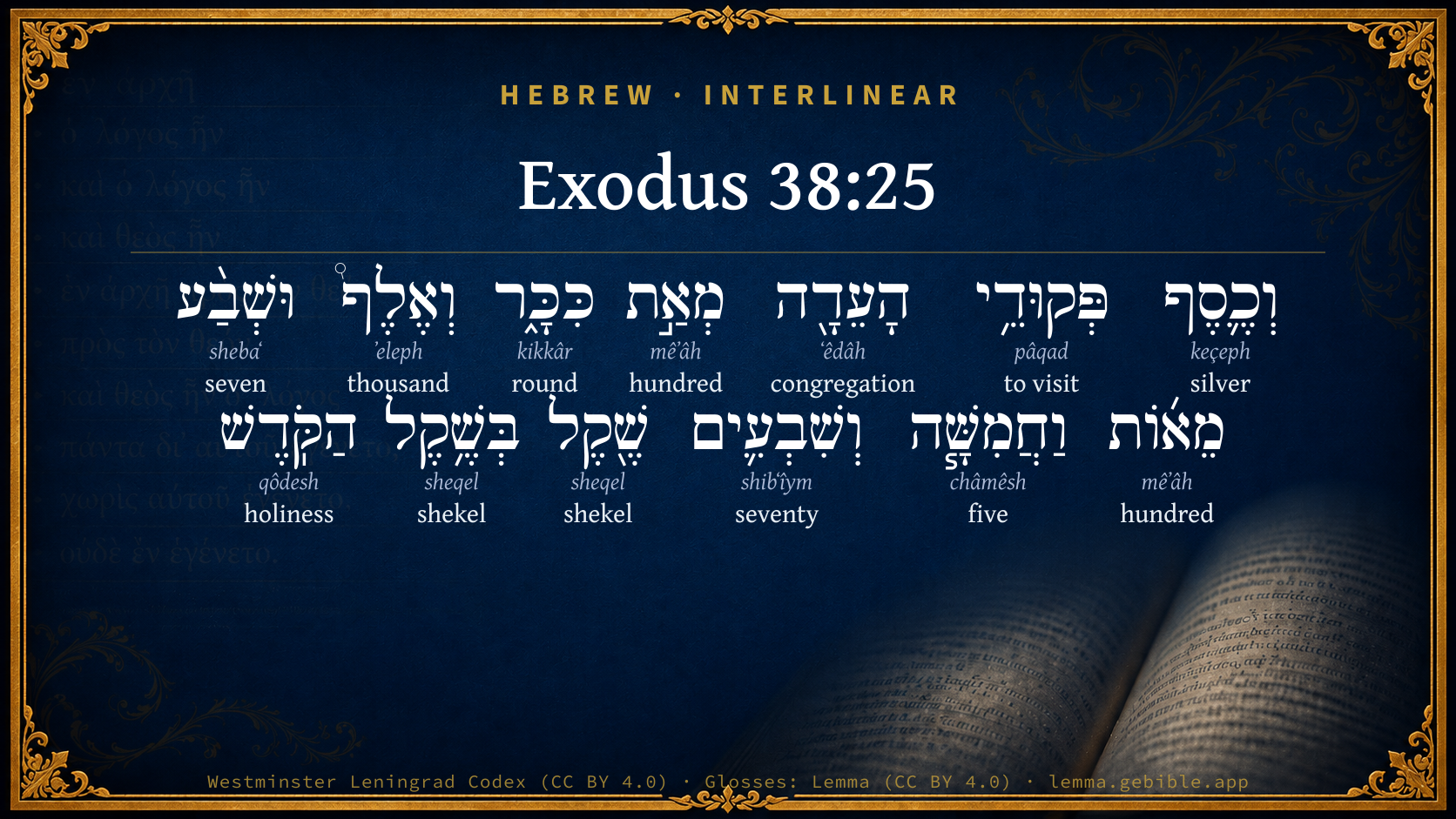
Hebrew (Westminster Leningrad Codex) Exodus 38:25 appears in the Hebrew Old Testament. The text above is from the Westminster Leningrad Codex. Each word links to its Strong’s number, a concise gloss, and parsing drawn from the Open Scriptures Hebrew Bible morphology. Click any word for its full Brown-Driver-Briggs (BDB) entry.
Download image
Cite this verse

Exodus 38:25 (World English Bible). Public Domain. Lemma interlinear Bible study tool, https://lemma.gebible.app/v/exodus/38/25.

Show BibTeX & RIS
BibTeX
RIS
English Translation
The silver of those who were numbered of the congregation was one hundred talents, and one thousand seven hundred seventy-five shekels, after the shekel of the sanctuary:
World English Bible · Public Domain
Download a study sheet

One document with this verse’s original text, its word-by-word gloss line, the meaning frame, cross-references with their text, attributed commentary, and full source and license credits — printable, and it pastes into notes with its structure intact.

This verse Autodidact and up

Study sheet (.html) Plain text (.txt)

A passage Seminary Student

Up to 50 verses in one chapter. A passage sheet keeps up to 6 commentary sources and 12 cross-references per verse, in the order this page ranks them, and says so on the sheet whenever that leaves anything out. Ask for a single verse and you get the Autodidact verse sheet above.

Everything on this page stays free to read, with no account — the sheet is a download of what is already on screen, not access to it.

Want to remove ads? Support Godless Engineer
Compare translations 3

The same verse in 3 English versions, stacked beneath the original-language interlinear above. Click any original word for its lexicon entry.

Each is an independent rendering of the whole verse — the interlinear is not word-aligned to these translations.

Highlighted words mark where these versions differ — a whole-verse word diff, not a word-by-word alignment.

  • World English Bible Public Domain
    The silver of those who were numbered of the congregation was one hundred talents, and one thousand seven hundred seventy-five shekels, after the shekel of the sanctuary:
  • King James Version Public Domain
    And the silver of them that were numbered of the congregation was an hundred talents, and a thousand seven hundred and threescore and fifteen shekels, after the shekel of the sanctuary:
  • unfoldingWord Literal Text CC BY-SA 4.0
    And the silver of the counted of the congregation 100 talents and 1, 775 shekels, by the shekel of the sanctuary,

unfoldingWord Literal Text — © unfoldingWord, licensed CC BY-SA 4.0. Word-aligned USFM3 via Door43 (git.door43.org/unfoldingWord/en_ult).

Versions to compare (up to 4)

3 of 4 selected

Show all 18 translations

Every available English version of this verse, each an independent rendering of the whole verse.

  • World English Bible Public Domain
    The silver of those who were numbered of the congregation was one hundred talents, and one thousand seven hundred seventy-five shekels, after the shekel of the sanctuary:
  • Berean Standard Bible Public Domain
    The silver from those numbered among the congregation totaled 100 talents and 1,775 shekels, according to the sanctuary shekel—
  • Majority Standard Bible Public Domain
    The silver from those numbered among the congregation totaled 100 talents and 1,775 shekels, according to the sanctuary shekel—
  • King James Version Public Domain
    And the silver of them that were numbered of the congregation was an hundred talents, and a thousand seven hundred and threescore and fifteen shekels, after the shekel of the sanctuary:
  • American Standard Version (1901) Public Domain
    And the silver of them that were numbered of the congregation was a hundred talents, and a thousand seven hundred and threescore and fifteen shekels, after the shekel of the sanctuary:
  • Revised Version (1885) Public Domain
    And the silver of them that were numbered of the congregation was an hundred talents, and a thousand seven hundred and threescore and fifteen shekels, after the shekel of the sanctuary:
  • Geneva Bible (1599) Public Domain
    But the siluer of them that were numbred in the Congregation, was an hundreth talents, and a thousand seuen hundreth seuentie and fiue shekels, after the shekel of the Sanctuarie.
  • Douay-Rheims (1899) Public Domain
    And it was offered by them that went to be numbered, from twenty years old and upwards, of six hundred and three thousand five hundred and fifty men able to bear arms.
  • Young's Literal Translation Public Domain
    And the silver of those numbered of the company `is' a hundred talents, and a thousand and seven hundred and five and seventy shekels, by the shekel of the sanctuary;
  • Literal Standard Version CC BY-SA 4.0
    And the silver of those numbered of the congregation [is] one hundred talents, and one thousand and seven hundred and seventy-five shekels, by the shekel of the holy place;
  • Unlocked Literal Bible CC BY-SA 4.0
    The silver given by the community weighed one hundred talents and 1,775 shekels, according to the sanctuary shekel,
  • unfoldingWord Literal Text CC BY-SA 4.0
    And the silver of the counted of the congregation 100 talents and 1, 775 shekels, by the shekel of the sanctuary,
  • Darby Bible Public Domain
    And the silver of them that were numbered of the assembly was a hundred talents, and a thousand seven hundred and seventy-five shekels, according to the shekel of the sanctuary:
  • World Messianic Bible Public Domain
    The silver of those who were counted of the congregation was one hundred talents and one thousand seven hundred seventy-five shekels, according to the shekel of the sanctuary:
  • Webster's Bible Public Domain
    And the silver of them that were numbered of the congregation was a hundred talents, and a thousand seven hundred and seventy five shekels, after the shekel of the sanctuary:
  • Free Bible Version CC BY-SA 4.0
    The total amount of silver from those who had been counted in the census was 100 talents and 1,775 shekels (using the sanctuary shekel standard).
  • Bible in Basic English Public Domain
    And the silver given by those who were numbered of the people was a hundred talents, and a thousand, seven hundred and seventy-five shekels in weight, by the scale of the holy place.
  • JPS Tanakh (1917) Public Domain
    And the silver of them that were numbered of the congregation was a hundred talents, and a thousand seven hundred and three-score and fifteen shekels, after the shekel of the sanctuary:

Literal Standard Version (2020), Covenant Press — licensed CC BY-SA 4.0. Text via the HelloAO Bible API (eBible.org). Unlocked Literal Bible (unfoldingWord) — licensed CC BY-SA 4.0. Text via the HelloAO Bible API (eBible.org). unfoldingWord Literal Text — © unfoldingWord, licensed CC BY-SA 4.0. Word-aligned USFM3 via Door43 (git.door43.org/unfoldingWord/en_ult). Free Bible Version, Dr. Jonathan Gallagher — licensed CC BY-SA 4.0. Text via the HelloAO Bible API (eBible.org).

Word by word

More ways to search: Search by grammar → Find every occurrence → Compare this word →

Practice this passage: Drill this verse → Learn its vocabulary →

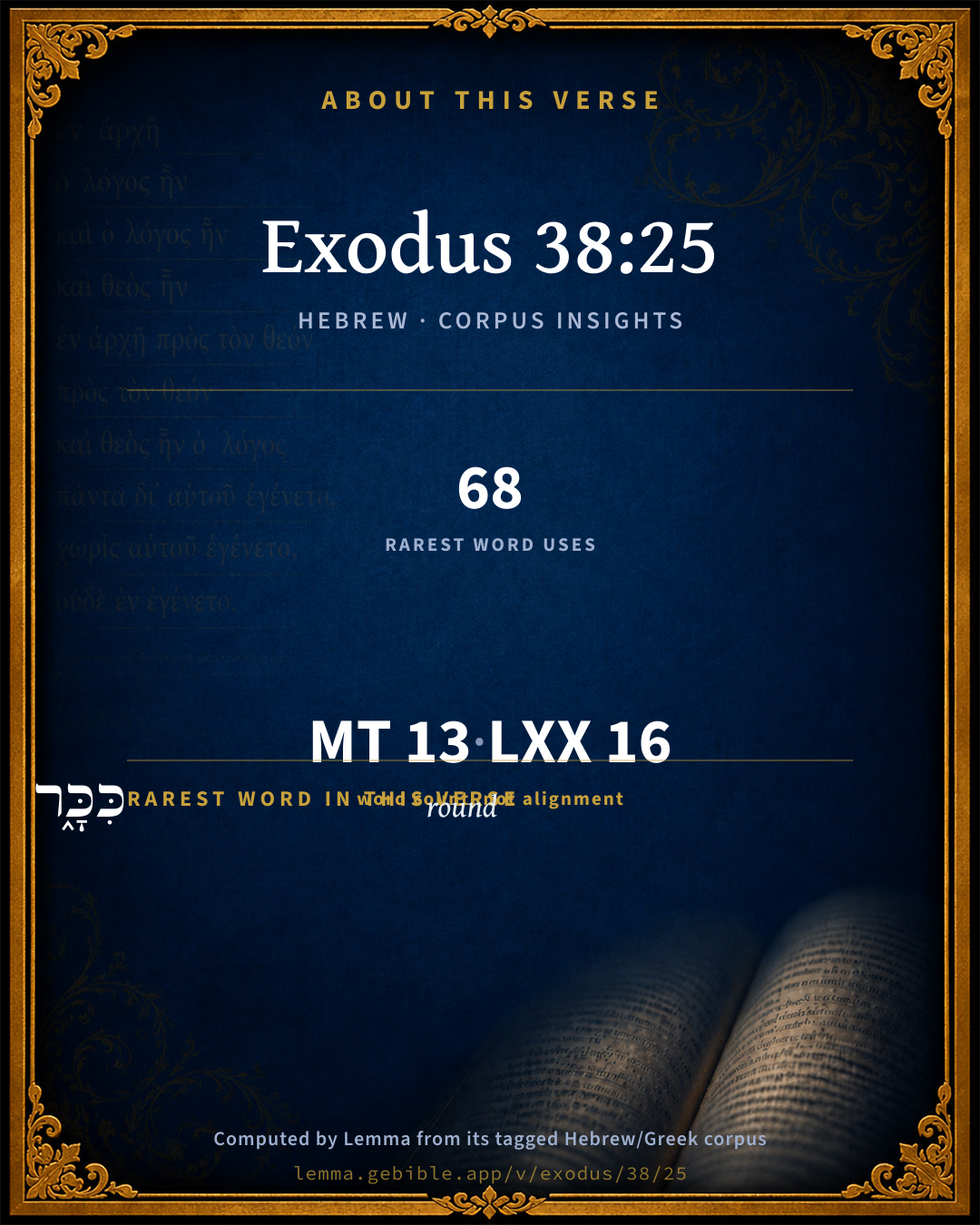
כִּכָּ֑ר
kikkâr
H3603
“round”
Noun, Common, Both, Singular, Absolute
Part of Speech
Noun
Type
Common
Gender
Both
Number
Singular
State
Absolute
Full BDB Definition

Origin: from H3769

TWOT: None

round - a round district (environs of the Jordan valley) - a round loaf (of bread) - a round weight, talent (of gold, silver, bronze, iron)
  1. וְכֶ֛סֶף keçeph H3701 “and · silver of” Conjunction + Noun, Common, Masculine, Singular, Construct
  2. פְּקוּדֵ֥י pâqad H6485 “visited” Verb, Qal, Participle Passive, Masculine, Plural, Construct
  3. הָעֵדָ֖ה ʻêdâh H5712 “the · congregation” Particle, Definite Article + Noun, Common, Feminine, Singular, Absolute
  4. מְאַ֣ת mêʼâh H3967 “hundred” Adjective, Cardinal number, Feminine, Singular, Construct
  5. וְאֶלֶף֩ ʼeleph H505 “and · thousand” Conjunction + Adjective, Cardinal number, Both, Singular, Absolute
  6. וּשְׁבַ֨ע shebaʻ H7651 “and · seven” Conjunction + Adjective, Cardinal number, Feminine, Singular, Absolute
  7. מֵא֜וֹת mêʼâh H3967 “hundred” Adjective, Cardinal number, Both, Plural, Absolute
  8. וַחֲמִשָּׁ֧ה châmêsh H2568 “and · five” Conjunction + Adjective, Cardinal number, Masculine, Singular, Absolute
  9. וְשִׁבְעִ֛ים shibʻîym H7657 “and · seventy” Conjunction + Adjective, Cardinal number, Both, Plural, Absolute
  10. שֶׁ֖קֶל sheqel H8255 “shekel” Noun, Common, Masculine, Singular, Absolute
  11. בְּשֶׁ֥קֶל sheqel H8255 “in/at · shekel of” Preposition + Noun, Common, Masculine, Singular, Construct
  12. הַקֹּֽדֶשׁ qôdesh H6944 “the · holiness” Particle, Definite Article + Noun, Common, Masculine, Singular, Absolute

About this verse

These counts appear in no published source. They are computed here, from the morphology-tagged text and Lemma’s own curated glosses. What Lemma adds →

13
words
11
distinct lemmas
Pentateuch
section

Grammatical profile

  • 1 verb
  • 6 nouns
  • 6 adjectives

Verb forms

  • פְּקוּדֵ֥י Qal · Participle Passive

Repetition

Words recur within this verse — often emphatic in Hebrew:

  • מְאַ֣ת hundred H3967 ×2
  • שֶׁ֖קֶל shekel H8255 ×2

Hebrew & Septuagint length

In English translation the verse runs 27 words from the Hebrew and 18 from the Septuagint (LXX English) — the Septuagint runs noticeably shorter here. See the side-by-side →

A rough comparison of the two English renderings, which tokenize alike — not a word-level alignment.

Word counts can differ between the Hebrew and the Greek without any difference in meaning — e.g. the Hebrew direct-object marker אֵת has no separate Greek word, and Greek often adds the article ὁ.

In the original languages it is 13 Hebrew tokens and 16 Greek tokens — but the two are counted differently (Hebrew bundles its prefixes and suffixes into one token; the Greek is in lemma form), so that isn’t a like-for-like length.

Cross-references

1

Topical passages linked to Exodus 38:25 in the Treasury of Scripture Knowledge — connected by theme and wording, ordered by reader-vote popularity; previews shown in the World English Bible.

  • Exodus 30:12 "When you take a census of the children of Israel, according to those who are numbered among them, then each man shall give a ransom for his soul to Yahweh, when you number them; that there be no plague among them when you number them.

Cross-references courtesy of OpenBible.info (CC BY 4.0).

Hebrew and Greek witnesses Masoretic Hebrew ↔ Greek Septuagint

The same verse in the two great witnesses to the Old Testament, shown verse-for-verse.

Here the Septuagint runs noticeably shorter than the Hebrew — LXX2012 (modern English Septuagint) 18 words vs World English Bible 27. A rough length comparison of the two English translations, not a word-level alignment — read both below.

These are two independent witnesses, not word-aligned to each other, and the Septuagint is shown in lemma (dictionary) form.

Hebrew Exodus 38:25 Masoretic · Westminster Leningrad Codex

וְכֶ֛סֶף פְּקוּדֵ֥י הָעֵדָ֖ה מְאַ֣ת כִּכָּ֑ר וְאֶלֶף֩ וּשְׁבַ֨ע מֵא֜וֹת וַחֲמִשָּׁ֧ה וְשִׁבְעִ֛ים שֶׁ֖קֶל בְּשֶׁ֥קֶל הַקֹּֽדֶשׁ

The silver of those who were numbered of the congregation was one hundred talents, and one thousand seven hundred seventy-five shekels, after the shekel of the sanctuary:

World English Bible · Public Domain

Greek LXX Exodus 38:25 Septuagint · lemma form

οὗτος ποιέω ὁ ἔλαιον ὁ χρίσις ὁ ἅγιος καί ὁ σύνθεσις ὁ θυμίαμα καθαρός ἔργον μυρεψός

He made the holy anointing oil and the composition of the incense, the pure work of the perfumer.

LXX2012 (modern English Septuagint) · Public Domain

Hebrew: Westminster Leningrad Codex (CC BY 4.0). Greek: Septuagint (public domain); English from LXX2012 (modern English Septuagint) (Public Domain). How the Septuagint differs from the Hebrew →

Targum (Aramaic paraphrase)

2

The Targum is the ancient Jewish Aramaic paraphrase of the Hebrew Scriptures — an interpretive translation, not the Hebrew text itself. Onkelos (literal) and Pseudo-Jonathan (expansive) render the Torah, and Jonathan the Prophets. Coverage is partial: where no permissively-licensed English translation exists for a verse, only the Aramaic is shown. This is verse-level text, not a word-by-word alignment to the Hebrew.

  1. Targum Onkelos Torah (Genesis–Deuteronomy)
    וּכְסַף מִנְיָנֵי כְנִשְׁתָּא מְאָה כִכְּרִין וְאֶלֶף וּשְׁבַע מְאָה וְשִׁבְעִין וְחַמְשָׁא סִלְעִין בְּסִלְעֵי קוּדְשָׁא:

    (no public-domain English translation for this verse)

    Targum Onkelos — Aramaic: “Onkelos Genesis” (public domain); “Onkelos Exodus” (public domain); “Onkelos Leviticus” (public domain); “Onkelos Numbers” (public domain); “Onkelos Deuteronomy” (public domain). English: “Sefaria Community Translation” (CC0 1.0 (public-domain dedication)); “J.W. Etheridge. The Targums of Onkelos and Jonathan Ben Uzziel on the Pentateuch. London: Longmans, Green, 1862” (public domain). Text via Sefaria.

  2. Targum Pseudo-Jonathan Torah (Genesis–Deuteronomy)
    וּכְסַף מִנְיָינֵי דִּבְנֵי יִשְרָאֵל דִּיהָבוּ בִּזְמַן דִּמְמַנּוּן משֶׁה גְּבַר פּוּרְקַן נַפְשֵׁיהּ מְאָה קַנְטְרִין וְאַלְפָא וּשְׁבַע מְאָה וְשׁוּבְעִין וְחָמֵשׁ סַלְעִין בְּסִלְעֵי קוּדְשָׁא

    And the silver of them who were numbered of the sons of Israel, who gave at the time when Mosheh numbered them, every one for the redemption of his soul, a hundred talents, and a thousand and seven hundred and seventy and five shekels, of the shekel of the sanctuary.

    Targum Pseudo-Jonathan — Aramaic: “Targum Jonathan on Genesis” (public domain); “Targum Jonathan on Exodus” (public domain); “Targum Jonathan on Leviticus” (public domain); “Targum Jonathan on Numbers” (public domain); “Targum Jonathan on Deuteronomy” (public domain). English: “The Targum of Jonathan ben Uzziel, trans. J. W. Etheridge, London, 1862” (public domain). Text via Sefaria.

Commentary

Notes on Exodus 38:25 from classic Christian and Jewish commentators (each source and its license shown beneath its notes). The classic Christian expositions comment on the surrounding passage and are grouped to its opening verse, so a note may address several verses; the Jewish commentaries on the Tanakh (Rashi and others) are per-verse, so they appear only where the commentator wrote on this verse.

Lemma curates 59 commentaries, every one of them public domain or Creative Commons licensed, each selected and text-cleaned for this edition rather than reprinted as found. About our sources →

Jamieson, Fausset & Brown

Robert Jamieson, A. R. Fausset & David Brown

the silver of them that were numbered--603,550 men at half a shekel each would contribute 301,775 shekels; which at 2s. 4d. each, amounts to £35,207 sterling. It may seem difficult to imagine how the Israelites should be possessed of so much wealth in the desert; but it should be remembered that they were enriched first by the spoils of the Egyptians, and afterwards by those of the Amalekites. Besides, it is highly probable that during their sojourn they traded with the neighboring nations who bordered on the wilderness [HEWLETT].

Next: Exodus Chapter 39

Jamieson, Fausset & Brown — Commentary Critical and Explanatory on the Whole Bible (1871) — public domain (CC PDM 1.0). Text via the HelloAO Bible API.

Ellicott's Commentary for English Readers

(25) The silver . . . was an hundred talents.—The silver talent contained 3,000 shekels, as all allow, and as appears from the present passage. If the “shekel of the sanctuary” weighed, as is generally supposed, about 220 grains troy, the value of the silver contributed would have been £40,000, or a little under. It was contributed by “them that were numbered of the congregation,” each of whom paid a bekah, or half a shekel. (See above, Exo_30:12-16.)

A Bible Commentary for English Readers, edited by Charles John Ellicott (1878–1897) — public domain. Text from a community e-Sword module.

The Cambridge Bible for Schools and Colleges

gen. ed. J. J. S. Perowne

25–28. The silver, with particulars of the purposes for which it was used. This amounted to 100 talents and 1775 shekels, i.e. 301,775 shekels (c. Exo 140,828 oz.), being half a shekel a head, exacted (according to Exo_30:13 f.) from the 603,550 male Israelites, of 20 years old and upwards, of the census described in Numbers 1 (see v. 46). No account is taken of the silver offered voluntarily (Exo_25:3, Exo_35:5 f., 24).

The Cambridge Bible for Schools and Colleges (gen. ed. J. J. S. Perowne; Cambridge University Press, 1878–1918) — public domain. Text from a community e-Sword module.

John Gill's Exposition

And of the hundred talents of silver were cast the sockets of the sanctuary, and the sockets of the vail,.... The sockets for the boards of the tabernacle, into which they were put; and the sockets for the vail, which divided between the holy and the most holy place, in which the pillars were set the vail was hung upon, and which was the silver foundation of the whole fabric:

one hundred sockets of the one hundred talents, a talent for a socket; there were ninety six sockets for the sanctuary or tabernacle, and four for the vail; and on each of these a talent of silver was expended; which, according to Dr. Cumberland, was three hundred and fifty three pounds, eleven shillings, and some odd pence; so much every socket cost.

John Gill's Exposition of the Whole Bible (1746–1763) — public domain (CC PDM 1.0). Text via the HelloAO Bible API.

Haydock's Catholic Bible Commentary

And it, &c. Hebrew is rather more express, "And the silver given by those who were numbered, was a hundred talents, 1775 sicles of the weight of the sanctuary, ver. 26. They gave each half a sicle, paid by all those who were 20 years old and upwards, amounting to 603,550 men." Hence the talent would weigh exactly 3000 sicles, (Calmet) or 12,000 drachmas. Some say that the common talent weighed 100 pounds, and that of the sanctuary 120, each pound containing 25 sicles. (Du Hamel)

George Leo Haydock (1774–1849), Haydock's Catholic Family Bible and Commentary, 1859 edition — public domain. Excludes Psalms (Douay-Rheims chapter numbering differs from Protestant) and Deuterocanonical books (Catholic canon only).

The Pulpit Commentary

The silver. The silver seems to have amounted to about four times the weight of the gold; but the value of it was very much less, not exceeding of our money (Cook). It may seem surprising that this should have been so; but there are grounds for believing that both in Africa and in Asia gold was more plentiful than silver in the early ages. And it is certainly much more suitable for ornaments. Of them that were numbered. See above, Exo_30:12-16. The silver for the sanctuary was collected by a compulsory tax, of the nature of a church-rate. This produced the amount here given, No estimate is made of the weight of the silver freewill offerings, (Exo_35:24) nor is any account given of their application. It has been suggested that they were returned to the donors as superfluous, which is certainly possible,

The Pulpit Commentary (1880–1919), ed. H.D.M. Spence-Jones & Joseph S. Exell — public domain. Text from a community e-Sword module.

Lesson kit

Teaching starters — assembled from the data on this page, not authored interpretation. Every prompt links to the verse data it draws on. Edit before teaching.

Exodus, in the Pentateuch, opens this verse with 13 words (11 distinct Hebrew lemmas). Its most distinctive word is kikkâr (“round”). The Greek Septuagint runs shorter here. A historical commentator’s framing appears above. Read the whole chapter for the surrounding context.

Discussion questions

  1. How does “round” (kikkâr) shape what this verse is saying?
  2. Exodus 30:12 shares this passage’s theme. How do the two illuminate each other?
  3. “hundred” occurs 2× in this one verse. What is the effect of the repetition?
  4. Compared with the Hebrew, the Septuagint runs shorter here. What questions does that raise?
  5. These translations render this verse differently. What is at stake in choosing one wording over another?
  6. The verb «פְּקוּדֵ֥י» is Qal Participle Passive. How does its form color the action?
  7. Reading how Jamieson, Fausset & Brown and Ellicott's Commentary for English Readers read this verse, where do the two commentators agree and where do they part?

Things to notice

Reading settings

Reading text

Shown beneath each verse's original-language words.

Old Testament
Old Testament edition

Read the OT as the Masoretic Hebrew (MT) or the Greek Septuagint (LXX).

English shown for the Greek Septuagint (in the Hebrew ↔ Greek comparison).

Comparing translations? Open the Compare panel on any verse page to stack up to four side by side.