Leviticus 26:18

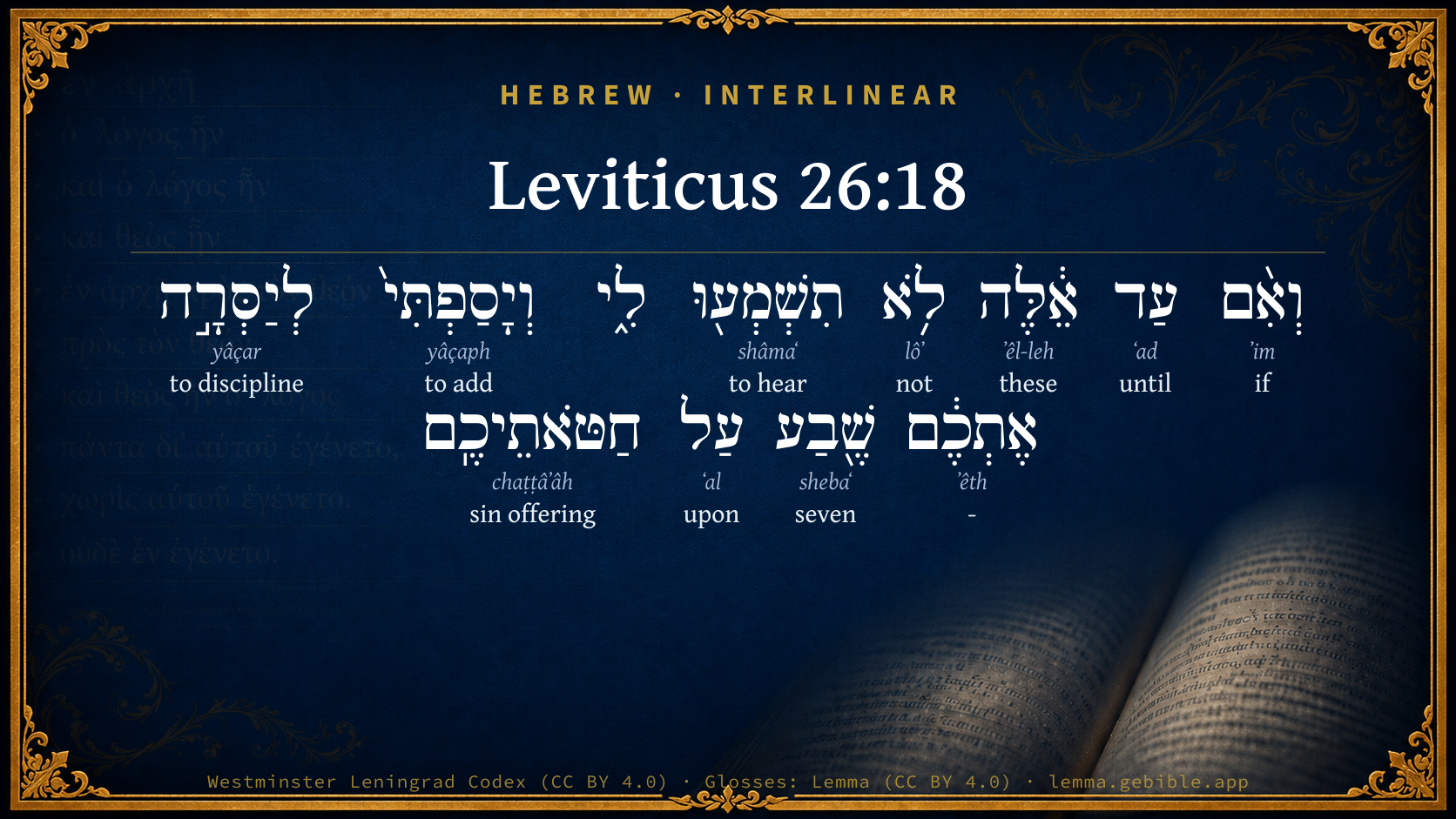
Hebrew (Westminster Leningrad Codex) Leviticus 26:18 appears in the Hebrew Old Testament. The text above is from the Westminster Leningrad Codex. Each word links to its Strong’s number, a concise gloss, and parsing drawn from the Open Scriptures Hebrew Bible morphology. Click any word for its full Brown-Driver-Briggs (BDB) entry.
Download image
Cite this verse

Leviticus 26:18 (World English Bible). Public Domain. Lemma interlinear Bible study tool, https://lemma.gebible.app/v/leviticus/26/18.

Show BibTeX & RIS
BibTeX
RIS
English Translation
"'If you in spite of these things will not listen to me, then I will chastise you seven times more for your sins.
World English Bible · Public Domain
Highlights
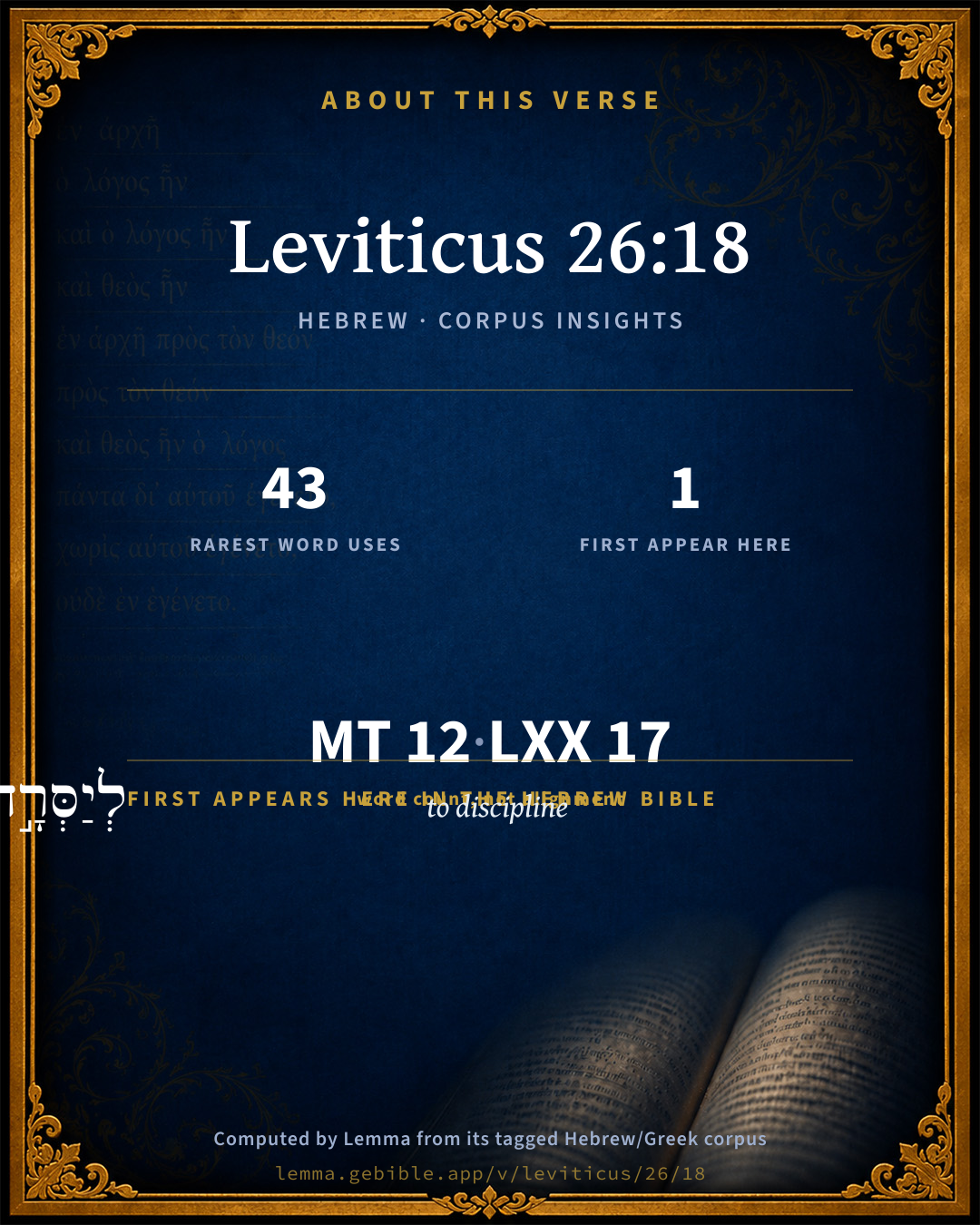
  • 1 first appearance in the Hebrew Bible
Full analysis ↓
Download a study sheet

One document with this verse’s original text, its word-by-word gloss line, the meaning frame, cross-references with their text, attributed commentary, and full source and license credits — printable, and it pastes into notes with its structure intact.

This verse Autodidact and up

Study sheet (.html) Plain text (.txt)

A passage Seminary Student

Up to 50 verses in one chapter. A passage sheet keeps up to 6 commentary sources and 12 cross-references per verse, in the order this page ranks them, and says so on the sheet whenever that leaves anything out. Ask for a single verse and you get the Autodidact verse sheet above.

Everything on this page stays free to read, with no account — the sheet is a download of what is already on screen, not access to it.

Want to remove ads? Support Godless Engineer
Compare translations 3

The same verse in 3 English versions, stacked beneath the original-language interlinear above. Click any original word for its lexicon entry.

Each is an independent rendering of the whole verse — the interlinear is not word-aligned to these translations.

Highlighted words mark where these versions differ — a whole-verse word diff, not a word-by-word alignment.

  • World English Bible Public Domain
    "'If you in spite of these things will not listen to me, then I will chastise you seven times more for your sins.
  • King James Version Public Domain
    And if ye will not yet for all this hearken unto me, then I will punish you seven times more for your sins.
  • unfoldingWord Literal Text CC BY-SA 4.0
    And if up to these you will not listen to me, then I will continue to discipline you seven for your sins.

unfoldingWord Literal Text — © unfoldingWord, licensed CC BY-SA 4.0. Word-aligned USFM3 via Door43 (git.door43.org/unfoldingWord/en_ult).

Versions to compare (up to 4)

3 of 4 selected

Show all 18 translations

Every available English version of this verse, each an independent rendering of the whole verse.

  • World English Bible Public Domain
    "'If you in spite of these things will not listen to me, then I will chastise you seven times more for your sins.
  • Berean Standard Bible Public Domain
    And if after all this you will not obey Me, I will proceed to punish you sevenfold for your sins.
  • Majority Standard Bible Public Domain
    And if after all this you will not obey Me, I will proceed to punish you sevenfold for your sins.
  • King James Version Public Domain
    And if ye will not yet for all this hearken unto me, then I will punish you seven times more for your sins.
  • American Standard Version (1901) Public Domain
    And if ye will not yet for these things hearken unto me, then I will chastise you seven times more for your sins.
  • Revised Version (1885) Public Domain
    And if ye will not yet for these things hearken unto me, then I will chastise you seven times more for your sins.
  • Geneva Bible (1599) Public Domain
    And if ye wil not for these things obey me, then wil I punish you seuen times more, according to your sinnes,
  • Douay-Rheims (1899) Public Domain
    But if you will not yet for all this obey me: I will chastise you seven times more for your sins,
  • Young's Literal Translation Public Domain
    `And if unto these ye hearken not to Me, -- then I have added to chastise you seven times for your sins;
  • Literal Standard Version CC BY-SA 4.0
    And if up to these you [still] do not listen to Me—then I have added to discipline you sevenfold for your sins;
  • Unlocked Literal Bible CC BY-SA 4.0
    If after all this you do not listen to me, then I will punish you seven times as severely for your sins.
  • unfoldingWord Literal Text CC BY-SA 4.0
    And if up to these you will not listen to me, then I will continue to discipline you seven for your sins.
  • Darby Bible Public Domain
    And if for this ye hearken not unto me, I will punish you sevenfold more for your sins,
  • World Messianic Bible Public Domain
    “‘If you in spite of these things will not listen to me, then I will chastise you seven times more for your sins.
  • Webster's Bible Public Domain
    And if ye will not yet for all this hearken to me, then I will punish you seven times more for your sins.
  • Free Bible Version CC BY-SA 4.0
    If after all this you still refuse to obey me, I will move to punishing you seven times over for your sins.
  • Bible in Basic English Public Domain
    And if, even after these things, you will not give ear to me, then I will send you punishment seven times more for your sins.
  • JPS Tanakh (1917) Public Domain
    And if ye will not yet for these things hearken unto Me, then I will chastise you seven times more for your sins.

Literal Standard Version (2020), Covenant Press — licensed CC BY-SA 4.0. Text via the HelloAO Bible API (eBible.org). Unlocked Literal Bible (unfoldingWord) — licensed CC BY-SA 4.0. Text via the HelloAO Bible API (eBible.org). unfoldingWord Literal Text — © unfoldingWord, licensed CC BY-SA 4.0. Word-aligned USFM3 via Door43 (git.door43.org/unfoldingWord/en_ult). Free Bible Version, Dr. Jonathan Gallagher — licensed CC BY-SA 4.0. Text via the HelloAO Bible API (eBible.org).

Word by word

More ways to search: Search by grammar → Find every occurrence → Compare this word →

Practice this passage: Drill this verse → Learn its vocabulary →

לְיַסְּרָ֣ה
yâçar
H3256
“to discipline”
Preposition + Verb, Piel, Infinitive Construct
Part of Speech
Preposition + Verb
Stem
Piel
Form
Infinitive Construct
Full BDB Definition

Origin: a primitive root

TWOT: 877

to chasten, discipline, instruct, admonish - (Qal) - to chasten, admonish - to instruct - to discipline - (Niphal) to let oneself be chastened or corrected or admonished - (Piel) - to discipline, correct - to chasten, chastise - (Hiphil) to chasten - (Nithpael) to teach
  1. וְאִ֨ם ʼim H518 “and · if” Conjunction + Conjunction
  2. עַד ʻad H5704 “until” Preposition
  3. אֵ֔לֶּה ʼêl-leh H428 “these” Pronoun, Demonstrative, Common, Plural
  4. לֹ֥א lôʼ H3808 “not” Particle, Negative
  5. תִשְׁמְע֖וּ shâmaʻ H8085 “to hear” Verb, Qal, Imperfect, 2nd Person, Masculine, Plural
  6. וְיָסַפְתִּי֙ yâçaph H3254 “and · to add” Conjunction + Verb, Qal, Sequential Perfect, 1st Person, Common, Singular
  7. אֶתְכֶ֔ם ʼêth H853 “- · you” Particle, Direct Object + Suffix, Personal, 2nd Person, Masculine, Plural
  8. שֶׁ֖בַע shebaʻ H7651 “seven” Adjective, Cardinal number, Feminine, Singular, Absolute
  9. עַל ʻal H5921 “upon” Preposition
  10. חַטֹּאתֵיכֶֽם chaṭṭâʼâh H2403 “sin offerings · your” Noun, Common, Feminine, Plural, Construct + Suffix, Personal, 2nd Person, Masculine, Plural

About this verse

These counts appear in no published source. They are computed here, from the morphology-tagged text and Lemma’s own curated glosses. What Lemma adds →

12
words
11
distinct lemmas
Pentateuch
section

First appearance in Scripture

This word makes its first canonical appearance in the Hebrew Bible here:

  • לְיַסְּרָ֣ה to discipline H3256

Shared distinctive vocabulary

לְיַסְּרָ֣ה to discipline H3256 occurs in 38 verses of the Hebrew Bible. Also found in:

Grammatical profile

  • 3 verbs
  • 1 noun
  • 1 adjective
  • 1 pronoun
  • 3 prepositions
  • 1 conjunction
  • 2 particles

Verb forms

  • תִשְׁמְע֖וּ Qal · Imperfect
  • וְיָסַפְתִּי֙ Qal · Sequential Perfect
  • לְיַסְּרָ֣ה Piel · Infinitive Construct

Hebrew & Septuagint length

In English translation the verse runs 23 words from the Hebrew and 22 from the Septuagint (LXX English) — closely comparable.

A rough comparison of the two English renderings, which tokenize alike — not a word-level alignment.

Word counts can differ between the Hebrew and the Greek without any difference in meaning — e.g. the Hebrew direct-object marker אֵת has no separate Greek word, and Greek often adds the article ὁ.

In the original languages it is 12 Hebrew tokens and 17 Greek tokens — but the two are counted differently (Hebrew bundles its prefixes and suffixes into one token; the Greek is in lemma form), so that isn’t a like-for-like length.

Cross-references

7

Topical passages linked to Leviticus 26:18 in the Treasury of Scripture Knowledge — connected by theme and wording, ordered by reader-vote popularity; previews shown in the World English Bible.

  • Leviticus 26:21 "'If you walk contrary to me, and won't listen to me, then I will bring seven times more plagues on you according to your sins.
  • Leviticus 26:24 then I will also walk contrary to you; and I will strike you, even I, seven times for your sins.
  • Leviticus 26:28 then I will walk contrary to you in wrath; and I also will chastise you seven times for your sins.
  • 1 Samuel 2:5 Those who were full have hired out themselves for bread; Those who were hungry have ceased [to hunger]: Yes, the barren has borne seven; She who has many children languishes.
  • Psalms 119:164 Seven times a day, I praise you, Because of your righteous ordinances.
  • Proverbs 24:16 For a righteous man falls seven times, and rises up again; But the wicked are overthrown by calamity.
  • Daniel 3:19 Then was Nebuchadnezzar full of fury, and the form of his visage was changed against Shadrach, Meshach, and Abednego: [therefore] he spoke, and commanded that they should heat the furnace seven times more than it was wont to be heated.

Cross-references courtesy of OpenBible.info (CC BY 4.0).

Hebrew and Greek witnesses Masoretic Hebrew ↔ Greek Septuagint

The same verse in the two great witnesses to the Old Testament, shown verse-for-verse.

These are two independent witnesses, not word-aligned to each other, and the Septuagint is shown in lemma (dictionary) form.

Hebrew Leviticus 26:18 Masoretic · Westminster Leningrad Codex

וְאִ֨ם עַד אֵ֔לֶּה לֹ֥א תִשְׁמְע֖וּ לִ֑י וְיָסַפְתִּי֙ לְיַסְּרָ֣ה אֶתְכֶ֔ם שֶׁ֖בַע עַל חַטֹּאתֵיכֶֽם

"'If you in spite of these things will not listen to me, then I will chastise you seven times more for your sins.

World English Bible · Public Domain

Greek LXX Leviticus 26:18 Septuagint · lemma form

καί ἐάν ἕως οὗτος μή ὑποἀκούω ἐγώ καί προςτίθημι ὁ παιδεύω σύ ἑπτάκις ἐπί ὁ ἁμαρτία σύ

And if you⌃ still refuse to listen to me, then will I chasten you yet more even seven times for your sins.

LXX2012 (modern English Septuagint) · Public Domain

Hebrew: Westminster Leningrad Codex (CC BY 4.0). Greek: Septuagint (public domain); English from LXX2012 (modern English Septuagint) (Public Domain). How the Septuagint differs from the Hebrew →

Targum (Aramaic paraphrase)

2

The Targum is the ancient Jewish Aramaic paraphrase of the Hebrew Scriptures — an interpretive translation, not the Hebrew text itself. Onkelos (literal) and Pseudo-Jonathan (expansive) render the Torah, and Jonathan the Prophets. Coverage is partial: where no permissively-licensed English translation exists for a verse, only the Aramaic is shown. This is verse-level text, not a word-by-word alignment to the Hebrew.

  1. Targum Onkelos Torah (Genesis–Deuteronomy)
    וְאִם עַד אִלֵין לָא תְקַבְּלוּן לְמֵימְרִי וְאוֹסֵף לְמִרְדֵי יָתְכוֹן שְׁבַע עַל חוֹבֵיכוֹן

    (no public-domain English translation for this verse)

    Targum Onkelos — Aramaic: “Onkelos Genesis” (public domain); “Onkelos Exodus” (public domain); “Onkelos Leviticus” (public domain); “Onkelos Numbers” (public domain); “Onkelos Deuteronomy” (public domain). English: “Sefaria Community Translation” (CC0 1.0 (public-domain dedication)); “J.W. Etheridge. The Targums of Onkelos and Jonathan Ben Uzziel on the Pentateuch. London: Longmans, Green, 1862” (public domain). Text via Sefaria.

  2. Targum Pseudo-Jonathan Torah (Genesis–Deuteronomy)
    וְאִין בָּתַר אִלֵין מַרְדְוָותָא לָא תִצְבּוּן לְמִשְׁמַע לְאוּלְפַן אוֹרַיְיתִי וְאוֹסֵף לְמִירְדֵי יַתְכוֹן שְׁבַע מָאחָאתָא עַל שְׁבַע עֲבֵירָן דִי חַטִיתוּן קֳדָמָי

    And if after these chastisements ye be not willing to obey the doctrines of My law, I will add to punish you with seven plagues, for the seven transgressions with which ye have sinned before Me.

    Targum Pseudo-Jonathan — Aramaic: “Targum Jonathan on Genesis” (public domain); “Targum Jonathan on Exodus” (public domain); “Targum Jonathan on Leviticus” (public domain); “Targum Jonathan on Numbers” (public domain); “Targum Jonathan on Deuteronomy” (public domain). English: “The Targum of Jonathan ben Uzziel, trans. J. W. Etheridge, London, 1862” (public domain). Text via Sefaria.

Commentary

Notes on Leviticus 26:18 from classic Christian and Jewish commentators (each source and its license shown beneath its notes). The classic Christian expositions comment on the surrounding passage and are grouped to its opening verse, so a note may address several verses; the Jewish commentaries on the Tanakh (Rashi and others) are per-verse, so they appear only where the commentator wrote on this verse.

Lemma curates 59 commentaries, every one of them public domain or Creative Commons licensed, each selected and text-cleaned for this edition rather than reprinted as found. About our sources →

Trapp's Complete Commentary

John Trapp

Lev 26:18 And if ye will not yet for all this hearken unto me, then I will punish you seven times more for your sins.

Ver. 18. Seven times more.] God will have the better of us, and good reason: for is it fit that he should cast down the bucklers first? Illud quidem sic habeto, said the orator, {a} nisi sanatus animus sit, quod sine philosophia fieri non potest, finem miseriarum nullum fore, Be sure of this; if thy mind mend not, there will be no end of thy misery.

{a} Tusc. Quae., Cic. iii.

John Trapp, A Commentary or Exposition upon All the Books of the Old and New Testament (1647–1656) — public domain. Text from a community e-Sword module.

Tyndale Open Study Notes

Tyndale Open Resources

26:18 seven times over: I.e., many times (see also 26:21, 24, 28; Gen 4:15).

Tyndale Open Study Notes — © Tyndale Open Resources, licensed CC BY-SA 4.0. Text via the HelloAO Bible API.

Geneva Bible (1599)

Geneva Bible translators

That is, more extremely.

Geneva Bible (1599) marginal notes — public domain. Text via Bolls.life.

Jamieson, Fausset & Brown

Robert Jamieson, A. R. Fausset & David Brown

if ye will not yet for all this hearken unto me, then I will punish you seven times more--that is, with far more severe and protracted calamities.

Jamieson, Fausset & Brown — Commentary Critical and Explanatory on the Whole Bible (1871) — public domain (CC PDM 1.0). Text via the HelloAO Bible API.

Ellicott's Commentary for English Readers

(18) And if ye will not yet for all this hearken unto me.—Better, and if up to these ye will not hearken unto me, that is, if they should persist in their disobedience to the very end of those punishments mentioned in Lev_26:16-17. This verse, therefore, introduces the second degree of punishments, which ends with Lev_26:20.

I will punish you seven times more.—That is, indefinitely or unceasingly; many more times. Seven being a complete number is often used to denote thoroughness (see Note on Lev_4:6), a large or indefinite number. Hence the declaration “He shall deliver thee in six troubles; yea, in seven there shall no evil touch thee” (Job_5:19), and “if he trespass against thee seven times in a day” (Luk_17:4), that is, an indefinite number of times. (Comp. also Psa_119:164; Pro_24:16, &c.)

A Bible Commentary for English Readers, edited by Charles John Ellicott (1878–1897) — public domain. Text from a community e-Sword module.

John Gill's Exposition

And I will break the pride of your power,.... Which the Targum of Jonathan and Jarchi interpret of the sanctuary, which they were proud of, trusted in, and boasted of; but was broke or destroyed, first by Nebuchadnezzar, then by the Romans: but it may rather signify their country, the glory of all lands for its fruitfulness, which for their sins should become barren, as follows; or the multitude of their forces, and the strength of their mighty men of war, in which they put their confidence; it may take in everything, civil and ecclesiastical, they prided themselves with, and had their dependence on, thinking themselves safe on account of them, but should be broken to shivers, and be of no service to them:

and I will make your heaven as iron; so that neither dew nor rain shall descend from thence to make the earth fruitful; but, on the contrary, an heat should be reflected, which would parch it, and make it barren:

and your earth as brass; that the seed could not be cast into it, nor anything spring out of it, for the service of man and beast, so that a famine must unavoidably follow.

John Gill's Exposition of the Whole Bible (1746–1763) — public domain (CC PDM 1.0). Text via the HelloAO Bible API.

Haydock's Catholic Bible Commentary

More, (septuplum.) "Very often, or very much;" in which sense it is used in this chapter. (Calmet)

George Leo Haydock (1774–1849), Haydock's Catholic Family Bible and Commentary, 1859 edition — public domain. Excludes Psalms (Douay-Rheims chapter numbering differs from Protestant) and Deuterocanonical books (Catholic canon only).

Whedon's Commentary on the Bible

Daniel D. Whedon

18. Seven times more — Seven typifies perfection. The chastisement will be complete. The resources of Jehovah are infinite, and he has the cycles of eternity for their development.

For your sins — National sins are punished in this world, because nations do not exist after death. Individual sinners are reserved unto the day of judgment to be punished.

Daniel D. Whedon (gen. ed.), Commentary on the Old and New Testaments (1874–1909) — public domain. Text from a community e-Sword module.

The Pulpit Commentary

Vers. 18-20. Punishment in its second degree. I will make your heaven as iron, and your earth as brass; the result of no rain in a land scorched by the fiery Eastern sun. Your land shall not yield her increase, neither shall the tress of the land yield their fruits. Cf. 1Ki_8:35 Hag_1:10, Hag_1:11.

The Pulpit Commentary (1880–1919), ed. H.D.M. Spence-Jones & Joseph S. Exell — public domain. Text from a community e-Sword module.

Keil & Delitzsch

C. F. Keil & F. Delitzsch

First stage of the aggravated judgments. - If they did not hearken אלּה עד, "up to these" (the punishments named in Lev 26:16, Lev 26:17), that is to say, if they persisted in their disobedience even when the judgments reached to this height, God would add a sevenfold chastisement on account of their sins, would punish them seven times more severely, and break down their strong pride by fearful drought. Seven, as the number of perfection in the works of God, denotes the strengthening of the chastisement, even to the height of its full measure (cf. Pro 24:16). עז גּאון, lit., the eminence or pride of strength, includes everything upon which a nation rests its might; then the pride and haughtiness which rely upon earthly might and its auxiliaries (Eze 30:6, Eze 30:18; Eze 33:28); here it signifies the pride of a nation, puffed up by the fruitfulness and rich produce of its land. God would make their heaven (the sky of their land) like iron and their earth like brass, i.e., as hard and dry as metal, so that not a drop of rain and dew would fall from heaven to moisten the earth, and not a plant could grow out of the earth (cf. Deu 28:23); and when the land was cultivated, the people would exhaust their strength for nought. תּמם, consumi.

Keil & Delitzsch — Biblical Commentary on the Old Testament (1861–1891) — public domain (CC PDM 1.0). Text via the HelloAO Bible API. (Old Testament only.)

unfoldingWord translationNotes

Door43 World Missions Community

seven times

Here "seven times" is not literal. It means Yahweh will increase the severity of his punishment. (See: Idiom)

I will break your pride in your power

Using force to cause them not to be proud is spoken of as if he were to break their pride. AT: "I will punish you and so end the pride that you feel about your power" or "I will punish you so that you will no longer be proud of your power" (See: Metaphor)

I will make the sky over you like iron and your land like bronze

This means God will stop the rain from falling from the sky. This will make the ground hard so that people cannot plant seed or grow crops. (See: Simile)

Your strength will be used up for nothing

Working very hard is spoken of as if they were to use all their strength until they had no more strength. The phrase "for nothing" means that they would get nothing from working so hard. AT: "You will work very hard in vain" or "You will work very hard, but you will not receive anything good from working so hard" (See: Metaphor and Idiom)

translationWords

command

punish

sin

proud

power

heaven

bronze

harvest

unfoldingWord translationNotes — © Distant Shores Media and the Door43 World Missions Community, licensed CC BY-SA 4.0. Source: git.door43.org/Door43/en_tn.

Rashi

Rabbi Shlomo Yitzchaki (Rashi)

ואם עד אלה means AND IF, WHILE THESE ARE YET with you,לא תשמעו YOU WILL NOT HEARKEN,

ויספתי — This together with ליסרה means, THEN I WILL ADD still other afflictions,

שבע על חטאתיכם SEVEN punishments FOR THE seven SINS which were mentioned above (Sifra, Bechukotai, Chapter 5 1).

Rashi on the Tanakh — English translations: “The Judaica Press complete Tanach with Rashi, translated by A. J. Rosenberg” (CC BY 4.0); “Pentateuch with Rashi's commentary by M. Rosenbaum and A.M. Silbermann, 1929-1934” (public domain); “The Metsudah Tanach series, Lakewood, N.J” (CC BY 4.0); and “The Book of Joshua, Metsudah Publications, 1997” (CC BY 4.0). Text via Sefaria.

Lesson kit

Teaching starters — assembled from the data on this page, not authored interpretation. Every prompt links to the verse data it draws on. Edit before teaching.

Leviticus, in the Pentateuch, opens this verse with 12 words (11 distinct Hebrew lemmas). Its most distinctive word is yâçar (“to discipline”). A historical commentator’s framing appears above. Read the whole chapter for the surrounding context.

Discussion questions

  1. The word yâçar carries the sense “to discipline.” How does it shape the verse?
  2. This is the first place “to discipline” appears in Scripture (first appears here). What does its debut here establish?
  3. How does Leviticus 26:23, which shares the word «to discipline», read alongside this verse?
  4. The translations on this page render this verse differently — a whole-verse word diff, not a word-by-word alignment. What might account for the different wordings?
  5. «תִשְׁמְע֖וּ» is a Qal Imperfect verb. How does that grammatical form shape the action described?
  6. Compare how Trapp's Complete Commentary and Tyndale Open Study Notes read this verse. Where do they agree or differ?

Things to notice

Reading settings

Reading text

Shown beneath each verse's original-language words.

Old Testament
Old Testament edition

Read the OT as the Masoretic Hebrew (MT) or the Greek Septuagint (LXX).

English shown for the Greek Septuagint (in the Hebrew ↔ Greek comparison).

Comparing translations? Open the Compare panel on any verse page to stack up to four side by side.