
Leviticus 15:19

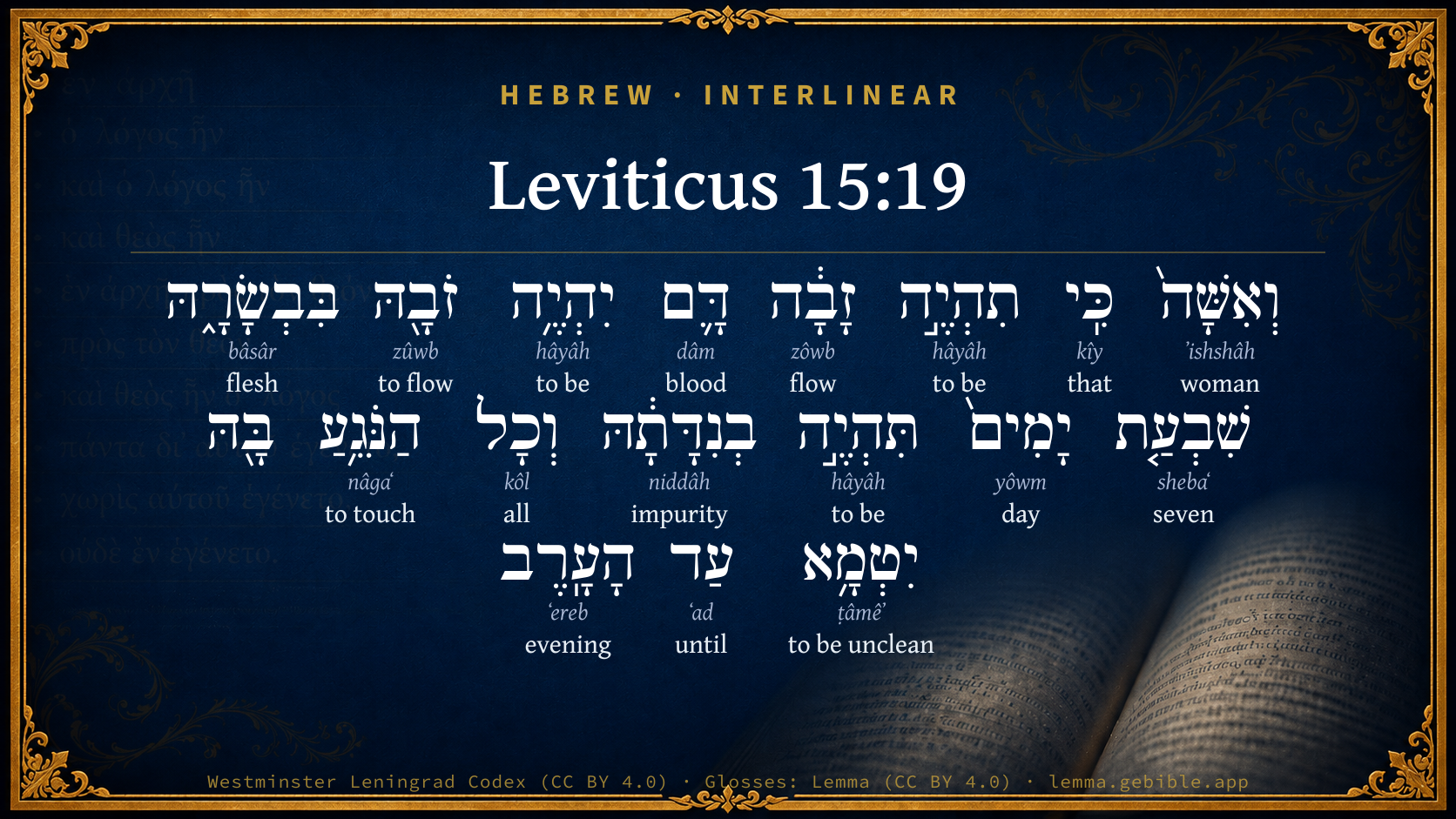
Hebrew (Westminster Leningrad Codex) Leviticus 15:19 appears in the Hebrew Old Testament. The text above is from the Westminster Leningrad Codex. Each word links to its Strong’s number, a concise gloss, and parsing drawn from the Open Scriptures Hebrew Bible morphology. Click any word for its full Brown-Driver-Briggs (BDB) entry.
Download image
Cite this verse

Leviticus 15:19 (World English Bible). Public Domain. Lemma interlinear Bible study tool, https://lemma.gebible.app/v/leviticus/15/19.

Show BibTeX & RIS
BibTeX
RIS
English Translation
"'If a woman has a discharge, and her discharge in her flesh is blood, she shall be in her impurity seven days: and whoever touches her shall be unclean until the evening.
World English Bible · Public Domain
Download a study sheet

One document with this verse’s original text, its word-by-word gloss line, the meaning frame, cross-references with their text, attributed commentary, and full source and license credits — printable, and it pastes into notes with its structure intact.

This verse Autodidact and up

Study sheet (.html) Plain text (.txt)

A passage Seminary Student

Up to 50 verses in one chapter. A passage sheet keeps up to 6 commentary sources and 12 cross-references per verse, in the order this page ranks them, and says so on the sheet whenever that leaves anything out. Ask for a single verse and you get the Autodidact verse sheet above.

Everything on this page stays free to read, with no account — the sheet is a download of what is already on screen, not access to it.

Want to remove ads? Support Godless Engineer
Compare translations 3

The same verse in 3 English versions, stacked beneath the original-language interlinear above. Click any original word for its lexicon entry.

Each is an independent rendering of the whole verse — the interlinear is not word-aligned to these translations.

Highlighted words mark where these versions differ — a whole-verse word diff, not a word-by-word alignment.

  • World English Bible Public Domain
    "'If a woman has a discharge, and her discharge in her flesh is blood, she shall be in her impurity seven days: and whoever touches her shall be unclean until the evening.
  • King James Version Public Domain
    And if a woman have an issue, and her issue in her flesh be blood, she shall be put apart seven days: and whosoever toucheth her shall be unclean until the even.
  • unfoldingWord Literal Text CC BY-SA 4.0
    And a woman, when she is flowing—blood is her flow in her flesh— seven days, she will be in her menstruation. And any person who touches her shall be unclean until the evening.

unfoldingWord Literal Text — © unfoldingWord, licensed CC BY-SA 4.0. Word-aligned USFM3 via Door43 (git.door43.org/unfoldingWord/en_ult).

Versions to compare (up to 4)

3 of 4 selected

Show all 18 translations

Every available English version of this verse, each an independent rendering of the whole verse.

  • World English Bible Public Domain
    "'If a woman has a discharge, and her discharge in her flesh is blood, she shall be in her impurity seven days: and whoever touches her shall be unclean until the evening.
  • Berean Standard Bible Public Domain
    When a woman has a discharge consisting of blood from her body, she will be unclean due to her menstruation for seven days, and anyone who touches her will be unclean until evening.
  • Majority Standard Bible Public Domain
    When a woman has a discharge consisting of blood from her body, she will be unclean due to her menstruation for seven days, and anyone who touches her will be unclean until evening.
  • King James Version Public Domain
    And if a woman have an issue, and her issue in her flesh be blood, she shall be put apart seven days: and whosoever toucheth her shall be unclean until the even.
  • American Standard Version (1901) Public Domain
    And if a woman have an issue, `and' her issue in her flesh be blood, she shall be in her impurity seven days: and whosoever toucheth her shall be unclean until the even.
  • Revised Version (1885) Public Domain
    And if a woman have an issue, and her issue in her flesh be blood, she shall be in her impurity seven days: and whosoever toucheth her shall be unclean until the even.
  • Geneva Bible (1599) Public Domain
    Also when a woman shall haue an issue, and her issue in her flesh shalbe blood, she shalbe put apart seuen dayes: and whosoeuer toucheth her, shalbe vncleane vnto the euen.
  • Douay-Rheims (1899) Public Domain
    The woman, who at the return of the month, hath her issue of blood, shall be separated seven days.
  • Young's Literal Translation Public Domain
    `And when a woman hath an issue -- blood is her issue in her flesh -- seven days she is in her separation, and any one who is coming against her is unclean till the evening.
  • Literal Standard Version CC BY-SA 4.0
    And when a woman has discharging—blood is her discharge in her flesh—she is in her separation [for] seven days, and anyone who is coming against her is unclean until the evening.
  • Unlocked Literal Bible CC BY-SA 4.0
    When a woman menstruates, her impurity will continue for seven days, and whoever touches her will be unclean until evening.
  • unfoldingWord Literal Text CC BY-SA 4.0
    And a woman, when she is flowing—blood is her flow in her flesh— seven days, she will be in her menstruation. And any person who touches her shall be unclean until the evening.
  • Darby Bible Public Domain
    And if a woman have a flux, and her flux in her flesh be blood, she shall be seven days in her separation, and whoever toucheth her shall be unclean until the even.
  • World Messianic Bible Public Domain
    “‘If a woman has a discharge, and her discharge in her flesh is blood, she shall be in her impurity seven days. Whoever touches her shall be unclean until the evening.
  • Webster's Bible Public Domain
    And if a woman shall have an issue, and her issue in her flesh be blood, she shall be put apart seven days: and whoever toucheth her shall be unclean until the evening.
  • Free Bible Version CC BY-SA 4.0
    When a woman has a discharge of blood from her body, she will be unclean because of her period for seven days, and anyone who touches her will be unclean until the evening.
  • Bible in Basic English Public Domain
    And if a woman has a flow of blood from her body, she will have to be kept separate for seven days, and anyone touching her will be unclean till evening.
  • JPS Tanakh (1917) Public Domain
    And if a woman have an issue, and her issue in her flesh be blood, she shall be in her impurity seven days; and whosoever toucheth her shall be unclean until the even.

Literal Standard Version (2020), Covenant Press — licensed CC BY-SA 4.0. Text via the HelloAO Bible API (eBible.org). Unlocked Literal Bible (unfoldingWord) — licensed CC BY-SA 4.0. Text via the HelloAO Bible API (eBible.org). unfoldingWord Literal Text — © unfoldingWord, licensed CC BY-SA 4.0. Word-aligned USFM3 via Door43 (git.door43.org/unfoldingWord/en_ult). Free Bible Version, Dr. Jonathan Gallagher — licensed CC BY-SA 4.0. Text via the HelloAO Bible API (eBible.org).

Word by word

More ways to search: Search by grammar → Find every occurrence → Compare this word →

Practice this passage: Drill this verse → Learn its vocabulary →

זָבָ֔ה
zôwb
H2101
“flow”
Verb, Qal, Participle Active, Feminine, Singular, Absolute
Part of Speech
Verb
Stem
Qal
Form
Participle Active
Gender
Feminine
Number
Singular
State
Absolute
Full BDB Definition

Origin: from H2100

TWOT: 534a

a flow, issue, discharge, flux - semen, discharge (venereal disease) (of men) - issue, flux (of woman)
  1. וְאִשָּׁה֙ ʼishshâh H802 “and · woman” Conjunction + Noun, Common, Feminine, Singular, Absolute
  2. כִּֽי kîy H3588 “that” Conjunction
  3. תִהְיֶ֣ה hâyâh H1961 “to be” Verb, Qal, Imperfect, 3rd Person, Feminine, Singular
  4. דָּ֛ם dâm H1818 “blood” Noun, Common, Masculine, Singular, Absolute
  5. יִהְיֶ֥ה hâyâh H1961 “to be” Verb, Qal, Imperfect, 3rd Person, Masculine, Singular
  6. זֹבָ֖הּ zûwb H2100 “discharge · her” Noun, Common, Masculine, Singular, Construct + Suffix, Personal, 3rd Person, Feminine, Singular
  7. בִּבְשָׂרָ֑הּ bâsâr H1320 “in/at · flesh · her” Preposition + Noun, Common, Masculine, Singular, Construct + Suffix, Personal, 3rd Person, Feminine, Singular
  8. שִׁבְעַ֤ת shebaʻ H7651 “seven” Adjective, Cardinal number, Masculine, Singular, Construct
  9. יָמִים֙ yôwm H3117 “days” Noun, Common, Masculine, Plural, Absolute
  10. תִּהְיֶ֣ה hâyâh H1961 “to be” Verb, Qal, Imperfect, 3rd Person, Feminine, Singular
  11. בְנִדָּתָ֔הּ niddâh H5079 “in/at · impurity · her” Preposition + Noun, Common, Feminine, Singular, Construct + Suffix, Personal, 3rd Person, Feminine, Singular
  12. וְכָל kôl H3605 “and · all of” Conjunction + Noun, Common, Masculine, Singular, Construct
  13. הַנֹּגֵ֥עַ nâgaʻ H5060 “the · touching” Particle, Definite Article + Verb, Qal, Participle Active, Masculine, Singular, Absolute
  14. יִטְמָ֥א ṭâmêʼ H2930 “to be unclean” Verb, Qal, Imperfect, 3rd Person, Masculine, Singular
  15. עַד ʻad H5704 “until” Preposition
  16. הָעָֽרֶב ʻereb H6153 “the · evening” Particle, Definite Article + Noun, Common, Masculine, Singular, Absolute

About this verse

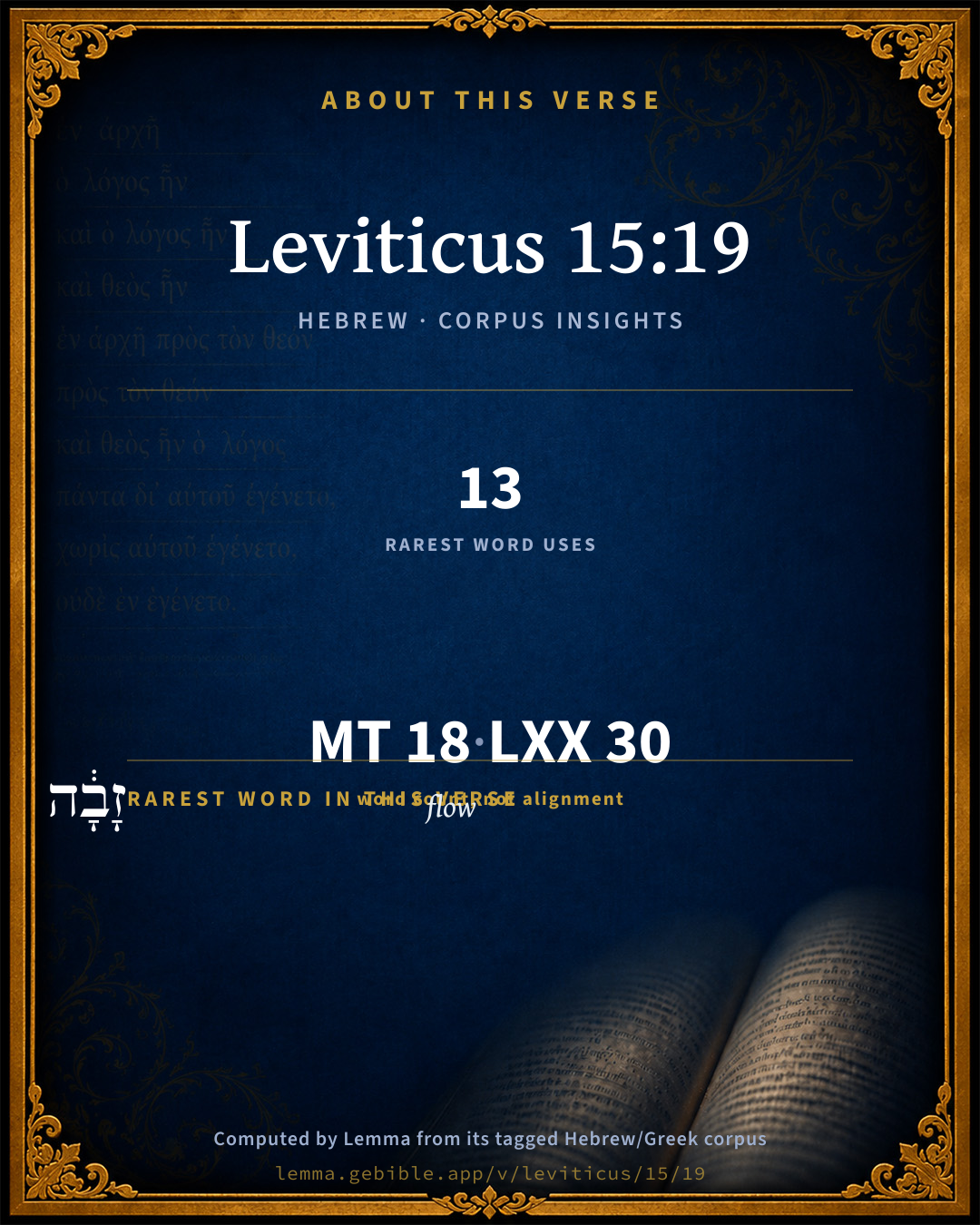
These counts appear in no published source. They are computed here, from the morphology-tagged text and Lemma’s own curated glosses. What Lemma adds →

18
words
15
distinct lemmas
Pentateuch
section

Notable vocabulary

The rarest word here is זָבָ֔ה flow H2101 — appearing just 13 times in the whole Hebrew Bible.

Shared distinctive vocabulary

זָבָ֔ה flow H2101 occurs in 10 verses of the Hebrew Bible. Also found in:

Grammatical profile

  • 6 verbs
  • 8 nouns
  • 1 adjective
  • 2 prepositions
  • 1 conjunction

Verb forms

  • תִהְיֶ֣ה Qal · Imperfect
  • זָבָ֔ה Qal · Participle Active
  • יִהְיֶ֥ה Qal · Imperfect
  • תִּהְיֶ֣ה Qal · Imperfect
  • הַנֹּגֵ֥עַ Qal · Participle Active
  • יִטְמָ֥א Qal · Imperfect

Repetition

A word recurs within this verse — often emphatic in Hebrew:

  • תִהְיֶ֣ה to be H1961 ×3

Hebrew & Septuagint length

In English translation the verse runs 32 words from the Hebrew and 35 from the Septuagint (LXX English) — closely comparable.

A rough comparison of the two English renderings, which tokenize alike — not a word-level alignment.

Word counts can differ between the Hebrew and the Greek without any difference in meaning — e.g. the Hebrew direct-object marker אֵת has no separate Greek word, and Greek often adds the article ὁ.

In the original languages it is 18 Hebrew tokens and 30 Greek tokens — but the two are counted differently (Hebrew bundles its prefixes and suffixes into one token; the Greek is in lemma form), so that isn’t a like-for-like length.

Cross-references

8

Topical passages linked to Leviticus 15:19 in the Treasury of Scripture Knowledge — connected by theme and wording, ordered by reader-vote popularity; previews shown in the World English Bible.

  • Leviticus 12:2 "Speak to the children of Israel, saying, 'If a woman conceives, and bears a male child, then she shall be unclean seven days; as in the days of her monthly period she shall be unclean.
  • Matthew 15:19 For out of the heart come forth evil thoughts, murders, adulteries, sexual sins, thefts, false testimony, and blasphemies.
  • Mark 5:25 A certain woman, who had an issue of blood for twelve years,
  • Leviticus 12:4 She shall continue in the blood of purification thirty-three days. She shall not touch any holy thing, nor come into the sanctuary, until the days of her purifying are completed.
  • Leviticus 20:18 "'If a man lies with a woman having her monthly period, and uncovers her nakedness; he has made naked her fountain, and she has uncovered the fountain of her blood: and both of them shall be cut off from among their people.
  • Lamentations 1:8–9 Jerusalem has grievously sinned; therefore she is become as an unclean thing; All who honored her despise her, because they have seen her nakedness: Yes, she sighs, and turns backward.
  • Lamentations 1:17 Zion spreads forth her hands; there is none to comfort her; Yahweh has commanded concerning Jacob, that those who are round about him should be his adversaries: Jerusalem is among them as an unclean thing.
  • Ezekiel 36:17 Son of man, when the house of Israel lived in their own land, they defiled it by their way and by their doings: their way before me was as the uncleanness of a woman in her impurity.

Cross-references courtesy of OpenBible.info (CC BY 4.0).

Hebrew and Greek witnesses Masoretic Hebrew ↔ Greek Septuagint

The same verse in the two great witnesses to the Old Testament, shown verse-for-verse.

These are two independent witnesses, not word-aligned to each other, and the Septuagint is shown in lemma (dictionary) form.

Hebrew Leviticus 15:19 Masoretic · Westminster Leningrad Codex

וְאִשָּׁה֙ כִּֽי תִהְיֶ֣ה זָבָ֔ה דָּ֛ם יִהְיֶ֥ה זֹבָ֖הּ בִּבְשָׂרָ֑הּ שִׁבְעַ֤ת יָמִים֙ תִּהְיֶ֣ה בְנִדָּתָ֔הּ וְכָל הַנֹּגֵ֥עַ בָּ֖הּ יִטְמָ֥א עַד הָעָֽרֶב

"'If a woman has a discharge, and her discharge in her flesh is blood, she shall be in her impurity seven days: and whoever touches her shall be unclean until the evening.

World English Bible · Public Domain

Greek LXX Leviticus 15:19 Septuagint · lemma form

καί γυνή ὅστις ἐάν εἰμί ῥέω αἷμα εἰμί ὁ ῥύσις αὐτός ἐν ὁ σῶμα αὐτός ἑπτά ἡμέρα εἰμί ἐν ὁ ἄφεδρος αὐτός πᾶς ὁ ἅπτομαι αὐτός ἀκάθαρτος εἰμί ἕως ἑσπέρα

And the woman whoever shall have an issue of blood, when her issue shall be in her body, shall be seven days in her separation; every one that touches her shall be unclean until evening.

LXX2012 (modern English Septuagint) · Public Domain

Hebrew: Westminster Leningrad Codex (CC BY 4.0). Greek: Septuagint (public domain); English from LXX2012 (modern English Septuagint) (Public Domain). How the Septuagint differs from the Hebrew →

Targum (Aramaic paraphrase)

2

The Targum is the ancient Jewish Aramaic paraphrase of the Hebrew Scriptures — an interpretive translation, not the Hebrew text itself. Onkelos (literal) and Pseudo-Jonathan (expansive) render the Torah, and Jonathan the Prophets. Coverage is partial: where no permissively-licensed English translation exists for a verse, only the Aramaic is shown. This is verse-level text, not a word-by-word alignment to the Hebrew.

  1. Targum Onkelos Torah (Genesis–Deuteronomy)
    וְאִתְּתָא אֲרֵי תְהֵי דָיְבָא דָם יְהֵי דוֹבָהּ בְּבִשְׂרָהּ שִׁבְעָא יוֹמִין תְּהֵי בְרִחוּקָהּ וְכָל דְיִקְרַב בָּהּ יְהֵי מְסָאָב עַד רַמְשָׁא

    (no public-domain English translation for this verse)

    Targum Onkelos — Aramaic: “Onkelos Genesis” (public domain); “Onkelos Exodus” (public domain); “Onkelos Leviticus” (public domain); “Onkelos Numbers” (public domain); “Onkelos Deuteronomy” (public domain). English: “Sefaria Community Translation” (CC0 1.0 (public-domain dedication)); “J.W. Etheridge. The Targums of Onkelos and Jonathan Ben Uzziel on the Pentateuch. London: Longmans, Green, 1862” (public domain). Text via Sefaria.

  2. Targum Pseudo-Jonathan Torah (Genesis–Deuteronomy)
    וְאִנְתְּתָא אֲרוּם תְּהֵי דַיְיבָא אֲדַם סִמוּק וְאוּכָם וּמוֹרִיק הֵי כְגַוָן זָעְפָרָנָא אוֹ הֵי כְמוֹ דְגַרְגִישְׁתָּא אוֹ הֵי כִמְזַג חֲמַר סִימוּק בִּתְרֵין חוּלְקִין דְמוֹי אֲדַם מְסָאָב הֲוֵי דוֹבָא בְּבִישְרָא שׁוּבְעָא יוֹמִין תְּהֵי יָתְבָא בְּרִיחוּקָהּ כָּל דְיִקְרַב בָּהּ יְהֵי מְסָאָב עַד רַמְשָׁא

    And if a woman hath an issue of blood, red or dark, yellow as saffron, or water of clay, or as red wine mixed with two parts of water, she hath an uncleanness of blood in her flesh; she shall dwell apart seven days; any one who toucheth her shall be unclean until evening.

    Targum Pseudo-Jonathan — Aramaic: “Targum Jonathan on Genesis” (public domain); “Targum Jonathan on Exodus” (public domain); “Targum Jonathan on Leviticus” (public domain); “Targum Jonathan on Numbers” (public domain); “Targum Jonathan on Deuteronomy” (public domain). English: “The Targum of Jonathan ben Uzziel, trans. J. W. Etheridge, London, 1862” (public domain). Text via Sefaria.

Commentary

Notes on Leviticus 15:19 from classic Christian and Jewish commentators (each source and its license shown beneath its notes). The classic Christian expositions comment on the surrounding passage and are grouped to its opening verse, so a note may address several verses; the Jewish commentaries on the Tanakh (Rashi and others) are per-verse, so they appear only where the commentator wrote on this verse.

Lemma curates 59 commentaries, every one of them public domain or Creative Commons licensed, each selected and text-cleaned for this edition rather than reprinted as found. About our sources →

Matthew Henry's Commentary

This is concerning the ceremonial uncleanness which women lay under from their issues, both those that were regular and healthful, and according to the course of nature (Lev 15:19-24), and those that were unseasonable, excessive, and the disease of the body; such was the bloody issue of that poor woman who was suddenly cured by touching the hem of Christ's garment, after she had lain twelve years under her distemper, and had spent her estate upon physicians and physic in vain. This made the woman that was afflicted with it unclean (Lev 15:25) and every thing she touched unclean, Lev 15:26, Lev 15:27. And if she was cured, and found by seven days' trial that she was perfectly free from her issue of blood, she was to be cleansed by the offering of two turtle-doves or two young pigeons, to make an atonement for her, Lev 15:28, Lev 15:29. All wicked courses, particularly idolatries, are compared to the uncleanness of a removed woman (Eze 36:17), and, in allusion to this, it is said of Jerusalem (Lam 1:9), Her filthiness is in her skirts, so that (as it follows, Lev 15:17) she was shunned as a menstruous woman.

I. The reasons given for all these laws (which we are ready to think might very well have been spared) we have, Lev 15:31. 1. Thus shall you separate the children of Israel (for to them only and their servants and proselytes these laws pertained) from their uncleanness; that is, (1.) By these laws they were taught their privilege and honour, that they were purified unto God a peculiar people, and were intended by the holy God for a kingdom of priests, a holy nation; for that was a defilement to them which was not so to others. (2.) They were also taught their duty, which was to preserve the honour of their purity, and to keep themselves from all sinful pollutions. It was easy for them to argue that if those pollutions which were natural, unavoidable, involuntary, their affliction and not their sin, rendered them for the time so odious that they were not fit for communion either with God or man, much more abominable and filthy were they if they sinned against the light and law of nature, by drunkenness, adultery, fraud, and the like sins, which defile the very mind and conscience. And, if these ceremonial pollutions could not be done away but by sacrifice and offering, something greater and much more valuable must be expected and depended upon for the purifying of the soul from the uncleanness of sin. 2. Thus their dying in their uncleanness by the hand of God's justice, if while they were under any of these defilements they should come near the sanctuary, would be prevented. Note, It is a dangerous thing to die in our uncleanness; and it is our own fault if we do, since we have not only fair warning given us, by God's law, against those things that will defile us, but also such gracious provision made by his gospel for our cleansing if at any time we be defiled. 3. In all these laws there seems to be a special regard had to the honour of the tabernacle, to which none must approach in their uncleanness, that they defile not my tabernacle. Infinite Wisdom took this course to preserve in the minds of that careless people a continual dread of, and veneration for, the manifestations of God's glory and presence among them in his sanctuary. Now that the tabernacle of God was with men familiarity would be apt to breed contempt, and therefore the law made so many things of frequent incidence to be ceremonial pollutions, and to involve an incapacity of drawing near to the sanctuary (making death the penalty), that so they might not approach without great caution, and reverence, and serious preparation, and fear of being found unfit. Thus they were taught never to draw near to God but with an awful humble sense of their distance and danger, and an exact observance of every thing that was required in order to their safety and acceptance.

II. And what duty must we learn from all this? 1. Let us bless God that we are not under the yoke of these carnal ordinances, that, as nothing can destroy us, so nothing can defile us, but sin. Those may now partake of the Lord's supper who durst not then eat of the peace-offerings. And the defilement we contract by our sins of daily infirmity we may be cleansed from in secret by the renewed acts of repentance and faith, without bathing in water or bringing an offering to the door of the tabernacle. 2. Let us carefully abstain from all sin, as defiling to the conscience, and particularly from all fleshly lusts, possessing our vessel in sanctification and honour, and not in the lusts of uncleanness, which not only pollute the soul, but war against it, and threaten its ruin. 3. Let us all see how indispensably necessary real holiness is to our future happiness, and get our hearts purified by faith, that we may see God. Perhaps it is in allusion to these laws which forbade the unclean to approach the sanctuary that when it is asked, Who shall stand in God's holy place? it is answered, He that hath clean hands and a pure heart (Psa 24:3, Psa 24:4); for without holiness no man shall see the Lord.

Matthew Henry's Commentary on the Whole Bible (1708–1710) — public domain (CC PDM 1.0). Text via the HelloAO Bible API.

Jamieson, Fausset & Brown

Robert Jamieson, A. R. Fausset & David Brown

UNCLEANNESS OF WOMEN. (Lev 15:19-33)

if a woman have an issue--Though this, like the leprosy, might be a natural affection, it was anciently considered contagious and entailed a ceremonial defilement which typified a moral impurity. This ceremonial defilement had to be removed by an appointed method of ceremonial expiation, and the neglect of it subjected any one to the guilt of defiling the tabernacle, and to death as the penalty of profane temerity.

Jamieson, Fausset & Brown — Commentary Critical and Explanatory on the Whole Bible (1871) — public domain (CC PDM 1.0). Text via the HelloAO Bible API.

Joseph Benson's Commentary

Lev 15:19. She shall be put apart — Not out of the camp, but from converse with her husband and others, and from access to the house of God. Seven days — During the time of her infirmity, which might perhaps continue so long, and it was decent to allow time for her purification after the ceasing of her issue. Whosoever toucheth her — Of grown persons; for the infant, to whom in that case she might give suck, was exempted from this pollution by the greater law of necessity, and by that antecedent law, which required women to give suck to their own children.

Joseph Benson's Commentary on the Old and New Testaments (1811–1818) — public domain. Text from a community e-Sword module.

Whedon's Commentary on the Bible

Daniel D. Whedon

THE UNCLEANNESS OF WOMEN IN THEIR ISSUES, Lev_15:19-33.

The separation of the woman during the menstrual period is so obviously a sanitary requirement that the custom was not confined to the Hebrews.

19. Seven days — This is sufficient to cover the ordinary period of physical impurity. It is worthy of note that no ceremonial cleansing or atonement is required at the expiration of this normal uncleanness, as there is after the healing of an abnormal issue. See Lev_15:25; Lev_15:30.

Toucheth — This word is used in its common signification, and not in the Pauline sense, (1Co_7:1,) which is treated of in Lev_15:24, and especially in Lev_20:18, where the penalty of excision is attached.

Daniel D. Whedon (gen. ed.), Commentary on the Old and New Testaments (1874–1909) — public domain. Text from a community e-Sword module.

Keil & Delitzsch

C. F. Keil & F. Delitzsch

The menses of a woman. - "If a woman have an issue, (if) blood is her issue in her flesh, she shall be seven days in her uncleanness." As the discharge does not last as a rule more than four or five days, the period of seven days was fixed on account of the significance of the number seven. In this condition she rendered every one who touched her unclean (Lev 15:19), everything upon which she lay or sat (Lev 15:20), every one who touched her bed or whatever she sat upon (Lev 15:21, Lev 15:22), also any one who touched the blood upon her bed or seat (Lev 15:23, where הוּא and בּו are to be referred to דּם); and they remained unclean till the evening, when they had to wash their clothes and bathe themselves.

Keil & Delitzsch — Biblical Commentary on the Old Testament (1861–1891) — public domain (CC PDM 1.0). Text via the HelloAO Bible API. (Old Testament only.)

Tyndale Open Study Notes

Tyndale Open Resources

15:19-23 There is nothing wrong or diseased about a woman’s menstrual period. However, because it is accompanied by a bloody discharge, the woman was considered ceremonially unclean (see 15:32-33). The restrictions were similar to the restrictions on the man with the bodily discharge (15:2-12): She was allowed to live at home, but whatever she sat on became unclean. Anyone who touched her had to wash, and presumably she also did so at the end of the seven-day quarantine. However, no animal sacrifice was required.

Tyndale Open Study Notes — © Tyndale Open Resources, licensed CC BY-SA 4.0. Text via the HelloAO Bible API.

Geneva Bible (1599)

Geneva Bible translators

Or, secret part.

Geneva Bible (1599) marginal notes — public domain. Text via Bolls.life.

Ellicott's Commentary for English Readers

(19) And if a woman have an issue.—Having legislated for cases in connection with man—as well as for one case in which both the husband and the wife are concerned, the Law now lays down directions for two cases affecting the woman.

And her issue in her flesh be blood.—Better, if her issue, &c. This clause defines the preceding one, stating more minutely what the issue consists of and proceeds from.

She shall be put apart seven days.—Though as a rule the discharge ceases after three or four days, yet, as in the first stage after childbirth, the period of uncleanness is extended to seven days to include exceptional cases. (See Lev_12:2.) To fully appreciate the merciful provisions of the laws here enacted, it is necessary to bear in mind not only the gross superstitions which obtained among the ancients about women in this condition, but the cruel treatment to which wives and daughters were subjected, and in some countries both in the Old and New Worlds still are subjected. It was believed that if a woman in this condition sat under a tree, all its fruit fell off; at her approach the edge of a tool became blunted, and copper utensils contracted a fetid smell, and meat got sour, and a thousand other things. Hence the Parsees not only isolated her from the rest of the family, but forbade her speaking to any one, and those who took food to her in her seclusion had to put it at some distance from her. The Zabii purified with fire every place which she trod. Even if the wind which came from the quarter where she was blew upon any one, he became polluted. To this day the negroes in Issing, the Calmucks, and many others, have special houses for them outside each town and village; and at the River La Plata they are sewn into hammocks, with only a small aperture for the mouth, till they are well again. To restrain the Jews from sharing these superstitions, and from resorting to any of these inhuman acts, as well as for sanitary purposes, the Lawgiver ordained these benign and necessary rules.

Whosoever toucheth her shall be unclean.—Like other unclean persons, she defiled by being touched. Though not expressed here, it is implied that he who contracted this defilement had both to wash his garments and bathe his body as usual.

A Bible Commentary for English Readers, edited by Charles John Ellicott (1878–1897) — public domain. Text from a community e-Sword module.

The Cambridge Bible for Schools and Colleges

gen. ed. J. J. S. Perowne

As regards women (19–30)

19–24. Normal periodical issues. The uncleanness of these issues is similar to that in the preceding case (cp. Lev_15:4-11), but no sacrifice is required at the close of the period. For the belief in early religions that in such cases special precautions were needed against maleficent spiritual agencies, see Rob.-Sm. Rel. Sem.2 447 ff., and Frazer, G.B.3, Pt II. pp. 145 ff.

The Cambridge Bible for Schools and Colleges (gen. ed. J. J. S. Perowne; Cambridge University Press, 1878–1918) — public domain. Text from a community e-Sword module.

John Gill's Exposition

And if a woman have an issue,.... Having finished, as Aben Ezra observes, what was to be said of the male, now the Scripture begins with the female, whose issue, of a different sort, is thus described:

and her issue in her flesh be blood; or, "blood be her issue in her flesh"; not in any part of her, but in that which by an euphemism is so called, in the same sense as the phrase is used of men, Lev 15:2; and so it distinguishes it from any flow of blood elsewhere, as a bleeding at the nose, &c.

she shall be put apart seven days; not out of the camp, nor out of the house, but might not go into the house of God:

whosoever toucheth her shall be unclean until the even; the same as one that had touched a man that had an issue, Lev 15:7; the pollution of the one reached to the same things as that of the other; and so, in the Misnah (h), they are put together, and the same is ascribed to the touch of the one as of the other; it may be understood of everything as well as of every person.

(h) Zabim, c. 5. sect. 6, 7.

John Gill's Exposition of the Whole Bible (1746–1763) — public domain (CC PDM 1.0). Text via the HelloAO Bible API.

Haydock's Catholic Bible Commentary

At....month. The Hebrew and other versions omit this. (Calmet) --- But "her issue in her flesh," implies as much. (Haydock) --- Days, not out of the camp, but from the company of men.

George Leo Haydock (1774–1849), Haydock's Catholic Family Bible and Commentary, 1859 edition — public domain. Excludes Psalms (Douay-Rheims chapter numbering differs from Protestant) and Deuterocanonical books (Catholic canon only).

Matthew Poole's English Annotations

Heb. And a woman, when she shall have an issue of blood, (and because that might be at her nose or other parts, he adds,) and her issue shall be in her flesh, i.e. in her secret parts, as the word flesh is taken Lev 15:2. So it notes her monthly disease. Apart, not out of the camp, as the lepers and some others, but from converse with her husband and others, and from access to the house of God.

Seven days; for sometimes it continues so long, and it was but decent to allow some time for purification after the ceasing of her issue.

Whosoever toucheth her, to wit, of grown persons. For the infant, to whom in that case she might give suck, was exempted from this pollution by the greater law of necessity, and by that antecedent law which required women to give suck to their own children.

Matthew Poole's English Annotations on the Holy Bible (1683–1685) — public domain. Text from a community e-Sword/MySword module.

The Pulpit Commentary

Vers. 19-24. The fourth case of an issue that of ordinary menstruation. (cf. Lev_12:2 Lev_20:18)

The Pulpit Commentary (1880–1919), ed. H.D.M. Spence-Jones & Joseph S. Exell — public domain. Text from a community e-Sword module.

John Wesley's Explanatory Notes

And if a woman - Hebrew. And a woman when she shall have an issue of blood, and her issue shalt be in her flesh, that is, in her secret parts, as flesh is taken, ver. 2. So it notes her monthly disease. Put apart - Not out of the camp, but from converse with her husband and others, and from access to the house of God. Seven days - For sometimes it continues so long; and it was decent to allow some time for purification after the ceasing of her issue. Whosoever toucheth her - Of grown persons. For the infant, to whom in that case she might give suck, was exempted from this pollution by the greater law of necessity, and by that antecedent law which required women to give suck to their own children.

John Wesley, Explanatory Notes Upon the Whole Bible (1754–1765) — public domain. Text via the GEBible commentary corpus.

Kretzmann's Popular Commentary

Paul E. Kretzmann

In the Case of Women

v. 19. And if a woman have an issue, and her issue in her flesh be blood, the regular menstrual flow, she shall be put apart seven days; and whosoever toucheth her shall be unclean until the even; every form of contact, even if it was ever so slight, rendered unclean for the day.

v. 20. And everything that she lieth upon in her separation shall be unclean; everything also that she sitteth upon shall be unclean; beds and chairs and every other article of furniture upon which she rested were here included.

v. 21. And whosoever toucheth her bed shall wash his clothes, and bathe himself in water, and be unclean until the even, having become Levitically defiled by the mere outward contact.

v. 22. And whosoever toucheth anything that she sat upon shall wash his clothes, and bathe himself in water, and be unclean until the even.

v. 23. And if it, any of the menstrual discharge, be on her bed, or on anything whereon she sitteth, when he, any person,toucheth it, he shall be unclean until the even.

v. 24. And if any man lie with her at all, in the specific marital relation, and her flowers, some of the discharge, be upon him, he shall be unclean seven days; and all the bed whereon he lieth shall be unclean; he will enter into the condition of her Levitical uncleanness.

v. 25. And if a woman have an issue of her blood many days out of the time of her separation, beyond the normal limit of seven days, as in the case of the woman whom Jesus healed, Mat 9:20-22, or if it run beyond the time of her separation, all the days of the issue of her uncleanness shall be as the days of Her separation; she shall be unclean; during that whole period she was to be regarded as being in the uncleanness of menstruation.

v. 26. Every bed whereon she lieth all the days of her issue shall be unto her as the bed of her separation; and whatsoever she sitteth upon shall be unclean, as the uncleanness of her separation.

v. 27. And whosoever toucheth those things shall be unclean, and shall wash his clothes, and bathe himself in water, and be unclean until the even.

v. 28. But if she be cleansed of her issue, then she shall number to herself Seven days, as in the case of the man,

v. 13. and after that she shall be clean.

v. 29. And on the eighth day she shall take unto her two turtles, the wild turtle-doves, or two young pigeons, and bring them unto the priest, to the door of the Tabernacle of the Congregation.

v. 30. And the priest shall offer the one for a sin-offering and the other for a burnt offering; and the priest shall make an atonement for her before the Lord For the issue of her uncleanness. While ordinary menstruation required no sacrifice, this abnormal flow, being an uncleanness which estranged from God, made an offering of atonement necessary, for the Lord wanted external, physical purity as a mark and expression of internal cleanness in all the members of His people.

v. 31. Thus shall ye separate the children of Israel from their uncleanness, set them apart as people consecrated to the Lord, that they die not in their uncleanness when they defile my Tabernacle that is among them. The measures here ordered were not merely sanitary, but they also regulated sexual life among the Israelites, besides being typical of the perfect purity which the Lord expects from all His children at all times.

v. 32. This is the law of him that hath an issue, and of him whose seed goeth from him and is defiled therewith,

v. 33. and of her that is sick of her flowers, with the menstrual flow, and of him that hath an issue, of the man, and of the woman, and of him that lieth with her that is unclean. Christian spouses will keep in mind at all times that they know how to possess their organs and vessels in sanctification and honor, not in the loathsome lust of concupiscence, as the Gentiles that know not God, 1Th 4:4-5.

Paul E. Kretzmann, Popular Commentary of the Bible (1921–1924) — public domain. Text from a community e-Sword module.

unfoldingWord translationNotes

Door43 World Missions Community

menstruates ... her period

Both of these refer to the time when blood flows from a woman's womb.

her impurity will continue

"she will continue to be impure"

will be unclean

People and objects that other people must not touch are spoken of as if they were physically unclean. (See: Metaphor)

translationWords

clean

unfoldingWord translationNotes — © Distant Shores Media and the Door43 World Missions Community, licensed CC BY-SA 4.0. Source: git.door43.org/Door43/en_tn.

Rashi

Rabbi Shlomo Yitzchaki (Rashi)

כי תהיה זבה AND IF A WOMAN HAVE AN ISSUE — One might think that this means: if there be an, issue from any limb of her body (e. g. ear, nose)! It, however, states in a law referring to this matter, (Leviticus 20:18) “and she hath uncovered the fountain of her blood” — only that issue of blood therefore makes her unclean which comes from her fountain (Sifra, Metzora Parashat Zavim, Section 4 2).

דם יהיה זובה בבשרה AND HER ISSUE IN HER FLESH BE BLOOD — Her issue does not come under the term “flux” to cause uncleanness except if it is red (cf. Niddah 19a).

בנדתה [SHE SHALL BE] PUT APART [SEVEN DAYS] — The word has the same meaning as, (Job. 18:18) “and they shall drive him out (ינדהו) of the world” — and her state is so called because she is set apart from the touch of any person (separated, so that no-one shall touch her).

תהיה בנדתה [SEVEN DAYS] SHALL SHE BE IN HER SEPARATION. even though she has seen a show of blood only once (lit., only the first show — i. e., not 7 days continuously) (Sifra, Metzora Parashat Zavim, Section 4 5).

Rashi on the Tanakh — English translations: “The Judaica Press complete Tanach with Rashi, translated by A. J. Rosenberg” (CC BY 4.0); “Pentateuch with Rashi's commentary by M. Rosenbaum and A.M. Silbermann, 1929-1934” (public domain); “The Metsudah Tanach series, Lakewood, N.J” (CC BY 4.0); and “The Book of Joshua, Metsudah Publications, 1997” (CC BY 4.0). Text via Sefaria.

Lesson kit

Teaching starters — assembled from the data on this page, not authored interpretation. Every prompt links to the verse data it draws on. Edit before teaching.

Leviticus, in the Pentateuch, opens this verse with 18 words (15 distinct Hebrew lemmas). Its most distinctive word is zôwb (“flow”). A historical commentator’s framing appears above. Read the whole chapter for the surrounding context.

Discussion questions

  1. The word zôwb carries the sense “flow.” How does it shape the verse?
  2. Leviticus 15:2 shares the word «flow» with this verse. How do the two illuminate each other?
  3. “to be” occurs 3× in this one verse. What is the effect of the repetition?
  4. These translations render this verse differently; the difference is in the English rendering, not the original. What questions does that raise?
  5. The verb «תִהְיֶ֣ה» is Qal Imperfect. How does its form color the action?
  6. Reading how Matthew Henry's Commentary and Jamieson, Fausset & Brown read this verse, where do the two commentators agree and where do they part?

Things to notice

Reading settings

Reading text

Shown beneath each verse's original-language words.

Old Testament
Old Testament edition

Read the OT as the Masoretic Hebrew (MT) or the Greek Septuagint (LXX).

English shown for the Greek Septuagint (in the Hebrew ↔ Greek comparison).

Comparing translations? Open the Compare panel on any verse page to stack up to four side by side.