
1 Kings 8:65

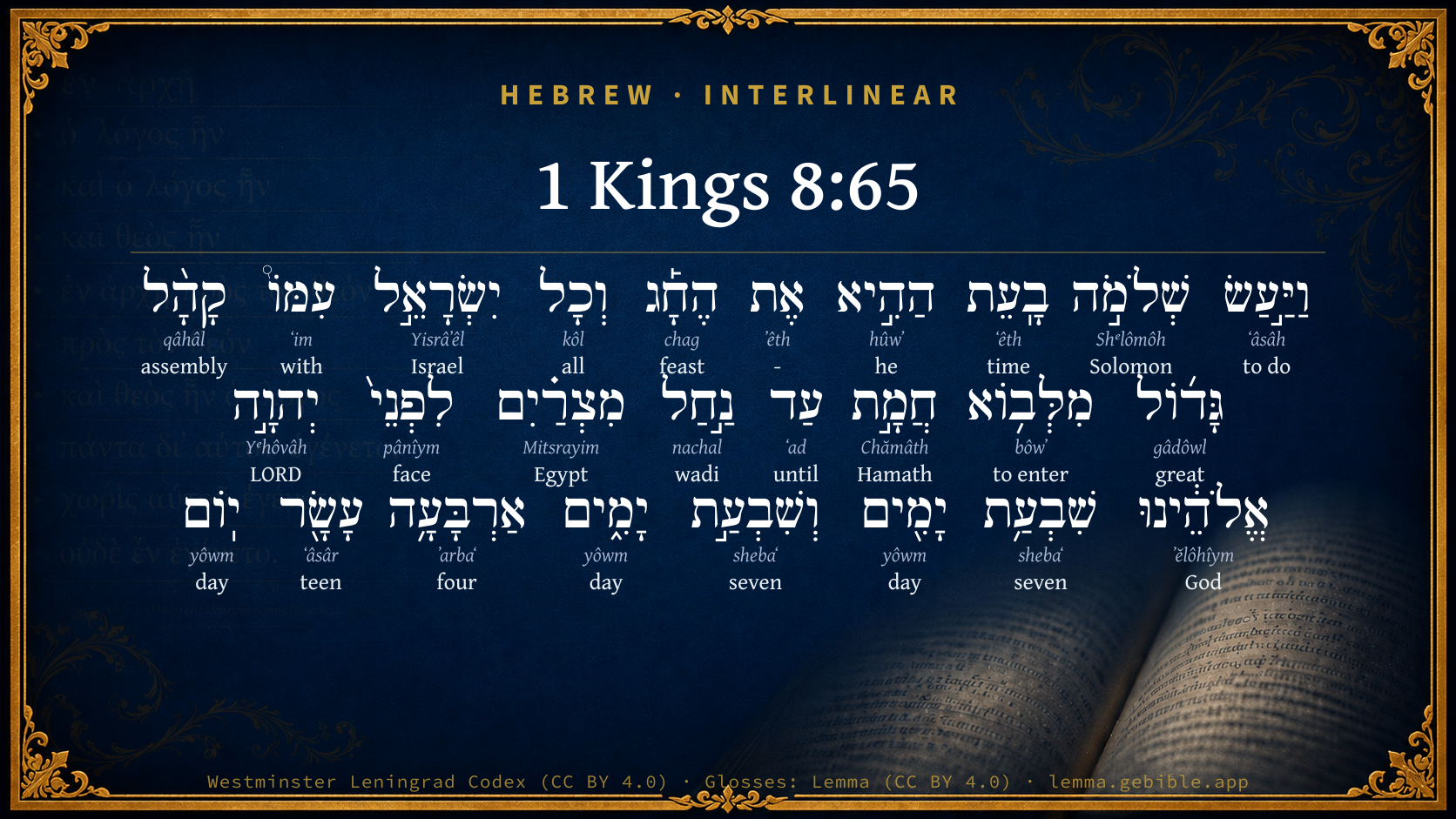
Hebrew (Westminster Leningrad Codex) 1 Kings 8:65 appears in the Hebrew Old Testament. The text above is from the Westminster Leningrad Codex. Each word links to its Strong’s number, a concise gloss, and parsing drawn from the Open Scriptures Hebrew Bible morphology. Click any word for its full Brown-Driver-Briggs (BDB) entry.
Download image
Cite this verse

1 Kings 8:65 (World English Bible). Public Domain. Lemma interlinear Bible study tool, https://lemma.gebible.app/v/1-kings/8/65.

Show BibTeX & RIS
BibTeX
RIS
English Translation
So Solomon held the feast at that time, and all Israel with him, a great assembly, from the entrance of Hamath to the brook of Egypt, before Yahweh our God, seven days and seven days, even fourteen days.
World English Bible · Public Domain
Download a study sheet

One document with this verse’s original text, its word-by-word gloss line, the meaning frame, cross-references with their text, attributed commentary, and full source and license credits — printable, and it pastes into notes with its structure intact.

This verse Autodidact and up

Study sheet (.html) Plain text (.txt)

A passage Seminary Student

Up to 50 verses in one chapter. A passage sheet keeps up to 6 commentary sources and 12 cross-references per verse, in the order this page ranks them, and says so on the sheet whenever that leaves anything out. Ask for a single verse and you get the Autodidact verse sheet above.

Everything on this page stays free to read, with no account — the sheet is a download of what is already on screen, not access to it.

Want to remove ads? Support Godless Engineer
Compare translations 3

The same verse in 3 English versions, stacked beneath the original-language interlinear above. Click any original word for its lexicon entry.

Each is an independent rendering of the whole verse — the interlinear is not word-aligned to these translations.

Highlighted words mark where these versions differ — a whole-verse word diff, not a word-by-word alignment.

  • World English Bible Public Domain
    So Solomon held the feast at that time, and all Israel with him, a great assembly, from the entrance of Hamath to the brook of Egypt, before Yahweh our God, seven days and seven days, even fourteen days.
  • King James Version Public Domain
    And at that time Solomon held a feast, and all Israel with him, a great congregation, from the entering in of Hamath unto the river of Egypt, before the LORD our God, seven days and seven days, even fourteen days.
  • unfoldingWord Literal Text CC BY-SA 4.0
    And Solomon observed the feast at that time, and all of Israel with him, a great assembly, from Lebo Hamath to the wadi of Egypt, to the face of Yahweh our God, seven days and seven days, fourteen days.

unfoldingWord Literal Text — © unfoldingWord, licensed CC BY-SA 4.0. Word-aligned USFM3 via Door43 (git.door43.org/unfoldingWord/en_ult).

Versions to compare (up to 4)

3 of 4 selected

Show all 18 translations

Every available English version of this verse, each an independent rendering of the whole verse.

  • World English Bible Public Domain
    So Solomon held the feast at that time, and all Israel with him, a great assembly, from the entrance of Hamath to the brook of Egypt, before Yahweh our God, seven days and seven days, even fourteen days.
  • Berean Standard Bible Public Domain
    So at that time Solomon and all Israel with him—a great assembly of people from Lebo-hamath to the Brook of Egypt—kept the feast before the LORD our God for seven days and seven more days—fourteen days in all.
  • Majority Standard Bible Public Domain
    So at that time Solomon and all Israel with him—a great assembly of people from Lebo-hamath to the Brook of Egypt—kept the feast before the LORD our God for seven days and seven more days—fourteen days in all.
  • King James Version Public Domain
    And at that time Solomon held a feast, and all Israel with him, a great congregation, from the entering in of Hamath unto the river of Egypt, before the LORD our God, seven days and seven days, even fourteen days.
  • American Standard Version (1901) Public Domain
    So Solomon held the feast at that time, and all Israel with him, a great assembly, from the entrance of Hamath unto the brook of Egypt, before Jehovah our God, seven days and seven days, even fourteen days.
  • Revised Version (1885) Public Domain
    So Solomon held the feast at that time, and all Israel with him, a great congregation, from the entering in of Hamath unto the brook of Egypt, before the LORD our God, seven days and seven days, even fourteen days.
  • Geneva Bible (1599) Public Domain
    And Salomon made at that time a feast and all Israel with him, a very great Congregation, euen from the entring in of Hamath vnto the riuer of Egypt, before the Lord our God, seuen dayes and seuen dayes, euen fourteene dayes.
  • Douay-Rheims (1899) Public Domain
    And Solomon made at the same time a solemn feast, and all Israel with him, a great multitude from the entrance of Emath to the river of Egypt, before the Lord our God, seven days and seven days, that is, fourteen days.
  • Young's Literal Translation Public Domain
    And Solomon maketh, at that time, the festival -- and all Israel with him, a great assembly from the entering in of Hamath unto the brook of Egypt -- before Jehovah our God, seven days and seven days; fourteen days.
  • Literal Standard Version CC BY-SA 4.0
    And Solomon makes, at that time, the festival—and all Israel with him, a great assembly from the entering in of Hamath to the Brook of Egypt—before our God YHWH, [for] seven days and seven [more] days—fourteen days.
  • Unlocked Literal Bible CC BY-SA 4.0
    So Solomon held the feast at that time, and all Israel with him, a great assembly, from Lebo Hamath to the brook of Egypt, before Yahweh our God for seven days and also for another seven days, a total of fourteen days.
  • unfoldingWord Literal Text CC BY-SA 4.0
    And Solomon observed the feast at that time, and all of Israel with him, a great assembly, from Lebo Hamath to the wadi of Egypt, to the face of Yahweh our God, seven days and seven days, fourteen days.
  • Darby Bible Public Domain
    And at that time Solomon held the feast, and all Israel with him, a great congregation, from the entrance of Hamath unto the torrent of Egypt, before Jehovah our God, seven days and seven days, fourteen days.
  • World Messianic Bible Public Domain
    So Solomon held the feast at that time, and all Israel with him, a great assembly, from the entrance of Hamath to the brook of Egypt, before the LORD our God, seven days and seven more days, even fourteen days.
  • Webster's Bible Public Domain
    And at that time Solomon held a feast, and all Israel with him, a great congregation, from the entrance into Hamath to the river of Egypt, before the LORD our God, seven days and seven days, even fourteen days.
  • Free Bible Version CC BY-SA 4.0
    Then Solomon together with all of Israel observed the festival before the Lord our God for seven days, and then another seven days—fourteen days in all. It was a large assembly of people, who came from as far away as Lebo-hamath to the Wadi of Egypt.
  • Bible in Basic English Public Domain
    So Solomon and all Israel with him, a very great meeting, (for the people had come together from the way into Hamath to the river of Egypt,) kept the feast at that time before the Lord our God, for two weeks, even fourteen days.
  • JPS Tanakh (1917) Public Domain
    So Solomon held the feast at that time, and all Israel with him, a great congregation, from the entrance Hamath unto the Brook of Egypt, before the LORD our God, seven days and seven days, even fourteen days.

Literal Standard Version (2020), Covenant Press — licensed CC BY-SA 4.0. Text via the HelloAO Bible API (eBible.org). Unlocked Literal Bible (unfoldingWord) — licensed CC BY-SA 4.0. Text via the HelloAO Bible API (eBible.org). unfoldingWord Literal Text — © unfoldingWord, licensed CC BY-SA 4.0. Word-aligned USFM3 via Door43 (git.door43.org/unfoldingWord/en_ult). Free Bible Version, Dr. Jonathan Gallagher — licensed CC BY-SA 4.0. Text via the HelloAO Bible API (eBible.org).

Word by word

More ways to search: Search by grammar → Find every occurrence → Compare this word →

Practice this passage: Drill this verse → Learn its vocabulary →

חֲמָ֣ת
Chămâth
H2574
“Hamath”
Noun, Proper
Part of Speech
Noun
Type
Proper
Full BDB Definition

Origin: from the same as H2346

TWOT: None

Hamath = "fortress" - the principle city of upper Syria in the valley of the Orontes (noun proper locative) - father of the house of Rechab (noun proper masculine)
  1. וַיַּ֣עַשׂ ʻâsâh H6213 “and · to do” Conjunction + Verb, Qal, Sequential Imperfect, 3rd Person, Masculine, Singular
  2. שְׁלֹמֹ֣ה Shᵉlômôh H8010 “Solomon” Noun, Proper
  3. בָֽעֵת ʻêth H6256 “in/at the · time” Preposition, Determined + Noun, Common, Both, Singular, Absolute
  4. הַהִ֣יא hûwʼ H1931 “the · he” Particle, Definite Article + Pronoun, Personal, 3rd Person, Feminine, Singular
  5. אֶת ʼêth H853 “-” Particle, Direct Object
  6. הֶחָ֡ג chag H2282 “the · feast” Particle, Definite Article + Noun, Common, Masculine, Singular, Absolute
  7. וְכָל kôl H3605 “and · all of” Conjunction + Noun, Common, Masculine, Singular, Construct
  8. יִשְׂרָאֵ֣ל Yisrâʼêl H3478 “Israel” Noun, Proper
  9. עִמּוֹ֩ ʻim H5973 “with · him” Preposition + Suffix, Personal, 3rd Person, Masculine, Singular
  10. קָהָ֨ל qâhâl H6951 “assembly” Noun, Common, Masculine, Singular, Absolute
  11. גָּד֜וֹל gâdôwl H1419 “great” Adjective, Adjective, Masculine, Singular, Absolute
  12. מִלְּב֥וֹא bôwʼ H935 “from · entrance” Preposition + Noun, Proper
  13. עַד ʻad H5704 “until” Preposition
  14. נַ֣חַל nachal H5158 “wadi of” Noun, Common, Masculine, Singular, Construct
  15. מִצְרַ֗יִם Mitsrayim H4714 “Egypt” Noun, Proper
  16. לִפְנֵי֙ pânîym H6440 “to/for · face(s) of” Preposition + Noun, Common, Both, Plural, Construct
  17. יְהוָ֣ה Yᵉhôvâh H3068 “LORD” Noun, Proper
  18. אֱלֹהֵ֔ינוּ ʼĕlôhîym H430 “God(s) · our” Noun, Common, Masculine, Plural, Construct + Suffix, Personal, 1st Person, Common, Plural
  19. שִׁבְעַ֥ת shebaʻ H7651 “seven” Adjective, Cardinal number, Masculine, Singular, Construct
  20. יָמִ֖ים yôwm H3117 “days” Noun, Common, Masculine, Plural, Absolute
  21. וְשִׁבְעַ֣ת shebaʻ H7651 “and · seven” Conjunction + Adjective, Cardinal number, Masculine, Singular, Construct
  22. יָמִ֑ים yôwm H3117 “days” Noun, Common, Masculine, Plural, Absolute
  23. אַרְבָּעָ֥ה ʼarbaʻ H702 “four” Adjective, Cardinal number, Masculine, Singular, Absolute
  24. עָשָׂ֖ר ʻâsâr H6240 “teen” Adjective, Cardinal number, Masculine, Singular, Absolute
  25. יֽוֹם yôwm H3117 “day” Noun, Common, Masculine, Singular, Absolute

About this verse

These counts appear in no published source. They are computed here, from the morphology-tagged text and Lemma’s own curated glosses. What Lemma adds →

26
words
23
distinct lemmas
Historical
section

Shared distinctive vocabulary

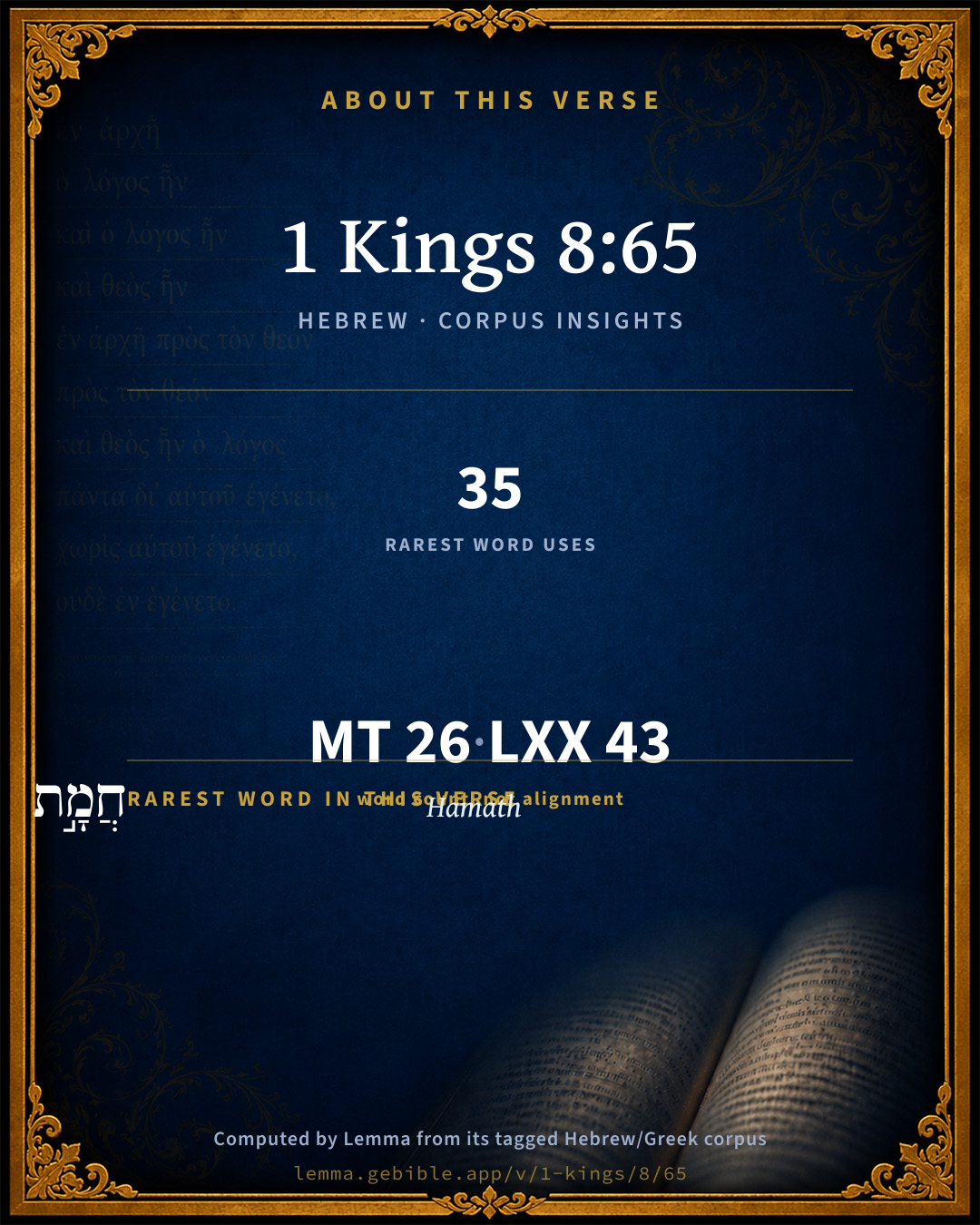
חֲמָ֣ת Hamath H2574 occurs in 33 verses of the Hebrew Bible. Also found in:

Grammatical profile

  • 1 verb
  • 16 nouns
  • 5 adjectives
  • 1 pronoun
  • 2 prepositions
  • 1 particle

Verb forms

  • וַיַּ֣עַשׂ Qal · Sequential Imperfect

Repetition

Words recur within this verse — often emphatic in Hebrew:

  • יָמִ֖ים day H3117 ×3
  • שִׁבְעַ֥ת seven H7651 ×2

Hebrew & Septuagint length

In English translation the verse runs 38 words from the Hebrew and 51 from the Septuagint (LXX English) — closely comparable.

A rough comparison of the two English renderings, which tokenize alike — not a word-level alignment.

Word counts can differ between the Hebrew and the Greek without any difference in meaning — e.g. the Hebrew direct-object marker אֵת has no separate Greek word, and Greek often adds the article ὁ.

In the original languages it is 26 Hebrew tokens and 43 Greek tokens — but the two are counted differently (Hebrew bundles its prefixes and suffixes into one token; the Greek is in lemma form), so that isn’t a like-for-like length.

Cross-references

17

Topical passages linked to 1 Kings 8:65 in the Treasury of Scripture Knowledge — connected by theme and wording, ordered by reader-vote popularity; previews shown in the World English Bible.

  • Numbers 34:5 and the border shall turn about from Azmon to the brook of Egypt, and the goings out of it shall be at the sea.
  • Numbers 34:8 from Mount Hor you shall mark out to the entrance of Hamath; and the goings out of the border shall be at Zedad;
  • 1 Kings 8:2 All the men of Israel assembled themselves to king Solomon at the feast, in the month Ethanim, which is the seventh month.
  • Genesis 15:18 In that day Yahweh made a covenant with Abram, saying, "To your seed have I given this land, from the river of Egypt to the great river, the river Euphrates:
  • Joshua 13:5 and the land of the Gebalites, and all Lebanon, toward the sunrise, from Baal Gad under Mount Hermon to the entrance of Hamath;
  • Judges 3:3 [namely], the five lords of the Philistines, and all the Canaanites, and the Sidonians, and the Hivites who lived on Mount Lebanon, from Mount Baal Hermon to the entrance of Hamath.
  • 2 Kings 14:25 He restored the border of Israel from the entrance of Hamath to the sea of the Arabah, according to the word of Yahweh, the God of Israel, which he spoke by his servant Jonah the son of Amittai, the prophet, who was of Gath Hepher.
  • 2 Chronicles 7:8–9 So Solomon held the feast at that time seven days, and all Israel with him, a very great assembly, from the entrance of Hamath to the brook of Egypt.
  • Exodus 23:31 I will set your border from the Red Sea even to the sea of the Philistines, and from the wilderness to the River; for I will deliver the inhabitants of the land into your hand, and you shall drive them out before you.
  • Joshua 13:3 from the Shihor, which is before Egypt, even to the border of Ekron northward, [which] is reckoned to the Canaanites; the five lords of the Philistines; the Gazites, and the Ashdodites, the Ashkelonites, the Gittites, and the Ekronites; also the Avvim,
  • Leviticus 23:34–43 "Speak to the children of Israel, and say, 'On the fifteenth day of this seventh month is the feast of tents for seven days to Yahweh.
  • 1 Kings 4:21 Solomon ruled over all the kingdoms from the River to the land of the Philistines, and to the border of Egypt: they brought tribute, and served Solomon all the days of his life.
  • 1 Kings 4:24 For he had dominion over all [the region] on this side the River, from Tiphsah even to Gaza, over all the kings on this side the River: and he had peace on all sides round about him.
  • 2 Chronicles 30:13 There assembled at Jerusalem much people to keep the feast of unleavened bread in the second month, a very great assembly.
  • 2 Chronicles 30:23 The whole assembly took counsel to keep other seven days; and they kept [other] seven days with gladness.
  • Psalms 40:9–10 I have proclaimed glad news of righteousness in the great assembly. Behold, I will not seal my lips, Yahweh, you know.
  • Amos 6:14 For, behold, I will raise up against you a nation, house of Israel," Says Yahweh, the God of hosts; "And they will afflict you from the entrance of Hamath to the brook of the Arabah."

Cross-references courtesy of OpenBible.info (CC BY 4.0).

Hebrew and Greek witnesses Masoretic Hebrew ↔ Greek Septuagint

The same verse in the two great witnesses to the Old Testament, shown verse-for-verse.

These are two independent witnesses, not word-aligned to each other, and the Septuagint is shown in lemma (dictionary) form.

Hebrew 1 Kings 8:65 Masoretic · Westminster Leningrad Codex

וַיַּ֣עַשׂ שְׁלֹמֹ֣ה בָֽעֵת הַהִ֣יא אֶת הֶחָ֡ג וְכָל יִשְׂרָאֵ֣ל עִמּוֹ֩ קָהָ֨ל גָּד֜וֹל מִלְּב֥וֹא חֲמָ֣ת עַד נַ֣חַל מִצְרַ֗יִם לִפְנֵי֙ יְהוָ֣ה אֱלֹהֵ֔ינוּ שִׁבְעַ֥ת יָמִ֖ים וְשִׁבְעַ֣ת יָמִ֑ים אַרְבָּעָ֥ה עָשָׂ֖ר יֽוֹם

So Solomon held the feast at that time, and all Israel with him, a great assembly, from the entrance of Hamath to the brook of Egypt, before Yahweh our God, seven days and seven days, even fourteen days.

World English Bible · Public Domain

Greek LXX 1 Kings 8:65 Septuagint · lemma form

καί ποιέω σαλωμών ὁ ἑορτή ἐν ὁ ἡμέρα ἐκεῖνος καί πᾶς ἰσραήλ μετά αὐτός ἐκκλησία μέγας ἀπό ὁ εἴσοδος ημαθ ἕως ποταμός αἴγυπτος ἐνώπιον κύριος θεός ἐγώ ἐν ὁ οἶκος ὅς οἰκοδομέω ἐσθίω καί πίνω καί εὐφραίνω ἐνώπιον κύριος θεός ἐγώ ἑπτά ἡμέρα

And Solomon kept the feast in that day, and all Israel with him, even a great assembly from the entering in of Hemath to the river of Egypt, before the Lord our God in the house which he built, eating and drinking, and rejoicing before the Lord our God seven days.

LXX2012 (modern English Septuagint) · Public Domain

On this verse, The Cambridge Bible for Schools and Colleges discusses the Septuagint’s reading. Read the note in Commentary ↓

Hebrew: Westminster Leningrad Codex (CC BY 4.0). Greek: Septuagint (public domain); English from LXX2012 (modern English Septuagint) (Public Domain). How the Septuagint differs from the Hebrew →

Targum (Aramaic paraphrase)

1

The Targum is the ancient Jewish Aramaic paraphrase of the Hebrew Scriptures — an interpretive translation, not the Hebrew text itself. Onkelos (literal) and Pseudo-Jonathan (expansive) render the Torah, and Jonathan the Prophets. Coverage is partial: where no permissively-licensed English translation exists for a verse, only the Aramaic is shown. This is verse-level text, not a word-by-word alignment to the Hebrew.

  1. Targum Jonathan Prophets (Joshua–Malachi)
    וַעֲבַד שְׁלֹמֹה בְּעִדָנָא הַהִיא יַת חַגָא וְכָל יִשְׂרָאֵל עִמֵיהּ קְהָלָא רַב מִמַעֲלָנָא דַחֲמָת עַד נַחֲלָא דְמִצְרַיִם קֳדָם יְיָ אֱלָהָנָא שַׁבְעָא יוֹמִין חֲנֻכַּת בֵּיתָא וְשַׁבְעָא יוֹמִין חַגָא אַרְבַּעַת עֲשַׂר יוֹמִין:

    (no public-domain English translation for this verse)

    Targum Jonathan — Aramaic: “Mikraot Gedolot” (public domain). English: “Sefaria Community Translation” (CC0 1.0 (public-domain dedication)); “London "Chaldee Paraphrase," 1871” (public domain). Text via Sefaria.

Commentary

Notes on 1 Kings 8:65 from classic Christian and Jewish commentators (each source and its license shown beneath its notes). The classic Christian expositions comment on the surrounding passage and are grouped to its opening verse, so a note may address several verses; the Jewish commentaries on the Tanakh (Rashi and others) are per-verse, so they appear only where the commentator wrote on this verse.

Lemma curates 59 commentaries, every one of them public domain or Creative Commons licensed, each selected and text-cleaned for this edition rather than reprinted as found. About our sources →

Jamieson, Fausset & Brown

Robert Jamieson, A. R. Fausset & David Brown

THE PEOPLE JOYFUL. (Kg1 8:65)

from the entering in of Hamath unto the river of Egypt--that is, from one extremity of the kingdom to the other. The people flocked from all quarters.

seven days and seven days, even fourteen days--The first seven were occupied with the dedication, and the other seven devoted to the feast of tabernacles (Ch2 7:9). The particular form of expression indicates that the fourteen days were not continuous. Some interval occurred in consequence of the great day of atonement falling on the tenth of the seventh month (Kg1 8:2), and the last day of the feast of tabernacles was on the twenty-third (Ch2 7:10), when the people returned to their homes with feelings of the greatest joy and gratitude "for all the goodness that the Lord had done for David his servant, and for Israel his people."

Next: 1 Kings Chapter 9

Jamieson, Fausset & Brown — Commentary Critical and Explanatory on the Whole Bible (1871) — public domain (CC PDM 1.0). Text via the HelloAO Bible API.

Trapp's Complete Commentary

John Trapp

1Ki 8:65 And at that time Solomon held a feast, and all Israel with him, a great congregation, from the entering in of Hamath unto the river of Egypt, before the LORD our God, seven days and seven days, [even] fourteen days.

Ver. 65. From the entering in of Hamath,] i.e., From north to south. Understand also from east to west.

Seven days and seven days.] The first seven were for the dedication, εγκαινια, the priests, Levites, and one hundred and twenty singers making all manner of music; {2Ch 5:11} the second seven for the feast of tabernacles. Within the first seven days, viz., on the tenth day, fell out their yearly public fast, {Lev 23:27} which was dispensed with, as some think. Others hold that they killed their sacrifices on that day also, but ate not of them till the evening, or till the next day, haply.

John Trapp, A Commentary or Exposition upon All the Books of the Old and New Testament (1647–1656) — public domain. Text from a community e-Sword module.

Joseph Benson's Commentary

1Ki 8:65-66. At that time Solomon held a feast — That is, kept a solemn festival. And all Israel from Hamath unto the river of Egypt — The usual and known bounds of the land, in the utmost length of it, Num 34:8; Jos 13:5; Jdg 3:3. Before the Lord — Before the temple, as in God’s presence. Seven days and seven days — Seven for the dedication of the temple, or altar; and the other seven for the feast of tabernacles. And it seems to be expressed in this manner, to intimate, that these fourteen days of rejoicing were not all together, but that there was some interval between them, which indeed was necessary, because the day of atonement was on the tenth day of this month, Lev 23:27. And because these fourteen days ended on the twenty-second day, (2Ch 7:10,) it may seem most probable, that the feast of the dedication was kept before the tenth day; and the feast of tabernacles some days after it. On the eighth day he sent the people away — Having joined with them in the solemn assembly, which was kept on the eighth day; in the close of that day he took his solemn farewell, and dismissed them with his blessing; and the next morning, when the heads and elders, with divers of the people, came to take their leave of the king, he sent them away. And they blessed the king — They applauded, admired, and returned him the thanks of the congregation for the great care and pains he had taken in building the temple and setting up God’s worship among them. Or, they prayed to God to bless him, according to their duty and custom. And went to their tents joyful and glad of heart — Easy in mind and pleased; rejoicing in all the goodness that the Lord had done for David — In giving him a sure house, and a wise and religious son, by whom he had now fulfilled the promise made to him about building the temple. And for Israel his people — They rejoiced in God’s blessings both on the royal family and on the kingdom. In this spirit should we go home from holy ordinances, and should rejoice for God’s goodness to our Lord Jesus, of whom David his servant was a type, in the advancement and establishment of his throne, pursuant to the covenant of redemption; and to all believers, his spiritual Israel, in their sanctification and consolation, pursuant to the covenant of grace. If we rejoice not herein always, it is our own fault; it is owing to the weakness of our faith and hope, and the coldness of our love.

Joseph Benson's Commentary on the Old and New Testaments (1811–1818) — public domain. Text from a community e-Sword module.

Tyndale Open Study Notes

Tyndale Open Resources

8:65 Lebo-hamath to the north in Aram and the Brook of Egypt (Wadi al Arish) to the south are the geographic boundaries that defined the Promised Land (Josh 13:5; 15:4). • seven days for the dedication of the altar and seven days for the Festival of Shelters: When the seven days for the dedication were completed, the Festival of Shelters was observed for another seven days.

Tyndale Open Study Notes — © Tyndale Open Resources, licensed CC BY-SA 4.0. Text via the HelloAO Bible API.

Geneva Bible (1599)

Geneva Bible translators

That is, from North to South: meaning all the country.

Seven days for the dedication, and seven for the feast.

Geneva Bible (1599) marginal notes — public domain. Text via Bolls.life.

Adam Clarke's Commentary

Verse 65. From - Hamath] Supposed to be Antioch of Syria; unto the river of Egypt - to the Rhinocorura; the former being on the north, the latter on the south: i.e., from one extremity of the land to the other.

Adam Clarke's Commentary on the Bible (1810–1826) — public domain. Text from a community e-Sword/MySword module.

Ellicott's Commentary for English Readers

(65) The entering in of Hamath, is the significant name given to the great valley between Lebanon and Anti - Lebanon, which the Greeks called Cœle- Syria; for it was the main entrance to Palestine from the north, down which the hosts of Assyria and Babylon so constantly poured. Evidently it extended at this time beyond Damascus.

The river of Egypt is not, as might naturally be thought, the Nile, or any of its branches; for the word used signifies rather a “brook” or “torrent,” and the torrent, described in Num_34:5 and Jos_15:4 as the border of Israel, is identified by all authorities with the torrent falling into the sea at El-Arish.

(65, 66) Seven days and seven days, even fourteen days. On the eighth day. . . .—The origin of this curious phrase is singularly illustrated by the account in 2Ch_7:9-10, for it tells us that the people were dismissed on “the three and twentieth day” of the month, which was the day after the close of the Feast of Tabernacles. Hence it is clear that the festival week of the Dedication preceded the regular feast; and the day of dismissal was the “eighth day,” regularly so-called, of the close of the Feast of Tabernacles.

Unto their tents.—The old memory of the wandering life of Israel still lingers in this expression, as in the well-known phrase “To your tents, O Israel!” (2Sa_20:1; 1Ki_12:16.) It may have been suggested to the writer in this place by the ideas symbolised in the Feast of Tabernacles, of which he had just recorded the observance.

A Bible Commentary for English Readers, edited by Charles John Ellicott (1878–1897) — public domain. Text from a community e-Sword module.

The Cambridge Bible for Schools and Colleges

gen. ed. J. J. S. Perowne

65. Solomon held a feast] Better ‘the feast.’ The special feast of Tabernacles (cf. 1Ki_8:2), a very fitting occasion for the great multitude to make themselves an encampment in the open country around.

The part played by Solomon in all this dedication ceremony shews us that the ordinances of the Pentateuch had not yet come into observance. Israel had not advanced beyond the traditional religion contained in the ‘book of the covenant’. But the failure of the nation herein cannot of itself be held to establish the non-existence of the Levitical law.

from the entering in of Hamath unto the river of Egypt] Within these limits the whole land of Palestine was embraced. Hamath on the north was situated in the valley of the Orontes, and for a long time was the chief city of the northern part of Syria. On the south the river of Egypt (nahal Mizraim) is identified for us in the LXX. (Isa_27:12) by being translated ὁ ποταμὸς ἕως Ῥινοκορούρων. Rhinocoroura (i.e. Rhinocolura) is the modern El Arish, and so the nahal Mizraim was probably Wady el Arïsh, a desert stream on the border of Egypt.

before the Lord our God] The last two words have the appearance of an editorial addition. They would hardly appear in the original narrative.

seven days and seven days] As explained in 2Ch_7:9 the dedication of the altar lasted seven days, and the feast (of Tabernacles proper) other seven days. This double observance accounts for the form of words here used.

The Cambridge Bible for Schools and Colleges (gen. ed. J. J. S. Perowne; Cambridge University Press, 1878–1918) — public domain. Text from a community e-Sword module.

Albert Barnes' Notes on the Bible

A feast necessarily accompanied such a sacrifice as Solomon was holding. Compare Lev 19:5. On the present occasion there was a double festival - first, the Feast of the Dedication, from the 8th to the 15th of the month Ethanim (or Tisri), and then the Feast of tabernacles, from the 15th to the 22nd 1Ki 8:2. On the day after this, “the eighth day,” counting from the commencement of the second seven, and the twenty-third day of the month (margin reference “m”), Solomon dismissed the people to their homes.

The entering in of Hamath - Compare Num 13:21, note andmargin reference. The phrase marks the extreme northern boundary of the holy land.

The river of Egypt - The Wady-el-Arish, the only large water-course on this coast (margin reference).

Albert Barnes' Notes on the Bible (1834–1885) — public domain. Text from a community e-Sword/MySword module.

Haydock's Catholic Bible Commentary

Egypt. Rhinocolura, (Menochius) or rather the branch of the Nile nearest Arabia, Josue xiii. 3., and Numbers xiii. 22. (Calmet) --- Seven, for each festival, ver. 1.

George Leo Haydock (1774–1849), Haydock's Catholic Family Bible and Commentary, 1859 edition — public domain. Excludes Psalms (Douay-Rheims chapter numbering differs from Protestant) and Deuterocanonical books (Catholic canon only).

Matthew Poole's English Annotations

Held a feast, i.e. kept the solemnity. From the entering in of Hamath unto the river of Egypt; the usual and known bounds of the land, in the utmost length of it; of which see Num 34:8; Jos 13:5; Jdg 3:3.

Before the Lord, i.e. before the temple, and as in God’s presence.

Seven days and seven days; seven for the dedication of the temple or altar, and the other seven for the feast of tabernacles, as, nay be gathered from 2Ch 7:9. And it seems to be expressed in this manner, to intimate that these fourteen days of rejoicing were not all together, but that there was some interval between them, which indeed was necessary, because the day of atonement was on the tenth day of this month, Lev 23:27. And because these fourteen days ended on the twenty-second day, 2Ch 7:9, it may seem most probable that the feast of the dedication was kept before the tenth day, and the feast of tabernacles some days after it.

Matthew Poole's English Annotations on the Holy Bible (1683–1685) — public domain. Text from a community e-Sword/MySword module.

Whedon's Commentary on the Bible

Daniel D. Whedon

65. Held a feast — The feast of dedication, followed by the feast of tabernacles.

Hamath — An ancient city of Syria, situated on the Orontes. See on Num_13:21; Num_34:8; Jos_13:5.

River of Egypt — Often mentioned as the southern limit of the Land of Promise. See on Gen_15:18; Num_34:5; Jos_15:4. Some think, but without sufficient reason, that the Nile is meant; but the reference is, doubtless, to the Wady-el-Arish, which runs northerly through the middle of the Sinaitic Peninsula and empties into the Mediterranean Sea. This formed a southwestern border towards Egypt.

Seven days and seven days — That is, the feast of dedication and the feast of tabernacles lasted each seven days, making the entire festival to continue fourteen days.

Daniel D. Whedon (gen. ed.), Commentary on the Old and New Testaments (1874–1909) — public domain. Text from a community e-Sword module.

The Pulpit Commentary

And at that time Solomon held a feast the necessary sequel to such number of peace offerings. cf. 1Ki_3:15 All the flesh that could be, must be eaten, (Lev_19:5, Lev_19:6) and all Israel with him, a great congregation see note on ver. 64. "All Israel" would hardly be an exaggeration, from the entering in of Hamath the northern boundary of Palestine (Num_34:8; cf. 13:31; Jos_13:5 Jud_1:3:3 Eze_47:16; Stanley, S. and P. p. 407; Dict. Bib. 1. p. 644; Porter, pp. 620, 621 unto the river Heb. ljn i.e., torrent bed, watercourse, wady (river is rhn). See Stanley, S. and P. pp. 14, 505, 506 of Egypt i.e., the southern limit of the Holy Land. See Num_34:5 Jos_15:4, 47 2Ki_24:7 Gen_15:18, where the word is rh; n; refers to the Nile. The Wady el Arish must be intended (Dict. Bib. vol. 3. p. 1046, 1047, and Gesen., Thesaurus, vol. 2. p. 872, Porter, p. 267), before the Lord our God, seven days and seven days, even fourteen days The two periods are thus distinguished, because they were properly distinct, the first being the feast of dedication, the second the feast of tabernacles. This is more clearly explained in 2Ch_7:9, 10

The Pulpit Commentary (1880–1919), ed. H.D.M. Spence-Jones & Joseph S. Exell — public domain. Text from a community e-Sword module.

John Wesley's Explanatory Notes

Seven - Seven for the dedication of the temple, or altar; and the other seven for the feast of tabernacles. And it seems to be expressed in this manner, to intimate, that these fourteen days of rejoicing, were not altogether, but that there was some interval between them, which indeed was necessary, because the day of atonement was on the tenth day of this month, Lev. xxiii, 27. And because these fourteen days ended on the twenty-second day, 2 Chron. vii, 10, it may seem most probable, that the feast of the dedication was kept before the tenth day: and the feast of tabernacles some days after it.

John Wesley, Explanatory Notes Upon the Whole Bible (1754–1765) — public domain. Text via the GEBible commentary corpus.

Keil & Delitzsch

C. F. Keil & F. Delitzsch

Thus Solomon held the feast at that time, and all Israel with him, a great assembly from the neighbourhood of Hamath to the brook of Egypt, i.e., from the whole land in its fullest extent from north to south. "The district of Hamath," i.e., Epiphania on the Orontes, is mentioned as the northern boundary (cf. Num 34:8; Num 13:21; Jos 13:5, etc.); and "the brook of Egypt" (מצרים נחל), Rhinocorura, as the southern boundary (cf. Num 34:8; Jos 15:4). "The feast" (החג), which Solomon held with the people "seven days and seven days, fourteen days," is not the feast of the dedication, but, as in Kg1 8:2, the feast of tabernacles, which fell in the seventh month; and the meaning of the verse is, that on that occasion the feast of the seventh month was kept for fourteen days, namely, seven days as the feast of the dedication, and seven days as the feast of tabernacles. We are obliged to take the words in this way, partly on account of the evident reference to בּחג (at the feast) in Kg1 8:2 in the expression את־החג (the feast) in this verse, and partly on account of the statement which follows in Kg1 8:66, "and on the eighth day he sent the people away." The "eight day" is not the first day of the feast of tabernacles (Thenius); but the eighth day, as the conclusion of the feast of tabernacles, עצרת (Lev 23:36). The correctness of this view is placed beyond all doubt by the context in the Chronicles, which states more clearly that, "Solomon kept the feast seven days, and all Israel with him ... and they kept עצרת (the closing feast) on the eight day; for they kept the dedication of the altar seven days and the feast seven days; and on the twenty-third day of the seventh month he sent the people away." The feast of tabernacles lasted seven days, from the 15th to the 21st, with a closing festival on the eighth day, i.e., the 22nd of the month (Lev 23:33-39). This festival was preceded by the dedication of the temple from the 8th to the 14th of the month. The statement in Kg1 8:66, "on the eighth day he sent the people away," if we take the words in their strict sense, is at variance with the statement in the Chronicles, "on the 23rd day," since the eighth day of the feast of tabernacles was the 22nd day of the month; but it may easily be accounted for from want of precision in a well-known matter. Solomon sent the people away on the eighth day, i.e., on the afternoon or evening of the atzereth of the feast of tabernacles, so that on the morning of the next day, i.e., on the 23rd of the month, the people took their journey home, "joyful and glad of heart for all the goodness that the Lord had shown to His servant David and to the people." David is mentioned, because the completion of the building of the temple was the fulfilment of the divine promise given to him. "Tents," for houses, as in Sa2 10:1; Jdg 7:8, and other passages.

Keil & Delitzsch — Biblical Commentary on the Old Testament (1861–1891) — public domain (CC PDM 1.0). Text via the HelloAO Bible API. (Old Testament only.)

unfoldingWord translationNotes

Door43 World Missions Community

all Israel with him

This generalization may refer either 1) to the people whom Solomon called to Jerusalem and who are listed in 1 Kings 8:1, or 2) to those who traveled to Jerusalem for the feast, not necessarily to every person who lived in Israel. See how you translated similar words in 1 Kings 8:62. (See: Hyperbole and Generalization)

seven days ... seven days ... fourteen days

"7 days ... 7 days ... 14 days" (See: Numbers)

eighth day

The word "eighth" is the ordinal form of "8." (See: Ordinal Numbers)

joyful and glad

The two words mean basically the same thing and are combined for emphasis. (See: Doublet)

translationWords

Solomon

feast

assembly

Hamath

Egypt

bless

joy

heart

good

David

servant

unfoldingWord translationNotes — © Distant Shores Media and the Door43 World Missions Community, licensed CC BY-SA 4.0. Source: git.door43.org/Door43/en_tn.

Rashi

Rabbi Shlomo Yitzchaki (Rashi)

[Stretching] from the entrance of Chamos. Located in the north of Eretz Yisroel.

To the Brook of Egypt. Which is opposite it, in the south, [as is delineated] in [the section entitled], “These are the travels.”

Seven days. Of inauguration.

And seven [more] days. Of Succos. It is found that they ate and drank on Yom Kippur.

Rashi on the Tanakh — English translations: “The Judaica Press complete Tanach with Rashi, translated by A. J. Rosenberg” (CC BY 4.0); “Pentateuch with Rashi's commentary by M. Rosenbaum and A.M. Silbermann, 1929-1934” (public domain); “The Metsudah Tanach series, Lakewood, N.J” (CC BY 4.0); and “The Book of Joshua, Metsudah Publications, 1997” (CC BY 4.0). Text via Sefaria.

Lesson kit

Teaching starters — assembled from the data on this page, not authored interpretation. Every prompt links to the verse data it draws on. Edit before teaching.

1 Kings, in the Historical, opens this verse with 26 words (23 distinct Hebrew lemmas). Its most distinctive word is Chămâth (“Hamath”). A historical commentator’s framing appears above. Read the whole chapter for the surrounding context.

Discussion questions

  1. The word Chămâth carries the sense “Hamath.” How does it shape the verse?
  2. Numbers 13:21 shares the word «Hamath» with this verse. How do the two illuminate each other?
  3. “day” occurs 3× in this one verse. What is the effect of the repetition?
  4. These translations render this verse differently. What is at stake in choosing one wording over another?
  5. The verb «וַיַּ֣עַשׂ» is Qal Sequential Imperfect. How does its form color the action?
  6. Reading how Jamieson, Fausset & Brown and Trapp's Complete Commentary read this verse, where do the two commentators agree and where do they part?

Things to notice

Reading settings

Reading text

Shown beneath each verse's original-language words.

Old Testament
Old Testament edition

Read the OT as the Masoretic Hebrew (MT) or the Greek Septuagint (LXX).

English shown for the Greek Septuagint (in the Hebrew ↔ Greek comparison).

Comparing translations? Open the Compare panel on any verse page to stack up to four side by side.