
Leviticus 12:2

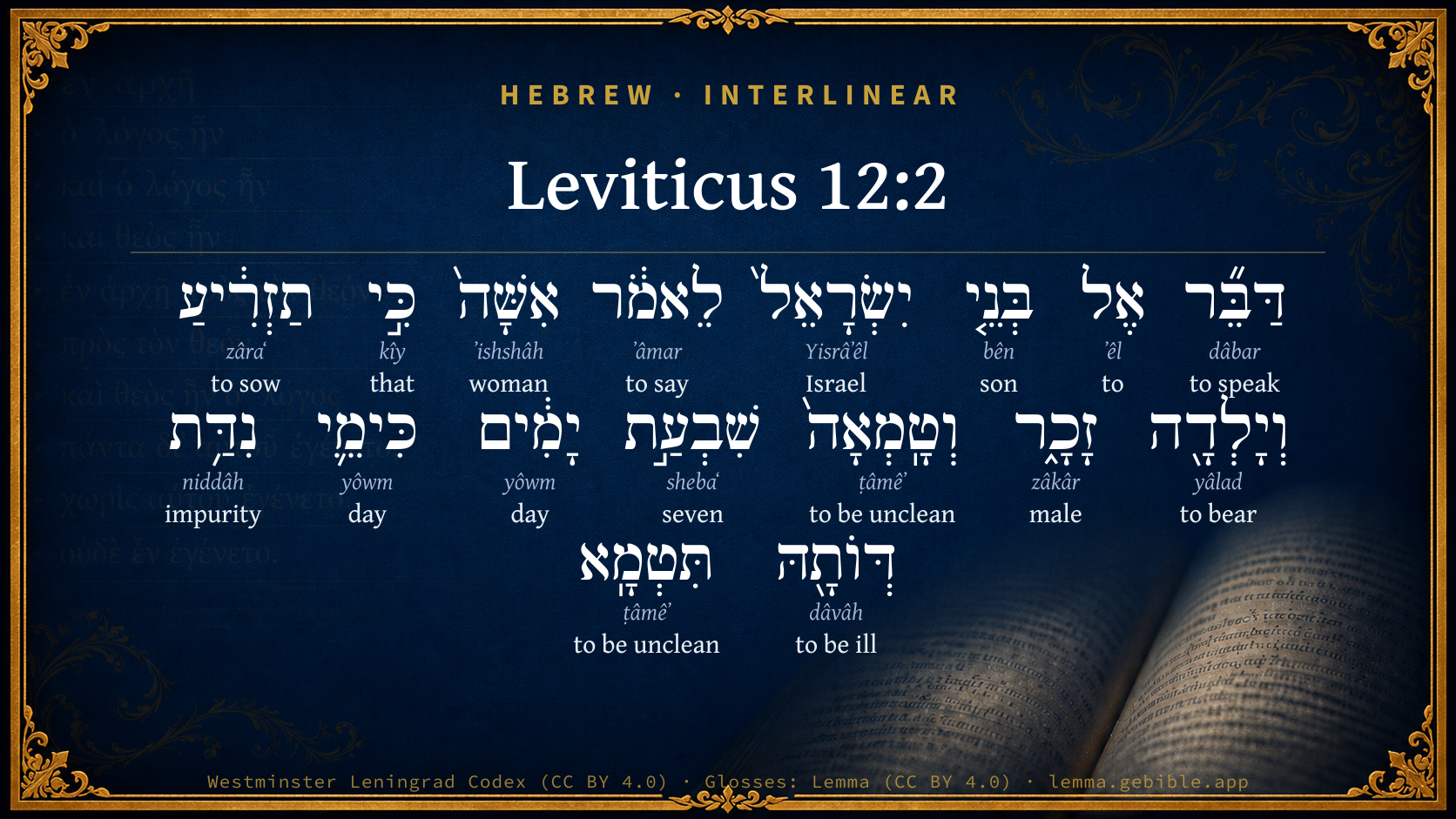
Hebrew (Westminster Leningrad Codex) Leviticus 12:2 appears in the Hebrew Old Testament. The text above is from the Westminster Leningrad Codex. Each word links to its Strong’s number, a concise gloss, and parsing drawn from the Open Scriptures Hebrew Bible morphology. Click any word for its full Brown-Driver-Briggs (BDB) entry.
Download image
Cite this verse

Leviticus 12:2 (World English Bible). Public Domain. Lemma interlinear Bible study tool, https://lemma.gebible.app/v/leviticus/12/2.

Show BibTeX & RIS
BibTeX
RIS
English Translation
"Speak to the children of Israel, saying, 'If a woman conceives, and bears a male child, then she shall be unclean seven days; as in the days of her monthly period she shall be unclean.
World English Bible · Public Domain
Highlights
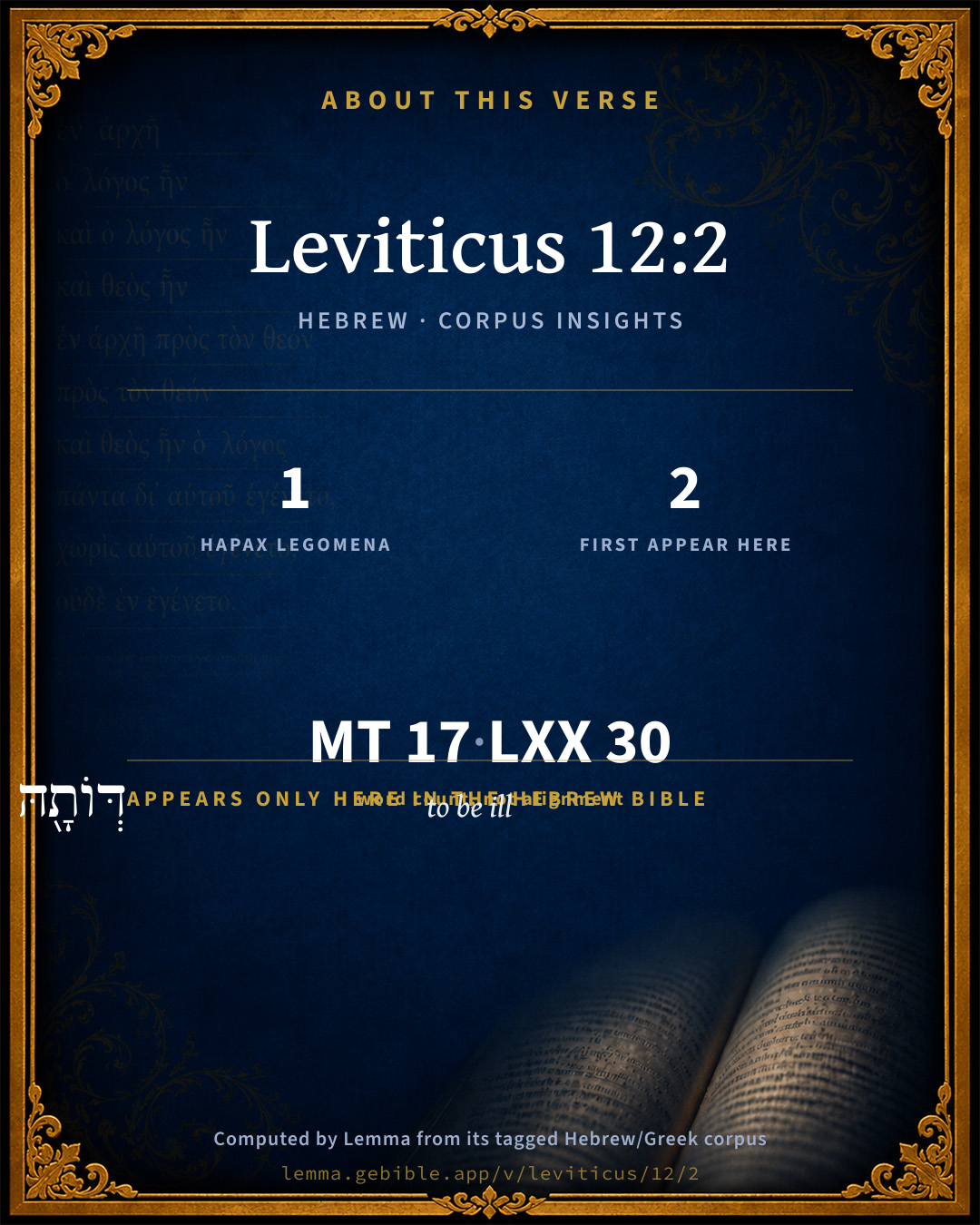
  • 1 hapax legomenon — only here in the Hebrew Bible
  • 2 first appearances in the Hebrew Bible
Full analysis ↓
Download a study sheet

One document with this verse’s original text, its word-by-word gloss line, the meaning frame, cross-references with their text, attributed commentary, and full source and license credits — printable, and it pastes into notes with its structure intact.

This verse Autodidact and up

Study sheet (.html) Plain text (.txt)

A passage Seminary Student

Up to 50 verses in one chapter. A passage sheet keeps up to 6 commentary sources and 12 cross-references per verse, in the order this page ranks them, and says so on the sheet whenever that leaves anything out. Ask for a single verse and you get the Autodidact verse sheet above.

Everything on this page stays free to read, with no account — the sheet is a download of what is already on screen, not access to it.

Want to remove ads? Support Godless Engineer
Compare translations 3

The same verse in 3 English versions, stacked beneath the original-language interlinear above. Click any original word for its lexicon entry.

Each is an independent rendering of the whole verse — the interlinear is not word-aligned to these translations.

Highlighted words mark where these versions differ — a whole-verse word diff, not a word-by-word alignment.

  • World English Bible Public Domain
    "Speak to the children of Israel, saying, 'If a woman conceives, and bears a male child, then she shall be unclean seven days; as in the days of her monthly period she shall be unclean.
  • King James Version Public Domain
    Speak unto the children of Israel, saying, If a woman have conceived seed, and born a man child: then she shall be unclean seven days; according to the days of the separation for her infirmity shall she be unclean.
  • unfoldingWord Literal Text CC BY-SA 4.0
    “Speak to the sons of Israel, saying, ‘A woman, if she produces seed and bears a male, then she shall be unclean for seven days. Like the days of the menstruation of her menstruating, she shall be unclean.

unfoldingWord Literal Text — © unfoldingWord, licensed CC BY-SA 4.0. Word-aligned USFM3 via Door43 (git.door43.org/unfoldingWord/en_ult).

Versions to compare (up to 4)

3 of 4 selected

Show all 18 translations

Every available English version of this verse, each an independent rendering of the whole verse.

  • World English Bible Public Domain
    "Speak to the children of Israel, saying, 'If a woman conceives, and bears a male child, then she shall be unclean seven days; as in the days of her monthly period she shall be unclean.
  • Berean Standard Bible Public Domain
    “Say to the Israelites, ‘A woman who becomes pregnant and gives birth to a son will be unclean for seven days, as she is during the days of her menstruation.
  • Majority Standard Bible Public Domain
    “Say to the Israelites, ‘A woman who becomes pregnant and gives birth to a son will be unclean for seven days, as she is during the days of her menstruation.
  • King James Version Public Domain
    Speak unto the children of Israel, saying, If a woman have conceived seed, and born a man child: then she shall be unclean seven days; according to the days of the separation for her infirmity shall she be unclean.
  • American Standard Version (1901) Public Domain
    Speak unto the children of Israel, saying, If a woman conceive seed, and bear a man-child, then she shall be unclean seven days; as in the days of the impurity of her sickness shall she be unclean.
  • Revised Version (1885) Public Domain
    Speak unto the children of Israel, saying, If a woman conceive seed, and bear a man child, then she shall be unclean seven days; as in the days of the impurity of her sickness shall she be unclean.
  • Geneva Bible (1599) Public Domain
    Speake vnto the children of Israel, and say, When a woman hath brought forth seede, and borne a manchilde, shee shalbe vncleane seuen dayes, like as she is vncleane when she is put apart for her disease.
  • Douay-Rheims (1899) Public Domain
    Speak to the children of Israel, and thou shalt say to them: If a woman having received seed shall bear a man child, she shall be unclean seven days, according to the days of the separation of her flowers.
  • Young's Literal Translation Public Domain
    `Speak unto the sons of Israel, saying, A woman when she giveth seed, and hath born a male, then she hath been unclean seven days, according to the days of separation for her sickness she is unclean;
  • Literal Standard Version CC BY-SA 4.0
    “Speak to the sons of Israel, saying, A woman when she gives seed, and has borne a male, then she has been unclean [for] seven days; she is unclean according to the days of separation for her sickness;
  • Unlocked Literal Bible CC BY-SA 4.0
    “Speak to the people of Israel, saying, 'If a woman conceives and gives birth to a male child, then she will be unclean for seven days, just as she is unclean during the days of her monthly period.
  • unfoldingWord Literal Text CC BY-SA 4.0
    “Speak to the sons of Israel, saying, ‘A woman, if she produces seed and bears a male, then she shall be unclean for seven days. Like the days of the menstruation of her menstruating, she shall be unclean.
  • Darby Bible Public Domain
    Speak unto the children of Israel, saying, If a woman conceive seed, and bear a male, then she shall be unclean seven days; as in the days of the separation of her infirmity shall she be unclean.
  • World Messianic Bible Public Domain
    “Speak to the children of Israel, saying, ‘If a woman conceives, and bears a male child, then she shall be unclean seven days; as in the days of her monthly period she shall be unclean.
  • Webster's Bible Public Domain
    Speak to the children of Israel, saying, If a woman hath conceived seed, and borne a male-child; then she shall be unclean seven days; according to the days of the separation for her infirmity shall she be unclean.
  • Free Bible Version CC BY-SA 4.0
    Any woman who becomes pregnant and has a boy, she will be unclean for one week, in the same way that she is unclean during her period.
  • Bible in Basic English Public Domain
    Say to the children of Israel, If a woman is with child and gives birth to a male child, she will be unclean for seven days, as when she is unwell.
  • JPS Tanakh (1917) Public Domain
    Speak unto the children of Israel, saying: If a woman be delivered, and bear a man-child, then she shall be unclean seven days; as in the days of the impurity of her sickness shall she be unclean.

Literal Standard Version (2020), Covenant Press — licensed CC BY-SA 4.0. Text via the HelloAO Bible API (eBible.org). Unlocked Literal Bible (unfoldingWord) — licensed CC BY-SA 4.0. Text via the HelloAO Bible API (eBible.org). unfoldingWord Literal Text — © unfoldingWord, licensed CC BY-SA 4.0. Word-aligned USFM3 via Door43 (git.door43.org/unfoldingWord/en_ult). Free Bible Version, Dr. Jonathan Gallagher — licensed CC BY-SA 4.0. Text via the HelloAO Bible API (eBible.org).

Word by word

More ways to search: Search by grammar → Find every occurrence → Compare this word →

Practice this passage: Drill this verse → Learn its vocabulary →

דְּוֺתָ֖הּ
dâvâh
H1738
“to be ill · her”
Verb, Qal, Infinitive Construct + Suffix, Personal, 3rd Person, Feminine, Singular
Part of Speech
Verb
Stem
Qal
Form
Infinitive Construct
Full BDB Definition

Origin: a primitive root

TWOT: 411

(Qal) to be ill, be unwell - (TWOT)infirmity
  1. דַּבֵּ֞ר dâbar H1696 “speak” Verb, Piel, Imperative, 2nd Person, Masculine, Singular
  2. אֶל ʼêl H413 “to” Preposition
  3. בְּנֵ֤י bên H1121 “sons of” Noun, Common, Masculine, Plural, Construct
  4. יִשְׂרָאֵל֙ Yisrâʼêl H3478 “Israel” Noun, Proper
  5. לֵאמֹ֔ר ʼâmar H559 “to say” Preposition + Verb, Qal, Infinitive Construct
  6. אִשָּׁה֙ ʼishshâh H802 “woman” Noun, Common, Feminine, Singular, Absolute
  7. כִּ֣י kîy H3588 “that” Conjunction
  8. תַזְרִ֔יעַ zâraʻ H2232 “to sow” Verb, Hiphil, Imperfect, 3rd Person, Feminine, Singular
  9. וְיָלְדָ֖ה yâlad H3205 “and · to bear” Conjunction + Verb, Qal, Sequential Perfect, 3rd Person, Feminine, Singular
  10. זָכָ֑ר zâkâr H2145 “male” Adjective, Adjective, Masculine, Singular, Absolute
  11. וְטָֽמְאָה֙ ṭâmêʼ H2930 “and · to be unclean” Conjunction + Verb, Qal, Sequential Perfect, 3rd Person, Feminine, Singular
  12. שִׁבְעַ֣ת shebaʻ H7651 “seven” Adjective, Cardinal number, Masculine, Singular, Construct
  13. יָמִ֔ים yôwm H3117 “days” Noun, Common, Masculine, Plural, Absolute
  14. כִּימֵ֛י yôwm H3117 “like/as · days of” Preposition + Noun, Common, Masculine, Plural, Construct
  15. נִדַּ֥ת niddâh H5079 “impurity of” Noun, Common, Feminine, Singular, Construct
  16. תִּטְמָֽא ṭâmêʼ H2930 “to be unclean” Verb, Qal, Imperfect, 3rd Person, Feminine, Singular

About this verse

These counts appear in no published source. They are computed here, from the morphology-tagged text and Lemma’s own curated glosses. What Lemma adds →

17
words
15
distinct lemmas
Pentateuch
section

Notable vocabulary

1 hapax legomenon — a word that appears only here in the entire Hebrew Bible:

  • דְּוֺתָ֖הּ to be ill H1738

First appearance in Scripture

These words make their first canonical appearance in the Hebrew Bible here:

  • נִדַּ֥ת impurity H5079
  • דְּוֺתָ֖הּ to be ill H1738

Shared distinctive vocabulary

נִדַּ֥ת impurity H5079 occurs in 24 verses of the Hebrew Bible. Also found in:

Grammatical profile

  • 7 verbs
  • 6 nouns
  • 2 adjectives
  • 1 preposition
  • 1 conjunction

Verb forms

  • דַּבֵּ֞ר Piel · Imperative
  • לֵאמֹ֔ר Qal · Infinitive Construct
  • תַזְרִ֔יעַ Hiphil · Imperfect
  • וְיָלְדָ֖ה Qal · Sequential Perfect
  • וְטָֽמְאָה֙ Qal · Sequential Perfect
  • דְּוֺתָ֖הּ Qal · Infinitive Construct
  • תִּטְמָֽא Qal · Imperfect

Repetition

Words recur within this verse — often emphatic in Hebrew:

  • וְטָֽמְאָה֙ to be unclean H2930 ×2
  • יָמִ֔ים day H3117 ×2

Hebrew & Septuagint length

In English translation the verse runs 35 words from the Hebrew and 41 from the Septuagint (LXX English) — closely comparable.

A rough comparison of the two English renderings, which tokenize alike — not a word-level alignment.

Word counts can differ between the Hebrew and the Greek without any difference in meaning — e.g. the Hebrew direct-object marker אֵת has no separate Greek word, and Greek often adds the article ὁ.

In the original languages it is 17 Hebrew tokens and 30 Greek tokens — but the two are counted differently (Hebrew bundles its prefixes and suffixes into one token; the Greek is in lemma form), so that isn’t a like-for-like length.

Cross-references

10

Topical passages linked to Leviticus 12:2 in the Treasury of Scripture Knowledge — connected by theme and wording, ordered by reader-vote popularity; previews shown in the World English Bible.

  • Luke 2:22 When the days of their purification according to the law of Moses were fulfilled, they brought him up to Jerusalem, to present him to the Lord
  • Leviticus 15:19 "'If a woman has a discharge, and her discharge in her flesh is blood, she shall be in her impurity seven days: and whoever touches her shall be unclean until the evening.
  • Leviticus 18:19 "'You shall not approach a woman to uncover her nakedness, as long as she is impure by her uncleanness.
  • Job 14:4 Who can bring a clean thing out of an unclean? Not one.
  • Job 15:14 What is man, that he should be clean? He who is born of a woman, that he should be righteous?
  • Job 25:4 How then can man be just with God? Or how can he who is born of a woman be clean?
  • Romans 5:12–19 Therefore, as sin entered into the world through one man, and death through sin; and so death passed to all men, because all sinned.
  • Genesis 1:28 God blessed them. God said to them, "Be fruitful, multiply, fill the earth, and subdue it. Have dominion over the fish of the sea, over the birds of the sky, and over every living thing that moves on the earth."
  • Genesis 3:16 To the woman he said, "I will greatly multiply your pain in childbirth. In pain you will bring forth children. Your desire will be for your husband, and he will rule over you."
  • Psalms 51:5 Behold, I was brought forth in iniquity. In sin my mother conceived me.

Cross-references courtesy of OpenBible.info (CC BY 4.0).

Hebrew and Greek witnesses Masoretic Hebrew ↔ Greek Septuagint

The same verse in the two great witnesses to the Old Testament, shown verse-for-verse.

These are two independent witnesses, not word-aligned to each other, and the Septuagint is shown in lemma (dictionary) form.

Hebrew Leviticus 12:2 Masoretic · Westminster Leningrad Codex

דַּבֵּ֞ר אֶל בְּנֵ֤י יִשְׂרָאֵל֙ לֵאמֹ֔ר אִשָּׁה֙ כִּ֣י תַזְרִ֔יעַ וְיָלְדָ֖ה זָכָ֑ר וְטָֽמְאָה֙ שִׁבְעַ֣ת יָמִ֔ים כִּימֵ֛י נִדַּ֥ת דְּוֺתָ֖הּ תִּטְמָֽא

"Speak to the children of Israel, saying, 'If a woman conceives, and bears a male child, then she shall be unclean seven days; as in the days of her monthly period she shall be unclean.

World English Bible · Public Domain

Greek LXX Leviticus 12:2 Septuagint · lemma form

λαλέω ὁ υἱός ἰσραήλ καί εἶπον πρός αὐτός γυνή ὅστις ἐάν σπερματίζω καί τίκτω ἄρσην καί ἀκάθαρτος εἰμί ἑπτά ἡμέρα κατά ὁ ἡμέρα ὁ χωρίσμος ὁ ἄφεδρος αὐτός ἀκάθαρτος εἰμί

Speak to the children of Israel, and you shall say to them, Whatsoever woman shall have conceived and born a male child shall be unclean seven days, she shall be unclean according to the days of separation for her monthly courses.

LXX2012 (modern English Septuagint) · Public Domain

Hebrew: Westminster Leningrad Codex (CC BY 4.0). Greek: Septuagint (public domain); English from LXX2012 (modern English Septuagint) (Public Domain). How the Septuagint differs from the Hebrew →

Targum (Aramaic paraphrase)

2

The Targum is the ancient Jewish Aramaic paraphrase of the Hebrew Scriptures — an interpretive translation, not the Hebrew text itself. Onkelos (literal) and Pseudo-Jonathan (expansive) render the Torah, and Jonathan the Prophets. Coverage is partial: where no permissively-licensed English translation exists for a verse, only the Aramaic is shown. This is verse-level text, not a word-by-word alignment to the Hebrew.

  1. Targum Onkelos Torah (Genesis–Deuteronomy)
    מַלֵל עִם בְּנֵי יִשְׂרָאֵל לְמֵימָר אִתְּתָא אֲרֵי תְעַדִי וּתְלִיד דְכָר וּתְהֵי מְסָאָבָא שִׁבְעַת יוֹמִין כְּיוֹמֵי רִחוּק סוֹבְתַהּ תְּהֵי מְסָאָבָא

    (no public-domain English translation for this verse)

    Targum Onkelos — Aramaic: “Onkelos Genesis” (public domain); “Onkelos Exodus” (public domain); “Onkelos Leviticus” (public domain); “Onkelos Numbers” (public domain); “Onkelos Deuteronomy” (public domain). English: “Sefaria Community Translation” (CC0 1.0 (public-domain dedication)); “J.W. Etheridge. The Targums of Onkelos and Jonathan Ben Uzziel on the Pentateuch. London: Longmans, Green, 1862” (public domain). Text via Sefaria.

  2. Targum Pseudo-Jonathan Torah (Genesis–Deuteronomy)
    מַלֵיל עִם בְּנֵי יִשְרָאֵל לְמֵימָר אִתְּתָא אֲרוּם תַעֲדֵי וְתֵילִיד בִּיר דְכַר וּתְהֵי מְסָאָבָא שַׁבְעָא יוֹמִין הֵי כְיוֹמֵי רִיחוּק סְאוּבְתָּהּ הֵיכְדֵין תִּסְתָּאֵב

    Speak with the sons of Israel, saying: When a woman hath conceived and borne a male child, she shall be unclean seven days, as the days of the removal of her uncleanness shall she be unclean.

    Targum Pseudo-Jonathan — Aramaic: “Targum Jonathan on Genesis” (public domain); “Targum Jonathan on Exodus” (public domain); “Targum Jonathan on Leviticus” (public domain); “Targum Jonathan on Numbers” (public domain); “Targum Jonathan on Deuteronomy” (public domain). English: “The Targum of Jonathan ben Uzziel, trans. J. W. Etheridge, London, 1862” (public domain). Text via Sefaria.

Commentary

Notes on Leviticus 12:2 from classic Christian and Jewish commentators (each source and its license shown beneath its notes). The classic Christian expositions comment on the surrounding passage and are grouped to its opening verse, so a note may address several verses; the Jewish commentaries on the Tanakh (Rashi and others) are per-verse, so they appear only where the commentator wrote on this verse.

Lemma curates 59 commentaries, every one of them public domain or Creative Commons licensed, each selected and text-cleaned for this edition rather than reprinted as found. About our sources →

Trapp's Complete Commentary

John Trapp

Lev 12:2 Speak unto the children of Israel, saying, If a woman have conceived seed, and born a man child: then she shall be unclean seven days; according to the days of the separation for her infirmity shall she be unclean.

Ver. 2. If a woman have conceived seed.] Or yielded seed, as Gen 1:11. Urgendum hoc adversus Anabaptistas; qui, ut suos de humanae Christi naturae origine errores stabiliant, faeminas semen habere praefracte negant. {a} Hebraeorum magistri, ex eodem loco, {Gen 1:11-12} colligunt marem edi quoties mulier semen mittere prior coeperit; foeminam, ubi vir. {b}

Then she shall be unclean.] This signified that corruption of man’s nature wherein he is conceived, {Psa 51:5} being condemned as soon as conceived, Damnatus antequam natus, {c} and the remedy we have in Christ.

{a} Amama, Antibarbar, 575.

{b} Gatak. cont. Pfochen.

{c} Augustine.

John Trapp, A Commentary or Exposition upon All the Books of the Old and New Testament (1647–1656) — public domain. Text from a community e-Sword module.

Joseph Benson's Commentary

Lev 12:2. Seven days — Not for any filthiness which was either in the conception, or in bringing forth, but to signify the universal and deep pollution of man’s nature, even from the birth, and from the conception. Seven days, or thereabouts, nature is employed in the purgation of most women. Her infirmity — Her monthly infirmity. And it may note an agreement therewith not only in the time, (Lev 15:19,) but in the degree of uncleanness.

Joseph Benson's Commentary on the Old and New Testaments (1811–1818) — public domain. Text from a community e-Sword module.

Tyndale Open Study Notes

Tyndale Open Resources

12:2 menstrual period: See 15:19-24.

Tyndale Open Study Notes — © Tyndale Open Resources, licensed CC BY-SA 4.0. Text via the HelloAO Bible API.

Geneva Bible (1599)

Geneva Bible translators

So that her husband for that time could not resort to her.

Or, flowers.

Geneva Bible (1599) marginal notes — public domain. Text via Bolls.life.

Adam Clarke's Commentary

Verse 2. If a woman have conceived] In the extent mentioned here the ordinances of this chapter have little relation to us: and to inquire into their physical reasons, as far as they related to the Jews, could afford but little edification; and to make such a subject sufficiently plain would require such minute examination and circumstantial detail as could scarcely be proper for several readers. All that is necessary to be said the reader will find on Le 12:4.

Adam Clarke's Commentary on the Bible (1810–1826) — public domain. Text from a community e-Sword/MySword module.

Ellicott's Commentary for English Readers

(2) If a woman have conceived seed.—Rather, if a woman bringeth forth seed, that is, is delivered of a child. (See Gen_1:11-12; Gen_1:29.) This general statement is afterwards specified by the phrases “and born a man child,” and “bear a maid child,” in the verse before us, and in Lev_12:5. Thus the regulations about impurity naturally begin with the beginning of life. According to the administrators of the law during the second Temple, the regulations here set forth with regard to the deliverance are in force even when it is an untimely birth, or when the child is born dead, provided it has a perfect shape, which it assumes after forty days of its conception. Amongst the Hindoos, too, the mother in case of a miscarriage remains in a state of defilement as many nights as months have elapsed since her conception.

And born a man child.—Better, and giveth birth to a male child. The expression rendered here in the Authorised Version by “a man child” is translated in Lev_12:7 simply “male.” In so short a paragraph discussing the same enactment it is important that words identical in the original should be translated uniformly in English.

She shall be unclean seven days.—Though the issue of blood which succeeds child-birth generally only lasts three or four days, yet the period of uncleanness is extended to seven days to include exceptional cases.

According to the days . . . . —Better, as in the days of the uncleanness of her monthly courses, that is, her uncleanness is to be of the same duration, and she is to observe the same rules, and be subjected to the same restraints as during the period of her menstruation. (See Lev_15:19.) The fact that reference is here made to the regulations about the periodical impurity of women which have not as yet been laid down shows that, like other laws, this law was already known to and generally practised by the Jews before it was finally fixed in the Levitical code.

A Bible Commentary for English Readers, edited by Charles John Ellicott (1878–1897) — public domain. Text from a community e-Sword module.

The Cambridge Bible for Schools and Colleges

gen. ed. J. J. S. Perowne

2. Compare Gen_17:12; Exo_22:29-30; Luk_1:59; Php_3:5. Reference is here made to the regulation of Lev_15:19.

The Cambridge Bible for Schools and Colleges (gen. ed. J. J. S. Perowne; Cambridge University Press, 1878–1918) — public domain. Text from a community e-Sword module.

John Gill's Exposition

Speak unto the children of Israel,.... For this law only concerned them, and not other nations of the world:

if a woman have conceived seed; by lying with a man, and so becomes pregnant, and goes on with her pregnancy until she brings forth a child. The Jews from hence gather, that this law respects abortions; that if a woman has conceived and miscarries, eighty one days after the birth of a female, and forty one after a male, she must bring her offering (m); but the law seems only to regard such as are with child, and proceed to the due time of childbirth, whether then the child is born alive or dead:

and born a man child; which is, generally speaking, not only matter of joy to the mother, but to the whole family, see Joh 16:21 then she shall be unclean seven days; be separate from all company, except those whose presence is necessary to take care of her in her circumstances, and do what is proper for her, and even these became ceremonially unclean thereby; yea, her husband was not permitted to sit near her, nor to eat and drink with her:

according to the days of the separation for her infirmity shall she be unclean; the same number of days, even seven, she was unclean on account of childbirth, as she was for her monthly courses, called here an infirmity or sickness, incident to all females when grown up, at which time they were separate from all persons; and the case was the same with a new mother; see Lev 15:14.

(m) Misn. Ceritot, c. 1. sect. 6. Maimon. & Bartenora, in ib.

John Gill's Exposition of the Whole Bible (1746–1763) — public domain (CC PDM 1.0). Text via the HelloAO Bible API.

Haydock's Catholic Bible Commentary

Child. By this manner of expressing himself, Moses excludes the blessed Virgin, as the ancient fathers and the moderns generally remark. She conceived without concupiscence, and was subject to none of the usual inconveniences of child-birth. (Suarez) --- So that whether this law was instituted to expiate the former, or to purify the latter, she was not included. All other mothers were separated, at least seven days, and longer if their state required it; (Calmet) during which time, they were treated like those mentioned, chap xv. 19. After that period they were allowed to manage their affairs, as usual, but not to touch any thing sacred, nor suffer their husbands to approach them, till the expiration of 33 days more, ver. 4. (Menochius) --- Euripides blames Diana for keeping such women at a distance from her altar, while she delighted in human sacrifices. (Iphigen. v. 380.) Censorinus says, "Prægnan ante diem quadragesimum non prodit in Fanum; & post partum pleræque graviores sunt, nec sanguinem interdum continent." (Grotius)

George Leo Haydock (1774–1849), Haydock's Catholic Family Bible and Commentary, 1859 edition — public domain. Excludes Psalms (Douay-Rheims chapter numbering differs from Protestant) and Deuterocanonical books (Catholic canon only).

Matthew Poole's English Annotations

From uncleanness contracted by the touching or eating of external things, he now comes to that uncleanness which ariseth from ourselves.

She shall be unclean; not for any filthiness which was either in the conception or in bringing forth, but to signify the universal and deep pollution of man’s nature even from the birth, and from the conception. For

seven days, or thereabouts, nature is employed in the purgation of most women.

For her infirmity, i.e. for her monthly infirmity. And it may note an agreement therewith not only in the time, Lev 15:19, but in the degree of uncleanness, which was such that she defiled every thing she touched, &c.

Matthew Poole's English Annotations on the Holy Bible (1683–1685) — public domain. Text from a community e-Sword/MySword module.

The Pulpit Commentary

Vers. 2-4. She shall be unclean seven days. The mother is to be unclean seven days, and after that to be in the blood of her purifying three and thirty days (verse 4). The difference between these two states maybe seen by looking on to Lev_15:19-28, and comparing that passage with verse 4 of this chapter. In the first stage, during the seven days, she made all that she touched unclean; in the second stage, during the thirty-three days, she was only required to touch no hallowed thing, nor come into the sanctuary, as she was progressing towards cleanness. The number of days during which she is to be altogether unclean is to be according to the days of the separation for her infirmity, that is, seven days, as in the case of her monthly courses. (see Lev_15:19) In the eighth day the flesh of his foreskin shall be circumcised. The Levitical legislation recognizes the regulation as to the day of the circumcision made at the time of the covenant with Abraham. "And he that is eight days old (or a son of eight days) shall be circumcised among you, every man child in your generations". (Gen_17:12) Until the days of her purifying be fulfilled. "When in a state of impurity, the Hebrews were forbidden to enter the sanctuary, to keep the Passover, and to partake of holy food, whether of sacrificial meat, of sacred offerings and gifts, or of shew-bread, because the clean only were fit to approach the holy God and all that appertains to him" (Lev_7:19-21 Lev_22:3 Num_9:6 Num_18:11 1Sa_21:5) (Kalisch).

The Pulpit Commentary (1880–1919), ed. H.D.M. Spence-Jones & Joseph S. Exell — public domain. Text from a community e-Sword module.

John Wesley's Explanatory Notes

Seven days - Not for any filthiness which was either in the conception, or in bringing forth, but to signify the universal and deep pollution of man's nature, even from the birth, and from the conception. Seven days or thereabouts, nature is employed in the purgation of most women. Her infirmity - Her monthly infirmity. And it may note an agreement therewith not only in the time, chap. xv, 19, but in the degree of uncleanness.

John Wesley, Explanatory Notes Upon the Whole Bible (1754–1765) — public domain. Text via the GEBible commentary corpus.

Rashi

Rabbi Shlomo Yitzchaki (Rashi)

אשה כי תזריע IF A WOMAN HAVE CONCEIVED SEED — R. Simlai said: Even as the formation of man took place after that of every cattle, beast and fowl when the world was created, so, too, the law regarding him is set forth after the law regarding cattle, beast and fowl (contained in the previous chapter) (Leviticus Rabbah 14:1).

כי תזריע — These words are superfluous, כי ילדה would suffice — they mean literally, ”if she bringeth forth seed” and are employed to include the case that if she gave birth to him (the male child) as a pulpy mass which had dissolved, having become liquified like seed, even then its mother becomes unclean as though it were a normal birth (Niddah 27b).

כימי נדת דותה תטמא AS IN THE DAYS OF THE SEPARATION FOR HER IMPURITY SHALL SHE BECOME UNCLEAN — According to the regulation of every uncleanness which is mentioned in the case of a נדה does she become unclean in respect to the uncleanness resulting from child-birth — even though the womb opened without any issue of blood (cf. Niddah 21a).

דותה — This is an expression for anything which flows from her body (‎‎‏זב = דו, “flowing”), and the translation is: “as in the days of separation due to her flux”. Another explanation is: it has the same meaning as.מדוה (root דוה), malady and sickness, and this is termed דותה, “her sickness”, because no woman sees an issue of blood from herself except that, as a result of it, she becomes unwell and her head and limbs feel heavy (cf. Niddah 9a).

Rashi on the Tanakh — English translations: “The Judaica Press complete Tanach with Rashi, translated by A. J. Rosenberg” (CC BY 4.0); “Pentateuch with Rashi's commentary by M. Rosenbaum and A.M. Silbermann, 1929-1934” (public domain); “The Metsudah Tanach series, Lakewood, N.J” (CC BY 4.0); and “The Book of Joshua, Metsudah Publications, 1997” (CC BY 4.0). Text via Sefaria.

Ramban (Nachmanides)

Rabbi Moshe ben Nachman (Ramban / Nachmanides)

Rashi commented: “If a woman have conceived seed, and born [a male]. This includes a case where she gave birth to [the male child as] a fleshy mass which had dissolved, so that it became liquefied and like seed, in which case his mother becomes impure because of the birth” [as if it were a normal child]. The explanation of this matter is that we know that the child has been formed already in human form, and then became liquefied, for anything that does not have a human form is not considered a child, and similarly, whatever is not fit to become a creature with a soul, is not considered a child. But even if it is a fleshy dissolved mass at the time of birth, it makes the mother impure [for the prescribed number of days] provided we recognize its form, such as a foetus with its human parts fashioned, in which case the mother is certainly impure, and if not [i.e., the matter is in doubt] she is impure because of a doubt. This is what this verse comes to include according to the words of our Rabbis. Now with regard to the implication of the verse the Rabbis have said:, 31a. “Ishah ki thazria — if the woman emits seed first, she will bear a son.” The intent of the Rabbis was not that the child is formed from the woman’s seed, for although the woman has generative organs [i.e., ovaries] like those of the man, yet seed is not formed by them at all, or [if it is formed], that seed is not thick and does not contribute anything to the embryo. Rather, the Rabbis used the term “she emits seed” with reference to the blood of the womb, which gathers in the mother at the time of the consummation of coition, and attaches itself to the seed of the male. For in the opinion of the Rabbis the child is formed from the blood of the female and the white [semen] of the man, and both of them are called “seed.” Thus the Rabbis have said:, 31a. “There are three partners in [the formation of] man: The male emits the white [semen], from which are formed the sinews, the bones, and the white substance in the eye. The female emits a red secretion from which are formed the skin, the flesh, the blood, the hair, and the black substance in the eye.” The opinion of doctors as to the formation [of the embryo of the child] is also the same. In the opinion of the Greek philosophers, however, the whole body of the child is formed from [the substance of] the blood of the mother, the father only contributing that generative force which is known in their language as hyly, which gives form to matter., p. 23. For there is no difference at all between the egg of a chicken which is laid because it was fructified by a male, and that laid as a result of the mother rolling herself in the dust, except that the egg [that had been fructified by a male] germinates into a young bird, while the other is not sown, nor beareth, because it is deprived of the elemental heat which is its hyly. And if so, the word tazria [in ishah ki thazria] will be like u’cheganah zeiru’eha thatzmiach (as the garden causeth the seeds that are sown in it to spring forth). can be understood in its simple meaning: “when the female emits her secretion” first etc. But according to the philosophers who say that the child is formed entirely from the body of the mother, and the male semen is merely a generative force which gives form to matter, then the word tazria can no longer mean “emitting,” but is like thatzmiach — “causes to spring up.” And so did Onkelos render it: “If a woman conceives.”

D’VOTHAH.’ “This is an expression for anything which flows from her body, derived from the wording for malady [madveh] and sickness, for no woman sees an issue of blood without becoming unwell, and her head and her limbs feeling heavy on her.” This is Rashi’s language. But I do not know on the basis of which root the word d’vothah can be an expression in the Sacred Language for “anything which flows.” But it is possible that it is an expression of malady, on the basis of what the Rabbis have said, “and her head and limbs are heavy on her.” So also is the opinion of Rabbi Abraham ibn Ezra, who writes: “D’vothah is a noun and means sickness, for the blood which issues indicates a sickness in the woman.” Now it is true that the flow constitutes a cleansing of surpluses [of blood], and due to the fact that her head and her limbs feel heavy upon her, the flow is perhaps termed “a sickness.” The correct interpretation, however, is that d’vothah is an expression derived from the word madveh [which does not mean “sickness,” i.e., an unnatural occurrence in the body, since a woman’s menses are natural; and d’vothah is therefore like the terms] plague and pain, just as in the expressions: My heart is ‘davoi’ (faint) within me; for this our heart is ‘daveh’ (faint), and like: the plague of his heart. Thus menstruation is an affliction upon the woman even though it is in her nature [to experience it regularly]. A similar expression is upon the bed of ‘d’voi’ (illness].

Ramban (Nachmanides) on the Tanakh — English translation: “Commentary on the Torah by Ramban (Nachmanides). Translated and annotated by Charles B. Chavel. New York, Shilo Pub. House, 1971-1976” (CC BY 4.0). Text via Sefaria.

Ibn Ezra

Rabbi Abraham ibn Ezra

When a woman conceives. After completing the instructions of the clean and the unclean regarding food, the Torah touches upon uncleanness in man, starting with a woman who gave birth, because birth is the beginning. Many have said that when a woman is first to bring forth seed she gives birth to a male child, and therefore it says, “and she gives birth to a male child”.

Ibn Ezra on the Tanakh — English translations: “Sefaria Community Translation” (CC0 1.0 (public-domain dedication)); “Yalkut, Sifsei Chachomim Chumash, Metsudah Publications, 2009” (CC BY 4.0); and “Commentary of Ibn Ezra on Isaiah - trans. by M. Friedlander, 1873” (public domain). Text via Sefaria.

Lesson kit

Teaching starters — assembled from the data on this page, not authored interpretation. Every prompt links to the verse data it draws on. Edit before teaching.

Leviticus, in the Pentateuch, opens this verse with 17 words (15 distinct Hebrew lemmas). Its most distinctive word is dâvâh (“to be ill”). A historical commentator’s framing appears above. Read the whole chapter for the surrounding context.

Discussion questions

  1. How does “to be ill” (dâvâh) shape what this verse is saying?
  2. 1 word here appears nowhere else in the Hebrew Bible. Why might the author reach for such rare wording?
  3. 2 words make their first appearance in Scripture here. What does this debut establish?
  4. How does Leviticus 12:5, which shares the word «impurity», read alongside this verse?
  5. What does the repetition of “to be unclean” (2× in this one verse) do in this verse?
  6. These translations render this verse differently. What is at stake in choosing one wording over another?
  7. «דַּבֵּ֞ר» is a Piel Imperative verb. How does that grammatical form shape the action described?
  8. Compare how Trapp's Complete Commentary and Joseph Benson's Commentary read this verse. Where do they agree or differ?

Things to notice

  • 1 word in this verse appears nowhere else in the Hebrew Bible.
  • 2 words make their first canonical appearance in Scripture here.
  • This verse counts 17 Hebrew ↔ 30 Greek words.
  • These translations choose different wording for 20 words in this verse.
  • “to be unclean” occurs 2× in this single verse.

Reading settings

Reading text

Shown beneath each verse's original-language words.

Old Testament
Old Testament edition

Read the OT as the Masoretic Hebrew (MT) or the Greek Septuagint (LXX).

English shown for the Greek Septuagint (in the Hebrew ↔ Greek comparison).

Comparing translations? Open the Compare panel on any verse page to stack up to four side by side.