
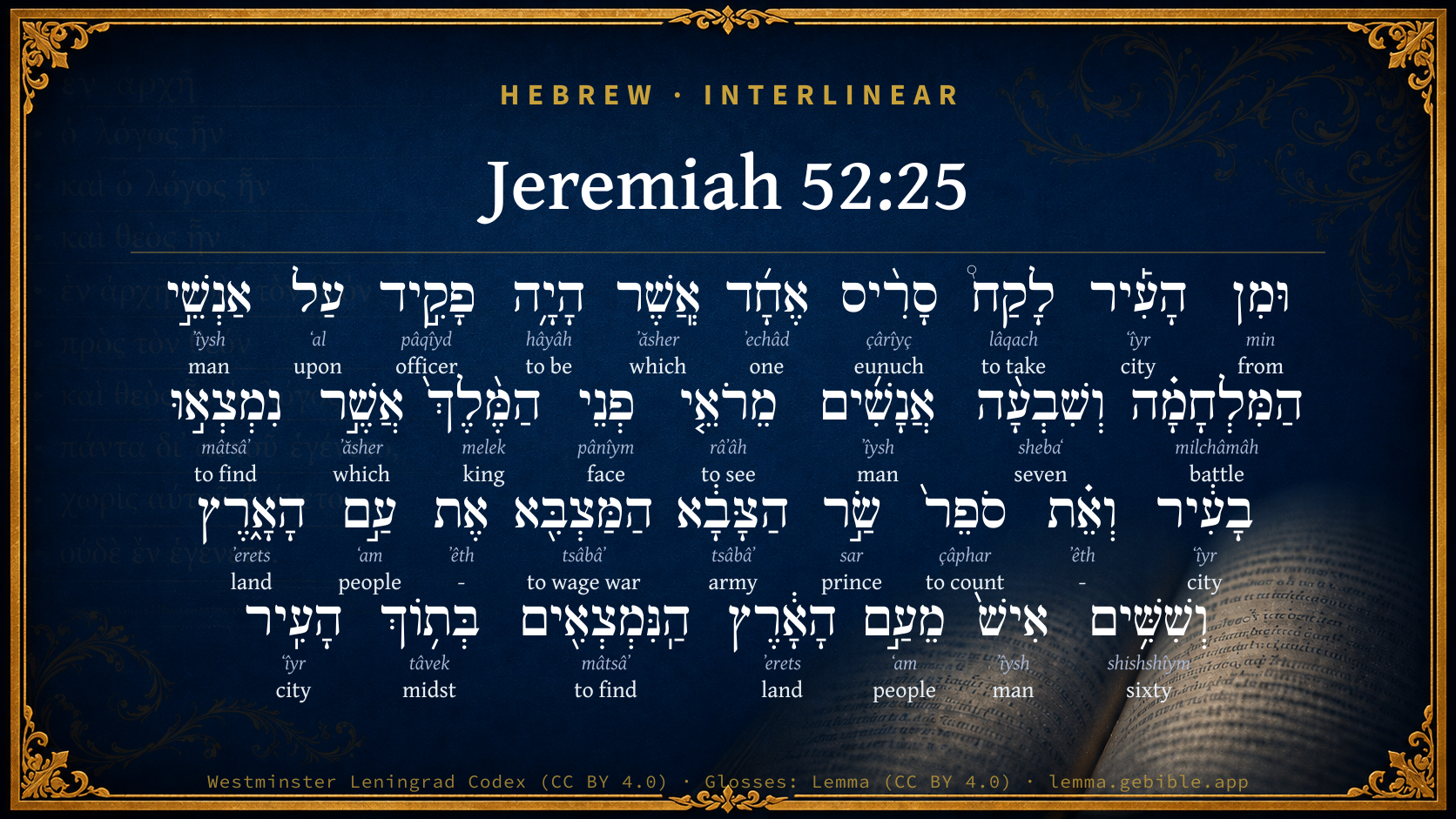
Jeremiah 52:25

Hebrew (Westminster Leningrad Codex) Jeremiah 52:25 appears in the Hebrew Old Testament. The text above is from the Westminster Leningrad Codex. Each word links to its Strong’s number, a concise gloss, and parsing drawn from the Open Scriptures Hebrew Bible morphology. Click any word for its full Brown-Driver-Briggs (BDB) entry.
Download image
Cite this verse

Jeremiah 52:25 (World English Bible). Public Domain. Lemma interlinear Bible study tool, https://lemma.gebible.app/v/jeremiah/52/25.

Show BibTeX & RIS
BibTeX
RIS
English Translation
and out of the city he took an officer who was set over the men of war; and seven men of those who saw the king's face, who were found in the city; and the scribe of the captain of the host, who mustered the people of the land; and sixty men of the people of the land, who were found in the midst of the city.
World English Bible · Public Domain
Download a study sheet

One document with this verse’s original text, its word-by-word gloss line, the meaning frame, cross-references with their text, attributed commentary, and full source and license credits — printable, and it pastes into notes with its structure intact.

This verse Autodidact and up

Study sheet (.html) Plain text (.txt)

A passage Seminary Student

Up to 50 verses in one chapter. A passage sheet keeps up to 6 commentary sources and 12 cross-references per verse, in the order this page ranks them, and says so on the sheet whenever that leaves anything out. Ask for a single verse and you get the Autodidact verse sheet above.

Everything on this page stays free to read, with no account — the sheet is a download of what is already on screen, not access to it.

Want to remove ads? Support Godless Engineer
Compare translations 3

The same verse in 3 English versions, stacked beneath the original-language interlinear above. Click any original word for its lexicon entry.

Each is an independent rendering of the whole verse — the interlinear is not word-aligned to these translations.

Highlighted words mark where these versions differ — a whole-verse word diff, not a word-by-word alignment.

  • World English Bible Public Domain
    and out of the city he took an officer who was set over the men of war; and seven men of those who saw the king's face, who were found in the city; and the scribe of the captain of the host, who mustered the people of the land; and sixty men of the people of the land, who were found in the midst of the city.
  • King James Version Public Domain
    He took also out of the city an eunuch, which had the charge of the men of war; and seven men of them that were near the king's person, which were found in the city; and the principal scribe of the host, who mustered the people of the land; and threescore men of the people of the land, that were found in the midst of the city.
  • unfoldingWord Literal Text CC BY-SA 4.0
    From the city he took prisoner an officer who was in charge of soldiers, and seven men of those who advised the king, who were still in the city. He also took prisoner the king’s army officer responsible for drafting men into the army, along with sixty important men from the land who were in the city.

unfoldingWord Literal Text — © unfoldingWord, licensed CC BY-SA 4.0. Word-aligned USFM3 via Door43 (git.door43.org/unfoldingWord/en_ult).

Versions to compare (up to 4)

3 of 4 selected

Show all 18 translations

Every available English version of this verse, each an independent rendering of the whole verse.

  • World English Bible Public Domain
    and out of the city he took an officer who was set over the men of war; and seven men of those who saw the king's face, who were found in the city; and the scribe of the captain of the host, who mustered the people of the land; and sixty men of the people of the land, who were found in the midst of the city.
  • Berean Standard Bible Public Domain
    Of those still in the city, he took a court official who had been appointed over the men of war, as well as seven trusted royal advisers. He also took the scribe of the captain of the army, who had enlisted the people of the land, and sixty men who were found in the city.
  • Majority Standard Bible Public Domain
    Of those still in the city, he took a court official who had been appointed over the men of war, as well as seven trusted royal advisers. He also took the scribe of the captain of the army, who had enlisted the people of the land, and sixty men who were found in the city.
  • King James Version Public Domain
    He took also out of the city an eunuch, which had the charge of the men of war; and seven men of them that were near the king's person, which were found in the city; and the principal scribe of the host, who mustered the people of the land; and threescore men of the people of the land, that were found in the midst of the city.
  • American Standard Version (1901) Public Domain
    and out of the city he took an officer that was set over the men of war; and seven men of them that saw the king's face, that were found in the city; and the scribe of the captain of the host, who mustered the people of the land; and threescore men of the people of the land, that were found in the midst of the city.
  • Revised Version (1885) Public Domain
    and out of the city he took an officer that was set over the men of war; and seven men of them that saw the king’s face, which were found in the city; and the scribe of the captain of the host, who mustered the people of the land; and threescore men of the people of the land, that were found in the midst of the city.
  • Geneva Bible (1599) Public Domain
    Hee tooke also out of the citie an Eunuch, which had the ouersight of the men of warre, and seuen men that were in the Kings presence, which were founde in the citie, and Sopher captayne of the hoste who mustered the people of the lande, and threescore men of the people of the land, that were found in the middes of the citie.
  • Douay-Rheims (1899) Public Domain
    He also took out of the city one eunuch that was chief over the men of war: and seven men of them that were near the king's person, that were found in the city: and a scribe, an officer of the army who exercised the young soldiers: and threescore men of the people of the land, that were found in the midst of the city.
  • Young's Literal Translation Public Domain
    and out of the city he hath taken a certain eunuch, who hath been inspector over the men of war, and seven men of those seeing the king's face, who have been found in the city, and the head scribe of the host, who mustereth the people of the land, and sixty men of the people of the land, who are found in the midst of the city;
  • Literal Standard Version CC BY-SA 4.0
    and he has taken a certain eunuch out of the city, who has been inspector over the men of war, and seven men of those seeing the king’s face, who have been found in the city, and the head scribe of the host, who musters the people of the land, and sixty men of the people of the land, who are found in the midst of the city;
  • Unlocked Literal Bible CC BY-SA 4.0
    From the city he took prisoner an officer who was in charge of soldiers, and seven men of those who advised the king, who were still in the city. He also took prisoner the king's army officer responsible for drafting men into the army, along with sixty important men from the land who were in the city.
  • unfoldingWord Literal Text CC BY-SA 4.0
    From the city he took prisoner an officer who was in charge of soldiers, and seven men of those who advised the king, who were still in the city. He also took prisoner the king’s army officer responsible for drafting men into the army, along with sixty important men from the land who were in the city.
  • Darby Bible Public Domain
    And out of the city he took a eunuch that was set over the men of war, and seven men of them that were in the king's presence, who were found in the city, and the scribe of the captain of the host, who enrolled the people of the land. And sixty men of the people of the land that were found in the midst of the city.
  • World Messianic Bible Public Domain
    and out of the city he took an officer who was set over the men of war; and seven men of those who saw the king’s face, who were found in the city; and the scribe of the captain of the army, who mustered the people of the land; and sixty men of the people of the land, who were found in the middle of the city.
  • Webster's Bible Public Domain
    He took also out of the city a eunuch, who had the charge of the men of war; and seven men of them that were near the king's person, who were found in the city; and the principal scribe of the host, who mustered the people of the land; and sixty men of the people of the land, that were found in the midst of the city.
  • Free Bible Version CC BY-SA 4.0
    From those left in the city he took the officer in charge of the soldiers, and seven of the king's advisors. He also took the secretary to the army commander who was in charge of calling up the people for military service, and sixty other men who were present in the city.
  • Bible in Basic English Public Domain
    And from the town he took the unsexed servant who was over the men of war, and seven of the king's near friends who were in the town, and the scribe of the captain of the army, who was responsible for getting the people of the land together in military order, and sixty men of the people of the land who were in the town.
  • JPS Tanakh (1917) Public Domain
    and out of the city he took an officer that was set over the men of war; and seven men of them that saw the king's face, who were found in the city; and the scribe of the captain of the host, who mustered the people of the land; and threescore men of the people of the land, that were found in the midst of the city.

Literal Standard Version (2020), Covenant Press — licensed CC BY-SA 4.0. Text via the HelloAO Bible API (eBible.org). Unlocked Literal Bible (unfoldingWord) — licensed CC BY-SA 4.0. Text via the HelloAO Bible API (eBible.org). unfoldingWord Literal Text — © unfoldingWord, licensed CC BY-SA 4.0. Word-aligned USFM3 via Door43 (git.door43.org/unfoldingWord/en_ult). Free Bible Version, Dr. Jonathan Gallagher — licensed CC BY-SA 4.0. Text via the HelloAO Bible API (eBible.org).

Word by word

More ways to search: Search by grammar → Find every occurrence → Compare this word →

Practice this passage: Drill this verse → Learn its vocabulary →

פָקִ֣יד
pâqîyd
H6496
“officer”
Noun, Common, Masculine, Singular, Absolute
Part of Speech
Noun
Type
Common
Gender
Masculine
Number
Singular
State
Absolute
Full BDB Definition

Origin: from H6485

TWOT: 1802c

commissioner, deputy, overseer, officer
  1. וּמִן min H4480 “and · from” Conjunction + Preposition
  2. הָעִ֡יר ʻîyr H5892 “the · city” Particle, Definite Article + Noun, Common, Feminine, Singular, Absolute
  3. לָקַח֩ lâqach H3947 “to take” Verb, Qal, Perfect, 3rd Person, Masculine, Singular
  4. סָרִ֨יס çârîyç H5631 “eunuch” Noun, Common, Masculine, Singular, Absolute
  5. אֶחָ֜ד ʼechâd H259 “one” Adjective, Cardinal number, Masculine, Singular, Absolute
  6. אֲֽשֶׁר ʼăsher H834 “which” Particle, Relative
  7. הָיָ֥ה hâyâh H1961 “to be” Verb, Qal, Perfect, 3rd Person, Masculine, Singular
  8. עַל ʻal H5921 “upon” Preposition
  9. אַנְשֵׁ֣י ʼîysh H376 “men of” Noun, Common, Masculine, Plural, Construct
  10. הַמִּלְחָמָ֗ה milchâmâh H4421 “the · battle” Particle, Definite Article + Noun, Common, Feminine, Singular, Absolute
  11. וְשִׁבְעָ֨ה shebaʻ H7651 “and · seven” Conjunction + Adjective, Cardinal number, Masculine, Singular, Absolute
  12. אֲנָשִׁ֜ים ʼîysh H376 “men” Noun, Common, Masculine, Plural, Absolute
  13. מֵרֹאֵ֤י râʼâh H7200 “from · seeing” Preposition + Verb, Qal, Participle Active, Masculine, Plural, Construct
  14. פְנֵי pânîym H6440 “face(s) of” Noun, Common, Both, Plural, Construct
  15. הַמֶּ֨לֶךְ֙ melek H4428 “the · king” Particle, Definite Article + Noun, Common, Masculine, Singular, Absolute
  16. אֲשֶׁ֣ר ʼăsher H834 “which” Particle, Relative
  17. נִמְצְא֣וּ mâtsâʼ H4672 “to find” Verb, Niphal, Perfect, 3rd Person, Common, Plural
  18. בָעִ֔יר ʻîyr H5892 “in/at the · city” Preposition, Determined + Noun, Common, Feminine, Singular, Absolute
  19. וְאֵ֗ת ʼêth H853 “and · -” Conjunction + Particle, Direct Object
  20. סֹפֵר֙ çâphar H5608 “scribe of” Noun, Common, Masculine, Singular, Construct
  21. שַׂ֣ר sar H8269 “prince of” Noun, Common, Masculine, Singular, Construct
  22. הַצָּבָ֔א tsâbâʼ H6635 “the · army” Particle, Definite Article + Noun, Common, Both, Singular, Absolute
  23. הַמַּצְבִּ֖א tsâbâʼ H6633 “the · waging war” Particle, Definite Article + Verb, Hiphil, Participle Active, Masculine, Singular, Absolute
  24. אֶת ʼêth H853 “-” Particle, Direct Object
  25. עַ֣ם ʻam H5971 “people of” Noun, Common, Masculine, Singular, Construct
  26. הָאָ֑רֶץ ʼerets H776 “the · land” Particle, Definite Article + Noun, Common, Both, Singular, Absolute
  27. וְשִׁשִּׁ֥ים shishshîym H8346 “and · sixty” Conjunction + Adjective, Cardinal number, Both, Plural, Absolute
  28. אִישׁ֙ ʼîysh H376 “man” Noun, Common, Masculine, Singular, Absolute
  29. מֵעַ֣ם ʻam H5971 “from · people of” Preposition + Noun, Common, Masculine, Singular, Construct
  30. הָאָ֔רֶץ ʼerets H776 “the · land” Particle, Definite Article + Noun, Common, Both, Singular, Absolute
  31. הַֽנִּמְצְאִ֖ים mâtsâʼ H4672 “the · finding” Particle, Definite Article + Verb, Niphal, Participle Active, Masculine, Plural, Absolute
  32. בְּת֥וֹךְ tâvek H8432 “in/at · midst of” Preposition + Noun, Common, Masculine, Singular, Construct
  33. הָעִֽיר ʻîyr H5892 “the · city” Particle, Definite Article + Noun, Common, Feminine, Singular, Absolute

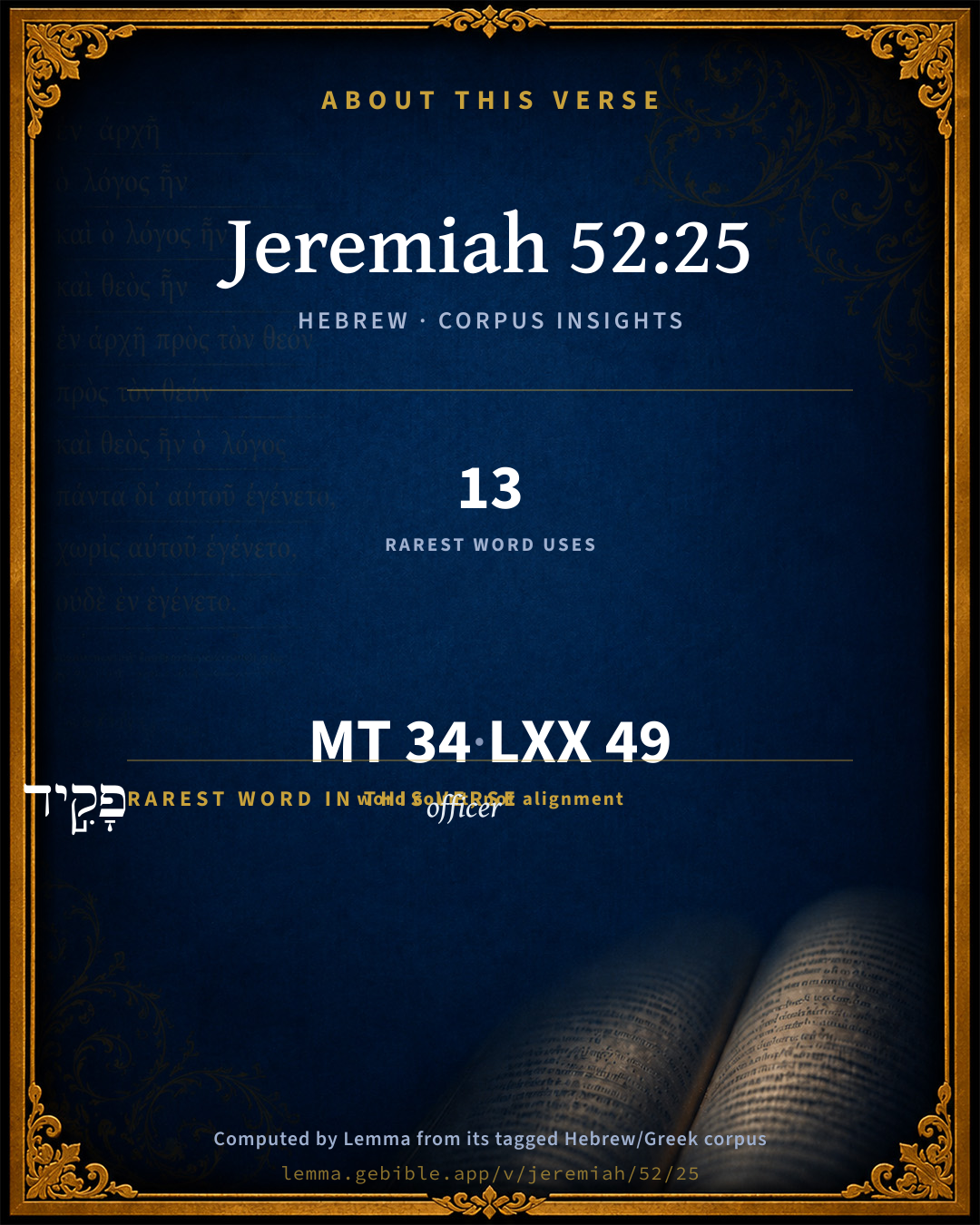
About this verse

These counts appear in no published source. They are computed here, from the morphology-tagged text and Lemma’s own curated glosses. What Lemma adds →

34
words
25
distinct lemmas
Prophets
section

Notable vocabulary

The rarest word here is פָקִ֣יד officer H6496 — appearing just 13 times in the whole Hebrew Bible.

Shared distinctive vocabulary

פָקִ֣יד officer H6496 occurs in 13 verses of the Hebrew Bible. Also found in:

Grammatical profile

  • 6 verbs
  • 19 nouns
  • 3 adjectives
  • 2 prepositions
  • 4 particles

Verb forms

  • לָקַח֩ Qal · Perfect
  • הָיָ֥ה Qal · Perfect
  • מֵרֹאֵ֤י Qal · Participle Active
  • נִמְצְא֣וּ Niphal · Perfect
  • הַמַּצְבִּ֖א Hiphil · Participle Active
  • הַֽנִּמְצְאִ֖ים Niphal · Participle Active

Repetition

Words recur within this verse — often emphatic in Hebrew:

  • הָעִ֡יר city H5892 ×3
  • אַנְשֵׁ֣י man H376 ×3
  • נִמְצְא֣וּ to find H4672 ×2
  • עַ֣ם people H5971 ×2
  • הָאָ֑רֶץ land H776 ×2
  • אֲֽשֶׁר which H834 ×2

Hebrew & Septuagint length

In the original languages it is 34 Hebrew tokens and 49 Greek tokens — but the two are counted differently (Hebrew bundles its prefixes and suffixes into one token; the Greek is in lemma form), so that isn’t a like-for-like length.

Cross-references

3

Topical passages linked to Jeremiah 52:25 in the Treasury of Scripture Knowledge — connected by theme and wording, ordered by reader-vote popularity; previews shown in the World English Bible.

  • 2 Kings 25:19 and out of the city he took an officer who was set over the men of war; and five men of those who saw the king's face, who were found in the city; and the scribe, the captain of the host, who mustered the people of the land; and sixty men of the people of the land, who were found in the city.
  • Esther 1:14 and the next to him were Carshena, Shethar, Admatha, Tarshish, Meres, Marsena, and Memucan, the seven princes of Persia and Media, who saw the king's face, and sat first in the kingdom),
  • Matthew 18:10 See that you don't despise one of these little ones, for I tell you that in heaven their angels always see the face of my Father who is in heaven.

Cross-references courtesy of OpenBible.info (CC BY 4.0).

Hebrew and Greek witnesses Masoretic Hebrew ↔ Greek Septuagint

The same verse in the two great witnesses to the Old Testament, shown verse-for-verse.

These are two independent witnesses, not word-aligned to each other, and the Septuagint is shown in lemma (dictionary) form.

Hebrew Jeremiah 52:25 Masoretic · Westminster Leningrad Codex

וּמִן הָעִ֡יר לָקַח֩ סָרִ֨יס אֶחָ֜ד אֲֽשֶׁר הָיָ֥ה פָקִ֣יד עַל אַנְשֵׁ֣י הַמִּלְחָמָ֗ה וְשִׁבְעָ֨ה אֲנָשִׁ֜ים מֵרֹאֵ֤י פְנֵי הַמֶּ֨לֶךְ֙ אֲשֶׁ֣ר נִמְצְא֣וּ בָעִ֔יר וְאֵ֗ת סֹפֵר֙ שַׂ֣ר הַצָּבָ֔א הַמַּצְבִּ֖א אֶת עַ֣ם הָאָ֑רֶץ וְשִׁשִּׁ֥ים אִישׁ֙ מֵעַ֣ם הָאָ֔רֶץ הַֽנִּמְצְאִ֖ים בְּת֥וֹךְ הָעִֽיר

and out of the city he took an officer who was set over the men of war; and seven men of those who saw the king's face, who were found in the city; and the scribe of the captain of the host, who mustered the people of the land; and sixty men of the people of the land, who were found in the midst of the city.

World English Bible · Public Domain

Greek LXX Structure differs

In the Septuagint, Jeremiah is about an eighth shorter than the Hebrew and arranges its material differently — the Oracles Against the Nations (Hebrew chapters 46–51) appear in the middle of the Greek book, after 25:13. Because the chapter and verse boundaries do not line up, a verse-for-verse comparison with the Hebrew is not shown.

A verse-for-verse comparison isn’t shown here because the chapters and verses don’t line up. Switch to the LXX edition with the MT / LXX toggle above to read the Greek directly.

Hebrew: Westminster Leningrad Codex (CC BY 4.0). Greek: Septuagint (public domain); English from a public-domain English Septuagint. How the Septuagint differs from the Hebrew →

Targum (Aramaic paraphrase)

1

The Targum is the ancient Jewish Aramaic paraphrase of the Hebrew Scriptures — an interpretive translation, not the Hebrew text itself. Onkelos (literal) and Pseudo-Jonathan (expansive) render the Torah, and Jonathan the Prophets. Coverage is partial: where no permissively-licensed English translation exists for a verse, only the Aramaic is shown. This is verse-level text, not a word-by-word alignment to the Hebrew.

  1. Targum Jonathan Prophets (Joshua–Malachi)
    וּמִן קַרְתָּא דְבַר גֵוִזָא חַד דַהֲוָה מְמַנָא עַל גַבְרֵי עָבְדֵי קְרָבָא וְשִׁבְעָא גַבְרִין דְחָזָן אַפֵּי מַלְכָּא דְאִשְׁתְּכִחוּ בְקַרְתָּא וְיַת סַפְרָא רַב חֵילָא דְכָנֵשׁ יַת עַמָא דְאַרְעָא וְשִׁתִּין גַבְרָא מֵעַמָא דְאַרְעָא דְאִשְׁתְּכִחוּ בְגוֹ קַרְתָּא:

    (no public-domain English translation for this verse)

    Targum Jonathan — Aramaic: “Mikraot Gedolot” (public domain). English: “Sefaria Community Translation” (CC0 1.0 (public-domain dedication)); “London "Chaldee Paraphrase," 1871” (public domain). Text via Sefaria.

Commentary

Notes on Jeremiah 52:25 from classic Christian and Jewish commentators (each source and its license shown beneath its notes). The classic Christian expositions comment on the surrounding passage and are grouped to its opening verse, so a note may address several verses; the Jewish commentaries on the Tanakh (Rashi and others) are per-verse, so they appear only where the commentator wrote on this verse.

Lemma curates 59 commentaries, every one of them public domain or Creative Commons licensed, each selected and text-cleaned for this edition rather than reprinted as found. About our sources →

Tyndale Open Study Notes

Tyndale Open Resources

52:25 seven: The parallel in 2 Kgs 25:18 reads “five.”

Tyndale Open Study Notes — © Tyndale Open Resources, licensed CC BY-SA 4.0. Text via the HelloAO Bible API.

Geneva Bible (1599)

Geneva Bible translators

In 2 Kings 25:19, is read but of five: those were the most excellent, and the other two, which were not so noble, are not there mentioned with them.

Geneva Bible (1599) marginal notes — public domain. Text via Bolls.life.

Jamieson, Fausset & Brown

Robert Jamieson, A. R. Fausset & David Brown

seven men--but in Kg2 25:19 it is "five." Perhaps two were less illustrious persons and are therefore omitted.

principal scribe of the host-- (Isa 33:18). His office was to preside over the levy and enroll recruits. RAWLINSON observes that the Assyrian records are free from the exaggerated expressions found in the Egyptian. A minute account was taken of the spoil. Two "scribes of the host" are seen in every bas-relief, writing down the various objects brought to them: the heads of the slain, the prisoners, cattle, sheep, &c.

Jamieson, Fausset & Brown — Commentary Critical and Explanatory on the Whole Bible (1871) — public domain (CC PDM 1.0). Text via the HelloAO Bible API.

Adam Clarke's Commentary

Verse 25. Seven men - that were near the king's person] These were privy counsellors.

Adam Clarke's Commentary on the Bible (1810–1826) — public domain. Text from a community e-Sword/MySword module.

Ellicott's Commentary for English Readers

(25) An eunuch, which had the charge of the men of war.—Omit the article before “charge.” The Hebrew term (Pakid) conveys the meaning of “deputy,” a superintendent under a chief commander. The officer in question had probably, together with the persons named in Jer_52:24, been more conspicuous than his fellows in resisting the Chaldæans.

Seven men.—2Ki_25:19 gives “five” as the number. Here also we have to think of the exile as the punishment of prominence in the defence of the city. The chief scribe of the army, the “secretary of war,” would naturally occupy such a position. The description of the men as those “that were near the king’s person” (literally, saw the king’s face) implies a high official rank.

A Bible Commentary for English Readers, edited by Charles John Ellicott (1878–1897) — public domain. Text from a community e-Sword module.

The Cambridge Bible for Schools and Colleges

gen. ed. J. J. S. Perowne

25. seven men] in 2 Kings (Jer_25:19) five men.

saw the king’s face] were near his person as privileged members of the court. So in Est_1:14. Cp. 2Sa_3:13; 2Sa_14:24; 2Sa_14:28.

scribe] secretary.

mustered] organised in military fashion.

The Cambridge Bible for Schools and Colleges (gen. ed. J. J. S. Perowne; Cambridge University Press, 1878–1918) — public domain. Text from a community e-Sword module.

John Gill's Exposition

So Nebuzaradan captain of the guard took them,.... In the city, and made them captives:

and brought them to the king of Babylon to Riblah; to knew his mind concerning them; how they should be disposed of; and for him to pass sentence on them: as he had done on the king of Judah, his sons, and his princes, in the same place.

John Gill's Exposition of the Whole Bible (1746–1763) — public domain (CC PDM 1.0). Text via the HelloAO Bible API.

Albert Barnes' Notes on the Bible

An eunuch ... men of war - Or, who had charge of men of war. The King James Version makes him commander-in-chief; he was second in command, i. e., a lieutenant, possibly one among many others of equal rank.

Albert Barnes' Notes on the Bible (1834–1885) — public domain. Text from a community e-Sword/MySword module.

Haydock's Catholic Bible Commentary

Seven: 4 Kings has five. But this seems more correct, as seven were commonly employed, Esther i. 10., and Tobias xii. 15. (Calmet) --- Two might be taken later. (Haydock) --- A scribe. St. Jerome has Sopher, (4 Kings) as if it were a proper name, and not an office.

George Leo Haydock (1774–1849), Haydock's Catholic Family Bible and Commentary, 1859 edition — public domain. Excludes Psalms (Douay-Rheims chapter numbering differs from Protestant) and Deuterocanonical books (Catholic canon only).

Matthew Poole's English Annotations

See 2Ki 25:19; only there is mention out of five men, here there is mention of seven, but probably two of them were of less note.

Matthew Poole's English Annotations on the Holy Bible (1683–1685) — public domain. Text from a community e-Sword/MySword module.

Lesson kit

Teaching starters — assembled from the data on this page, not authored interpretation. Every prompt links to the verse data it draws on. Edit before teaching.

Jeremiah, in the Prophets, opens this verse with 34 words (25 distinct Hebrew lemmas). Its most distinctive word is pâqîyd (“officer”). A historical commentator’s framing appears above. Read the whole chapter for the surrounding context.

Discussion questions

  1. How does “officer” (pâqîyd) shape what this verse is saying?
  2. How does Genesis 41:34, which shares the word «officer», read alongside this verse?
  3. What does the repetition of “city” (3× in this one verse) do in this verse?
  4. These translations render this verse differently; the difference is in the English rendering, not the original. What questions does that raise?
  5. «לָקַח֩» is a Qal Perfect verb. How does that grammatical form shape the action described?
  6. Compare how Tyndale Open Study Notes and Geneva Bible (1599) read this verse. Where do they agree or differ?

Things to notice

Reading settings

Reading text

Shown beneath each verse's original-language words.

Old Testament
Old Testament edition

Read the OT as the Masoretic Hebrew (MT) or the Greek Septuagint (LXX).

English shown for the Greek Septuagint (in the Hebrew ↔ Greek comparison).

Comparing translations? Open the Compare panel on any verse page to stack up to four side by side.