
Exodus 29:37

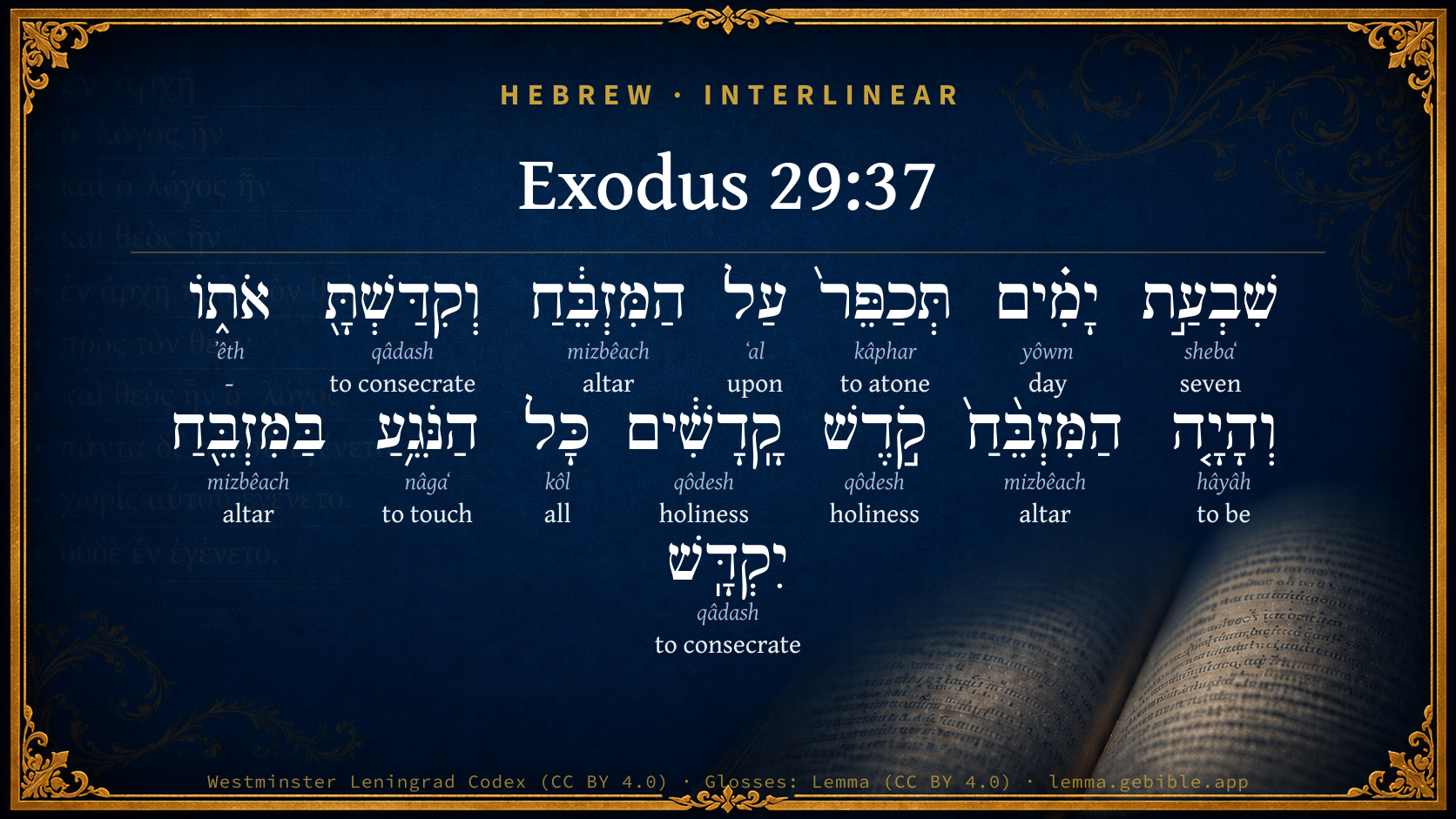
Hebrew (Westminster Leningrad Codex) Exodus 29:37 appears in the Hebrew Old Testament. The text above is from the Westminster Leningrad Codex. Each word links to its Strong’s number, a concise gloss, and parsing drawn from the Open Scriptures Hebrew Bible morphology. Click any word for its full Brown-Driver-Briggs (BDB) entry.
Download image
Cite this verse

Exodus 29:37 (World English Bible). Public Domain. Lemma interlinear Bible study tool, https://lemma.gebible.app/v/exodus/29/37.

Show BibTeX & RIS
BibTeX
RIS
English Translation
Seven days you shall make atonement for the altar, and sanctify it: and the altar shall be most holy; whatever touches the altar shall be holy.
World English Bible · Public Domain
Download a study sheet

One document with this verse’s original text, its word-by-word gloss line, the meaning frame, cross-references with their text, attributed commentary, and full source and license credits — printable, and it pastes into notes with its structure intact.

This verse Autodidact and up

Study sheet (.html) Plain text (.txt)

A passage Seminary Student

Up to 50 verses in one chapter. A passage sheet keeps up to 6 commentary sources and 12 cross-references per verse, in the order this page ranks them, and says so on the sheet whenever that leaves anything out. Ask for a single verse and you get the Autodidact verse sheet above.

Everything on this page stays free to read, with no account — the sheet is a download of what is already on screen, not access to it.

Want to remove ads? Support Godless Engineer
Compare translations 3

The same verse in 3 English versions, stacked beneath the original-language interlinear above. Click any original word for its lexicon entry.

Each is an independent rendering of the whole verse — the interlinear is not word-aligned to these translations.

Highlighted words mark where these versions differ — a whole-verse word diff, not a word-by-word alignment.

  • World English Bible Public Domain
    Seven days you shall make atonement for the altar, and sanctify it: and the altar shall be most holy; whatever touches the altar shall be holy.
  • King James Version Public Domain
    Seven days thou shalt make an atonement for the altar, and sanctify it; and it shall be an altar most holy: whatsoever toucheth the altar shall be holy.
  • unfoldingWord Literal Text CC BY-SA 4.0
    You shall make atonement for the altar seven days, and set it apart. And the altar will be a holiest holy thing. Whatever touches the altar will be set apart.

unfoldingWord Literal Text — © unfoldingWord, licensed CC BY-SA 4.0. Word-aligned USFM3 via Door43 (git.door43.org/unfoldingWord/en_ult).

Versions to compare (up to 4)

3 of 4 selected

Show all 18 translations

Every available English version of this verse, each an independent rendering of the whole verse.

  • World English Bible Public Domain
    Seven days you shall make atonement for the altar, and sanctify it: and the altar shall be most holy; whatever touches the altar shall be holy.
  • Berean Standard Bible Public Domain
    For seven days you shall make atonement for the altar and consecrate it. Then the altar will become most holy; whatever touches the altar will be holy.
  • Majority Standard Bible Public Domain
    For seven days you shall make atonement for the altar and consecrate it. Then the altar will become most holy; whatever touches the altar will be holy.
  • King James Version Public Domain
    Seven days thou shalt make an atonement for the altar, and sanctify it; and it shall be an altar most holy: whatsoever toucheth the altar shall be holy.
  • American Standard Version (1901) Public Domain
    Seven days thou shalt make atonement for the altar, and sanctify it: and the altar shall be most holy; whatsoever toucheth the altar shall be holy.
  • Revised Version (1885) Public Domain
    Seven days thou shalt make atonement for the altar, and sanctify it: and the altar shall be most holy; whatsoever toucheth the altar shall be holy.
  • Geneva Bible (1599) Public Domain
    Seuen dayes shalt thou cleanse the altar, and sanctifie it, so the altar shalbe most holy: and whatsoeuer toucheth the altar, shalbe holy.
  • Douay-Rheims (1899) Public Domain
    Seven days shalt thou expiate the altar and sanctify it, and it shall be most holy. Every one that shall touch it shall be holy.
  • Young's Literal Translation Public Domain
    seven days thou dost make atonement for the altar, and hast sanctified it, and the altar hath been most holy; all that is coming against the altar is holy.
  • Literal Standard Version CC BY-SA 4.0
    [for] seven days you make atonement for the altar, and have sanctified it, and the altar has been most holy; all that is coming against the altar is holy.
  • Unlocked Literal Bible CC BY-SA 4.0
    For seven days you must make atonement for the altar and set it apart it to Yahweh. Then the altar will be completely set apart to me. Whatever touches the altar will be set apart to Yahweh.
  • unfoldingWord Literal Text CC BY-SA 4.0
    You shall make atonement for the altar seven days, and set it apart. And the altar will be a holiest holy thing. Whatever touches the altar will be set apart.
  • Darby Bible Public Domain
    Seven days shalt thou make atonement for the altar and hallow it; and the altar shall be most holy: whatever toucheth the altar shall be holy.
  • World Messianic Bible Public Domain
    Seven days you shall make atonement for the altar, and sanctify it; and the altar shall be most holy. Whatever touches the altar shall be holy.
  • Webster's Bible Public Domain
    Seven days thou shalt make an atonement for the altar, and sanctify it; and it shall be an altar most holy: whatever toucheth the altar shall be holy.
  • Free Bible Version CC BY-SA 4.0
    For seven days you shall purify the altar and consecrate it. Then the altar will become completely holy, and everything that touches the altar will become holy.
  • Bible in Basic English Public Domain
    For seven days you are to make offerings for the altar and make it holy, so that it may become completely holy, and anything touching it will become holy.
  • JPS Tanakh (1917) Public Domain
    Seven days thou shalt make atonement for the altar, and sanctify it; thus shall the altar be most holy; whatsoever toucheth the altar shall be holy.

Literal Standard Version (2020), Covenant Press — licensed CC BY-SA 4.0. Text via the HelloAO Bible API (eBible.org). Unlocked Literal Bible (unfoldingWord) — licensed CC BY-SA 4.0. Text via the HelloAO Bible API (eBible.org). unfoldingWord Literal Text — © unfoldingWord, licensed CC BY-SA 4.0. Word-aligned USFM3 via Door43 (git.door43.org/unfoldingWord/en_ult). Free Bible Version, Dr. Jonathan Gallagher — licensed CC BY-SA 4.0. Text via the HelloAO Bible API (eBible.org).

Word by word

More ways to search: Search by grammar → Find every occurrence → Compare this word →

Practice this passage: Drill this verse → Learn its vocabulary →

תְּכַפֵּר֙
kâphar
H3722
“to atone”
Verb, Piel, Imperfect, 2nd Person, Masculine, Singular
Part of Speech
Verb
Stem
Piel
Form
Imperfect
Person
2nd Person
Gender
Masculine
Number
Singular
Full BDB Definition

Origin: a primitive root

TWOT: 1023 , 1024 , 1025 , 1026

to cover, purge, make an atonement, make reconciliation, cover over with pitch - (Qal) to coat or cover with pitch - (Piel) - to cover over, pacify, propitiate - to cover over, atone for sin, make atonement for - to cover over, atone for sin and persons by legal rites - (Pual) - to be covered over - to make atonement for - (Hithpael) to be covered
  1. שִׁבְעַ֣ת shebaʻ H7651 “seven” Adjective, Cardinal number, Masculine, Singular, Construct
  2. יָמִ֗ים yôwm H3117 “days” Noun, Common, Masculine, Plural, Absolute
  3. עַל ʻal H5921 “upon” Preposition
  4. הַמִּזְבֵּ֔חַ mizbêach H4196 “the · altar” Particle, Definite Article + Noun, Common, Masculine, Singular, Absolute
  5. וְקִדַּשְׁתָּ֖ qâdash H6942 “and · to consecrate” Conjunction + Verb, Piel, Sequential Perfect, 2nd Person, Masculine, Singular
  6. אֹת֑וֹ ʼêth H853 “- · him” Particle, Direct Object + Suffix, Personal, 3rd Person, Masculine, Singular
  7. וְהָיָ֤ה hâyâh H1961 “and · to be” Conjunction + Verb, Qal, Sequential Perfect, 3rd Person, Masculine, Singular
  8. הַמִּזְבֵּ֨חַ֙ mizbêach H4196 “the · altar” Particle, Definite Article + Noun, Common, Masculine, Singular, Absolute
  9. קֹ֣דֶשׁ qôdesh H6944 “holiness of” Noun, Common, Masculine, Singular, Construct
  10. קָֽדָשִׁ֔ים qôdesh H6944 “holy things” Noun, Common, Masculine, Plural, Absolute
  11. כָּל kôl H3605 “all of” Noun, Common, Masculine, Singular, Construct
  12. הַנֹּגֵ֥עַ nâgaʻ H5060 “the · touching” Particle, Definite Article + Verb, Qal, Participle Active, Masculine, Singular, Absolute
  13. בַּמִּזְבֵּ֖חַ mizbêach H4196 “in/at the · altar” Preposition, Determined + Noun, Common, Masculine, Singular, Absolute
  14. יִקְדָּֽשׁ qâdash H6942 “to consecrate” Verb, Qal, Imperfect, 3rd Person, Masculine, Singular

About this verse

These counts appear in no published source. They are computed here, from the morphology-tagged text and Lemma’s own curated glosses. What Lemma adds →

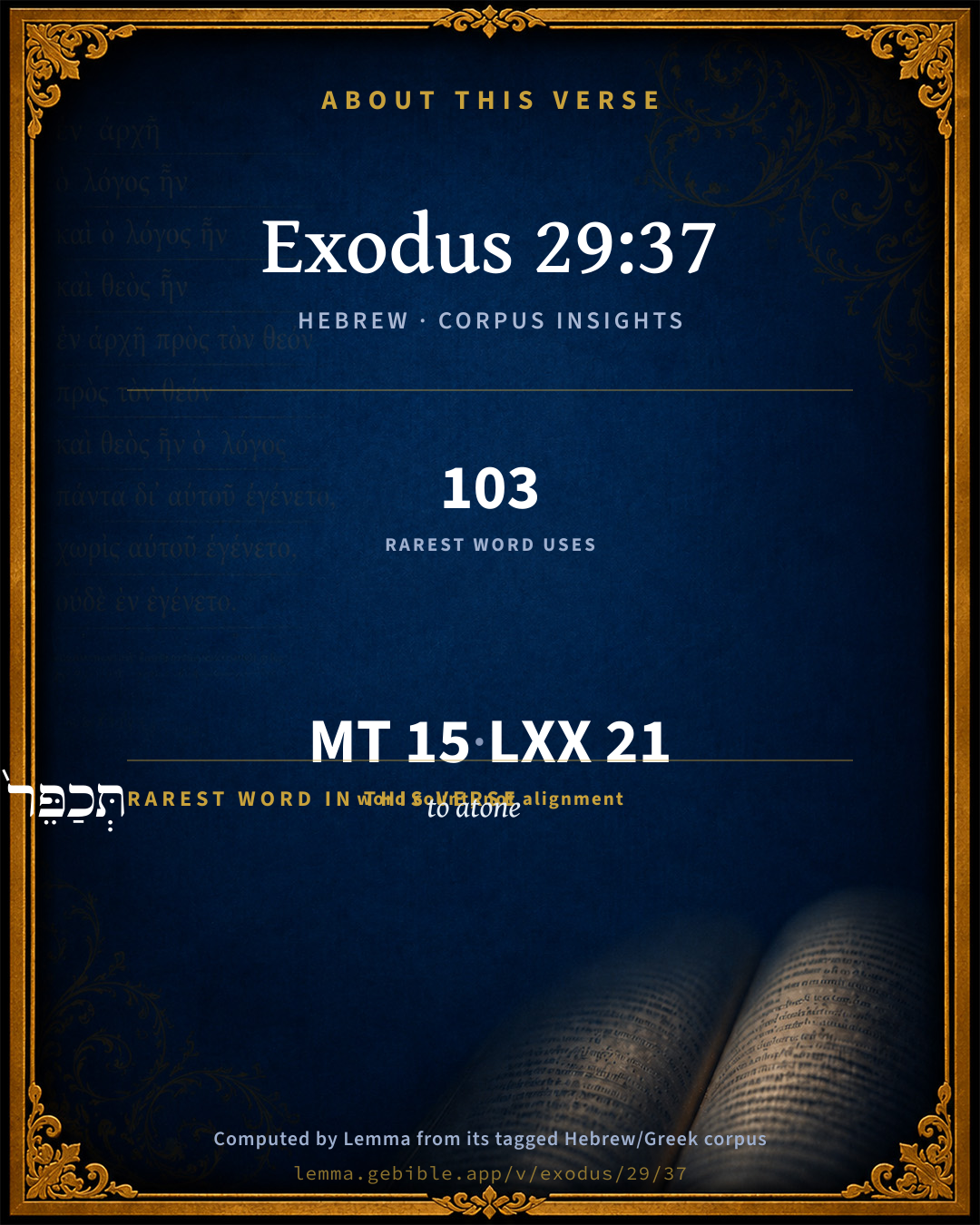
15
words
11
distinct lemmas
Pentateuch
section

Grammatical profile

  • 5 verbs
  • 7 nouns
  • 1 adjective
  • 1 preposition
  • 1 particle

Verb forms

  • תְּכַפֵּר֙ Piel · Imperfect
  • וְקִדַּשְׁתָּ֖ Piel · Sequential Perfect
  • וְהָיָ֤ה Qal · Sequential Perfect
  • הַנֹּגֵ֥עַ Qal · Participle Active
  • יִקְדָּֽשׁ Qal · Imperfect

Repetition

Words recur within this verse — often emphatic in Hebrew:

  • הַמִּזְבֵּ֔חַ altar H4196 ×3
  • וְקִדַּשְׁתָּ֖ to consecrate H6942 ×2
  • קֹ֣דֶשׁ holiness H6944 ×2

Hebrew & Septuagint length

In English translation the verse runs 26 words from the Hebrew and 26 from the Septuagint (LXX English) — the same length.

A rough comparison of the two English renderings, which tokenize alike — not a word-level alignment.

Word counts can differ between the Hebrew and the Greek without any difference in meaning — e.g. the Hebrew direct-object marker אֵת has no separate Greek word, and Greek often adds the article ὁ.

In the original languages it is 15 Hebrew tokens and 21 Greek tokens — but the two are counted differently (Hebrew bundles its prefixes and suffixes into one token; the Greek is in lemma form), so that isn’t a like-for-like length.

Cross-references

5

Topical passages linked to Exodus 29:37 in the Treasury of Scripture Knowledge — connected by theme and wording, ordered by reader-vote popularity; previews shown in the World English Bible.

  • Exodus 40:10 You shall anoint the altar of burnt offering, with all its vessels, and sanctify the altar: and the altar will be most holy.
  • Matthew 23:19 You blind fools! For which is greater, the gift, or the altar that sanctifies the gift?
  • Exodus 30:28–29 the altar of burnt offering with all its utensils, and the basin with its base.
  • Daniel 9:24 Seventy weeks are decreed on your people and on your holy city, to finish disobedience, and to make an end of sins, and to make reconciliation for iniquity, and to bring in everlasting righteousness, and to seal up vision and prophecy, and to anoint the most holy.
  • Matthew 23:17 You blind fools! For which is greater, the gold, or the temple that sanctifies the gold?

Cross-references courtesy of OpenBible.info (CC BY 4.0).

Hebrew and Greek witnesses Masoretic Hebrew ↔ Greek Septuagint

The same verse in the two great witnesses to the Old Testament, shown verse-for-verse.

These are two independent witnesses, not word-aligned to each other, and the Septuagint is shown in lemma (dictionary) form.

Hebrew Exodus 29:37 Masoretic · Westminster Leningrad Codex

שִׁבְעַ֣ת יָמִ֗ים תְּכַפֵּר֙ עַל הַמִּזְבֵּ֔חַ וְקִדַּשְׁתָּ֖ אֹת֑וֹ וְהָיָ֤ה הַמִּזְבֵּ֨חַ֙ קֹ֣דֶשׁ קָֽדָשִׁ֔ים כָּל הַנֹּגֵ֥עַ בַּמִּזְבֵּ֖חַ יִקְדָּֽשׁ

Seven days you shall make atonement for the altar, and sanctify it: and the altar shall be most holy; whatever touches the altar shall be holy.

World English Bible · Public Domain

Greek LXX Exodus 29:37 Septuagint · lemma form

ἑπτά ἡμέρα καθαρίζω ὁ θυσιαστήριον καί ἁγιάζω αὐτός καί εἰμί ὁ θυσιαστήριον ἅγιος ὁ ἅγιος πᾶς ὁ ἅπτομαι ὁ θυσιαστήριον ἁγιάζω

Seven days shall you purify the altar and sanctify it; and the altar shall be most holy, every one that touches the altar shall be hallowed.

LXX2012 (modern English Septuagint) · Public Domain

Hebrew: Westminster Leningrad Codex (CC BY 4.0). Greek: Septuagint (public domain); English from LXX2012 (modern English Septuagint) (Public Domain). How the Septuagint differs from the Hebrew →

Targum (Aramaic paraphrase)

2

The Targum is the ancient Jewish Aramaic paraphrase of the Hebrew Scriptures — an interpretive translation, not the Hebrew text itself. Onkelos (literal) and Pseudo-Jonathan (expansive) render the Torah, and Jonathan the Prophets. Coverage is partial: where no permissively-licensed English translation exists for a verse, only the Aramaic is shown. This is verse-level text, not a word-by-word alignment to the Hebrew.

  1. Targum Onkelos Torah (Genesis–Deuteronomy)
    שִׁבְעַת יוֹמִין תְּכַפֵּר עַל מַדְבְּחָא וּתְקַדֵשׁ יָתֵהּ וִיהֵי מַדְבְּחָא קֹדֶשׁ קוּדְשַׁיָא כָּל דְיִקְרַב בְּמַדְבְּחָא יִתְקַדָשׁ:

    (no public-domain English translation for this verse)

    Targum Onkelos — Aramaic: “Onkelos Genesis” (public domain); “Onkelos Exodus” (public domain); “Onkelos Leviticus” (public domain); “Onkelos Numbers” (public domain); “Onkelos Deuteronomy” (public domain). English: “Sefaria Community Translation” (CC0 1.0 (public-domain dedication)); “J.W. Etheridge. The Targums of Onkelos and Jonathan Ben Uzziel on the Pentateuch. London: Longmans, Green, 1862” (public domain). Text via Sefaria.

  2. Targum Pseudo-Jonathan Torah (Genesis–Deuteronomy)
    שׁוּבְעָא יוֹמִין תְּכַפֵּר עַל מַדְבְּחָא וּתְקַדֵּישׁ יָתֵיהּ וִיהֵי מַדְבְּחָא קוֹדֶשׁ קוּדְשִׁין כָּל דְּיִקְרַב בְּמַדְבְּחָא יִתְקַדֵּשׁ מִן בְּנֵי אַהֲרן בְּרַם מִן שְׁאַר עַמָּא לֵית אֶפְשַׁר לְהוֹן לְמִקְרַב דִּלְמָא יִתּוֹקְדוּן בְּאֵשָׁא מְצַלְהֲבָא דְנָפִיק מִן קוּדְשַׁיָא

    Seven days make thou atonement upon the altar to consecrate it; and it shall be the altar of the Holy of Holies. Every one of the sons of Aharon who approacheth to the altar must be holy; to the rest of the people it is not lawful to approach, lest they be burned with the fiery flame which cometh from the holy place.

    Targum Pseudo-Jonathan — Aramaic: “Targum Jonathan on Genesis” (public domain); “Targum Jonathan on Exodus” (public domain); “Targum Jonathan on Leviticus” (public domain); “Targum Jonathan on Numbers” (public domain); “Targum Jonathan on Deuteronomy” (public domain). English: “The Targum of Jonathan ben Uzziel, trans. J. W. Etheridge, London, 1862” (public domain). Text via Sefaria.

Commentary

Notes on Exodus 29:37 from classic Christian and Jewish commentators (each source and its license shown beneath its notes). The classic Christian expositions comment on the surrounding passage and are grouped to its opening verse, so a note may address several verses; the Jewish commentaries on the Tanakh (Rashi and others) are per-verse, so they appear only where the commentator wrote on this verse.

Lemma curates 59 commentaries, every one of them public domain or Creative Commons licensed, each selected and text-cleaned for this edition rather than reprinted as found. About our sources →

Trapp's Complete Commentary

John Trapp

Exo 29:37 Seven days thou shalt make an atonement for the altar, and sanctify it; and it shall be an altar most holy: whatsoever toucheth the altar shall be holy.

Ver. 37. Whatsoever toucheth the altar.] See Mat 23:19. {See Trapp on "Mat 23:19"}

John Trapp, A Commentary or Exposition upon All the Books of the Old and New Testament (1647–1656) — public domain. Text from a community e-Sword module.

Tyndale Open Study Notes

Tyndale Open Resources

29:37 As with the priests, the altar was to be made holy so it could be used in service of the holy God.

Tyndale Open Study Notes — © Tyndale Open Resources, licensed CC BY-SA 4.0. Text via the HelloAO Bible API.

Adam Clarke's Commentary

Verse 37. Whatsoever touches the altar shall be holy.] To this our Lord refers Mt 23:19, where he says the altar sanctifies the gift; and this may be understood as implying that whatever was laid on the altar became the Lord's property, and must be wholly devoted to sacred uses, for in no other sense could such things be sanctified by touching the altar.

Adam Clarke's Commentary on the Bible (1810–1826) — public domain. Text from a community e-Sword/MySword module.

Ellicott's Commentary for English Readers

(37) An altar most holy.—Heb., an altar, holiness of holinesses.

Whatsoever toucheth the altar shall be holy.—Rather, must be holy; nothing which is not holy must touch it. The future has the force of an imperative, as in the Ten Commandments.

A Bible Commentary for English Readers, edited by Charles John Ellicott (1878–1897) — public domain. Text from a community e-Sword module.

The Cambridge Bible for Schools and Colleges

gen. ed. J. J. S. Perowne

37. most holy] a technical term of the priestly phraseology, applied to many different things brought specially near to God, e.g. to the altar of burnt-offering, here and Exo_40:10; to the altar of incense, Exo_30:10; to the Tent of Meeting and vessels belonging to it, Exo_30:26-29; to the meal-offering, Lev_2:3, &c. (see a complete list in Daniel in the Camb. Bible, p. 137; also in Di.’s note on Lev_21:22, where its distinction from holy is explained).

shall become holy] i.e. become sacred to Jehovah, implying that, if it be a thing (‘whatsoever’), it will be forfeited to the sanctuary (cf. Num_16:37-38, where the censers which had rashly been made ‘holy,’ are retained in the service of the sanctuary, and made into beaten plates for the altar; Deu_22:9, Lev_27:10, Jos_6:19 a, compared with 19b), and, if it be a person (‘whosoever,’ the more prob. rendering), not already properly consecrated, and so able to touch sacred things with impunity, that he is given over to the Deity to be dealt with by Him as He pleases. So Exo_30:29, Lev_6:18 b, Lev_6:27; cf. Eze_46:20 b, where ‘sanctify’ is to be similarly explained. We have here, as in the passages quoted, a survival of primitive ideas of ‘holiness.’ Holiness, i.e. consecration to a deity, is a contagious quality: thus the altar or the incense is holy, and whatever touches it becomes holy. What is holy must further be kept from profane use, and not touched, without due precaution, or by unfit persons; a person touching it in heedlessness or curiosity becomes thereby ‘holy’ himself, and may be dealt with by he Deity as He pleases, even to the extent of having to pay for his imprudence with his life: cf. 2Sa_6:6 f.; Num_4:15; Num_4:20; Num_16:37 end, 38a [read as RVm.]. See Dr Gray’s luminous note, Numbers, pp. 209–211, with the passages cited by him from Frazer’s Golden Bough, e.g. i. 321 (ed. 2), ‘In New Zealand the dread of the sanctity of chiefs was at least as great as in Tonga. Their ghostly power, derived from an ancestral spirit or atua, diffused itself by contagion over everything they touched, and could strike dead all who rashly or unwittingly meddled with it’; Rel. Sem. pp. 142 f., 427 ff. (ed. 2, pp. 152 f., 446 ff.); DB. iv. 826 f.

The Cambridge Bible for Schools and Colleges (gen. ed. J. J. S. Perowne; Cambridge University Press, 1878–1918) — public domain. Text from a community e-Sword module.

John Gill's Exposition

Seven days thou shalt make atonement for the altar, and sanctify it,.... That it might be thoroughly fit to have sacrifices offered on it:

and it shall be an altar most holy; as Christ is, and is called the Most Holy, and said to be anointed, Dan 9:24. He is holy in his person, nature, and offices, more holy than angels or men; as holy as the Lord God, the God of Israel, his Father, who is glorious in holiness, and none like to him for it:

whatsoever toucheth the altar shall be holy; that is, whatsoever gift or sacrifice, according to law, was offered on it, whatever appertained unto it, or were suitable for it; for as for other things, they were not made holy by a touch of it, Hag 2:11. The Targum of Jonathan refers it to persons, paraphrasing the words, that such should be holy who were"of the sons of Aaron, but of the rest of the people it was not lawful for them to draw nigh, lest they should be burnt with flaming fire that comes out of the holy things;''but our Lord applies it to gifts and offerings of the altar, for to this case he seems to have respect, Mat 23:19 for he is the altar that sanctifies not only the persons, but the services of his people, and their sacrifices of prayer and praise come up with acceptance to God from off this altar; though even the best duties and services of theirs need atonement and purification by the sacrifice and blood of Christ.

John Gill's Exposition of the Whole Bible (1746–1763) — public domain (CC PDM 1.0). Text via the HelloAO Bible API.

Haydock's Catholic Bible Commentary

Seven. This number is frequently prescribed in Scripture. Balaam required seven altars, (Numbers xxiii.) and the Egyptians never spent less than seven days in their expiations. (Porphyrius, Abstin. 4.) (Calmet) --- Shall be holy, consecrated according to this rite, (Menochius) or defiled; for sacred things purify those who approach in a proper manner, while they defile or increase the guilt of the unworthy. (Calmet) --- By the unleavened bread, (ver. 23,) we are reminded of the blessed eucharist; and by oil, of the grace of the spirit. (Du Hamel)

George Leo Haydock (1774–1849), Haydock's Catholic Family Bible and Commentary, 1859 edition — public domain. Excludes Psalms (Douay-Rheims chapter numbering differs from Protestant) and Deuterocanonical books (Catholic canon only).

Matthew Poole's English Annotations

It shall be an altar most holy, as appears from the following reason, because it was not only holy in itself, but by its touch communicated a legal holiness to other things.

Whatsoever toucheth the altar shall be holy: this may be understood either,

1. Of persons, as a caution that none should touch the altar but holy and consecrated persons. Or rather,

2. Of things, yet not of all things, for polluted things were not made holy by the touch of holy things, which is affirmed, Hag 2:12; but of things belonging to the altar Of offerings, which by God’s appointment were to be offered, which were sanctified by being laid upon this altar, and therefore the altar was greater and more holy than the gift, as our blessed Saviour notes, Mat 23:19.

Matthew Poole's English Annotations on the Holy Bible (1683–1685) — public domain. Text from a community e-Sword/MySword module.

The Pulpit Commentary

Seven days shalt thou make an atonement. All the ceremonial was to be repeated seven times, not only the atonement for the. (Lev_8:33) An altar most holy. Literally, "holiness of holinesses," as in Exo_40:10. Whatever toucheth the altar shall be holy. Rather, "must be holy." Nothing that is not holy must touch it (Kalisch)

The Pulpit Commentary (1880–1919), ed. H.D.M. Spence-Jones & Joseph S. Exell — public domain. Text from a community e-Sword module.

Scofield Reference Notes

C. I. Scofield

atonement

(See Scofield "Exo 29:33").

The Scofield Reference Bible (1917 edition), notes by C. I. Scofield — public domain. Text from a community e-Sword module.

Rashi

Rabbi Shlomo Yitzchaki (Rashi)

והיה המזבח קדש AND THE ALTAR SHALL BE [MOST] HOLY — and in what consists its holiness? In this: כל הנגע במזבח יקדש that WHATSOEVER TOUCHETH THE ALTAR SHALL BECOME HOLY — that even a sacrifice which is really invalid that has been brought upon it — even that does the altar sanctify making it a valid sacrifice in so far that it must not be taken down from the altar. Now since it is said, “Anything that toucheth the altar shall become holy”, I might infer that this applies to a thing whether it was fitting to be an offering at the time when it was brought into the Sanctuary or whether it was not so fitting as, for example, in the latter case, something the disqualification of which did not happen within the Sanctuary itself but had happened before it was brought there, such as, an animal, male or female, with which sexual sin had been committed, or an animal which had been set aside as a sacrifice to an idol, or one which had been worshipped as a god, or one which showed signs of incapacity to live owing to certain diseases (technically termed טרפה) and animals similar to these (with similar disqualifications); consequently it states, “Now this is that which thou shalt offer [upon the altar]”, which follows immediately after this (in v. 38). Now how is it in the case of the burnt-offering which is mentioned in the next verse as something commanded to be brought upon the altar? It must be fitted to be brought upon the altar! So, also, the preceding statement, “Whatever [touches the altar shall become holy]”, refers only to whatever was fitting, i. e. what was already fitting to be brought upon the altar and became disqualified only after it had been brought into the fore-court of the Sanctuary, as, for example, that which had been left over night (the blood or fat of a sacrifice which had been left until the morning without having been placed upon the altar), or that which, before it had been placed upon the altar, had been taken (lit., had gone forth) outside the forecourt, or that which had become unclean, or an animal which had been slaughtered with the intention to sprinkle the blood or to burn the fat or to eat the flesh outside the prescribed period or outside the prescribed place, and animals similar to these (Zevachim 83b).

Rashi on the Tanakh — English translations: “The Judaica Press complete Tanach with Rashi, translated by A. J. Rosenberg” (CC BY 4.0); “Pentateuch with Rashi's commentary by M. Rosenbaum and A.M. Silbermann, 1929-1934” (public domain); “The Metsudah Tanach series, Lakewood, N.J” (CC BY 4.0); and “The Book of Joshua, Metsudah Publications, 1997” (CC BY 4.0). Text via Sefaria.

Lesson kit

Teaching starters — assembled from the data on this page, not authored interpretation. Every prompt links to the verse data it draws on. Edit before teaching.

Exodus, in the Pentateuch, opens this verse with 15 words (11 distinct Hebrew lemmas). Its most distinctive word is kâphar (“to atone”). A historical commentator’s framing appears above. Read the whole chapter for the surrounding context.

Discussion questions

  1. What does “to atone” (kâphar) contribute to the verse as a whole?
  2. How does Exodus 40:10, which shares this passage’s theme, read alongside this verse?
  3. What does the repetition of “altar” (3× in this one verse) do in this verse?
  4. These translations render this verse differently. What is at stake in choosing one wording over another?
  5. «תְּכַפֵּר֙» is a Piel Imperfect verb. How does that grammatical form shape the action described?
  6. Compare how Trapp's Complete Commentary and Tyndale Open Study Notes read this verse. Where do they agree or differ?

Things to notice

Reading settings

Reading text

Shown beneath each verse's original-language words.

Old Testament
Old Testament edition

Read the OT as the Masoretic Hebrew (MT) or the Greek Septuagint (LXX).

English shown for the Greek Septuagint (in the Hebrew ↔ Greek comparison).

Comparing translations? Open the Compare panel on any verse page to stack up to four side by side.