Numbers 12:15

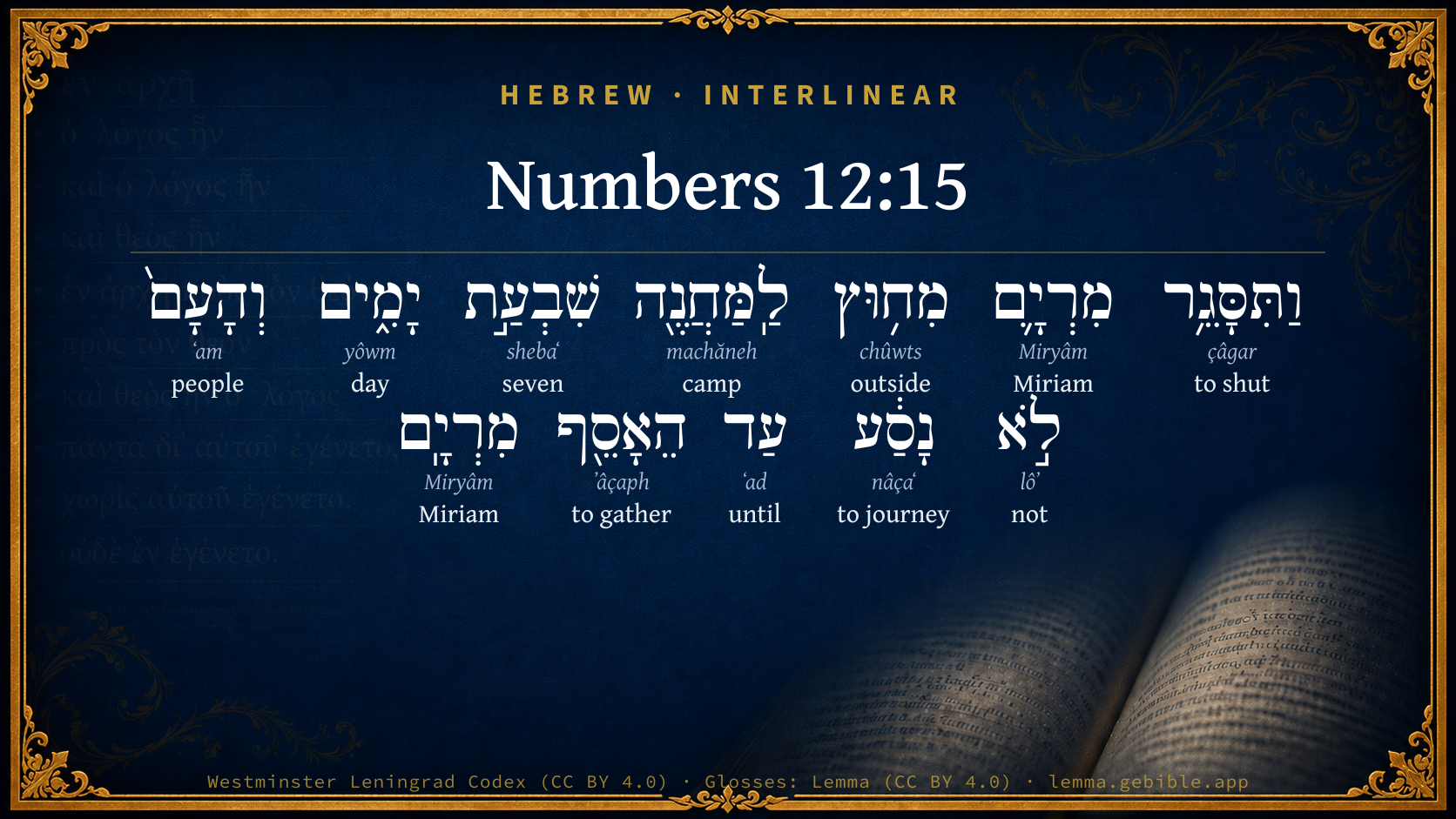
Hebrew (Westminster Leningrad Codex) Numbers 12:15 appears in the Hebrew Old Testament. The text above is from the Westminster Leningrad Codex. Each word links to its Strong’s number, a concise gloss, and parsing drawn from the Open Scriptures Hebrew Bible morphology. Click any word for its full Brown-Driver-Briggs (BDB) entry.
Download image
Cite this verse

Numbers 12:15 (World English Bible). Public Domain. Lemma interlinear Bible study tool, https://lemma.gebible.app/v/numbers/12/15.

Show BibTeX & RIS
BibTeX
RIS
English Translation
Miriam was shut up outside of the camp seven days: and the people didn't travel until Miriam was brought in again.
World English Bible · Public Domain
Download a study sheet

One document with this verse’s original text, its word-by-word gloss line, the meaning frame, cross-references with their text, attributed commentary, and full source and license credits — printable, and it pastes into notes with its structure intact.

This verse Autodidact and up

Study sheet (.html) Plain text (.txt)

A passage Seminary Student

Up to 50 verses in one chapter. A passage sheet keeps up to 6 commentary sources and 12 cross-references per verse, in the order this page ranks them, and says so on the sheet whenever that leaves anything out. Ask for a single verse and you get the Autodidact verse sheet above.

Everything on this page stays free to read, with no account — the sheet is a download of what is already on screen, not access to it.

Want to remove ads? Support Godless Engineer
Compare translations 3

The same verse in 3 English versions, stacked beneath the original-language interlinear above. Click any original word for its lexicon entry.

Each is an independent rendering of the whole verse — the interlinear is not word-aligned to these translations.

Highlighted words mark where these versions differ — a whole-verse word diff, not a word-by-word alignment.

  • World English Bible Public Domain
    Miriam was shut up outside of the camp seven days: and the people didn't travel until Miriam was brought in again.
  • King James Version Public Domain
    And Miriam was shut out from the camp seven days: and the people journeyed not till Miriam was brought in again.
  • unfoldingWord Literal Text CC BY-SA 4.0
    And Miriam was shut up from outside to the camp seven days, and the people did not set out until Miriam was gathered.

unfoldingWord Literal Text — © unfoldingWord, licensed CC BY-SA 4.0. Word-aligned USFM3 via Door43 (git.door43.org/unfoldingWord/en_ult).

Versions to compare (up to 4)

3 of 4 selected

Show all 18 translations

Every available English version of this verse, each an independent rendering of the whole verse.

  • World English Bible Public Domain
    Miriam was shut up outside of the camp seven days: and the people didn't travel until Miriam was brought in again.
  • Berean Standard Bible Public Domain
    So Miriam was confined outside the camp for seven days, and the people did not move on until she was brought in again.
  • Majority Standard Bible Public Domain
    So Miriam was confined outside the camp for seven days, and the people did not move on until she was brought in again.
  • King James Version Public Domain
    And Miriam was shut out from the camp seven days: and the people journeyed not till Miriam was brought in again.
  • American Standard Version (1901) Public Domain
    And Miriam was shut up without the camp seven days: and the people journeyed not till Miriam was brought in again.
  • Revised Version (1885) Public Domain
    And Miriam was shut up without the camp seven days: and the people journeyed not till Miriam was brought in again.
  • Geneva Bible (1599) Public Domain
    So Miriam was shut out of the hoste seuen dayes, and the people remooued not, till Miriam was brought in againe.
  • Douay-Rheims (1899) Public Domain
    Mary therefore was put out of the camp seven days: and the people moved not from that place until Mary was called again.
  • Young's Literal Translation Public Domain
    And Miriam is shut out at the outside of the camp seven days, and the people hath not journeyed till Miriam is gathered;
  • Literal Standard Version CC BY-SA 4.0
    And Miriam is shut out at the outside of the camp [for] seven days, and the people have not journeyed until Miriam is gathered;
  • Unlocked Literal Bible CC BY-SA 4.0
    So Miriam was shut outside the camp for seven days. The people did not journey until she had returned to the camp.
  • unfoldingWord Literal Text CC BY-SA 4.0
    And Miriam was shut up from outside to the camp seven days, and the people did not set out until Miriam was gathered.
  • Darby Bible Public Domain
    And Miriam was shut outside the camp seven days; and the people did not journey till Miriam was received in [again].
  • World Messianic Bible Public Domain
    Miriam was shut up outside of the camp seven days, and the people didn’t travel until Miriam was brought in again.
  • Webster's Bible Public Domain
    And Miriam was shut out from the camp seven days: and the people journeyed not till Miriam was brought in again.
  • Free Bible Version CC BY-SA 4.0
    Miriam was kept in isolation outside the camp for seven days, and the people did not move on until she was taken back in.
  • Bible in Basic English Public Domain
    So Miriam was shut up outside the tent-circle for seven days: and the people did not go forward on their journey till Miriam had come in again.
  • JPS Tanakh (1917) Public Domain
    And Miriam was shut up without the camp seven days; and the people journeyed not till Miriam was brought in again.

Literal Standard Version (2020), Covenant Press — licensed CC BY-SA 4.0. Text via the HelloAO Bible API (eBible.org). Unlocked Literal Bible (unfoldingWord) — licensed CC BY-SA 4.0. Text via the HelloAO Bible API (eBible.org). unfoldingWord Literal Text — © unfoldingWord, licensed CC BY-SA 4.0. Word-aligned USFM3 via Door43 (git.door43.org/unfoldingWord/en_ult). Free Bible Version, Dr. Jonathan Gallagher — licensed CC BY-SA 4.0. Text via the HelloAO Bible API (eBible.org).

Word by word

More ways to search: Search by grammar → Find every occurrence → Compare this word →

Practice this passage: Drill this verse → Learn its vocabulary →

מִרְיָ֛ם
Miryâm
H4813
“Miriam”
Noun, Proper
Part of Speech
Noun
Type
Proper
Full BDB Definition

Origin: from H4805

TWOT: None

Miriam = "rebellion" - elder sister of Moses and Aaron - a woman of Judah
  1. וַתִּסָּגֵ֥ר çâgar H5462 “and · to shut” Conjunction + Verb, Niphal, Sequential Imperfect, 3rd Person, Feminine, Singular
  2. מִח֥וּץ chûwts H2351 “from · outside” Preposition + Noun, Common, Masculine, Singular, Absolute
  3. לַֽמַּחֲנֶ֖ה machăneh H4264 “to/for the · camp” Preposition, Determined + Noun, Common, Both, Singular, Absolute
  4. שִׁבְעַ֣ת shebaʻ H7651 “seven” Adjective, Cardinal number, Masculine, Singular, Construct
  5. יָמִ֑ים yôwm H3117 “days” Noun, Common, Masculine, Plural, Absolute
  6. וְהָעָם֙ ʻam H5971 “and · the · people” Conjunction + Particle, Definite Article + Noun, Common, Masculine, Singular, Absolute
  7. לֹ֣א lôʼ H3808 “not” Particle, Negative
  8. נָסַ֔ע nâçaʻ H5265 “to journey” Verb, Qal, Perfect, 3rd Person, Masculine, Singular
  9. עַד ʻad H5704 “until” Preposition
  10. הֵאָסֵ֖ף ʼâçaph H622 “to gather” Verb, Niphal, Infinitive Construct
  11. מִרְיָֽם Miryâm H4813 “Miriam” Noun, Proper

About this verse

These counts appear in no published source. They are computed here, from the morphology-tagged text and Lemma’s own curated glosses. What Lemma adds →

12
words
11
distinct lemmas
Pentateuch
section

Notable vocabulary

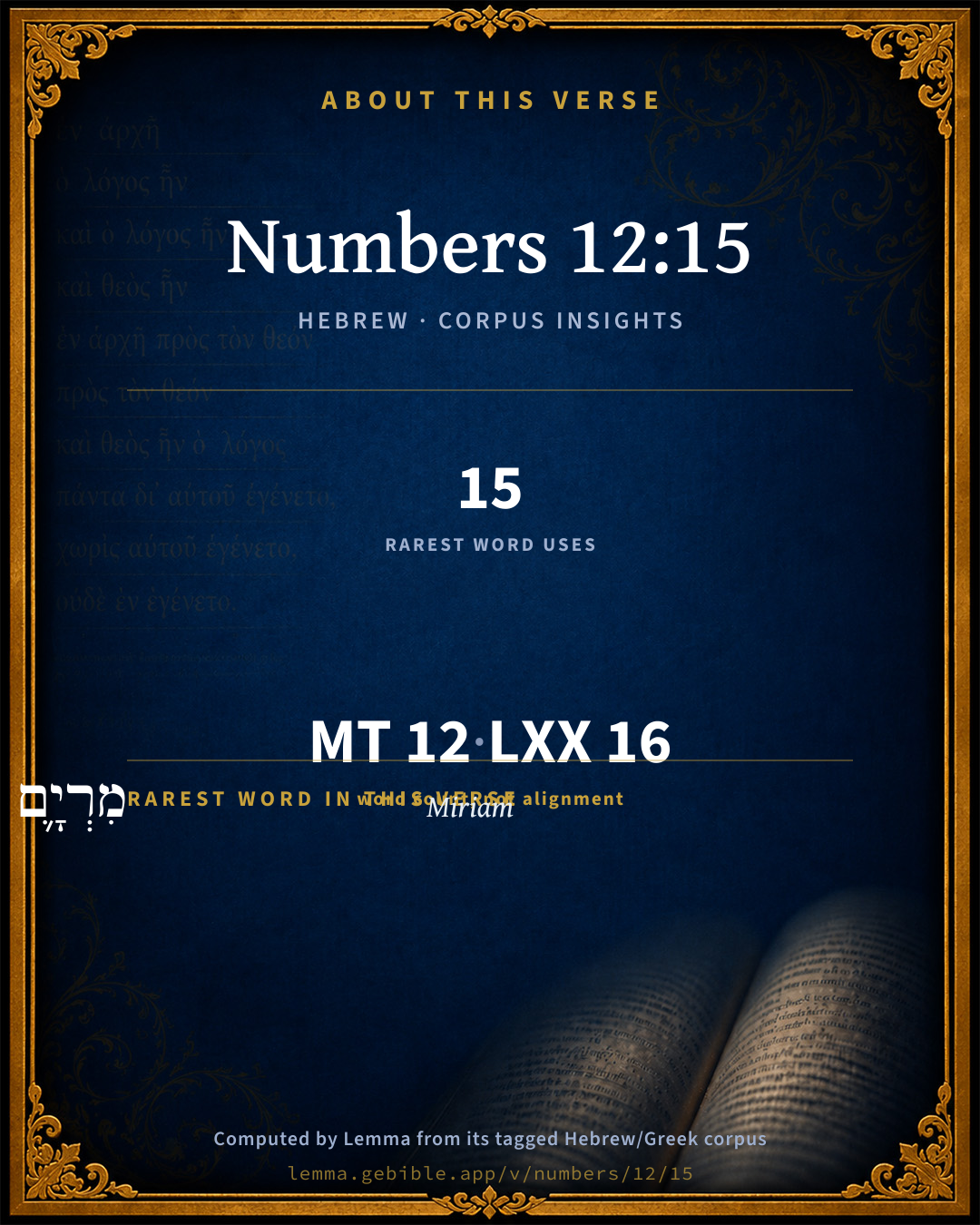
The rarest word here is מִרְיָ֛ם Miriam H4813 — appearing just 15 times in the whole Hebrew Bible.

Shared distinctive vocabulary

מִרְיָ֛ם Miriam H4813 occurs in 13 verses of the Hebrew Bible. Also found in:

Grammatical profile

  • 3 verbs
  • 6 nouns
  • 1 adjective
  • 1 preposition
  • 1 particle

Verb forms

  • וַתִּסָּגֵ֥ר Niphal · Sequential Imperfect
  • נָסַ֔ע Qal · Perfect
  • הֵאָסֵ֖ף Niphal · Infinitive Construct

Repetition

A word recurs within this verse — often emphatic in Hebrew:

  • מִרְיָ֛ם Miriam H4813 ×2

Hebrew & Septuagint length

In English translation the verse runs 21 words from the Hebrew and 19 from the Septuagint (LXX English) — closely comparable.

A rough comparison of the two English renderings, which tokenize alike — not a word-level alignment.

Word counts can differ between the Hebrew and the Greek without any difference in meaning — e.g. the Hebrew direct-object marker אֵת has no separate Greek word, and Greek often adds the article ὁ.

In the original languages it is 12 Hebrew tokens and 16 Greek tokens — but the two are counted differently (Hebrew bundles its prefixes and suffixes into one token; the Greek is in lemma form), so that isn’t a like-for-like length.

Cross-references

7

Topical passages linked to Numbers 12:15 in the Treasury of Scripture Knowledge — connected by theme and wording, ordered by reader-vote popularity; previews shown in the World English Bible.

  • Deuteronomy 24:8–9 Take heed in the plague of leprosy, that you observe diligently, and do according to all that the priests the Levites shall teach you: as I commanded them, so you shall observe to do.
  • Lamentations 3:32 For though he cause grief, yet will he have compassion according to the multitude of his loving kindnesses.
  • Micah 6:4 For I brought you up out of the land of Egypt, And redeemed you out of the house of bondage. I sent before you Moses, Aaron, and Miriam.
  • Micah 7:8–9 Don't rejoice against me, my enemy. When I fall, I will arise. When I sit in darkness, Yahweh will be a light to me.
  • Habakkuk 3:2 Yahweh, I have heard of your fame. I stand in awe of your deeds, Yahweh. Renew your work in the midst of the years. In the midst of the years make it known. In wrath, you remember mercy.
  • Genesis 9:21–23 He drank of the wine, and got drunk. He was uncovered within his tent.
  • Exodus 20:12 "Honor your father and your mother, that your days may be long in the land which Yahweh your God gives you.

Cross-references courtesy of OpenBible.info (CC BY 4.0).

Hebrew and Greek witnesses Masoretic Hebrew ↔ Greek Septuagint

The same verse in the two great witnesses to the Old Testament, shown verse-for-verse.

These are two independent witnesses, not word-aligned to each other, and the Septuagint is shown in lemma (dictionary) form.

Hebrew Numbers 12:15 Masoretic · Westminster Leningrad Codex

וַתִּסָּגֵ֥ר מִרְיָ֛ם מִח֥וּץ לַֽמַּחֲנֶ֖ה שִׁבְעַ֣ת יָמִ֑ים וְהָעָם֙ לֹ֣א נָסַ֔ע עַד הֵאָסֵ֖ף מִרְיָֽם

Miriam was shut up outside of the camp seven days: and the people didn't travel until Miriam was brought in again.

World English Bible · Public Domain

Greek LXX Numbers 12:15 Septuagint · lemma form

καί ἀποὁρίζω μαριαμ ἔξω ὁ παρεμβολή ἑπτά ἡμέρα καί ὁ λαός οὐ ἐκαἴρω ἕως καθαρίζω μαριαμ

And Mariam was separated without the camp seven days; and the people moved not forward till Mariam was cleansed.

LXX2012 (modern English Septuagint) · Public Domain

Hebrew: Westminster Leningrad Codex (CC BY 4.0). Greek: Septuagint (public domain); English from LXX2012 (modern English Septuagint) (Public Domain). How the Septuagint differs from the Hebrew →

Targum (Aramaic paraphrase)

2

The Targum is the ancient Jewish Aramaic paraphrase of the Hebrew Scriptures — an interpretive translation, not the Hebrew text itself. Onkelos (literal) and Pseudo-Jonathan (expansive) render the Torah, and Jonathan the Prophets. Coverage is partial: where no permissively-licensed English translation exists for a verse, only the Aramaic is shown. This is verse-level text, not a word-by-word alignment to the Hebrew.

  1. Targum Onkelos Torah (Genesis–Deuteronomy)
    וְאִסְתְּגָרַת מִרְיָם מִבָּרָא לְמַשְׁרִיתָא שַׁבְעָא יוֹמִין וְעַמָא לָא נְטַל עַד דְאִתְכְּנֵשַׁת מִרְיָם

    (no public-domain English translation for this verse)

    Targum Onkelos — Aramaic: “Onkelos Genesis” (public domain); “Onkelos Exodus” (public domain); “Onkelos Leviticus” (public domain); “Onkelos Numbers” (public domain); “Onkelos Deuteronomy” (public domain). English: “Sefaria Community Translation” (CC0 1.0 (public-domain dedication)); “J.W. Etheridge. The Targums of Onkelos and Jonathan Ben Uzziel on the Pentateuch. London: Longmans, Green, 1862” (public domain). Text via Sefaria.

  2. Targum Pseudo-Jonathan Torah (Genesis–Deuteronomy)
    וְאִיטְרְדַת מִרְיָם מִבָּרָא לְמַשְׁרִיתָא שִׁבְעָתֵי יוֹמִין וְעַמָא לָא נָטַל עַד זְמַן דְאִתַּסְיַת מִרְיָם

    And Miriam was kept apart without the camp for seven days, and the people went not forward until the time that Miriam was healed.

    Targum Pseudo-Jonathan — Aramaic: “Targum Jonathan on Genesis” (public domain); “Targum Jonathan on Exodus” (public domain); “Targum Jonathan on Leviticus” (public domain); “Targum Jonathan on Numbers” (public domain); “Targum Jonathan on Deuteronomy” (public domain). English: “The Targum of Jonathan ben Uzziel, trans. J. W. Etheridge, London, 1862” (public domain). Text via Sefaria.

Commentary

Notes on Numbers 12:15 from classic Christian and Jewish commentators (each source and its license shown beneath its notes). The classic Christian expositions comment on the surrounding passage and are grouped to its opening verse, so a note may address several verses; the Jewish commentaries on the Tanakh (Rashi and others) are per-verse, so they appear only where the commentator wrote on this verse.

Lemma curates 59 commentaries, every one of them public domain or Creative Commons licensed, each selected and text-cleaned for this edition rather than reprinted as found. About our sources →

Trapp's Complete Commentary

John Trapp

Num 12:15 And Miriam was shut out from the camp seven days: and the people journeyed not till Miriam was brought in [again].

Ver. 15. And the people journeyed not.] But stayed for her restoration. She had once stayed for Moses, saith Jarchi, when he was cast into the river, {Exo 2:4} therefore the people stay for her. There is a memorandum set upon this leprosy of Miriam, {Deu 24:9} like as afterwards was upon Lot’s wife’s transformation. {Luk 17:32}

John Trapp, A Commentary or Exposition upon All the Books of the Old and New Testament (1647–1656) — public domain. Text from a community e-Sword module.

Joseph Benson's Commentary

Num 12:15. Journeyed not — Which was a testimony of respect to her both from God and from the people; God so ordering it, partly lest she should be overwhelmed by such a public rebuke from God, and partly lest, she being a prophetess, the gift of prophecy should come into contempt.

Joseph Benson's Commentary on the Old and New Testaments (1811–1818) — public domain. Text from a community e-Sword module.

Jamieson, Fausset & Brown

Robert Jamieson, A. R. Fausset & David Brown

the people journeyed not till Miriam was brought in again--Either not to crush her by a sentence of overwhelming severity or not to expose her, being a prophetess, to popular contempt.

Jamieson, Fausset & Brown — Commentary Critical and Explanatory on the Whole Bible (1871) — public domain (CC PDM 1.0). Text via the HelloAO Bible API.

Ellicott's Commentary for English Readers

(15) And the people journeyed not . . . —The law for the purification of the leper, as prescribed in Leviticus 14, had already been delivered.

A Bible Commentary for English Readers, edited by Charles John Ellicott (1878–1897) — public domain. Text from a community e-Sword module.

John Gill's Exposition

And Miriam was shut out of the camp seven days,.... And so in later times lepers dwelt alone, and in a separate house, as long as the leprosy was upon them, see Ch2 26:21; Miriam no doubt was healed at once, but, as a punishment for her sin, she was obliged to keep out of the camp of Israel for such a space of time:

and the people journeyed not till Miriam was brought in again; partly out of respect unto her, she being a prophetess, and one that went before them, and led them with Moses and Aaron, Mic 6:4; and partly for want of the cloud to direct them, which had departed at a distance from them.

John Gill's Exposition of the Whole Bible (1746–1763) — public domain (CC PDM 1.0). Text via the HelloAO Bible API.

Matthew Poole's English Annotations

Which was a testimony of respect to her both from God and from the people, God so ordering it, partly lest she should be overwhelmed by such a public rebuke from God, and partly lest, she being a prophetess, together with her person, the gift of prophecy should come into contempt.

Matthew Poole's English Annotations on the Holy Bible (1683–1685) — public domain. Text from a community e-Sword/MySword module.

Whedon's Commentary on the Bible

Daniel D. Whedon

15. And the people journeyed not — More than two million people — Bertheau calculates three million — are retarded in their journey by the sin of one influential person. Thus the unbelieving spies kept the whole nation out of Canaan nearly thirty-nine years. The sins of the great are national calamities.

Till Miriam was brought in — There is no account of her healing. She was probably healed when Moses prayed. The healed leper was not permitted to enter his tent till seven days after the priest declared him healed. Lev_14:8. Two of the Targums read thus: “Because Miriam, the prophetess, had watched for a little hour on the river bank to know what would be the fate of Moses, for the sake of that merit all Israel, numbering sixty myriads, being eighty legions, and the cloud of glory, the tabernacle, and the well, went not till she was healed.”

Daniel D. Whedon (gen. ed.), Commentary on the Old and New Testaments (1874–1909) — public domain. Text from a community e-Sword module.

The Pulpit Commentary

Miriam was shut out from the camp seven days. It does not say that Miriam was healed forthwith of her leprosy, but the presumption is to that effect. Not the punishment itself, but the shame of it, was to last according to the answer of God. Her ease, therefore, would not fall under the law of Num_5:2, or of Lev_13:46, but would be analogous to that treated of in Leviticus 14. No doubt size had to submit to all the rites there prescribed, humiliating as they must have been to the prophetess and the sister of the law-giver; and these rites involved exclusion from her tent for a period of seven days. (Lev_14:8) By God"s command exclusion from her tent was made exclusion from the comp.

The Pulpit Commentary (1880–1919), ed. H.D.M. Spence-Jones & Joseph S. Exell — public domain. Text from a community e-Sword module.

John Wesley's Explanatory Notes

Journeyed not - Which was a testimony of respect to her both from God and from the people, God so ordering it, partly lest she should be overwhelmed by such a publick rebuke from God, and partly lest, she being a prophetess, the gift of prophesy should come into contempt.

John Wesley, Explanatory Notes Upon the Whole Bible (1754–1765) — public domain. Text via the GEBible commentary corpus.

Rashi

Rabbi Shlomo Yitzchaki (Rashi)

והעם לא נסע AND THE PEOPLE JOURNEYED NOT [TILL MIRIAM WAS BROUGHT IN] — This honour the Omnipresent showed her as a reward for the single hour she tarried for Moses’ sake when he was thrown into the river, as it is said, (Exodus 2:4) “And his sister placed herself afar off (i. e. she waited) [to know what would be done to him]” (Sotah 9b).

Rashi on the Tanakh — English translations: “The Judaica Press complete Tanach with Rashi, translated by A. J. Rosenberg” (CC BY 4.0); “Pentateuch with Rashi's commentary by M. Rosenbaum and A.M. Silbermann, 1929-1934” (public domain); “The Metsudah Tanach series, Lakewood, N.J” (CC BY 4.0); and “The Book of Joshua, Metsudah Publications, 1997” (CC BY 4.0). Text via Sefaria.

Lesson kit

Teaching starters — assembled from the data on this page, not authored interpretation. Every prompt links to the verse data it draws on. Edit before teaching.

Numbers, in the Pentateuch, opens this verse with 12 words (11 distinct Hebrew lemmas). Its most distinctive word is Miryâm (“Miriam”). A historical commentator’s framing appears above. Read the whole chapter for the surrounding context.

Discussion questions

  1. What does “Miriam” (Miryâm) contribute to the verse as a whole?
  2. How does Exodus 15:20, which shares the word «Miriam», read alongside this verse?
  3. What does the repetition of “Miriam” (2× in this one verse) do in this verse?
  4. These translations render this verse differently. What is at stake in choosing one wording over another?
  5. «וַתִּסָּגֵ֥ר» is a Niphal Sequential Imperfect verb. How does that grammatical form shape the action described?
  6. Compare how Trapp's Complete Commentary and Joseph Benson's Commentary read this verse. Where do they agree or differ?

Things to notice

Reading settings

Reading text

Shown beneath each verse's original-language words.

Old Testament
Old Testament edition

Read the OT as the Masoretic Hebrew (MT) or the Greek Septuagint (LXX).

English shown for the Greek Septuagint (in the Hebrew ↔ Greek comparison).

Comparing translations? Open the Compare panel on any verse page to stack up to four side by side.