
Judges 16:13

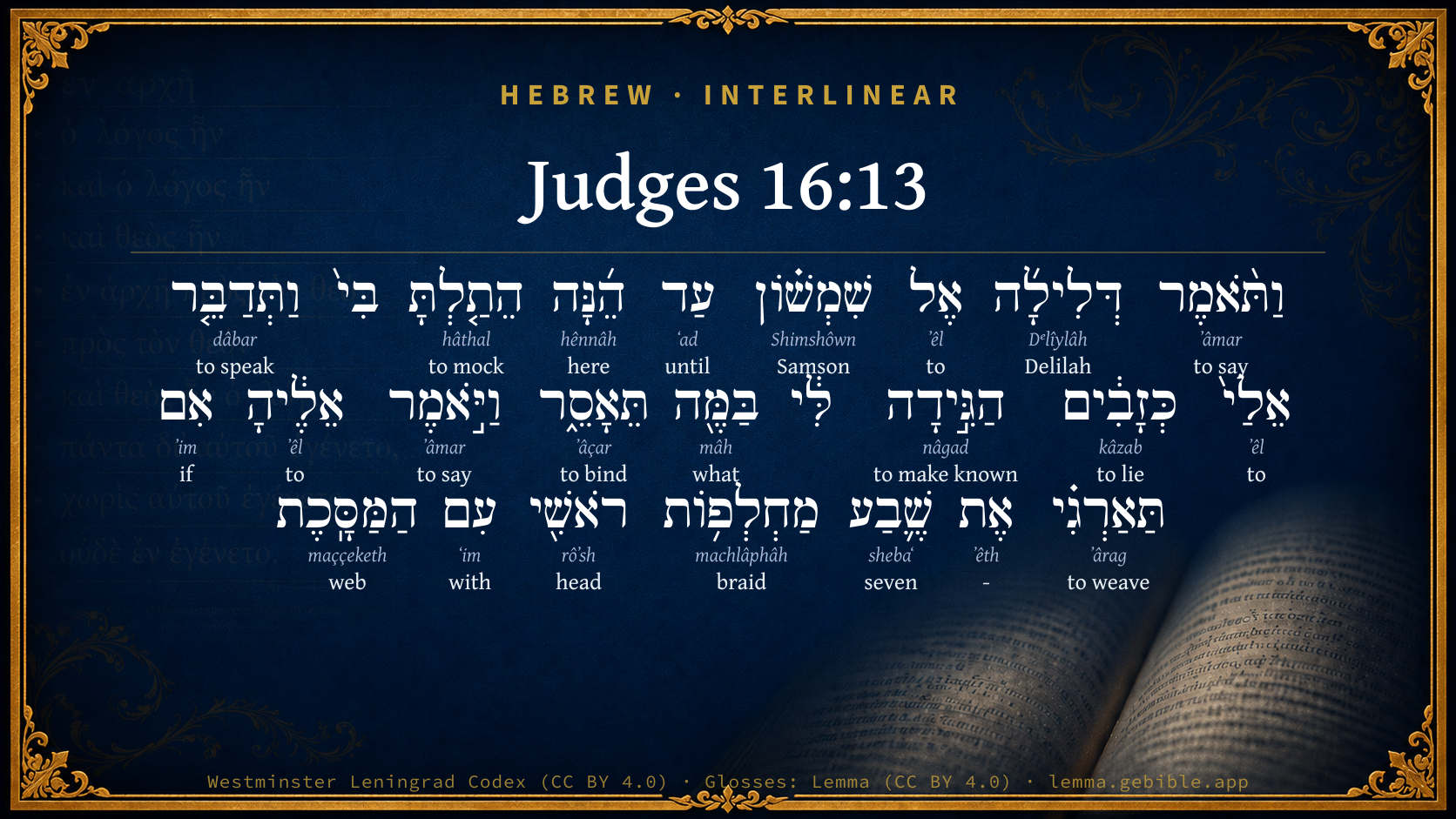
Hebrew (Westminster Leningrad Codex) Judges 16:13 appears in the Hebrew Old Testament. The text above is from the Westminster Leningrad Codex. Each word links to its Strong’s number, a concise gloss, and parsing drawn from the Open Scriptures Hebrew Bible morphology. Click any word for its full Brown-Driver-Briggs (BDB) entry.
Download image
Cite this verse

Judges 16:13 (World English Bible). Public Domain. Lemma interlinear Bible study tool, https://lemma.gebible.app/v/judges/16/13.

Show BibTeX & RIS
BibTeX
RIS
English Translation
Delilah said to Samson, Hitherto you have mocked me, and told me lies: tell me with which you might be bound. He said to her, If you weave the seven locks of my head with the web.
World English Bible · Public Domain
Highlights Full analysis ↓
Download a study sheet

One document with this verse’s original text, its word-by-word gloss line, the meaning frame, cross-references with their text, attributed commentary, and full source and license credits — printable, and it pastes into notes with its structure intact.

This verse Autodidact and up

Study sheet (.html) Plain text (.txt)

A passage Seminary Student

Up to 50 verses in one chapter. A passage sheet keeps up to 6 commentary sources and 12 cross-references per verse, in the order this page ranks them, and says so on the sheet whenever that leaves anything out. Ask for a single verse and you get the Autodidact verse sheet above.

Everything on this page stays free to read, with no account — the sheet is a download of what is already on screen, not access to it.

Want to remove ads? Support Godless Engineer
Compare translations 3

The same verse in 3 English versions, stacked beneath the original-language interlinear above. Click any original word for its lexicon entry.

Each is an independent rendering of the whole verse — the interlinear is not word-aligned to these translations.

Highlighted words mark where these versions differ — a whole-verse word diff, not a word-by-word alignment.

  • World English Bible Public Domain
    Delilah said to Samson, Hitherto you have mocked me, and told me lies: tell me with which you might be bound. He said to her, If you weave the seven locks of my head with the web.
  • King James Version Public Domain
    And Delilah said unto Samson, Hitherto thou hast mocked me, and told me lies: tell me wherewith thou mightest be bound. And he said unto her, If thou weavest the seven locks of my head with the web.
  • unfoldingWord Literal Text CC BY-SA 4.0
    Then Delilah said to Samson, “Up to now you have deceived me and spoken lies to me. Declare to me in what you may be bound!” So he said to her, “If you weave the seven locks of my head with the warp.”

unfoldingWord Literal Text — © unfoldingWord, licensed CC BY-SA 4.0. Word-aligned USFM3 via Door43 (git.door43.org/unfoldingWord/en_ult).

Versions to compare (up to 4)

3 of 4 selected

Show all 18 translations

Every available English version of this verse, each an independent rendering of the whole verse.

  • World English Bible Public Domain
    Delilah said to Samson, Hitherto you have mocked me, and told me lies: tell me with which you might be bound. He said to her, If you weave the seven locks of my head with the web.
  • Berean Standard Bible Public Domain
    Then Delilah said to Samson, “You have mocked me and lied to me all along! Tell me how you can be tied up.” He told her, “If you weave the seven braids of my head into the web of a loom and tighten it with a pin, I will become as weak as any other man.”
  • Majority Standard Bible Public Domain
    Then Delilah said to Samson, “You have mocked me and lied to me all along! Tell me how you can be tied up.” He told her, “If you weave the seven braids of my head into the web of a loom and tighten it with a pin, I will become as weak as any other man.”
  • King James Version Public Domain
    And Delilah said unto Samson, Hitherto thou hast mocked me, and told me lies: tell me wherewith thou mightest be bound. And he said unto her, If thou weavest the seven locks of my head with the web.
  • American Standard Version (1901) Public Domain
    And Delilah said unto Samson, Hitherto thou hast mocked me, and told me lies: tell me wherewith thou mightest be bound. And he said unto her, If thou weavest the seven locks of my head with the web.
  • Revised Version (1885) Public Domain
    And Delilah said unto Samson, Hitherto thou hast mocked me, and told me lies: tell me wherewith thou mightest be bound. And he said unto her, If thou weavest the seven locks of my head with the web.
  • Geneva Bible (1599) Public Domain
    Afterward Delilah said to Samson, Hitherto thou hast beguiled mee, and tolde me lies: tell me how thou mightest be bounde. And he sayde vnto her, If thou plattedst seuen lockes of mine head with the threedes of the woufe.
  • Douay-Rheims (1899) Public Domain
    And Dalila said to him again: How long dost thou deceive me, and tell me lies? Shew me wherewith thou mayest be bound. And Samson answered her: If thou plattest the seven locks of my head with a lace, and tying them round about a nail fastenest it in the ground, I shall be weak.
  • Young's Literal Translation Public Domain
    And Delilah saith unto Samson, `Hitherto thou hast played upon me, and dost speak unto me lies; declare to me wherewith thou art bound.' And he saith unto her, `If thou weavest the seven locks of my head with the web.'
  • Literal Standard Version CC BY-SA 4.0
    And Delilah says to Samson, “Until now you have played on me, and speak lies to me; declare to me with what you are bound.” And he says to her, “If you weave the seven locks of my head with the web.”
  • Unlocked Literal Bible CC BY-SA 4.0
    Delilah said to Samson, “Until now you have deceived me and told me lies. Tell me how you may be overpowered.” Samson said to her, “If you weave seven locks of my hair into a fabric on a loom, and then nail that to the loom, I will be like any other man.”
  • unfoldingWord Literal Text CC BY-SA 4.0
    Then Delilah said to Samson, “Up to now you have deceived me and spoken lies to me. Declare to me in what you may be bound!” So he said to her, “If you weave the seven locks of my head with the warp.”
  • Darby Bible Public Domain
    And Deli'lah said to Samson, "Until now you have mocked me, and told me lies; tell me how you might be bound." And he said to her, "If you weave the seven locks of my head with the web and make it tight with the pin, then I shall become weak, and be like any other man."
  • World Messianic Bible Public Domain
    Delilah said to Samson, “Until now, you have mocked me and told me lies. Tell me with what you might be bound.” He said to her, “If you weave the seven locks of my head with the fabric on the loom.”
  • Webster's Bible Public Domain
    And Delilah said to Samson, hitherto thou hast mocked me, and told me lies: tell me with what thou mayest be bound. And he said to her, If thou weavest the seven locks of my head with the web.
  • Free Bible Version CC BY-SA 4.0
    Delilah said to Samson, “You keep on making me look stupid, telling me these lies! Just tell me what can be used to tie you up!” “If you were to weave the seven braids of my hair into the web on the loom and tighten it with the pin, I'll become as weak as anyone else,” he told her. So while he was asleep, Delilah took the seven braids of his head, weaving them into the web,
  • Bible in Basic English Public Domain
    Then Delilah said to Samson, Up to now you have made sport of me with false words; now say truly, how may you be put in bands? And he said to her, If you get the seven twists of my hair worked into the cloth you are making and fixed with the pin, I will become feeble and will be like any other man.
  • JPS Tanakh (1917) Public Domain
    And Delilah said unto Samson: 'Hitherto thou hast mocked me, and told me lies; tell me wherewith thou mightest be bound.' And he said unto her: 'If thou weavest the seven locks of my head with the web.'

Literal Standard Version (2020), Covenant Press — licensed CC BY-SA 4.0. Text via the HelloAO Bible API (eBible.org). Unlocked Literal Bible (unfoldingWord) — licensed CC BY-SA 4.0. Text via the HelloAO Bible API (eBible.org). unfoldingWord Literal Text — © unfoldingWord, licensed CC BY-SA 4.0. Word-aligned USFM3 via Door43 (git.door43.org/unfoldingWord/en_ult). Free Bible Version, Dr. Jonathan Gallagher — licensed CC BY-SA 4.0. Text via the HelloAO Bible API (eBible.org).

Word by word

More ways to search: Search by grammar → Find every occurrence → Compare this word →

Practice this passage: Drill this verse → Learn its vocabulary →

מַחְלְפ֥וֹת
machlâphâh
H4253
“braids of”
Noun, Common, Feminine, Plural, Construct
Part of Speech
Noun
Type
Common
Gender
Feminine
Number
Plural
State
Construct
Full BDB Definition

Origin: from H2498

TWOT: 666e

braid, lock, plait - of hair
  1. וַתֹּ֨אמֶר ʼâmar H559 “and · to say” Conjunction + Verb, Qal, Sequential Imperfect, 3rd Person, Feminine, Singular
  2. דְּלִילָ֜ה Dᵉlîylâh H1807 “Delilah” Noun, Proper
  3. אֶל ʼêl H413 “to” Preposition
  4. שִׁמְשׁ֗וֹן Shimshôwn H8123 “Samson” Noun, Proper
  5. עַד ʻad H5704 “until” Preposition
  6. הֵ֜נָּה hênnâh H2008 “here” Adverb
  7. הֵתַ֤לְתָּ hâthal H2048 “to mock” Verb, Hiphil, Perfect, 2nd Person, Masculine, Singular
  8. וַתְּדַבֵּ֤ר dâbar H1696 “and · to speak” Conjunction + Verb, Piel, Sequential Imperfect, 2nd Person, Masculine, Singular
  9. אֵלַי֙ ʼêl H413 “to · me” Preposition + Suffix, Personal, 1st Person, Common, Singular
  10. כְּזָבִ֔ים kâzab H3576 “liars” Noun, Common, Masculine, Plural, Absolute
  11. הַגִּ֣ידָה nâgad H5046 “make known” Verb, Hiphil, Imperative, 2nd Person, Masculine, Singular + Suffix, h
  12. בַּמֶּ֖ה mâh H4100 “in/at · what” Preposition + Particle, Interrogative
  13. תֵּאָסֵ֑ר ʼâçar H631 “to bind” Verb, Niphal, Imperfect, 2nd Person, Masculine, Singular
  14. וַיֹּ֣אמֶר ʼâmar H559 “and · to say” Conjunction + Verb, Qal, Sequential Imperfect, 3rd Person, Masculine, Singular
  15. אֵלֶ֔יהָ ʼêl H413 “to · her” Preposition + Suffix, Personal, 3rd Person, Feminine, Singular
  16. אִם ʼim H518 “if” Conjunction
  17. תַּאַרְגִ֗י ʼârag H707 “to weave” Verb, Qal, Imperfect, 2nd Person, Feminine, Singular
  18. אֶת ʼêth H853 “-” Particle, Direct Object
  19. שֶׁ֛בַע shebaʻ H7651 “seven” Adjective, Cardinal number, Feminine, Singular, Absolute
  20. רֹאשִׁ֖י rôʼsh H7218 “head · my” Noun, Common, Masculine, Singular, Construct + Suffix, Personal, 1st Person, Common, Singular
  21. עִם ʻim H5973 “with” Preposition
  22. הַמַּסָּֽכֶת maççeketh H4545 “the · web” Particle, Definite Article + Noun, Common, Feminine, Singular, Absolute

About this verse

These counts appear in no published source. They are computed here, from the morphology-tagged text and Lemma’s own curated glosses. What Lemma adds →

25
words
20
distinct lemmas
Historical
section

Notable vocabulary

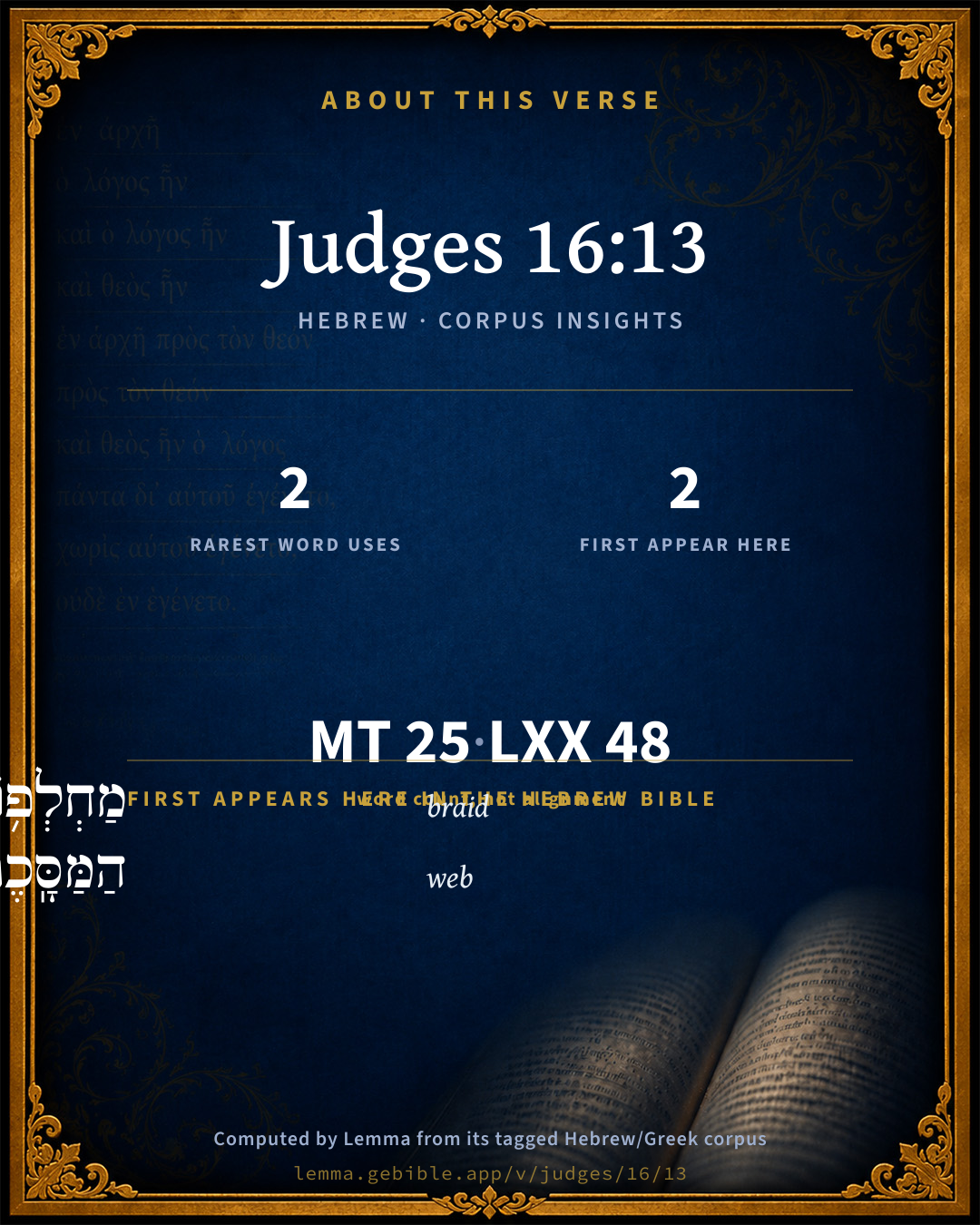
The rarest word here is מַחְלְפ֥וֹת braid H4253 — appearing just 2 times in the whole Hebrew Bible.

First appearance in Scripture

These words make their first canonical appearance in the Hebrew Bible here:

  • מַחְלְפ֥וֹת braid H4253
  • הַמַּסָּֽכֶת web H4545

Shared distinctive vocabulary

מַחְלְפ֥וֹת braid H4253 occurs in 2 verses of the Hebrew Bible. Also found in:

Grammatical profile

  • 7 verbs
  • 6 nouns
  • 1 adjective
  • 7 prepositions
  • 1 conjunction
  • 1 adverb
  • 2 particles

Verb forms

  • וַתֹּ֨אמֶר Qal · Sequential Imperfect
  • הֵתַ֤לְתָּ Hiphil · Perfect
  • וַתְּדַבֵּ֤ר Piel · Sequential Imperfect
  • הַגִּ֣ידָה Hiphil · Imperative
  • תֵּאָסֵ֑ר Niphal · Imperfect
  • וַיֹּ֣אמֶר Qal · Sequential Imperfect
  • תַּאַרְגִ֗י Qal · Imperfect

Repetition

Words recur within this verse — often emphatic in Hebrew:

  • וַתֹּ֨אמֶר to say H559 ×2
  • אֶל to H413 ×3

Hebrew & Septuagint length

In English translation the verse runs 37 words from the Hebrew and 60 from the Septuagint (LXX English) — the Septuagint runs noticeably longer here. See the side-by-side →

A rough comparison of the two English renderings, which tokenize alike — not a word-level alignment.

Word counts can differ between the Hebrew and the Greek without any difference in meaning — e.g. the Hebrew direct-object marker אֵת has no separate Greek word, and Greek often adds the article ὁ.

In the original languages it is 25 Hebrew tokens and 48 Greek tokens — but the two are counted differently (Hebrew bundles its prefixes and suffixes into one token; the Greek is in lemma form), so that isn’t a like-for-like length.

Hebrew and Greek witnesses Masoretic Hebrew ↔ Greek Septuagint

The same verse in the two great witnesses to the Old Testament, shown verse-for-verse.

Here the Septuagint runs noticeably longer than the Hebrew — LXX2012 (modern English Septuagint) 60 words vs World English Bible 37. A rough length comparison of the two English translations, not a word-level alignment — read both below.

These are two independent witnesses, not word-aligned to each other, and the Septuagint is shown in lemma (dictionary) form.

Hebrew Judges 16:13 Masoretic · Westminster Leningrad Codex

וַתֹּ֨אמֶר דְּלִילָ֜ה אֶל שִׁמְשׁ֗וֹן עַד הֵ֜נָּה הֵתַ֤לְתָּ בִּי֙ וַתְּדַבֵּ֤ר אֵלַי֙ כְּזָבִ֔ים הַגִּ֣ידָה לִּ֔י בַּמֶּ֖ה תֵּאָסֵ֑ר וַיֹּ֣אמֶר אֵלֶ֔יהָ אִם תַּאַרְגִ֗י אֶת שֶׁ֛בַע מַחְלְפ֥וֹת רֹאשִׁ֖י עִם הַמַּסָּֽכֶת

Delilah said to Samson, Hitherto you have mocked me, and told me lies: tell me with which you might be bound. He said to her, If you weave the seven locks of my head with the web.

World English Bible · Public Domain

Greek LXX Judges 16:13 Septuagint · lemma form

καί εἶπον δαλιδα πρός σαμψων ἰδού πλανάω ἐγώ καί λαλέω πρός ἐγώ ψευδής ἀποἀγγέλλω δή ἐγώ ἐν τίς δέω καί εἶπον πρός αὐτός ἐάν ὑφαίνω ὁ ἑπτά σειρά ὁ κεφαλή ἐγώ σύν ὁ δίασμα καί ἐνκρούω ὁ πάσσαλος εἰς ὁ τοῖχος καί εἰμί ὡς εἷς ὁ ἄνθρωπος ἀσθενής

And Dalida said to Sampson, Behold, you have deceived me, and told me lies; tell me, I entreat you, wherewith you may be bound: and he said to her, If you should weave the seven locks of my head with the web, and should fasten them with the pin into the wall, then shall I be weak as another man.

LXX2012 (modern English Septuagint) · Public Domain

On this verse, Adam Clarke's Commentary discusses the Septuagint’s reading. Read the note in Commentary ↓

Hebrew: Westminster Leningrad Codex (CC BY 4.0). Greek: Septuagint (public domain); English from LXX2012 (modern English Septuagint) (Public Domain). How the Septuagint differs from the Hebrew →

Targum (Aramaic paraphrase)

1

The Targum is the ancient Jewish Aramaic paraphrase of the Hebrew Scriptures — an interpretive translation, not the Hebrew text itself. Onkelos (literal) and Pseudo-Jonathan (expansive) render the Torah, and Jonathan the Prophets. Coverage is partial: where no permissively-licensed English translation exists for a verse, only the Aramaic is shown. This is verse-level text, not a word-by-word alignment to the Hebrew.

  1. Targum Jonathan Prophets (Joshua–Malachi)
    וַאֲמַרַת דְלִילָה לְשִׁמְשׁוֹן עַד הָכָא שְׁקַרְתָּ בִּי וּמַלֵילְתָּא עִמִי כַּדְבִין חַוִי כְעַן לִי בַּמֶה תִּתְאַסָר וַאֲמַר לָהּ אִם תִּשְׁתִּין יַת שְׁבַע גְדִילַת רֵישִׁי עִם אַכְסְנָא דְמַשְׁתֵּיתָא:

    (no public-domain English translation for this verse)

    Targum Jonathan — Aramaic: “Mikraot Gedolot” (public domain). English: “Sefaria Community Translation” (CC0 1.0 (public-domain dedication)); “London "Chaldee Paraphrase," 1871” (public domain). Text via Sefaria.

Commentary

Notes on Judges 16:13 from classic Christian and Jewish commentators (each source and its license shown beneath its notes). The classic Christian expositions comment on the surrounding passage and are grouped to its opening verse, so a note may address several verses; the Jewish commentaries on the Tanakh (Rashi and others) are per-verse, so they appear only where the commentator wrote on this verse.

Lemma curates 59 commentaries, every one of them public domain or Creative Commons licensed, each selected and text-cleaned for this edition rather than reprinted as found. About our sources →

The Cambridge Bible for Schools and Colleges

gen. ed. J. J. S. Perowne

13. If thou weavest the seven locks … web] plaits … warp. Weaving was the work of women as well as of men; see the illustration from the Egyptian tombs at Beni Hasan dating from the Middle Kingdom, Benzinger, Hebr. Archäol.2, p. 151; Delîlah has a loom in her house. This was a horizontal loom fastened into the ground, as in the illustration referred to1[56]

[56] It looks as if it were upright; but this is due to the absence of perspective in Egyptian drawing.

; hence it would be easy to weave the hair of a person lying asleep upon the floor into the warp, i.e. the horizontal threads which are intersected at right angles by the weft, in this case Samson’s hair. To form the web, i.e. the woven cloth, a further operation is necessary, the beating up of the weft with a flat rod or batten, here rendered pin (Jdg_16:14); the word usually means peg, esp. a tent-peg (see Jdg_5:26 mg.), but that it could also be used of a flat stick appears from Deu_23:13 (paddle or spade).

The sentences needed to complete Jdg_16:13 and to provide the proper beginning of Jdg_16:14 have accidentally fallen out. With the help of the Greek versions the gap may be filled thus: “If thou weavest the seven plaits of my head with the warp, and beatest them up with the batten, then shall I become weak and be as any other man. So she made him sleep, and wove the seven plaits of his head with the warp, and beat them up with the batten.” It will be noticed that the existing text and the restored text both end in the same way. The eye of the copyist passed from the first with the warp to the second, and overlooked the intervening lines: a good instance of the source of textual mistakes known as homoioteleuton. The seven locks may have something to do with solar mythology. The Babyl. Gilgãmesh had seven locks; in later Greek art Helios is usually represented with the same number.

The Cambridge Bible for Schools and Colleges (gen. ed. J. J. S. Perowne; Cambridge University Press, 1878–1918) — public domain. Text from a community e-Sword module.

Trapp's Complete Commentary

John Trapp

Jdg 16:13 And Delilah said unto Samson, Hitherto thou hast mocked me, and told me lies: tell me wherewith thou mightest be bound. And he said unto her, If thou weavest the seven locks of my head with the web.

Ver. 13. And told me lies.] See Jdg 16:10.

The seven locks of my head.] Here he came nearer the business than before; till at length she had his whole heart out. Well might Terence call harlots Cruces.

John Trapp, A Commentary or Exposition upon All the Books of the Old and New Testament (1647–1656) — public domain. Text from a community e-Sword module.

Joseph Benson's Commentary

Jdg 16:13. If thou weavest the seven locks of my head — If my hair, which is all divided into seven locks, be fastened about a weaver’s beam, or interwoven with weavers’ threads, then I shall be weak as another man. It is probable there was some loom or instrument of weaving in the room where Samson now was, which put him upon saying this to Delilah, to get rid of her importunity.

Joseph Benson's Commentary on the Old and New Testaments (1811–1818) — public domain. Text from a community e-Sword module.

Geneva Bible (1599)

Geneva Bible translators

It is impossible if we give place to our wicked affections, but at length we shall be destroyed.

Geneva Bible (1599) marginal notes — public domain. Text via Bolls.life.

Jamieson, Fausset & Brown

Robert Jamieson, A. R. Fausset & David Brown

If thou weavest the seven locks of my head--braids or tresses, into which, like many in the East, he chose to plait his hair. Working at the loom was a female employment; and Delilah's appears to have been close at hand. It was of a very simple construction; the woof was driven into the warp, not by a reed, but by a wooden spatula. The extremity of the web was fastened to a pin or stake fixed in the wall or ground; and while Delilah sat squatting at her loom, Samson lay stretched on the floor, with his head reclining on her lap--a position very common in the East.

Jamieson, Fausset & Brown — Commentary Critical and Explanatory on the Whole Bible (1871) — public domain (CC PDM 1.0). Text via the HelloAO Bible API.

Adam Clarke's Commentary

Verse 13. The seven locks of my head] Probably Samson had his long hair plaited into seven divisions, and as his vow of a Nazarite obliged him to wear his hair, so, seven being a number of perfection among the Hebrews, his hair being divided into seven locks might more particularly point out the perfection designed by his Nazarite state.

Every person must see that this verse ends abruptly, and does not contain a full sense. Houbigant has particularly noticed this, and corrected the text from the Septuagint, the reading of which I shall here subjoin:

Εαν ὑφανῃς τας ἑπτα σειρας της κεφαλης μον αυν τῳ διασματι, και εγκρουσῃς τῳ πασσαλῳ εις τον τοιχον, και εσομαι ὡς εἱς των ανθρωπων ασθενης· Και εγενετο εν τῳ κοιμασθαι αυτον, και ελαβε Δαλιδα τας ἑπτα σειρας της κεφαλης αυτου, και ὑφανεν εν τῳ διασματι, και επηξε τῳ πασσαλῳ εις τον τοιχον;

"If thou shalt weave the seven locks of my head with the web, and shalt fasten them with the pin in the wall, I shall become weak like other men: And so it was that, when he slept, Dalida took the seven locks of his head, and wove them with the web, and fastened it with the pin to the wall and said unto him," c.

All the words printed here in italic, are wanting in the present Hebrew copies but are preserved in the Septuagint, and are most obviously necessary to complete the sense; else Delilah appears to do something that she is not ordered to do, and to omit what she was commanded.

Adam Clarke's Commentary on the Bible (1810–1826) — public domain. Text from a community e-Sword/MySword module.

Ellicott's Commentary for English Readers

(13) If thou weavest the seven locks of my head with the web.—The illustrious and “sunny locks of the Nazarite” did not, as Milton imagines, “lie waving and curling about his god-like shoulders,” but were plaited into seven locks. The word for “locks”—machelephoth—occurs here only. The LXX. render it “curls” (bostruchous) and seiras, which appears to mean “plaits,” like the Greek plokamous. The word for “web” is a technical word, and perhaps means warp. The LXX. and the Vulg. add, “and drive them with the peg into the wall,” which is implied in the next verse. With almost incredible levity and folly, Samson here goes to the very verge of the true secret, and suffers his sacred hair to be woven in a harlot’s loom. (Tertio de mysterio deprompsit jam lapsuro propior. St. Ambrose.)

A Bible Commentary for English Readers, edited by Charles John Ellicott (1878–1897) — public domain. Text from a community e-Sword module.

John Gill's Exposition

And Delilah said unto Samson,.... At another time, when she thought it most proper to upbraid him with his deception of her:

hitherto thou hast mocked me, and told me lies; both the times that she had solicited him to impart the secret of his strength to her:

tell me wherewith thou mightest be bound; tell me the real truth, and deceive me no more:

and he said unto her, if thou weavest the seven locks of my head with the web; it seems that Samson's hair was parted into seven locks, which no doubt hung down very long; and now he tells her, that if these were interwoven with the warp which was upon the beam in a loom near by; perhaps in the same room, where Delilah used to weave, as was the custom of those times, and in various nations (a); his strength would be weakened; for Braunius (b) is mistaken in supposing this to be the beam about which the web was rolled, as he is also in the pin next mentioned, which he takes to be the "spatha", or lathe, with which the threads are knocked together.

(a) "Arguto conjux", &c. Virgil. Georgie. l. 1. v. 294. So Penelope in Homer, Minerva & Arachne in Ovid. Metamorph. l. 6. fab. 1. v. 55, &c. Vid. Pignorium de servis, p. 418. Braunium de Vest. Sacerd. Hebr. l. 1. c. 17. sect. 33. (b) "De Vest". Sacerd. Hebr. l. 1. c. 16. sect. 8.

John Gill's Exposition of the Whole Bible (1746–1763) — public domain (CC PDM 1.0). Text via the HelloAO Bible API.

Haydock's Catholic Bible Commentary

Lace, (licio;) "the woof about the beam," &c. Hebrew, "the web, (14) and she fastened it," &c. The original text is here imperfect. (Haydock) --- The Septuagint have preserved eighteen words, which have been omitted in Hebrew, "the web, (and fastened them with a pin unto the wall, then shall I be weak, and be as another man. (14) An it came to pass, when he slept, that Dalilia took seven locks of his head, and wove them with a web) and fastened them with a pin, (unto the wall) and said," &c. (Kennicott, Diss. ii.) --- The Vulgate expresses the whole idea in fewer words: but the Hebrew leaves the proposal of Samson imperfect. It is observable that Grabe’s edition of the Alexandrian Septuagint has no mark of any thing being redundant; whence we might suppose, that in the days of Origen, (whose marks he endeavours to exhibit) the Hebrew agreed with the Greek version: but the 14th verse is rather different from the Vatican copy, which has been given above. --- "And Dalila (so the Septuagint always style her) lulled him asleep; (Greek: ekoimisen, as [in] ver. 19, (Haydock) perhaps by giving him some potion, with which people of her character are frequently provided; Salien) and she wove the seven curls of his head with the wool, (Greek: ektaseos) and she fastened them with the pins of wood into the wall," &c. (Haydock) --- The Hebrew text is liable to many difficulties, says Calmet; "If thou shalt make a tissue of seven locks of my head with the veil, which thou weavest, and shalt fasten it to a nail, I shall become weak as another man: or, If thou weave together my hair and my thread," &c. The ancients were accustomed to weave standing. Samson was probably lying on the ground, while Dalila was acting this farce. (Calmet)

George Leo Haydock (1774–1849), Haydock's Catholic Family Bible and Commentary, 1859 edition — public domain. Excludes Psalms (Douay-Rheims chapter numbering differs from Protestant) and Deuterocanonical books (Catholic canon only).

Matthew Poole's English Annotations

Or, thread which is woven about a weaver’s loom; or,

with a weaver’s beam. If my hair, which is all divided into seven locks, be fastened about a weaver’s beam, or interwoven with weavers’ threads; understand out of the foregoing verses, then I shall be weak as another man.

Matthew Poole's English Annotations on the Holy Bible (1683–1685) — public domain. Text from a community e-Sword/MySword module.

Whedon's Commentary on the Bible

Daniel D. Whedon

13. The seven locks — He probably wore his long Nazarite hair in seven braids or flowing tresses.

If thou weavest… with the web — The meaning is, that she should weave his seven braids of hair fast into the warp of the cloth which was upon her loom. “This time,” says Kitto, “he approached dangerously near his great secret. His infatuation was like that of the moth, approaching gradually nearer and nearer to the flame which destroys it at last. This device was suggested by the presence of the small loom in which the women of these days wove their household stuffs — a kind of industry from which it would seem that females even of Delilah’s stamp did not hold themselves exempt. These looms, as shown in Egyptian sculptures, and as still subsisting in the East, are very simple and comparatively light, and must by no means be confounded with the ponderous apparatus of our own hand-loom weavers.”

Daniel D. Whedon (gen. ed.), Commentary on the Old and New Testaments (1874–1909) — public domain. Text from a community e-Sword module.

The Pulpit Commentary

The seven locks, by which we learn that his mass of hair as a Nazarite was arranged in seven locks or plaits. His resistance was becoming weaker, and he now approached the dangerous ground of his unshorn hair. With the web . This must mean the warp, which was already fastened in the loom, and across which Samson s locks were to be woven as the woof.

The Pulpit Commentary (1880–1919), ed. H.D.M. Spence-Jones & Joseph S. Exell — public domain. Text from a community e-Sword module.

John Wesley's Explanatory Notes

Web - Or, thread which is woven about a weaver's loom: or, with a weaver's beam. If my hair, which is all divided into seven locks, be fastened about a weaver's beam; or interwoven with weaver's threads: then I shall be weak as another man.

John Wesley, Explanatory Notes Upon the Whole Bible (1754–1765) — public domain. Text via the GEBible commentary corpus.

unfoldingWord translationNotes

Door43 World Missions Community

you have deceived me and told me lies

Deceiving and lying mean the same thing and are stated to emphasize how angry Delilah felt. AT: "you have greatly deceived me" (See: Parallelism)

you may be overpowered

This can be stated in active form. AT: "people can overpower you" (See: Active or Passive)

weave

crossing pieces of material together so they hold each other in place

locks of my hair

small bunches of hair

fabric

cloth made from weaving material together

loom

a machine used for combining many threads of material into a cloth (See: Translate Unknowns)

then nail that to the loom

"then nail the fabric to the loom"

nail

to hammer a nail in order to hold something in one place

I will be like any other man

The full meaning of this statement can be made explicit. AT: "I will be as weak as any other man" (See: Assumed Knowledge and Implicit Information)

The Philistines are upon you

The phrase "upon you" means that they are there to capture him. AT: "The Philistines are here to capture you" (See: Idiom)

he pulled out the fabric and the pin from the loom

Samson pulled out the fabric from the loom when he pulled his hair away from the loom. This can be stated clearly. AT: "pulled away his hair, taking with it the pin of the loom and the fabric in the loom" (See: Assumed Knowledge and Implicit Information)

the pin

This is the wooden nail or peg used to fasten the fabric to the loom.

translationWords

Delilah

deceive

Samson

Philistines

unfoldingWord translationNotes — © Distant Shores Media and the Door43 World Missions Community, licensed CC BY-SA 4.0. Source: git.door43.org/Door43/en_tn.

Rashi

Rabbi Shlomo Yitzchaki (Rashi)

Tresses Locks. "Pelous" in old French.

With the mounting pin. A wooden rod which the weaver uses to mount the threads of the warp. The name of the wood is "ensouple", of the pin, "ourdissuire".

Rashi on the Tanakh — English translations: “The Judaica Press complete Tanach with Rashi, translated by A. J. Rosenberg” (CC BY 4.0); “Pentateuch with Rashi's commentary by M. Rosenbaum and A.M. Silbermann, 1929-1934” (public domain); “The Metsudah Tanach series, Lakewood, N.J” (CC BY 4.0); and “The Book of Joshua, Metsudah Publications, 1997” (CC BY 4.0). Text via Sefaria.

Lesson kit

Teaching starters — assembled from the data on this page, not authored interpretation. Every prompt links to the verse data it draws on. Edit before teaching.

Judges, in the Historical, opens this verse with 25 words (20 distinct Hebrew lemmas). Its most distinctive word is machlâphâh (“braid”). The Greek Septuagint runs longer here. A historical commentator’s framing appears above. Read the whole chapter for the surrounding context.

Discussion questions

  1. The word machlâphâh carries the sense “braid.” How does it shape the verse?
  2. 2 words make their first appearance in Scripture here. What does this debut establish?
  3. How does Judges 16:19, which shares the word «braid», read alongside this verse?
  4. What does the repetition of “to say” (2× in this one verse) do in this verse?
  5. The Septuagint runs longer here than the Hebrew. What might account for the difference?
  6. The translations on this page render this verse differently — a whole-verse word diff, not a word-by-word alignment. What might account for the different wordings?
  7. «וַתֹּ֨אמֶר» is a Qal Sequential Imperfect verb. How does that grammatical form shape the action described?
  8. Compare how The Cambridge Bible for Schools and Colleges and Trapp's Complete Commentary read this verse. Where do they agree or differ?

Things to notice

Reading settings

Reading text

Shown beneath each verse's original-language words.

Old Testament
Old Testament edition

Read the OT as the Masoretic Hebrew (MT) or the Greek Septuagint (LXX).

English shown for the Greek Septuagint (in the Hebrew ↔ Greek comparison).

Comparing translations? Open the Compare panel on any verse page to stack up to four side by side.