
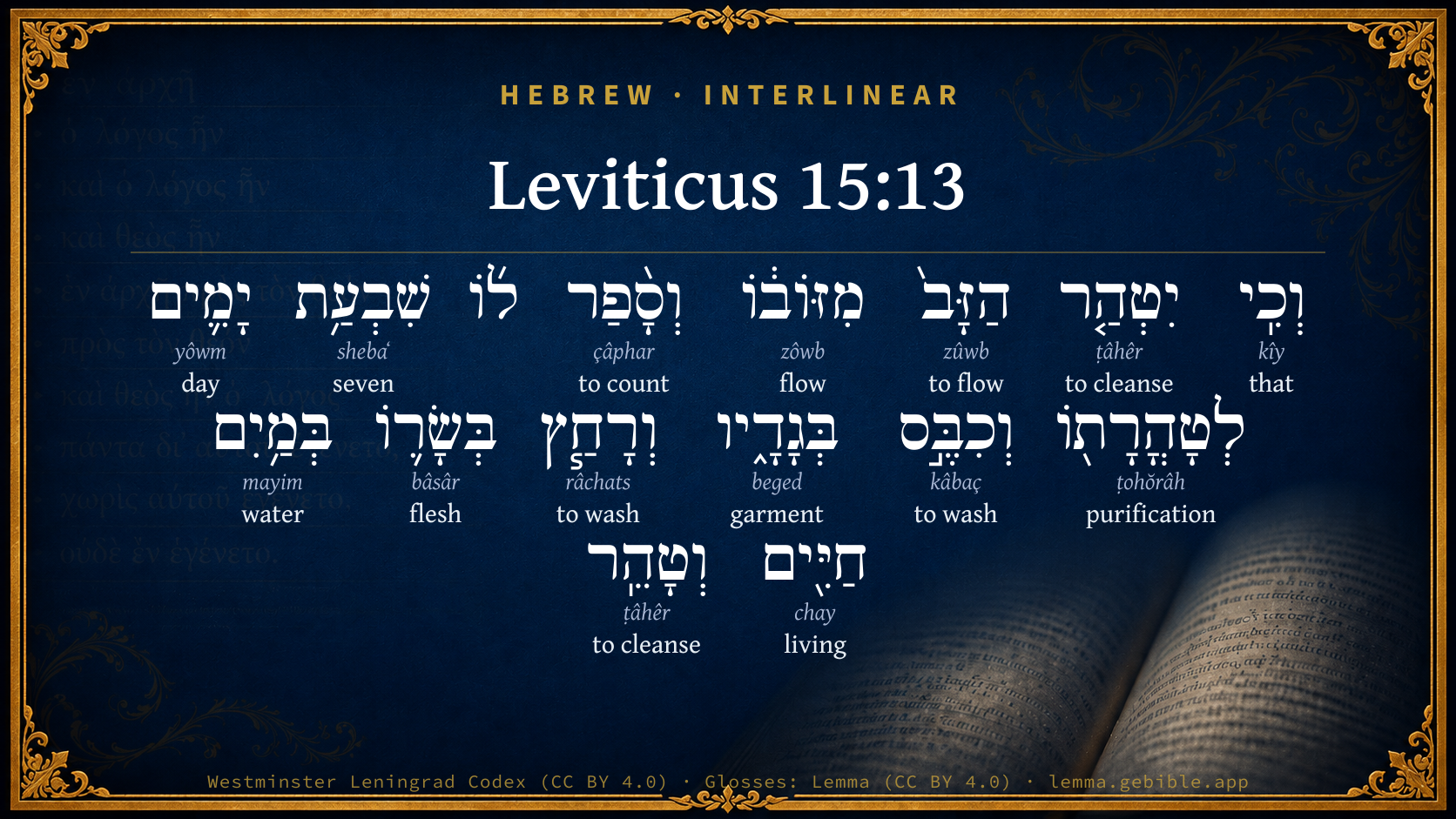
Leviticus 15:13

Hebrew (Westminster Leningrad Codex) Leviticus 15:13 appears in the Hebrew Old Testament. The text above is from the Westminster Leningrad Codex. Each word links to its Strong’s number, a concise gloss, and parsing drawn from the Open Scriptures Hebrew Bible morphology. Click any word for its full Brown-Driver-Briggs (BDB) entry.
Download image
Cite this verse

Leviticus 15:13 (World English Bible). Public Domain. Lemma interlinear Bible study tool, https://lemma.gebible.app/v/leviticus/15/13.

Show BibTeX & RIS
BibTeX
RIS
English Translation
"'When he who has a discharge is cleansed of his discharge, then he shall count to himself seven days for his cleansing, and wash his clothes; and he shall bathe his flesh in running water, and shall be clean.
World English Bible · Public Domain
Download a study sheet

One document with this verse’s original text, its word-by-word gloss line, the meaning frame, cross-references with their text, attributed commentary, and full source and license credits — printable, and it pastes into notes with its structure intact.

This verse Autodidact and up

Study sheet (.html) Plain text (.txt)

A passage Seminary Student

Up to 50 verses in one chapter. A passage sheet keeps up to 6 commentary sources and 12 cross-references per verse, in the order this page ranks them, and says so on the sheet whenever that leaves anything out. Ask for a single verse and you get the Autodidact verse sheet above.

Everything on this page stays free to read, with no account — the sheet is a download of what is already on screen, not access to it.

Want to remove ads? Support Godless Engineer
Compare translations 3

The same verse in 3 English versions, stacked beneath the original-language interlinear above. Click any original word for its lexicon entry.

Each is an independent rendering of the whole verse — the interlinear is not word-aligned to these translations.

Highlighted words mark where these versions differ — a whole-verse word diff, not a word-by-word alignment.

  • World English Bible Public Domain
    "'When he who has a discharge is cleansed of his discharge, then he shall count to himself seven days for his cleansing, and wash his clothes; and he shall bathe his flesh in running water, and shall be clean.
  • King James Version Public Domain
    And when he that hath an issue is cleansed of his issue; then he shall number to himself seven days for his cleansing, and wash his clothes, and bathe his flesh in running water, and shall be clean.
  • unfoldingWord Literal Text CC BY-SA 4.0
    And when the flowing cleanses from his flow, then he shall count for himself seven days for his cleansing. And he shall wash his clothes, and he shall bathe his flesh in living water. And he will be clean.

unfoldingWord Literal Text — © unfoldingWord, licensed CC BY-SA 4.0. Word-aligned USFM3 via Door43 (git.door43.org/unfoldingWord/en_ult).

Versions to compare (up to 4)

3 of 4 selected

Show all 18 translations

Every available English version of this verse, each an independent rendering of the whole verse.

  • World English Bible Public Domain
    "'When he who has a discharge is cleansed of his discharge, then he shall count to himself seven days for his cleansing, and wash his clothes; and he shall bathe his flesh in running water, and shall be clean.
  • Berean Standard Bible Public Domain
    When the man has been cleansed from his discharge, he must count off seven days for his cleansing, wash his clothes, and bathe himself in fresh water, and he shall be clean.
  • Majority Standard Bible Public Domain
    When the man has been cleansed from his discharge, he must count off seven days for his cleansing, wash his clothes, and bathe himself in fresh water, and he shall be clean.
  • King James Version Public Domain
    And when he that hath an issue is cleansed of his issue; then he shall number to himself seven days for his cleansing, and wash his clothes, and bathe his flesh in running water, and shall be clean.
  • American Standard Version (1901) Public Domain
    And when he that hath an issue is cleansed of his issue, then he shall number to himself seven days for his cleansing, and wash his clothes; and he shall bathe his flesh in running water, and shall be clean.
  • Revised Version (1885) Public Domain
    And when he that hath an issue is cleansed of his issue, then he shall number to himself seven days for his cleansing, and wash his clothes; and he shall bathe his flesh in running water, and shall be clean.
  • Geneva Bible (1599) Public Domain
    But if he that hath an issue, be cleansed of his issue, then shall he count him seuen dayes for his cleansing, and wash his clothes, and wash his flesh in pure water: so shall he be cleane.
  • Douay-Rheims (1899) Public Domain
    If he who suffereth this disease be healed, he shall number seven days after his cleansing, and having washed his clothes, and all his body in living water, he shall be clean.
  • Young's Literal Translation Public Domain
    `And when he who hath the issue is clean from his issue, then he hath numbered to himself seven days for his cleansing, and hath washed his garments, and hath bathed his flesh with running water, and been clean.
  • Literal Standard Version CC BY-SA 4.0
    And when he who has the discharging is clean from his discharge, then he has numbered seven days for himself for his cleansing, and has washed his garments, and has bathed his flesh with running water, and been clean.
  • Unlocked Literal Bible CC BY-SA 4.0
    When he who has a flow is cleansed from his flow, then he must count for himself seven days for his cleansing; then he must wash his clothes and bathe his body in running water. Then he will be clean.
  • unfoldingWord Literal Text CC BY-SA 4.0
    And when the flowing cleanses from his flow, then he shall count for himself seven days for his cleansing. And he shall wash his clothes, and he shall bathe his flesh in living water. And he will be clean.
  • Darby Bible Public Domain
    And when he that hath a flux is clean of his flux, then he shall count seven days for his cleansing, and wash his clothes, and bathe his flesh in running water, and he shall be clean.
  • World Messianic Bible Public Domain
    “‘When he who has a discharge is cleansed of his discharge, then he shall count to himself seven days for his cleansing, and wash his clothes; and he shall bathe his flesh in running water, and shall be clean.
  • Webster's Bible Public Domain
    And when he that hath an issue is cleansed of his issue; then he shall number to himself seven days for his cleansing, and wash his clothes, and bathe his flesh in running water, and shall be clean.
  • Free Bible Version CC BY-SA 4.0
    Once the discharge has healed, the man must allocate seven days for his cleaning process, wash his clothes, and wash himself in fresh water, and he will be clean.
  • Bible in Basic English Public Domain
    And when a man who has a flow from his body is made clean from it, he is to take seven days to make himself clean, washing his clothing and bathing his body in flowing water, and then he will be clean.
  • JPS Tanakh (1917) Public Domain
    And when he that hath an issue is cleansed of his issue, then he shall number to himself seven days for his cleansing, and wash his clothes; and he shall bathe his flesh in running water, and shall be clean.

Literal Standard Version (2020), Covenant Press — licensed CC BY-SA 4.0. Text via the HelloAO Bible API (eBible.org). Unlocked Literal Bible (unfoldingWord) — licensed CC BY-SA 4.0. Text via the HelloAO Bible API (eBible.org). unfoldingWord Literal Text — © unfoldingWord, licensed CC BY-SA 4.0. Word-aligned USFM3 via Door43 (git.door43.org/unfoldingWord/en_ult). Free Bible Version, Dr. Jonathan Gallagher — licensed CC BY-SA 4.0. Text via the HelloAO Bible API (eBible.org).

Word by word

More ways to search: Search by grammar → Find every occurrence → Compare this word →

Practice this passage: Drill this verse → Learn its vocabulary →

מִזּוֹב֔וֹ
zôwb
H2101
“from · flow · his”
Preposition + Noun, Common, Masculine, Singular, Construct + Suffix, Personal, 3rd Person, Masculine, Singular
Part of Speech
Preposition + Noun
Type
Common
Gender
Masculine
Number
Singular
State
Construct
Full BDB Definition

Origin: from H2100

TWOT: 534a

a flow, issue, discharge, flux - semen, discharge (venereal disease) (of men) - issue, flux (of woman)
  1. וְכִֽי kîy H3588 “and · that” Conjunction + Conjunction
  2. יִטְהַ֤ר ṭâhêr H2891 “to cleanse” Verb, Qal, Imperfect, 3rd Person, Masculine, Singular
  3. הַזָּב֙ zûwb H2100 “the · flowing” Particle, Definite Article + Verb, Qal, Participle Active, Masculine, Singular, Absolute
  4. וְסָ֨פַר çâphar H5608 “and · to count” Conjunction + Verb, Qal, Sequential Perfect, 3rd Person, Masculine, Singular
  5. שִׁבְעַ֥ת shebaʻ H7651 “seven” Adjective, Cardinal number, Masculine, Singular, Construct
  6. יָמִ֛ים yôwm H3117 “days” Noun, Common, Masculine, Plural, Absolute
  7. לְטָהֳרָת֖וֹ ṭohŏrâh H2893 “to/for · purification · his” Preposition + Noun, Common, Both, Singular, Construct + Suffix, Personal, 3rd Person, Masculine, Singular
  8. וְכִבֶּ֣ס kâbaç H3526 “and · to wash” Conjunction + Verb, Piel, Sequential Perfect, 3rd Person, Masculine, Singular
  9. בְּגָדָ֑יו beged H899 “garments · his” Noun, Common, Masculine, Plural, Construct + Suffix, Personal, 3rd Person, Masculine, Singular
  10. וְרָחַ֧ץ râchats H7364 “and · to wash” Conjunction + Verb, Qal, Sequential Perfect, 3rd Person, Masculine, Singular
  11. בְּשָׂר֛וֹ bâsâr H1320 “flesh · his” Noun, Common, Masculine, Singular, Construct + Suffix, Personal, 3rd Person, Masculine, Singular
  12. בְּמַ֥יִם mayim H4325 “in/at · water(s)” Preposition + Noun, Common, Masculine, Plural, Absolute
  13. חַיִּ֖ים chay H2416 “living” Adjective, Adjective, Masculine, Plural, Absolute
  14. וְטָהֵֽר ṭâhêr H2891 “and · to cleanse” Conjunction + Verb, Qal, Sequential Perfect, 3rd Person, Masculine, Singular

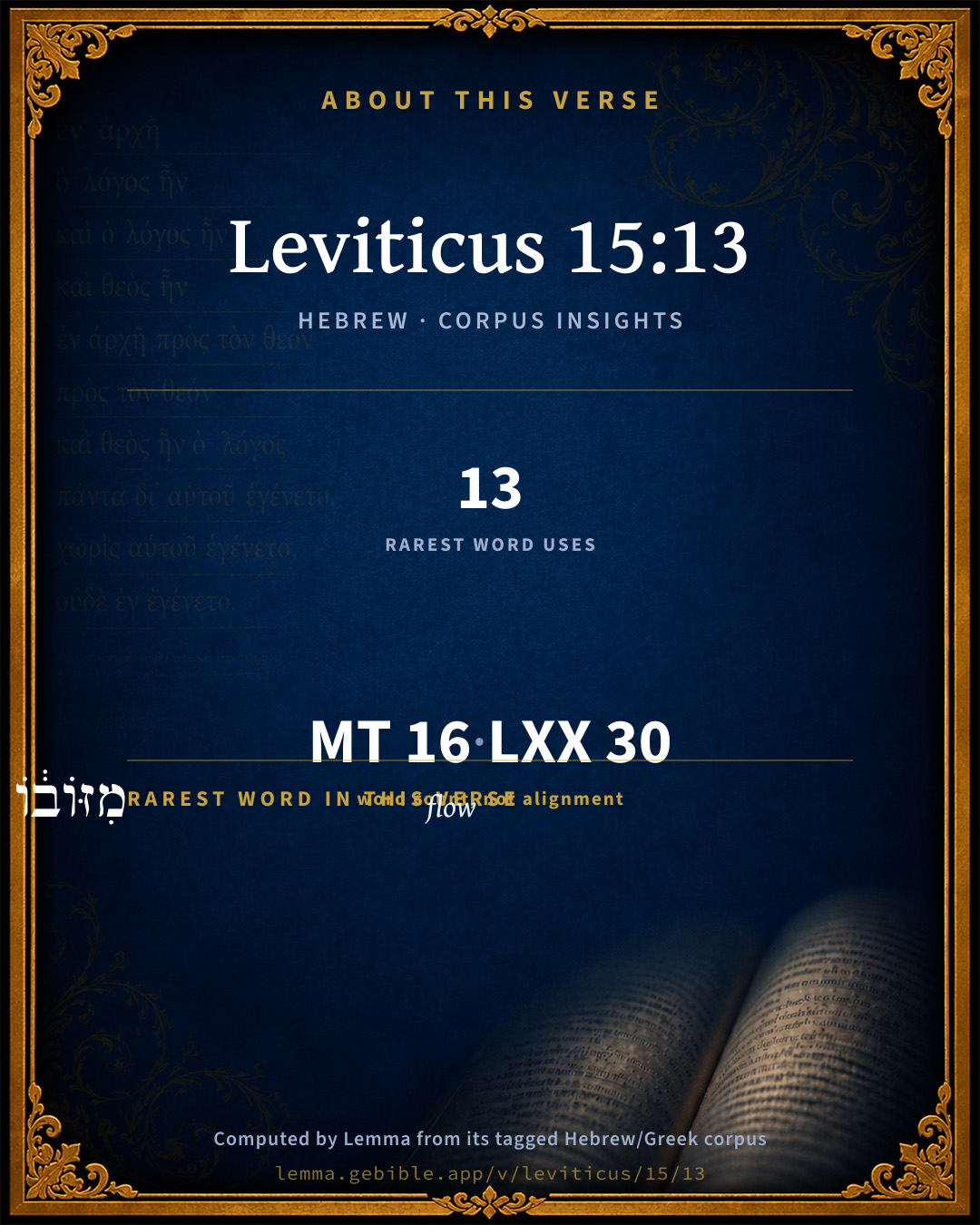
About this verse

These counts appear in no published source. They are computed here, from the morphology-tagged text and Lemma’s own curated glosses. What Lemma adds →

16
words
14
distinct lemmas
Pentateuch
section

Notable vocabulary

The rarest word here is מִזּוֹב֔וֹ flow H2101 — appearing just 13 times in the whole Hebrew Bible.

Shared distinctive vocabulary

מִזּוֹב֔וֹ flow H2101 occurs in 10 verses of the Hebrew Bible. Also found in:

Grammatical profile

  • 6 verbs
  • 6 nouns
  • 2 adjectives
  • 1 preposition
  • 1 conjunction

Verb forms

  • יִטְהַ֤ר Qal · Imperfect
  • הַזָּב֙ Qal · Participle Active
  • וְסָ֨פַר Qal · Sequential Perfect
  • וְכִבֶּ֣ס Piel · Sequential Perfect
  • וְרָחַ֧ץ Qal · Sequential Perfect
  • וְטָהֵֽר Qal · Sequential Perfect

Repetition

A word recurs within this verse — often emphatic in Hebrew:

  • יִטְהַ֤ר to cleanse H2891 ×2

Hebrew & Septuagint length

In English translation the verse runs 39 words from the Hebrew and 40 from the Septuagint (LXX English) — closely comparable.

A rough comparison of the two English renderings, which tokenize alike — not a word-level alignment.

Word counts can differ between the Hebrew and the Greek without any difference in meaning — e.g. the Hebrew direct-object marker אֵת has no separate Greek word, and Greek often adds the article ὁ.

In the original languages it is 16 Hebrew tokens and 30 Greek tokens — but the two are counted differently (Hebrew bundles its prefixes and suffixes into one token; the Greek is in lemma form), so that isn’t a like-for-like length.

Cross-references

16

Topical passages linked to Leviticus 15:13 in the Treasury of Scripture Knowledge — connected by theme and wording, ordered by reader-vote popularity; previews shown in the World English Bible.

  • Leviticus 8:33 You shall not go out from the door of the Tent of Meeting seven days, until the days of your consecration are fulfilled: for he shall consecrate you seven days.
  • Leviticus 14:8 "He who is to be cleansed shall wash his clothes, and shave off all his hair, and bathe himself in water; and he shall be clean. After that he shall come into the camp, but shall dwell outside his tent seven days.
  • Leviticus 15:5 Whoever touches his bed shall wash his clothes, and bathe himself in water, and be unclean until the evening.
  • Leviticus 15:28 "'But if she is cleansed of her discharge, then she shall count to herself seven days, and after that she shall be clean.
  • Exodus 29:35 "Thus shall you do to Aaron, and to his sons, according to all that I have commanded you. Seven days shall you consecrate them.
  • Exodus 29:37 Seven days you shall make atonement for the altar, and sanctify it: and the altar shall be most holy; whatever touches the altar shall be holy.
  • Leviticus 9:1 It happened on the eighth day, that Moses called Aaron and his sons, and the elders of Israel;
  • Leviticus 14:10 "On the eighth day he shall take two male lambs without blemish, and one ewe lamb a year old without blemish, and three tenths of an ephah of fine flour for a meal offering, mingled with oil, and one log of oil.
  • Leviticus 15:10–11 Whoever touches anything that was under him shall be unclean until the evening. He who carries those things shall wash his clothes, and bathe himself in water, and be unclean until the evening.
  • Numbers 12:14 Yahweh said to Moses, If her father had but spit in her face, shouldn't she be ashamed seven days? let her be shut up outside of the camp seven days, and after that she shall be brought in again.
  • Numbers 19:11–12 He who touches the dead body of any man shall be unclean seven days:
  • Jeremiah 33:8 I will cleanse them from all their iniquity, by which they have sinned against me; and I will pardon all their iniquities, by which they have sinned against me, and by which they have transgressed against me.
  • Ezekiel 36:25–29 I will sprinkle clean water on you, and you shall be clean: from all your filthiness, and from all your idols, will I cleanse you.
  • 2 Corinthians 7:1 Having therefore these promises, beloved, let us cleanse ourselves from all defilement of flesh and spirit, perfecting holiness in the fear of God.
  • James 4:8 Draw near to God, and he will draw near to you. Cleanse your hands, you sinners; and purify your hearts, you double-minded.
  • Revelation 1:5 and from Jesus Christ, the faithful witness, the firstborn of the dead, and the ruler of the kings of the earth. To him who loves us, and washed us from our sins by his blood;

Cross-references courtesy of OpenBible.info (CC BY 4.0).

Hebrew and Greek witnesses Masoretic Hebrew ↔ Greek Septuagint

The same verse in the two great witnesses to the Old Testament, shown verse-for-verse.

These are two independent witnesses, not word-aligned to each other, and the Septuagint is shown in lemma (dictionary) form.

Hebrew Leviticus 15:13 Masoretic · Westminster Leningrad Codex

וְכִֽי יִטְהַ֤ר הַזָּב֙ מִזּוֹב֔וֹ וְסָ֨פַר ל֜וֹ שִׁבְעַ֥ת יָמִ֛ים לְטָהֳרָת֖וֹ וְכִבֶּ֣ס בְּגָדָ֑יו וְרָחַ֧ץ בְּשָׂר֛וֹ בְּמַ֥יִם חַיִּ֖ים וְטָהֵֽר

"'When he who has a discharge is cleansed of his discharge, then he shall count to himself seven days for his cleansing, and wash his clothes; and he shall bathe his flesh in running water, and shall be clean.

World English Bible · Public Domain

Greek LXX Leviticus 15:13 Septuagint · lemma form

ἐάν δέ καθαρίζω ὁ γονορρυής ἐκ ὁ ῥύσις αὐτός καί ἐκἀριθμέω αὐτός ἑπτά ἡμέρα εἰς ὁ καθαρισμός καί πλύνω ὁ ἱμάτιον αὐτός καί λούω ὁ σῶμα ὕδωρ καί καθαρός εἰμί

and if he that has the issue should be cleansed of his issue, then shall he number to himself seven days for his purification; and he shall wash his garments, and bathe his body in water, and shall be clean.

LXX2012 (modern English Septuagint) · Public Domain

Hebrew: Westminster Leningrad Codex (CC BY 4.0). Greek: Septuagint (public domain); English from LXX2012 (modern English Septuagint) (Public Domain). How the Septuagint differs from the Hebrew →

Targum (Aramaic paraphrase)

2

The Targum is the ancient Jewish Aramaic paraphrase of the Hebrew Scriptures — an interpretive translation, not the Hebrew text itself. Onkelos (literal) and Pseudo-Jonathan (expansive) render the Torah, and Jonathan the Prophets. Coverage is partial: where no permissively-licensed English translation exists for a verse, only the Aramaic is shown. This is verse-level text, not a word-by-word alignment to the Hebrew.

  1. Targum Onkelos Torah (Genesis–Deuteronomy)
    וַאֲרֵי יִדְכֵּי דוֹבָנָא מִדוֹבֵהּ וְיִמְנֵי לֵהּ שִׁבְעַת יוֹמִין לְדָכוּתֵהּ וִיצַבַּע לְבוּשׁוֹהִי וְיַסְחֵי בִשְׂרֵהּ בְּמֵי מַבּוּעַ וְיִדְכֵּי

    (no public-domain English translation for this verse)

    Targum Onkelos — Aramaic: “Onkelos Genesis” (public domain); “Onkelos Exodus” (public domain); “Onkelos Leviticus” (public domain); “Onkelos Numbers” (public domain); “Onkelos Deuteronomy” (public domain). English: “Sefaria Community Translation” (CC0 1.0 (public-domain dedication)); “J.W. Etheridge. The Targums of Onkelos and Jonathan Ben Uzziel on the Pentateuch. London: Longmans, Green, 1862” (public domain). Text via Sefaria.

  2. Targum Pseudo-Jonathan Torah (Genesis–Deuteronomy)
    וַאֲרוּם אִין פָּסַק מִדוֹבָנָא דוֹבֵיהּ וְיִמְנֵי לֵיהּ שׁוּבְעָא יוֹמִין לִדְכוּתֵיהּ וְיִצְבַּע לְבוּשׁוֹי וְיִסְחֵי בִּישְרֵיהּ בְּמֵי מַבּוּעַ וְיִדְכֵּי

    But if he who hath had the issue shall have ceased from it, he shall number to himself seven days for his purification, and wash his clothes, and bathe his flesh in spring water, to be clean.

    Targum Pseudo-Jonathan — Aramaic: “Targum Jonathan on Genesis” (public domain); “Targum Jonathan on Exodus” (public domain); “Targum Jonathan on Leviticus” (public domain); “Targum Jonathan on Numbers” (public domain); “Targum Jonathan on Deuteronomy” (public domain). English: “The Targum of Jonathan ben Uzziel, trans. J. W. Etheridge, London, 1862” (public domain). Text via Sefaria.

Commentary

Notes on Leviticus 15:13 from classic Christian and Jewish commentators (each source and its license shown beneath its notes). The classic Christian expositions comment on the surrounding passage and are grouped to its opening verse, so a note may address several verses; the Jewish commentaries on the Tanakh (Rashi and others) are per-verse, so they appear only where the commentator wrote on this verse.

Lemma curates 59 commentaries, every one of them public domain or Creative Commons licensed, each selected and text-cleaned for this edition rather than reprinted as found. About our sources →

Trapp's Complete Commentary

John Trapp

Lev 15:13 And when he that hath an issue is cleansed of his issue; then he shall number to himself seven days for his cleansing, and wash his clothes, and bathe his flesh in running water, and shall be clean.

Ver. 13. Bathe his flesh.] This taught them to run to that open fountain, that kings’ bath. {Zec 13:1 Eze 36:29}

John Trapp, A Commentary or Exposition upon All the Books of the Old and New Testament (1647–1656) — public domain. Text from a community e-Sword module.

Tyndale Open Study Notes

Tyndale Open Resources

15:13-15 In contrast to the man with a skin disease (see 13:46), a man with a bodily discharge was apparently allowed to live at home. He did not have to undergo the more elaborate cleansing ritual described in ch 14. He simply had to wait seven days after the discharge ceased, wash (15:13), and present the least expensive animal sacrifice of two birds—one as a sin offering and the other as a whole burnt offering.

Tyndale Open Study Notes — © Tyndale Open Resources, licensed CC BY-SA 4.0. Text via the HelloAO Bible API.

Geneva Bible (1599)

Geneva Bible translators

That is, be restored to his old state, and be healed thereof.

Geneva Bible (1599) marginal notes — public domain. Text via Bolls.life.

Jamieson, Fausset & Brown

Robert Jamieson, A. R. Fausset & David Brown

then he shall number to himself seven days for his cleansing--Like a leprous person he underwent a week's probation, to make sure he was completely healed. Then with the sacrifices prescribed, the priest made an atonement for him, that is, offered the oblations necessary for the removal of his ceremonial defilement, as well as the typical pardon of his sins.

Jamieson, Fausset & Brown — Commentary Critical and Explanatory on the Whole Bible (1871) — public domain (CC PDM 1.0). Text via the HelloAO Bible API.

Ellicott's Commentary for English Readers

(13) And when he . . . is cleansed of his issue.—That is, recovered or healed of his infirmity (see Lev_15:28), as the real purification was not accomplished till he had performed the ritual prescribed in this and in the two following verses. He is, however, not to perform these rites as soon as he finds that the issue has ceased, but has to wait seven clear days, so as to afford sufficient time to ascertain whether the infirmity had actually disappeared. If any vestige of it was seen during these seven days, or even at the end of the seventh day, and after he was baptized, he had again to count seven other days.

Bathe his flesh in running water.—Or, more literally, living water. It will be seen that whilst all other defiled persons and things were to be immersed in a collection of water, the restored man who had suffered from the issue in question was ordered to bathe in a fountain or in spring water. For the phrase “living water,” see Lev_14:5; Lev_14:50. It is more than probable that the term “flesh” has here, too, the euphemistic sense in which it has hitherto been used in this section. (See Lev_15:2-3; Lev_15:7.) This derives support from the fact that whenever bathing of the body is ordered, the phrase for it throughout this section is uniformly “bathe in water” simply, which occurs no less than ten times (Lev_15:5-8; Lev_15:10-11; Lev_15:18; Lev_15:21-22; Lev_15:27), and where the Authorised Version has in all cases inserted himself in italics. This, moreover, seems to be confirmed by the fact that in the only passage in this section where the expression “flesh” is used in its literal sense for “body” (see Lev_15:16), the sacred writer designedly added (ĕth kol) “all,” so that it might be distinguished from the euphemistic sense in which it is used in all the other passages in this section, This, however, would not exclude the bathing of the body as well, but, on the contrary, premises it.

A Bible Commentary for English Readers, edited by Charles John Ellicott (1878–1897) — public domain. Text from a community e-Sword module.

The Cambridge Bible for Schools and Colleges

gen. ed. J. J. S. Perowne

13. When the man is physically cured, he has yet to observe the rules for ritual purification, and to offer sacrifices, a Sin-Offering and a Burnt-Offering.

The Cambridge Bible for Schools and Colleges (gen. ed. J. J. S. Perowne; Cambridge University Press, 1878–1918) — public domain. Text from a community e-Sword module.

John Gill's Exposition

And when he that hath an issue is cleansed of his issue,.... That is, it is ceased from him, as the Targum of Jonathan and Jarchi explain it; for otherwise, according to the ceremonial law, he was not yet cleansed, until he had done everything next prescribed; but when he perceived there was an entire stop put to his disorder:

then he shall number to himself seven days for his cleansing; by which time it would appear whether he was thoroughly rid of it or not; and these seven days, as Jarchi observes, must be seven pure days, quite free from pollution, and continued in a constant course, without interruption; for, as Gersom says, if he saw any impurity in anyone of these days it did not come into the account: nay, according to Maimonides (b), he must begin to number again from the day of the last appearance:

and wash his clothes, and bathe his flesh in running water; typical of the fountain opened in Christ to wash in for sin and uncleanness, even the fountain of his blood, which cleanses from all sin; and in which both the persons and garments of the saints are washed and made white:

and shall be clean; in a ceremonial sense; as all that are washed from their sins in the blood of Christ are clean in a spiritual and evangelical sense.

(b) Hilchot Mechosre Capharah, c. 3. sect. 1.

John Gill's Exposition of the Whole Bible (1746–1763) — public domain (CC PDM 1.0). Text via the HelloAO Bible API.

Albert Barnes' Notes on the Bible

The mere cessation of the issue does not make him clean: he must wait seven days, etc., preparatory to his offering sacrifice.

Albert Barnes' Notes on the Bible (1834–1885) — public domain. Text from a community e-Sword/MySword module.

Matthew Poole's English Annotations

Is cleansed of his issue; when his issue is not only stopped in part, or for a season, but hath wholly ceased.

For his cleansing, to wit, for the use of the ceremonies prescribed in such cases. See Num 19:11,12. Shall be clean, i.e. admitted to converse with men, and with God in public ordinances.

Matthew Poole's English Annotations on the Holy Bible (1683–1685) — public domain. Text from a community e-Sword/MySword module.

Whedon's Commentary on the Bible

Daniel D. Whedon

13-15. When he… is cleansed — When by any means his issue was healed and his physical purity was restored he was to pass through a ceremonial cleansing after seven days by washing his clothes and bathing his flesh in running, that is, living, water, and by presenting to the priest two turtle doves, or two young pigeons, one for a sin offering and the other for a burnt offering. For the order see Introduction, (5.) The sin offering was required because all natural evil springs more or less directly from moral evil or sin.

An atonement… for his issue — The physical defilement needed to be covered from the eye of Infinite Purity, and its moral cause needed expiation, in addition to the satisfaction which should be rendered for duties omitted during the period of uncleanness. Jesus Christ “bare our sicknesses.” Mat_8:17, note. If we “are complete in him,” (Col_2:10,) both body and soul, diseased by sin, are to be ultimately restored by the great Physician.

Daniel D. Whedon (gen. ed.), Commentary on the Old and New Testaments (1874–1909) — public domain. Text from a community e-Sword module.

John Wesley's Explanatory Notes

When he is cleansed - When his issue hath wholly ceased.

John Wesley, Explanatory Notes Upon the Whole Bible (1754–1765) — public domain. Text via the GEBible commentary corpus.

Keil & Delitzsch

C. F. Keil & F. Delitzsch

When he was cleansed, i.e., recovered from his issue, he was to wait seven days with regard to his purification, and then wash his clothes and bathe his body in fresh water, and be clean. On the eighth day he was to bring two turtle-doves or young pigeons, in order that the priest might prepare one as a sin-offering and the other as a burnt-offering, and make an atonement for him before the Lord for his issue.

Keil & Delitzsch — Biblical Commentary on the Old Testament (1861–1891) — public domain (CC PDM 1.0). Text via the HelloAO Bible API. (Old Testament only.)

unfoldingWord translationNotes

Door43 World Missions Community

is cleansed from his flow

The man recovering from his sickness is spoken of as if he becomes physically clean. This can be stated in active form. AT: "recovers from his flow" (See: Metaphor and Active or Passive)

Then he will be clean

The man whom other people may touch is spoken of as if he were physically clean. (See: Metaphor)

translationWords

dove

Yahweh

tent of meeting

priest

sin offering

burnt offering

atonement

unfoldingWord translationNotes — © Distant Shores Media and the Door43 World Missions Community, licensed CC BY-SA 4.0. Source: git.door43.org/Door43/en_tn.

Rashi

Rabbi Shlomo Yitzchaki (Rashi)

וכי יטהר means WHEN HE CEASETH [FROM HIS ISSUE] (Sifra, Metzora Parashat Zavim, Chapter 5 1).

שבעת ימים לטהרתו [THEN SHALL HE NUMBER TO HIMSELF] SEVEN DAYS FROM THE DATE WHEN HE CEASED — i. e. seven days clean (free) from the uncleanness resulting from the issue, i. e. in which he sees no issue, and all of them (of the seven days) must be consecutive (Sifra, Metzora Parashat Zavim, Chapter 5 6).

Rashi on the Tanakh — English translations: “The Judaica Press complete Tanach with Rashi, translated by A. J. Rosenberg” (CC BY 4.0); “Pentateuch with Rashi's commentary by M. Rosenbaum and A.M. Silbermann, 1929-1934” (public domain); “The Metsudah Tanach series, Lakewood, N.J” (CC BY 4.0); and “The Book of Joshua, Metsudah Publications, 1997” (CC BY 4.0). Text via Sefaria.

Lesson kit

Teaching starters — assembled from the data on this page, not authored interpretation. Every prompt links to the verse data it draws on. Edit before teaching.

Leviticus, in the Pentateuch, opens this verse with 16 words (14 distinct Hebrew lemmas). Its most distinctive word is zôwb (“flow”). A historical commentator’s framing appears above. Read the whole chapter for the surrounding context.

Discussion questions

  1. The word zôwb carries the sense “flow.” How does it shape the verse?
  2. Leviticus 15:2 shares the word «flow» with this verse. How do the two illuminate each other?
  3. “to cleanse” occurs 2× in this one verse. What is the effect of the repetition?
  4. These translations render this verse differently; the difference is in the English rendering, not the original. What questions does that raise?
  5. The verb «יִטְהַ֤ר» is Qal Imperfect. How does its form color the action?
  6. Reading how Trapp's Complete Commentary and Tyndale Open Study Notes read this verse, where do the two commentators agree and where do they part?

Things to notice

Reading settings

Reading text

Shown beneath each verse's original-language words.

Old Testament
Old Testament edition

Read the OT as the Masoretic Hebrew (MT) or the Greek Septuagint (LXX).

English shown for the Greek Septuagint (in the Hebrew ↔ Greek comparison).

Comparing translations? Open the Compare panel on any verse page to stack up to four side by side.