
Leviticus 23:24

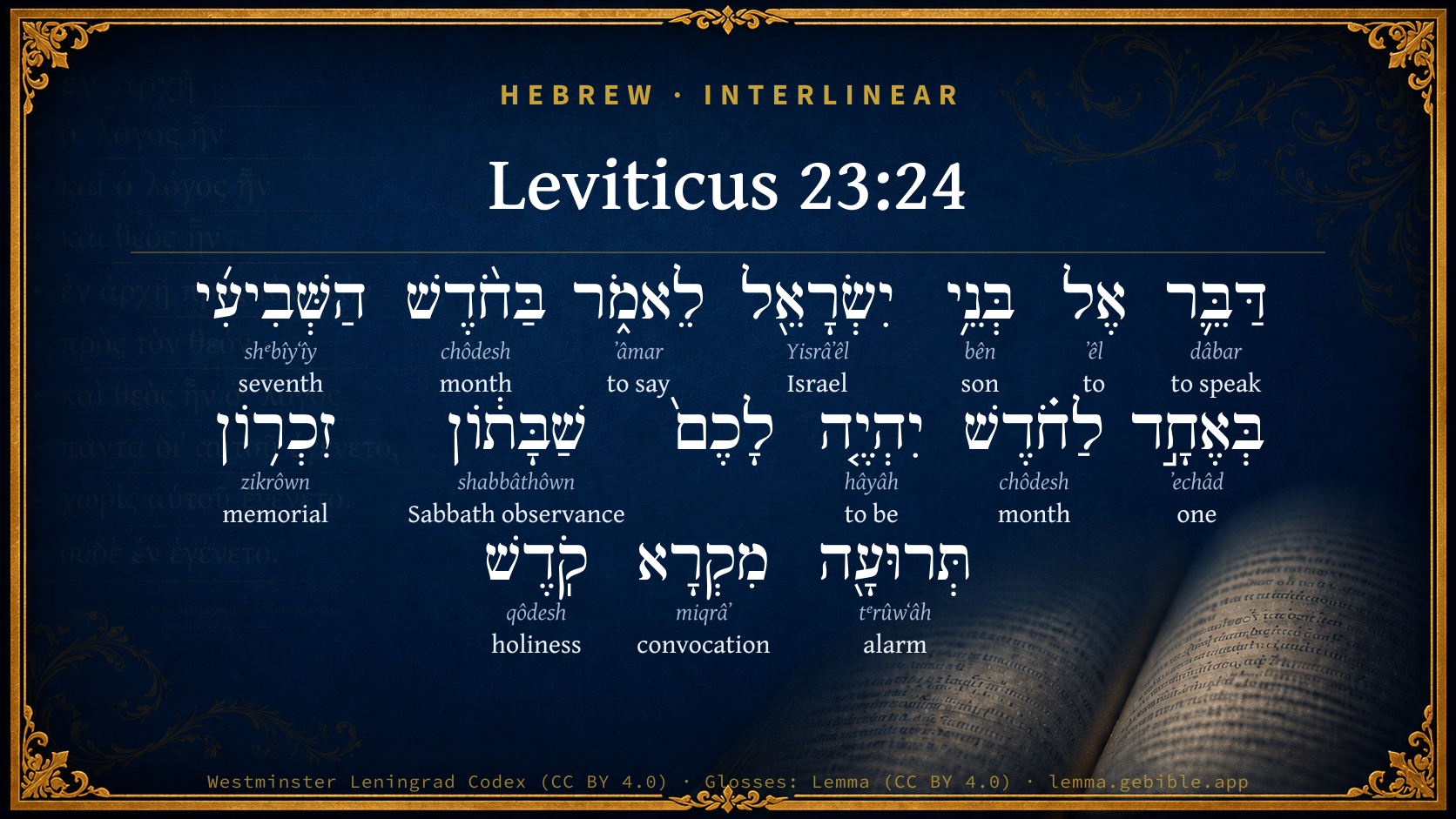
Hebrew (Westminster Leningrad Codex) Leviticus 23:24 appears in the Hebrew Old Testament. The text above is from the Westminster Leningrad Codex. Each word links to its Strong’s number, a concise gloss, and parsing drawn from the Open Scriptures Hebrew Bible morphology. Click any word for its full Brown-Driver-Briggs (BDB) entry.
Download image
Cite this verse

Leviticus 23:24 (World English Bible). Public Domain. Lemma interlinear Bible study tool, https://lemma.gebible.app/v/leviticus/23/24.

Show BibTeX & RIS
BibTeX
RIS
English Translation
"Speak to the children of Israel, saying, 'In the seventh month, on the first day of the month, shall be a solemn rest to you, a memorial of blowing of trumpets, a holy convocation.
World English Bible · Public Domain
Highlights
  • 1 first appearance in the Hebrew Bible
Full analysis ↓
Download a study sheet

One document with this verse’s original text, its word-by-word gloss line, the meaning frame, cross-references with their text, attributed commentary, and full source and license credits — printable, and it pastes into notes with its structure intact.

This verse Autodidact and up

Study sheet (.html) Plain text (.txt)

A passage Seminary Student

Up to 50 verses in one chapter. A passage sheet keeps up to 6 commentary sources and 12 cross-references per verse, in the order this page ranks them, and says so on the sheet whenever that leaves anything out. Ask for a single verse and you get the Autodidact verse sheet above.

Everything on this page stays free to read, with no account — the sheet is a download of what is already on screen, not access to it.

Want to remove ads? Support Godless Engineer
Compare translations 3

The same verse in 3 English versions, stacked beneath the original-language interlinear above. Click any original word for its lexicon entry.

Each is an independent rendering of the whole verse — the interlinear is not word-aligned to these translations.

Highlighted words mark where these versions differ — a whole-verse word diff, not a word-by-word alignment.

  • World English Bible Public Domain
    "Speak to the children of Israel, saying, 'In the seventh month, on the first day of the month, shall be a solemn rest to you, a memorial of blowing of trumpets, a holy convocation.
  • King James Version Public Domain
    Speak unto the children of Israel, saying, In the seventh month, in the first day of the month, shall ye have a sabbath, a memorial of blowing of trumpets, an holy convocation.
  • unfoldingWord Literal Text CC BY-SA 4.0
    “Speak to the sons of Israel, saying, ‘In the seventh month, on one of the month, there shall be for you a rest, a memorial of a loud blast, an assembly of holiness.

unfoldingWord Literal Text — © unfoldingWord, licensed CC BY-SA 4.0. Word-aligned USFM3 via Door43 (git.door43.org/unfoldingWord/en_ult).

Versions to compare (up to 4)

3 of 4 selected

Show all 18 translations

Every available English version of this verse, each an independent rendering of the whole verse.

  • World English Bible Public Domain
    "Speak to the children of Israel, saying, 'In the seventh month, on the first day of the month, shall be a solemn rest to you, a memorial of blowing of trumpets, a holy convocation.
  • Berean Standard Bible Public Domain
    “Speak to the Israelites and say, ‘On the first day of the seventh month you are to have a day of rest, a sacred assembly announced by trumpet blasts.
  • Majority Standard Bible Public Domain
    “Speak to the Israelites and say, ‘On the first day of the seventh month you are to have a day of rest, a sacred assembly announced by trumpet blasts.
  • King James Version Public Domain
    Speak unto the children of Israel, saying, In the seventh month, in the first day of the month, shall ye have a sabbath, a memorial of blowing of trumpets, an holy convocation.
  • American Standard Version (1901) Public Domain
    Speak unto the children of Israel, saying, In the seventh month, on the first day of the month, shall be a solemn rest unto you, a memorial of blowing of trumpets, a holy convocation.
  • Revised Version (1885) Public Domain
    Speak unto the children of Israel, saying, In the seventh month, in the first day of the month, shall be a solemn rest unto you, a memorial of blowing of trumpets, an holy convocation.
  • Geneva Bible (1599) Public Domain
    Speake vnto the children of Israel, and say, In the seuenth moneth, and in the first day of the moneth shall ye haue a Sabbath, for the remembrance of blowing the trumpets, an holy conuocation.
  • Douay-Rheims (1899) Public Domain
    Say to the children of Israel: The seventh month, on the first day of the month, you shall keep a sabbath, a memorial, with she sound of trumpets, and it shall be called holy.
  • Young's Literal Translation Public Domain
    `Speak unto the sons of Israel, saying, In the seventh month, on the first of the month, ye have a sabbath, a memorial of shouting, a holy convocation;
  • Literal Standard Version CC BY-SA 4.0
    “Speak to the sons of Israel, saying, In the seventh month, on the first of the month, you have a Sabbath, a memorial of shouting, a holy convocation;
  • Unlocked Literal Bible CC BY-SA 4.0
    “Speak to the people of Israel and say, 'In the seventh month, the first day of that month will be a solemn rest for you, a memorial with the blowing of trumpets, and a holy assembly.
  • unfoldingWord Literal Text CC BY-SA 4.0
    “Speak to the sons of Israel, saying, ‘In the seventh month, on one of the month, there shall be for you a rest, a memorial of a loud blast, an assembly of holiness.
  • Darby Bible Public Domain
    Speak unto the children of Israel, saying, In the seventh month, on the first of the month, shall ye have a rest, a memorial of blowing of trumpets, a holy convocation.
  • World Messianic Bible Public Domain
    “Speak to the children of Israel, saying, ‘In the seventh month, on the first day of the month, there shall be a solemn rest for you, a memorial of blowing of shofars, a holy convocation.
  • Webster's Bible Public Domain
    Speak to the children of Israel, saying, In the seventh month, in the first day of the month, shall ye have a sabbath, a memorial of blowing of trumpets, a holy convocation.
  • Free Bible Version CC BY-SA 4.0
    “Tell the Israelites that on the first day of the seventh month you are to have a special Sabbath of complete rest, a holy meeting that is announced by the sound of trumpets.
  • Bible in Basic English Public Domain
    Say to the children of Israel, In the seventh month, on the first day of the month, let there be a special day of rest for you, a day of memory, marked by the blowing of horns, a meeting for worship.
  • JPS Tanakh (1917) Public Domain
    Speak unto the children of Israel, saying: In the seventh month, in the first day of the month, shall be a solemn rest unto you, a memorial proclaimed with the blast of horns, a holy convocation.

Literal Standard Version (2020), Covenant Press — licensed CC BY-SA 4.0. Text via the HelloAO Bible API (eBible.org). Unlocked Literal Bible (unfoldingWord) — licensed CC BY-SA 4.0. Text via the HelloAO Bible API (eBible.org). unfoldingWord Literal Text — © unfoldingWord, licensed CC BY-SA 4.0. Word-aligned USFM3 via Door43 (git.door43.org/unfoldingWord/en_ult). Free Bible Version, Dr. Jonathan Gallagher — licensed CC BY-SA 4.0. Text via the HelloAO Bible API (eBible.org).

Word by word

More ways to search: Search by grammar → Find every occurrence → Compare this word →

Practice this passage: Drill this verse → Learn its vocabulary →

שַׁבָּת֔וֹן
shabbâthôwn
H7677
“Sabbath observance”
Noun, Common, Masculine, Singular, Absolute
Part of Speech
Noun
Type
Common
Gender
Masculine
Number
Singular
State
Absolute
Full BDB Definition

Origin: from H7676

TWOT: 2323d

Sabbath observance, sabbatism - of weekly sabbath - day of atonement - sabbatical year - of Feast of Trumpets - of the 1st and last days of the Feast of Tabernacles
  1. דַּבֵּ֛ר dâbar H1696 “speak” Verb, Piel, Imperative, 2nd Person, Masculine, Singular
  2. אֶל ʼêl H413 “to” Preposition
  3. בְּנֵ֥י bên H1121 “sons of” Noun, Common, Masculine, Plural, Construct
  4. יִשְׂרָאֵ֖ל Yisrâʼêl H3478 “Israel” Noun, Proper
  5. לֵאמֹ֑ר ʼâmar H559 “to say” Preposition + Verb, Qal, Infinitive Construct
  6. בַּחֹ֨דֶשׁ chôdesh H2320 “in/at the · month” Preposition, Determined + Noun, Common, Masculine, Singular, Absolute
  7. הַשְּׁבִיעִ֜י shᵉbîyʻîy H7637 “the · seventh” Particle, Definite Article + Adjective, Ordinal number, Masculine, Singular, Absolute
  8. בְּאֶחָ֣ד ʼechâd H259 “in/at · one” Preposition + Adjective, Cardinal number, Masculine, Singular, Absolute
  9. לַחֹ֗דֶשׁ chôdesh H2320 “to/for the · month” Preposition, Determined + Noun, Common, Masculine, Singular, Absolute
  10. יִהְיֶ֤ה hâyâh H1961 “to be” Verb, Qal, Imperfect, 3rd Person, Masculine, Singular
  11. זִכְר֥וֹן zikrôwn H2146 “memorial of” Noun, Common, Masculine, Singular, Construct
  12. תְּרוּעָ֖ה tᵉrûwʻâh H8643 “alarm” Noun, Common, Feminine, Singular, Absolute
  13. מִקְרָא miqrâʼ H4744 “convocation of” Noun, Common, Masculine, Singular, Construct
  14. קֹֽדֶשׁ qôdesh H6944 “holiness” Noun, Common, Masculine, Singular, Absolute

About this verse

These counts appear in no published source. They are computed here, from the morphology-tagged text and Lemma’s own curated glosses. What Lemma adds →

16
words
14
distinct lemmas
Pentateuch
section

Notable vocabulary

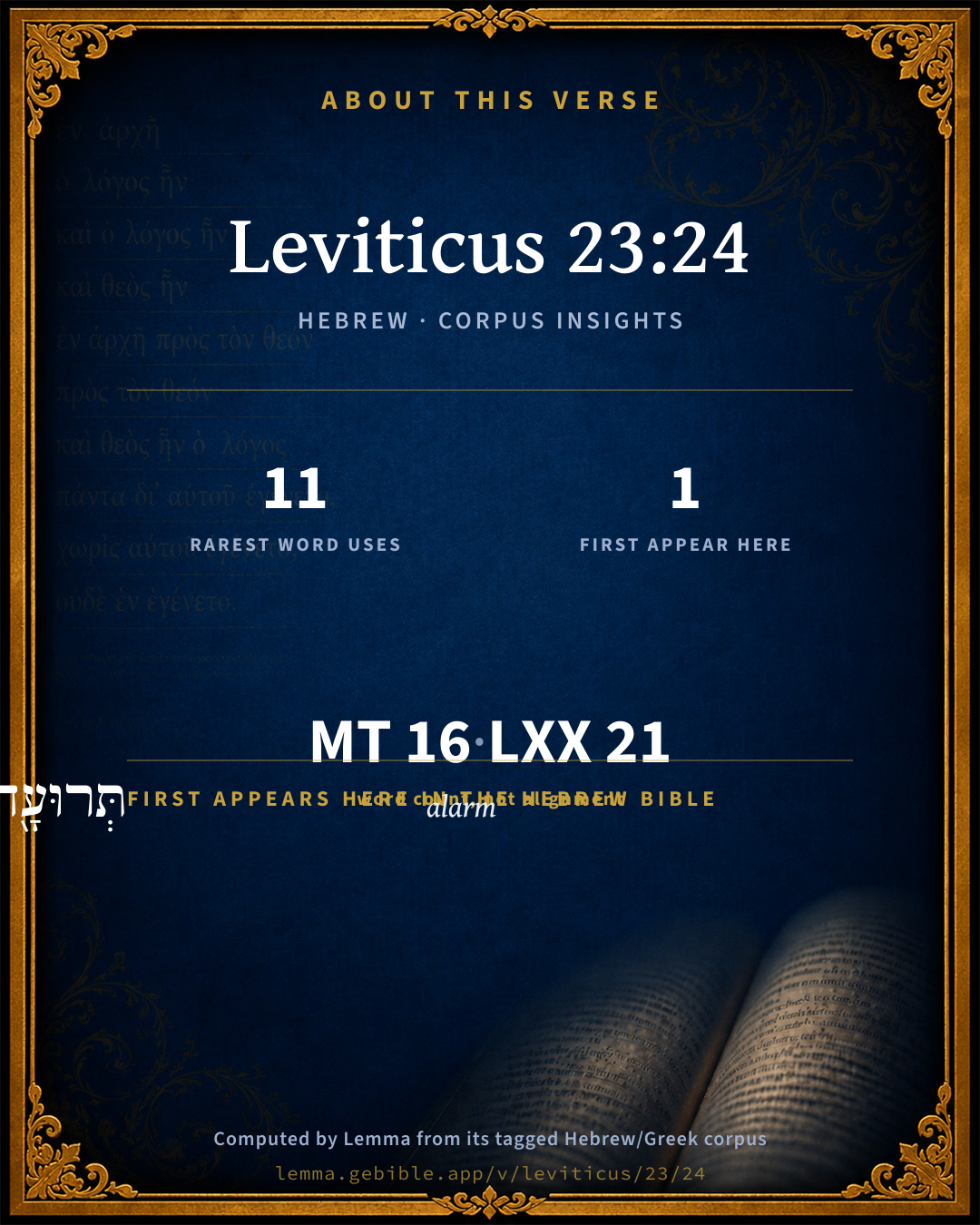
The rarest word here is שַׁבָּת֔וֹן Sabbath observance H7677 — appearing just 11 times in the whole Hebrew Bible.

First appearance in Scripture

This word makes its first canonical appearance in the Hebrew Bible here:

  • תְּרוּעָ֖ה alarm H8643

Shared distinctive vocabulary

שַׁבָּת֔וֹן Sabbath observance H7677 occurs in 10 verses of the Hebrew Bible. Also found in:

Grammatical profile

  • 3 verbs
  • 9 nouns
  • 2 adjectives
  • 2 prepositions

Verb forms

  • דַּבֵּ֛ר Piel · Imperative
  • לֵאמֹ֑ר Qal · Infinitive Construct
  • יִהְיֶ֤ה Qal · Imperfect

Repetition

A word recurs within this verse — often emphatic in Hebrew:

  • בַּחֹ֨דֶשׁ month H2320 ×2

Hebrew & Septuagint length

In English translation the verse runs 34 words from the Hebrew and 35 from the Septuagint (LXX English) — closely comparable.

A rough comparison of the two English renderings, which tokenize alike — not a word-level alignment.

Word counts can differ between the Hebrew and the Greek without any difference in meaning — e.g. the Hebrew direct-object marker אֵת has no separate Greek word, and Greek often adds the article ὁ.

In the original languages it is 16 Hebrew tokens and 21 Greek tokens — but the two are counted differently (Hebrew bundles its prefixes and suffixes into one token; the Greek is in lemma form), so that isn’t a like-for-like length.

Cross-references

11

Topical passages linked to Leviticus 23:24 in the Treasury of Scripture Knowledge — connected by theme and wording, ordered by reader-vote popularity; previews shown in the World English Bible.

  • 1 Corinthians 15:52 in a moment, in the twinkling of an eye, at the last trumpet. For the trumpet will sound, and the dead will be raised incorruptible, and we will be changed.
  • 1 Thessalonians 4:16 For the Lord himself will descend from heaven with a shout, with the voice of the archangel, and with God's trumpet. The dead in Christ will rise first,
  • Leviticus 25:9 Then you shall sound the loud trumpet on the tenth day of the seventh month. On the Day of Atonement you shall sound the trumpet throughout all your land.
  • Numbers 29:1–6 In the seventh month, on the first day of the month, you shall have a holy convocation; you shall do no servile work: it is a day of blowing of trumpets to you.
  • Numbers 10:9–10 When you go to war in your land against the adversary who oppresses you, then you shall sound an alarm with the trumpets; and you shall be remembered before Yahweh your God, and you shall be saved from your enemies.
  • Psalms 98:6 With trumpets and sound of the ram's horn, Make a joyful noise before the King, Yahweh.
  • 2 Chronicles 5:13 it happened, when the trumpeters and singers were as one, to make one sound to be heard in praising and thanking Yahweh; and when they lifted up their voice with the trumpets and cymbals and instruments of music, and praised Yahweh, [saying], For he is good; for his loving kindness endures forever; that then the house was filled with a cloud, even the house of Yahweh,
  • Psalms 81:1–4 Sing aloud to God, our strength! Make a joyful shout to the God of Jacob!
  • Ezra 3:6 From the first day of the seventh month began they to offer burnt offerings to Yahweh: but the foundation of the temple of Yahweh was not yet laid.
  • Isaiah 27:13 It shall happen in that day, that a great trumpet shall be blown; and they shall come who were ready to perish in the land of Assyria, and those who were outcasts in the land of Egypt; and they shall worship Yahweh in the holy mountain at Jerusalem.
  • 1 Chronicles 15:28 Thus all Israel brought up the ark of the covenant of Yahweh with shouting, and with sound of the cornet, and with trumpets, and with cymbals, sounding aloud with psalteries and harps.

Cross-references courtesy of OpenBible.info (CC BY 4.0).

Hebrew and Greek witnesses Masoretic Hebrew ↔ Greek Septuagint

The same verse in the two great witnesses to the Old Testament, shown verse-for-verse.

These are two independent witnesses, not word-aligned to each other, and the Septuagint is shown in lemma (dictionary) form.

Hebrew Leviticus 23:24 Masoretic · Westminster Leningrad Codex

דַּבֵּ֛ר אֶל בְּנֵ֥י יִשְׂרָאֵ֖ל לֵאמֹ֑ר בַּחֹ֨דֶשׁ הַשְּׁבִיעִ֜י בְּאֶחָ֣ד לַחֹ֗דֶשׁ יִהְיֶ֤ה לָכֶם֙ שַׁבָּת֔וֹן זִכְר֥וֹן תְּרוּעָ֖ה מִקְרָא קֹֽדֶשׁ

"Speak to the children of Israel, saying, 'In the seventh month, on the first day of the month, shall be a solemn rest to you, a memorial of blowing of trumpets, a holy convocation.

World English Bible · Public Domain

Greek LXX Leviticus 23:24 Septuagint · lemma form

λαλέω ὁ υἱός ἰσραήλ λέγω ὁ μήν ὁ ἕβδομος εἷς ὁ μήν εἰμί σύ ἀνάπαυσις μνημόσυνον σάλπιγξ κλητός ἅγιος εἰμί σύ

Speak to the children of Israel, saying, In the seventh month, on the first day of the month, you⌃ shall have a rest, a memorial of trumpets: it shall be to you a holy convocation.

LXX2012 (modern English Septuagint) · Public Domain

Hebrew: Westminster Leningrad Codex (CC BY 4.0). Greek: Septuagint (public domain); English from LXX2012 (modern English Septuagint) (Public Domain). How the Septuagint differs from the Hebrew →

Targum (Aramaic paraphrase)

2

The Targum is the ancient Jewish Aramaic paraphrase of the Hebrew Scriptures — an interpretive translation, not the Hebrew text itself. Onkelos (literal) and Pseudo-Jonathan (expansive) render the Torah, and Jonathan the Prophets. Coverage is partial: where no permissively-licensed English translation exists for a verse, only the Aramaic is shown. This is verse-level text, not a word-by-word alignment to the Hebrew.

  1. Targum Onkelos Torah (Genesis–Deuteronomy)
    מַלֵיל עִם בְּנֵי יִשְׂרָאֵל לְמֵימָר בְּיַרְחָא שְׁבִיעָאָה בְּחַד לְיַרְחָא יְהֵי לְכוֹן נְיָחָא דוּכְרָן יַבָּבָא מְעָרַע קַדִישׁ

    (no public-domain English translation for this verse)

    Targum Onkelos — Aramaic: “Onkelos Genesis” (public domain); “Onkelos Exodus” (public domain); “Onkelos Leviticus” (public domain); “Onkelos Numbers” (public domain); “Onkelos Deuteronomy” (public domain). English: “Sefaria Community Translation” (CC0 1.0 (public-domain dedication)); “J.W. Etheridge. The Targums of Onkelos and Jonathan Ben Uzziel on the Pentateuch. London: Longmans, Green, 1862” (public domain). Text via Sefaria.

  2. Targum Pseudo-Jonathan Torah (Genesis–Deuteronomy)
    מַלֵיל עִם בְּנֵי יִשְרָאֵל לְמֵימָר בְּתִשְׁרֵי דְהוּא יַרְחָא שְׁבִיעָאָה יְהֵי לְכוֹן יוֹמָא טָבָא דוּכְרַן יַבָּבָא מְאָרַע קַדִישׁ

    Speak with the children of Israel, saying: In Tishri, which is the seven month, shall be to you a festival of seven days, a memorial of trumpets, a holy convocation.

    Targum Pseudo-Jonathan — Aramaic: “Targum Jonathan on Genesis” (public domain); “Targum Jonathan on Exodus” (public domain); “Targum Jonathan on Leviticus” (public domain); “Targum Jonathan on Numbers” (public domain); “Targum Jonathan on Deuteronomy” (public domain). English: “The Targum of Jonathan ben Uzziel, trans. J. W. Etheridge, London, 1862” (public domain). Text via Sefaria.

Commentary

Notes on Leviticus 23:24 from classic Christian and Jewish commentators (each source and its license shown beneath its notes). The classic Christian expositions comment on the surrounding passage and are grouped to its opening verse, so a note may address several verses; the Jewish commentaries on the Tanakh (Rashi and others) are per-verse, so they appear only where the commentator wrote on this verse.

Lemma curates 59 commentaries, every one of them public domain or Creative Commons licensed, each selected and text-cleaned for this edition rather than reprinted as found. About our sources →

Trapp's Complete Commentary

John Trapp

Lev 23:24 Speak unto the children of Israel, saying, In the seventh month, in the first [day] of the month, shall ye have a sabbath, a memorial of blowing of trumpets, an holy convocation.

Ver. 24. Of blowing of trumpets.] This feast signified the spiritual joy and gladness of the saints that are redeemed by Christ, all their life long. {Isa 23:10}

John Trapp, A Commentary or Exposition upon All the Books of the Old and New Testament (1647–1656) — public domain. Text from a community e-Sword module.

Joseph Benson's Commentary

Lev 23:24. A sabbath — Solemnized with the blowing of trumpets by the priests, not in a common way, as they did every first day of every month, but in an extraordinary manner, not only in Jerusalem, but in all the cities of Israel. They began to blow at sunrise, and continued blowing till sunset. This seems to have been instituted, 1st, To solemnize the beginning of the new year, whereof, as to civil matters, and particularly as to the jubilee, this was the first day; concerning which it was fit the people should be admonished, both to excite their thankfulness for God’s blessings in the last year, and to direct them in the management of their civil affairs. 2d, To put a special honour upon this month. For, as the seventh day was the sabbath, and the seventh year was a sabbatical year, so God would have the seventh month to be a kind of sabbatical month, on account of the many sabbaths and solemn feasts which were observed in this, more than in any other month. And by this sounding of the trumpets in its beginning, God would quicken and prepare them for the following sabbaths, as well that of atonement, and humiliation for their sins, as those of thanksgiving for God’s mercies.

Joseph Benson's Commentary on the Old and New Testaments (1811–1818) — public domain. Text from a community e-Sword module.

Tyndale Open Study Notes

Tyndale Open Resources

23:24 On the first day of the appointed month in early autumn: The Israelite calendar was divided into two half-years. The first half-year began with the first month, Nisan (Babylonian name) or Abib (the more ancient agricultural name). The second half-year began with the seventh month (Tishri in the modern Jewish calendar). The celebration of this holiday marked the beginning of the second half-year.

Tyndale Open Study Notes — © Tyndale Open Resources, licensed CC BY-SA 4.0. Text via the HelloAO Bible API.

Geneva Bible (1599)

Geneva Bible translators

Or, an holy day to the Lord.

That is, about the end of September.

Which blowing was to put them in remembrance of the manifold feasts that were in that month, and of the Jubilee.

Geneva Bible (1599) marginal notes — public domain. Text via Bolls.life.

Jamieson, Fausset & Brown

Robert Jamieson, A. R. Fausset & David Brown

FEAST OF TRUMPETS. (Lev 23:23-25)

In the seventh month, in the first day of the month, shall ye have a sabbath--That was the first day of the ancient civil year.

a memorial of blowing of trumpets--Jewish writers say that the trumpets were sounded thirty successive times, and the reason for the institution was for the double purpose of announcing the commencement of the new year, which was (Lev 23:25) to be religiously observed (see Num 29:3), and of preparing the people for the approaching solemn feast.

Jamieson, Fausset & Brown — Commentary Critical and Explanatory on the Whole Bible (1871) — public domain (CC PDM 1.0). Text via the HelloAO Bible API.

Adam Clarke's Commentary

Verse 24. A memorial of blowing of trumpets] This is generally called the feast of trumpets; and as it took place on the first day of the seventh month, Tisri, which answers to September, which month was the commencement of what was called the civil year, the feast probably had no other design than to celebrate the commencement of that year, if indeed such a distinction obtained among the ancient Jews. See Clarke on Ex 12:2. Some think creation began at this time.

Adam Clarke's Commentary on the Bible (1810–1826) — public domain. Text from a community e-Sword/MySword module.

Ellicott's Commentary for English Readers

(24) A memorial of blowing of trumpets.—Literally, remembrance blowing, for which see Num_29:1, the only place in the Old Testament where this festival is named as “the day of blessing,” i.e., the trumpets. As the first of Ethanim, as the month is called in the Bible (1Ki_8:2), or Tishri, as the Jews call it, in which this festival occurs, is the commencement of the civil new year, this festival was called “the Festival of New Year” ever since the time of the second Temple, and has been regarded as preparatory to the great day of Atonement, which is ten days later. The blowing of trumpets, therefore, which was the distinguishing feature of this festival, was designed to summon the Israelites to enter upon the work of sanctification, which will be accounted to them as a merit in the sight of God, and for which they are promised to be especially remembered before the Lord (Num_10:9-10). Hence its name, Remembrance blowing—the blowing of trumpets, which will make them to be remembered before the Lord. The synagogue, however, takes the name more in the sense of “reminding” God of the merits of the patriarchs and his covenant with them, and for this reason has appointed Gen_21:1-34; Gen_22:1-24, recording the birth and sacrifice of Isaac, as the lesson for this festival.

A Bible Commentary for English Readers, edited by Charles John Ellicott (1878–1897) — public domain. Text from a community e-Sword module.

The Cambridge Bible for Schools and Colleges

gen. ed. J. J. S. Perowne

24. blowing of trumpets] See on Lev_23:2-3.

The Cambridge Bible for Schools and Colleges (gen. ed. J. J. S. Perowne; Cambridge University Press, 1878–1918) — public domain. Text from a community e-Sword module.

John Gill's Exposition

Speak unto the children of Israel,.... For all the people of Israel were concerned in the following precept, and obliged to observe it, even priests, Levites, Israelites, proselytes, and freed servants; though other servants, and women, and children, were not obliged to hear the sound of the trumpets (b), and which were blown not in Jerusalem only, but in all cities and towns where the sanhedrim was (c); and it was the hearing of them the people were bound unto, and not less than nine distinct soundings were they obliged to hear (d); to which perhaps respect is had in Psa 89:15,

in the seventh month; the month Tisri, as the Targum of Jonathan, which was the seventh from the month Nisan or Abib; which was appointed the first month of the year, on account of the Israelites coming out of Egypt in it; otherwise, before, this month Tisri was the first, and so it still continued, for the fixing the years, and settling the sabbatical and jubilee years, and for the planting of trees and herbs (e):

in the first day of the month shall ye have a sabbath; not entirely as the weekly sabbath, in which no manner of work at all was to be done, but in which no servile work was to be done; and was observed in like manner as the first and seventh days of unleavened bread, and the day of pentecost, Lev 23:7,

a memorial of blowing of trumpets; which, according to the Jewish writers, was continued from sun rising to sun setting (f); but what this blowing of trumpets was a memorial of is not easy to say; some think it was in memory of the wars the people of Israel had with their enemies the Amalekites and Canaanites, and the victories they obtained over them, and particularly in remembrance of the walls of Jericho falling down at the sound of rams' horns; but then it must be by anticipation: it is more commonly received with the Jews (g) that it was on the account of the binding of Isaac on this day, being delivered through a ram being sacrificed in his stead; and on this account it is said, that the trumpets blown on this day were made of rams horns, and no other might be used (h); yea, that ram's head was used to be eaten on this day, in remembrance of the ram of Isaac, and also to intimate that the Jews would be the head and not the tail (i): the Jews also say, that this day, every year, was a sort of day of judgment, in which God sat and judged men, and also determined all events of the following year (k); and this was attended with blowing of trumpets, to strike a terror into them, and put them in mind of the judgment of God, and to induce them to repent of their sins (l): and it may be observed, that the resurrection of the dead, in order to the last general judgment, will be attended with the voice of the archangel and the trumpet of God, Co1 15:52; whether this is so represented in reference to this notion, let it be considered: but as this was New Year's Day, as before observed, this ceremony seems to have been appointed to express joy for all the mercies and blessings of the last year; and the rather, at this time of the year all the fruits of the earth were gathered in, not only the barley and the wheat, but the oil and wine, and under such grateful acknowledgment, to expect the divine blessing to attend them the following year; and besides, at this time of the year, it was generally thought by the Jews (m), and by others, that the world was created, and this blowing of trumpets might be in memory of that, and as an emblem of the shoutings of the sons of God, the angels, the morning stars, who sang for joy when the foundations of the earth were laid, Job 38:6; to which it may be added, this seventh month was very memorable for holy solemnities, as the day of atonement on the tenth, and the feast of tabernacles, which began on the fifteenth, and therefore was ushered in with blowing of trumpets to make it the more significant, and particularly to put the people in mind to prepare for the day of atonement near at hand; and so Gersom observes, that as the sound of a trumpet strikes men with fear, the design of this precept was, to fill the mind with fear, and to excite to repentance and brokenness of heart, and humiliation for sin, and to search their works and actions, and correct what was amiss, and so be ready for the day of atonement: hence Ainsworth thinks, that this was a figure of the ministry of John the Baptist preaching the baptism of repentance for the remission of sins; but rather it seems to be an emblem of the Gospel, and the ministry of it, in the acceptable year of the Lord, or the Gospel dispensation, which is sometimes signified by the blowing of the great trumpet, and by the ministers of it lifting up their voice like a trumpet, Isa 27:13; by which sinners are roused and awakened to a sense of their sin and danger, and to hear a joyful sound of love, grace, mercy, peace, pardon, righteousness, and salvation through Christ: the Jews say (n), this blowing of trumpets was to disturb Satan, when he came to accuse the Israelites; it is certain there is nothing gives him more disturbance than the pure and powerful preaching of the Gospel, which he endeavours to obstruct as much as possible, and there is nothing like what that brings to silence his accusations, see Co2 4:3,

an holy convocation; on which the people were called together to holy exercises; and so the Jews observe it to this day; for after they return home from attendance to the blowing of the trumpets in their synagogues, they sit down to meat, and spend the rest of the day in hearing sermons, and in other religious exercises (o).

(b) Maimon. Hilchot Shophar ve Succah, c. 2. sect. 1. (c) Ibid. sect. 8. (d) Ib. ch. 3. sect. 1. Schulchan Aruch, par. 1. No. 590. sect. 1. (e) Misn. Roshhashanah, c. 1. sect. 1. (f) Schulchan Aruch, par. 1. c. 588. sect. 1. Lebush, par. 2. c. 588. sect. 1. (g) R. Alphes, par. 1. fol. 346. 2. & Jarchi in loc. (h) Maimon. ut supra, (b)) c. 1. sect. 1. Schulchan Aruch, ib. c. 526. sect. 1. (i) Schulchan Aruch, ib. c. 583. sect. 2. Lebush, ib. 583. sect. 2. (k) Misn. Roshhashanah, c. 1. sect. 2. T. Bab. Roshhashanah, fol. 16. 2. (l) Leo Modena's History of Rites of the present Jews, par. 3. c. 5. sect. 7. (m) T. Bab. Roshhashanah, fol. 10. 2. (n) Targum Jon. in Numb. xxix. 1. R. Alphes, par. 1, fol. 346. 2. T. Bab. Roshhashanah, fol. 16. 2. (o) Leo Modena, ut supra. (l))

John Gill's Exposition of the Whole Bible (1746–1763) — public domain (CC PDM 1.0). Text via the HelloAO Bible API.

Albert Barnes' Notes on the Bible

A sabbath - Here and in Lev 23:39 a word which should rather be rendered a sabbatical rest.

Blowing of trumpets - Here and in Num 29:1, literally “shouting”. There is no mention of trumpets in the Hebrew text of the Law in connection with the day. However, there is no reason to doubt the tradition that the day was distinguished by a general blowing of trumpets throughout the land, and that the kind of trumpet generally used for the purpose was the curved horn of an animal or a cornet of metal, such as was used at Sinai Exo 19:16, and on the Day of Jubilee Lev 25:9. It must have differed in this respect from the ordinary festival of the New moon when the long straight trumpet of the temple alone was blown (Num 10:2; Exo 25:23; see cut).

Seventh month - Called by the Jews in later times it was called Tisri, but in the Old Testament Ethanim, 1Ki 8:2. According to the uniform voice of tradition “the first day” of this month was the first day of the Civil year in use before the Exodus, and was observed as the festival of the New year. Some have viewed it as a commemoration of the Creation of the world Job 38:7 : others, as the anniversary of the giving of the Law.

Albert Barnes' Notes on the Bible (1834–1885) — public domain. Text from a community e-Sword/MySword module.

Haydock's Catholic Bible Commentary

Memorial, or a memorable sabbath. This third great festival sanctified the commencement of the civil year in Tisri, the sabbatical month, according to the ecclesiastical calculation. (Tirinus) See Numbers xxix. 3. --- The sound of trumpets, which ushered in the year with great solemnity, reminded the Jews of the approaching fast, ver. 27, (Maimonides) and of those terrible sounds which had been heard at Sinai. (Theodoret, q. 32.) The Rabbins say that a ram’s horn was used, because Abraham had sacrificed a ram instead of his son. (Genesis xxii. 11.; Zacharias ix. 14.) The Jews on this day sound the horn 30 times, feast, and wish one another a happy year. (Boxtorf., xyn. xix.) We know not on what account this festival was instituted. But it was probably ordained in order that the people might learn to thank God for the favours received during the past year, and might beg his blessing on that, upon which they were now entering. (Calmet)

George Leo Haydock (1774–1849), Haydock's Catholic Family Bible and Commentary, 1859 edition — public domain. Excludes Psalms (Douay-Rheims chapter numbering differs from Protestant) and Deuterocanonical books (Catholic canon only).

Matthew Poole's English Annotations

A memorial of blowing of trumpets, i.e. solemnized with the blowing of trumpets by the priests; not in a common way, as they did every first day of every month, Num 10:10, but in an extraordinary manner, not only in Jerusalem, but in all the cities of Israel. This seems to have been instituted,

1. To solemnize the beginning of the new year, whereof as to civil matters, and particularly as to the jubilee, this was the first day; concerning which it was fit the people should be admonished, both to excite their thankfulness for God’s blessing in the last year, and to direct them in the management of their civil affairs.

2. To put a special honour upon this month. For as the seventh day was the sabbath, and the seventh year was a sabbatical year; so God would have the seventh month to be a kind of sabbatical month, for the many sabbaths and solemn feasts which were observed in this more than in any other month. And by this sounding of the trumpets in its beginning, God would quicken and prepare them for the following sabbaths, as well that of atonement and humiliation for their sins, as those of thanksgiving for God’s mercies.

Matthew Poole's English Annotations on the Holy Bible (1683–1685) — public domain. Text from a community e-Sword/MySword module.

Whedon's Commentary on the Bible

Daniel D. Whedon

THE FEAST OF TRUMPETS, Lev_23:23-25.

24. Seventh month — The beginning of this month must be signalized in order to accord with that symbolism of number which distinguishes the seventh day and the seventh year. Hence we have a sabbatical month as well as a sabbatical year. The seventh month closed the cycle of the annual festivals. It also contained the most important day of the year — the day of atonement — in which all the sins and uncleanness of the people were typically wiped away in the access of the high priest to the mercyseat with the blood of atonement. This month also contained the feast of tabernacles, which commenced five days afterwards, affording an antepast of the blessedness of communion with Christ and his saints.

The first day… a sabbath — This was a day of rest, a holy convocation, as also was the tenth. Neither was necessarily a decalogue sabbath, and one of them could not be, since they were ten days apart.

A memorial of blowing of trumpets — Literally, a memorial of shouts of joy. According to Num_10:10, the straight trumpet was to be sounded in the day of gladness; but tradition says that the shophar, cornet, or crooked trumpet, was also used. See wood-cut Jos_6:4. The latter produced a dull, far-reaching tone. There are various opinions respecting the significance of this trumpet-blast — as that it was designed to be an alarm-signal to call the people to prepare for the coming day of atonement, as we have intimation in Joe_2:15; or to emphasize the coming in of the sabbatical month; or to commemorate the giving of the law; or to re-echo the shout of the sons of God over the newborn world; or, as is the common opinion of Jews and Christians, to hail the beginning of the civil year, the feast of Tisri. In the year of jubilee it was the prelude to that glad sound which, on the day of atonement of the fiftieth year, announced the advent of “that great year of grace under the old covenant.” The rabbies fancied that on this new year’s day all men passed before God in judgment, as a flock of sheep pass, one by one, before their shepherd.

Daniel D. Whedon (gen. ed.), Commentary on the Old and New Testaments (1874–1909) — public domain. Text from a community e-Sword module.

John Wesley's Explanatory Notes

A sabbath - Solemnized with the blowing of trumpets by the priests, not in a common way, as they did every first day of every month, but in an extraordinary manner, not only in Jerusalem, but in all the cities of Israel. They began to blow at sun-rise, and continued blowing till sun-set. This seems to have been instituted,

1. To solemnize the beginning of the new year, whereof as to civil matters and particularly as to the Jubilee, this was the first day; concerning which it was fit the people should be admonished, both to excite their thankfulness for God's blessings in the last year, and to direct them in the management of their civil affairs.

2. To put a special honour upon this month. For as the seventh day was the sabbath, and the seventh year was a sabbatical year, so God would have the seventh month to be a kind of sabbatical month, for the many sabbaths and solemn feasts which were observed in this more than in any other month. And by this sounding of the trumpets in its beginning, God would quicken and prepare them for the following sabbaths, as well as that of atonement and humiliation for their sins, as those of thanksgiving for God's mercies.

John Wesley, Explanatory Notes Upon the Whole Bible (1754–1765) — public domain. Text via the GEBible commentary corpus.

Scofield Reference Notes

C. I. Scofield

trumpets

The feast of Trumpets, Lev 23:23-25. This feast is a prophetical type and refers to the future regathering of long-dispersed Israel. A long interval elapses between Pentecost and Trumpets, answering to the long period occupied in the pentecostal work of the Holy Spirit in the present dispensation. Study carefully; Isa 18:3; Isa 27:13 (with contexts); Isa 58:1-14 (entire chapter), and; Joe 2:1 to Joe 3:21; in connection with the "trumpets," and it will be seen that these trumpets, always symbols of testimony, are connected with the regathering and repentance of Israel after the church, or pentecostal period is ended. This feast is immediately followed by the day of atonement.

seventh month

i.e. October; also Lev 23:27; Lev 23:34; Lev 23:39; Lev 23:41.

The Scofield Reference Bible (1917 edition), notes by C. I. Scofield — public domain. Text from a community e-Sword module.

Rashi

Rabbi Shlomo Yitzchaki (Rashi)

זכרון תרועה [THERE SHALL BE UNTO YOU] A זכרון OF SOUNDING THE CORNET — a mention (זכרון) of Biblical verses which speak of the Divine remembrance and Biblical verses which have reference to the blowing of the Shofar (a ram’s horn) on the occasion of important historical events (Sifra; Rosh Hashanah 32a) that I may recall to memory (זכרון) for you the offering (lit., the “Binding”) of Isaac in whose stead a ram was offered (cf. Rosh Hashanah 16a) having been caught by its horn (שופר‎).

Rashi on the Tanakh — English translations: “The Judaica Press complete Tanach with Rashi, translated by A. J. Rosenberg” (CC BY 4.0); “Pentateuch with Rashi's commentary by M. Rosenbaum and A.M. Silbermann, 1929-1934” (public domain); “The Metsudah Tanach series, Lakewood, N.J” (CC BY 4.0); and “The Book of Joshua, Metsudah Publications, 1997” (CC BY 4.0). Text via Sefaria.

Ramban (Nachmanides)

Rabbi Moshe ben Nachman (Ramban / Nachmanides)

IT SHALL BE UNTO YOU ‘SHABBATHON’ (A SOLEMN REST). This means that it is to be a day of rest, to repose thereon [from work]. And our Rabbis have said: “The word shabbathon (a solemn rest) amounts to a positive commandment.” Thus one who does work on a festival day transgresses both a negative commandment and a positive commandment, and one who rests thereon fulfills a positive commandment. And in their opinion [that of the Rabbis], all the festivals have been likened one to another, (above, Verse 4), thus teaching that all festivals are alike with respect to a positive commandment [to rest thereon] and a negative commandment [not to do work], even though in the case of some festivals, [as the text continues], the positive commandment is not clearly set forth in Scripture. for the word shabbathon is not mentioned in connection with the Festival of Unleavened Bread, nor in connection with the Festival of Weeks.Now in the Mechilta on the section of Hachodesh I have seen the following text: 9. “And ye shall observe this day. Why is this said? Has it not already been stated, no manner of work shall be done in them?, Verse 16. From this I would know only about matters which are considered m’lachah [‘work’ on the Sabbath, and thus forbidden by the Torah]. How do I know about activities which are termed sh’vuth [as explained later on]? From the verse which states, and ye shall observe this day, which includes those activities which are termed sh’vuth. I might then think that on the intermediate days of the festival those activities known as sh’vuth are likewise forbidden, and the following reasoning would favor it etc; is stated both with reference to the first and seventh days of Passover (ibid., Verse 16), and the intermediate days of the festival are similarly termed [in the verse, These are the appointed seasons of the Eternal, even holy convocations — Verse 4 in the section before us], therefore just as activities called sh’vuth are forbidden on the first and seventh days, so are they also forbidden on the intermediate days of the festival.” — So it could be argued. Scripture therefore states [with reference to the Festival of Tabernacles], On the first day shall be a solemn rest” [but not on the following intermediate days of the festival].Thus the Sages interpreted the word shabbathon as indicating a complete rest on that day, desisting even from those activities which are not of the chief labors or their derivatives. But this interpretation is not clear to me. For if you say that this Mechilta is a mere Scriptural support for a Rabbinic ordinance, what reason is there for the Rabbis to use this language [i.e., “How do I know about activities which are termed sh’vuth?” when instead they should have said, “How do I know about activities which are not regarded as m’lachah?”], for the term sh’vuth in the language of the Sages is always used with reference to activities forbidden by the Rabbis; and so how is it possible to say, “How do I know that activities which are forbidden on account of sh’vuth instituted by the Rabbis, are forbidden on the basis of a verse [in Scripture]!” The way in which such [Beraithoth make use of] Scriptural texts as a support for Rabbinical enactments, is by teaching [an interpretation in a verse] showing that they [such Rabbinical enactments] are based on the Torah, but they never say, “That activity which is forbidden by the Sages, from what verse in the Torah do we derive it?” Instead, this [Beraitha of the Mechilta] should have stated, “Activities which are not in the category of m’lachah (‘work’), whence do we know that they are forbidden? From the word shabbathon!”It appears to me that this interpretation intends to state that we are commanded by law of the Torah to have rest on a festival day even from activities which are not in the category of m’lachah (“work”). Thus we are not to be engaged the whole day in wearisome tasks: measuring out crops of the field, weighing fruits and gifts, filling the barrels with wine and clearing away the vessels, and moving stones from house to house and from place to place [although none of these activities is “work” in the strict sense of the term]. Similarly, if it be a city encompassed by a wall and its gates are locked at night, [and it is therefore according to law of the Torah treated as one domain, and the prohibition against taking out aught from one domain to another is inapplicable there], they would be loading heaps on asses, as also wine, grapes, and figs and all manner of burdens they would bring on a festival; and the market place would be full for all business transactions, the shops standing open and the shopkeepers giving credit, the money-changers sitting before their tables with the golden coins before them, and the workers would rise early to go to their work and hire themselves out for such works [as described above] just as on weekdays, and so on! And since all these matters do not entail m’lachah, they would be permissible on a festival day and even on the Sabbath itself! Therefore the Torah said that [the festival should be a day of] shabbathon (solemn rest), meaning that it should be a day of rest and ease, not a day of labor [and weariness]. This is a good and beautiful interpretation. Afterwards I saw the other Mechilta of Rabbi Shimon ben Yochai where it is taught in another form: “I know only that it is forbidden [on a festival day to do] the kind of work for which, [if transgressed on the Sabbath through error], one must bring a sin-offering. How do I know that [it is forbidden to do] such works [on a festival day] for which one does not have to bring a sin-offering [if transgressed through error on the Sabbath], such as climbing a tree or riding on animals or swimming in the water, or slapping one’s thighs or clapping one’s hands? From the verse, no manner of work shall be done in them. I know only concerning acts of [one’s own] choice. How do I know concerning acts commanded [in the Torah], that we may not dedicate anything [to the Temple treasury], or make a vow of valuation, or devote anything [for Temple repairs, or for the priests], or set apart the heave-offering or the tithes? From the expression shabbathon, which means sh’vuth” (rest, abstention from ordinary occupation). In a similar way this [Beraitha] is taught in the Torath Kohanim with reference to the Day of Atonement. 7:9. Now although these Beraithoth, Note 65. differ in their language and in their interpretations, perhaps they all intend one common thing, namely, to find some Scriptural support for activities forbidden by the Rabbis. But nonetheless, whether the interpretation of the first Beraitha [mentioned above] be as we have said [i.e., that it is forbidden by Scriptural law to do on a festival day activities which are not strictly speaking “work,” but are wearisome labors], or whether all [these Beraithoth] intend only to find a Scriptural support for matters forbidden by the Rabbis, the meaning of the term shabbathon is as we have explained, namely, that we should have a day of repose from labor and toil. This is indeed a very proper and excellent interpretation.Thus we have been prohibited from doing [any of the main classes of] “work” on the Sabbath by a negative commandment, and [for the intentional transgression thereof is prescribed] the punishment of excision [if the court has no knowledge of the transgression or there are no witnesses, but if there are witnesses who testify, the punishment] is death — but as for labors and toils [which are not strictly speaking “work”], we are commanded by means of this positive commandment; (here in Verse 3): Six days shall work be done, but on the seventh it is a Sabbath of ‘shabbathon’ (solemn rest). and on a festival day we are prohibited from doing “work” by a negative commandment, [the punishment for the intentional transgression thereof being whipping], and the doing of labors [which are not strictly speaking “work”] we are forbidden by means of a positive commandment. It is on this basis that the prophet [Isaiah] said, If thou turn away thy foot because of the Sabbath, from pursuing thy business on My holy day … not doing thy wonted ways, nor pursuing thy business, nor speaking thereof; [then shalt thou delight thyself in the Eternal]. Similarly, a Sabbath of ‘shabbathon’ (solemn rest) shall be for the Land means that [the seventh year] shall be a Sabbath of rest, that one is not to plow nor cultivate the Land at all. It is because of this that the Sages have interpreted [in the first Beraitha mentioned above] that on the intermediate days of the festival those activities known as sh’vuth are not forbidden. But this is only according to the law of the Torah, for by Rabbinic enactment whatever one may not do oneself one is not permitted to say to a non-Jew to do, since even with reference to the Rabbinic prohibition against telling [a non-Jew to do work], the Sages were strict [in not permitting it on an intermediate day of the festival]. involving only speech, it is clear that they prohibited every sh’vuth involving action.

A MEMORIAL OF T’RUAH’ (A BLAST OF THE RAM’S HORN) — “[a memorial by means of recitation of] Biblical verses which tell of Divine Remembrance, and verses which have reference to the blowing of the Shofar [the ram’s horn], so that I shall recall in memory for your sake the Binding of Isaac, instead of whom a ram was offered.” This is Rashi’s language.Now the Rabbi [Rashi] should have mentioned also the Rabbinic interpretation for the recitation of verses in which the Sovereignty of G-d is described,. See in Vol. I, p. 268 Note 318. for it is impossible that Scripture should mention the verses of Divine Remembrance and of the Shofar, and should not mention also the verses of Sovereignty. And the Sages have already derived [the duty of reciting] them from the verse, And they shall be to you for a memorial before your G-d: I am the Eternal your G-d: “There was no need for Scripture to state here, I am the Eternal your G-d. And why does it state I am the Eternal your G-d?, it states already, and ye shall be remembered before the Eternal your G-d. Why then is it said in Verse 10 again, I am the Eternal your G-d? It is stated only to establish a general law, that wherever you recite verses of Divine Remembrance you recite next to them those of Sovereignty,” as it is taught in Torath Kohanim 11:2. and in Tractate Rosh Hashanah. However, all these interpretations are only Scriptural supports for Rabbinic enactments. For the Rabbis have explicitly said:, 34 b. The Gemara there brings a Beraitha as follows: “If there are two cities, in one of which they blow the Shofar [but there is no-one who can recite the Additional Service of the New Year with the special verses about G-d’s Sovereignty etc.], and in the other they recite the Service but have no Shofar, then we are to go” etc., as Ramban continues. “We are to go to the place where they blow the Shofar, and we are not to go to the place where they recite the Service” [without the blowing of the Shofar. On this statement of the Beraitha the Rabbis of the Gemara asked:] “Surely this is so! The blowing of the Shofar is commanded by law of the Torah, and the recitation of the verses is only by law of the Rabbis [and what need is there for the Beraitha to teach me that the law of the Torah takes precedence!” To this the Gemara answered: “The Beraitha is] necessary only to teach this in a case where one is certain and one is in doubt.” in one community, whilst in the other it is certain that they will recite the Service, but without the sounding of the Shofar, the Beraitha teaches that we are yet to go to the place where there is a possibility of the Shofar being blown, even though there is a doubt about it.Rather, the expression a memorial of ‘t’ruah’ is like the verse, it shall be a day of ‘t’ruah’ unto you, Scripture stating that we are to blow [the Shofar] on that day, and this shall be to us for a memorial before G-d, as it is said further on, and ye shall blow with the trumpets [over your burnt-offerings, and over the offerings of your peace-offerings], and they shall be to you for a memorial before your G-d. And since He said there, And in the day of your gladness, and in your appointed seasons, and in your New Moons, ye shall blow with the trumpets over your burnt-offerings, and over the offerings of your peace-offerings, whereas here He commanded only a t’ruah [a blast of the horn] for this festival [the New Year], and following it He said, and ye shall bring an offering made by fire, we deduce that this t’ruah [mentioned here] is not the same blowing which was done with the [silver] trumpets over the offerings. We furthermore [deduce] that this t’ruah here was not done over the offerings, but it is obligatory upon all Israel [wherever they are], and is to be done with the Shofar [the ram’s horn], for he had not yet commanded him [Moses] to make the trumpets, and all unqualified expressions of t’ruah are done with the Shofar, as it is said, And thou shalt make proclamation with ‘shofar t’ruah’ (the blast of the horn). Now Scripture did not explain the reason for this commandment, why [we must do] the blowing [of the horn], and why we need a memorial before G-d on this day more than on all other days, and why He commanded altogether that this day should be a holy convocation. But because this day comes at the beginning of the month in which the Day of Atonement occurs, it would appear that on the New Year there is a judgment before Him, blessed be He, for by these He judgeth the peoples, on the New Year He sits upon the throne as the righteous Judge, and afterwards in the course of the next ten days He forgives the transgression of His servants. Scripture is thus alluding to this matter which is well-known in Israel by word of the prophets and our holy ancestors. has stood by our fathers etc.” (see text here) (Ramban in his Sermon on Rosh Hashanah, Kithvei Haramban, I, p. 220). And by way of the Truth, [the mystic teachings of the Cabala], t’ruah is that which has stood by our fathers and us, as it is said, Happy is the people that know the ‘t’ruah,’ (the quavering sound) on trumpets and ram’s horns, and yet their portion is unhappiness, and similarly we find the contrary! Rather, t’ruah is symbolic of the attribute of justice … and the sense of the verse is: Happy is the people that know the ‘t’ruah,’ that possesses the knowledge of cleaving the G-d in time of t’ruah, for the term ‘knowing’ is used for attachment, as it is written, And the man ‘knew’ Eve his wife” (Genesis 4:1) (Kithvei Haramban, I, p. 220). For by doing repentance [as will be explained later on] and cleaving to G-d, the judgment will be rendered in mercy. similar in meaning to that which it is written, ‘t’ruath’(the alarm of) war; for The Eternal is a man of war. If so, it shall be a day of ‘t’ruah’ unto you means that the day which is set aside for t’ruah [i.e., when the world is judged according to the attribute of justice], will be to our succor [for we will be remembered in mercy]. Similarly, a memorial of ‘t’ruah,’ a holy convocation means that there will be a remembrance [of mercy] in the t’ruah [the quavering sound which alludes to the attribute of justice], and therefore it is a holy convocation. It was not necessary for Scripture to mention the Shofar [i.e., that “it shall be a day of Shofar unto you”], for the Shofar is already alluded to in the word “day,” [the ram’s horn] is symbolic of mercy, it is already hinted at in the word “day” which likewise symbolizes mercy (L’vush in his commentary to Ricanti quoting the language of Ramban). and the t’ruah is on [that “day”], and thus it is a day of judgment in mercy, not a ‘t’ruath’ (alarm of) war. It is for this reason that Scripture mentioned only the t’ruah [but did not mention the t’kioth, the accompanying plain sounds], because it is already a tradition received by our Rabbis which all Israel have seen [done] as far back as Moses our teacher, that each t’ruah (quavering sound) has one plain accompanying sound before it and one after it. And why should Scripture mention the t’ruah, and not mention the t’kioth at all, neither in connection with the New Year nor the Day of Atonement [of the Jubilee year]? ” (Rosh Hashanah 26 b). But it is because the t’kiah [the plain accompanying sound] is the memorial, and it is the Shofar [all alluding to the attribute of mercy], and the t’ruah is as its name indicates [i.e., a reference to the attribute of judgment]. in the verse: ‘t’ro’eim’ (thou shalt break them) with a rod of iron (Psalms 2:9) (L’vush in his commentary to Ricanti). And because it [the t’ruah] is wholly surrounded by mercy — an accompanying plain sound before it and one after it — therefore He said of those who know the ‘t’ruah’ (the quavering sound) on trumpets and ram’s horns, and yet their portion is unhappiness, and similarly we find the contrary! Rather, t’ruah is symbolic of the attribute of justice … and the sense of the verse is: Happy is the people that know the ‘t’ruah,’ that possesses the knowledge of cleaving the G-d in time of t’ruah, for the term ‘knowing’ is used for attachment, as it is written, And the man ‘knew’ Eve his wife” (Genesis 4:1) (Kithvei Haramban, I, p. 220). For by doing repentance [as will be explained later on] and cleaving to G-d, the judgment will be rendered in mercy. that through righteousness they will be exalted, for Thou art the glory of their strength. Thus it is clear that everything depends upon repentance, but on the New Year He is concerned entirely with the attribute of justice and conducts His world [by that attribute], and on the Day of Atonement He is concerned entirely with the attribute of mercy. It is this which is expressed in the saying of the Rabbis [with reference to these solemn days]: “The King sitteth upon the throne of judgment etc.” Thus the New Year is a day of judgment in mercy, and the Day of Atonement is a day of mercy in judgment.From that which we have explained about this subject you will understand the sense of the verse written in [the section of] the journeyings [in the wilderness]: They shall blow ‘t’ruah’ (an alarm) for their journeys. But when the assembly is to be gathered together, ye shall blow, but ye shall not sound an alarm. For of their journeys it is written, and the angel of G-d journeyed, and it is further written, And it came to pass, when the ark set forward, that Moses said: ‘Rise up, O Eternal, and let Thine enemies be scattered; and let them that hate Thee flee before Thee,’ which is similar in meaning to the verse, The face of the Eternal is against them that do evil. — But when the assembly is to be gathered it is said, Return, O Eternal, unto the ten thousands, Verse 36. similar in meaning to the verse, And there was a King in Jeshurun, when the heads of the people were gathered. And the ten days between the New Year and the Day of Atonement allude to the Ten Emanations, for on the Day of Atonement He is exalted by them, and the Eternal of hosts is exalted through justice as is known in tradition. Furthermore there is also a sign about this in the heavens, for this month of Tishri has as its constellation the zodiac sign of the Balance, thus signifying that in that month a just balance and scales are set by the Eternal.

Ramban (Nachmanides) on the Tanakh — English translation: “Commentary on the Torah by Ramban (Nachmanides). Translated and annotated by Charles B. Chavel. New York, Shilo Pub. House, 1971-1976” (CC BY 4.0). Text via Sefaria.

Sforno

Rabbi Ovadia Sforno

A remembrance of the sounding. A remembrance of the sounding of the King, in which they rejoice with their King, as it says (Tehillim 81:2): “Sing praises to the God Who is our might, sound the shofar.” This is because He is sitting then on the Throne of Judgment, as we know from Tradition, and as it says (ibid. 4): “Sound the shofar on the New Moon, on the appointed time for the day of our festival. For it is a statute for Yisroel, the judgment of the God of Yaakov.” It is fitting that we rejoice more at that time because He is our King and He will tilt towards Kindness and acquit us when He judges us, as it says (Yeshayahu 33:22): “For Hashem is our judge; Hashem is our ruler; Hashem is our king; He shall save us”.

Sforno on the Tanakh — English translation: “Yalkut, Sifsei Chachomim Chumash, Metsudah Publications, 2009” (CC BY 4.0). Text via Sefaria.

Lesson kit

Teaching starters — assembled from the data on this page, not authored interpretation. Every prompt links to the verse data it draws on. Edit before teaching.

Leviticus, in the Pentateuch, opens this verse with 16 words (14 distinct Hebrew lemmas). Its most distinctive word is shabbâthôwn (“Sabbath observance”). A historical commentator’s framing appears above. Read the whole chapter for the surrounding context.

Discussion questions

  1. The word shabbâthôwn carries the sense “Sabbath observance.” How does it shape the verse?
  2. This is the first place “alarm” appears in Scripture (first appears here). What does its debut here establish?
  3. How does Exodus 16:23, which shares the word «Sabbath observance», read alongside this verse?
  4. What does the repetition of “month” (2× in this one verse) do in this verse?
  5. The translations on this page render this verse differently — a whole-verse word diff, not a word-by-word alignment. What might account for the different wordings?
  6. «דַּבֵּ֛ר» is a Piel Imperative verb. How does that grammatical form shape the action described?
  7. Compare how Trapp's Complete Commentary and Joseph Benson's Commentary read this verse. Where do they agree or differ?

Things to notice

Reading settings

Reading text

Shown beneath each verse's original-language words.

Old Testament
Old Testament edition

Read the OT as the Masoretic Hebrew (MT) or the Greek Septuagint (LXX).

English shown for the Greek Septuagint (in the Hebrew ↔ Greek comparison).

Comparing translations? Open the Compare panel on any verse page to stack up to four side by side.