Genesis 29:18

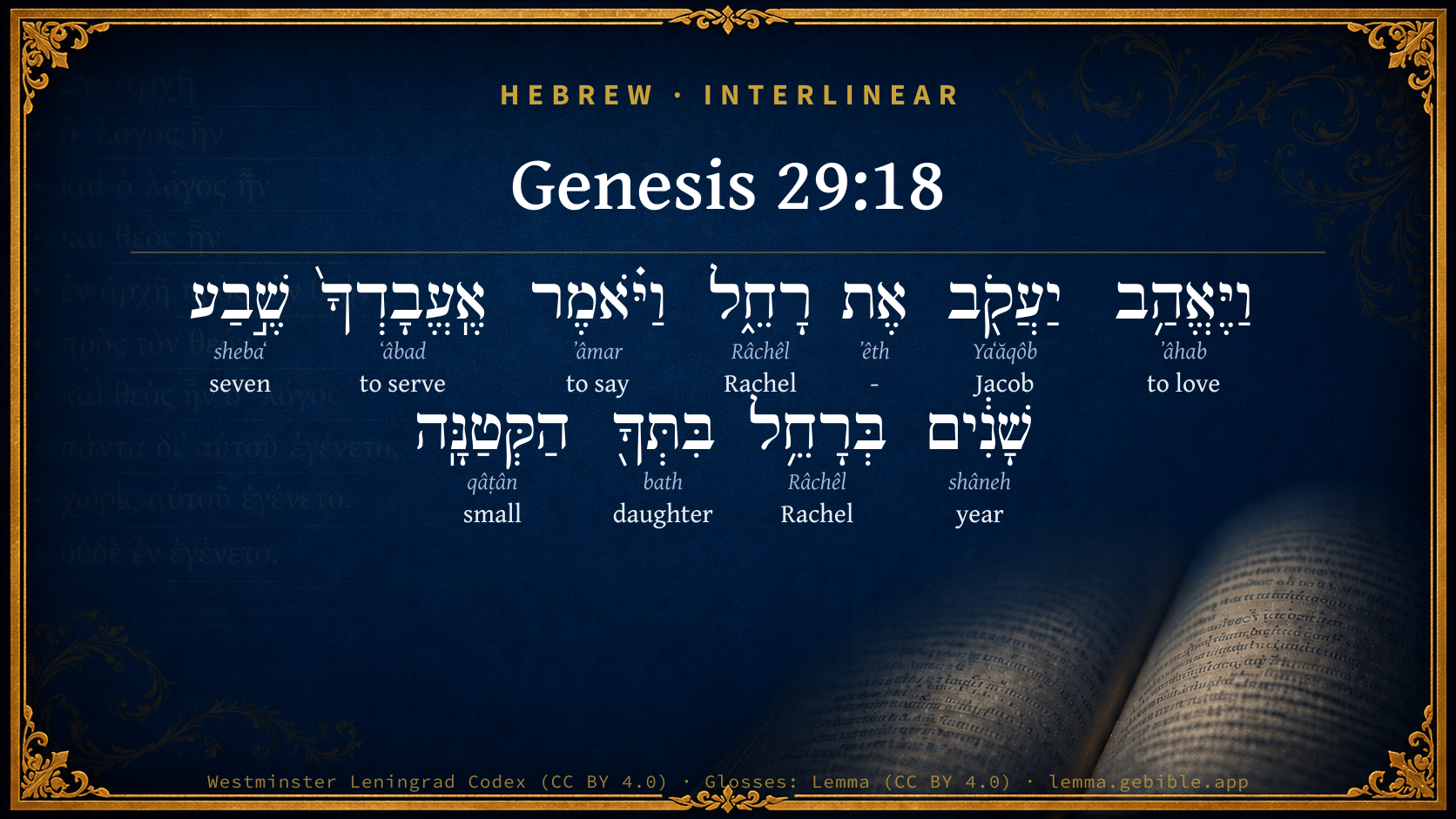
Hebrew (Westminster Leningrad Codex) Genesis 29:18 appears in the Hebrew Old Testament. The text above is from the Westminster Leningrad Codex. Each word links to its Strong’s number, a concise gloss, and parsing drawn from the Open Scriptures Hebrew Bible morphology. Click any word for its full Brown-Driver-Briggs (BDB) entry.
Download image
Cite this verse

Genesis 29:18 (World English Bible). Public Domain. Lemma interlinear Bible study tool, https://lemma.gebible.app/v/genesis/29/18.

Show BibTeX & RIS
BibTeX
RIS
English Translation
Jacob loved Rachel. He said, "I will serve you seven years for Rachel, your younger daughter."
World English Bible · Public Domain
Download a study sheet

One document with this verse’s original text, its word-by-word gloss line, the meaning frame, cross-references with their text, attributed commentary, and full source and license credits — printable, and it pastes into notes with its structure intact.

This verse Autodidact and up

Study sheet (.html) Plain text (.txt)

A passage Seminary Student

Up to 50 verses in one chapter. A passage sheet keeps up to 6 commentary sources and 12 cross-references per verse, in the order this page ranks them, and says so on the sheet whenever that leaves anything out. Ask for a single verse and you get the Autodidact verse sheet above.

Everything on this page stays free to read, with no account — the sheet is a download of what is already on screen, not access to it.

Want to remove ads? Support Godless Engineer
Compare translations 3

The same verse in 3 English versions, stacked beneath the original-language interlinear above. Click any original word for its lexicon entry.

Each is an independent rendering of the whole verse — the interlinear is not word-aligned to these translations.

Highlighted words mark where these versions differ — a whole-verse word diff, not a word-by-word alignment.

  • World English Bible Public Domain
    Jacob loved Rachel. He said, "I will serve you seven years for Rachel, your younger daughter."
  • King James Version Public Domain
    And Jacob loved Rachel; and said, I will serve thee seven years for Rachel thy younger daughter.
  • unfoldingWord Literal Text CC BY-SA 4.0
    And Jacob loved Rachel, so he said, “I will serve you seven years for Rachel your younger daughter.”

unfoldingWord Literal Text — © unfoldingWord, licensed CC BY-SA 4.0. Word-aligned USFM3 via Door43 (git.door43.org/unfoldingWord/en_ult).

Versions to compare (up to 4)

3 of 4 selected

Show all 18 translations

Every available English version of this verse, each an independent rendering of the whole verse.

  • World English Bible Public Domain
    Jacob loved Rachel. He said, "I will serve you seven years for Rachel, your younger daughter."
  • Berean Standard Bible Public Domain
    Since Jacob loved Rachel, he answered, “I will serve you seven years for your younger daughter Rachel.”
  • Majority Standard Bible Public Domain
    Since Jacob loved Rachel, he answered, “I will serve you seven years for your younger daughter Rachel.”
  • King James Version Public Domain
    And Jacob loved Rachel; and said, I will serve thee seven years for Rachel thy younger daughter.
  • American Standard Version (1901) Public Domain
    And Jacob loved Rachel. And he said, I will serve thee seven years for Rachel thy younger daughter.
  • Revised Version (1885) Public Domain
    And Jacob loved Rachel; and he said, I will serve thee seven years for Rachel thy younger daughter.
  • Geneva Bible (1599) Public Domain
    And Iaakob loued Rahel, and sayde, I will serue thee seuen yeeres for Rahel thy yonger daughter.
  • Douay-Rheims (1899) Public Domain
    And Jacob being in love with her, said: I will serve thee seven years for Rachel thy younger daughter.
  • Young's Literal Translation Public Domain
    And Jacob loveth Rachel, and saith, `I serve thee seven years for Rachel thy younger daughter:'
  • Literal Standard Version CC BY-SA 4.0
    And Jacob loves Rachel and says, “I serve you seven years for Rachel your younger daughter”:
  • Unlocked Literal Bible CC BY-SA 4.0
    Jacob loved Rachel, so he said, “I will serve you seven years for Rachel, your younger daughter.”
  • unfoldingWord Literal Text CC BY-SA 4.0
    And Jacob loved Rachel, so he said, “I will serve you seven years for Rachel your younger daughter.”
  • Darby Bible Public Domain
    And Jacob loved Rachel, and said, I will serve thee seven years for Rachel thy younger daughter.
  • World Messianic Bible Public Domain
    Jacob loved Rachel. He said, “I will serve you seven years for Rachel, your younger daughter.”
  • Webster's Bible Public Domain
    And Jacob loved Rachel; and said, I will serve thee seven years for Rachel thy younger daughter.
  • Free Bible Version CC BY-SA 4.0
    Jacob was in love with Rachel so he promised Laban, “I'll do seven years work for you for Rachel, your younger daughter.”
  • Bible in Basic English Public Domain
    And Jacob was in love with Rachel; and he said, I will be your servant seven years for Rachel, your younger daughter.
  • JPS Tanakh (1917) Public Domain
    And Jacob loved Rachel; and he said: 'I will serve thee seven years for Rachel thy younger daughter.'

Literal Standard Version (2020), Covenant Press — licensed CC BY-SA 4.0. Text via the HelloAO Bible API (eBible.org). Unlocked Literal Bible (unfoldingWord) — licensed CC BY-SA 4.0. Text via the HelloAO Bible API (eBible.org). unfoldingWord Literal Text — © unfoldingWord, licensed CC BY-SA 4.0. Word-aligned USFM3 via Door43 (git.door43.org/unfoldingWord/en_ult). Free Bible Version, Dr. Jonathan Gallagher — licensed CC BY-SA 4.0. Text via the HelloAO Bible API (eBible.org).

Word by word

More ways to search: Search by grammar → Find every occurrence → Compare this word →

Practice this passage: Drill this verse → Learn its vocabulary →

רָחֵ֑ל
Râchêl
H7354
“Rachel”
Noun, Proper
Part of Speech
Noun
Type
Proper
Full BDB Definition

Origin: the same as H7353

TWOT: None

Rachel = "ewe" - daughter of Laban, wife of Jacob, and mother of Joseph and Benjamin
  1. וַיֶּאֱהַ֥ב ʼâhab H157 “and · to love” Conjunction + Verb, Qal, Sequential Imperfect, 3rd Person, Masculine, Singular
  2. יַעֲקֹ֖ב Yaʻăqôb H3290 “Jacob” Noun, Proper
  3. אֶת ʼêth H853 “-” Particle, Direct Object
  4. וַיֹּ֗אמֶר ʼâmar H559 “and · to say” Conjunction + Verb, Qal, Sequential Imperfect, 3rd Person, Masculine, Singular
  5. אֶֽעֱבָדְךָ֙ ʻâbad H5647 “to serve · you” Verb, Qal, Imperfect, 1st Person, Common, Singular + Suffix, Personal, 2nd Person, Masculine, Singular
  6. שֶׁ֣בַע shebaʻ H7651 “seven” Adjective, Cardinal number, Feminine, Singular, Absolute
  7. שָׁנִ֔ים shâneh H8141 “years” Noun, Common, Feminine, Plural, Absolute
  8. בְּרָחֵ֥ל Râchêl H7354 “in/at · Rachel” Preposition + Noun, Proper
  9. בִּתְּךָ֖ bath H1323 “daughter · your” Noun, Common, Feminine, Singular, Construct + Suffix, Personal, 2nd Person, Masculine, Singular
  10. הַקְּטַנָּֽה qâṭân H6996 “the · small” Particle, Definite Article + Adjective, Adjective, Feminine, Singular, Absolute

About this verse

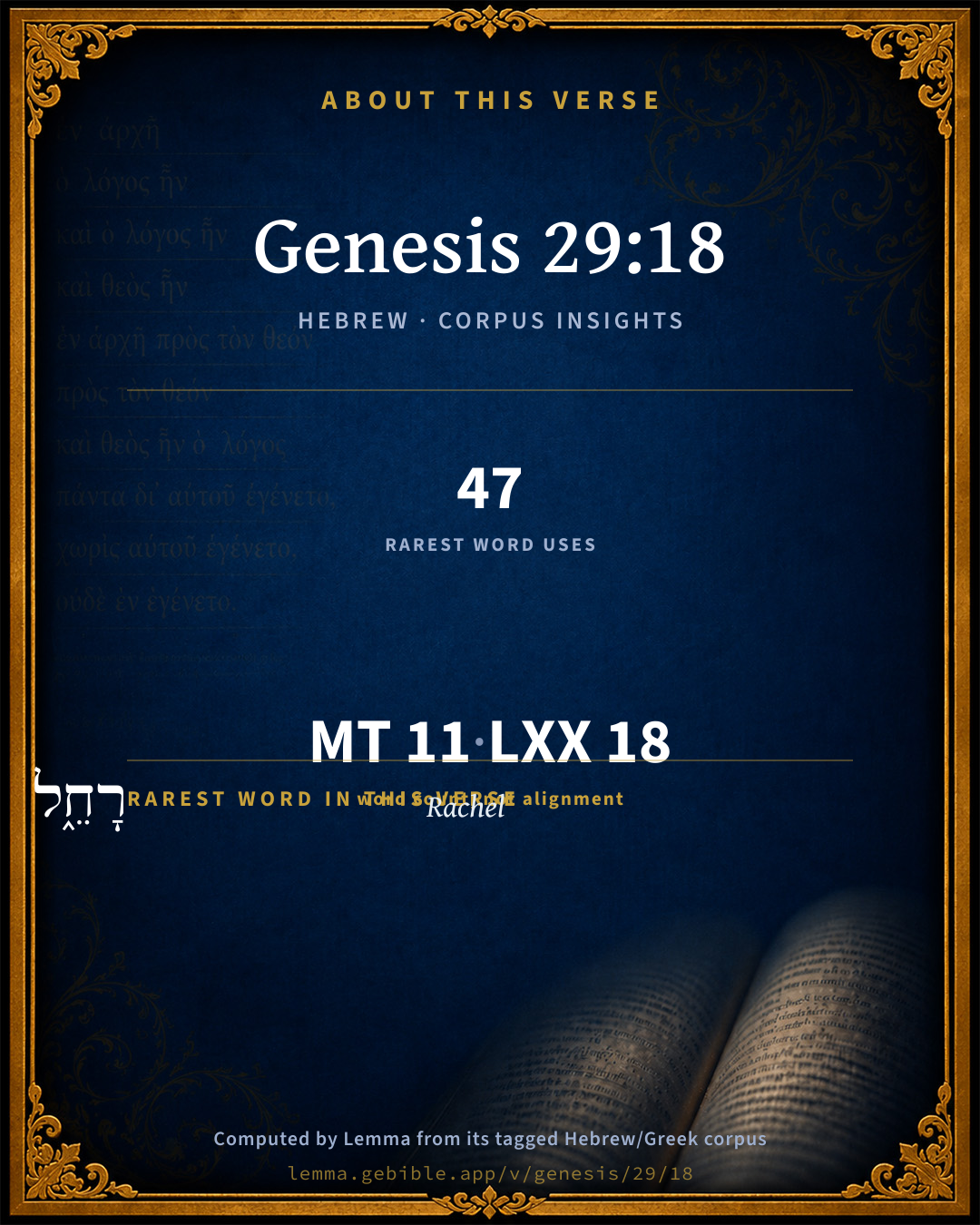
These counts appear in no published source. They are computed here, from the morphology-tagged text and Lemma’s own curated glosses. What Lemma adds →

11
words
10
distinct lemmas
Pentateuch
section

Shared distinctive vocabulary

רָחֵ֑ל Rachel H7354 occurs in 44 verses of the Hebrew Bible. Also found in:

Grammatical profile

  • 3 verbs
  • 5 nouns
  • 2 adjectives
  • 1 particle

Verb forms

  • וַיֶּאֱהַ֥ב Qal · Sequential Imperfect
  • וַיֹּ֗אמֶר Qal · Sequential Imperfect
  • אֶֽעֱבָדְךָ֙ Qal · Imperfect

Repetition

A word recurs within this verse — often emphatic in Hebrew:

  • רָחֵ֑ל Rachel H7354 ×2

Hebrew & Septuagint length

In English translation the verse runs 16 words from the Hebrew and 17 from the Septuagint (LXX English) — closely comparable.

A rough comparison of the two English renderings, which tokenize alike — not a word-level alignment.

Word counts can differ between the Hebrew and the Greek without any difference in meaning — e.g. the Hebrew direct-object marker אֵת has no separate Greek word, and Greek often adds the article ὁ.

In the original languages it is 11 Hebrew tokens and 18 Greek tokens — but the two are counted differently (Hebrew bundles its prefixes and suffixes into one token; the Greek is in lemma form), so that isn’t a like-for-like length.

Cross-references

8

Topical passages linked to Genesis 29:18 in the Treasury of Scripture Knowledge — connected by theme and wording, ordered by reader-vote popularity; previews shown in the World English Bible.

  • Hosea 12:12 Jacob fled into the country of Aram, And Israel served to get a wife, And for a wife he tended flocks and herds.
  • Exodus 22:16–17 "If a man entices a virgin who isn't pledged to be married, and lies with her, he shall surely pay a dowry for her to be his wife.
  • Genesis 34:12 Ask me a great amount for a dowry, and I will give whatever you ask of me, but give me the young lady as a wife."
  • Genesis 29:20 Jacob served seven years for Rachel. They seemed to him but a few days, for the love he had for her.
  • Genesis 29:30 He went in also to Rachel, and he loved also Rachel more than Leah, and served with him yet seven other years.
  • Genesis 31:41 These twenty years have I been in your house. I served you fourteen years for your two daughters, and six years for your flock, and you have changed my wages ten times.
  • 2 Samuel 3:14 David sent messengers to Ish-bosheth, Saul's son, saying, Deliver me my wife Michal, whom I pledged to be married to me for one hundred foreskins of the Philistines.
  • Hosea 3:2 So I bought her for myself for fifteen pieces of silver and a homer and a half of barley.

Cross-references courtesy of OpenBible.info (CC BY 4.0).

Hebrew and Greek witnesses Masoretic Hebrew ↔ Greek Septuagint

The same verse in the two great witnesses to the Old Testament, shown verse-for-verse.

These are two independent witnesses, not word-aligned to each other, and the Septuagint is shown in lemma (dictionary) form.

Hebrew Genesis 29:18 Masoretic · Westminster Leningrad Codex

וַיֶּאֱהַ֥ב יַעֲקֹ֖ב אֶת רָחֵ֑ל וַיֹּ֗אמֶר אֶֽעֱבָדְךָ֙ שֶׁ֣בַע שָׁנִ֔ים בְּרָחֵ֥ל בִּתְּךָ֖ הַקְּטַנָּֽה

Jacob loved Rachel. He said, "I will serve you seven years for Rachel, your younger daughter."

World English Bible · Public Domain

Greek LXX Genesis 29:18 Septuagint · lemma form

ἀγαπάω δέ ἰακώβ ὁ ραχηλ καί εἶπον δουλεύω σύ ἑπτά ἔτος περί ραχηλ ὁ θυγάτηρ σύ ὁ νέος

And Jacob loved Rachel, and said, I will serve you seven years for your younger daughter Rachel.

LXX2012 (modern English Septuagint) · Public Domain

Hebrew: Westminster Leningrad Codex (CC BY 4.0). Greek: Septuagint (public domain); English from LXX2012 (modern English Septuagint) (Public Domain). How the Septuagint differs from the Hebrew →

Targum (Aramaic paraphrase)

2

The Targum is the ancient Jewish Aramaic paraphrase of the Hebrew Scriptures — an interpretive translation, not the Hebrew text itself. Onkelos (literal) and Pseudo-Jonathan (expansive) render the Torah, and Jonathan the Prophets. Coverage is partial: where no permissively-licensed English translation exists for a verse, only the Aramaic is shown. This is verse-level text, not a word-by-word alignment to the Hebrew.

  1. Targum Onkelos Torah (Genesis–Deuteronomy)
    וּרְחֵם יַעֲקֹב יָת רָחֵל וַאֲמַר אֶפְלְחִנָּךְ שְׁבַע שְׁנִין בְּרָחֵל בְּרַתָּךְ זְעֶרְתָּא

    (no public-domain English translation for this verse)

    Targum Onkelos — Aramaic: “Onkelos Genesis” (public domain); “Onkelos Exodus” (public domain); “Onkelos Leviticus” (public domain); “Onkelos Numbers” (public domain); “Onkelos Deuteronomy” (public domain). English: “Sefaria Community Translation” (CC0 1.0 (public-domain dedication)); “J.W. Etheridge. The Targums of Onkelos and Jonathan Ben Uzziel on the Pentateuch. London: Longmans, Green, 1862” (public domain). Text via Sefaria.

  2. Targum Pseudo-Jonathan Torah (Genesis–Deuteronomy)
    וּרְחַם יַעֲקב יַת רָחֵל וַאֲמַר אֶפְלְחִינָךְ שֵׁב שְׁנִין בְּגִין רָחֵל בְּרַתָּךְ זְעֵירְתָּא

    And Jakob loved Rahel; and he said, I will serve thee seven years for Rahel thy Younger daughter.

    Targum Pseudo-Jonathan — Aramaic: “Targum Jonathan on Genesis” (public domain); “Targum Jonathan on Exodus” (public domain); “Targum Jonathan on Leviticus” (public domain); “Targum Jonathan on Numbers” (public domain); “Targum Jonathan on Deuteronomy” (public domain). English: “The Targum of Jonathan ben Uzziel, trans. J. W. Etheridge, London, 1862” (public domain). Text via Sefaria.

Commentary

Notes on Genesis 29:18 from classic Christian and Jewish commentators (each source and its license shown beneath its notes). The classic Christian expositions comment on the surrounding passage and are grouped to its opening verse, so a note may address several verses; the Jewish commentaries on the Tanakh (Rashi and others) are per-verse, so they appear only where the commentator wrote on this verse.

Lemma curates 59 commentaries, every one of them public domain or Creative Commons licensed, each selected and text-cleaned for this edition rather than reprinted as found. About our sources →

Trapp's Complete Commentary

John Trapp

Gen 29:18 And Jacob loved Rachel; and said, I will serve thee seven years for Rachel thy younger daughter.

Ver. 18. I will serve thee seven years.] He had nothing to endow her with; he would therefore earn her with his hard labour: which, as it shows Laban’s churlishness to suffer it, and his baseness to make a prize and a prey of his two daughters, so it sets forth Jacob’s meekness, poverty, patience, and hard condition here, mentioned many years after by the prophet Hosea. {Hos 12:12} He was a man of many sorrows; and from him therefore the Church hath her denomination: neither were the faithful ever since called Abrahamites but Israelites.

John Trapp, A Commentary or Exposition upon All the Books of the Old and New Testament (1647–1656) — public domain. Text from a community e-Sword module.

Tyndale Open Study Notes

Tyndale Open Resources

29:18 Seven years of service was a high bride-price in the ancient world, but Rachel was beautiful (like Sarah and Rebekah), and Jacob was in love with her.

Tyndale Open Study Notes — © Tyndale Open Resources, licensed CC BY-SA 4.0. Text via the HelloAO Bible API.

Jamieson, Fausset & Brown

Robert Jamieson, A. R. Fausset & David Brown

I will serve thee seven years for Rachel thy daughter--A proposal of marriage is made to the father without the daughter being consulted, and the match is effected by the suitor either bestowing costly presents on the family, or by giving cattle to the value the father sets upon his daughter, or else by giving personal services for a specified period. The last was the course necessity imposed on Jacob; and there for seven years he submitted to the drudgery of a hired shepherd, with the view of obtaining Rachel. The time went rapidly away; for even severe and difficult duties become light when love is the spring of action.

Jamieson, Fausset & Brown — Commentary Critical and Explanatory on the Whole Bible (1871) — public domain (CC PDM 1.0). Text via the HelloAO Bible API.

John Calvin's Commentaries

18. I will serve thee seven years. The iniquity of Laban betrays itself in a moment; for it is a shameful barbarity to give his daughter, by way of reward, in exchange for Jacob’s services, making her the subject of a kind of barter. He ought, on the other hand, not only to have assigned a portion to his daughter, but also to have acted more liberally towards his future son-in-law. But under the pretext of affinity, he defrauds him of the reward of his labor, the very thing which he had before acknowledged to be unjust. We therefore perceive still more clearly what I have previously alluded to, that although from their mother’s womb men have a general notion of justice, yet as soon as their own advantage presents itself to view, they become actually unjust, unless the Lord reforms them by his Spirit. Moses does not here relate something rare or unusual, but what is of most common occurrence. For though men do not set their daughters to sale, yet the desire of gain hurries the greater part so far away, that they prostitute their honor and sell their souls. Further, it is not altogether to be deemed a fault that Jacob was rather inclined to love Rachel; whether it was that Leah, on account of her tender eyes, was less beautiful, or that she was pleasing only by the comeliness of her eyes, while Rachel excelled her altogether in elegance of form. For we see how naturally a secret kind of affection produces mutual love. Only excess is to be guarded against, and so much the more diligently, because it is difficult so to restrain affections of this kind, that they do not prevail to the stifling of reason. Therefore he who shall be induced to choose a wife, because of the elegance of her form, will not necessarily sin, provided reason always maintains the ascendancy, and holds the wantonness of passion in subjection. Yet perhaps Jacob sinned in being too self-indulgent, when he desired Rachel the younger sister to be given to him, to the injury of the elder; and also, while yielding to the desire of his own eyes, he undervalued the virtues of Leah: for this is a very culpable want of self-government, when any one chooses a wife only for the sake of her beauty, whereas excellence of disposition ought to be deemed of the first importance. But the strength and ardor of his attachment manifests itself in this, that he felt no weariness in the labor of seven years: but chastity was also joined with it, so that he persevered, during this long period, with a patient and quiet mind in the midst of so many labors. And here again the integrity and continence of that age is apparent, because, though dwelling under the same roof, and accustomed to familiar intercourse, Jacob yet conducted himself with modesty, and abstained from all impropriety. Therefore, at the close of the appointed time he said, “Give me my wife, that I may go in unto her,” by which he implies that she had been hitherto a pure virgin.

John Calvin's Commentaries (1540-1563) — public domain. Text from the Calvin Translation Society English edition (1840s-50s) via the Christian Classics Ethereal Library (ccel.org). Calvin's coverage is partial (roughly two-thirds of the Bible); uncommented books and verses are honest gaps, never fabricated. The 19th-century editor's footnotes and remarks are omitted so the notes are faithfully Calvin's own voice.

Ellicott's Commentary for English Readers

(18) I will serve thee seven years for Rachel thy younger daughter.—Heb., thy daughter, the little one, just as Leah, in Gen_29:16, is called the great one. (See Note on Gen_9:24.) So in Gen_44:20, the phrase “the little one” simply means the youngest. Wives had to be purchased in the East (Gen_24:53), and as Jacob had brought no rich presents, such as Abraham had sent when seeking a wife for his son, he had only his personal services to offer. As the sale was usually veiled in true Oriental fashion under the specious form of freewill gifts, we shall find that both Leah and Rachel are offended at being thus openly bartered by Laban.

A Bible Commentary for English Readers, edited by Charles John Ellicott (1878–1897) — public domain. Text from a community e-Sword module.

The Cambridge Bible for Schools and Colleges

gen. ed. J. J. S. Perowne

18. I will serve … Rachel] He has no money to offer; he is ready to give seven years’ service without wages, in order to win Rachel as his bride. He cannot as bridegroom, or suitor, offer the usual gifts, or mohar (see note on Gen_24:53). So he offers the equivalent in work. See the reference to this incident in Hos_12:12.

The Cambridge Bible for Schools and Colleges (gen. ed. J. J. S. Perowne; Cambridge University Press, 1878–1918) — public domain. Text from a community e-Sword module.

John Gill's Exposition

And Jacob loved Rachel,.... As he seems to have done from the moment he saw her at the well, being beautiful, modest, humble, affable, diligent, and industrious:

and he said, I will serve thee seven years for Rachel thy younger daughter: signifying, that he desired no other wages for his service than that, that he might have her for his wife, at the end of seven years' servitude, which he was very willing to oblige himself to, on that condition; for having no money to give as a dowry, as was customary in those times, he proposed servitude instead of it; though Schmidt thinks this was contrary to custom, and that Laban treated his daughters like bondmaids, and such as are taken captives or strangers, and sold them, of which they complain, Gen 31:15.

John Gill's Exposition of the Whole Bible (1746–1763) — public domain (CC PDM 1.0). Text via the HelloAO Bible API.

Matthew Poole's English Annotations

It being then the custom for men to buy their wives. See Ge 34:12; Ex 22:17; 1Sa 18:25; 2Sa 3:14; Ho 3:2

Matthew Poole's English Annotations on the Holy Bible (1683–1685) — public domain. Text from a community e-Sword/MySword module.

Whedon's Commentary on the Bible

Daniel D. Whedon

18. I will serve thee seven years — A week of years. Jacob had not, like his grandfather’s servant, rich presents to offer as a dowry for his bride, (Gen_24:53,) but he offers what he can, the cheerful labour of willing and active hands.

Daniel D. Whedon (gen. ed.), Commentary on the Old and New Testaments (1874–1909) — public domain. Text from a community e-Sword module.

The Pulpit Commentary

And Jacob loved Rachel (it is more than probable that this was an illustration of what is known as "love at first sight" on the part of Rachel as well as Jacob); and said, I will serve thee seven years for Rachel thy younger daughter. Having no property, with which to buy his wife, according to Oriental custom (Kalisch), or to give the usual dowry for her to her father (Keil), cf. Gen_14:5 Gen_34:12; 1Sa_18:25, Jacob"s offer was at once accepted by his grasping uncle, though he was that uncle"s "brother" (ver. 15).

The Pulpit Commentary (1880–1919), ed. H.D.M. Spence-Jones & Joseph S. Exell — public domain. Text from a community e-Sword module.

Rashi

Rabbi Shlomo Yitzchaki (Rashi)

אעבדך שבע שנים I WILL SERVE THEE SEVEN YEARS — These are the “few days” of which his mother had spoken to him (27:44)): “And thou shalt tarry with him a few days”. You can see that this is so, for it is written (v. 20) “And they (the seven years) were in his eyes (i.e. according to his view) the few days” of which his mother had spoken (Genesis Rabbah 70:17).

ברחל בתך הקטנה (literally, for Rachel, thy daughter, the younger one) — What reason was there for mentioning all these detailed descriptions of Rachel? Because he (Jacob) knew that he (Laban) was a deceiver. He said to him, “I will serve thee for Rachel”: and should you say that I mean any other Rachel out of the street, therefore I say “your daughter”. Should you say, “I will change Leah’s name and call her Rachel”, I say “your younger one”. In spite of this, however, all these precautions did not avail, for he did actually deceive him (Genesis Rabbah 70:17).

Rashi on the Tanakh — English translations: “The Judaica Press complete Tanach with Rashi, translated by A. J. Rosenberg” (CC BY 4.0); “Pentateuch with Rashi's commentary by M. Rosenbaum and A.M. Silbermann, 1929-1934” (public domain); “The Metsudah Tanach series, Lakewood, N.J” (CC BY 4.0); and “The Book of Joshua, Metsudah Publications, 1997” (CC BY 4.0). Text via Sefaria.

Radak

Rabbi David Kimhi (Radak)

ויאהב...אעבדך, in response to the question: “what shall be your wages?,” he answered Lavan that his wages would be in addition to food lodging and clothes that Lavan would give him his daughter Rachel as a wife. Even though Yaakov had spelled out which daughter, namely Rachel, he added the word הקטנה, “the younger one,” so that Lavan could not deceive him by giving him a different girl called Rachel. Some people question that seeing that the righteous marry with a view to producing children, why would Rachel’s exterior appearance have been of interest to Yaakov at all? After all they did not want their wives to be women who would excite their libidos, and it is clear from the fact that Yaakov was willing to delay marriage by seven years was due to his choosing a beautiful bride. He appears to have been angry at Lavan for having given him Leah instead, seeing that Leah was not as attractive as her sister. We have to answer this by saying that in choosing a beautiful woman as their brides, the righteous people had good intentions. They wanted their libidos to be aroused by them in order to produce many children together. Furthermore, they also wanted their children to be handsome like their mothers. Looking at beautiful people helps a person to remain in a joyous frame of mind, something which is a requirement for man for we know that people who are not in a joyful frame of mind cannot serve G’d in the best possible fashion. Even prophets cannot function as such unless they are in a state of joy, and on occasion they require stimulants such as music in order to put them in a more joyful frame of mind (Kohelet 5,19,--compare also Kings II 3,14-15)

Radak on the Tanakh — English translations: “Sefaria Community Translation” (CC0 1.0 (public-domain dedication)); “Eliyahu Munk, HaChut Hameshulash” (CC BY 4.0); “Rabbi Mike Feuer, Jerusalem Anthology” (CC BY 4.0); and “R. David Kimhi on the first book of Psalms, Translated by R.G. Finch, London, 1919” (public domain). Text via Sefaria.

Lesson kit

Teaching starters — assembled from the data on this page, not authored interpretation. Every prompt links to the verse data it draws on. Edit before teaching.

Genesis, in the Pentateuch, opens this verse with 11 words (10 distinct Hebrew lemmas). Its most distinctive word is Râchêl (“Rachel”). A historical commentator’s framing appears above. Read the whole chapter for the surrounding context.

Discussion questions

  1. How does “Rachel” (Râchêl) shape what this verse is saying?
  2. Genesis 29:6 shares the word «Rachel» with this verse. How do the two illuminate each other?
  3. “Rachel” occurs 2× in this one verse. What is the effect of the repetition?
  4. The translations on this page render this verse differently — a whole-verse word diff, not a word-by-word alignment. What might account for the different wordings?
  5. The verb «וַיֶּאֱהַ֥ב» is Qal Sequential Imperfect. How does its form color the action?
  6. Reading how Trapp's Complete Commentary and Tyndale Open Study Notes read this verse, where do the two commentators agree and where do they part?

Things to notice

Reading settings

Reading text

Shown beneath each verse's original-language words.

Old Testament
Old Testament edition

Read the OT as the Masoretic Hebrew (MT) or the Greek Septuagint (LXX).

English shown for the Greek Septuagint (in the Hebrew ↔ Greek comparison).

Comparing translations? Open the Compare panel on any verse page to stack up to four side by side.