
Judges 14:12

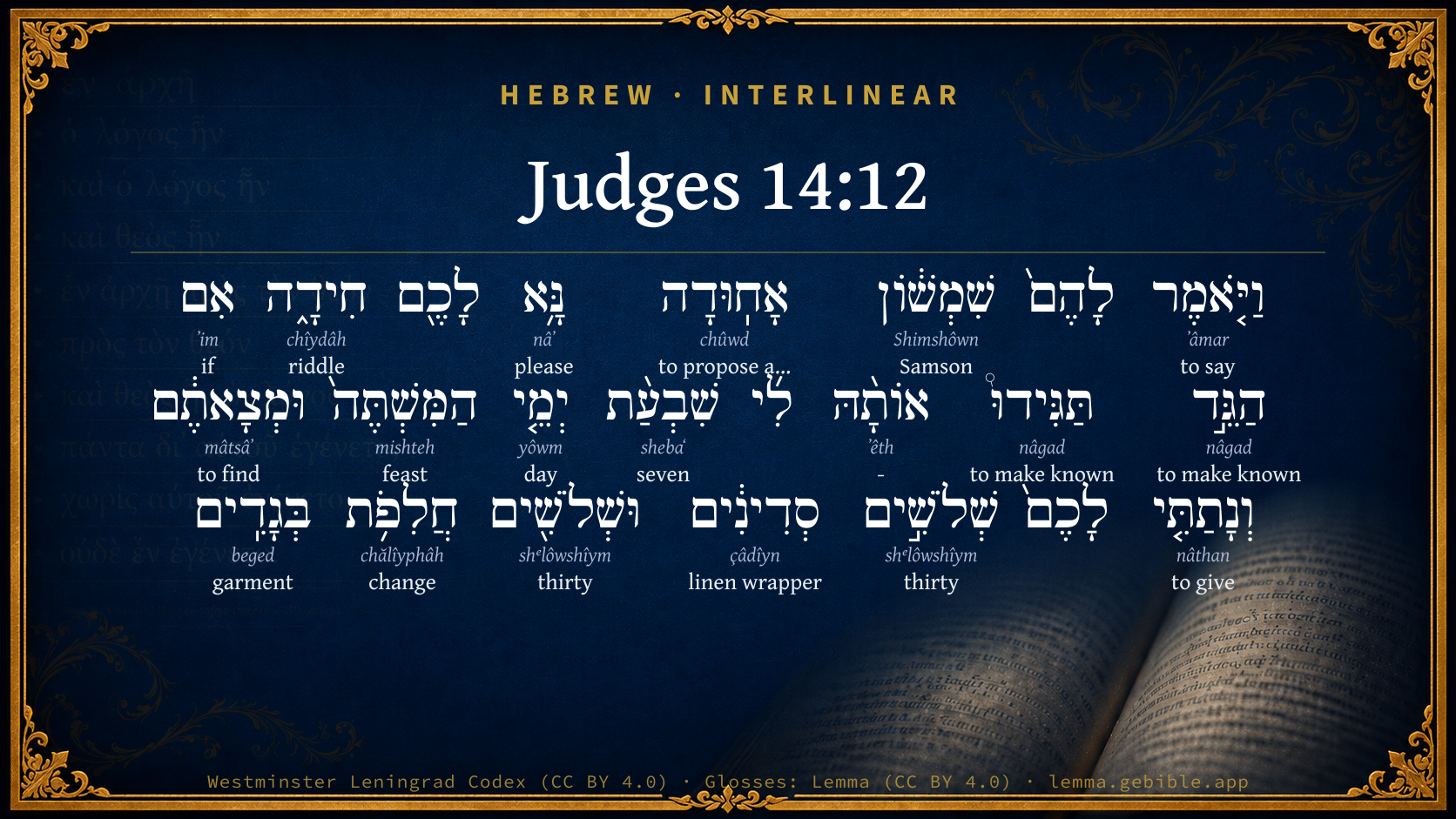
Hebrew (Westminster Leningrad Codex) Judges 14:12 appears in the Hebrew Old Testament. The text above is from the Westminster Leningrad Codex. Each word links to its Strong’s number, a concise gloss, and parsing drawn from the Open Scriptures Hebrew Bible morphology. Click any word for its full Brown-Driver-Briggs (BDB) entry.
Download image
Cite this verse

Judges 14:12 (World English Bible). Public Domain. Lemma interlinear Bible study tool, https://lemma.gebible.app/v/judges/14/12.

Show BibTeX & RIS
BibTeX
RIS
English Translation
Samson said to them, Let me now put forth a riddle to you: if you can declare it to me within the seven days of the feast, and find it out, then I will give you thirty linen garments and thirty changes of clothing;
World English Bible · Public Domain
Highlights
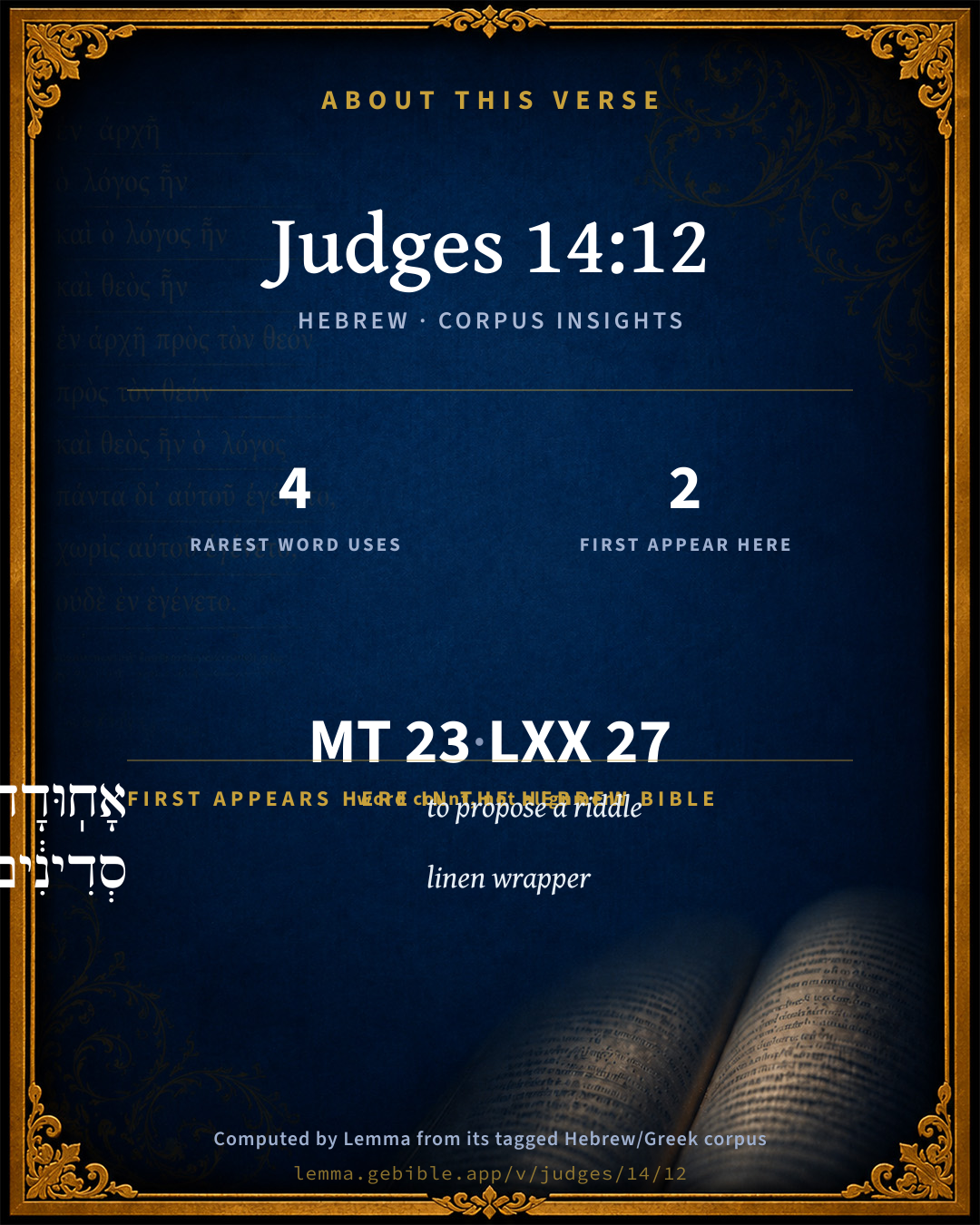
  • 2 first appearances in the Hebrew Bible
Full analysis ↓
Download a study sheet

One document with this verse’s original text, its word-by-word gloss line, the meaning frame, cross-references with their text, attributed commentary, and full source and license credits — printable, and it pastes into notes with its structure intact.

This verse Autodidact and up

Study sheet (.html) Plain text (.txt)

A passage Seminary Student

Up to 50 verses in one chapter. A passage sheet keeps up to 6 commentary sources and 12 cross-references per verse, in the order this page ranks them, and says so on the sheet whenever that leaves anything out. Ask for a single verse and you get the Autodidact verse sheet above.

Everything on this page stays free to read, with no account — the sheet is a download of what is already on screen, not access to it.

Want to remove ads? Support Godless Engineer
Compare translations 3

The same verse in 3 English versions, stacked beneath the original-language interlinear above. Click any original word for its lexicon entry.

Each is an independent rendering of the whole verse — the interlinear is not word-aligned to these translations.

Highlighted words mark where these versions differ — a whole-verse word diff, not a word-by-word alignment.

  • World English Bible Public Domain
    Samson said to them, Let me now put forth a riddle to you: if you can declare it to me within the seven days of the feast, and find it out, then I will give you thirty linen garments and thirty changes of clothing;
  • King James Version Public Domain
    And Samson said unto them, I will now put forth a riddle unto you: if ye can certainly declare it me within the seven days of the feast, and find it out, then I will give you thirty sheets and thirty change of garments:
  • unfoldingWord Literal Text CC BY-SA 4.0
    And Samson said to them, “Please let me put a riddle to you. If declaring, you declare it to me the seven days of the feast and you find, then I will give to you 30 linen garments and 30 changes of clothes.

unfoldingWord Literal Text — © unfoldingWord, licensed CC BY-SA 4.0. Word-aligned USFM3 via Door43 (git.door43.org/unfoldingWord/en_ult).

Versions to compare (up to 4)

3 of 4 selected

Show all 18 translations

Every available English version of this verse, each an independent rendering of the whole verse.

  • World English Bible Public Domain
    Samson said to them, Let me now put forth a riddle to you: if you can declare it to me within the seven days of the feast, and find it out, then I will give you thirty linen garments and thirty changes of clothing;
  • Berean Standard Bible Public Domain
    “Let me tell you a riddle,” Samson said to them. “If you can solve it for me within the seven days of the feast, I will give you thirty linen garments and thirty sets of clothes.
  • Majority Standard Bible Public Domain
    “Let me tell you a riddle,” Samson said to them. “If you can solve it for me within the seven days of the feast, I will give you thirty linen garments and thirty sets of clothes.
  • King James Version Public Domain
    And Samson said unto them, I will now put forth a riddle unto you: if ye can certainly declare it me within the seven days of the feast, and find it out, then I will give you thirty sheets and thirty change of garments:
  • American Standard Version (1901) Public Domain
    And Samson said unto them, Let me now put forth a riddle unto you: if ye can declare it unto me within the seven days of the feast, and find it out, then I will give you thirty linen garments and thirty changes of raiment;
  • Revised Version (1885) Public Domain
    And Samson said unto them, Let me now put forth a riddle unto you: if ye can declare it me within the seven days of the feast, and find it out, then I will give you thirty linen garments and thirty changes of raiment:
  • Geneva Bible (1599) Public Domain
    Then Samson sayd vnto them, I will nowe put forth a riddle vnto you: and if you can declare it me within seuen dayes of the feast, and finde it out, I will giue you thirty sheetes, and thirtie change of garments.
  • Douay-Rheims (1899) Public Domain
    And Samson said to them: I will propose to you a riddle, which if you declare unto me within the seven days of the feast, I will give you thirty shirts, and as many coats:
  • Young's Literal Translation Public Domain
    And Samson saith to them, `Let me, I pray you, put forth to you a riddle; if ye certainly declare it to me `in' the seven days of the banquet, and have found `it' out, then I have given to you thirty linen shirts, and thirty changes of garments;
  • Literal Standard Version CC BY-SA 4.0
    And Samson says to them, “Now let me put forth a riddle to you; if you certainly declare it to me [in] the seven days of the banquet, and have found [it] out, then I have given thirty linen shirts and thirty changes of garments to you;
  • Unlocked Literal Bible CC BY-SA 4.0
    Samson said to them, “Let me now tell you a riddle. If one of you can find it out and tell me the answer during the seven days of the feast, I will give out thirty linen robes and thirty sets of clothes.
  • unfoldingWord Literal Text CC BY-SA 4.0
    And Samson said to them, “Please let me put a riddle to you. If declaring, you declare it to me the seven days of the feast and you find, then I will give to you 30 linen garments and 30 changes of clothes.
  • Darby Bible Public Domain
    And Samson said to them, "Let me now put a riddle to you; if you can tell me what it is, within the seven days of the feast, and find it out, then I will give you thirty linen garments and thirty festal garments;
  • World Messianic Bible Public Domain
    Samson said to them, “Let me tell you a riddle now. If you can tell me the answer within the seven days of the feast, and find it out, then I will give you thirty linen garments and thirty changes of clothing;
  • Webster's Bible Public Domain
    And Samson said to them, I will now propose a riddle to you: if ye can certainly declare it me within the seven days of the feast, and find it out, then I will give you thirty sheets and thirty change of garments:
  • Free Bible Version CC BY-SA 4.0
    “Let me pose a riddle to you,” Samson said to them. “If you can find its meaning and explain it to me during the seven days of the party, I'll give you thirty linen cloaks and thirty sets of clothes.
  • Bible in Basic English Public Domain
    And Samson said, Now I have a hard question for you: if you are able to give me the answer before the seven days of the feast are over, I will give you thirty linen robes and thirty changes of clothing;
  • JPS Tanakh (1917) Public Domain
    And Samson said unto them: 'Let me now put forth a riddle unto you; if ye can declare it me within the seven days of the feast, and find it out, then I will give you thirty linen garments and thirty changes of raiment;

Literal Standard Version (2020), Covenant Press — licensed CC BY-SA 4.0. Text via the HelloAO Bible API (eBible.org). Unlocked Literal Bible (unfoldingWord) — licensed CC BY-SA 4.0. Text via the HelloAO Bible API (eBible.org). unfoldingWord Literal Text — © unfoldingWord, licensed CC BY-SA 4.0. Word-aligned USFM3 via Door43 (git.door43.org/unfoldingWord/en_ult). Free Bible Version, Dr. Jonathan Gallagher — licensed CC BY-SA 4.0. Text via the HelloAO Bible API (eBible.org).

Word by word

More ways to search: Search by grammar → Find every occurrence → Compare this word →

Practice this passage: Drill this verse → Learn its vocabulary →

אָחֽוּדָה
chûwd
H2330
“to propose a riddle”
Verb, Qal, Cohortative, 1st Person, Common, Singular
Part of Speech
Verb
Stem
Qal
Form
Cohortative
Person
1st Person
Gender
Common
Number
Singular
Full BDB Definition

Origin: a primitive root

TWOT: 616

(Qal) to propose a riddle, propound a riddle
  1. וַיֹּ֤אמֶר ʼâmar H559 “and · to say” Conjunction + Verb, Qal, Sequential Imperfect, 3rd Person, Masculine, Singular
  2. שִׁמְשׁ֔וֹן Shimshôwn H8123 “Samson” Noun, Proper
  3. נָּ֥א nâʼ H4994 “please” Particle, Interjection
  4. חִידָ֑ה chîydâh H2420 “riddle” Noun, Common, Feminine, Singular, Absolute
  5. אִם ʼim H518 “if” Conjunction
  6. הַגֵּ֣ד nâgad H5046 “to make known” Verb, Hiphil, Infinitive Absolute
  7. תַּגִּידוּ֩ nâgad H5046 “to make known” Verb, Hiphil, Imperfect, 2nd Person, Masculine, Plural
  8. אוֹתָ֨הּ ʼêth H853 “- · her” Particle, Direct Object + Suffix, Personal, 3rd Person, Feminine, Singular
  9. שִׁבְעַ֨ת shebaʻ H7651 “seven” Adjective, Cardinal number, Masculine, Singular, Construct
  10. יְמֵ֤י yôwm H3117 “days of” Noun, Common, Masculine, Plural, Construct
  11. הַמִּשְׁתֶּה֙ mishteh H4960 “the · feast” Particle, Definite Article + Noun, Common, Masculine, Singular, Absolute
  12. וּמְצָאתֶ֔ם mâtsâʼ H4672 “and · to find” Conjunction + Verb, Qal, Perfect, 2nd Person, Masculine, Plural
  13. וְנָתַתִּ֤י nâthan H5414 “and · to give” Conjunction + Verb, Qal, Sequential Perfect, 1st Person, Common, Singular
  14. שְׁלֹשִׁ֣ים shᵉlôwshîym H7970 “thirty” Adjective, Cardinal number, Both, Plural, Absolute
  15. סְדִינִ֔ים çâdîyn H5466 “linen wrappers” Noun, Common, Masculine, Plural, Absolute
  16. וּשְׁלֹשִׁ֖ים shᵉlôwshîym H7970 “and · thirty” Conjunction + Adjective, Cardinal number, Both, Plural, Absolute
  17. חֲלִפֹ֥ת chălîyphâh H2487 “changes of” Noun, Common, Feminine, Plural, Construct
  18. בְּגָדִֽים beged H899 “garments” Noun, Common, Masculine, Plural, Absolute

About this verse

These counts appear in no published source. They are computed here, from the morphology-tagged text and Lemma’s own curated glosses. What Lemma adds →

23
words
17
distinct lemmas
Historical
section

Notable vocabulary

The rarest word here is אָחֽוּדָה to propose a riddle H2330 — appearing just 4 times in the whole Hebrew Bible.

First appearance in Scripture

These words make their first canonical appearance in the Hebrew Bible here:

  • אָחֽוּדָה to propose a riddle H2330
  • סְדִינִ֔ים linen wrapper H5466

Shared distinctive vocabulary

אָחֽוּדָה to propose a riddle H2330 occurs in 4 verses of the Hebrew Bible. Also found in:

Grammatical profile

  • 6 verbs
  • 7 nouns
  • 3 adjectives
  • 4 prepositions
  • 1 conjunction
  • 2 particles

Verb forms

  • וַיֹּ֤אמֶר Qal · Sequential Imperfect
  • אָחֽוּדָה Qal · Cohortative
  • הַגֵּ֣ד Hiphil · Infinitive Absolute
  • תַּגִּידוּ֩ Hiphil · Imperfect
  • וּמְצָאתֶ֔ם Qal · Perfect
  • וְנָתַתִּ֤י Qal · Sequential Perfect

Repetition

Words recur within this verse — often emphatic in Hebrew:

  • הַגֵּ֣ד to make known H5046 ×2
  • שְׁלֹשִׁ֣ים thirty H7970 ×2

Hebrew & Septuagint length

In English translation the verse runs 44 words from the Hebrew and 38 from the Septuagint (LXX English) — closely comparable.

A rough comparison of the two English renderings, which tokenize alike — not a word-level alignment.

Word counts can differ between the Hebrew and the Greek without any difference in meaning — e.g. the Hebrew direct-object marker אֵת has no separate Greek word, and Greek often adds the article ὁ.

In the original languages it is 23 Hebrew tokens and 27 Greek tokens — but the two are counted differently (Hebrew bundles its prefixes and suffixes into one token; the Greek is in lemma form), so that isn’t a like-for-like length.

Cross-references

19

Topical passages linked to Judges 14:12 in the Treasury of Scripture Knowledge — connected by theme and wording, ordered by reader-vote popularity; previews shown in the World English Bible.

  • 1 Kings 10:1 When the queen of Sheba heard of the fame of Solomon concerning the name of Yahweh, she came to prove him with hard questions.
  • Genesis 45:22 To all of them he gave each man changes of clothing, but to Benjamin he gave three hundred pieces of silver and five changes of clothing.
  • Ezekiel 17:2 Son of man, put forth a riddle, and speak a parable to the house of Israel;
  • 2 Kings 5:5 The king of Syria said, Go now, and I will send a letter to the king of Israel. He departed, and took with him ten talents of silver, and six thousand [pieces] of gold, and ten changes of clothing.
  • 2 Kings 5:22 He said, All is well. My master has sent me, saying, Behold, even now there are come to me from the hill-country of Ephraim two young men of the sons of the prophets; please give them a talent of silver, and two changes of clothing.
  • Proverbs 1:6 To understand a proverb, and parables, The words and riddles of the wise.
  • Ezekiel 20:49 Then said I, Ah Lord Yahweh! they say of me, Isn't he a speaker of parables?
  • Matthew 6:19 "Don't lay up treasures for yourselves on the earth, where moth and rust consume, and where thieves break through and steal;
  • Matthew 13:34 Jesus spoke all these things in parables to the multitudes; and without a parable, he didn't speak to them,
  • John 16:29 His disciples said to him, "Behold, now you speak plainly, and speak no figures of speech.
  • 1 Corinthians 13:12 For now we see in a mirror, dimly, but then face to face. Now I know in part, but then I will know fully, even as I was also fully known.
  • James 5:2 Your riches are corrupted and your garments are moth-eaten.
  • Genesis 29:27–28 Fulfill the week of this one, and we will give you the other also for the service which you will serve with me yet seven other years."
  • 2 Chronicles 7:8 So Solomon held the feast at that time seven days, and all Israel with him, a very great assembly, from the entrance of Hamath to the brook of Egypt.
  • Psalms 49:4 I will incline my ear to a proverb. I will open my riddle on the harp.
  • Matthew 13:13 Therefore I speak to them in parables, because seeing they don't see, and hearing, they don't hear, neither do they understand.
  • Matthew 27:28 They stripped him, and put a scarlet robe on him.
  • Mark 14:51–52 A certain young man followed him, having a linen cloth thrown around himself, over his naked body. The young men grabbed him,
  • Luke 14:7 He spoke a parable to those who were invited, when he noticed how they chose the best seats, and said to them,

Cross-references courtesy of OpenBible.info (CC BY 4.0).

Hebrew and Greek witnesses Masoretic Hebrew ↔ Greek Septuagint

The same verse in the two great witnesses to the Old Testament, shown verse-for-verse.

These are two independent witnesses, not word-aligned to each other, and the Septuagint is shown in lemma (dictionary) form.

Hebrew Judges 14:12 Masoretic · Westminster Leningrad Codex

וַיֹּ֤אמֶר לָהֶם֙ שִׁמְשׁ֔וֹן אָחֽוּדָה נָּ֥א לָכֶ֖ם חִידָ֑ה אִם הַגֵּ֣ד תַּגִּידוּ֩ אוֹתָ֨הּ לִ֜י שִׁבְעַ֨ת יְמֵ֤י הַמִּשְׁתֶּה֙ וּמְצָאתֶ֔ם וְנָתַתִּ֤י לָכֶם֙ שְׁלֹשִׁ֣ים סְדִינִ֔ים וּשְׁלֹשִׁ֖ים חֲלִפֹ֥ת בְּגָדִֽים

Samson said to them, Let me now put forth a riddle to you: if you can declare it to me within the seven days of the feast, and find it out, then I will give you thirty linen garments and thirty changes of clothing;

World English Bible · Public Domain

Greek LXX Judges 14:12 Septuagint · lemma form

καί εἶπον αὐτός σαμψων πρόβλημα σύ προβάλλω ἐάν ἀποἀγγέλλω ἀποἀγγέλλω αὐτός ἐν ὁ ἑπτά ἡμέρα ὁ πότος καί εὑρίσκω δίδωμι σύ τριάκοντα σινδών καί τριάκοντα στολή ἱμάτιον

And Sampson said to them, I propound you a riddle: if you⌃ will indeed tell it me, and discover it within the seven days of the feast, I will you give thirty sheets and thirty changes of raiment.

LXX2012 (modern English Septuagint) · Public Domain

On this verse, Ellicott's Commentary for English Readers discusses the Septuagint’s reading. Read the note in Commentary ↓

Hebrew: Westminster Leningrad Codex (CC BY 4.0). Greek: Septuagint (public domain); English from LXX2012 (modern English Septuagint) (Public Domain). How the Septuagint differs from the Hebrew →

Targum (Aramaic paraphrase)

1

The Targum is the ancient Jewish Aramaic paraphrase of the Hebrew Scriptures — an interpretive translation, not the Hebrew text itself. Onkelos (literal) and Pseudo-Jonathan (expansive) render the Torah, and Jonathan the Prophets. Coverage is partial: where no permissively-licensed English translation exists for a verse, only the Aramaic is shown. This is verse-level text, not a word-by-word alignment to the Hebrew.

  1. Targum Jonathan Prophets (Joshua–Malachi)
    וַאֲמַר לְהוֹן שִׁמְשׁוֹן אֵיחוּד כְּעַן לְכוֹן חוּדִיתָא אִם חַוָאָה תְחַווּן יָתָהּ לִי שַׁבְעַת יוֹמֵי מִשְׁתַּיָא וְתַשְׁכְּחוּן וְאֶתֵּן לְכוֹן תְּלָתִין פִּלְדָסִין וּתְלָתִין אִצְטָלַוָן דִלְבוּשָׁא:

    (no public-domain English translation for this verse)

    Targum Jonathan — Aramaic: “Mikraot Gedolot” (public domain). English: “Sefaria Community Translation” (CC0 1.0 (public-domain dedication)); “London "Chaldee Paraphrase," 1871” (public domain). Text via Sefaria.

Commentary

Notes on Judges 14:12 from classic Christian and Jewish commentators (each source and its license shown beneath its notes). The classic Christian expositions comment on the surrounding passage and are grouped to its opening verse, so a note may address several verses; the Jewish commentaries on the Tanakh (Rashi and others) are per-verse, so they appear only where the commentator wrote on this verse.

Lemma curates 59 commentaries, every one of them public domain or Creative Commons licensed, each selected and text-cleaned for this edition rather than reprinted as found. About our sources →

Jamieson, Fausset & Brown

Robert Jamieson, A. R. Fausset & David Brown

HIS RIDDLE. (Jdg 14:12-18)

I will now put forth a riddle--Riddles are a favorite Oriental amusement at festive entertainments of this nature, and rewards are offered to those who give the solution. Samson's riddle related to honey in the lion's carcass. The prize he offered was thirty sindinim, or shirts, and thirty changes of garments, probably woolen. Three days were passed in vain attempts to unravel the enigma. The festive week was fast drawing to a close when they secretly enlisted the services of the newly married wife, who having got the secret, revealed it to her friends.

Jamieson, Fausset & Brown — Commentary Critical and Explanatory on the Whole Bible (1871) — public domain (CC PDM 1.0). Text via the HelloAO Bible API.

Trapp's Complete Commentary

John Trapp

Jdg 14:12 And Samson said unto them, I will now put forth a riddle unto you: if ye can certainly declare it me within the seven days of the feast, and find [it] out, then I will give you thirty sheets and thirty change of garments:

Ver. 12. I will now put forth a riddle unto you.] He prudently took no notice of the guard set upon him; but set them an exercise of wit, as at feasts was usual. Plato and Xenophon thought it fit and profitable that men’s speeches at meals should be written. But if Christians should do so, what manner of books would they be? Luther’s "Convivula" or table talk is printed to very good purpose: but there are not many Luthers.

Then I will give you thirty sheets.] Which they carried about them usually in those eastern parts, to rub and dry themselves, &c. The women of the Isle of Man here in England, whensoever they go out of their doors, are reported to gird themselves about with the winding sheet that they purpose to be buried in: to show themselves mindful of their mortality. {a} For "sheets" here some read "shirts"; and by "change of garments," they understand upper garments which they changed at pleasure, as gowns, cloaks.

{a} Speed’s description of that island abridged.

John Trapp, A Commentary or Exposition upon All the Books of the Old and New Testament (1647–1656) — public domain. Text from a community e-Sword module.

Joseph Benson's Commentary

Jdg 14:12. I will now put forth a riddle unto you — The custom of those times, and which was transmitted to succeeding ages, was to propose some enigmatical questions to the guests, in order to render the feast more agreeable. Within the seven days of the feast — For so long marriage-feasts lasted. Sheets — Vestments of linen, which were worn next the skin, (Mar 14:51,) or fine linen clothes, which were used for divers purposes, Mat 27:59. Thirty changes of raiment — Suits of clothes, which consisted of an upper and under garment.

Joseph Benson's Commentary on the Old and New Testaments (1811–1818) — public domain. Text from a community e-Sword module.

Geneva Bible (1599)

Geneva Bible translators

To wear at feasts, or solemn days.

Geneva Bible (1599) marginal notes — public domain. Text via Bolls.life.

Adam Clarke's Commentary

Verse 12. I will now put forth a riddle] Probably this was one part of the amusements at a marriage-feast; each in his turn proposing a riddle, to be solved by any of the rest on a particular forfeit; the proposer forfeiting, if solved, the same which the company must forfeit if they could not solve it.

Thirty sheets] I have no doubt that the Arab hayk, or hake, is here meant; a dress in which the natives of the East wrap themselves, as a Scottish Highlander does in his plaid. In Asiatic countries the dress scarcely ever changes; being nearly the same now that it was 2000 years ago. Mr. Jackson, in his account of the Empire of Morocco, thus mentions the Moorish dress: "It resembles," says he, "that of the ancient patriarchs, as represented in paintings; (but the paintings are taken from Asiatic models;) that of the men consists of a red cap and turban, a (kumja) shirt, which hangs outside of the drawers, and comes down below the knee; a (caftan) coat, which buttons close before, and down to the bottom, with large open sleeves; over which, when they go out of doors, they throw carelessly, and sometimes elegantly, a hayk, or garment of white cotton, silk, or wool, five or six yards long, and five feet wide. The Arabs often dispense with the caftan, and even with the shirt, wearing nothing but the hayk." When an Arab does not choose to wrap himself in the hayk, he throws it over his left shoulder, where it hangs till the weather, c., obliges him to wrap it round him. The hayk is either mean or elegant, according to the quality of the cloth, and of the person who wears it. I have myself seen the natives of Fez, with hayks, or hykes, both elegant and costly. By the changes of garments, it is very likely that the kumja and caftan are meant, or at least the caftan but most likely both: for the Hebrew has חליפות בגדים chaliphoth begadim, changes or succession of garments. Samson, therefore, engaged to give or receive thirty hayks, and thirty kumjas and caftans, on the issue of the interpretation or non-interpretation of his riddle: these were complete suits.

Adam Clarke's Commentary on the Bible (1810–1826) — public domain. Text from a community e-Sword/MySword module.

Ellicott's Commentary for English Readers

(12) I will now put forth a riddle unto you.—Chidah, “a riddle,” comes from chud, “to knot.” The use of riddles at feasts is of great antiquity both among the Jews (1Ki_10:1, &c.) and Greeks (Athen. x. 457; Pollux, vi. 107, &c.). Jewish legends have much to tell us of the riddles which passed between Solomon and the Queen of Sheba, and between Solomon and Hiram (Dius ap. Jos., Antt. viii. 5, § 3); and as large sums often depended on the discovery of the answer, they were very much of the nature of wagers. A sharp boy named Abdemon helped Hiram, just as the Greek sage Bias is said to have helped Amasis to solve the riddles of the Ethiopian king, which would otherwise have caused heavy losses. The Sphinx of Theban legend devoured those who could not solve her riddle. Mirth and riddles are also connected with the rites of Hercules (Müller, Dorians, ii. 12).

Sheets.—Rather, as in the margin, shirts; but it means shirts of fine linen (sedinim; LXX. Vulg., sin-dones), such as are only won by the wealthy (Isa_3:23; Mar_14:51). Samson’s offer was fair enough, for if defeated, each paranymph would only have to provide one sindon and one robe, whereas Samson, if they guessed his riddle, would have to provide thirty.

A Bible Commentary for English Readers, edited by Charles John Ellicott (1878–1897) — public domain. Text from a community e-Sword module.

The Cambridge Bible for Schools and Colleges

gen. ed. J. J. S. Perowne

12. a riddle] This is the only specimen in the O.T. of a riddle in our sense (1Ki_10:1); elsewhere the word means a sententious maxim Pro_1:6, or a parable Eze_17:2.

the seven days] Cf. Gen_29:22; Gen_29:27, Tob_8:19 f., Jdg_11:19. Similarly among the early Arabs (Benzinger, Hebr. Arch.2, p. 109 n.).

linen garments] The garment referred to (Hebr. sâdîn, Isa_3:23, Pro_31:24, perhaps of foreign origin, cf. Assyr. sudinnu) was of fine material, and seems to have been worn sometimes outside the other clothes, sometimes next the skin. The Talmud implies that it was a linen sheet or wrapper of considerable size, and put to various uses. The LXX render by sindôn, cf. Mar_14:51 f., Mar_15:46.

changes of raiment] Hebr. ḥalîfôth begâdîm, generally explained as clothes which might be exchanged for ordinary raiment on festal occasions, gala dresses; Gen_45:22, 2Ki_5:5; 2Ki_5:22-23. But ḥalîfôth may be a loan-word from the Babylonian (ḥalâpu = ‘clothe’) with the sense of clothings; if this is the case, the two words ḥalîfôth begâdîm will each mean the same thing (like our ‘dress-clothes’), the foreign word being explained by the native one. It is worth noticing that LXX here render στολὰς ἱματίων, and that in Jdg_14:19 ḥalîfôth occurs alone, robes.

The Cambridge Bible for Schools and Colleges (gen. ed. J. J. S. Perowne; Cambridge University Press, 1878–1918) — public domain. Text from a community e-Sword module.

John Gill's Exposition

And Samson said unto them,.... His thirty companions, very likely on the first day of the feast:

I will now put forth a riddle to you: a secret, hidden, abstruse thing, not easy to be understood; a dark saying, wrapped up in figurative terms; and this he proposed as an amusement to them, to exercise their wits, which it seems was usual to entertain guests with, and might be both pleasing and profitable:

if you can certainly declare it unto me within the seven days of the feast; for so long the nuptial feast was usually kept, see Gen 29:27. If they could find it out; and with clearness and certainty explain the riddle to him within that period of time, which was giving them time enough to do it in:

then I will give you thirty sheets, and thirty change of garments: that is, every man one of each. By "sheets" he means, as Kimchi and Ben Melech interpret it, a covering of the body in the night next to the flesh, in which a man lies, and was made of linen; meaning either what we call shirts, or bed sheet, and by change of raiment, a suit of clothes worn in the daytime.

John Gill's Exposition of the Whole Bible (1746–1763) — public domain (CC PDM 1.0). Text via the HelloAO Bible API.

Albert Barnes' Notes on the Bible

See the marginal references. Riddles formed one of the amusements of these protracted feasts.

Sheets - Rather “linen shirts;” the “garments” which follow are the outward garments worn by the Orientals.

Albert Barnes' Notes on the Bible (1834–1885) — public domain. Text from a community e-Sword/MySword module.

Haydock's Catholic Bible Commentary

Riddle. Such obscure and ingenious questions were much liked in the East, 3 Kings x. 1. The Egyptians concealed the mysteries of their religion, and Pythagoras his choicest maxims under them. (Clement of Alexandria, strom. 5.) The Greeks proposed the Greek: griphous at feasts, determining some reward or punishment to those who succeeded or failed to explain them. Athenæus (x. 22,) relates that Simonides proposed this to his companions, after he had seen a blacksmith asleep, with a skin of win and a craw-fish beside him. "The father of the kid, which eateth all sorts of herbs, and the miserable fish knocked their heads against each other, and he who has received upon his eye-lids the son of the night, would not feed the minister, who kills the oxen of king Bacchus." He could not get his ax mended. The ancients kept their wine in skins of kids, &c., whence he alludes to the bottle of wine, near the miserable craw-fish or lobster. --- Shirts. Hebrew sedinim, "sindons," the garment which was worn next the skin, Mark xiv. 51. It was used also by women, (Isaias iii. 23,) and is probably the same which is called a tunic. (Calmet) --- Coats. Hebrew, "change of garments." Some understand new and splendid garments. But Samson complied with his promise, by giving such as he found upon the 30 men, whom he slew, ver. 19. (Haydock) --- The custom of making presents of garments has long prevailed in the East. The Turkish emperor still receives and makes such presents to ambassadors. (Calmet) --- Their long robes may easily be made to fit any person. (Haydock)

George Leo Haydock (1774–1849), Haydock's Catholic Family Bible and Commentary, 1859 edition — public domain. Excludes Psalms (Douay-Rheims chapter numbering differs from Protestant) and Deuterocanonical books (Catholic canon only).

Matthew Poole's English Annotations

A riddle, i.e. an obscure sentence for you to resolve and explain.

The seven days of the feast; for so long marriage-feasts lasted. See Gen 29:27.

Thirty sheets; fine linen clothes, which were used for many purposes in those parts. See Mat 27:59; Mar 14:51.

Thirty change of garments, i.e. changeable suits of apparel, as below, Jdg 14:19; Gen 45:22.

Matthew Poole's English Annotations on the Holy Bible (1683–1685) — public domain. Text from a community e-Sword/MySword module.

Whedon's Commentary on the Bible

Daniel D. Whedon

12. I will now put forth a riddle unto you — Literally, I will twist you a knot. The custom of telling riddles at banquets for the purpose of entertainment was an ancient custom, and is often mentioned or alluded to by Greek writers.

Within the seven days — That is, within the rest of the seven days which now remained of the feast. See notes on Jdg_14:14; Jdg_14:17. Probably the amusement of telling and guessing riddles had been going on for several days of the feast before Samson proposed this one.

Thirty sheets — One for each guest. Sheets is not a proper rendering of the Hebrew word, but shirts, as in the margin. They were under-garments woven of fine linen, and probably very costly.

Change of garments — Costly dresses, which were frequently changed on festal occasions. Compare Gen_45:22; 2Ki_5:5. The prize of such inner and outer garments was therefore worth contending for.

Daniel D. Whedon (gen. ed.), Commentary on the Old and New Testaments (1874–1909) — public domain. Text from a community e-Sword module.

The Pulpit Commentary

Riddle. The Hebrew word is the same as that which is rendered hard questions in 1Ki_10:1, and dark questions, Num_12:8, and occurs also in Eze_17:2, where the phrase is the same as here and in ver. 16, as if we should say in English, I will riddle you a riddle. In English, however, to riddle, as a verb active, means to solve a riddle, not, as in Hebrew, to propound one. The derivation of the Hebrew word and of the English is the same as regards the sense something intricate and twisted. Thirty sheets, or rather, as in the margin, shirts, a linen garment worn next the skin. In Isa_3:23 spoken of the women"s garment, the fine linen ," A.V, as also Pro_31:24. The word (sadin, Sanscrit sindu) means Indian linen. Change of garments the outward garment of the Orientalist, which was part of the wealth of the rich and great, and was, and is to the present day, one of the most frequent presents on all state occasions. (see Gen_45:22 2Ki_5:5, 22 Isa_3:6, 7 Mat_6:19, etc.)

HOMILIES BY A.F. MUIR. Ver. 14. Samson"s riddle.

A strong impression had been produced by the circumstance upon the mind of Samson. This was one of the means used by God to penetrate and awaken the moral nature of his servant. A certain Divine wisdom is given for its interpretation, and for its suitable statement to the world, the heathen of his day. The form which the circumstance assumes when declared to the Philistines is a favourite one to this day amongst Eastern and primitive peoples. It constituted a distinct portion of God"s great revelation of himself to man, but for many and weighty reasons it was not a plain declaration, but the "wisdom of God in a mystery.

I THE PHENOMENA OF THE NATURAL WORLD LINK THEMSELVES WITH, AND BECOME SYMBOLS OF, SPIRITUAL EXPERIENCE. Thus the deepest things of the spiritual universe may be uttered by those who are but dimly conscious of their meaning. And no man is wholly destitute of spiritual teaching. The teachings of revelation thus become indefinitely enriched and extended.

II TO THE AWAKENED SPIRIT OF MAN THE DIVINE MEANINGS OF LIFE AND THE WORLD ARE ALONE IMPORTANT. How vast is the relationship of the truth thus generalised! For many days will such food sustain the soul. Trials may become the sources of spiritual consolation if overcome in God"s strength. Death is the gate of Life.

III TO THE UNBELIEVING IS THE TRUTH OF GOD SPOKEN IN PARABLES, THAT SEEING, THEY MAY NOT PERCEIVE, AND HEARING, THEY MAY NOT UNDERSTAND. This might be called the "gospel of the Philistines." It is a mighty revelation. How near were these heathen, if they had known it, to the wisdom and kingdom of God! So is it to-day with the preaching of the gospel to unbelievers. The moral character, and not the mere intellectual power, of men is tested in this way. What the Spirit of the Lord inspires the same Spirit can interpret. God will bestow illumination upon those who seek it. How often has God spoken through striking incidents to those who would not care to hear the preaching of his word, or to whom it has not been granted! Do not let any one hastily say, "I never heard." Do not let Christians despair of those who have not heard, and who will not hear the preaching of men. God has his own way to every heart. M.

HOMILIES BY W.F. ADENEY Ver. 14. Samson"s riddle.

The first intention of Samson"s riddle is plainly, as he shows in the interpretation, to wrap up in mystery a simple event of his own experience. But, with the Eastern instinct for imagery, Samson may well be supposed to intend also to set forth general principles which he sees illustrated in that event. The words seem to suggest the beautiful truth that things harsh and destructive may be found to contain within them sources of happiness and life.

I SOURCES OF LIFE MAY BE FOUND IN POWERS OF DESTRUCTION. Out of the destroyer came forth food.

1. The destroying agencies of nature prepare the way for fresh life. Geological catastrophes renew the face of the old earth with virgin fields of fertility. The products of decay are the food of new life; the rotting leaves of autumn nourishing the blooming flowers of spring.

2. National revolutions sometimes introduce a better order. Out of the corruption and disintegration of the Roman empire the separate nationalities of modern Europe sprang into being.

3. Religious destructive agencies prepare the way for new religious institutions. The work of the Hebrew prophets, of Christ and his apostles, especially St. Paul, of the leaders of the Reformation, was largely destructive, and only after a certain amount of ruthless breaking up of old revered habits and doctrines was it possible to introduce the good things they were ultimately destined to establish. We may be too fearful of needful but painful destroying agencies, and by joining the new cloth to the old garment may only increase the final rent.

1. Destructive influences in private life are overruled by God"s providence to produce fruitful issues. Our cherished hope is dashed to the ground; for the moment we are in despair. But in time out of the grave of the past God makes a purer, nobler hope to spring.

2. The death of Christ is the source of the Christian"s life. In his broken body we see our bread of life. (1Co_11:24)

II SOURCES OF QUIET BLESSEDNESS MAY BE FOUND IN MOVEMENTS OF VIOLENT STRENGTH. Out of the strong comes forth sweetness.

1. It is only in strength that we can find true gentleness. While gentleness makes us great, greatness is necessary to the perfection of gentleness. Soft weakness is not gentleness. Self-control, forbearance, quiet work in the midst of difficulty are signs of gentleness, and they all imply great, strength of soul. Christ"s shadow shelters us because he is a great rock. (Isa_32:2)

2. Violent exercises of strength are sometimes required to remove an unsettled, restless condition of things, to establish an equilibrium, and so secure more peace. Storms clear the air and bring about a more stable calm than that which preceded them. The troubles of life subdue our passions, rebuke our wilfulness, chasten our affections, and thus prepare us to receive the peace of God.

3. A healthy exercise of strength is the means of bringing happiness to others. Sentimental sympathy is of little use. If we wish to sweeten the lot of the most miserable classes of men, we must be prepared for active measures of improvement.

4. In proportion to the violence of earthly trials will be the sweetness of the heavenly rest. A.

The Pulpit Commentary (1880–1919), ed. H.D.M. Spence-Jones & Joseph S. Exell — public domain. Text from a community e-Sword module.

John Wesley's Explanatory Notes

Seven days - For so long marriage-feasts lasted. Sheets - Fine linen-clothes, which were used for many purposes in those parts. Changes - Suits of apparel.

John Wesley, Explanatory Notes Upon the Whole Bible (1754–1765) — public domain. Text via the GEBible commentary corpus.

unfoldingWord translationNotes

Door43 World Missions Community

riddle

a game in which the players must discover the answer to a difficult question

can find it out

This means to figure out the meaning of the riddle. AT: "can figure out its meaning" (See: Idiom)

thirty linen robes and thirty sets of clothes

"30 linen robes and 30 sets of clothes" (See: Numbers)

But if you cannot tell me

Here the word "you" is plural and refers to the guests at the feast. (See: Forms of You)

linen

a type of cloth

translationWords

Samson

feast

robe

unfoldingWord translationNotes — © Distant Shores Media and the Door43 World Missions Community, licensed CC BY-SA 4.0. Source: git.door43.org/Door43/en_tn.

Lesson kit

Teaching starters — assembled from the data on this page, not authored interpretation. Every prompt links to the verse data it draws on. Edit before teaching.

Judges, in the Historical, opens this verse with 23 words (17 distinct Hebrew lemmas). Its most distinctive word is chûwd (“to propose a riddle”). A historical commentator’s framing appears above. Read the whole chapter for the surrounding context.

Discussion questions

  1. What does “to propose a riddle” (chûwd) contribute to the verse as a whole?
  2. 2 words here appear for the first time in Scripture. What is being introduced at this debut?
  3. Judges 14:13 shares the word «to propose a riddle» with this verse. How do the two illuminate each other?
  4. “to make known” occurs 2× in this one verse. What is the effect of the repetition?
  5. These translations render this verse differently; the difference is in the English rendering, not the original. What questions does that raise?
  6. The verb «וַיֹּ֤אמֶר» is Qal Sequential Imperfect. How does its form color the action?
  7. Reading how Jamieson, Fausset & Brown and Trapp's Complete Commentary read this verse, where do the two commentators agree and where do they part?

Things to notice

Reading settings

Reading text

Shown beneath each verse's original-language words.

Old Testament
Old Testament edition

Read the OT as the Masoretic Hebrew (MT) or the Greek Septuagint (LXX).

English shown for the Greek Septuagint (in the Hebrew ↔ Greek comparison).

Comparing translations? Open the Compare panel on any verse page to stack up to four side by side.