Numbers 19:4

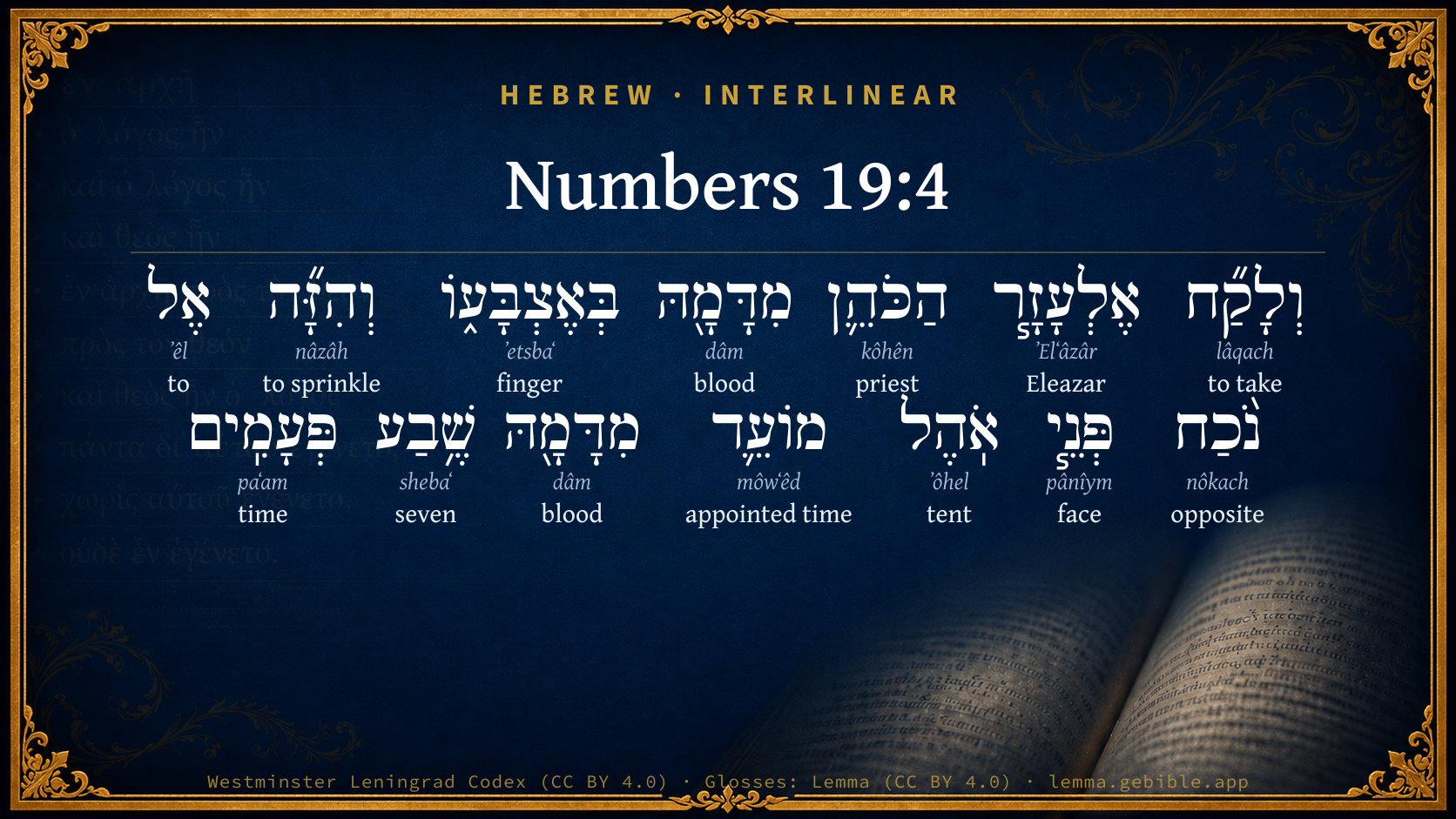
Hebrew (Westminster Leningrad Codex) Numbers 19:4 appears in the Hebrew Old Testament. The text above is from the Westminster Leningrad Codex. Each word links to its Strong’s number, a concise gloss, and parsing drawn from the Open Scriptures Hebrew Bible morphology. Click any word for its full Brown-Driver-Briggs (BDB) entry.
Download image
Cite this verse

Numbers 19:4 (World English Bible). Public Domain. Lemma interlinear Bible study tool, https://lemma.gebible.app/v/numbers/19/4.

Show BibTeX & RIS
BibTeX
RIS
English Translation
and Eleazar the priest shall take of her blood with his finger, and sprinkle her blood toward the front of the tent of meeting seven times.
World English Bible · Public Domain
Download a study sheet

One document with this verse’s original text, its word-by-word gloss line, the meaning frame, cross-references with their text, attributed commentary, and full source and license credits — printable, and it pastes into notes with its structure intact.

This verse Autodidact and up

Study sheet (.html) Plain text (.txt)

A passage Seminary Student

Up to 50 verses in one chapter. A passage sheet keeps up to 6 commentary sources and 12 cross-references per verse, in the order this page ranks them, and says so on the sheet whenever that leaves anything out. Ask for a single verse and you get the Autodidact verse sheet above.

Everything on this page stays free to read, with no account — the sheet is a download of what is already on screen, not access to it.

Want to remove ads? Support Godless Engineer
Compare translations 3

The same verse in 3 English versions, stacked beneath the original-language interlinear above. Click any original word for its lexicon entry.

Each is an independent rendering of the whole verse — the interlinear is not word-aligned to these translations.

Highlighted words mark where these versions differ — a whole-verse word diff, not a word-by-word alignment.

  • World English Bible Public Domain
    and Eleazar the priest shall take of her blood with his finger, and sprinkle her blood toward the front of the tent of meeting seven times.
  • King James Version Public Domain
    And Eleazar the priest shall take of her blood with his finger, and sprinkle of her blood directly before the tabernacle of the congregation seven times:
  • unfoldingWord Literal Text CC BY-SA 4.0
    And Eleazar the priest shall take some of its blood with his finger, and he shall sprinkle some of its blood toward opposite the face of the tent of meeting seven times.

unfoldingWord Literal Text — © unfoldingWord, licensed CC BY-SA 4.0. Word-aligned USFM3 via Door43 (git.door43.org/unfoldingWord/en_ult).

Versions to compare (up to 4)

3 of 4 selected

Show all 18 translations

Every available English version of this verse, each an independent rendering of the whole verse.

  • World English Bible Public Domain
    and Eleazar the priest shall take of her blood with his finger, and sprinkle her blood toward the front of the tent of meeting seven times.
  • Berean Standard Bible Public Domain
    Eleazar the priest is to take some of its blood on his finger and sprinkle it seven times toward the front of the Tent of Meeting.
  • Majority Standard Bible Public Domain
    Eleazar the priest is to take some of its blood on his finger and sprinkle it seven times toward the front of the Tent of Meeting.
  • King James Version Public Domain
    And Eleazar the priest shall take of her blood with his finger, and sprinkle of her blood directly before the tabernacle of the congregation seven times:
  • American Standard Version (1901) Public Domain
    and Eleazar the priest shall take of her blood with his finger, and sprinkle her blood toward the front of the tent of meeting seven times.
  • Revised Version (1885) Public Domain
    and Eleazar the priest shall take of her blood with his finger, and sprinkle of her blood toward the front of the tent of meeting seven times:
  • Geneva Bible (1599) Public Domain
    Then shall Eleazar the Priest take of her blood with his finger, and sprinkle it before the Tabernacle of the Congregation seuen times,
  • Douay-Rheims (1899) Public Domain
    And dipping his finger in her blood, shall sprinkle it over against the door of the tabernacle seven times,
  • Young's Literal Translation Public Domain
    `And Eleazar the priest hath taken of its blood with his finger, and hath sprinkled over-against the front of the tent of meeting of her blood seven times;
  • Literal Standard Version CC BY-SA 4.0
    And Eleazar the priest has taken of its blood with his finger, and has sprinkled [it] toward the front of the face of the Tent of Meeting from its blood seven times;
  • Unlocked Literal Bible CC BY-SA 4.0
    Eleazar the priest must take some of its blood with his finger and sprinkle it seven times toward the front of the tent of meeting.
  • unfoldingWord Literal Text CC BY-SA 4.0
    And Eleazar the priest shall take some of its blood with his finger, and he shall sprinkle some of its blood toward opposite the face of the tent of meeting seven times.
  • Darby Bible Public Domain
    And Eleazar the priest shall take of its blood with his finger, and shall sprinkle of its blood directly before the tent of meeting seven times.
  • World Messianic Bible Public Domain
    Eleazar the priest shall take some of her blood with his finger, and sprinkle her blood toward the front of the Tent of Meeting seven times.
  • Webster's Bible Public Domain
    And Eleazar the priest shall take of her blood with his finger, and sprinkle of her blood directly before the tabernacle of the congregation seven times:
  • Free Bible Version CC BY-SA 4.0
    Eleazar the priest will put some of its blood on his finger and sprinkle it seven times towards the entrance of the Tent of Meeting.
  • Bible in Basic English Public Domain
    Then let Eleazar the priest take some of her blood on his finger, shaking the blood seven times in the direction of the front of the Tent of meeting:
  • JPS Tanakh (1917) Public Domain
    And Eleazar the priest shall take of her blood with his finger, and sprinkle of her blood toward the front of the tent of meeting seven times.

Literal Standard Version (2020), Covenant Press — licensed CC BY-SA 4.0. Text via the HelloAO Bible API (eBible.org). Unlocked Literal Bible (unfoldingWord) — licensed CC BY-SA 4.0. Text via the HelloAO Bible API (eBible.org). unfoldingWord Literal Text — © unfoldingWord, licensed CC BY-SA 4.0. Word-aligned USFM3 via Door43 (git.door43.org/unfoldingWord/en_ult). Free Bible Version, Dr. Jonathan Gallagher — licensed CC BY-SA 4.0. Text via the HelloAO Bible API (eBible.org).

Word by word

More ways to search: Search by grammar → Find every occurrence → Compare this word →

Practice this passage: Drill this verse → Learn its vocabulary →

נֹ֨כַח
nôkach
H5227
“opposite”
Preposition
Part of Speech
Preposition
Full BDB Definition

Origin: from the same as H5226

TWOT: 1365a

be in front of - in front of, opposite to, in the sight of, before, to the front, right on - towards the front of, in front of, on behalf of, as far as in front of
  1. וְלָקַ֞ח lâqach H3947 “and · to take” Conjunction + Verb, Qal, Sequential Perfect, 3rd Person, Masculine, Singular
  2. אֶלְעָזָ֧ר ʼElʻâzâr H499 “Eleazar” Noun, Proper
  3. הַכֹּהֵ֛ן kôhên H3548 “the · priest” Particle, Definite Article + Noun, Common, Masculine, Singular, Absolute
  4. מִדָּמָ֖הּ dâm H1818 “from · blood · her” Preposition + Noun, Common, Masculine, Singular, Construct + Suffix, Personal, 3rd Person, Feminine, Singular
  5. בְּאֶצְבָּע֑וֹ ʼetsbaʻ H676 “in/at · finger · his” Preposition + Noun, Common, Feminine, Singular, Construct + Suffix, Personal, 3rd Person, Masculine, Singular
  6. וְהִזָּ֞ה nâzâh H5137 “and · to sprinkle” Conjunction + Verb, Hiphil, Sequential Perfect, 3rd Person, Masculine, Singular
  7. אֶל ʼêl H413 “to” Preposition
  8. פְּנֵ֧י pânîym H6440 “face(s) of” Noun, Common, Both, Plural, Construct
  9. אֹֽהֶל ʼôhel H168 “tent of” Noun, Common, Masculine, Singular, Construct
  10. מוֹעֵ֛ד môwʻêd H4150 “appointed time” Noun, Common, Masculine, Singular, Absolute
  11. מִדָּמָ֖הּ dâm H1818 “from · blood · her” Preposition + Noun, Common, Masculine, Singular, Construct + Suffix, Personal, 3rd Person, Feminine, Singular
  12. שֶׁ֥בַע shebaʻ H7651 “seven” Adjective, Cardinal number, Feminine, Singular, Absolute
  13. פְּעָמִֽים paʻam H6471 “times” Noun, Common, Feminine, Plural, Absolute

About this verse

These counts appear in no published source. They are computed here, from the morphology-tagged text and Lemma’s own curated glosses. What Lemma adds →

14
words
13
distinct lemmas
Pentateuch
section

Notable vocabulary

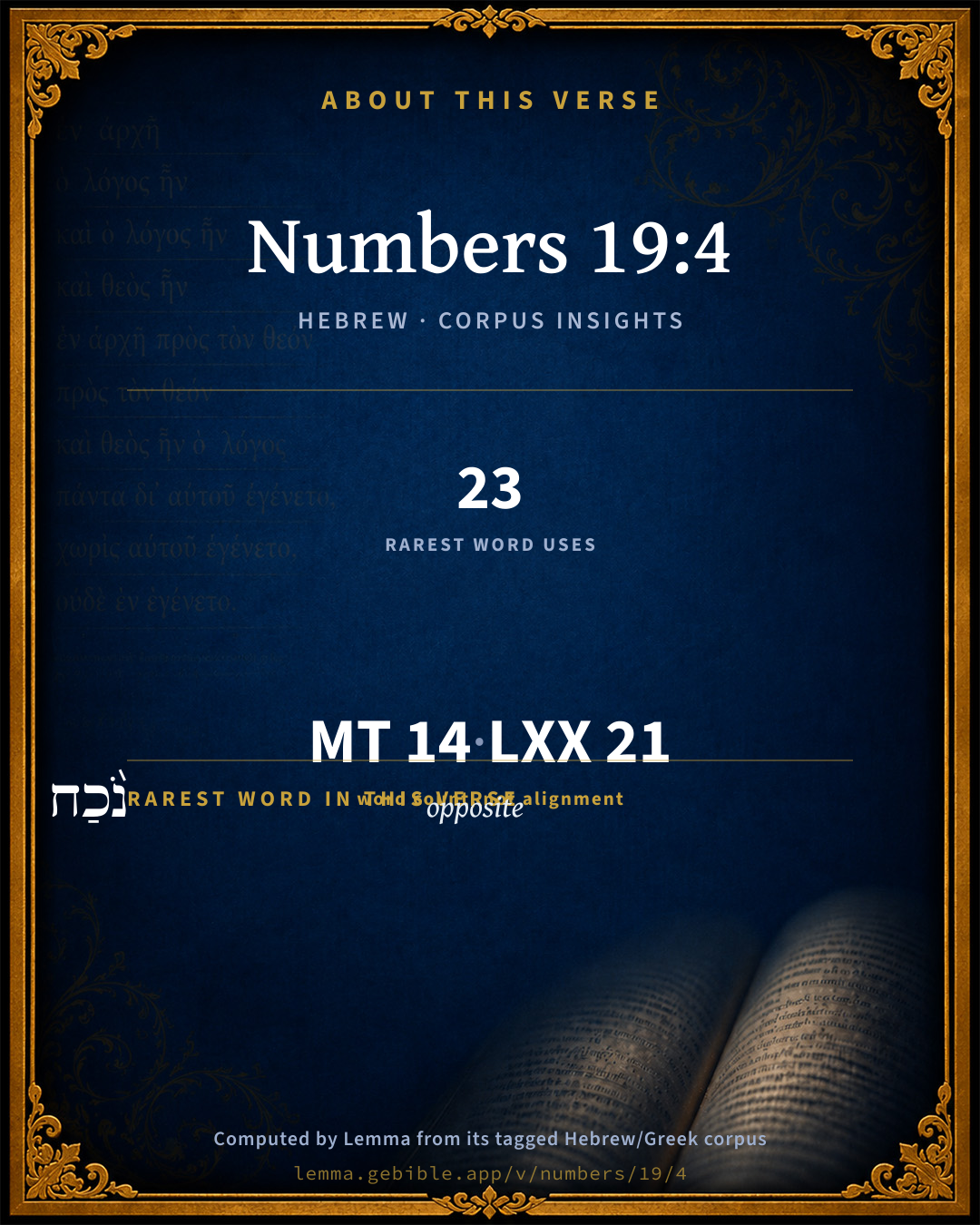
The rarest word here is נֹ֨כַח opposite H5227 — appearing just 23 times in the whole Hebrew Bible.

Shared distinctive vocabulary

נֹ֨כַח opposite H5227 occurs in 22 verses of the Hebrew Bible. Also found in:

Grammatical profile

  • 2 verbs
  • 9 nouns
  • 1 adjective
  • 2 prepositions

Verb forms

  • וְלָקַ֞ח Qal · Sequential Perfect
  • וְהִזָּ֞ה Hiphil · Sequential Perfect

Repetition

A word recurs within this verse — often emphatic in Hebrew:

  • מִדָּמָ֖הּ blood H1818 ×2

Hebrew & Septuagint length

In English translation the verse runs 26 words from the Hebrew and 21 from the Septuagint (LXX English) — closely comparable.

A rough comparison of the two English renderings, which tokenize alike — not a word-level alignment.

Word counts can differ between the Hebrew and the Greek without any difference in meaning — e.g. the Hebrew direct-object marker אֵת has no separate Greek word, and Greek often adds the article ὁ.

In the original languages it is 14 Hebrew tokens and 21 Greek tokens — but the two are counted differently (Hebrew bundles its prefixes and suffixes into one token; the Greek is in lemma form), so that isn’t a like-for-like length.

Cross-references

7

Topical passages linked to Numbers 19:4 in the Treasury of Scripture Knowledge — connected by theme and wording, ordered by reader-vote popularity; previews shown in the World English Bible.

  • Leviticus 4:17 and the priest shall dip his finger in the blood, and sprinkle it seven times before Yahweh, before the veil.
  • Leviticus 4:6 The priest shall dip his finger in the blood, and sprinkle some of the blood seven times before Yahweh, before the veil of the sanctuary.
  • Leviticus 16:14 He shall take some of the blood of the bull, and sprinkle it with his finger on the mercy seat on the east; and before the mercy seat he shall sprinkle some of the blood with his finger seven times.
  • Leviticus 16:19 He shall sprinkle some of the blood on it with his finger seven times, and cleanse it, and make it holy from the uncleanness of the children of Israel.
  • Hebrews 9:13–14 For if the blood of goats and bulls, and the ashes of a heifer sprinkling those who have been defiled, sanctify to the cleanness of the flesh:
  • Hebrews 12:24 to Jesus, the mediator of a new covenant, and to the blood of sprinkling that speaks better than that of Abel.
  • 1 Peter 1:2 according to the foreknowledge of God the Father, in sanctification of the Spirit, that you may obey Jesus Christ and be sprinkled in his blood: Grace to you and peace be multiplied.

Cross-references courtesy of OpenBible.info (CC BY 4.0).

Hebrew and Greek witnesses Masoretic Hebrew ↔ Greek Septuagint

The same verse in the two great witnesses to the Old Testament, shown verse-for-verse.

These are two independent witnesses, not word-aligned to each other, and the Septuagint is shown in lemma (dictionary) form.

Hebrew Numbers 19:4 Masoretic · Westminster Leningrad Codex

וְלָקַ֞ח אֶלְעָזָ֧ר הַכֹּהֵ֛ן מִדָּמָ֖הּ בְּאֶצְבָּע֑וֹ וְהִזָּ֞ה אֶל נֹ֨כַח פְּנֵ֧י אֹֽהֶל מוֹעֵ֛ד מִדָּמָ֖הּ שֶׁ֥בַע פְּעָמִֽים

and Eleazar the priest shall take of her blood with his finger, and sprinkle her blood toward the front of the tent of meeting seven times.

World English Bible · Public Domain

Greek LXX Numbers 19:4 Septuagint · lemma form

καί λαμβάνω ελεαζαρ ἀπό ὁ αἷμα αὐτός καί ῥαίνω ἀπέναντι ὁ πρόσωπον ὁ σκηνή ὁ μαρτύριον ἀπό ὁ αἷμα αὐτός ἑπτάκις

And Eleazar shall take of her blood, and sprinkle of her blood seven times in front of the tabernacle of witness.

LXX2012 (modern English Septuagint) · Public Domain

Hebrew: Westminster Leningrad Codex (CC BY 4.0). Greek: Septuagint (public domain); English from LXX2012 (modern English Septuagint) (Public Domain). How the Septuagint differs from the Hebrew →

Targum (Aramaic paraphrase)

2

The Targum is the ancient Jewish Aramaic paraphrase of the Hebrew Scriptures — an interpretive translation, not the Hebrew text itself. Onkelos (literal) and Pseudo-Jonathan (expansive) render the Torah, and Jonathan the Prophets. Coverage is partial: where no permissively-licensed English translation exists for a verse, only the Aramaic is shown. This is verse-level text, not a word-by-word alignment to the Hebrew.

  1. Targum Onkelos Torah (Genesis–Deuteronomy)
    וְיִסַב אֶלְעָזָר כַּהֲנָא מִדְמַהּ בְּאֶצְבְּעֵיהּ וְיַדֵי לָקֳבֵל אַפֵּי מַשְׁכַּן זִמְנָא מִדְמַהּ שְׁבַע זִמְנִין

    (no public-domain English translation for this verse)

    Targum Onkelos — Aramaic: “Onkelos Genesis” (public domain); “Onkelos Exodus” (public domain); “Onkelos Leviticus” (public domain); “Onkelos Numbers” (public domain); “Onkelos Deuteronomy” (public domain). English: “Sefaria Community Translation” (CC0 1.0 (public-domain dedication)); “J.W. Etheridge. The Targums of Onkelos and Jonathan Ben Uzziel on the Pentateuch. London: Longmans, Green, 1862” (public domain). Text via Sefaria.

  2. Targum Pseudo-Jonathan Torah (Genesis–Deuteronomy)
    וְיִסַב אֶלְעָזָר בְּכִיהוּנֵיהּ מִן אַדְמֵיהּ בְּאַדְבַּע יַד יְמִינֵיהּ וְלָא יְקַבְּלִינֵיהּ בְּמָנָא וְיַדֵי לְסִידוּרָא דְקִיסֵי תֵינַיָא מִן לָגִין מִן צִטְרָא דִמְמַצַע כָּל קֳבֵיל אַפֵּי מַשְׁכַּן זִימְנָא מֵאַדְמָא בְּטִיבוּלָא חֲדָא שְׁבַע זִמְנִין

    And Elazar, in his priestly dress, shall take of her blood with the finger of his right hand, without (first) containing it in a vessel, and shall sprinkle the border of fig branches, and (afterwards) from the midst of a vessel on one side towards the tabernacle of ordinance, with one dipping, seven times (shall he sprinkle).

    Targum Pseudo-Jonathan — Aramaic: “Targum Jonathan on Genesis” (public domain); “Targum Jonathan on Exodus” (public domain); “Targum Jonathan on Leviticus” (public domain); “Targum Jonathan on Numbers” (public domain); “Targum Jonathan on Deuteronomy” (public domain). English: “The Targum of Jonathan ben Uzziel, trans. J. W. Etheridge, London, 1862” (public domain). Text via Sefaria.

Commentary

Notes on Numbers 19:4 from classic Christian and Jewish commentators (each source and its license shown beneath its notes). The classic Christian expositions comment on the surrounding passage and are grouped to its opening verse, so a note may address several verses; the Jewish commentaries on the Tanakh (Rashi and others) are per-verse, so they appear only where the commentator wrote on this verse.

Lemma curates 59 commentaries, every one of them public domain or Creative Commons licensed, each selected and text-cleaned for this edition rather than reprinted as found. About our sources →

Trapp's Complete Commentary

John Trapp

Num 19:4 And Eleazar the priest shall take of her blood with his finger, and sprinkle of her blood directly before the tabernacle of the congregation seven times:

Ver. 4. Shall take of the blood with his finger.] Not with his whole hand. Christ’s blood must be touched or applied with great discretion and reverence; our practice also must be dyed in Christ’s blood.

John Trapp, A Commentary or Exposition upon All the Books of the Old and New Testament (1647–1656) — public domain. Text from a community e-Sword module.

Joseph Benson's Commentary

Num 19:4. Sprinkle of her blood directly before the tabernacle — This made it in some sort an expiation of sin; for the sprinkling of the blood before the Lord was the chief solemnity in all the sacrifices of atonement: therefore, though this was not done at the altar, yet, being done toward the sanctuary, it was intimated hereby that the virtue and validity of it depended upon the sanctuary, and were derived from it. Thus, in the satisfaction that was made to God by the death of Christ, our great High- Priest, who, by the eternal Spirit, (called, Luk 12:20, the finger of God,) offered himself without spot to God; he did, as it were, sprinkle his own blood directly before the sanctuary, when he said, “Father, into thy hands I commit my spirit.” This also signifies how necessary it was, to the purifying our hearts, that satisfaction should be made to divine justice. This sprinkling of the blood put virtue into the ashes.

Joseph Benson's Commentary on the Old and New Testaments (1811–1818) — public domain. Text from a community e-Sword module.

Ellicott's Commentary for English Readers

(4) And Eleazar the priest shall take of her blood . . . —The appointed rites were to be discharged by Eleazar, not by Aaron, who would otherwise have been temporarily disqualified by legal impurity from the discharge of his high-priestly functions.

Before the tabernacle of the congregation . . . —i.e., opposite to the entrance of the Tabernacle, but, as stated in the preceding verse, outside the camp, because the act had reference to the uncleanness of death.

A Bible Commentary for English Readers, edited by Charles John Ellicott (1878–1897) — public domain. Text from a community e-Sword module.

John Gill's Exposition

And Eleazar the priest shall take of her blood with his finger,.... He took the blood in his left hand, and sprinkled it with the finger of his right hand, as Maimonides says (a); and so the Targum of Jonathan, which says, he did not receive it into a vessel, but into the palm of his hand, and from thence sprinkled it with his finger (b): which Ainsworth thinks signified the Spirit of Christ, our high priest, called "the finger of God", Luk 11:20; who takes the blood of Christ, and sprinkles it on the hearts of his people, whereby they are freed from an evil conscience:

and sprinkle of her blood directly before the tabernacle of the congregation seven times; or "towards the tabernacle", so Noldius (c); as sprinkling of the blood was the principal action in sacrifices, this was to be done directly before the tabernacle, from whence its purifying virtue was expected, though it was not shed in it, that it might have all the appearance of a sacrifice it could have; and being done seven times, denotes the perfection of it: the priest, when he sprinkled, stood on the east side, with his face to the west. When the temple was built at Jerusalem, this affair was transacted on the mount of Olives, which was east of Jerusalem. Jarchi says, the priest stood in the east of Jerusalem, and placed himself so that he might see the door of the temple at the time of sprinkling the blood. Now it appears, as Maimonides says (d), that the floor of the temple was higher than the floor of the eastern gate of the mountain of the house twenty two cubits, and the height of the gate of the mountain of the house was twenty cubits; wherefore one that stood over against the eastern gate could not see the door of the temple, therefore they made the wall, which was over the top of this gate (the battlement of it), low, so that he (the priest), that stood on the mount of Olives, might see the door of the temple, at the time he sprinkled the blood of the cow over against the temple; otherwise he could only have seen the eighth step of the porch of the temple, as the same writer observes (e), with which agrees the Misnah (f), that all the walls there (about the mountain of the house) were high, except the eastern wall, that so the priest that burnt the cow might stand on the top of the mount of Olives, and look and behold the door of the temple, when he sprinkled the blood.

(a) Hilchot Parah Adumah, c. 3. sect. 2. (b) Vid. Misn. Parah, c. 3. sect. 7. (c) P. 81. No. 379. (d) Hilchot Beth Habechirah, c. 6. sect. 2. (e) In Misn, Middot, c. 2. sect. 4. (f) Misn. ib.

John Gill's Exposition of the Whole Bible (1746–1763) — public domain (CC PDM 1.0). Text via the HelloAO Bible API.

Haydock's Catholic Bible Commentary

And. Hebrew, "And Eleazar, the priest, shall take part of her blood with his finger." He looked from the pile of wood, where he was standing, towards the west, and sprinkled the blood, and wiping his fingers upon the skin of the cow, waiting till the fire was kindled, before he opened her belly; he then threw into the fire the cedar-wood, &c. (Drusius) --- Others believe that this last ceremony was performed by some one else, (ver. 7,) as it is not clear that Eleazar became unclean. His being substituted instead of Aaron, might shew that Christ would institute a new priesthood.

George Leo Haydock (1774–1849), Haydock's Catholic Family Bible and Commentary, 1859 edition — public domain. Excludes Psalms (Douay-Rheims chapter numbering differs from Protestant) and Deuterocanonical books (Catholic canon only).

Matthew Poole's English Annotations

Directly before the tabernacle, or, towards or over against the tabernacle; either,

1. Near to it; and so we must suppose that he took some of the blood in a basin, and carried it from without the camp to the tabernacle, and then returned to this place again; which might be done, though it be not here expressed. And this seems to agree best with other places, where this sprinkling seven times was performed in or near the tabernacle, as Lev 4:17. Or,

2. Standing at a good distance from it, even without the camp, yet turning and looking towards it. For here is no intimation that he went into the camp before this work was done, but rather the contrary is implied, Num 19:7. And because being defiled by this work he could not come near to the tabernacle, it was sufficient for him to turn and took towards it. Either way this posture signified his presenting of this blood before the Lord by way of atonement and satisfaction for his and the people’s sins, and his expectation of acceptance and pardon only from God, and from his mercy-seat in the tabernacle.

Matthew Poole's English Annotations on the Holy Bible (1683–1685) — public domain. Text from a community e-Sword/MySword module.

Whedon's Commentary on the Bible

Daniel D. Whedon

4. Before the tabernacle — Properly toward the front of the tabernacle. Thus was the sacrifice referred to Jehovah.

Seven times — Lev_4:6, note.

Daniel D. Whedon (gen. ed.), Commentary on the Old and New Testaments (1874–1909) — public domain. Text from a community e-Sword module.

The Pulpit Commentary

And Eleazar... shall... sprinkle of her blood directly before (yneP jknOAlae) the tabernacle. By this act the death of the heifer became a sacrificial offering. The sprinkling in the direction of the sanctuary intimated that the offering was made to him that dwelt therein, and the "seven times" was the ordinary number of perfect performance. (Lev_4:17, &c.);

The Pulpit Commentary (1880–1919), ed. H.D.M. Spence-Jones & Joseph S. Exell — public domain. Text from a community e-Sword module.

John Wesley's Explanatory Notes

Before the tabernacle - Or, towards the tabernacle, standing at a good distance from it, even without the camp, yet turning and looking towards it. For here is no intimation that he went into the camp before this work was done, but rather the contrary is implied, ver. 7. And because being defiled by this work he could not come near the tabernacle, it was sufficient for him to turn and look towards it. This signified his presenting this blood before the Lord by way of atonement for his and the people's sins, and his expectation of acceptance and pardon only from God, and from his mercy-seat in the tabernacle. And this typified the satisfaction that was made to God, by the death of Christ, who by the eternal Spirit offered himself without spot to God, and did as it were sprinkle his own blood before the sanctuary, when he said, Into thy hands I commend my spirit!

John Wesley, Explanatory Notes Upon the Whole Bible (1754–1765) — public domain. Text via the GEBible commentary corpus.

Rashi

Rabbi Shlomo Yitzchaki (Rashi)

אל נכח פני אהל מועד [HE SHALL SPRINKLE THE BLOOD] TOWARDS THE FRONT SIDE OF THE APPOINTED TENT He stands at the East of Jerusalem and must direct his gaze straight towards the entrance of the Hechal at the time of sprinkling the blood (Sifrei Bamidbar 123:2; Yoma 68a).

Rashi on the Tanakh — English translations: “The Judaica Press complete Tanach with Rashi, translated by A. J. Rosenberg” (CC BY 4.0); “Pentateuch with Rashi's commentary by M. Rosenbaum and A.M. Silbermann, 1929-1934” (public domain); “The Metsudah Tanach series, Lakewood, N.J” (CC BY 4.0); and “The Book of Joshua, Metsudah Publications, 1997” (CC BY 4.0). Text via Sefaria.

Lesson kit

Teaching starters — assembled from the data on this page, not authored interpretation. Every prompt links to the verse data it draws on. Edit before teaching.

Numbers, in the Pentateuch, opens this verse with 14 words (13 distinct Hebrew lemmas). Its most distinctive word is nôkach (“opposite”). A historical commentator’s framing appears above. Read the whole chapter for the surrounding context.

Discussion questions

  1. The word nôkach carries the sense “opposite.” How does it shape the verse?
  2. Genesis 25:21 shares the word «opposite» with this verse. How do the two illuminate each other?
  3. “blood” occurs 2× in this one verse. What is the effect of the repetition?
  4. The translations on this page render this verse differently — a whole-verse word diff, not a word-by-word alignment. What might account for the different wordings?
  5. The verb «וְלָקַ֞ח» is Qal Sequential Perfect. How does its form color the action?
  6. Reading how Trapp's Complete Commentary and Joseph Benson's Commentary read this verse, where do the two commentators agree and where do they part?

Things to notice

Reading settings

Reading text

Shown beneath each verse's original-language words.

Old Testament
Old Testament edition

Read the OT as the Masoretic Hebrew (MT) or the Greek Septuagint (LXX).

English shown for the Greek Septuagint (in the Hebrew ↔ Greek comparison).

Comparing translations? Open the Compare panel on any verse page to stack up to four side by side.