1 Samuel 16:10

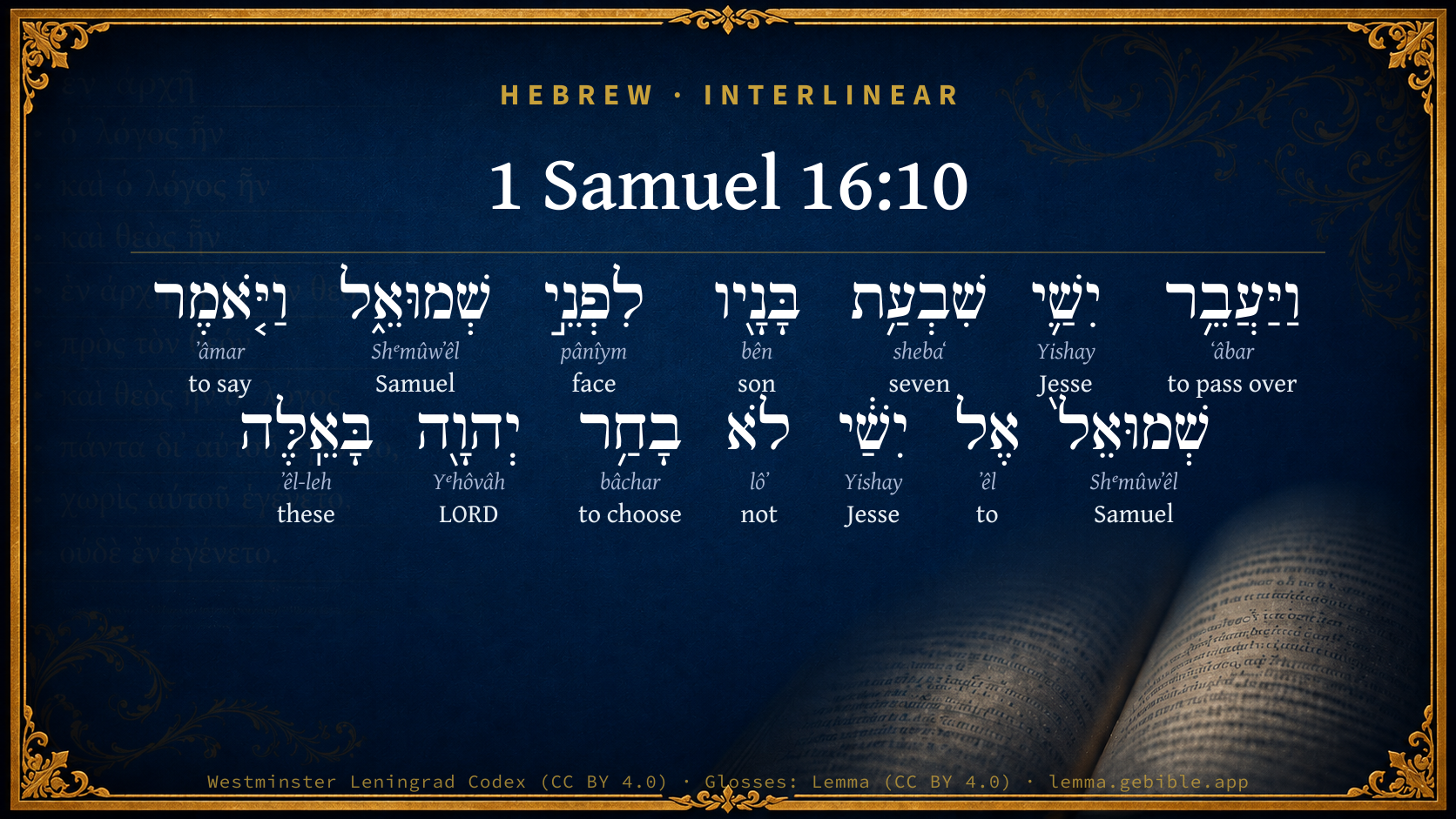
Hebrew (Westminster Leningrad Codex) 1 Samuel 16:10 appears in the Hebrew Old Testament. The text above is from the Westminster Leningrad Codex. Each word links to its Strong’s number, a concise gloss, and parsing drawn from the Open Scriptures Hebrew Bible morphology. Click any word for its full Brown-Driver-Briggs (BDB) entry.
Download image
Cite this verse

1 Samuel 16:10 (World English Bible). Public Domain. Lemma interlinear Bible study tool, https://lemma.gebible.app/v/1-samuel/16/10.

Show BibTeX & RIS
BibTeX
RIS
English Translation
Jesse made seven of his sons to pass before Samuel. Samuel said to Jesse, Yahweh has not chosen these.
World English Bible · Public Domain
Download a study sheet

One document with this verse’s original text, its word-by-word gloss line, the meaning frame, cross-references with their text, attributed commentary, and full source and license credits — printable, and it pastes into notes with its structure intact.

This verse Autodidact and up

Study sheet (.html) Plain text (.txt)

A passage Seminary Student

Up to 50 verses in one chapter. A passage sheet keeps up to 6 commentary sources and 12 cross-references per verse, in the order this page ranks them, and says so on the sheet whenever that leaves anything out. Ask for a single verse and you get the Autodidact verse sheet above.

Everything on this page stays free to read, with no account — the sheet is a download of what is already on screen, not access to it.

Want to remove ads? Support Godless Engineer
Compare translations 3

The same verse in 3 English versions, stacked beneath the original-language interlinear above. Click any original word for its lexicon entry.

Each is an independent rendering of the whole verse — the interlinear is not word-aligned to these translations.

Highlighted words mark where these versions differ — a whole-verse word diff, not a word-by-word alignment.

  • World English Bible Public Domain
    Jesse made seven of his sons to pass before Samuel. Samuel said to Jesse, Yahweh has not chosen these.
  • King James Version Public Domain
    Again, Jesse made seven of his sons to pass before Samuel. And Samuel said unto Jesse, The LORD hath not chosen these.
  • unfoldingWord Literal Text CC BY-SA 4.0
    And Jesse made seven of his sons pass over to the face of Samuel, but Samuel said to Jesse, “Yahweh has not chosen among these.”

unfoldingWord Literal Text — © unfoldingWord, licensed CC BY-SA 4.0. Word-aligned USFM3 via Door43 (git.door43.org/unfoldingWord/en_ult).

Versions to compare (up to 4)

3 of 4 selected

Show all 18 translations

Every available English version of this verse, each an independent rendering of the whole verse.

  • World English Bible Public Domain
    Jesse made seven of his sons to pass before Samuel. Samuel said to Jesse, Yahweh has not chosen these.
  • Berean Standard Bible Public Domain
    Thus Jesse made seven of his sons pass before Samuel, but Samuel told him, “The LORD has not chosen any of these.”
  • Majority Standard Bible Public Domain
    Thus Jesse made seven of his sons pass before Samuel, but Samuel told him, “The LORD has not chosen any of these.”
  • King James Version Public Domain
    Again, Jesse made seven of his sons to pass before Samuel. And Samuel said unto Jesse, The LORD hath not chosen these.
  • American Standard Version (1901) Public Domain
    And Jesse made seven of his sons to pass before Samuel. And Samuel said unto Jesse, Jehovah hath not chosen these.
  • Revised Version (1885) Public Domain
    And Jesse made seven of his sons to pass before Samuel. And Samuel said unto Jesse, The LORD hath not chosen these.
  • Geneva Bible (1599) Public Domain
    Againe Ishai made his seue sonnes to come before Samuel: and Samuel saide vnto Ishai, The Lord hath chosen none of these.
  • Douay-Rheims (1899) Public Domain
    Isai therefore brought his seven sons before Samuel: and Samuel said to Isai: The Lord hath not chosen any one of these.
  • Young's Literal Translation Public Domain
    And Jesse causeth seven of his sons to pass by before Samuel, and Samuel saith to Jesse, `Jehovah hath not fixed on these.'
  • Literal Standard Version CC BY-SA 4.0
    And Jesse causes seven of his sons to pass by before Samuel, and Samuel says to Jesse, “YHWH has not fixed on these.”
  • Unlocked Literal Bible CC BY-SA 4.0
    Jesse made seven of his sons pass before Samuel. Then Samuel said to Jesse, “Yahweh has not chosen any of these.”
  • unfoldingWord Literal Text CC BY-SA 4.0
    And Jesse made seven of his sons pass over to the face of Samuel, but Samuel said to Jesse, “Yahweh has not chosen among these.”
  • Darby Bible Public Domain
    And Jesse made seven of his sons pass before Samuel. And Samuel said to Jesse, Jehovah has not chosen these.
  • World Messianic Bible Public Domain
    Jesse made seven of his sons to pass before Samuel. Samuel said to Jesse, “The LORD has not chosen these.”
  • Webster's Bible Public Domain
    Again, Jesse made seven of his sons to pass before Samuel. And Samuel said to Jesse, The LORD hath not chosen these.
  • Free Bible Version CC BY-SA 4.0
    Jesse had seven of his sons come before Samuel, but Samuel told him, “The Lord has not chosen any of these.”
  • Bible in Basic English Public Domain
    And Jesse made his seven sons come before Samuel. And Samuel said to Jesse, The Lord has not taken any of these.
  • JPS Tanakh (1917) Public Domain
    And Jesse made seven of his sons to pass before Samuel. And Samuel said unto Jesse: 'The LORD hath not chosen these.'

Literal Standard Version (2020), Covenant Press — licensed CC BY-SA 4.0. Text via the HelloAO Bible API (eBible.org). Unlocked Literal Bible (unfoldingWord) — licensed CC BY-SA 4.0. Text via the HelloAO Bible API (eBible.org). unfoldingWord Literal Text — © unfoldingWord, licensed CC BY-SA 4.0. Word-aligned USFM3 via Door43 (git.door43.org/unfoldingWord/en_ult). Free Bible Version, Dr. Jonathan Gallagher — licensed CC BY-SA 4.0. Text via the HelloAO Bible API (eBible.org).

Word by word

More ways to search: Search by grammar → Find every occurrence → Compare this word →

Practice this passage: Drill this verse → Learn its vocabulary →

יִשַׁ֛י
Yishay
H3448
“Jesse”
Noun, Proper
Part of Speech
Noun
Type
Proper
Full BDB Definition

Origin: from the same as H3426

TWOT: 926

Jesse = "I possess" - son of Boaz and the father of king David
  1. וַיַּעֲבֵ֥ר ʻâbar H5674 “and · to pass over” Conjunction + Verb, Hiphil, Sequential Imperfect, 3rd Person, Masculine, Singular
  2. שִׁבְעַ֥ת shebaʻ H7651 “seven” Adjective, Cardinal number, Masculine, Singular, Construct
  3. בָּנָ֖יו bên H1121 “sons · his” Noun, Common, Masculine, Plural, Construct + Suffix, Personal, 3rd Person, Masculine, Singular
  4. לִפְנֵ֣י pânîym H6440 “to/for · face(s) of” Preposition + Noun, Common, Both, Plural, Construct
  5. שְׁמוּאֵ֑ל Shᵉmûwʼêl H8050 “Samuel” Noun, Proper
  6. וַיֹּ֤אמֶר ʼâmar H559 “and · to say” Conjunction + Verb, Qal, Sequential Imperfect, 3rd Person, Masculine, Singular
  7. שְׁמוּאֵל֙ Shᵉmûwʼêl H8050 “Samuel” Noun, Proper
  8. אֶל ʼêl H413 “to” Preposition
  9. יִשַׁ֔י Yishay H3448 “Jesse” Noun, Proper
  10. לֹא lôʼ H3808 “not” Particle, Negative
  11. בָחַ֥ר bâchar H977 “to choose” Verb, Qal, Perfect, 3rd Person, Masculine, Singular
  12. יְהוָ֖ה Yᵉhôvâh H3068 “LORD” Noun, Proper
  13. בָּאֵֽלֶּה ʼêl-leh H428 “in/at · these” Preposition + Pronoun, Demonstrative, Common, Plural

About this verse

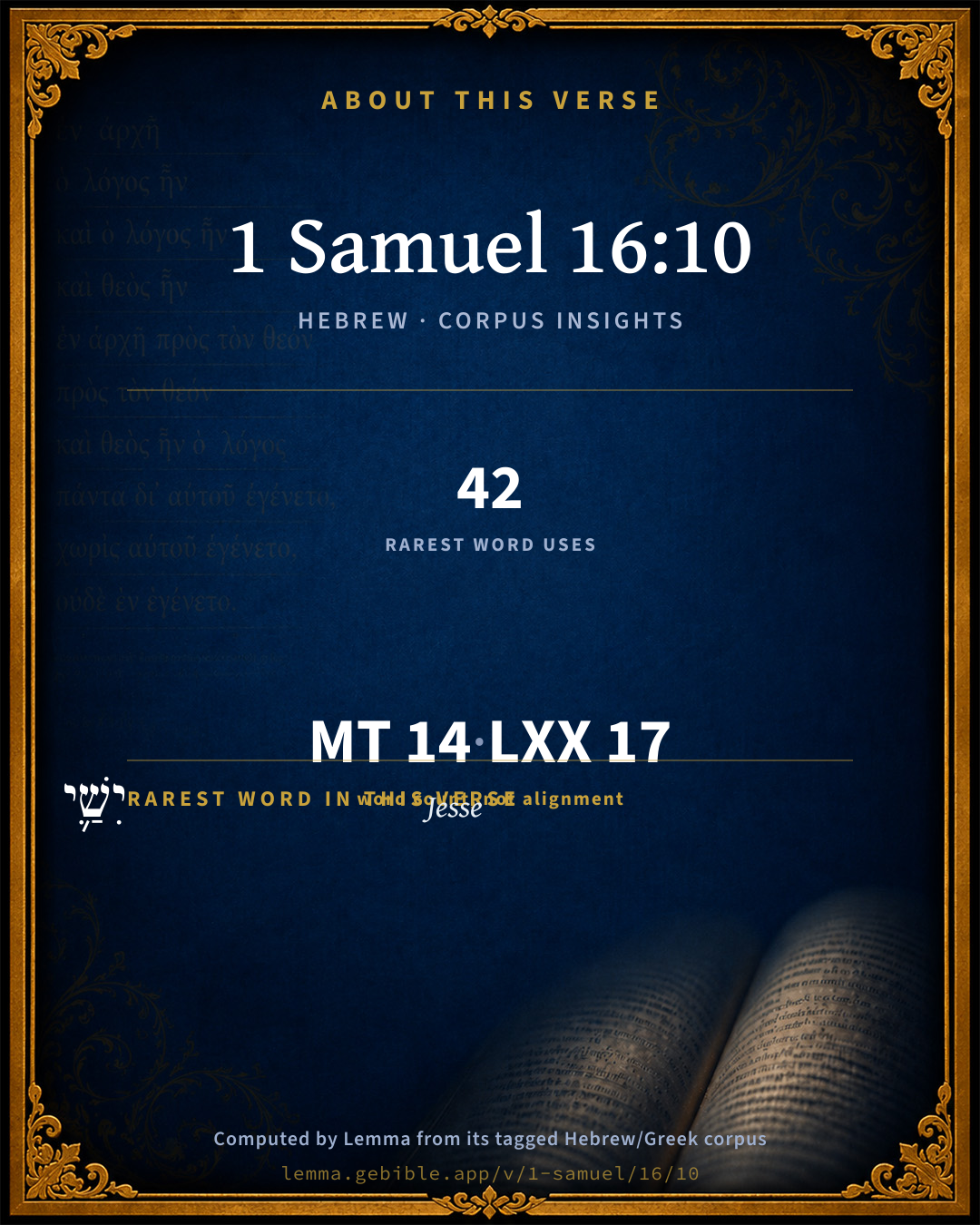
These counts appear in no published source. They are computed here, from the morphology-tagged text and Lemma’s own curated glosses. What Lemma adds →

14
words
12
distinct lemmas
Historical
section

Shared distinctive vocabulary

יִשַׁ֛י Jesse H3448 occurs in 39 verses of the Hebrew Bible. Also found in:

Grammatical profile

  • 3 verbs
  • 7 nouns
  • 1 adjective
  • 1 pronoun
  • 1 preposition
  • 1 particle

Verb forms

  • וַיַּעֲבֵ֥ר Hiphil · Sequential Imperfect
  • וַיֹּ֤אמֶר Qal · Sequential Imperfect
  • בָחַ֥ר Qal · Perfect

Repetition

Words recur within this verse — often emphatic in Hebrew:

  • יִשַׁ֛י Jesse H3448 ×2
  • שְׁמוּאֵ֑ל Samuel H8050 ×2

Hebrew & Septuagint length

In English translation the verse runs 19 words from the Hebrew and 19 from the Septuagint (LXX English) — the same length.

A rough comparison of the two English renderings, which tokenize alike — not a word-level alignment.

Word counts can differ between the Hebrew and the Greek without any difference in meaning — e.g. the Hebrew direct-object marker אֵת has no separate Greek word, and Greek often adds the article ὁ.

In the original languages it is 14 Hebrew tokens and 17 Greek tokens — but the two are counted differently (Hebrew bundles its prefixes and suffixes into one token; the Greek is in lemma form), so that isn’t a like-for-like length.

Cross-references

1

Topical passages linked to 1 Samuel 16:10 in the Treasury of Scripture Knowledge — connected by theme and wording, ordered by reader-vote popularity; previews shown in the World English Bible.

  • 1 Chronicles 2:13–15 and Jesse became the father of his firstborn Eliab, and Abinadab the second, and Shimea the third,

Cross-references courtesy of OpenBible.info (CC BY 4.0).

Hebrew and Greek witnesses Masoretic Hebrew ↔ Greek Septuagint

The same verse in the two great witnesses to the Old Testament, shown verse-for-verse.

These are two independent witnesses, not word-aligned to each other, and the Septuagint is shown in lemma (dictionary) form.

Hebrew 1 Samuel 16:10 Masoretic · Westminster Leningrad Codex

וַיַּעֲבֵ֥ר יִשַׁ֛י שִׁבְעַ֥ת בָּנָ֖יו לִפְנֵ֣י שְׁמוּאֵ֑ל וַיֹּ֤אמֶר שְׁמוּאֵל֙ אֶל יִשַׁ֔י לֹא בָחַ֥ר יְהוָ֖ה בָּאֵֽלֶּה

Jesse made seven of his sons to pass before Samuel. Samuel said to Jesse, Yahweh has not chosen these.

World English Bible · Public Domain

Greek LXX 1 Samuel 16:10 Septuagint · lemma form

καί παραἄγω ιεσσαι ὁ ἑπτά υἱός αὐτός ἐνώπιον σαμουηλ καί εἶπον σαμουηλ οὐ ἐκλέγω κύριος ἐν οὗτος

And Jessae caused his seven sons to pass before Samuel: and Samuel said, the Lord has not chosen these.

LXX2012 (modern English Septuagint) · Public Domain

Hebrew: Westminster Leningrad Codex (CC BY 4.0). Greek: Septuagint (public domain); English from LXX2012 (modern English Septuagint) (Public Domain). How the Septuagint differs from the Hebrew →

Targum (Aramaic paraphrase)

1

The Targum is the ancient Jewish Aramaic paraphrase of the Hebrew Scriptures — an interpretive translation, not the Hebrew text itself. Onkelos (literal) and Pseudo-Jonathan (expansive) render the Torah, and Jonathan the Prophets. Coverage is partial: where no permissively-licensed English translation exists for a verse, only the Aramaic is shown. This is verse-level text, not a word-by-word alignment to the Hebrew.

  1. Targum Jonathan Prophets (Joshua–Malachi)
    וְאַעֲבַר יִשַׁי שַׁבְעָא בְנוֹהִי קֳדָם שְׁמוּאֵל וַאֲמַר שְׁמוּאֵל לְיִשַׁי לָא רַעֲוָא קֳדָם יְיָ בְּאִלֵין:

    (no public-domain English translation for this verse)

    Targum Jonathan — Aramaic: “Mikraot Gedolot” (public domain). English: “Sefaria Community Translation” (CC0 1.0 (public-domain dedication)); “London "Chaldee Paraphrase," 1871” (public domain). Text via Sefaria.

Commentary

Notes on 1 Samuel 16:10 from classic Christian and Jewish commentators (each source and its license shown beneath its notes). The classic Christian expositions comment on the surrounding passage and are grouped to its opening verse, so a note may address several verses; the Jewish commentaries on the Tanakh (Rashi and others) are per-verse, so they appear only where the commentator wrote on this verse.

Lemma curates 59 commentaries, every one of them public domain or Creative Commons licensed, each selected and text-cleaned for this edition rather than reprinted as found. About our sources →

Trapp's Complete Commentary

John Trapp

1Sa 16:10 Again, Jesse made seven of his sons to pass before Samuel. And Samuel said unto Jesse, The LORD hath not chosen these.

Ver. 10. Again, Jesse made seven of his sons.] For he had eight in all, {1Sa 17:12} though one of them likely died without issue, and is not therefore reckoned. {1Ch 2:13}

John Trapp, A Commentary or Exposition upon All the Books of the Old and New Testament (1647–1656) — public domain. Text from a community e-Sword module.

The Biblical Illustrator

Joseph S. Exell

1Sa_16:10-13

Jesse made seven of his sons to pass before Samuel.

How Gods election works

Our subject is the choosing of a king from among the sons of Jesse the Bethlehemite. This narrative shows how the choosing was done. I have a situation to offer. There is no doubt about the offer or about the gift; the only doubt lies with yourself, as of old the difficulty lay among the sons of Jesse. For what is the office of the preacher, but always to be on the errand on which Samuel went, to that glen in Bethlehem of Judaea? We are ambassadors of Christ; we are here to offer to men a crown, a Kingdom that never fades away. Ah, wake up and listen! The King has come very near to people who could have had no expectation that He would come so near, when the preacher stands before an audience in London or anywhere else. Why did not Eliab get Samuels gift? Ah! says the Spirit of God, virtually, just, because he was too big; he made too big a show in the flesh, and too little a show in the spirit. And a number of us are kept from Christ, and kept out of the Kingdom, for the very same reason. If you are going to be proud and lifted up, man, you will do for the devil, and you will come to the devils reward at the end. But the Son of God will do without you. If there is anything that God sets Himself against, it is this. A high look is an abomination unto God; and that is what makes me tremble for some people when I am preaching the Gospel. Unless my judgment utterly fails me, you have not a gracious look, my poor lad; it does not seem as if the humbling and subsequently elevating grace of God had ever scratched the surface of your pride. There is a veneering over you, and would be God, as your friend, I could strip that paint off! Now, will you remember that the Lord Jesus Christ looks upon the heart, and a high look and a lofty look are an abomination unto Him. He will go past us, notwithstanding all our physical inches, and all our intellectual endowment, and He will take somebody out of the gutter, lift up that soul, and show that he is beholden absolutely for nothing to pride of mental or bodily girth. But before Samuel got to David he had more to do with other sons of Jesse. In came Abinadab, the second; and he said, Neither hath the Lord chosen thee. Then came Shammah--he passed by and out. And seven sons of Jesse, in they came, and out they went.

I. Why did these seven lose it? Look at that procession--and I ask, what was wrong with them? Well, I think this is it: Eliab lost it because he was too big, too much concerned with himself, too proud; he would not do. And I rather think these other sons lost it because they were away at the other extreme; while Eliab was too big, they were too small, too little. Do not go about flaunting like a peacock, drawing all eyes to yourself and your strutting. But, on the other hand, and as much on the other hand, do not be a nobody. Do not be a round O, a mere decimal; and do not be thus, because life has in it one splendid opportunity that should compel every man to be bright and eager, and on the outlook for it, as it domes within his reach. I think, too, that it is depressing to read how these seven came in and went out, when I read their names, because in the Old Testament names meant something. Names nowadays mean nothing; they mean less than nothing and vanity. I met, not, so long ago, a poor abject creature with the glorious name of Hampden stuck upon him as a kind of sarcastic label of what he was not! So you have it hero. One of these is Abinadab, and another Shammah; great names that have something noble in them, as many Hebrew names had. Yet, notwithstanding their names, there may be no more in the owners of them than a days work, a days whistling at the plough tail, an evenings pleasure, a nights sleep, and their wages, Oh, they sadly lost it; and it came so near to them and it hung after all so far above their heads! For when we are going to be nobodies, God will treat us like that, and will not, come and thrust upon you this salvation of yours, that cost Christ, His precious blood and all the wonderful thirty years of His incarnate history hero among men. They missed it because they deserved to miss it, because it, would have been wasted on them.

II. Now, how did David get it? After these seven came in and went out, Davids turn camel. Here David came m, and be is described for us; just as Eliab was described so David is. And they sent and brought him. Now, he was ruddy, and withal of a beautiful countenance, and goodly to look at. The Lord hath no objection to fine looks, the Lord has no objection to a fine physique, and no objection to your developing your physique, in all natural, healthy, gymnastic exercises, as far as you please and as far as you may. God never wastes Himself on nothings and nobodies. Of course, to Him be all the praise; it is He who makes us what we are. Oh, will you humbly return from the pride and conceit that are killing you, and come to God, for He will build you up on a new plan altogether. In came David; and the Spirit of God said to Samuel whenever his eyes lit on him, Arise, anoint him; for this is he. How did David get it?

1. First of all he got it because he was there to get it. Suppose somebody had come to my father and said, I want to choose one of your family for my situation, and I had been considered likely, and that I had been sent for, expecting to find me faithful to little things--namely, keeping crows away--but, lo, I was gone away hazel-nutting or bird-nesting, miles off! The point is this: Be faithful where you are, whatever your sphere, be diligent,. And if you want the call of God in the Gospel to surely settle on your head, be on hand when the call is made. I want to say a word about non-churchgoing. Man, you are playing the devils game, and he is winning with that trump card every time, since he got you to give up going to bear Gods Gospel preachers, and since he made you think there is nothing in it. Notwithstanding all, there is the Gospel, and God is behind it, and His offer is sincere; therefore, quit your careless ways and be on hand, be in the market when the marketing in heavenly merchandise is going on.

2. David got it because he was there to get it, and, last, of all, because he took it. You can imagine David being just like the rest, and saying to Samuel, I beg to decline. Really. Samuel, you have landed upon me too suddenly; dont you see, prophet, I have no time to think of this? I was out there keeping sheep, and I was suddenly called in; and here you are going to make me king, with all that that involves. I have no ambition that: way; it is not for me; give it to Eliab--I think they all thought Eliab was the man and let me go away back again. Do not take it home to think about it. The chances are--and here the parable of the sower comes in--that as surely as you go cut undecided, the devil will pick your pocket of my invitation and call to coma to Christ. For many of us are like the wayside hearers. The fowls of the air came, says Christ, and picked up the seed. Ah! this great day that, came to David did bring him trouble, it did bring him suffering. He was not, called to the throne, nor after that to the skies, but be was sustained, he came to the kingdom, and he came to the Eternal Kingdom in the fulness of time. There were dark days when David was hunted among the hills, when he might have said that the darkest day that ever came to him was the day when Samuel came and called him from following the sheep to be Gods anointed king. But he held on to God, and God held on to him; and God justified all that He had said, and God fulfilled all that He had promised. (John McNeill.)

The Biblical Illustrator, edited by Joseph S. Exell (c. 1880s–1900s) — public domain. Text from a community e-Sword module.

Joseph Benson's Commentary

1Sa 16:10. Again (or rather, Thus) Jesse made seven of his sons to pass before Samuel — Not all at once, but seven in all, one after another, in order, David being the eighth. See 1Sa 17:12. Probably, however, one of these was either only an adopted son, or was born of a concubine, and therefore is not noticed 1Ch 2:13; 1Ch 2:15, where only seven of Jesse’s sons are named, and David is said to have been the seventh. Samuel said unto Jesse, The Lord hath not chosen these — These words show that Samuel had acquainted Jesse with his business.

Joseph Benson's Commentary on the Old and New Testaments (1811–1818) — public domain. Text from a community e-Sword module.

Adam Clarke's Commentary

Verse 10. Seven of his sons] This certainly was not done publicly; Samuel, Jesse, and his children, must have been in a private apartment, previously to the public feast on the sacrifice; for Samuel says, 1Sa 16:11, We will not sit down till he (David) come.

Adam Clarke's Commentary on the Bible (1810–1826) — public domain. Text from a community e-Sword/MySword module.

Ellicott's Commentary for English Readers

(10) Seven of his sons.—These seven, with David, the youngest, make eight. In 1Ch_2:13-15 only seven of the family are recorded: one apparently of that bright band of youths died young.

A Bible Commentary for English Readers, edited by Charles John Ellicott (1878–1897) — public domain. Text from a community e-Sword module.

John Gill's Exposition

Again Jesse made seven of his sons pass before Samuel,.... Not seven more, for he had but eight sons in all with David, Sa1 17:12 but four more, which with the other three made seven; three of these four are mentioned by name, Nathanael, Raddai, and Ozem, Ch1 2:14, but the fourth we nowhere read of; perhaps he died quickly after this, was an obscure person, and of no fame and note, or might be by another woman:

and Samuel said unto Jesse, the Lord hath not chosen these; not anyone of them.

John Gill's Exposition of the Whole Bible (1746–1763) — public domain (CC PDM 1.0). Text via the HelloAO Bible API.

Albert Barnes' Notes on the Bible

Seven - i. e., including the three who had already passed. It appears that Jesse had eight sons; but in 1Ch 2:13-15, only seven are ascribed to him.

Albert Barnes' Notes on the Bible (1834–1885) — public domain. Text from a community e-Sword/MySword module.

Haydock's Catholic Bible Commentary

Seven. David was absent. Isai had eight sons, chap. xvii. 12. Yet only seven are mentioned, 1 Paralipomenon ii. 13. Perhaps one of those whom he produced on this occasion, might be a grandson, or one is omitted in Chronicles [Paralipomenon]. (Calmet)

George Leo Haydock (1774–1849), Haydock's Catholic Family Bible and Commentary, 1859 edition — public domain. Excludes Psalms (Douay-Rheims chapter numbering differs from Protestant) and Deuterocanonical books (Catholic canon only).

Matthew Poole's English Annotations

Seven of his sons, i.e. the rest of his sons, which were seven, besides David; for in all he had eight, 1Sa 17:12. It is true, there are but seven of them named 1Ch 2:13-15, but that may be because one of them was either born of a concubine, or an obscure person; or one that died immediately after this time.

Matthew Poole's English Annotations on the Holy Bible (1683–1685) — public domain. Text from a community e-Sword/MySword module.

Whedon's Commentary on the Bible

Daniel D. Whedon

10. The Lord hath not chosen these — This statement made to Jesse implies that Samuel had already, as we have remarked on 1Sa_16:5, privately informed him of the object of his coming.

Daniel D. Whedon (gen. ed.), Commentary on the Old and New Testaments (1874–1909) — public domain. Text from a community e-Sword module.

John Wesley's Explanatory Notes

Seven - There are but seven named, 1 Chron. ii, 13-15, because one of them was either born of a concubine: or, died immediately after this time.

John Wesley, Explanatory Notes Upon the Whole Bible (1754–1765) — public domain. Text via the GEBible commentary corpus.

Lesson kit

Teaching starters — assembled from the data on this page, not authored interpretation. Every prompt links to the verse data it draws on. Edit before teaching.

1 Samuel, in the Historical, opens this verse with 14 words (12 distinct Hebrew lemmas). Its most distinctive word is Yishay (“Jesse”). A historical commentator’s framing appears above. Read the whole chapter for the surrounding context.

Discussion questions

  1. How does “Jesse” (Yishay) shape what this verse is saying?
  2. Ruth 4:17 shares the word «Jesse» with this verse. How do the two illuminate each other?
  3. “Jesse” occurs 2× in this one verse. What is the effect of the repetition?
  4. These translations render this verse differently; the difference is in the English rendering, not the original. What questions does that raise?
  5. The verb «וַיַּעֲבֵ֥ר» is Hiphil Sequential Imperfect. How does its form color the action?
  6. Reading how Trapp's Complete Commentary and The Biblical Illustrator read this verse, where do the two commentators agree and where do they part?

Things to notice

Reading settings

Reading text

Shown beneath each verse's original-language words.

Old Testament
Old Testament edition

Read the OT as the Masoretic Hebrew (MT) or the Greek Septuagint (LXX).

English shown for the Greek Septuagint (in the Hebrew ↔ Greek comparison).

Comparing translations? Open the Compare panel on any verse page to stack up to four side by side.